Analysis of
Proposed
Development #1
Presented by BinaMok Project Management
and Cost Consultant Team
The Team:
Director: Mok Po Yi
Members:
Chin Weng Lok
Darren Loong Chi Yoong
Lee Jian Ru
Pang Khai Shuen
Sherlyn Ang Tse Yun
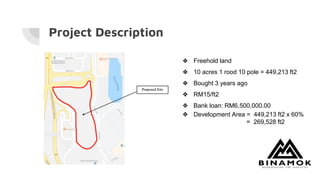
Project Description
❖ Freehold land
❖ 10 acres 1 rood 10 pole = 449,213 ft2
❖ Bought 3 years ago
❖ RM15/ft2
❖ Bank loan: RM6,500,000.00
❖ Development Area = 449,213 ft2 x 60%
= 269,528 ft2
Strength & Weaknesses
Strengths
1. Strategic location
a. In close proximity to the city centre, shopping complex and
universities.
2. High population density
a. According to world population review (2018), Subang Jaya is
home to as many as 708,296 people.
Strength & Weaknesses
3. High effective demand for houses and shop/ office lots
a. High student population as there are a lot of universities nearby.
b. Food and beverage businesses would opt for the shop lots in the
proposed site as it would be able to cater to the student.
Strength & Weaknesses
Weaknesses:
1. Inadequate Ingress/Egress
a. Only one ingress from LDP highway, one egress to Bandar Sunway
b. Two other high density developments that share the same main road
2. Limited Parking Facilities
a. Risk of excessive roadside parking unless development is gated & guarded
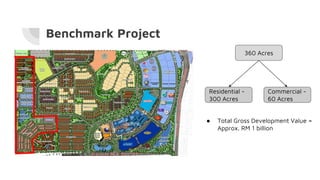
Benchmark Project
360 Acres
Residential -
300 Acres
Commercial -
60 Acres
● Total Gross Development Value =
Approx. RM 1 billion
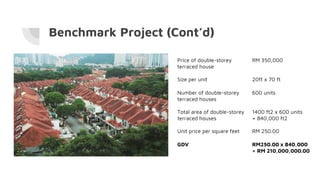
Benchmark Project (Cont’d)
Price of double-storey
terraced house
RM 350,000
Size per unit 20ft x 70 ft
Number of double-storey
terraced houses
600 units
Total area of double-storey
terraced houses
1400 ft2 x 600 units
= 840,000 ft2
Unit price per square feet RM 250.00
GDV RM250.00 x 840,000
= RM 210,000,000.00
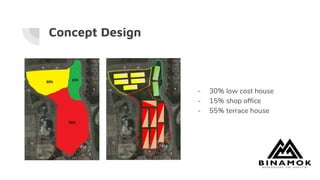
Concept Design
- 30% low cost house
- 15% shop office
- 55% terrace house
Quality Management
Pre-construction stage
Identification of project goal :
● Best value for money
● Expected gross profit - 30% from GDV
● Expected completion - end of December of 2014
● Expected budget - RM38 million
Procurement method: Traditional Procurement Method
Pre-construction stage
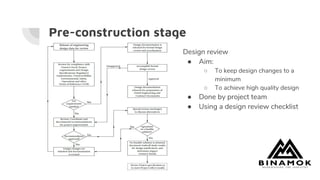
Design review
● Aim:
○ To keep design changes to a
minimum
○ To achieve high quality design
● Done by project team
● Using a design review checklist
Pre-construction stage
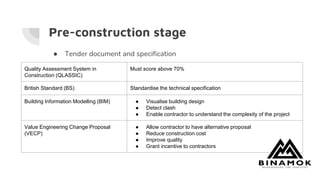
● Tender document and specification
Quality Assessment System in
Construction (QLASSIC)
Must score above 70%
British Standard (BS) Standardise the technical specification
Building Information Modelling (BIM) ● Visualise building design
● Detect clash
● Enable contractor to understand the complexity of the project
Value Engineering Change Proposal
(VECP)
● Allow contractor to have alternative proposal
● Reduce construction cost
● Improve quality
● Grant incentive to contractors
Pre-construction stage
Pre-qualification
Criteria for selecting potential contractor:
● Financial capacity
● Organisational capacity
● Performance capacity
● Resource availability
● Occupational health and safety management
● Quality management
● Relevant experience
Construction Stage
● A Project Quality Plan (PQP) to ensure a smooth execution of works
during construction stage is essential.
● Our PQP was prepared to satisfy the requirements in ISO 9001:2015
- Quality Management System Requirements.
Construction Stage
Quality Objectives:
✓ Proper planning of construction activities within a realistic timeframe and
control delays within 10%.
✓ Continuous review and control of costs to ensure completion of works
are within +/- 5% of budget.
✓ Constantly meeting with health and safety requirements in accordance to
the Occupational Health and Safety Assessment Series (OHSAS) 18000.
✓ Achieving minimum 80% client satisfaction in all construction activities to
maintain healthy relationship.
Construction Stage
Quality Policies:
1. Establish clearly defined responsibility and authority for compliance.
2. Translate client’s goals and objectives from the Contract Documents to top quality completed
facility while meeting the applicable standards.
3. Ensure the highest level of quality by maintaining supervised controls and written instructions
governing Quality Control procedures and practices.
4. Complete and maintain accurate records of inspections and tests.
5. Clearly specify procedures to ensure that quality requirements are communicated to all levels of
the field organization.
6. Identify and take corrective measures against non-conformance of quality related aspects and
ensuring all corrective measures are properly implemented and documented.
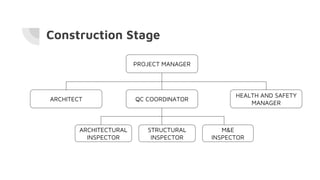
Construction Stage
PROJECT MANAGER
ARCHITECT QC COORDINATOR
HEALTH AND SAFETY
MANAGER
STRUCTURAL
INSPECTOR
M&E
INSPECTOR
ARCHITECTURAL
INSPECTOR
Construction Stage
Inspection and Test Plans (ITP):
● To identify, plan and provide a record of project specific inspections
and tests from project commencement to completion.
● Responsibility of the QC Coordinator and Consultant Inspectors.
● 4 Types of ITP:
1. Field inspection
2. Approved material inspection
3. Material test inspection
4. Re-work procedure
Post Construction Stage
Operation and Maintenance
-Maintenance is the process to be done to prevent the deterioration in the building and to
repair the damages towards the building.
-The life cycle cost of project should be taken into consideration during feasibility study,
such as operation and maintenance cost.
-It could create a great impact on the overall life cycle cost of the construction project during
post construction stage.
-Once the project is completed and the building is ready to function and occupied, it
becomes part of the operating system.
-The operation and maintenance (O&M) includes repair and replacement
(R&R), usually associated with the quality of the constructed project.
Post Construction Stage
Operation and Maintenance
Documents required to operate and maintain the completed facility, which are
submitted by the contractor during the testing, commissioning and handover phase of
the construction project:
I. As-built Drawings
II. Operation and Maintenance Manuals
III. Operating Procedures
IV. Source Information for Availability of Spare Parts of the Installed Works
Post Construction Stage
Operation and Maintenance Program
-The operation and maintenance personnel should be engaged and involved in
determining maintenance requirements which to be included into the design.
-The following procedures must be followed to create an effective and efficient
Operation and Maintenance Program:
● Ensure that as-built drawings for all systems are up to date and readily
available
● Ensure that operational procedures and manuals for the installed
equipments are readily available
● A master schedule for operation and preventive/predictive maintenance
must be prepared
Post Construction Stage
Operation and Maintenance Program
● Follow the manufacturer’s recommendations for maintenance of
equipment and systems
● Implement preventive maintenance programs complete with
maintenance schedules and records of all maintenance performed
for the equipment and systems installed in the facility or project
● Ensure the maintenance personnels are well trained and have full
knowledge of the equipment and systems installed which he is
responsible to operate and maintain
● Implement a monitoring program that provides function of
tracking documenting of equipment performance to identify and
diagnose potential problems
Risk Management
Introduction:
4 Stages of Risk Management:
1. Identification
2. Analysing
3. Responding
4. Monitoring
Identification of Risks
External Risks:
1. Political – Government Regulations, GST, Change of Government
2. Economic – Exchange Rate, GDP Growth
3. Social – Demographics, Cultural Trends, Population Size
4. Technological – IBS Scoring System 50%
5. Environmental – Pollution, Traffic planning
6. Legal – Local Authority
Identification of Risks
Internal Risks:
1. Pre-construction
a. Technical – Poor Buildability
b. Financial – Funding
2. Construction
a. Safety – Safety Officer
b. Material – Material Testing
c. Personnel – Unregistered Foreign Workers
3. Post-construction
a. Operation & Maintenance – After Sales Service
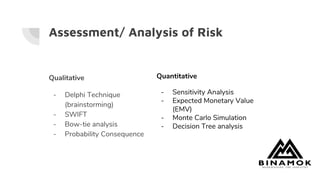
Assessment/ Analysis of Risk
Qualitative
- Delphi Technique
(brainstorming)
- SWIFT
- Bow-tie analysis
- Probability Consequence
Quantitative
- Sensitivity Analysis
- Expected Monetary Value
(EMV)
- Monte Carlo Simulation
- Decision Tree analysis
Recommendation of Risk Assessment
- We have chosen to use probability/consequence risk matrix.
- This is because the risk matrix showcases the probability as well as the
impact of a risk. This will enable us to shift our focus on the main driver of
the risk and mitigate the risk.
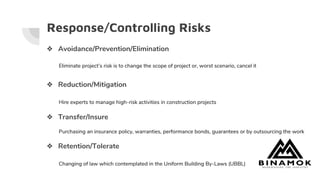
Response/Controlling Risks
❖ Avoidance/Prevention/Elimination
Eliminate project’s risk is to change the scope of project or, worst scenario, cancel it
❖ Reduction/Mitigation
Hire experts to manage high-risk activities in construction projects
❖ Transfer/Insure
Purchasing an insurance policy, warranties, performance bonds, guarantees or by outsourcing the work
❖ Retention/Tolerate
Changing of law which contemplated in the Uniform Building By-Laws (UBBL)
Monitoring Risks
- Continuous operative control of the effectiveness of the risk control
measures
- Helps to discover new risks, keep track of identified risks and eliminate
past risks from the risk assessment and project
- Monitoring of the risk is to supervise the status of the risks and take
corrective actions if needed
- Risk reassessment, status meetings and risk register updates must be
carried out continuously in order to improve the project work as the pros
and cons will be established
THANK YOUPlease give us an A thank you!

Project Management and Development Economics Project (Slides)

  • 1.
    Analysis of Proposed Development #1 Presentedby BinaMok Project Management and Cost Consultant Team
  • 2.
    The Team: Director: MokPo Yi Members: Chin Weng Lok Darren Loong Chi Yoong Lee Jian Ru Pang Khai Shuen Sherlyn Ang Tse Yun
  • 3.
    Project Description ❖ Freeholdland ❖ 10 acres 1 rood 10 pole = 449,213 ft2 ❖ Bought 3 years ago ❖ RM15/ft2 ❖ Bank loan: RM6,500,000.00 ❖ Development Area = 449,213 ft2 x 60% = 269,528 ft2
  • 4.
    Strength & Weaknesses Strengths 1.Strategic location a. In close proximity to the city centre, shopping complex and universities. 2. High population density a. According to world population review (2018), Subang Jaya is home to as many as 708,296 people.
  • 5.
    Strength & Weaknesses 3.High effective demand for houses and shop/ office lots a. High student population as there are a lot of universities nearby. b. Food and beverage businesses would opt for the shop lots in the proposed site as it would be able to cater to the student.
  • 6.
    Strength & Weaknesses Weaknesses: 1.Inadequate Ingress/Egress a. Only one ingress from LDP highway, one egress to Bandar Sunway b. Two other high density developments that share the same main road 2. Limited Parking Facilities a. Risk of excessive roadside parking unless development is gated & guarded
  • 7.
    Benchmark Project 360 Acres Residential- 300 Acres Commercial - 60 Acres ● Total Gross Development Value = Approx. RM 1 billion
  • 8.
    Benchmark Project (Cont’d) Priceof double-storey terraced house RM 350,000 Size per unit 20ft x 70 ft Number of double-storey terraced houses 600 units Total area of double-storey terraced houses 1400 ft2 x 600 units = 840,000 ft2 Unit price per square feet RM 250.00 GDV RM250.00 x 840,000 = RM 210,000,000.00
  • 9.
    Concept Design - 30%low cost house - 15% shop office - 55% terrace house
  • 10.
  • 11.
    Pre-construction stage Identification ofproject goal : ● Best value for money ● Expected gross profit - 30% from GDV ● Expected completion - end of December of 2014 ● Expected budget - RM38 million Procurement method: Traditional Procurement Method
  • 12.
    Pre-construction stage Design review ●Aim: ○ To keep design changes to a minimum ○ To achieve high quality design ● Done by project team ● Using a design review checklist
  • 13.
    Pre-construction stage ● Tenderdocument and specification Quality Assessment System in Construction (QLASSIC) Must score above 70% British Standard (BS) Standardise the technical specification Building Information Modelling (BIM) ● Visualise building design ● Detect clash ● Enable contractor to understand the complexity of the project Value Engineering Change Proposal (VECP) ● Allow contractor to have alternative proposal ● Reduce construction cost ● Improve quality ● Grant incentive to contractors
  • 14.
    Pre-construction stage Pre-qualification Criteria forselecting potential contractor: ● Financial capacity ● Organisational capacity ● Performance capacity ● Resource availability ● Occupational health and safety management ● Quality management ● Relevant experience
  • 15.
    Construction Stage ● AProject Quality Plan (PQP) to ensure a smooth execution of works during construction stage is essential. ● Our PQP was prepared to satisfy the requirements in ISO 9001:2015 - Quality Management System Requirements.
  • 16.
    Construction Stage Quality Objectives: ✓Proper planning of construction activities within a realistic timeframe and control delays within 10%. ✓ Continuous review and control of costs to ensure completion of works are within +/- 5% of budget. ✓ Constantly meeting with health and safety requirements in accordance to the Occupational Health and Safety Assessment Series (OHSAS) 18000. ✓ Achieving minimum 80% client satisfaction in all construction activities to maintain healthy relationship.
  • 17.
    Construction Stage Quality Policies: 1.Establish clearly defined responsibility and authority for compliance. 2. Translate client’s goals and objectives from the Contract Documents to top quality completed facility while meeting the applicable standards. 3. Ensure the highest level of quality by maintaining supervised controls and written instructions governing Quality Control procedures and practices. 4. Complete and maintain accurate records of inspections and tests. 5. Clearly specify procedures to ensure that quality requirements are communicated to all levels of the field organization. 6. Identify and take corrective measures against non-conformance of quality related aspects and ensuring all corrective measures are properly implemented and documented.
  • 18.
    Construction Stage PROJECT MANAGER ARCHITECTQC COORDINATOR HEALTH AND SAFETY MANAGER STRUCTURAL INSPECTOR M&E INSPECTOR ARCHITECTURAL INSPECTOR
  • 19.
    Construction Stage Inspection andTest Plans (ITP): ● To identify, plan and provide a record of project specific inspections and tests from project commencement to completion. ● Responsibility of the QC Coordinator and Consultant Inspectors. ● 4 Types of ITP: 1. Field inspection 2. Approved material inspection 3. Material test inspection 4. Re-work procedure
  • 20.
    Post Construction Stage Operationand Maintenance -Maintenance is the process to be done to prevent the deterioration in the building and to repair the damages towards the building. -The life cycle cost of project should be taken into consideration during feasibility study, such as operation and maintenance cost. -It could create a great impact on the overall life cycle cost of the construction project during post construction stage. -Once the project is completed and the building is ready to function and occupied, it becomes part of the operating system. -The operation and maintenance (O&M) includes repair and replacement (R&R), usually associated with the quality of the constructed project.
  • 21.
    Post Construction Stage Operationand Maintenance Documents required to operate and maintain the completed facility, which are submitted by the contractor during the testing, commissioning and handover phase of the construction project: I. As-built Drawings II. Operation and Maintenance Manuals III. Operating Procedures IV. Source Information for Availability of Spare Parts of the Installed Works
  • 22.
    Post Construction Stage Operationand Maintenance Program -The operation and maintenance personnel should be engaged and involved in determining maintenance requirements which to be included into the design. -The following procedures must be followed to create an effective and efficient Operation and Maintenance Program: ● Ensure that as-built drawings for all systems are up to date and readily available ● Ensure that operational procedures and manuals for the installed equipments are readily available ● A master schedule for operation and preventive/predictive maintenance must be prepared
  • 23.
    Post Construction Stage Operationand Maintenance Program ● Follow the manufacturer’s recommendations for maintenance of equipment and systems ● Implement preventive maintenance programs complete with maintenance schedules and records of all maintenance performed for the equipment and systems installed in the facility or project ● Ensure the maintenance personnels are well trained and have full knowledge of the equipment and systems installed which he is responsible to operate and maintain ● Implement a monitoring program that provides function of tracking documenting of equipment performance to identify and diagnose potential problems
  • 24.
  • 25.
    Introduction: 4 Stages ofRisk Management: 1. Identification 2. Analysing 3. Responding 4. Monitoring
  • 26.
    Identification of Risks ExternalRisks: 1. Political – Government Regulations, GST, Change of Government 2. Economic – Exchange Rate, GDP Growth 3. Social – Demographics, Cultural Trends, Population Size 4. Technological – IBS Scoring System 50% 5. Environmental – Pollution, Traffic planning 6. Legal – Local Authority
  • 27.
    Identification of Risks InternalRisks: 1. Pre-construction a. Technical – Poor Buildability b. Financial – Funding 2. Construction a. Safety – Safety Officer b. Material – Material Testing c. Personnel – Unregistered Foreign Workers 3. Post-construction a. Operation & Maintenance – After Sales Service
  • 28.
    Assessment/ Analysis ofRisk Qualitative - Delphi Technique (brainstorming) - SWIFT - Bow-tie analysis - Probability Consequence Quantitative - Sensitivity Analysis - Expected Monetary Value (EMV) - Monte Carlo Simulation - Decision Tree analysis
  • 29.
    Recommendation of RiskAssessment - We have chosen to use probability/consequence risk matrix. - This is because the risk matrix showcases the probability as well as the impact of a risk. This will enable us to shift our focus on the main driver of the risk and mitigate the risk.
  • 30.
    Response/Controlling Risks ❖ Avoidance/Prevention/Elimination Eliminateproject’s risk is to change the scope of project or, worst scenario, cancel it ❖ Reduction/Mitigation Hire experts to manage high-risk activities in construction projects ❖ Transfer/Insure Purchasing an insurance policy, warranties, performance bonds, guarantees or by outsourcing the work ❖ Retention/Tolerate Changing of law which contemplated in the Uniform Building By-Laws (UBBL)
  • 31.
    Monitoring Risks - Continuousoperative control of the effectiveness of the risk control measures - Helps to discover new risks, keep track of identified risks and eliminate past risks from the risk assessment and project - Monitoring of the risk is to supervise the status of the risks and take corrective actions if needed - Risk reassessment, status meetings and risk register updates must be carried out continuously in order to improve the project work as the pros and cons will be established
  • 32.
    THANK YOUPlease giveus an A thank you!