PROFESSIONAL PRACTICE 1
TUTORIAL NO.7
WONG JIA JING
YEAP PHAY SHIAN
YEE JYH LIN
QUESTION
Contractor’s claims for loss and expense have long been a contentious
issue in many building contracts. These claims are usually resolved during the
final accounting process but where negotiation fails, they usually become
disputes with the parties adopting legal route to resolve their differences.
Discuss the matters below based on the PAM Form of Contract 2006 (With Quantities):
a) The Contractor is granted an extension of time. Is there an automatic right to the recovery of loss
and expense?
b) Explain the grounds for claim of loss and expense and describe how the Contractor can register
their claims.
c) Claims are invariably initiated by the Contractor. Contractual claims, Extra contractual claims and
Exgratia claims are the 3 types of claims in a contract. Give SIX (6) main reasons for claims and SIX (6)
common types of claims. How does the Quantity Surveyor assess such claims?
QUESTION
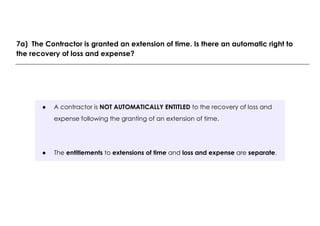
ā— A contractor is NOT AUTOMATICALLY ENTITLED to the recovery of loss and
expense following the granting of an extension of time.
ā— The entitlements to extensions of time and loss and expense are separate.
7a) The Contractor is granted an extension of time. Is there an automatic right to
the recovery of loss and expense?
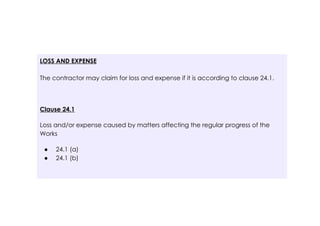
LOSS AND EXPENSE
The contractor may claim for loss and expense if it is according to clause 24.1.
Clause 24.1
Loss and/or expense caused by matters affecting the regular progress of the
Works
ā— 24.1 (a)
ā— 24.1 (b)
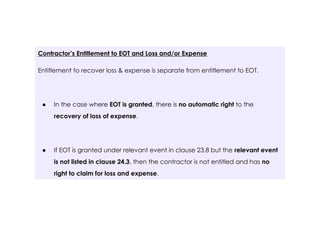
Contractor’s Entitlement to EOT and Loss and/or Expense
Entitlement to recover loss & expense is separate from entitlement to EOT.
ā— In the case where EOT is granted, there is no automatic right to the
recovery of loss of expense.
ā— If EOT is granted under relevant event in clause 23.8 but the relevant event
is not listed in clause 24.3, then the contractor is not entitled and has no
right to claim for loss and expense.
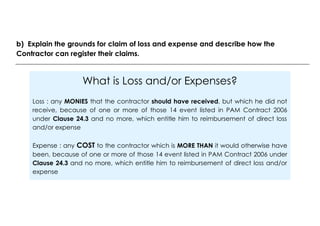
What is Loss and/or Expenses?
Loss : any MONIES that the contractor should have received, but which he did not
receive, because of one or more of those 14 event listed in PAM Contract 2006
under Clause 24.3 and no more, which entitle him to reimbursement of direct loss
and/or expense
Expense : any COST to the contractor which is MORE THAN it would otherwise have
been, because of one or more of those 14 event listed in PAM Contract 2006 under
Clause 24.3 and no more, which entitle him to reimbursement of direct loss and/or
expense
b) Explain the grounds for claim of loss and expense and describe how the
Contractor can register their claims.
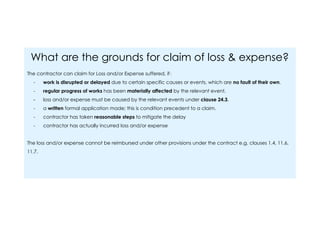
What are the grounds for claim of loss & expense?
The contractor can claim for Loss and/or Expense suffered, if:
- work is disrupted or delayed due to certain specific causes or events, which are no fault of their own.
- regular progress of works has been materially affected by the relevant event.
- loss and/or expense must be caused by the relevant events under clause 24.3.
- a written formal application made; this is condition precedent to a claim.
- contractor has taken reasonable steps to mitigate the delay
- contractor has actually incurred loss and/or expense
The loss and/or expense cannot be reimbursed under other provisions under the contract e.g. clauses 1.4, 11.6,
11.7.
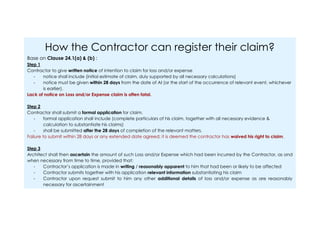
How the Contractor can register their claim?
Base on Clause 24.1(a) & (b) :
Step 1
Contractor to give written notice of intention to claim for loss and/or expense
- notice shall include (initial estimate of claim, duly supported by all necessary calculations)
- notice must be given within 28 days from the date of AI (or the start of the occurrence of relevant event, whichever
is earlier).
Lack of notice on Loss and/or Expense claim is often fatal.
Step 2
Contractor shall submit a formal application for claim.
- formal application shall include (complete particulars of his claim, together with all necessary evidence &
calculation to substantiate his claims)
- shall be submitted after the 28 days of completion of the relevant matters.
Failure to submit within 28 days or any extended date agreed; it is deemed the contractor has waived his right to claim.
Step 3
Architect shall then ascertain the amount of such Loss and/or Expense which had been incurred by the Contractor, as and
when necessary from time to time, provided that:
- Contractor’s application is made in writing / reasonably apparent to him that had been or likely to be affected
- Contractor submits together with his application relevant information substantiating his claim
- Contractor upon request submit to him any other additional details of loss and/or expense as are reasonably
necessary for ascertainment
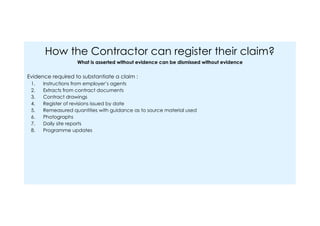
How the Contractor can register their claim?
What is asserted without evidence can be dismissed without evidence
Evidence required to substantiate a claim :
1. Instructions from employer’s agents
2. Extracts from contract documents
3. Contract drawings
4. Register of revisions issued by date
5. Remeasured quantities with guidance as to source material used
6. Photographs
7. Daily site reports
8. Programme updates
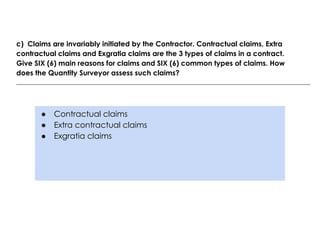
ā— Contractual claims
ā— Extra contractual claims
ā— Exgratia claims
c) Claims are invariably initiated by the Contractor. Contractual claims, Extra
contractual claims and Exgratia claims are the 3 types of claims in a contract.
Give SIX (6) main reasons for claims and SIX (6) common types of claims. How
does the Quantity Surveyor assess such claims?
SIX (6) main reasons for claims
ā— Late instruction
ā— Late issue of materials
ā— Failure of employer to carry out works
ā— Divergence between contract documents
ā— Variation
ā— Postponement of works
SIX (6) common types of claims
ā— Standing time for plant and labour
ā— Uneconomic working for plant and labour
ā— Additional contract overhead cost
ā— Disruption of work due to variation
ā— Carrying out work later than anticipated
ā— Condition different from planned
How does the Quantity Surveyor assess such
claims?
ā— Based on contractor’s disrupted output
ā— Based on contract overheads
ā— Based on formula:-eg. Hudson’s formula
THANK YOU!

Professional Practice 1 Tutorial 7

  • 1.
    PROFESSIONAL PRACTICE 1 TUTORIALNO.7 WONG JIA JING YEAP PHAY SHIAN YEE JYH LIN
  • 2.
    QUESTION Contractor’s claims forloss and expense have long been a contentious issue in many building contracts. These claims are usually resolved during the final accounting process but where negotiation fails, they usually become disputes with the parties adopting legal route to resolve their differences.
  • 3.
    Discuss the mattersbelow based on the PAM Form of Contract 2006 (With Quantities): a) The Contractor is granted an extension of time. Is there an automatic right to the recovery of loss and expense? b) Explain the grounds for claim of loss and expense and describe how the Contractor can register their claims. c) Claims are invariably initiated by the Contractor. Contractual claims, Extra contractual claims and Exgratia claims are the 3 types of claims in a contract. Give SIX (6) main reasons for claims and SIX (6) common types of claims. How does the Quantity Surveyor assess such claims? QUESTION
  • 4.
    ā— A contractoris NOT AUTOMATICALLY ENTITLED to the recovery of loss and expense following the granting of an extension of time. ā— The entitlements to extensions of time and loss and expense are separate. 7a) The Contractor is granted an extension of time. Is there an automatic right to the recovery of loss and expense?
  • 5.
    LOSS AND EXPENSE Thecontractor may claim for loss and expense if it is according to clause 24.1. Clause 24.1 Loss and/or expense caused by matters affecting the regular progress of the Works ā— 24.1 (a) ā— 24.1 (b)
  • 6.
    Contractor’s Entitlement toEOT and Loss and/or Expense Entitlement to recover loss & expense is separate from entitlement to EOT. ā— In the case where EOT is granted, there is no automatic right to the recovery of loss of expense. ā— If EOT is granted under relevant event in clause 23.8 but the relevant event is not listed in clause 24.3, then the contractor is not entitled and has no right to claim for loss and expense.
  • 7.
    What is Lossand/or Expenses? Loss : any MONIES that the contractor should have received, but which he did not receive, because of one or more of those 14 event listed in PAM Contract 2006 under Clause 24.3 and no more, which entitle him to reimbursement of direct loss and/or expense Expense : any COST to the contractor which is MORE THAN it would otherwise have been, because of one or more of those 14 event listed in PAM Contract 2006 under Clause 24.3 and no more, which entitle him to reimbursement of direct loss and/or expense b) Explain the grounds for claim of loss and expense and describe how the Contractor can register their claims.
  • 8.
    What are thegrounds for claim of loss & expense? The contractor can claim for Loss and/or Expense suffered, if: - work is disrupted or delayed due to certain specific causes or events, which are no fault of their own. - regular progress of works has been materially affected by the relevant event. - loss and/or expense must be caused by the relevant events under clause 24.3. - a written formal application made; this is condition precedent to a claim. - contractor has taken reasonable steps to mitigate the delay - contractor has actually incurred loss and/or expense The loss and/or expense cannot be reimbursed under other provisions under the contract e.g. clauses 1.4, 11.6, 11.7.
  • 9.
    How the Contractorcan register their claim? Base on Clause 24.1(a) & (b) : Step 1 Contractor to give written notice of intention to claim for loss and/or expense - notice shall include (initial estimate of claim, duly supported by all necessary calculations) - notice must be given within 28 days from the date of AI (or the start of the occurrence of relevant event, whichever is earlier). Lack of notice on Loss and/or Expense claim is often fatal. Step 2 Contractor shall submit a formal application for claim. - formal application shall include (complete particulars of his claim, together with all necessary evidence & calculation to substantiate his claims) - shall be submitted after the 28 days of completion of the relevant matters. Failure to submit within 28 days or any extended date agreed; it is deemed the contractor has waived his right to claim. Step 3 Architect shall then ascertain the amount of such Loss and/or Expense which had been incurred by the Contractor, as and when necessary from time to time, provided that: - Contractor’s application is made in writing / reasonably apparent to him that had been or likely to be affected - Contractor submits together with his application relevant information substantiating his claim - Contractor upon request submit to him any other additional details of loss and/or expense as are reasonably necessary for ascertainment
  • 10.
    How the Contractorcan register their claim? What is asserted without evidence can be dismissed without evidence Evidence required to substantiate a claim : 1. Instructions from employer’s agents 2. Extracts from contract documents 3. Contract drawings 4. Register of revisions issued by date 5. Remeasured quantities with guidance as to source material used 6. Photographs 7. Daily site reports 8. Programme updates
  • 11.
    ā— Contractual claims ā—Extra contractual claims ā— Exgratia claims c) Claims are invariably initiated by the Contractor. Contractual claims, Extra contractual claims and Exgratia claims are the 3 types of claims in a contract. Give SIX (6) main reasons for claims and SIX (6) common types of claims. How does the Quantity Surveyor assess such claims?
  • 12.
    SIX (6) mainreasons for claims ā— Late instruction ā— Late issue of materials ā— Failure of employer to carry out works ā— Divergence between contract documents ā— Variation ā— Postponement of works
  • 13.
    SIX (6) commontypes of claims ā— Standing time for plant and labour ā— Uneconomic working for plant and labour ā— Additional contract overhead cost ā— Disruption of work due to variation ā— Carrying out work later than anticipated ā— Condition different from planned
  • 14.
    How does theQuantity Surveyor assess such claims? ā— Based on contractor’s disrupted output ā— Based on contract overheads ā— Based on formula:-eg. Hudson’s formula
  • 15.