SCHOOL OF ARCHITECTURE, BUILDING AND DESIGN
Bachelor of Quantity Surveying (Honours)
Group members: Felix Vong Zhi Wei 0318462
Lee Ern Hui 0319703
Elliot Pang Tiu Seng 0319438
Welson Lum Wei Jiunn 0319514
Kevin Lee Hee Xian 0315192
PROCUREMENT METHOD
• Traditional method
• Design and Build
• Management Contracting
• Construction Management
Each procurement
method will affect the
time, cost and quality of
the project.
Risk should be
considered as for
choosing which
procurement method to
be used.
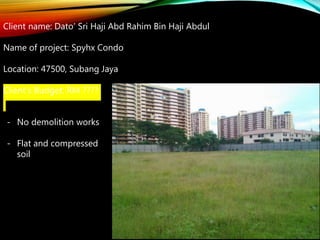
Client name: Dato’ Sri Haji Abd Rahim Bin Haji Abdul
Name of project: Spyhx Condo
Location: 47500, Subang Jaya
Client’s Budget: RM ????
- No demolition works
- Flat and compressed
soil
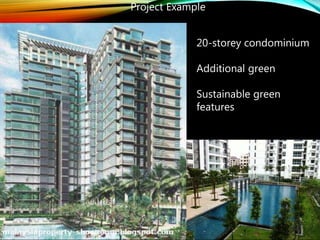
20-storey condominium
Additional green
Sustainable green
features
Project Example
MANAGEMENT
CONTRACTING
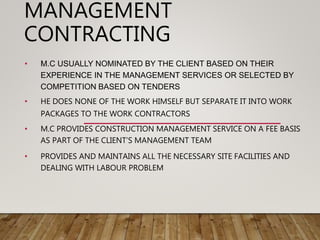
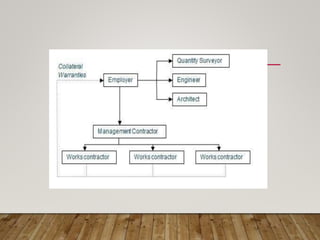
• M.C USUALLY NOMINATED BY THE CLIENT BASED ON THEIR
EXPERIENCE IN THE MANAGEMENT SERVICES OR SELECTED BY
COMPETITION BASED ON TENDERS
• HE DOES NONE OF THE WORK HIMSELF BUT SEPARATE IT INTO WORK
PACKAGES TO THE WORK CONTRACTORS
• M.C PROVIDES CONSTRUCTION MANAGEMENT SERVICE ON A FEE BASIS
AS PART OF THE CLIENT’S MANAGEMENT TEAM
• PROVIDES AND MAINTAINS ALL THE NECESSARY SITE FACILITIES AND
DEALING WITH LABOUR PROBLEM
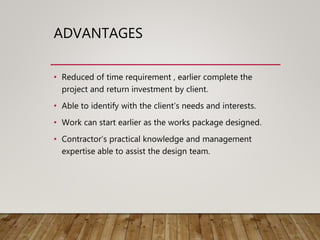
ADVANTAGES
• Reduced of time requirement , earlier complete the
project and return investment by client.
• Able to identify with the client’s needs and interests.
• Work can start earlier as the works package designed.
• Contractor’s practical knowledge and management
expertise able to assist the design team.
DISADVANTAGES
• The final cost of the project uncertainly until the last works
contract signed.
• Variations and the amount of re-measurement required
greater than traditional contracts.
TRADITIONAL PROCUREMENT
METHOD
• widely used by building projects.
• Suitable for all clients, including inexperienced clients „„
• Cost certainty
ADVANTAGES
• with the contractor building to a complete design, it should
be easier for the employer to minimise time and cost
overruns
• employer retains control of design
• There is a lot experience with this type of procurement
method
DISADVANTAGES
• It takes a long time before the project can start due to
selection of the consultant engineer, the time needed to
carry to design, selection of contractor.
• High risk for client if there are mistakes in the design of the
project
• The delays in the project will cause the exceed of the budget
due to unforeseen circumstances.
Examine of The
Contract Form
What is Lump Sum Contract?
Approach in terms of
1. DESIGN
2. QUALITY
3. COST
- Contract Sum is determined before construction work
started.
*reduce design & contract administration cost.
- Cost is Anticipated
Lump Sum Contract
Client’s Side
-Essentially assigned most of the risk to the Contractor.
-Client controls contingency.
-The tendered price included high risk contingency.
-Required to appoint consultant team at the early stage. (Contractor
does not provide pre-construction consulting services)
Lump Sum Contract
Contractor’s Side
-Ask for higher markup in order of unforeseen contingencies.
-Appointed by competitive tender/ Negotiation (Rare)
-Stated estimating on labour costs, material costs, contractor’s
overhead, and profit margin.
-Greater control in overhead cost and profit.
Lump Sum Contract
Contractor’s Side (Cons)
-Poor executed and Long-Delayed job will diminish the contractor’s profit
and affect contractor’s overhead cost.
Suitability of Lump Sum
Contract
Appropriate when work is defined in detail, limited variations are
expected, level of risk is low and quantifiable, and client does not wish
to participate in the management of the project.
Reduce Client’s Risk
Stable soil condition
DESIGN & BUILD PROCUREMENT
• EVALUATE THE VIABILITY OF THE DESIGN AND BUILD S
COMPARING TO BASIC PROCUREMENT METHODS FOR THE
NEW PROJECT.
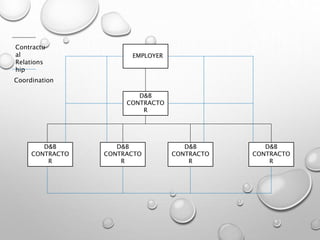
ffEMPLOYER
D&B
CONTRACTO
R
D&B
CONTRACTO
R
D&B
CONTRACTO
R
D&B
CONTRACTO
R
D&B
CONTRACTO
R
Contractu
al
Relations
hip
Coordination
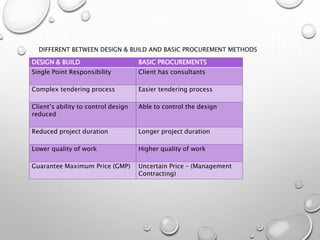
DIFFERENT BETWEEN DESIGN & BUILD AND BASIC PROCUREMENT METHODS
DESIGN & BUILD BASIC PROCUREMENTS
Single Point Responsibility Client has consultants
Complex tendering process Easier tendering process
Client’s ability to control design
reduced
Able to control the design
Reduced project duration Longer project duration
Lower quality of work Higher quality of work
Guarantee Maximum Price (GMP) Uncertain Price – (Management
Contracting)
Procurement Methods
• Traditional Method
• Management Contracting
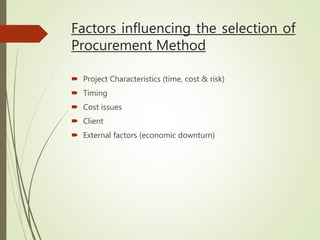
Factors influencing the selection of
Procurement Method
 Project Characteristics (time, cost & risk)
 Timing
 Cost issues
 Client
 External factors (economic downturn)
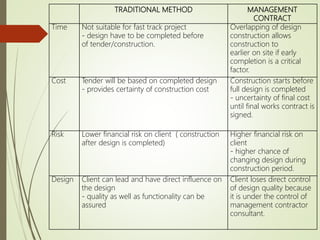
TRADITIONAL METHOD MANAGEMENT
CONTRACT
Time Not suitable for fast track project
- design have to be completed before
of tender/construction.
Overlapping of design
construction allows
construction to
earlier on site if early
completion is a critical
factor.
Cost Tender will be based on completed design
- provides certainty of construction cost
Construction starts before
full design is completed
- uncertainty of final cost
until final works contract is
signed.
Risk Lower financial risk on client ( construction
after design is completed)
Higher financial risk on
client
- higher chance of
changing design during
construction period.
Design Client can lead and have direct influence on
the design
- quality as well as functionality can be
assured
Client loses direct control
of design quality because
it is under the control of
management contractor
consultant.
Conclusion
Traditional Procurement Method – MOST SUITABLE
 Suitable for all clients including inexperienced clients
 Price certainty is achieved early - secure the project within
the client’s budget and also provides a firm contractual date
for completion
 The cost is fixed after contract signed - lower financial risk
on client (impact of economic)
 Client can be involved in design - can improve functionality
& quality of overall design
 A tried and test method of procurement which the market is
very familiar with.

Final pp1

  • 1.
    SCHOOL OF ARCHITECTURE,BUILDING AND DESIGN Bachelor of Quantity Surveying (Honours) Group members: Felix Vong Zhi Wei 0318462 Lee Ern Hui 0319703 Elliot Pang Tiu Seng 0319438 Welson Lum Wei Jiunn 0319514 Kevin Lee Hee Xian 0315192
  • 2.
    PROCUREMENT METHOD • Traditionalmethod • Design and Build • Management Contracting • Construction Management Each procurement method will affect the time, cost and quality of the project. Risk should be considered as for choosing which procurement method to be used.
  • 3.
    Client name: Dato’Sri Haji Abd Rahim Bin Haji Abdul Name of project: Spyhx Condo Location: 47500, Subang Jaya Client’s Budget: RM ???? - No demolition works - Flat and compressed soil
  • 4.
  • 5.
    MANAGEMENT CONTRACTING • M.C USUALLYNOMINATED BY THE CLIENT BASED ON THEIR EXPERIENCE IN THE MANAGEMENT SERVICES OR SELECTED BY COMPETITION BASED ON TENDERS • HE DOES NONE OF THE WORK HIMSELF BUT SEPARATE IT INTO WORK PACKAGES TO THE WORK CONTRACTORS • M.C PROVIDES CONSTRUCTION MANAGEMENT SERVICE ON A FEE BASIS AS PART OF THE CLIENT’S MANAGEMENT TEAM • PROVIDES AND MAINTAINS ALL THE NECESSARY SITE FACILITIES AND DEALING WITH LABOUR PROBLEM
  • 7.
    ADVANTAGES • Reduced oftime requirement , earlier complete the project and return investment by client. • Able to identify with the client’s needs and interests. • Work can start earlier as the works package designed. • Contractor’s practical knowledge and management expertise able to assist the design team.
  • 8.
    DISADVANTAGES • The finalcost of the project uncertainly until the last works contract signed. • Variations and the amount of re-measurement required greater than traditional contracts.
  • 9.
    TRADITIONAL PROCUREMENT METHOD • widelyused by building projects. • Suitable for all clients, including inexperienced clients „„ • Cost certainty
  • 10.
    ADVANTAGES • with thecontractor building to a complete design, it should be easier for the employer to minimise time and cost overruns • employer retains control of design • There is a lot experience with this type of procurement method
  • 11.
    DISADVANTAGES • It takesa long time before the project can start due to selection of the consultant engineer, the time needed to carry to design, selection of contractor. • High risk for client if there are mistakes in the design of the project • The delays in the project will cause the exceed of the budget due to unforeseen circumstances.
  • 12.
  • 13.
    What is LumpSum Contract? Approach in terms of 1. DESIGN 2. QUALITY 3. COST - Contract Sum is determined before construction work started. *reduce design & contract administration cost. - Cost is Anticipated
  • 14.
    Lump Sum Contract Client’sSide -Essentially assigned most of the risk to the Contractor. -Client controls contingency. -The tendered price included high risk contingency. -Required to appoint consultant team at the early stage. (Contractor does not provide pre-construction consulting services)
  • 15.
    Lump Sum Contract Contractor’sSide -Ask for higher markup in order of unforeseen contingencies. -Appointed by competitive tender/ Negotiation (Rare) -Stated estimating on labour costs, material costs, contractor’s overhead, and profit margin. -Greater control in overhead cost and profit.
  • 16.
    Lump Sum Contract Contractor’sSide (Cons) -Poor executed and Long-Delayed job will diminish the contractor’s profit and affect contractor’s overhead cost.
  • 17.
    Suitability of LumpSum Contract Appropriate when work is defined in detail, limited variations are expected, level of risk is low and quantifiable, and client does not wish to participate in the management of the project. Reduce Client’s Risk Stable soil condition
  • 18.
    DESIGN & BUILDPROCUREMENT • EVALUATE THE VIABILITY OF THE DESIGN AND BUILD S COMPARING TO BASIC PROCUREMENT METHODS FOR THE NEW PROJECT.
  • 19.
  • 20.
    DIFFERENT BETWEEN DESIGN& BUILD AND BASIC PROCUREMENT METHODS DESIGN & BUILD BASIC PROCUREMENTS Single Point Responsibility Client has consultants Complex tendering process Easier tendering process Client’s ability to control design reduced Able to control the design Reduced project duration Longer project duration Lower quality of work Higher quality of work Guarantee Maximum Price (GMP) Uncertain Price – (Management Contracting)
  • 21.
    Procurement Methods • TraditionalMethod • Management Contracting
  • 22.
    Factors influencing theselection of Procurement Method  Project Characteristics (time, cost & risk)  Timing  Cost issues  Client  External factors (economic downturn)
  • 23.
    TRADITIONAL METHOD MANAGEMENT CONTRACT TimeNot suitable for fast track project - design have to be completed before of tender/construction. Overlapping of design construction allows construction to earlier on site if early completion is a critical factor. Cost Tender will be based on completed design - provides certainty of construction cost Construction starts before full design is completed - uncertainty of final cost until final works contract is signed. Risk Lower financial risk on client ( construction after design is completed) Higher financial risk on client - higher chance of changing design during construction period. Design Client can lead and have direct influence on the design - quality as well as functionality can be assured Client loses direct control of design quality because it is under the control of management contractor consultant.
  • 24.
    Conclusion Traditional Procurement Method– MOST SUITABLE  Suitable for all clients including inexperienced clients  Price certainty is achieved early - secure the project within the client’s budget and also provides a firm contractual date for completion  The cost is fixed after contract signed - lower financial risk on client (impact of economic)  Client can be involved in design - can improve functionality & quality of overall design  A tried and test method of procurement which the market is very familiar with.