1
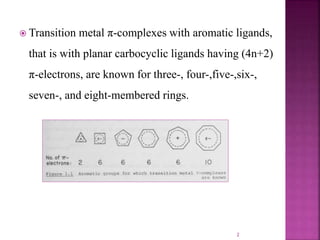
 Transition metal π-complexes with aromatic ligands,
that is with planar carbocyclic ligands having (4n+2)
π-electrons, are known for three-, four-,five-,six-,
seven-, and eight-membered rings.
2
 Cyclopentadienyl-metal complexes are known for all
the d-block transition metals except silver; numerous
mixed complexes containing a wide range of other
ligands such as carbonyl, tertiary phosphines, and
halides are also known
 The number of stable transition metal complexes
containing aromatic ligands decreases markedly in the
order C5H5
->C5H6>C7H7
+>C9H9
2-
3
 This may be related to the charge on the ring in
relation to the positively charged metal ion, and
also to the fact that as the size of the planar ring
increases the metal-ring distance must decrease in
order to maintain a reasonable overlap of metal
orbitals with ring π-orbitals.
4
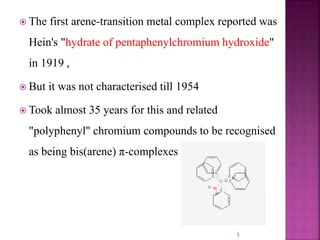
 The first arene-transition metal complex reported was
Hein's "hydrate of pentaphenylchromium hydroxide"
in 1919 ,
 But it was not characterised till 1954
 Took almost 35 years for this and related
"polyphenyl" chromium compounds to be recognised
as being bis(arene) π-complexes .
5
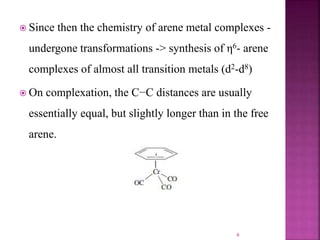
 Since then the chemistry of arene metal complexes -
undergone transformations -> synthesis of η6- arene
complexes of almost all transition metals (d2-d8)
 On complexation, the C−C distances are usually
essentially equal, but slightly longer than in the free
arene.
6
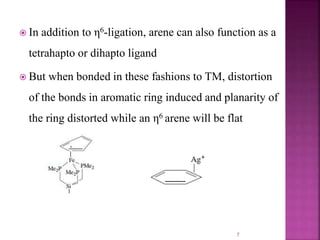
 In addition to η6-ligation, arene can also function as a
tetrahapto or dihapto ligand
 But when bonded in these fashions to TM, distortion
of the bonds in aromatic ring induced and planarity of
the ring distorted while an η6 arene will be flat
7
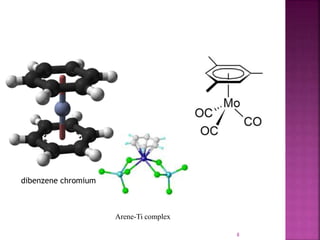
Arene-Ti complex
dibenzene chromium
8
 Arenes are much more reactive than Cp groups, and
they are also more easily lost from the metal so
arenes are normally actor, rather than spectator
ligands.
 13C NMR spectroscopy is the most useful method of
characterization, the metal-bound carbons showing a
∼25-ppm shift to high field on coordination, due to
the increased shielding from the nearby metal.
9
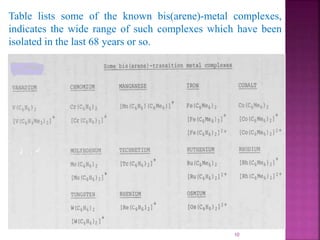
Table lists some of the known bis(arene)-metal complexes,
indicates the wide range of such complexes which have been
isolated in the last 68 years or so.
10
 The most general procedure for the preparation of
bis(arene)-metal complexes is the reducing
Friedel-Crafts synthesis, devised by Fischer and
Hafner , in which the anhydrous metal chloride is
treated with the required arene in the presence of
aluminium and aluminium chloride.
11
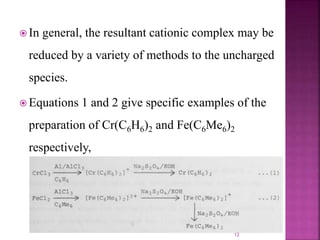
 In general, the resultant cationic complex may be
reduced by a variety of methods to the uncharged
species.
 Equations 1 and 2 give specific examples of the
preparation of Cr(C6H6)2 and Fe(C6Me6)2
respectively,
12
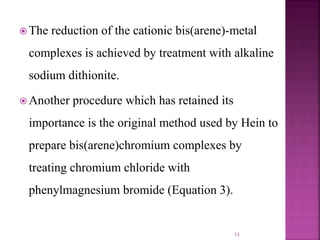
 The reduction of the cationic bis(arene)-metal
complexes is achieved by treatment with alkaline
sodium dithionite.
 Another procedure which has retained its
importance is the original method used by Hein to
prepare bis(arene)chromium complexes by
treating chromium chloride with
phenylmagnesium bromide (Equation 3).
13
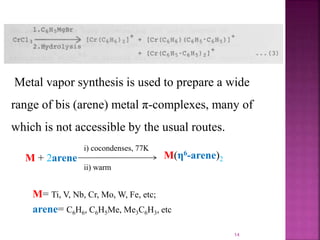
Metal vapor synthesis is used to prepare a wide
range of bis (arene) metal π-complexes, many of
which is not accessible by the usual routes.
M + 2arene
i) cocondenses, 77K
ii) warm
M(η6-arene)2
M= Ti, V, Nb, Cr, Mo, W, Fe, etc;
arene= C6H6, C6H5Me, Me3C6H3, etc
14
 X-ray studies show that bis(benzene)chromiurn
adopts a sandwich structure in which the two
benzene rings are eclipsed,
 While the arene-metal tricarbonyls adopt a half-
sandwich structure in which the configuration of the
carbonyl ligands with respect to the carbon atoms of
the ring depends on the substituents of the ring
15
 Spectroscopic and X-ray diffraction studies
information: benzene -planar, D6h symmetry
 C-C bond length = 1.39Å and bond angles: 120̊
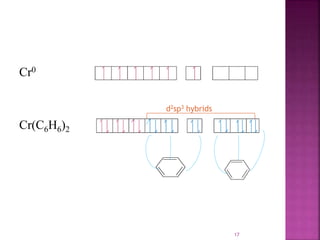
 From VBT, bonding in dibenzenechromium -in terms
of d2sp3 hybridisation of the chromium AO’s leading
to an octahedral configuration
16
Cr0
Cr(C6H6)2
d2sp3 hybrids
17
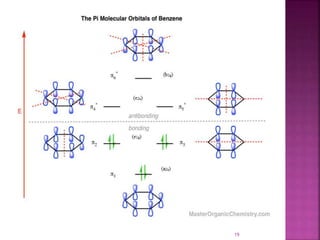
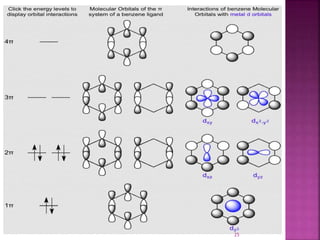
 In MO description, the six pπ atomic orbitals on
benzene molecule combine and produce six
molecular orbitals
 Three MO’s - bonding namely: Ψ1, Ψ2 and Ψ3
 Other three - ABMOs namely: Ψ4, Ψ5 and Ψ6
18
19
 These 6 MOs combine with similar set of second
benzene molecule
 One of these combinations is symmetric with respect
to inversion (gerade)
 Other combination is antisymmetric to
inversion(ungerade)
 The resulting 12 combined group MOs i.e., LGOs in
turn combine with metal orbitals having similar
symmetry
20
 A consideration of the symmetry of a molecule followed
by the application of group theory enables the
determination of which orbitals can combine to give
molecular orbitals.
 Only those ligand and metal orbitals which have the same
symmetry properties can overlap to form bonds.
 Although this aspect of the metal-arene bond description
is rigorous, the difficulty arises in determining the
relative energies of the molecular orbitals.
21
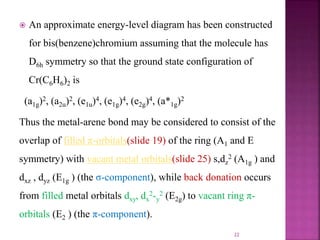
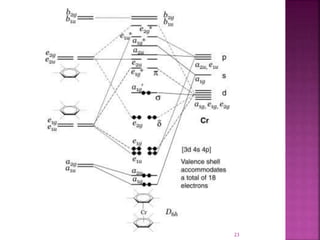
 An approximate energy-level diagram has been constructed
for bis(benzene)chromium assuming that the molecule has
D6h symmetry so that the ground state configuration of
Cr(C6H6)2 is
(a1g)2, (a2u)2, (e1u)4, (e1g)4, (e2g)4, (a*1g)2
Thus the metal-arene bond may be considered to consist of the
overlap of filled π-orbitals(slide 19) of the ring (A1 and E
symmetry) with vacant metal orbitals(slide 25) s,dz
2 (A1g ) and
dxz , dyz (E1g ) (the σ-component), while back donation occurs
from filled metal orbitals dxy, dx
2-y
2 (E2g) to vacant ring π-
orbitals (E2 ) (the π-component).
22
23
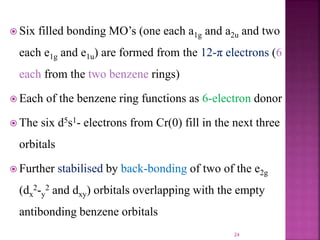
 Six filled bonding MO’s (one each a1g and a2u and two
each e1g and e1u) are formed from the 12-π electrons (6
each from the two benzene rings)
 Each of the benzene ring functions as 6-electron donor
 The six d5s1- electrons from Cr(0) fill in the next three
orbitals
 Further stabilised by back-bonding of two of the e2g
(dx
2-y
2 and dxy) orbitals overlapping with the empty
antibonding benzene orbitals
24
25
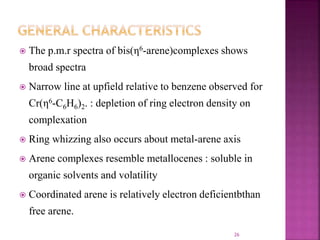
 The p.m.r spectra of bis(η6-arene)complexes shows
broad spectra
 Narrow line at upfield relative to benzene observed for
Cr(η6-C6H6)2. : depletion of ring electron density on
complexation
 Ring whizzing also occurs about metal-arene axis
 Arene complexes resemble metallocenes : soluble in
organic solvents and volatility
 Coordinated arene is relatively electron deficientbthan
free arene.
26
 More reactive than metallocenes, thermally and
aerially less stable
 Cr(η6-C6H6)2 readily oxidises to [Cr(η6-C6H6)2]+
Cr(C6H6)2 [Cr(C6H6)2]+
+ C2H5
.
C2H5I
(C2H6 + C2H4 + C4H10)
Disproportionation/addition
27
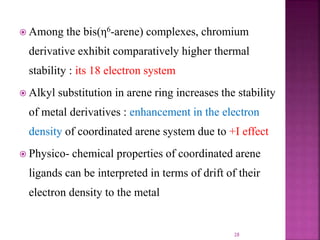
 Among the bis(η6-arene) complexes, chromium
derivative exhibit comparatively higher thermal
stability : its 18 electron system
 Alkyl substitution in arene ring increases the stability
of metal derivatives : enhancement in the electron
density of coordinated arene system due to +I effect
 Physico- chemical properties of coordinated arene
ligands can be interpreted in terms of drift of their
electron density to the metal
28
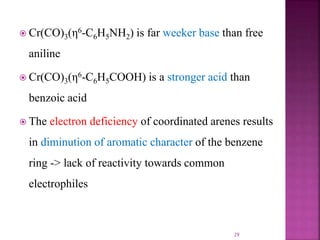
 Cr(CO)3(η6-C6H5NH2) is far weeker base than free
aniline
 Cr(CO)3(η6-C6H5COOH) is a stronger acid than
benzoic acid
 The electron deficiency of coordinated arenes results
in diminution of aromatic character of the benzene
ring -> lack of reactivity towards common
electrophiles
29

Powerpoint on Arene-Metal complexes.pptx

  • 1.
  • 2.
     Transition metalπ-complexes with aromatic ligands, that is with planar carbocyclic ligands having (4n+2) π-electrons, are known for three-, four-,five-,six-, seven-, and eight-membered rings. 2
  • 3.
     Cyclopentadienyl-metal complexesare known for all the d-block transition metals except silver; numerous mixed complexes containing a wide range of other ligands such as carbonyl, tertiary phosphines, and halides are also known  The number of stable transition metal complexes containing aromatic ligands decreases markedly in the order C5H5 ->C5H6>C7H7 +>C9H9 2- 3
  • 4.
     This maybe related to the charge on the ring in relation to the positively charged metal ion, and also to the fact that as the size of the planar ring increases the metal-ring distance must decrease in order to maintain a reasonable overlap of metal orbitals with ring π-orbitals. 4
  • 5.
     The firstarene-transition metal complex reported was Hein's "hydrate of pentaphenylchromium hydroxide" in 1919 ,  But it was not characterised till 1954  Took almost 35 years for this and related "polyphenyl" chromium compounds to be recognised as being bis(arene) π-complexes . 5
  • 6.
     Since thenthe chemistry of arene metal complexes - undergone transformations -> synthesis of η6- arene complexes of almost all transition metals (d2-d8)  On complexation, the C−C distances are usually essentially equal, but slightly longer than in the free arene. 6
  • 7.
     In additionto η6-ligation, arene can also function as a tetrahapto or dihapto ligand  But when bonded in these fashions to TM, distortion of the bonds in aromatic ring induced and planarity of the ring distorted while an η6 arene will be flat 7
  • 8.
  • 9.
     Arenes aremuch more reactive than Cp groups, and they are also more easily lost from the metal so arenes are normally actor, rather than spectator ligands.  13C NMR spectroscopy is the most useful method of characterization, the metal-bound carbons showing a ∼25-ppm shift to high field on coordination, due to the increased shielding from the nearby metal. 9
  • 10.
    Table lists someof the known bis(arene)-metal complexes, indicates the wide range of such complexes which have been isolated in the last 68 years or so. 10
  • 11.
     The mostgeneral procedure for the preparation of bis(arene)-metal complexes is the reducing Friedel-Crafts synthesis, devised by Fischer and Hafner , in which the anhydrous metal chloride is treated with the required arene in the presence of aluminium and aluminium chloride. 11
  • 12.
     In general,the resultant cationic complex may be reduced by a variety of methods to the uncharged species.  Equations 1 and 2 give specific examples of the preparation of Cr(C6H6)2 and Fe(C6Me6)2 respectively, 12
  • 13.
     The reductionof the cationic bis(arene)-metal complexes is achieved by treatment with alkaline sodium dithionite.  Another procedure which has retained its importance is the original method used by Hein to prepare bis(arene)chromium complexes by treating chromium chloride with phenylmagnesium bromide (Equation 3). 13
  • 14.
    Metal vapor synthesisis used to prepare a wide range of bis (arene) metal π-complexes, many of which is not accessible by the usual routes. M + 2arene i) cocondenses, 77K ii) warm M(η6-arene)2 M= Ti, V, Nb, Cr, Mo, W, Fe, etc; arene= C6H6, C6H5Me, Me3C6H3, etc 14
  • 15.
     X-ray studiesshow that bis(benzene)chromiurn adopts a sandwich structure in which the two benzene rings are eclipsed,  While the arene-metal tricarbonyls adopt a half- sandwich structure in which the configuration of the carbonyl ligands with respect to the carbon atoms of the ring depends on the substituents of the ring 15
  • 16.
     Spectroscopic andX-ray diffraction studies information: benzene -planar, D6h symmetry  C-C bond length = 1.39Å and bond angles: 120̊  From VBT, bonding in dibenzenechromium -in terms of d2sp3 hybridisation of the chromium AO’s leading to an octahedral configuration 16
  • 17.
  • 18.
     In MOdescription, the six pπ atomic orbitals on benzene molecule combine and produce six molecular orbitals  Three MO’s - bonding namely: Ψ1, Ψ2 and Ψ3  Other three - ABMOs namely: Ψ4, Ψ5 and Ψ6 18
  • 19.
  • 20.
     These 6MOs combine with similar set of second benzene molecule  One of these combinations is symmetric with respect to inversion (gerade)  Other combination is antisymmetric to inversion(ungerade)  The resulting 12 combined group MOs i.e., LGOs in turn combine with metal orbitals having similar symmetry 20
  • 21.
     A considerationof the symmetry of a molecule followed by the application of group theory enables the determination of which orbitals can combine to give molecular orbitals.  Only those ligand and metal orbitals which have the same symmetry properties can overlap to form bonds.  Although this aspect of the metal-arene bond description is rigorous, the difficulty arises in determining the relative energies of the molecular orbitals. 21
  • 22.
     An approximateenergy-level diagram has been constructed for bis(benzene)chromium assuming that the molecule has D6h symmetry so that the ground state configuration of Cr(C6H6)2 is (a1g)2, (a2u)2, (e1u)4, (e1g)4, (e2g)4, (a*1g)2 Thus the metal-arene bond may be considered to consist of the overlap of filled π-orbitals(slide 19) of the ring (A1 and E symmetry) with vacant metal orbitals(slide 25) s,dz 2 (A1g ) and dxz , dyz (E1g ) (the σ-component), while back donation occurs from filled metal orbitals dxy, dx 2-y 2 (E2g) to vacant ring π- orbitals (E2 ) (the π-component). 22
  • 23.
  • 24.
     Six filledbonding MO’s (one each a1g and a2u and two each e1g and e1u) are formed from the 12-π electrons (6 each from the two benzene rings)  Each of the benzene ring functions as 6-electron donor  The six d5s1- electrons from Cr(0) fill in the next three orbitals  Further stabilised by back-bonding of two of the e2g (dx 2-y 2 and dxy) orbitals overlapping with the empty antibonding benzene orbitals 24
  • 25.
  • 26.
     The p.m.rspectra of bis(η6-arene)complexes shows broad spectra  Narrow line at upfield relative to benzene observed for Cr(η6-C6H6)2. : depletion of ring electron density on complexation  Ring whizzing also occurs about metal-arene axis  Arene complexes resemble metallocenes : soluble in organic solvents and volatility  Coordinated arene is relatively electron deficientbthan free arene. 26
  • 27.
     More reactivethan metallocenes, thermally and aerially less stable  Cr(η6-C6H6)2 readily oxidises to [Cr(η6-C6H6)2]+ Cr(C6H6)2 [Cr(C6H6)2]+ + C2H5 . C2H5I (C2H6 + C2H4 + C4H10) Disproportionation/addition 27
  • 28.
     Among thebis(η6-arene) complexes, chromium derivative exhibit comparatively higher thermal stability : its 18 electron system  Alkyl substitution in arene ring increases the stability of metal derivatives : enhancement in the electron density of coordinated arene system due to +I effect  Physico- chemical properties of coordinated arene ligands can be interpreted in terms of drift of their electron density to the metal 28
  • 29.
     Cr(CO)3(η6-C6H5NH2) isfar weeker base than free aniline  Cr(CO)3(η6-C6H5COOH) is a stronger acid than benzoic acid  The electron deficiency of coordinated arenes results in diminution of aromatic character of the benzene ring -> lack of reactivity towards common electrophiles 29