Gels and Emulsion
Contents
• Introduction
• Gels and its classification
• Preparation
• Applications and properties
• Emulsion and its types
• Determination and its preparation
• Application and properties
• Conclusion
• Reference
INTRODUCTION
GELS
 Gels are the semisolid dosage form.
 In that dispersion of small molecules in an aqeous liquid vehicle.
 They produce jelly like consistency by the addition of gelling agent.
 Gels are formed by using synthetic polymers such as carbomer 934 & cellulose such as
hydroxypropylcellulose & hydroxypropylmethylcellulose.
 Gels may appear transparent or turbid based on type of gelling agent used
GELS
• Several lyophillic sols and a few lyophobic sols as well when coagulated
under certain conditions,change into semi rigid mass,enclosing the entire
amount of the liquid within itself. Such a product is called a gel.
• The process of transformation of sol into a gel is called gelation.
• Gel represents solid-liquid system. i.e liquid dispersed in solid.
• Amongst lyophillic sols the examples are :gelatin ,agar-agar,gum arabic etc.
• Amongst lyophobic sols the examples are: silicic acid, ferric
hydroxide ,ferric phosphate sols etc.
• The sols should be of sufficiently high concentration to facilitate the
gelation process.
• Gels and gelation are very important in medicine and biology because
plants and animals are primarily composed of gels.
Classification of gels
Gels can also be classified as follows:
 Gels can be classified as inorganic and organic based on their chemical
composition.
 When the dispersion medium in the gel is either water, alcohol or
benzene, then the gel formed is known as hydrogel,alcogel or benzogel
resp. If gels contain an organic solvent as the dispersion medium, the term
is called organogel.
 Gels are also classified based on mechanical properties they are:
 Elastic gels : It is prepared by dissolving the substance in warm water and
cooling it till it sets. Gelatin gel and agar-agar gel are the examples
 Non elastic gels:these are glassy and fall to a powder ,and lose their
elasticity on drying. Silica gel, alumina and ferric oxide gels are the
examples.
• Hydrogel:
 A hydrogel is a network of polymer chains that are hydrophillic,
sometimes found as a colloidal gel in which water is the
dispersion medium.
 Uses: drug delivery system, wound care, contact lenses,water
retention, cosmetics etc.
Alcogel:
 They are the gels where the liquid component is an alcohol
instead of water.
 Uses: precursor to aerogels, catalyst supporter, sensors,
seperation processes.
Organogel:
 Here the liquid component is organic solvent.
 Uses:Cosmetics,food industry, medicals, chemical industry.
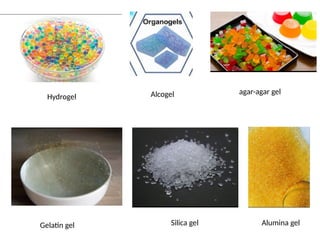
Hydrogel Alcogel agar-agar gel
Gelatin gel Silica gel Alumina gel
Preparations of gels
Depending on their nature ,gels may be prepared by following methods:
 By cooling of sols:
Agar agar, gelatin and many other substances are soluble in hot
and the solutions set on to form a gel on subsequent cooling.
 By Double decomposition:
The gels like silicic acid, aluminium hydroxide (commonly known as
silica gel and alumina gel)are prepared by this method. By adding
hydrochloric acid to a aqueous solution of sodium silicate, hydrated silicic
acid gets precipitated. This when allowed to stand sets into a gel.
 By change of solvents:
when ethanol is added to the solution of calcium acetate of fair
concentration, salt seperates out to give colloidal solution. When allowed
to stand it will get converted to semi - rigid gel of calcium actate.
PROPERTIES OF GELS
SWELLING
SYNERISIS
SOFTNESS
OPTICAL PROPERTIES
ELECTRICAL PROPERTIES
ELASTIC PROPERTIES
AGEING PROPERTY
APPLICATIONS OF GELS
Gels have found various applications. Some of them are:
 Silica gel is used in laboratory as well as in industry.
 It is also used to support platinum catalyst when the latter is used in the
contact process of manufacturing H2SO4
 Silica gel acts as a resistant to catalytic poisoning.
 Solified alcohol, which can be obtained from alcohol and calcium acetate,
is a gel used as a fuel in picnic stoves.
 Gelatin and agar gels are used in laboratories for making liquid junctions.
 NaCl gel are used in electrocardiography
EMULSIONS
• The word emulsion comes from the latin word for “to milk”.
• Emulsion is a heterogeneous system , consisting of atleast one
immiscible liquid dispersed in another in the form of droplets.
• Emulsions are generally unstable unless a third substance
called an emulsifying agent is present
• Emulsion should be used when both the dispersed and the
continuous phase are liquids.
• Examples are: milk, mayonnaise,and some metal cutting
fluids, paints polishes and ice cream etc.
Types of emulsions:
1. Oil in water emulsions
2. Water in oil emulsions
3. Macro emulsions
4. Micro emulsions
• Emulsion of oil in water:
• Those emulsions in which the dispersed phase is oil and medium is water. These are generally
represented as O in W emulsions.
Examples are : milk, vanishing cream.
• Emulsion of water in oil:
• Those emulsions in which the dispersed phase is water and medium is oil. These are generally
represented as W in O emulsions.
• Examples are: butter, ice creams etc
• The type of emulsion formed by the agitation of two liquids depends upon the proportion of the
two liquids in the mixture.
• The constituent present in excess will act as the dispersion medium and the other present in
small excess forms the inner phase.
Macroemulsion
• It is the opaque emulsions with particles>400nm. Easily
visible under microscope.
• They need intense agitation for their formation.
• According to the dispersed phase they are of two types:
• W/o macroemulsion and O/W macroemulsion.
• W/o emulsion: oil is used as inner phase and water as outer
phase.
• O/W emulsion : water is used as inner phase and oil is used as
outer phase.
• It is kinetically stable and has low surface area
Micro emulsion
• They are the transparent dispersions containing two immiscible
liquids with particles of 1-100nm diameter that are obtained
upon mixing the ingredient gently.
• The particles are not easily visible in microscope.
• They may be oil in water or water in oil type.
• Micro emulsions are generally prepared with more than one
surfactant or with a mixture of a surfactant and co-surfactant.
• They are thermodynamically stable and long shelf life
• Act as a super solvent for drug.
• Due to small droplet size it has large interfacial area of globule.
• Low viscosity.
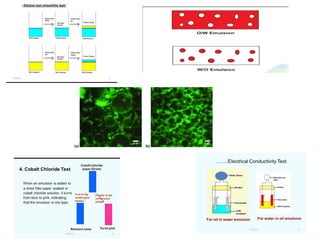
Determination of Emulsion:
 There are five methods of determination of type of
emulsion(o/w or w/o)
 Dye solubility method
 Dilution Method
 Flourescence method
 Filter paper method
 Conductivity method
Preparation
Dry gum method:
• Measure the required quantity of oil in a dry measure and
transfer in a dry mortar.
• Add the calculated amount of Gum Acacia into it and triturate
rapidly to form a uniform mixture.
• Add required quantity of water and triturate vigourously till a
clicking sound is produced and product becomes white the
emulsion produced is known as primary emulsion.
• By adding a more water required volume of emulsion is obtained.
Wet gum method
• Powder the Gum Acacia in a mortar
• Add water and triturate it with Gum acacia to form a uniform
mixture
• Add required quantity of oil in small portions and triturate
rapidly till the clicking sound is produced and product
becomes white.
• The emulsion produced is called primary emulsion.
• Add more water to produce the required volume.
Bottle or Forbs bottle method
• Useful for preparation of emulsions from volatile oil
or oleaginous substance of low viscosities.
• Powdered acacia is placed in a dry bottle and two
parts of oil is added.
• The mixture is thoroughly shaken in the capped
container.
• A volume of water (approx equal to volume of oil)is
added in portions and mixture is thoroughly shaken
after each addition until the primary emulsion forms.
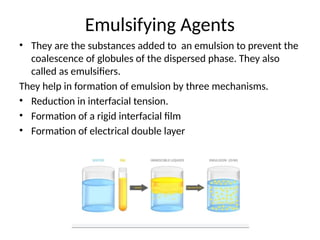
Emulsifying Agents
• They are the substances added to an emulsion to prevent the
coalescence of globules of the dispersed phase. They also
called as emulsifiers.
They help in formation of emulsion by three mechanisms.
• Reduction in interfacial tension.
• Formation of a rigid interfacial film
• Formation of electrical double layer
Properties of emulsion
• Emulsion exhibit all of the properties including Brownian
movement, electrophoresis.
• When light is diffused in equal proportions, emulsion take on
a white colour.
• Many phases integrate scatter light passing through
emissions, giving them a cloudy appearance.
Applications
• Oil in water mixture are widely used in food. Butter
mayonnaise homogenised milk are examples.
• They are used in pharmaceutical and cosmetics such as
moisturisers, creams and makeup removers.
• Emulsions are used in the productions of polymer dispersions
in chemical synthesis.
• These include basic ingredient in glues and paints
• Microemulsions are used to deliver vaccines to kill various
microbes.
Conclusion
• Gels is a semi solid system rich in liquid phase
whereas emulsion is a dispersion of one liquid in
another with which it is immiscible.
• They produce gelly like consistency by the addition of
gelling agent whereas emulsion is formed by the
addition of emulsifying agent.
Reference
• Priciples of physical Chemistry by Puri ,Sharma
and Pathania
• Colloid Chemistry by Dr. B.K. Sharma
• Physical Chemistry by Keith. J. Laidler and
John.H.Meiser
Thank you

Gels and Emulsion a colloidal substance.pptx

  • 1.
  • 2.
    Contents • Introduction • Gelsand its classification • Preparation • Applications and properties • Emulsion and its types • Determination and its preparation • Application and properties • Conclusion • Reference
  • 3.
    INTRODUCTION GELS  Gels arethe semisolid dosage form.  In that dispersion of small molecules in an aqeous liquid vehicle.  They produce jelly like consistency by the addition of gelling agent.  Gels are formed by using synthetic polymers such as carbomer 934 & cellulose such as hydroxypropylcellulose & hydroxypropylmethylcellulose.  Gels may appear transparent or turbid based on type of gelling agent used
  • 4.
    GELS • Several lyophillicsols and a few lyophobic sols as well when coagulated under certain conditions,change into semi rigid mass,enclosing the entire amount of the liquid within itself. Such a product is called a gel. • The process of transformation of sol into a gel is called gelation. • Gel represents solid-liquid system. i.e liquid dispersed in solid. • Amongst lyophillic sols the examples are :gelatin ,agar-agar,gum arabic etc. • Amongst lyophobic sols the examples are: silicic acid, ferric hydroxide ,ferric phosphate sols etc. • The sols should be of sufficiently high concentration to facilitate the gelation process. • Gels and gelation are very important in medicine and biology because plants and animals are primarily composed of gels.
  • 5.
    Classification of gels Gelscan also be classified as follows:  Gels can be classified as inorganic and organic based on their chemical composition.  When the dispersion medium in the gel is either water, alcohol or benzene, then the gel formed is known as hydrogel,alcogel or benzogel resp. If gels contain an organic solvent as the dispersion medium, the term is called organogel.  Gels are also classified based on mechanical properties they are:  Elastic gels : It is prepared by dissolving the substance in warm water and cooling it till it sets. Gelatin gel and agar-agar gel are the examples  Non elastic gels:these are glassy and fall to a powder ,and lose their elasticity on drying. Silica gel, alumina and ferric oxide gels are the examples.
  • 6.
    • Hydrogel:  Ahydrogel is a network of polymer chains that are hydrophillic, sometimes found as a colloidal gel in which water is the dispersion medium.  Uses: drug delivery system, wound care, contact lenses,water retention, cosmetics etc. Alcogel:  They are the gels where the liquid component is an alcohol instead of water.  Uses: precursor to aerogels, catalyst supporter, sensors, seperation processes. Organogel:  Here the liquid component is organic solvent.  Uses:Cosmetics,food industry, medicals, chemical industry.
  • 7.
    Hydrogel Alcogel agar-agargel Gelatin gel Silica gel Alumina gel
  • 8.
    Preparations of gels Dependingon their nature ,gels may be prepared by following methods:  By cooling of sols: Agar agar, gelatin and many other substances are soluble in hot and the solutions set on to form a gel on subsequent cooling.  By Double decomposition: The gels like silicic acid, aluminium hydroxide (commonly known as silica gel and alumina gel)are prepared by this method. By adding hydrochloric acid to a aqueous solution of sodium silicate, hydrated silicic acid gets precipitated. This when allowed to stand sets into a gel.  By change of solvents: when ethanol is added to the solution of calcium acetate of fair concentration, salt seperates out to give colloidal solution. When allowed to stand it will get converted to semi - rigid gel of calcium actate.
  • 9.
    PROPERTIES OF GELS SWELLING SYNERISIS SOFTNESS OPTICALPROPERTIES ELECTRICAL PROPERTIES ELASTIC PROPERTIES AGEING PROPERTY
  • 10.
    APPLICATIONS OF GELS Gelshave found various applications. Some of them are:  Silica gel is used in laboratory as well as in industry.  It is also used to support platinum catalyst when the latter is used in the contact process of manufacturing H2SO4  Silica gel acts as a resistant to catalytic poisoning.  Solified alcohol, which can be obtained from alcohol and calcium acetate, is a gel used as a fuel in picnic stoves.  Gelatin and agar gels are used in laboratories for making liquid junctions.  NaCl gel are used in electrocardiography
  • 12.
    EMULSIONS • The wordemulsion comes from the latin word for “to milk”. • Emulsion is a heterogeneous system , consisting of atleast one immiscible liquid dispersed in another in the form of droplets. • Emulsions are generally unstable unless a third substance called an emulsifying agent is present • Emulsion should be used when both the dispersed and the continuous phase are liquids. • Examples are: milk, mayonnaise,and some metal cutting fluids, paints polishes and ice cream etc.
  • 13.
    Types of emulsions: 1.Oil in water emulsions 2. Water in oil emulsions 3. Macro emulsions 4. Micro emulsions
  • 14.
    • Emulsion ofoil in water: • Those emulsions in which the dispersed phase is oil and medium is water. These are generally represented as O in W emulsions. Examples are : milk, vanishing cream. • Emulsion of water in oil: • Those emulsions in which the dispersed phase is water and medium is oil. These are generally represented as W in O emulsions. • Examples are: butter, ice creams etc • The type of emulsion formed by the agitation of two liquids depends upon the proportion of the two liquids in the mixture. • The constituent present in excess will act as the dispersion medium and the other present in small excess forms the inner phase.
  • 15.
    Macroemulsion • It isthe opaque emulsions with particles>400nm. Easily visible under microscope. • They need intense agitation for their formation. • According to the dispersed phase they are of two types: • W/o macroemulsion and O/W macroemulsion. • W/o emulsion: oil is used as inner phase and water as outer phase. • O/W emulsion : water is used as inner phase and oil is used as outer phase. • It is kinetically stable and has low surface area
  • 16.
    Micro emulsion • Theyare the transparent dispersions containing two immiscible liquids with particles of 1-100nm diameter that are obtained upon mixing the ingredient gently. • The particles are not easily visible in microscope. • They may be oil in water or water in oil type. • Micro emulsions are generally prepared with more than one surfactant or with a mixture of a surfactant and co-surfactant. • They are thermodynamically stable and long shelf life • Act as a super solvent for drug. • Due to small droplet size it has large interfacial area of globule. • Low viscosity.
  • 17.
    Determination of Emulsion: There are five methods of determination of type of emulsion(o/w or w/o)  Dye solubility method  Dilution Method  Flourescence method  Filter paper method  Conductivity method
  • 19.
    Preparation Dry gum method: •Measure the required quantity of oil in a dry measure and transfer in a dry mortar. • Add the calculated amount of Gum Acacia into it and triturate rapidly to form a uniform mixture. • Add required quantity of water and triturate vigourously till a clicking sound is produced and product becomes white the emulsion produced is known as primary emulsion. • By adding a more water required volume of emulsion is obtained.
  • 20.
    Wet gum method •Powder the Gum Acacia in a mortar • Add water and triturate it with Gum acacia to form a uniform mixture • Add required quantity of oil in small portions and triturate rapidly till the clicking sound is produced and product becomes white. • The emulsion produced is called primary emulsion. • Add more water to produce the required volume.
  • 21.
    Bottle or Forbsbottle method • Useful for preparation of emulsions from volatile oil or oleaginous substance of low viscosities. • Powdered acacia is placed in a dry bottle and two parts of oil is added. • The mixture is thoroughly shaken in the capped container. • A volume of water (approx equal to volume of oil)is added in portions and mixture is thoroughly shaken after each addition until the primary emulsion forms.
  • 22.
    Emulsifying Agents • Theyare the substances added to an emulsion to prevent the coalescence of globules of the dispersed phase. They also called as emulsifiers. They help in formation of emulsion by three mechanisms. • Reduction in interfacial tension. • Formation of a rigid interfacial film • Formation of electrical double layer
  • 23.
    Properties of emulsion •Emulsion exhibit all of the properties including Brownian movement, electrophoresis. • When light is diffused in equal proportions, emulsion take on a white colour. • Many phases integrate scatter light passing through emissions, giving them a cloudy appearance.
  • 24.
    Applications • Oil inwater mixture are widely used in food. Butter mayonnaise homogenised milk are examples. • They are used in pharmaceutical and cosmetics such as moisturisers, creams and makeup removers. • Emulsions are used in the productions of polymer dispersions in chemical synthesis. • These include basic ingredient in glues and paints • Microemulsions are used to deliver vaccines to kill various microbes.
  • 25.
    Conclusion • Gels isa semi solid system rich in liquid phase whereas emulsion is a dispersion of one liquid in another with which it is immiscible. • They produce gelly like consistency by the addition of gelling agent whereas emulsion is formed by the addition of emulsifying agent.
  • 26.
    Reference • Priciples ofphysical Chemistry by Puri ,Sharma and Pathania • Colloid Chemistry by Dr. B.K. Sharma • Physical Chemistry by Keith. J. Laidler and John.H.Meiser
  • 27.