Transition metal-1,3-Butadiene complex
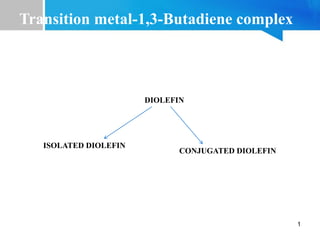
DIOLEFIN
ISOLATED DIOLEFIN
CONJUGATED DIOLEFIN
1
• The conjugated dienes such as 1,3-butadiene act as
4e- donor ligand
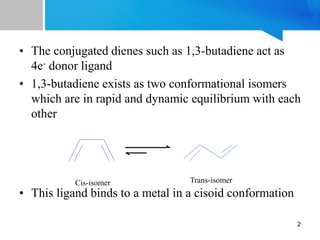
• 1,3-butadiene exists as two conformational isomers
which are in rapid and dynamic equilibrium with each
other
• This ligand binds to a metal in a cisoid conformation
Cis-isomer Trans-isomer
2
• The Dewar-Chatt model, when applied to 1,3-butadiene,
predicts that the ligand may bind to metal either as a L2 donor
type, similar to that of an alkene, or as an LX2 donor type,
similar to that of a metallacyclopentene form
L2 binding of 1,3-butadiene is rare, while the LX2 type binding is
more common
C1
C2
C3 C4
C1
C2
C3 C4
3
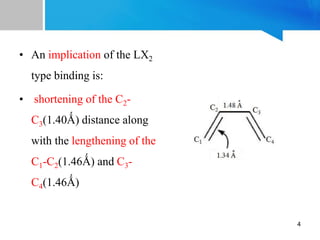
• An implication of the LX2
type binding is:
• shortening of the C2-
C3(1.40Ǻ) distance along
with the lengthening of the
C1-C2(1.46Ǻ) and C3-
C4(1.46Ǻ)
4
Methods of preparation
Metal butadiene complexes are usually prepared by the same
methods used for synthesizing metal-alkene complexes
1. Reaction of metal carbonyl with 1,3-butadiene
When a metal carbonyl is treated with 1,3-butadiene, two CO
ligands are replaced by the diene molecule forming transition
metal-butadiene complex
+ Fe(CO)5
High
Pressure
Fe(CO)3
+ 2CO
5
• When a mixture of 1,3-butadiene and Fe(CO)5 is irradiated
by UV light, four CO ligands are replaced by two
molecules of 1,3-butadiene forming a bis(η4-butadiene)
complex
Fe(CO)5 + 2CH2=CH-CH=CH2 [Fe(CO)(η4-C4H6)2]
UV
- 4CO
6
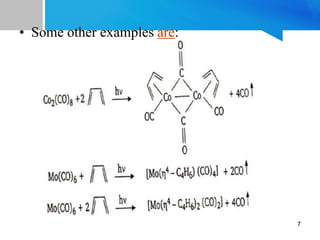
• Some other examples are:
7
2. Reaction of metal halide with 1,3-butadiene:
Some 1,3-butadiene complexes can be prepared by the
reaction of metal halide with 1,3-butadiene under suitable
conditions
K2[PtCl4] + CH2=CH-CH=CH2 K[PtCl3(η2-C4H6)]
In this complex 1,3-butadiene acts as 2e- donor, dihapto
ligand
- KCl
8
. Metal atom vapour phase synthesis:
The condensation of vapour of a metal in the presence of
1,3-butadiene and suitable co-ligand (such as CO,PR3 etc)
produces butadiene complex
Cr(g) + 4CO(g) + CH2=CH-CH=CH2(g) [Cr(CO)4(η4-C4H6)]
9
Structure
10
[Cr(CO)4(η4-C4H6)]
11
Structure and bonding
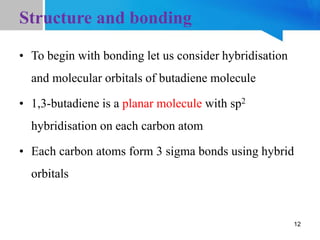
• To begin with bonding let us consider hybridisation
and molecular orbitals of butadiene molecule
• 1,3-butadiene is a planar molecule with sp2
hybridisation on each carbon atom
• Each carbon atoms form 3 sigma bonds using hybrid
orbitals
12
• After C-H and C-C bond formation, each carbon
atom has one singly filled 2p orbital which is
perpendicular to the molecular plane for π-bonding
• Four 2p orbitals take part in linear combination to
form four π-MOs
13
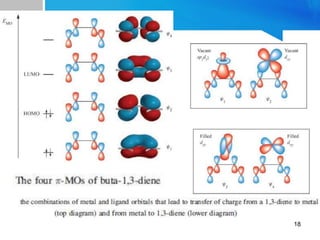
The MOs of the 1,3-
butadiene ligand
comprises of two filled
Ψ1(HOMO-1) and Ψ2
(HOMO) orbitals and two
empty Ψ3 (LUMO) and Ψ4
(LUMO+1) orbitals
14
• Appropriate combinations of four π MOs of 1,3-
butadiene and metal based orbitals can be used to
construct MOs of transition metal-Butadiene complex
15
16
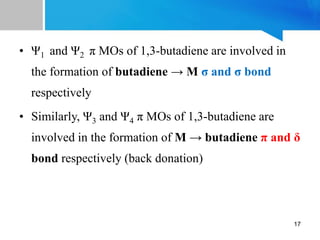
• Ψ1 and Ψ2 π MOs of 1,3-butadiene are involved in
the formation of butadiene → M σ and σ bond
respectively
• Similarly, Ψ3 and Ψ4 π MOs of 1,3-butadiene are
involved in the formation of M → butadiene π and δ
bond respectively (back donation)
17
18
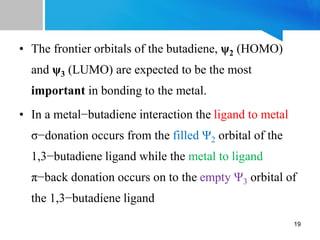
• The frontier orbitals of the butadiene, ψ2 (HOMO)
and ψ3 (LUMO) are expected to be the most
important in bonding to the metal.
• In a metal−butadiene interaction the ligand to metal
σ−donation occurs from the filled Ψ2 orbital of the
1,3−butadiene ligand while the metal to ligand
π−back donation occurs on to the empty Ψ3 orbital of
the 1,3−butadiene ligand
19
• The molecular orbital diagram shows that both the
depletion of electron density in ψ2 by σ donation to
the metal and population of ψ3 by back donation
from the metal lengthens terminal C-C bond and
shortens internal C-C bond.
• Binding to a metal usually depletes the ligand HOMO
and fills the ligand LUMO.
20
• The extent of ligand donation or metal back-donation
depends on the metal, substituents on the diene and
other ligands present
• An electron-rich metal will tend to populate Ψ3; an
electron-poor metal will tend to depopulate Ψ2.
• This is the main reason why binding has such a
profound effect on the chemical character of a ligand.
21
• The structure of the bound form of a ligand is similar to
that of the first excited state of the free ligand because to
reach this state we promote an electron from the HOMO
to the LUMO, thus partially depleting the former and
filling the latter.
22
• When the butadiene is excited, one of the electron
excited to higher orbital i.e., one of the electron from
ψ2 moves to ψ3
• The internal double bond character, bond length
decreases to 1.39Ǻ and terminal bond is single bond
and bond length increases to 1.45Ǻ
• As a result, lengthening of terminal C-C bonds as
well as shortening of the internal C-C bond can be
observed
23
• Similarly in metal-butadiene complexes, depopulation
of ψ2 and population of ψ3 would result in
lengthening of terminal C-C bonds and shortening of
internal C-C bonds
24
• The bonding between metal and butadiene may be
represented as follows
• When the donation from ψ2 into metal is important, the
bonding may be represented by (a)
• If donation from ψ1 into metal is important, the bonding
may be represented by (c)
• If ψ3 interactions are important, then represented by (b)
i.e., 1st excited state of butadiene fragment
25
For ex: [Fe(CO)3(η4-
C4H6)]. Its structure and
bonding is close to (c) in
which π electron cloud of
butadiene is delocalized on
the entire butadiene moiety
[Fe(CO)3(η4-C4H6)]
26
• If the interaction of ψ3 with metal orbital is important,
the structure and bonding may be represented by (b)
which suggests a shorter C2−C3 distance than two
outer C-C distances i.e., C1−C2 and C3−C4
• Ex: in [Cp2Zr(η4-2,3-Me2-C4H4)] C1-C2 and C3−C4
distances are longer than C2−C3 distance
27
Therefore, (b) is the main contributor to the
structure and bonding of the compound
In this complex, C1-C2 and C3-C4 distances are
longer than C2-C3 distance
The Zr-C1 and Zr-C4 distances are typical of Zr-
C sigma bonds
28
• At the same time Zr is farther from C2 and C3
than C1 and C4
• 2,3-dimethyl butadiene shows extreme LX2
i.e., (b) bonding pattern
• Zr is electron rich, it transfers 2 e-s to
butadiene via π-back-donation and generates
metallacyclopentene
29
Properties:
[Fe(CO)3(η4-C4H6)] is a yellow-brown oil which
is soluble in most of the organic solvents
The coordinated butadiene does not undergo
hydrogenation and Diels-Alder reaction
30
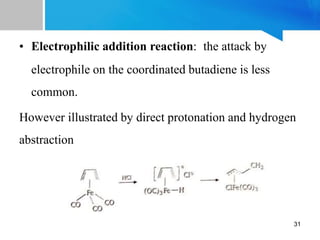
• Electrophilic addition reaction: the attack by
electrophile on the coordinated butadiene is less
common.
However illustrated by direct protonation and hydrogen
abstraction
31
• Sometimes, the carbocation electrophile abstracts
hydride ion from the saturated carbon atom adjacent
to the olefinic carbon atom extending the conjugation
• => lead to a change in the hydrocarbon ligand and its mode of bonding
32
• Nucleophilic attack: the coordinated butadiene is
readily attacked by a variety of nucleophiles such as
CH3O-, H-, CN-, R- etc.
33
• The addition of nucleophile to butadiene
saturates an olefinic carbon atom and thus
removes it from conjugation
34
• The nucleophile may also attack on the metal
atom.
35
Displacement reaction: The coordinated 1,3-
butadiene molecule can be displaced by other
neutral ligands such as PPh3
36

Power point presentation on TM-1,3-ButaDiene Complex

  • 1.
  • 2.
    • The conjugateddienes such as 1,3-butadiene act as 4e- donor ligand • 1,3-butadiene exists as two conformational isomers which are in rapid and dynamic equilibrium with each other • This ligand binds to a metal in a cisoid conformation Cis-isomer Trans-isomer 2
  • 3.
    • The Dewar-Chattmodel, when applied to 1,3-butadiene, predicts that the ligand may bind to metal either as a L2 donor type, similar to that of an alkene, or as an LX2 donor type, similar to that of a metallacyclopentene form L2 binding of 1,3-butadiene is rare, while the LX2 type binding is more common C1 C2 C3 C4 C1 C2 C3 C4 3
  • 4.
    • An implicationof the LX2 type binding is: • shortening of the C2- C3(1.40Ǻ) distance along with the lengthening of the C1-C2(1.46Ǻ) and C3- C4(1.46Ǻ) 4
  • 5.
    Methods of preparation Metalbutadiene complexes are usually prepared by the same methods used for synthesizing metal-alkene complexes 1. Reaction of metal carbonyl with 1,3-butadiene When a metal carbonyl is treated with 1,3-butadiene, two CO ligands are replaced by the diene molecule forming transition metal-butadiene complex + Fe(CO)5 High Pressure Fe(CO)3 + 2CO 5
  • 6.
    • When amixture of 1,3-butadiene and Fe(CO)5 is irradiated by UV light, four CO ligands are replaced by two molecules of 1,3-butadiene forming a bis(η4-butadiene) complex Fe(CO)5 + 2CH2=CH-CH=CH2 [Fe(CO)(η4-C4H6)2] UV - 4CO 6
  • 7.
    • Some otherexamples are: 7
  • 8.
    2. Reaction ofmetal halide with 1,3-butadiene: Some 1,3-butadiene complexes can be prepared by the reaction of metal halide with 1,3-butadiene under suitable conditions K2[PtCl4] + CH2=CH-CH=CH2 K[PtCl3(η2-C4H6)] In this complex 1,3-butadiene acts as 2e- donor, dihapto ligand - KCl 8
  • 9.
    . Metal atomvapour phase synthesis: The condensation of vapour of a metal in the presence of 1,3-butadiene and suitable co-ligand (such as CO,PR3 etc) produces butadiene complex Cr(g) + 4CO(g) + CH2=CH-CH=CH2(g) [Cr(CO)4(η4-C4H6)] 9
  • 10.
  • 11.
  • 12.
    Structure and bonding •To begin with bonding let us consider hybridisation and molecular orbitals of butadiene molecule • 1,3-butadiene is a planar molecule with sp2 hybridisation on each carbon atom • Each carbon atoms form 3 sigma bonds using hybrid orbitals 12
  • 13.
    • After C-Hand C-C bond formation, each carbon atom has one singly filled 2p orbital which is perpendicular to the molecular plane for π-bonding • Four 2p orbitals take part in linear combination to form four π-MOs 13
  • 14.
    The MOs ofthe 1,3- butadiene ligand comprises of two filled Ψ1(HOMO-1) and Ψ2 (HOMO) orbitals and two empty Ψ3 (LUMO) and Ψ4 (LUMO+1) orbitals 14
  • 15.
    • Appropriate combinationsof four π MOs of 1,3- butadiene and metal based orbitals can be used to construct MOs of transition metal-Butadiene complex 15
  • 16.
  • 17.
    • Ψ1 andΨ2 π MOs of 1,3-butadiene are involved in the formation of butadiene → M σ and σ bond respectively • Similarly, Ψ3 and Ψ4 π MOs of 1,3-butadiene are involved in the formation of M → butadiene π and δ bond respectively (back donation) 17
  • 18.
  • 19.
    • The frontierorbitals of the butadiene, ψ2 (HOMO) and ψ3 (LUMO) are expected to be the most important in bonding to the metal. • In a metal−butadiene interaction the ligand to metal σ−donation occurs from the filled Ψ2 orbital of the 1,3−butadiene ligand while the metal to ligand π−back donation occurs on to the empty Ψ3 orbital of the 1,3−butadiene ligand 19
  • 20.
    • The molecularorbital diagram shows that both the depletion of electron density in ψ2 by σ donation to the metal and population of ψ3 by back donation from the metal lengthens terminal C-C bond and shortens internal C-C bond. • Binding to a metal usually depletes the ligand HOMO and fills the ligand LUMO. 20
  • 21.
    • The extentof ligand donation or metal back-donation depends on the metal, substituents on the diene and other ligands present • An electron-rich metal will tend to populate Ψ3; an electron-poor metal will tend to depopulate Ψ2. • This is the main reason why binding has such a profound effect on the chemical character of a ligand. 21
  • 22.
    • The structureof the bound form of a ligand is similar to that of the first excited state of the free ligand because to reach this state we promote an electron from the HOMO to the LUMO, thus partially depleting the former and filling the latter. 22
  • 23.
    • When thebutadiene is excited, one of the electron excited to higher orbital i.e., one of the electron from ψ2 moves to ψ3 • The internal double bond character, bond length decreases to 1.39Ǻ and terminal bond is single bond and bond length increases to 1.45Ǻ • As a result, lengthening of terminal C-C bonds as well as shortening of the internal C-C bond can be observed 23
  • 24.
    • Similarly inmetal-butadiene complexes, depopulation of ψ2 and population of ψ3 would result in lengthening of terminal C-C bonds and shortening of internal C-C bonds 24
  • 25.
    • The bondingbetween metal and butadiene may be represented as follows • When the donation from ψ2 into metal is important, the bonding may be represented by (a) • If donation from ψ1 into metal is important, the bonding may be represented by (c) • If ψ3 interactions are important, then represented by (b) i.e., 1st excited state of butadiene fragment 25
  • 26.
    For ex: [Fe(CO)3(η4- C4H6)].Its structure and bonding is close to (c) in which π electron cloud of butadiene is delocalized on the entire butadiene moiety [Fe(CO)3(η4-C4H6)] 26
  • 27.
    • If theinteraction of ψ3 with metal orbital is important, the structure and bonding may be represented by (b) which suggests a shorter C2−C3 distance than two outer C-C distances i.e., C1−C2 and C3−C4 • Ex: in [Cp2Zr(η4-2,3-Me2-C4H4)] C1-C2 and C3−C4 distances are longer than C2−C3 distance 27
  • 28.
    Therefore, (b) isthe main contributor to the structure and bonding of the compound In this complex, C1-C2 and C3-C4 distances are longer than C2-C3 distance The Zr-C1 and Zr-C4 distances are typical of Zr- C sigma bonds 28
  • 29.
    • At thesame time Zr is farther from C2 and C3 than C1 and C4 • 2,3-dimethyl butadiene shows extreme LX2 i.e., (b) bonding pattern • Zr is electron rich, it transfers 2 e-s to butadiene via π-back-donation and generates metallacyclopentene 29
  • 30.
    Properties: [Fe(CO)3(η4-C4H6)] is ayellow-brown oil which is soluble in most of the organic solvents The coordinated butadiene does not undergo hydrogenation and Diels-Alder reaction 30
  • 31.
    • Electrophilic additionreaction: the attack by electrophile on the coordinated butadiene is less common. However illustrated by direct protonation and hydrogen abstraction 31
  • 32.
    • Sometimes, thecarbocation electrophile abstracts hydride ion from the saturated carbon atom adjacent to the olefinic carbon atom extending the conjugation • => lead to a change in the hydrocarbon ligand and its mode of bonding 32
  • 33.
    • Nucleophilic attack:the coordinated butadiene is readily attacked by a variety of nucleophiles such as CH3O-, H-, CN-, R- etc. 33
  • 34.
    • The additionof nucleophile to butadiene saturates an olefinic carbon atom and thus removes it from conjugation 34
  • 35.
    • The nucleophilemay also attack on the metal atom. 35
  • 36.
    Displacement reaction: Thecoordinated 1,3- butadiene molecule can be displaced by other neutral ligands such as PPh3 36