from Superlensing to Cloaking
 Background
 Metamaterials
 Diffraction
 Superlens
 Cloaking
 Conclusion
2
 Almost 40 years ago,Victor Veselago proposed the
idea,
 It could make light waves appear to flow
backward and behave in many other
counterintuitive ways,
 Veselago failed to find anything having the
electromagnetic properties he sought,
 Pendry, in the mid-1990s, material could gain its
electromagnetic properties from tiny structures,
 In 2000 Smith, found a combination of
metamaterials that provided the exclusive
property of negative refraction.
3
 Chemistry is not the only path to developing materials
with an interesting electromagnetic response.
 Engineer electromagnetic response by creating tiny but
macroscopic structures.
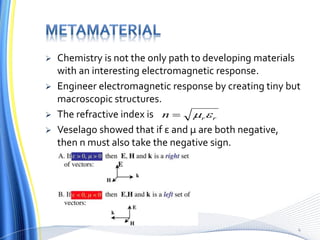
 The refractive index is
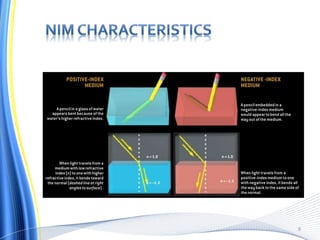
 Veselago showed that if ε and μ are both negative,
then n must also take the negative sign.
rrn 
4
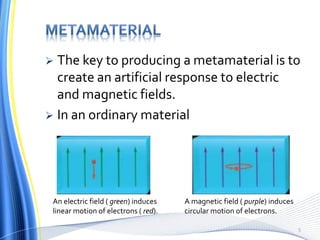
 The key to producing a metamaterial is to
create an artificial response to electric
and magnetic fields.
 In an ordinary material
A magnetic field ( purple) induces
circular motion of electrons.
An electric field ( green) induces
linear motion of electrons ( red).
5
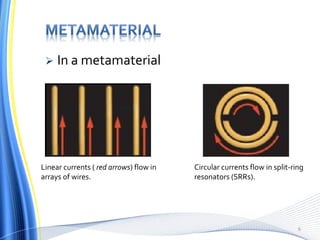
 In a metamaterial
Linear currents ( red arrows) flow in
arrays of wires.
Circular currents flow in split-ring
resonators (SRRs).
6
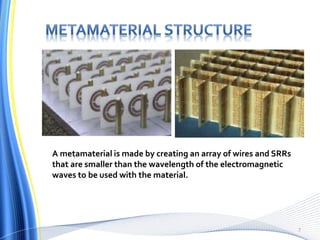
A metamaterial is made by creating an array of wires and SRRs
that are smaller than the wavelength of the electromagnetic
waves to be used with the material.
7
8
9
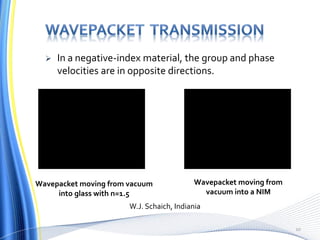
 In a negative-index material, the group and phase
velocities are in opposite directions.
Wavepacket moving from vacuum
into glass with n=1.5
Wavepacket moving from
vacuum into a NIM
W.J. Schaich, Indiania
10
 Places the ultimate limit on all imaging
systems.
 Also determines the smallest feature that
can be created by optical lithography
processes.
 limits the amount of information that can
be optically stored on DVD.
11
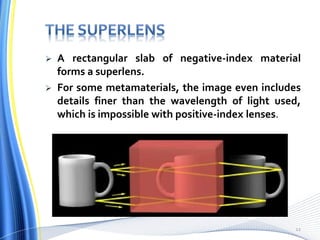
 A rectangular slab of negative-index material
forms a superlens.
 For some metamaterials, the image even includes
details finer than the wavelength of light used,
which is impossible with positive-index lenses.
12
 Limited by the quality of its negative-index material.
 The best performance requires not just that the
refractive index n = –1, but that both μ = –1 and ε = –1.
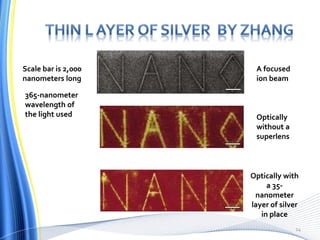
 In 2004, Anthony Grbic et.al showed experimentally
that a metamaterial designed to have ε = –1 and μ = –1
at radio frequencies could indeed resolve objects at a
scale smaller than the diffraction limit.
 When the distance between the object and the image is
much smaller than the wavelength, we need only fulfill
the condition ε = –1.
13
Optically
without a
superlens
Optically with
a 35-
nanometer
layer of silver
in place
Scale bar is 2,000
nanometers long
365-nanometer
wavelength of
the light used
A focused
ion beam
14
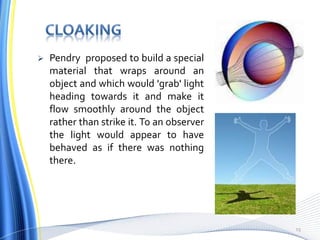
 Pendry proposed to build a special
material that wraps around an
object and which would 'grab' light
heading towards it and make it
flow smoothly around the object
rather than strike it. To an observer
the light would appear to have
behaved as if there was nothing
there.
15
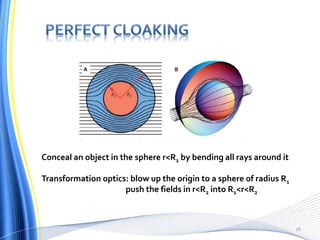
Conceal an object in the sphere r<R1 by bending all rays around it
Transformation optics: blow up the origin to a sphere of radius R1
push the fields in r<R2 into R1<r<R2
16
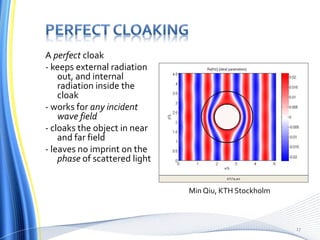
A perfect cloak
- keeps external radiation
out, and internal
radiation inside the
cloak
- works for any incident
wave field
- cloaks the object in near
and far field
- leaves no imprint on the
phase of scattered light
Min Qiu, KTH Stockholm
17
1. Negative  and : transparent, left-
handed plane waves
2. Negative refraction
3. Perfect lens Microscopy, lithography
4. Transformation optics Perfect cloaking
5. Perfect lenses & cloaks: near-field,
resonant phenomena
18

Negative Refraction

  • 1.
  • 2.
     Background  Metamaterials Diffraction  Superlens  Cloaking  Conclusion 2
  • 3.
     Almost 40years ago,Victor Veselago proposed the idea,  It could make light waves appear to flow backward and behave in many other counterintuitive ways,  Veselago failed to find anything having the electromagnetic properties he sought,  Pendry, in the mid-1990s, material could gain its electromagnetic properties from tiny structures,  In 2000 Smith, found a combination of metamaterials that provided the exclusive property of negative refraction. 3
  • 4.
     Chemistry isnot the only path to developing materials with an interesting electromagnetic response.  Engineer electromagnetic response by creating tiny but macroscopic structures.  The refractive index is  Veselago showed that if ε and μ are both negative, then n must also take the negative sign. rrn  4
  • 5.
     The keyto producing a metamaterial is to create an artificial response to electric and magnetic fields.  In an ordinary material A magnetic field ( purple) induces circular motion of electrons. An electric field ( green) induces linear motion of electrons ( red). 5
  • 6.
     In ametamaterial Linear currents ( red arrows) flow in arrays of wires. Circular currents flow in split-ring resonators (SRRs). 6
  • 7.
    A metamaterial ismade by creating an array of wires and SRRs that are smaller than the wavelength of the electromagnetic waves to be used with the material. 7
  • 8.
  • 9.
  • 10.
     In anegative-index material, the group and phase velocities are in opposite directions. Wavepacket moving from vacuum into glass with n=1.5 Wavepacket moving from vacuum into a NIM W.J. Schaich, Indiania 10
  • 11.
     Places theultimate limit on all imaging systems.  Also determines the smallest feature that can be created by optical lithography processes.  limits the amount of information that can be optically stored on DVD. 11
  • 12.
     A rectangularslab of negative-index material forms a superlens.  For some metamaterials, the image even includes details finer than the wavelength of light used, which is impossible with positive-index lenses. 12
  • 13.
     Limited bythe quality of its negative-index material.  The best performance requires not just that the refractive index n = –1, but that both μ = –1 and ε = –1.  In 2004, Anthony Grbic et.al showed experimentally that a metamaterial designed to have ε = –1 and μ = –1 at radio frequencies could indeed resolve objects at a scale smaller than the diffraction limit.  When the distance between the object and the image is much smaller than the wavelength, we need only fulfill the condition ε = –1. 13
  • 14.
    Optically without a superlens Optically with a35- nanometer layer of silver in place Scale bar is 2,000 nanometers long 365-nanometer wavelength of the light used A focused ion beam 14
  • 15.
     Pendry proposedto build a special material that wraps around an object and which would 'grab' light heading towards it and make it flow smoothly around the object rather than strike it. To an observer the light would appear to have behaved as if there was nothing there. 15
  • 16.
    Conceal an objectin the sphere r<R1 by bending all rays around it Transformation optics: blow up the origin to a sphere of radius R1 push the fields in r<R2 into R1<r<R2 16
  • 17.
    A perfect cloak -keeps external radiation out, and internal radiation inside the cloak - works for any incident wave field - cloaks the object in near and far field - leaves no imprint on the phase of scattered light Min Qiu, KTH Stockholm 17
  • 18.
    1. Negative and : transparent, left- handed plane waves 2. Negative refraction 3. Perfect lens Microscopy, lithography 4. Transformation optics Perfect cloaking 5. Perfect lenses & cloaks: near-field, resonant phenomena 18