E
k
H
S
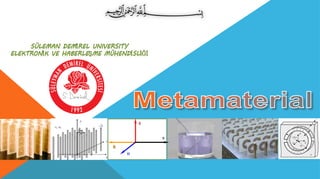
My name : Khalid Saeed Al-Badri
My supervisor
Yrd. Doç. Dr. EVREN EKMEKÇİ
Assistant Professor: Electronics and Communication
Engineering
METAMATERIAL BACKGROUND
Do not depend on the chemical
composition
Depend on the geometry of the
structure units. [1]
Metamaterials are artificial
engineered composite structures.
Not commonly found in nature.[2]
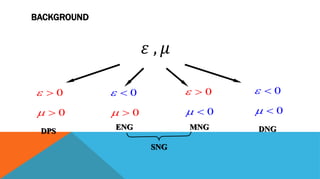
BACKGROUND
0
0


 



 0
0





 0
0






0
0


 




DPS
MNGENG DNG
SNG
𝜀 , 𝜇
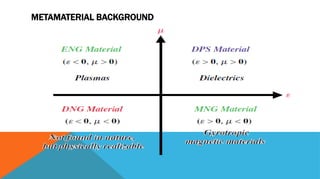
METAMATERIAL BACKGROUND
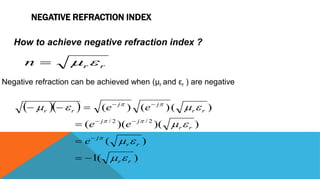
NEGATIVE REFRACTION INDEX
How to achieve negative refraction index ?
rrn 
Negative refraction can be achieved when (µr and εr ) are negative
  
)(1
)(
))()((
)()()(
2/2/
rr
rr
j
rr
jj
rr
jj
rr
e
ee
ee














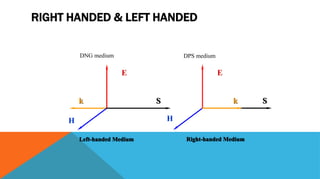
RIGHT HANDED & LEFT HANDED
E
H
Right-handed Medium
k S
DPS medium
E
k
H
Left-handed Medium
S
DNG medium
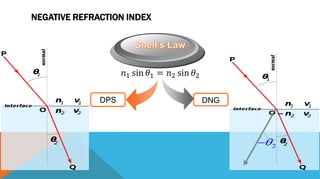
NEGATIVE REFRACTION INDEX
DPS
𝑛1 sin 𝜃1 = 𝑛2 sin 𝜃2
DNG
2

NEGATIVE REFRACTION INDEX
Fig. 1. (a) Calculated ray-tracing image of a metal rod in an empty drinking glass. (b) Same
scenery, but the glass is filled with normal water, n 1.3 , leading to ordinary refraction. (c)
The water is replaced by “water” with a fictitious refractive index of n  1.3 .[5]
*Gunnar Dolling and Martin Wegener :Photorealistic images of objects in effective negative-index materials, 6 March 2006 / Vol. 14, No. 5 / OPTICS EXPRESS 1843
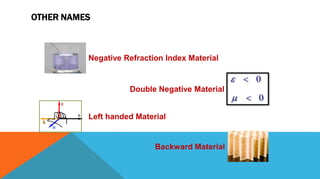
OTHER NAMES
Negative Refraction Index Material
Backward Material
Double Negative Material
Left handed Material
E
k
H
S
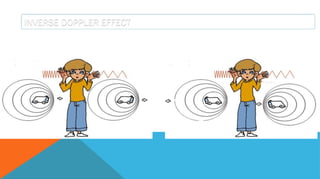
INVERSE DOPPLER EFFECT
NEGATIVE PERMITTIVITY
T
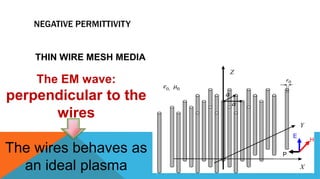
THIN WIRE MESH MEDIA
The EM wave:
perpendicular to the
wires
The wires behaves as
an ideal plasma
E
H
P
NEGATIVE PERMITTIVITY
T
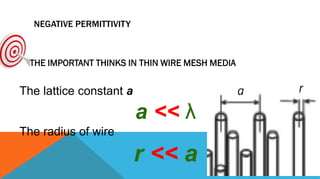
THE IMPORTANT THINKS IN THIN WIRE MESH MEDIA
The lattice constant a
a << λ
The radius of wire
r << a
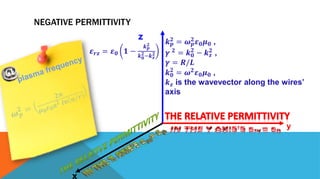
𝜺 𝒓𝒛 = 𝜺 𝟎 𝟏 −
𝒌 𝒑
𝟐
𝒌 𝟎
𝟐−𝒌 𝒛
𝟐
z
y
x
𝒌 𝒑
𝟐
= 𝝎 𝒑
𝟐
𝜺 𝟎 𝝁 𝟎 ,
𝜸 𝟐
= 𝒌 𝟎
𝟐
− 𝒌 𝒛
𝟐
,
𝜸 = 𝑹/𝑳
𝒌 𝟎
𝟐
= 𝝎 𝟐
𝜺 𝟎 𝝁 𝟎 ,
𝒌 𝒛 is the wavevector along the wires’
axis
NEGATIVE PERMITTIVITY
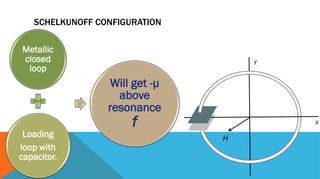
SCHELKUNOFF CONFIGURATION
X
y
H
Metallic
closed
loop
Loading
loop with
capacitor.
Will get -μ
above
resonance
f
SCHELKUNOFF CONFIGURATION
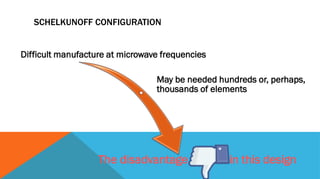
Difficult manufacture at microwave frequencies
May be needed hundreds or, perhaps,
thousands of elements
The disadvantage in this design
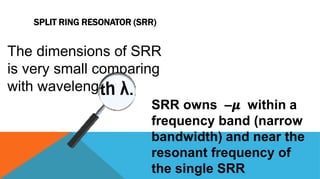
SPLIT RING RESONATOR (SRR)
The dimensions of SRR
is very small comparing
with waveleng
SRR owns –𝝁 within a
frequency band (narrow
bandwidth) and near the
resonant frequency of
the single SRR
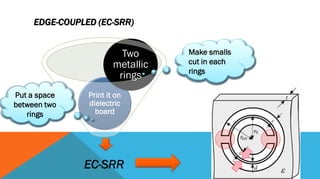
EDGE-COUPLED (EC-SRR)
EC-SRR
Print it on
dielectric
board
Two
metallic
rings
Make smalls
cut in each
rings
Put a space
between two
rings
EDGE-COUPLED (EC-SRR)
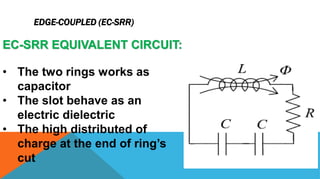
EC-SRR EQUIVALENT CIRCUIT:
• The two rings works as
capacitor
• The slot behave as an
electric dielectric
• The high distributed of
charge at the end of ring’s
cut
EDGE-COUPLED (EC-SRR)
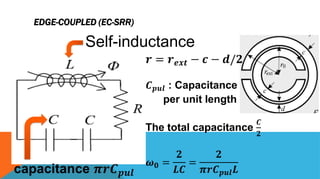
Self-inductance
capacitance 𝝅𝒓𝑪 𝒑𝒖𝒍
𝒓 = 𝒓 𝒆𝒙𝒕 − 𝒄 − 𝒅/𝟐
𝑪 𝒑𝒖𝒍 : Capacitance
per unit length
The total capacitance
𝑪
𝟐
𝝎 𝟎 =
𝟐
𝑳𝑪
=
𝟐
𝝅𝒓𝑪 𝒑𝒖𝒍 𝑳
EDGE-COUPLED (EC-SRR)
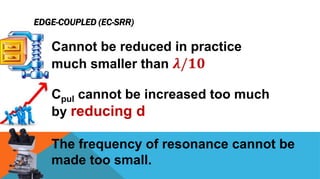
The frequency of resonance cannot be
made too small.
Cannot be reduced in practice
much smaller than 𝝀/𝟏𝟎
Cpul cannot be increased too much
by reducing d
EDGE-COUPLED (EC-SRR)
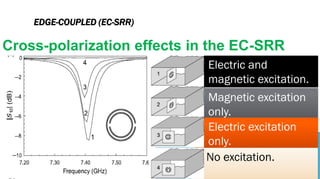
Cross-polarization effects in the EC-SRR
Electric and
magnetic excitation.
Magnetic excitation
only.
Electric excitation
only.
No excitation.
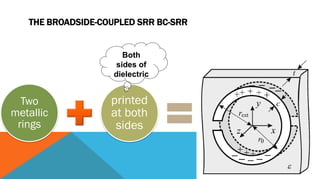
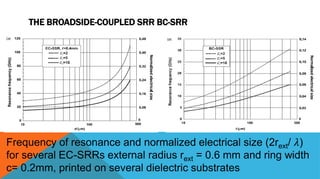
THE BROADSIDE-COUPLED SRR BC-SRR
Two
metallic
rings
printed
at both
sides
Both
sides of
dielectric
THE BROADSIDE-COUPLED SRR BC-SRR
Frequency of resonance and normalized electrical size (2rext/ 𝜆)
for several EC-SRRs external radius rext = 0.6 mm and ring width
c= 0.2mm, printed on several dielectric substrates
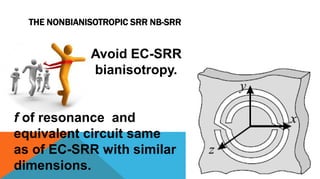
THE NONBIANISOTROPIC SRR NB-SRR
Avoid EC-SRR
bianisotropy.
f of resonance and
equivalent circuit same
as of EC-SRR with similar
dimensions.
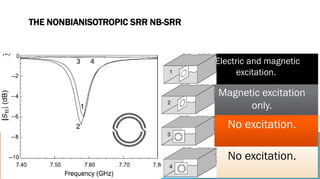
THE NONBIANISOTROPIC SRR NB-SRR
Electric and magnetic
excitation.
Magnetic excitation
only.
No excitation.
No excitation.
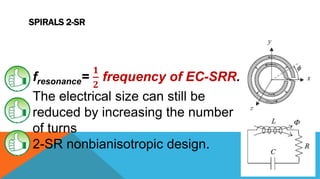
SPIRALS 2-SR
fresonance=
𝟏
𝟐
frequency of EC-SRR.
The electrical size can still be
reduced by increasing the number
of turns
2-SR nonbianisotropic design.
SWISS ROLL
Anisotropic metamaterial.[3]
It is well suited to operation in (RF) range, because it has a
low resonant frequency and a strong magnetic response.[4]
Example: Swiss Roll
material operating at
21.5 MHz for which
λ/a > 1000 (where a
is the unit cell size).
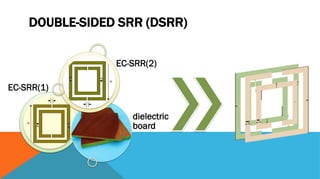
DOUBLE-SIDED SRR (DSRR)
EC-SRR(1)
dielectric
board
EC-SRR(2)
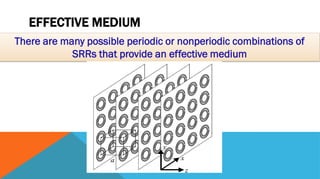
EFFECTIVE MEDIUM
There are many possible periodic or nonperiodic combinations of
SRRs that provide an effective medium
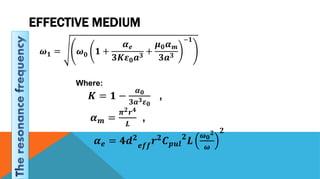
EFFECTIVE MEDIUM
𝝎 𝟏 = 𝝎 𝟎 𝟏 +
𝜶 𝒆
𝟑𝑲𝜺 𝟎 𝒂 𝟑
+
𝝁 𝟎 𝜶 𝒎
𝟑𝒂 𝟑
−𝟏
Where:
𝑲 = 𝟏 −
𝜶 𝟎
𝟑𝒂 𝟑 𝜺 𝟎
,
𝜶 𝒎 =
𝝅 𝟐 𝒓 𝟒
𝑳
,
𝜶 𝒆 = 𝟒𝒅 𝟐
𝒆𝒇𝒇
𝒓 𝟐
𝑪 𝒑𝒖𝒍
𝟐
𝑳
𝝎 𝟎
𝟐
𝝎
𝟐
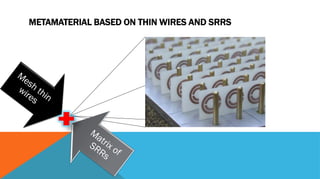
METAMATERIAL BASED ON THIN WIRES AND SRRS
REFERENCES
[1] Tatjana Asenov,Nebojša Dončovm ,Bratislav Milovanović: Application of Metamaterials for the Microwave Antenna
Realisations, SERBIAN JOURNAL OF ELECTRICAL ENGINEERING Vol. 9, No. 1, February 2012, 1-7
[2] MARQUES, RICARDO , FERRAN MARTIN and MARIO SOROLLA. Metamaterials with Negative Parameters:
Theory, Design, and Microwave Applications. John Wiley & Sons, Inc., 2008.
[3] M. C. K. Wiltshire and J. V. Hajnal, Metamaterial endoscope for magnetic field transfer: near field imaging with
magnetic wires, 2003 OSA 7 April 2003 / Vol. 11, No. 7 / OPTICS EXPRESS 713
[4] M C Kwiltshire, J B Pendry, An effective medium description of 'Swiss Rolls', a magnetic metamaterial, IOP
PUBLISHING JOURNAL OF PHYSICS: CONDENSED MATTER, 19 (2007) 456216 (16pp)
[5] Gunnar Dolling and Martin Wegener :Photorealistic images of objects in effective negative-index materials, 6 March
2006 / Vol. 14, No. 5 / OPTICS EXPRESS 1843
[6] A. Ishimaru, S. Jaruwatanadilok, and Y. Kuga by there research ( GENERALIZED SURFACE PLASMON
RESONANCE SENSORS USING METAMATERIALS AND NEGATIVE INDEX MATERIALS) Progress In
Electromagnetics Research, PIER 51, 139–152, 2005
Metamaterial

Metamaterial

  • 1.
  • 2.
    My name :Khalid Saeed Al-Badri
  • 3.
    My supervisor Yrd. Doç.Dr. EVREN EKMEKÇİ Assistant Professor: Electronics and Communication Engineering
  • 4.
    METAMATERIAL BACKGROUND Do notdepend on the chemical composition Depend on the geometry of the structure units. [1] Metamaterials are artificial engineered composite structures. Not commonly found in nature.[2]
  • 5.
    BACKGROUND 0 0         0 0      0 0       0 0         DPS MNGENG DNG SNG 𝜀 , 𝜇
  • 6.
  • 7.
    NEGATIVE REFRACTION INDEX Howto achieve negative refraction index ? rrn  Negative refraction can be achieved when (µr and εr ) are negative    )(1 )( ))()(( )()()( 2/2/ rr rr j rr jj rr jj rr e ee ee              
  • 8.
    RIGHT HANDED &LEFT HANDED E H Right-handed Medium k S DPS medium E k H Left-handed Medium S DNG medium
  • 9.
    NEGATIVE REFRACTION INDEX DPS 𝑛1sin 𝜃1 = 𝑛2 sin 𝜃2 DNG 2 
  • 10.
    NEGATIVE REFRACTION INDEX Fig.1. (a) Calculated ray-tracing image of a metal rod in an empty drinking glass. (b) Same scenery, but the glass is filled with normal water, n 1.3 , leading to ordinary refraction. (c) The water is replaced by “water” with a fictitious refractive index of n  1.3 .[5] *Gunnar Dolling and Martin Wegener :Photorealistic images of objects in effective negative-index materials, 6 March 2006 / Vol. 14, No. 5 / OPTICS EXPRESS 1843
  • 11.
    OTHER NAMES Negative RefractionIndex Material Backward Material Double Negative Material Left handed Material E k H S
  • 12.
  • 13.
    NEGATIVE PERMITTIVITY T THIN WIREMESH MEDIA The EM wave: perpendicular to the wires The wires behaves as an ideal plasma E H P
  • 14.
    NEGATIVE PERMITTIVITY T THE IMPORTANTTHINKS IN THIN WIRE MESH MEDIA The lattice constant a a << λ The radius of wire r << a
  • 15.
    𝜺 𝒓𝒛 =𝜺 𝟎 𝟏 − 𝒌 𝒑 𝟐 𝒌 𝟎 𝟐−𝒌 𝒛 𝟐 z y x 𝒌 𝒑 𝟐 = 𝝎 𝒑 𝟐 𝜺 𝟎 𝝁 𝟎 , 𝜸 𝟐 = 𝒌 𝟎 𝟐 − 𝒌 𝒛 𝟐 , 𝜸 = 𝑹/𝑳 𝒌 𝟎 𝟐 = 𝝎 𝟐 𝜺 𝟎 𝝁 𝟎 , 𝒌 𝒛 is the wavevector along the wires’ axis NEGATIVE PERMITTIVITY
  • 16.
  • 17.
    SCHELKUNOFF CONFIGURATION Difficult manufactureat microwave frequencies May be needed hundreds or, perhaps, thousands of elements The disadvantage in this design
  • 18.
    SPLIT RING RESONATOR(SRR) The dimensions of SRR is very small comparing with waveleng SRR owns –𝝁 within a frequency band (narrow bandwidth) and near the resonant frequency of the single SRR
  • 19.
    EDGE-COUPLED (EC-SRR) EC-SRR Print iton dielectric board Two metallic rings Make smalls cut in each rings Put a space between two rings
  • 20.
    EDGE-COUPLED (EC-SRR) EC-SRR EQUIVALENTCIRCUIT: • The two rings works as capacitor • The slot behave as an electric dielectric • The high distributed of charge at the end of ring’s cut
  • 21.
    EDGE-COUPLED (EC-SRR) Self-inductance capacitance 𝝅𝒓𝑪𝒑𝒖𝒍 𝒓 = 𝒓 𝒆𝒙𝒕 − 𝒄 − 𝒅/𝟐 𝑪 𝒑𝒖𝒍 : Capacitance per unit length The total capacitance 𝑪 𝟐 𝝎 𝟎 = 𝟐 𝑳𝑪 = 𝟐 𝝅𝒓𝑪 𝒑𝒖𝒍 𝑳
  • 22.
    EDGE-COUPLED (EC-SRR) The frequencyof resonance cannot be made too small. Cannot be reduced in practice much smaller than 𝝀/𝟏𝟎 Cpul cannot be increased too much by reducing d
  • 23.
    EDGE-COUPLED (EC-SRR) Cross-polarization effectsin the EC-SRR Electric and magnetic excitation. Magnetic excitation only. Electric excitation only. No excitation.
  • 24.
    THE BROADSIDE-COUPLED SRRBC-SRR Two metallic rings printed at both sides Both sides of dielectric
  • 25.
    THE BROADSIDE-COUPLED SRRBC-SRR Frequency of resonance and normalized electrical size (2rext/ 𝜆) for several EC-SRRs external radius rext = 0.6 mm and ring width c= 0.2mm, printed on several dielectric substrates
  • 26.
    THE NONBIANISOTROPIC SRRNB-SRR Avoid EC-SRR bianisotropy. f of resonance and equivalent circuit same as of EC-SRR with similar dimensions.
  • 27.
    THE NONBIANISOTROPIC SRRNB-SRR Electric and magnetic excitation. Magnetic excitation only. No excitation. No excitation.
  • 28.
    SPIRALS 2-SR fresonance= 𝟏 𝟐 frequency ofEC-SRR. The electrical size can still be reduced by increasing the number of turns 2-SR nonbianisotropic design.
  • 29.
    SWISS ROLL Anisotropic metamaterial.[3] Itis well suited to operation in (RF) range, because it has a low resonant frequency and a strong magnetic response.[4] Example: Swiss Roll material operating at 21.5 MHz for which λ/a > 1000 (where a is the unit cell size).
  • 30.
  • 31.
    EFFECTIVE MEDIUM There aremany possible periodic or nonperiodic combinations of SRRs that provide an effective medium
  • 32.
    EFFECTIVE MEDIUM 𝝎 𝟏= 𝝎 𝟎 𝟏 + 𝜶 𝒆 𝟑𝑲𝜺 𝟎 𝒂 𝟑 + 𝝁 𝟎 𝜶 𝒎 𝟑𝒂 𝟑 −𝟏 Where: 𝑲 = 𝟏 − 𝜶 𝟎 𝟑𝒂 𝟑 𝜺 𝟎 , 𝜶 𝒎 = 𝝅 𝟐 𝒓 𝟒 𝑳 , 𝜶 𝒆 = 𝟒𝒅 𝟐 𝒆𝒇𝒇 𝒓 𝟐 𝑪 𝒑𝒖𝒍 𝟐 𝑳 𝝎 𝟎 𝟐 𝝎 𝟐
  • 33.
    METAMATERIAL BASED ONTHIN WIRES AND SRRS
  • 34.
    REFERENCES [1] Tatjana Asenov,NebojšaDončovm ,Bratislav Milovanović: Application of Metamaterials for the Microwave Antenna Realisations, SERBIAN JOURNAL OF ELECTRICAL ENGINEERING Vol. 9, No. 1, February 2012, 1-7 [2] MARQUES, RICARDO , FERRAN MARTIN and MARIO SOROLLA. Metamaterials with Negative Parameters: Theory, Design, and Microwave Applications. John Wiley & Sons, Inc., 2008. [3] M. C. K. Wiltshire and J. V. Hajnal, Metamaterial endoscope for magnetic field transfer: near field imaging with magnetic wires, 2003 OSA 7 April 2003 / Vol. 11, No. 7 / OPTICS EXPRESS 713 [4] M C Kwiltshire, J B Pendry, An effective medium description of 'Swiss Rolls', a magnetic metamaterial, IOP PUBLISHING JOURNAL OF PHYSICS: CONDENSED MATTER, 19 (2007) 456216 (16pp) [5] Gunnar Dolling and Martin Wegener :Photorealistic images of objects in effective negative-index materials, 6 March 2006 / Vol. 14, No. 5 / OPTICS EXPRESS 1843 [6] A. Ishimaru, S. Jaruwatanadilok, and Y. Kuga by there research ( GENERALIZED SURFACE PLASMON RESONANCE SENSORS USING METAMATERIALS AND NEGATIVE INDEX MATERIALS) Progress In Electromagnetics Research, PIER 51, 139–152, 2005