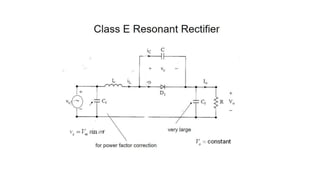
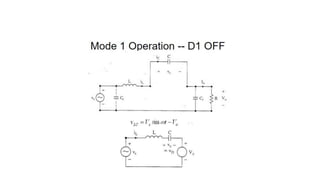
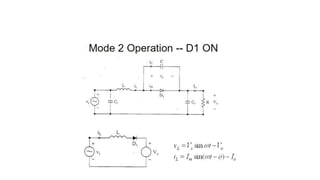
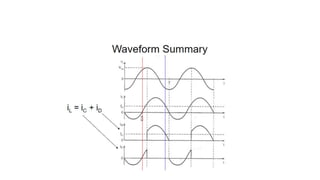
CLASS E RESONANT
INVERTERS AND RECTIFIERS
• Class E Resonant Inverters are theoretically
capable of delivering any power to a load and
achieve 100% efficiency at any frequency of
operation.
• In practice efficiency in the “high 90's” can be
achieved into megahertz frequencies regardless
of inverter output powers.
• The topology also allows the manipulation of
output power through sub-optimal operation, with
a negligible efficiency penalty.
• Class E topology for use in the growing market
for portable, battery powered lighting.
• It exhibits a peak recorded power efficiently of
over 98%, and a conservatively measured
efficiency of 95% across a range of dimming
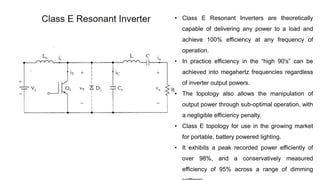
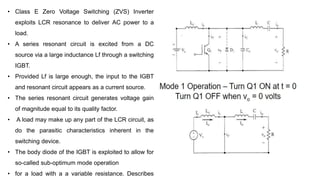
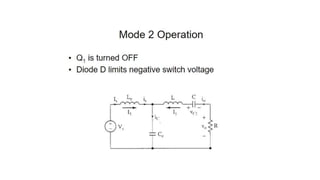
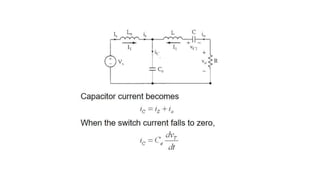
• Class E Zero Voltage Switching (ZVS) Inverter
exploits LCR resonance to deliver AC power to a
load.
• A series resonant circuit is excited from a DC
source via a large inductance Lf through a switching
IGBT.
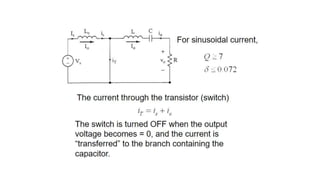
• Provided Lf is large enough, the input to the IGBT
and resonant circuit appears as a current source.
• The series resonant circuit generates voltage gain
of magnitude equal to its quality factor.
• A load may make up any part of the LCR circuit, as
do the parasitic characteristics inherent in the
switching device.
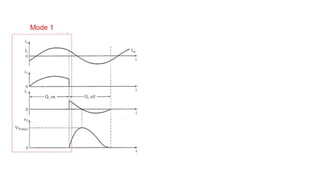
• The body diode of the IGBT is exploited to allow for
so-called sub-optimum mode operation
• for a load with a a variable resistance. Describes
Power class E inverter and rectifier.pptx

Power class E inverter and rectifier.pptx

  • 1.
  • 2.
    • Class EResonant Inverters are theoretically capable of delivering any power to a load and achieve 100% efficiency at any frequency of operation. • In practice efficiency in the “high 90's” can be achieved into megahertz frequencies regardless of inverter output powers. • The topology also allows the manipulation of output power through sub-optimal operation, with a negligible efficiency penalty. • Class E topology for use in the growing market for portable, battery powered lighting. • It exhibits a peak recorded power efficiently of over 98%, and a conservatively measured efficiency of 95% across a range of dimming
  • 3.
    • Class EZero Voltage Switching (ZVS) Inverter exploits LCR resonance to deliver AC power to a load. • A series resonant circuit is excited from a DC source via a large inductance Lf through a switching IGBT. • Provided Lf is large enough, the input to the IGBT and resonant circuit appears as a current source. • The series resonant circuit generates voltage gain of magnitude equal to its quality factor. • A load may make up any part of the LCR circuit, as do the parasitic characteristics inherent in the switching device. • The body diode of the IGBT is exploited to allow for so-called sub-optimum mode operation • for a load with a a variable resistance. Describes