Proceedings of the International Conference on Emerging Trends in Engineering and Management (ICETEM14)
30-31, December, 2014, Ernakulam, India
284
HALF BRIDGE CONVERTER WITH WIDE RANGE ZVS
AISWARYA GOPINATH 1
, JENSON JOSE 2
1
Mtech student, Jyothi engineering college, Cheruthuruthy, Kerala
2
Assistant professor, Jyothi engineering college, Cheruthuruthy, Kerala
ABSTRACT
A modified full bridge converter topology which can attain ZVS over wide load range and the circulating
current is fully eliminated. Two half bridge converters combined together to form a full bridge structure and they are
operated in phase shifted mode. The converter can perform in a 50% duty cycle which helps to achieve ZVS over wider
load range. The converter is able to perform both PWM mode as well as phase shifted mode. The switching frequency of
the converter is 100KHz.
Key words: Full Bridge Converter, Dual Half Bridge Converter, ZVS, Phase Shifting
I. INTRODUCTION
Most popular topologies for high power and high density applications in switching converter is a phase shifted
full bridge DCDC converter. Phase shifted full bridge is selected because of its capability for Zero Voltage Switching.
This configuration is mainly discussed in Texas Instruments application note. In spite of all the advantages, a problem
regarding this topology is its circulating current causing losses and ZVS not applicable for light loads.
Many methods have been introduced to added to the converter’s primary side. This helped to extend the soft
switching range but the excess energy in the converter lead to higher voltage spikes in the secondary side rectifier diodes.
By introducing a clamping circuit this problem is recovered and this captures most of the transient energy in the primary
side which is used for soft switching and is recycled back to the converter’s dc input.
For different output voltages different methods can be used to mitigate the conduction losses. Synchronous
MOSFETS are used to minimize the conduction losses for low output voltage such as 48Vor below. By maintaining
Synchronous FETs active we can achieve continuous conduction mode (CCM) and maintain constant duty cycle.
The output inductor current of the converter can be negative, positive and zero depending upon the load. In this case at
very light loads especially at zero load, negative mitigate this problem. Resonant inductor is energy become so
significant that too much energy is cycled back to the primary side resulting in efficiency loss.
When the output rectification devices are diodes it is difficult to extend ZVS range. Different circuits have been
introduced to mitigate this problem. A simple auxiliary circuit on the secondary side provides conditions for ZVZCS [4].
Another method is a passive LC network connecting to the bridge switches. [5,8].The major problem regarding of the full
bridge converter is the presence of circulating current which causes substantial power losses.
Many methods have been tried to remove this drawback. One method is resonant converters. Resonant converters will
remove circulating current but ZVS is not achieved. Another one is Asymmetrical control. This method is also applicable
for low power applications.
We all know that open loop half bridge converter is having higher efficiency at higher loads and can achieve
ZVS. The problem regarding this concept is that since PWM is fixed the output voltage cannot be regulated. If two such
converters is connected together we can achieve all the desired merits including the regulated output voltage. This
INTERNATIONAL JOURNAL OF ELECTRICAL ENGINEERING &
TECHNOLOGY (IJEET)
ISSN 0976 – 6545(Print)
ISSN 0976 – 6553(Online)
Volume 5, Issue 12, December (2014), pp. 284-288
© IAEME: www.iaeme.com/IJEET.asp
Journal Impact Factor (2014): 6.8310 (Calculated by GISI)
www.jifactor.com
IJEET
© I A E M E
Proceedings of the International Conference on Emerging Trends in Engineering and Management (ICETEM14)
30-31, December, 2014, Ernakulam, India
285
preferred topology which is going to be discussed in this paer can achieve can eliminate the circulating current and can
achieve ZVS at wider load range.
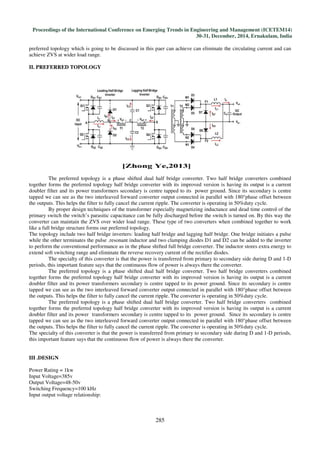
II. PREFERRED TOPOLOGY
The preferred topology is a phase shifted dual half bridge converter. Two half bridge converters combined
together forms the preferred topology half bridge converter with its improved version is having its output is a current
doubler filter and its power transformers secondary is centre tapped to its power ground. Since its secondary is centre
tapped we can see as the two interleaved forward converter output connected in parallel with 180°phase offset between
the outputs. This helps the filter to fully cancel the current ripple. The converter is operating in 50%duty cycle.
By proper design techniques of the transformer especially magnetizing inductance and dead time control of the
primary switch the switch’s parasitic capacitance can be fully discharged before the switch is turned on. By this way the
converter can maintain the ZVS over wider load range. These type of two converters when combined together to work
like a full bridge structure forms our preferred topology.
The topology include two half bridge inverters: leading half bridge and lagging half bridge. One bridge initiates a pulse
while the other terminates the pulse .resonant inductor and two clamping diodes D1 and D2 can be added to the inverter
to perform the conventional performance as in the phase shifted full bridge converter. The inductor stores extra energy to
extend soft switching range and eliminate the reverse recovery current of the rectifier diodes.
The specialty of this converter is that the power is transferred from primary to secondary side during D and 1-D
periods, this important feature says that the continuous flow of power is always there the converter.
The preferred topology is a phase shifted dual half bridge converter. Two half bridge converters combined
together forms the preferred topology half bridge converter with its improved version is having its output is a current
doubler filter and its power transformers secondary is centre tapped to its power ground. Since its secondary is centre
tapped we can see as the two interleaved forward converter output connected in parallel with 180°phase offset between
the outputs. This helps the filter to fully cancel the current ripple. The converter is operating in 50%duty cycle.
The preferred topology is a phase shifted dual half bridge converter. Two half bridge converters combined
together forms the preferred topology half bridge converter with its improved version is having its output is a current
doubler filter and its power transformers secondary is centre tapped to its power ground. Since its secondary is centre
tapped we can see as the two interleaved forward converter output connected in parallel with 180°phase offset between
the outputs. This helps the filter to fully cancel the current ripple. The converter is operating in 50%duty cycle.
The specialty of this converter is that the power is transferred from primary to secondary side during D and 1-D periods,
this important feature says that the continuous flow of power is always there the converter.
III .DESIGN
Power Rating = 1kw
Input Voltage=385v
Output Voltage=48-50v
Switching Frequency=100 kHz
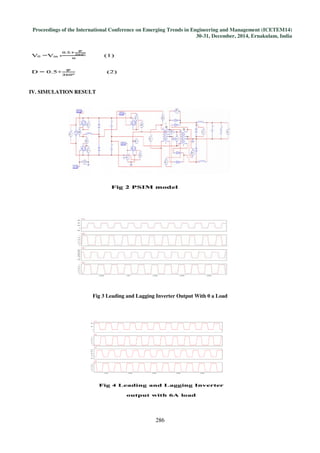
Input output voltage relationship:
Proceedings of the International Conference on Emerging Trends in Engineering and Management (ICETEM14)
30-31, December, 2014, Ernakulam, India
286
IV. SIMULATION RESULT
Fig 3 Leading and Lagging Inverter Output With 0 a Load
Proceedings of the International Conference on Emerging Trends in Engineering and Management (ICETEM14)
30-31, December, 2014, Ernakulam, India
287
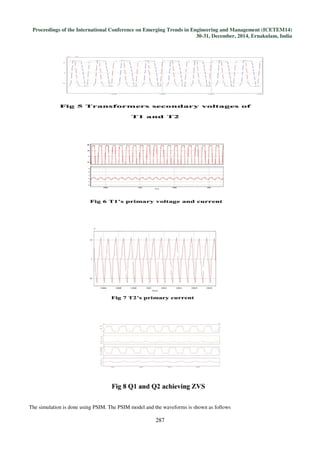
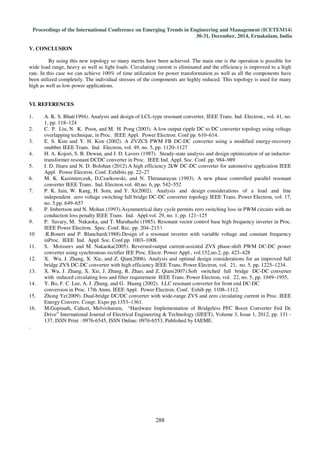
The simulation is done using PSIM. The PSIM model and the waveforms is shown as follows
Proceedings of the International Conference on Emerging Trends in Engineering and Management (ICETEM14)
30-31, December, 2014, Ernakulam, India
288
V. CONCLUSION
By using this new topology so many merits have been achieved. The main one is the operation is possible for
wide load range, heavy as well as light loads. Circulating current is eliminated and the efficiency is improved to a high
rate. In this case we can achieve 100% of time utilization for power transformation as well as all the components have
been utilized completely. The individual stresses of the components are highly reduced. This topology is used for many
high as well as low power applications.
VI. REFERENCES
1. A. K. S. Bhat(1994). Analysis and design of LCL-type resonant converter, IEEE Trans. Ind. Electron., vol. 41, no.
1, pp. 118–124
2. C. P. Liu, N. K. Poon, and M. H. Pong (2003). A low output ripple DC to DC converter topology using voltage
overlapping technique, in Proc. IEEE Appl. Power Electron. Conf pp. 610–614.
3. E. S. Kim and Y. H. Kim (2002). A ZVZCS PWM FB DC-DC converter using a modified energy-recovery
snubber IEEE Trans. Ind. Electron, vol. 49, no. 5, pp. 1120–1127
4. H. A. Kojori, S. B. Dewan, and J. D. Lavers (1987). Steady-state analysis and design optimization of an inductor-
transformer resonant DCDC converter in Proc. IEEE Ind. Appl. Soc. Conf. pp. 984–989
5. I. D. Jitaru and N. D. Bolohan (2012).A high efficiency 2kW DC-DC converter for automotive application IEEE
Appl. Power Electron. Conf. Exhibits pp. 22–27
6. M. K. Kazimierczuk, D.Czarkowski, and N. Thirunarayan (1993). A new phase controlled parallel resonant
converter IEEE Trans. Ind. Electron.vol. 40,no. 6, pp. 542–552
7. P. K. Jain, W. Kang, H. Soin, and Y. Xi(2002). Analysis and design considerations of a load and line
independent zero voltage switching full bridge DC-DC converter topology IEEE Trans. Power Electron, vol. 17,
no. 5,pp. 649–657
8. P. Imbertson and N. Mohan (1993).Asymmetrical duty cycle permits zero switching loss in PWM circuits with no
conduction loss penalty IEEE Trans. Ind. Appl.vol. 29, no. 1, pp. 121–125
9. P. Savary, M. Nakaoka, and T. Maruhashi (1985). Resonant vector control base high frequency inverter in Proc.
IEEE Power Electron. Spec. Conf. Rec. pp. 204–213.
10 .R.Bonert and P. Blanchard(1988).Design of a resonant inverter with variable voltage and constant frequency
inProc. IEEE Ind. Appl. Soc. Conf pp. 1003–1008.
11. S. Moisseev and M. Nakaoka(2005). Reversed-output current-assisted ZVS phase-shift PWM DC-DC power
converter using synchronous rectifier IEE Proc. Electr. Power Appl., vol.152,no.2, pp. 423–428
12. X. Wu, J. Zhang, X. Xie, and Z. Qian(2006). Analysis and optimal design considerations for an improved full
bridge ZVS DC-DC converter with high efficiency IEEE Trans. Power Electron, vol. 21, no. 5, pp. 1225–1234.
13. X. Wu, J. Zhang, X. Xie, J. Zhang, R. Zhao, and Z. Qian(2007).Soft switched full bridge DC-DC converter
with reduced circulating loss and filter requirement IEEE Trans. Power Electron, vol. 22, no. 5, pp. 1949–1955,
14. Y. Bo, F. C. Lee, A. J. Zhang, and G. Huang (2002). LLC resonant converter for front end DC-DC
conversion in Proc. 17th Annu. IEEE Appl. Power Electron. Conf. Exhib pp. 1108–1112.
15. Zhong Ye(2009). Dual-bridge DC/DC converter with wide-range ZVS and zero circulating current in Proc. IEEE
Energy Convers. Congr. Expo pp.1353–1361.
16. M.Gopinath, Cahcet, Melvisharam, “Hardware Implementation of Bridgeless PFC Boost Converter Fed Dc
Drive” International Journal of Electrical Engineering & Technology (IJEET), Volume 3, Issue 1, 2012, pp. 131 -
137, ISSN Print : 0976-6545, ISSN Online: 0976-6553, Published by IAEME.
.

Half bridge converter with wide range zvs

  • 1.
    Proceedings of theInternational Conference on Emerging Trends in Engineering and Management (ICETEM14) 30-31, December, 2014, Ernakulam, India 284 HALF BRIDGE CONVERTER WITH WIDE RANGE ZVS AISWARYA GOPINATH 1 , JENSON JOSE 2 1 Mtech student, Jyothi engineering college, Cheruthuruthy, Kerala 2 Assistant professor, Jyothi engineering college, Cheruthuruthy, Kerala ABSTRACT A modified full bridge converter topology which can attain ZVS over wide load range and the circulating current is fully eliminated. Two half bridge converters combined together to form a full bridge structure and they are operated in phase shifted mode. The converter can perform in a 50% duty cycle which helps to achieve ZVS over wider load range. The converter is able to perform both PWM mode as well as phase shifted mode. The switching frequency of the converter is 100KHz. Key words: Full Bridge Converter, Dual Half Bridge Converter, ZVS, Phase Shifting I. INTRODUCTION Most popular topologies for high power and high density applications in switching converter is a phase shifted full bridge DCDC converter. Phase shifted full bridge is selected because of its capability for Zero Voltage Switching. This configuration is mainly discussed in Texas Instruments application note. In spite of all the advantages, a problem regarding this topology is its circulating current causing losses and ZVS not applicable for light loads. Many methods have been introduced to added to the converter’s primary side. This helped to extend the soft switching range but the excess energy in the converter lead to higher voltage spikes in the secondary side rectifier diodes. By introducing a clamping circuit this problem is recovered and this captures most of the transient energy in the primary side which is used for soft switching and is recycled back to the converter’s dc input. For different output voltages different methods can be used to mitigate the conduction losses. Synchronous MOSFETS are used to minimize the conduction losses for low output voltage such as 48Vor below. By maintaining Synchronous FETs active we can achieve continuous conduction mode (CCM) and maintain constant duty cycle. The output inductor current of the converter can be negative, positive and zero depending upon the load. In this case at very light loads especially at zero load, negative mitigate this problem. Resonant inductor is energy become so significant that too much energy is cycled back to the primary side resulting in efficiency loss. When the output rectification devices are diodes it is difficult to extend ZVS range. Different circuits have been introduced to mitigate this problem. A simple auxiliary circuit on the secondary side provides conditions for ZVZCS [4]. Another method is a passive LC network connecting to the bridge switches. [5,8].The major problem regarding of the full bridge converter is the presence of circulating current which causes substantial power losses. Many methods have been tried to remove this drawback. One method is resonant converters. Resonant converters will remove circulating current but ZVS is not achieved. Another one is Asymmetrical control. This method is also applicable for low power applications. We all know that open loop half bridge converter is having higher efficiency at higher loads and can achieve ZVS. The problem regarding this concept is that since PWM is fixed the output voltage cannot be regulated. If two such converters is connected together we can achieve all the desired merits including the regulated output voltage. This INTERNATIONAL JOURNAL OF ELECTRICAL ENGINEERING & TECHNOLOGY (IJEET) ISSN 0976 – 6545(Print) ISSN 0976 – 6553(Online) Volume 5, Issue 12, December (2014), pp. 284-288 © IAEME: www.iaeme.com/IJEET.asp Journal Impact Factor (2014): 6.8310 (Calculated by GISI) www.jifactor.com IJEET © I A E M E
  • 2.
    Proceedings of theInternational Conference on Emerging Trends in Engineering and Management (ICETEM14) 30-31, December, 2014, Ernakulam, India 285 preferred topology which is going to be discussed in this paer can achieve can eliminate the circulating current and can achieve ZVS at wider load range. II. PREFERRED TOPOLOGY The preferred topology is a phase shifted dual half bridge converter. Two half bridge converters combined together forms the preferred topology half bridge converter with its improved version is having its output is a current doubler filter and its power transformers secondary is centre tapped to its power ground. Since its secondary is centre tapped we can see as the two interleaved forward converter output connected in parallel with 180°phase offset between the outputs. This helps the filter to fully cancel the current ripple. The converter is operating in 50%duty cycle. By proper design techniques of the transformer especially magnetizing inductance and dead time control of the primary switch the switch’s parasitic capacitance can be fully discharged before the switch is turned on. By this way the converter can maintain the ZVS over wider load range. These type of two converters when combined together to work like a full bridge structure forms our preferred topology. The topology include two half bridge inverters: leading half bridge and lagging half bridge. One bridge initiates a pulse while the other terminates the pulse .resonant inductor and two clamping diodes D1 and D2 can be added to the inverter to perform the conventional performance as in the phase shifted full bridge converter. The inductor stores extra energy to extend soft switching range and eliminate the reverse recovery current of the rectifier diodes. The specialty of this converter is that the power is transferred from primary to secondary side during D and 1-D periods, this important feature says that the continuous flow of power is always there the converter. The preferred topology is a phase shifted dual half bridge converter. Two half bridge converters combined together forms the preferred topology half bridge converter with its improved version is having its output is a current doubler filter and its power transformers secondary is centre tapped to its power ground. Since its secondary is centre tapped we can see as the two interleaved forward converter output connected in parallel with 180°phase offset between the outputs. This helps the filter to fully cancel the current ripple. The converter is operating in 50%duty cycle. The preferred topology is a phase shifted dual half bridge converter. Two half bridge converters combined together forms the preferred topology half bridge converter with its improved version is having its output is a current doubler filter and its power transformers secondary is centre tapped to its power ground. Since its secondary is centre tapped we can see as the two interleaved forward converter output connected in parallel with 180°phase offset between the outputs. This helps the filter to fully cancel the current ripple. The converter is operating in 50%duty cycle. The specialty of this converter is that the power is transferred from primary to secondary side during D and 1-D periods, this important feature says that the continuous flow of power is always there the converter. III .DESIGN Power Rating = 1kw Input Voltage=385v Output Voltage=48-50v Switching Frequency=100 kHz Input output voltage relationship:
  • 3.
    Proceedings of theInternational Conference on Emerging Trends in Engineering and Management (ICETEM14) 30-31, December, 2014, Ernakulam, India 286 IV. SIMULATION RESULT Fig 3 Leading and Lagging Inverter Output With 0 a Load
  • 4.
    Proceedings of theInternational Conference on Emerging Trends in Engineering and Management (ICETEM14) 30-31, December, 2014, Ernakulam, India 287 The simulation is done using PSIM. The PSIM model and the waveforms is shown as follows
  • 5.
    Proceedings of theInternational Conference on Emerging Trends in Engineering and Management (ICETEM14) 30-31, December, 2014, Ernakulam, India 288 V. CONCLUSION By using this new topology so many merits have been achieved. The main one is the operation is possible for wide load range, heavy as well as light loads. Circulating current is eliminated and the efficiency is improved to a high rate. In this case we can achieve 100% of time utilization for power transformation as well as all the components have been utilized completely. The individual stresses of the components are highly reduced. This topology is used for many high as well as low power applications. VI. REFERENCES 1. A. K. S. Bhat(1994). Analysis and design of LCL-type resonant converter, IEEE Trans. Ind. Electron., vol. 41, no. 1, pp. 118–124 2. C. P. Liu, N. K. Poon, and M. H. Pong (2003). A low output ripple DC to DC converter topology using voltage overlapping technique, in Proc. IEEE Appl. Power Electron. Conf pp. 610–614. 3. E. S. Kim and Y. H. Kim (2002). A ZVZCS PWM FB DC-DC converter using a modified energy-recovery snubber IEEE Trans. Ind. Electron, vol. 49, no. 5, pp. 1120–1127 4. H. A. Kojori, S. B. Dewan, and J. D. Lavers (1987). Steady-state analysis and design optimization of an inductor- transformer resonant DCDC converter in Proc. IEEE Ind. Appl. Soc. Conf. pp. 984–989 5. I. D. Jitaru and N. D. Bolohan (2012).A high efficiency 2kW DC-DC converter for automotive application IEEE Appl. Power Electron. Conf. Exhibits pp. 22–27 6. M. K. Kazimierczuk, D.Czarkowski, and N. Thirunarayan (1993). A new phase controlled parallel resonant converter IEEE Trans. Ind. Electron.vol. 40,no. 6, pp. 542–552 7. P. K. Jain, W. Kang, H. Soin, and Y. Xi(2002). Analysis and design considerations of a load and line independent zero voltage switching full bridge DC-DC converter topology IEEE Trans. Power Electron, vol. 17, no. 5,pp. 649–657 8. P. Imbertson and N. Mohan (1993).Asymmetrical duty cycle permits zero switching loss in PWM circuits with no conduction loss penalty IEEE Trans. Ind. Appl.vol. 29, no. 1, pp. 121–125 9. P. Savary, M. Nakaoka, and T. Maruhashi (1985). Resonant vector control base high frequency inverter in Proc. IEEE Power Electron. Spec. Conf. Rec. pp. 204–213. 10 .R.Bonert and P. Blanchard(1988).Design of a resonant inverter with variable voltage and constant frequency inProc. IEEE Ind. Appl. Soc. Conf pp. 1003–1008. 11. S. Moisseev and M. Nakaoka(2005). Reversed-output current-assisted ZVS phase-shift PWM DC-DC power converter using synchronous rectifier IEE Proc. Electr. Power Appl., vol.152,no.2, pp. 423–428 12. X. Wu, J. Zhang, X. Xie, and Z. Qian(2006). Analysis and optimal design considerations for an improved full bridge ZVS DC-DC converter with high efficiency IEEE Trans. Power Electron, vol. 21, no. 5, pp. 1225–1234. 13. X. Wu, J. Zhang, X. Xie, J. Zhang, R. Zhao, and Z. Qian(2007).Soft switched full bridge DC-DC converter with reduced circulating loss and filter requirement IEEE Trans. Power Electron, vol. 22, no. 5, pp. 1949–1955, 14. Y. Bo, F. C. Lee, A. J. Zhang, and G. Huang (2002). LLC resonant converter for front end DC-DC conversion in Proc. 17th Annu. IEEE Appl. Power Electron. Conf. Exhib pp. 1108–1112. 15. Zhong Ye(2009). Dual-bridge DC/DC converter with wide-range ZVS and zero circulating current in Proc. IEEE Energy Convers. Congr. Expo pp.1353–1361. 16. M.Gopinath, Cahcet, Melvisharam, “Hardware Implementation of Bridgeless PFC Boost Converter Fed Dc Drive” International Journal of Electrical Engineering & Technology (IJEET), Volume 3, Issue 1, 2012, pp. 131 - 137, ISSN Print : 0976-6545, ISSN Online: 0976-6553, Published by IAEME. .