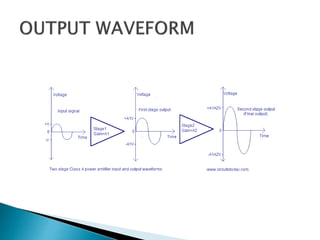
Class A power amplifier is a type of power amplifier where the
output transistor is ON full time and the output current flows for
the entire cycle of the input wave form. Class A power amplifier is
the simplest of all power amplifier configurations. They have high
fidelity and are totally immune to crossover distortion. Even
though the class A power amplifier have a handful of good
feature, they are not the prime choice because of their poor
efficiency. Since the active elements (transistors) are forward
biased full time, some current will flow through them even
though there is no input signal and this is the main reason for the
inefficiency.
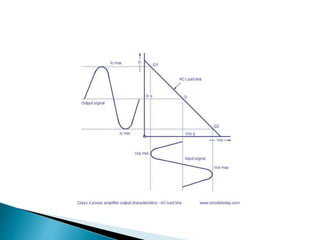
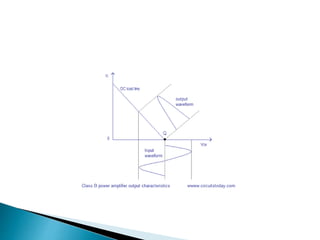
Output characteristics of a Class A power amplifier is shown in
the figure below.
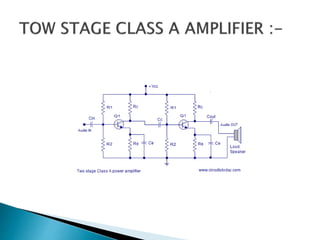
The circuit diagram of a two stage single ended
Class A power amplifier is shown above. R1 and R2
are the biasing resistors. They form a voltage divider
network which supplies the base of the transistor
with a voltage 0.7V higher than the “negative
maximum amplitude swing” of the input signal. This
is the reason behind the transistor being ON
irrespective of the input signal amplitude. Capacitor
Cin is the input decoupling capacitor which removes
the DC components present in the input signal. If
Cin is not there, and there are DC components in the
input signal, these DC components will be directly
coupled to the base of the transistor and will surely
alter the biasing conditions.
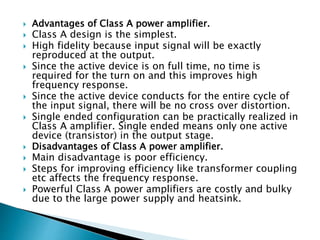
 Advantages of Class A power amplifier.
 Class A design is the simplest.
 High fidelity because input signal will be exactly
reproduced at the output.
 Since the active device is on full time, no time is
required for the turn on and this improves high
frequency response.
 Since the active device conducts for the entire cycle of
the input signal, there will be no cross over distortion.
 Single ended configuration can be practically realized in
Class A amplifier. Single ended means only one active
device (transistor) in the output stage.
 Disadvantages of Class A power amplifier.
 Main disadvantage is poor efficiency.
 Steps for improving efficiency like transformer coupling
etc affects the frequency response.
 Powerful Class A power amplifiers are costly and bulky
due to the large power supply and heatsink.
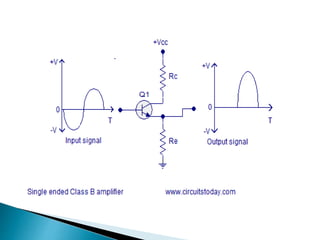
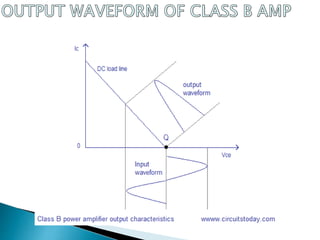
Class B amplifier is a type of power amplifier where
the active device (transistor) conducts only for one
half cycle of the input signal. That means the
conduction angle is 180° for a Class B amplifier.
Since the active device is switched off for half the
input cycle, the active device dissipates less power
and hence the efficiency is improved. Theoretical
maximum efficiency of Class B power amplifier is
78.5%. The schematic of a single ended Class B
amplifier and input , output waveforms are shown in
the figure below.
Advantages of Class B amplifier.
> High efficiency when compared to the Class A
configurations.
> Push-pull mechanism avoids even harmonics.
 No DC components in the output (in ideal case).
Disadvantages of Class B amplifier.
> The major disadvantage is the cross-over
distortion.
> Coupling transformers increases the cost and size.
> It is difficult to find ideal transformers.
 Transformer coupling causes hum in the output
and also affects the low frequency response.
> Transformer coupling is not practical in case of
huge loads.
Class C power amplifier is a type of amplifier where the active
element (transistor) conduct for less than one half cycle of the
input signal. Less than one half cycle means the conduction angle
is less than 180° and its typical value is 80° to 120°. The reduced
conduction angle improves the efficiency to a great extend but
causes a lot of distortion. Theoretical maximum efficiency of a
Class C amplifier is around 90%.
Due to the huge amounts of distortion, the Class C configurations
are not used in audio applications. The most common application
of the Class C amplifier is the RF (radio frequency) circuits like RF
oscillator, RF amplifier etc where there are additional tuned
circuits for retrieving the original input signal from the pulsed
output of the Class C amplifier and so the distortion caused by
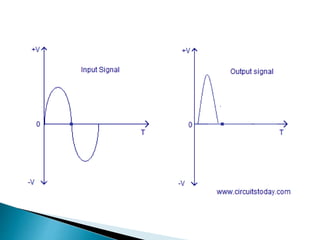
the amplifier has little effect on the final output. Input and output
waveforms of a typical Class C power amplifier is shown in the
figure below.
 Advantages of Class C power amplifier.
 High efficiency.
 Excellent in RF applications.
 Lowest physical size for a given power output.
 Disadvantages of Class C power
amplifier.
 Lowest linearity.
 Not suitable in audio applications.
 Creates a lot of RF interference.
 It is difficult to obtain ideal inductors and coupling
transformers.
 Reduced dynamic range.
 Applications of Class C power amplifier.
 RF oscillators.
 RF amplifier.
 FM transmitters.
 Booster amplifiers.
 High frequency repeaters.
 Tuned amplifiers etc.
Amplifier

Amplifier

  • 1.
    Class A poweramplifier is a type of power amplifier where the output transistor is ON full time and the output current flows for the entire cycle of the input wave form. Class A power amplifier is the simplest of all power amplifier configurations. They have high fidelity and are totally immune to crossover distortion. Even though the class A power amplifier have a handful of good feature, they are not the prime choice because of their poor efficiency. Since the active elements (transistors) are forward biased full time, some current will flow through them even though there is no input signal and this is the main reason for the inefficiency. Output characteristics of a Class A power amplifier is shown in the figure below.
  • 3.
    The circuit diagramof a two stage single ended Class A power amplifier is shown above. R1 and R2 are the biasing resistors. They form a voltage divider network which supplies the base of the transistor with a voltage 0.7V higher than the “negative maximum amplitude swing” of the input signal. This is the reason behind the transistor being ON irrespective of the input signal amplitude. Capacitor Cin is the input decoupling capacitor which removes the DC components present in the input signal. If Cin is not there, and there are DC components in the input signal, these DC components will be directly coupled to the base of the transistor and will surely alter the biasing conditions.
  • 6.
     Advantages ofClass A power amplifier.  Class A design is the simplest.  High fidelity because input signal will be exactly reproduced at the output.  Since the active device is on full time, no time is required for the turn on and this improves high frequency response.  Since the active device conducts for the entire cycle of the input signal, there will be no cross over distortion.  Single ended configuration can be practically realized in Class A amplifier. Single ended means only one active device (transistor) in the output stage.  Disadvantages of Class A power amplifier.  Main disadvantage is poor efficiency.  Steps for improving efficiency like transformer coupling etc affects the frequency response.  Powerful Class A power amplifiers are costly and bulky due to the large power supply and heatsink.
  • 7.
    Class B amplifieris a type of power amplifier where the active device (transistor) conducts only for one half cycle of the input signal. That means the conduction angle is 180° for a Class B amplifier. Since the active device is switched off for half the input cycle, the active device dissipates less power and hence the efficiency is improved. Theoretical maximum efficiency of Class B power amplifier is 78.5%. The schematic of a single ended Class B amplifier and input , output waveforms are shown in the figure below.
  • 10.
    Advantages of ClassB amplifier. > High efficiency when compared to the Class A configurations. > Push-pull mechanism avoids even harmonics.  No DC components in the output (in ideal case). Disadvantages of Class B amplifier. > The major disadvantage is the cross-over distortion. > Coupling transformers increases the cost and size. > It is difficult to find ideal transformers.  Transformer coupling causes hum in the output and also affects the low frequency response. > Transformer coupling is not practical in case of huge loads.
  • 11.
    Class C poweramplifier is a type of amplifier where the active element (transistor) conduct for less than one half cycle of the input signal. Less than one half cycle means the conduction angle is less than 180° and its typical value is 80° to 120°. The reduced conduction angle improves the efficiency to a great extend but causes a lot of distortion. Theoretical maximum efficiency of a Class C amplifier is around 90%. Due to the huge amounts of distortion, the Class C configurations are not used in audio applications. The most common application of the Class C amplifier is the RF (radio frequency) circuits like RF oscillator, RF amplifier etc where there are additional tuned circuits for retrieving the original input signal from the pulsed output of the Class C amplifier and so the distortion caused by the amplifier has little effect on the final output. Input and output waveforms of a typical Class C power amplifier is shown in the figure below.
  • 14.
     Advantages ofClass C power amplifier.  High efficiency.  Excellent in RF applications.  Lowest physical size for a given power output.  Disadvantages of Class C power amplifier.  Lowest linearity.  Not suitable in audio applications.  Creates a lot of RF interference.  It is difficult to obtain ideal inductors and coupling transformers.  Reduced dynamic range.  Applications of Class C power amplifier.  RF oscillators.  RF amplifier.  FM transmitters.  Booster amplifiers.  High frequency repeaters.  Tuned amplifiers etc.