Electrochemical methods
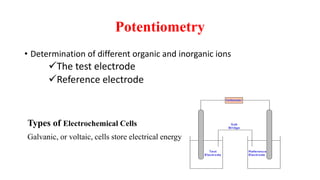
Potentiometry
• Determination of different organic and inorganic ions
The test electrode
Reference electrode
Types of Electrochemical Cells
Galvanic, or voltaic, cells store electrical energy
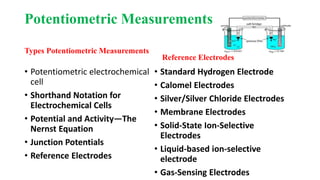
Potentiometric Measurements
Types Potentiometric Measurements
• Potentiometric electrochemical
cell
• Shorthand Notation for
Electrochemical Cells
• Potential and Activity—The
Nernst Equation
• Junction Potentials
• Reference Electrodes
Reference Electrodes
• Standard Hydrogen Electrode
• Calomel Electrodes
• Silver/Silver Chloride Electrodes
• Membrane Electrodes
• Solid-State Ion-Selective
Electrodes
• Liquid-based ion-selective
electrode
• Gas-Sensing Electrodes
Quantitative Applications
• Activity and Concentration basing on The Nernst equation which relates
the cell potential to the analyte’s activity
• Quantitative Analysis using External Standards which is presented Linear
regression gives the calibration curve
• Employed in the Determination of Fluoride in Toothpaste
• Measurement of pH.
• Clinical Applications-Na+, K+, Ca2+, H+, and Cl
• Analysis of Environmental Applications in anlysis of CN–, F–, NH3, and
NO3
– in water and wastewater.
• Potentiometric Titrations in determining the equivalence point of an acid–
base titration
Ion Selective Electrode
• Its transducer or sensor that measures activity of specific ion dissolve in a solution - into an
electrical potential - formed across “the membrane”
• This potential can be measured by either voltmeter or pH meter
• Voltage (mV) α Log (ionic activity) ; as per “Nernst Equation”
• Voltage depends on: (species used, concentration, temperature and pressure)
There is always two electrodes; reference electrode and analytes (sensing) specific electrode to
measure potential
- Electrode should always be in wet condition
- Transducer = any device that convert physical quantity into electrical signal or vice versa (like
heat, pressure, brightness, ….etc)
Introduction to ISE
• It’s a galvanic cell which is based on movement of ions without oxidation or reduction
reaction take place Ecell = EISE – Eref
• Also known as indicator electrodes.
• Used for direct potentiometric measurement.
We are concern here with “ION” not a protein.
 ISE: Ion for +/- ions and selective : for specific ion by membrane used in it and
utilize electrode for measuring the potential by voltmeter.
Specificity and sensitivity = ISE = separation and detection
Nernst equation is then drive for pH or [H+] electrical voltage is related to ion
concentration
 In 1909, Danish chemist work on “pH meter” with principle
of potentiometric
 [H+] in (mmol/L) in a solution led to discover conventional
pH scale (1 to 14)
 Combine electrode been design since 1940s
Why electrode should always be in wet
conditions???????
Therefore; Ion activity α Electrical potential α ion concentration
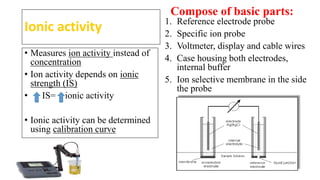
Ionic activity
• Measures ion activity instead of
concentration
• Ion activity depends on ionic
strength (IS)
• IS= ionic activity
• Ionic activity can be determined
using calibration curve
1. Reference electrode probe
2. Specific ion probe
3. Voltmeter, display and cable wires
4. Case housing both electrodes,
internal buffer
5. Ion selective membrane in the side
the probe
Compose of basic parts:
How does it work
• ISE works on the basic principle of galvanic cell: Ecell = EISE – Eref
• More active metals loses its electrons easily
• Two electrodes develop a voltage (potential) due to ion exchange occurring
between the sample and inorganic membrane
• -More active metals loses its electrons easily;
Voltage; Potential between two electrodes is measured
• -Current flow from reference electrode to sensing electrode.
Based on static (zero-current) measurements
• -Internal solution (solution inside electrode) contains ion of interest with constant
activity
 Ion of interest is also mixed with membrane
Type of ISEs: (analytes)
• Ions that can be measured using ISE:
(H+ or pH, NH3,NH4
+, Cd+2,Ca2+,CO2, Cl-,Cu+2,CN-,F-,I-,Pb+2,K+,Ag+, Na+
and ….etc.)
• Selectivity: depends greatly on type of selected membranes
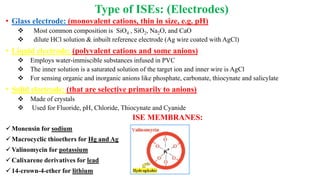
Type of ISEs: (Electrodes)
• Glass electrode: (monovalent cations, thin in size, e.g. pH)
 Most common composition is SiO4 , SiO2, Na2O, and CaO
 dilute HCl solution & inbuilt reference electrode (Ag wire coated with AgCl)
• Liquid electrode: (polyvalent cations and some anions)
 Employs water-immiscible substances infused in PVC
 The inner solution is a saturated solution of the target ion and inner wire is AgCl
 For sensing organic and inorganic anions like phosphate, carbonate, thiocynate and salicylate
• Solid electrode: (that are selective primarily to anions)
 Made of crystals
 Used for Fluoride, pH, Chloride, Thiocynate and Cyanide
ISE MEMBRANES:
Monensin for sodium
Macrocyclic thioethers for Hg and Ag
Valinomycin for potassium
Calixarene derivatives for lead
14-crown-4-ether for lithium
Maintenance of ISE:
Keep it wet
Rinse with distilled water
Polish the silver electrode
Calibrate ISE
Refill always with fresh reference
solution
Get rid of bubbles in ISE
Versatility; (direct measurement)
Cost effective
Time (Very fast like glass electrode)
Selectivity; ISE membranes
Non destructive to analytes
Not affected by color or turbidity of
sample
Exhibit wide response (Sensitivity)
Wide linear range (Stability)
Advantages of ISE:
ISE Applications
Analytical chemistry
Clinical Chemistry (Clinical diagnostic)
Agricultural and research
Environmental pollution monitoring & oil samples
Food/water process (Industrial)
POCT (Clinical diagnostic)
VOLTAMMETRY
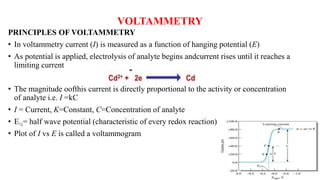
PRINCIPLES OF VOLTAMMETRY
• In voltammetry current (I) is measured as a function of hanging potential (E)
• As potential is applied, electrolysis of analyte begins andcurrent rises until it reaches a
limiting current
• The magnitude oofthis current is directly proportional to the activity or concentration
of analyte i.e. I =kC
• I = Current, K=Constant, C=Concentration of analyte
• E½= half wave potential (characteristic of every redox reaction)
• Plot of I vs E is called a voltammogram
Types of Voltammetry
• Polarography:diffusion, eliminates convection and uses dropping Hg
electrode (DME) as working electrode
• Voltammetry (solid working electrode)
• Anodic Stripping Voltammetry (ASV)
• Pulse Voltammetry
• Cyclic Voltammetry
Cryoscopic osmometry
The determination of total molality (moles/kg solvent) by the depression of
the freezing point of the solvent through the presence of osmotically active
species
Osmometry is an advanced analytical method for determining the osmotic
concentration of solutions
Expressed as: osmoles (Osm) per unit of volume (Osm/L) or weight
(Osm/kg)
Terminologies
Osmotic pressure: is the minimum pressure which need to be applied to a
solution to prevent the inward flow of water across a semipermeable
membrane
Refrigerant: a compound that can readily absorb heat at one temperature
Thermistor: a devise for determining temperature; also may be used for
control of temperature
Slush: an equilibrium of liquid and ice crystals
Freezing point: a temperature at which a liquid solidifies
Freezing point depression: describes the process in which adding a solute to
a solvent decreases the freezing point of the solvent.
Terminologies Cont…..
Vapour pressure: as the pressure exerted by a vapour to thermodynamics
equilibrium with its condensed phases (solid/ liquid) at a given
temperature in a closed system
Condensation:the change of water from its gaseous from (Water vapour)
into liquid water.
Pure solvent: a substance or liquid that is able to dissolve another
substance within itself.
Molal concentration (Molality): the number of moles of solute dissolved
per kilogram of solvent (mol/kg=m)
Instruments
Membrane Osmometry
Vapour Pressure Osmometry
Freezing Point Osmometry
MEMBRANE OSMOMETRY
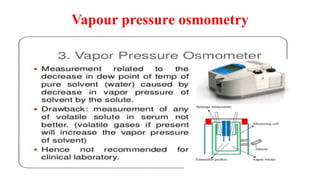
Vapour pressure osmometry
Freezing point osmometry
Advantages
Automated calibration
A short measurement time of 1 min
Automated measurement and calculation
The low sample volume of only 50 µl
Built-in printer and
Three-point calibration
Reproducibility of less than ±0.5% for 50 µm samples
A large measuring range of up to 3000 mOsm/kg
A resolution of 1 mOsm/kg over the entire measuring range
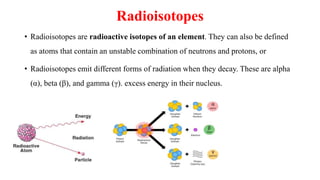
Radioisotopes
• Radioisotopes are radioactive isotopes of an element. They can also be defined
as atoms that contain an unstable combination of neutrons and protons, or
• Radioisotopes emit different forms of radiation when they decay. These are alpha
(α), beta (β), and gamma (γ). excess energy in their nucleus.
Applications
Irradiation of Food:
Radioactive Dating Radioactive isotopes
Medical Applications i.e.

Methods in Electrochemical in chemistry

  • 1.
  • 2.
    Potentiometry • Determination ofdifferent organic and inorganic ions The test electrode Reference electrode Types of Electrochemical Cells Galvanic, or voltaic, cells store electrical energy
  • 3.
    Potentiometric Measurements Types PotentiometricMeasurements • Potentiometric electrochemical cell • Shorthand Notation for Electrochemical Cells • Potential and Activity—The Nernst Equation • Junction Potentials • Reference Electrodes Reference Electrodes • Standard Hydrogen Electrode • Calomel Electrodes • Silver/Silver Chloride Electrodes • Membrane Electrodes • Solid-State Ion-Selective Electrodes • Liquid-based ion-selective electrode • Gas-Sensing Electrodes
  • 4.
    Quantitative Applications • Activityand Concentration basing on The Nernst equation which relates the cell potential to the analyte’s activity • Quantitative Analysis using External Standards which is presented Linear regression gives the calibration curve • Employed in the Determination of Fluoride in Toothpaste • Measurement of pH. • Clinical Applications-Na+, K+, Ca2+, H+, and Cl • Analysis of Environmental Applications in anlysis of CN–, F–, NH3, and NO3 – in water and wastewater. • Potentiometric Titrations in determining the equivalence point of an acid– base titration
  • 5.
    Ion Selective Electrode •Its transducer or sensor that measures activity of specific ion dissolve in a solution - into an electrical potential - formed across “the membrane” • This potential can be measured by either voltmeter or pH meter • Voltage (mV) α Log (ionic activity) ; as per “Nernst Equation” • Voltage depends on: (species used, concentration, temperature and pressure) There is always two electrodes; reference electrode and analytes (sensing) specific electrode to measure potential - Electrode should always be in wet condition - Transducer = any device that convert physical quantity into electrical signal or vice versa (like heat, pressure, brightness, ….etc)
  • 6.
    Introduction to ISE •It’s a galvanic cell which is based on movement of ions without oxidation or reduction reaction take place Ecell = EISE – Eref • Also known as indicator electrodes. • Used for direct potentiometric measurement. We are concern here with “ION” not a protein.  ISE: Ion for +/- ions and selective : for specific ion by membrane used in it and utilize electrode for measuring the potential by voltmeter. Specificity and sensitivity = ISE = separation and detection Nernst equation is then drive for pH or [H+] electrical voltage is related to ion concentration
  • 7.
     In 1909,Danish chemist work on “pH meter” with principle of potentiometric  [H+] in (mmol/L) in a solution led to discover conventional pH scale (1 to 14)  Combine electrode been design since 1940s
  • 8.
    Why electrode shouldalways be in wet conditions??????? Therefore; Ion activity α Electrical potential α ion concentration
  • 9.
    Ionic activity • Measuresion activity instead of concentration • Ion activity depends on ionic strength (IS) • IS= ionic activity • Ionic activity can be determined using calibration curve 1. Reference electrode probe 2. Specific ion probe 3. Voltmeter, display and cable wires 4. Case housing both electrodes, internal buffer 5. Ion selective membrane in the side the probe Compose of basic parts:
  • 10.
    How does itwork • ISE works on the basic principle of galvanic cell: Ecell = EISE – Eref • More active metals loses its electrons easily • Two electrodes develop a voltage (potential) due to ion exchange occurring between the sample and inorganic membrane • -More active metals loses its electrons easily; Voltage; Potential between two electrodes is measured • -Current flow from reference electrode to sensing electrode. Based on static (zero-current) measurements • -Internal solution (solution inside electrode) contains ion of interest with constant activity  Ion of interest is also mixed with membrane
  • 11.
    Type of ISEs:(analytes) • Ions that can be measured using ISE: (H+ or pH, NH3,NH4 +, Cd+2,Ca2+,CO2, Cl-,Cu+2,CN-,F-,I-,Pb+2,K+,Ag+, Na+ and ….etc.) • Selectivity: depends greatly on type of selected membranes
  • 12.
    Type of ISEs:(Electrodes) • Glass electrode: (monovalent cations, thin in size, e.g. pH)  Most common composition is SiO4 , SiO2, Na2O, and CaO  dilute HCl solution & inbuilt reference electrode (Ag wire coated with AgCl) • Liquid electrode: (polyvalent cations and some anions)  Employs water-immiscible substances infused in PVC  The inner solution is a saturated solution of the target ion and inner wire is AgCl  For sensing organic and inorganic anions like phosphate, carbonate, thiocynate and salicylate • Solid electrode: (that are selective primarily to anions)  Made of crystals  Used for Fluoride, pH, Chloride, Thiocynate and Cyanide ISE MEMBRANES: Monensin for sodium Macrocyclic thioethers for Hg and Ag Valinomycin for potassium Calixarene derivatives for lead 14-crown-4-ether for lithium
  • 13.
    Maintenance of ISE: Keepit wet Rinse with distilled water Polish the silver electrode Calibrate ISE Refill always with fresh reference solution Get rid of bubbles in ISE Versatility; (direct measurement) Cost effective Time (Very fast like glass electrode) Selectivity; ISE membranes Non destructive to analytes Not affected by color or turbidity of sample Exhibit wide response (Sensitivity) Wide linear range (Stability) Advantages of ISE:
  • 14.
    ISE Applications Analytical chemistry ClinicalChemistry (Clinical diagnostic) Agricultural and research Environmental pollution monitoring & oil samples Food/water process (Industrial) POCT (Clinical diagnostic)
  • 15.
    VOLTAMMETRY PRINCIPLES OF VOLTAMMETRY •In voltammetry current (I) is measured as a function of hanging potential (E) • As potential is applied, electrolysis of analyte begins andcurrent rises until it reaches a limiting current • The magnitude oofthis current is directly proportional to the activity or concentration of analyte i.e. I =kC • I = Current, K=Constant, C=Concentration of analyte • E½= half wave potential (characteristic of every redox reaction) • Plot of I vs E is called a voltammogram
  • 16.
    Types of Voltammetry •Polarography:diffusion, eliminates convection and uses dropping Hg electrode (DME) as working electrode • Voltammetry (solid working electrode) • Anodic Stripping Voltammetry (ASV) • Pulse Voltammetry • Cyclic Voltammetry
  • 17.
    Cryoscopic osmometry The determinationof total molality (moles/kg solvent) by the depression of the freezing point of the solvent through the presence of osmotically active species Osmometry is an advanced analytical method for determining the osmotic concentration of solutions Expressed as: osmoles (Osm) per unit of volume (Osm/L) or weight (Osm/kg)
  • 18.
    Terminologies Osmotic pressure: isthe minimum pressure which need to be applied to a solution to prevent the inward flow of water across a semipermeable membrane Refrigerant: a compound that can readily absorb heat at one temperature Thermistor: a devise for determining temperature; also may be used for control of temperature Slush: an equilibrium of liquid and ice crystals Freezing point: a temperature at which a liquid solidifies Freezing point depression: describes the process in which adding a solute to a solvent decreases the freezing point of the solvent.
  • 19.
    Terminologies Cont….. Vapour pressure:as the pressure exerted by a vapour to thermodynamics equilibrium with its condensed phases (solid/ liquid) at a given temperature in a closed system Condensation:the change of water from its gaseous from (Water vapour) into liquid water. Pure solvent: a substance or liquid that is able to dissolve another substance within itself. Molal concentration (Molality): the number of moles of solute dissolved per kilogram of solvent (mol/kg=m)
  • 20.
    Instruments Membrane Osmometry Vapour PressureOsmometry Freezing Point Osmometry
  • 21.
  • 22.
  • 23.
  • 24.
    Advantages Automated calibration A shortmeasurement time of 1 min Automated measurement and calculation The low sample volume of only 50 µl Built-in printer and Three-point calibration Reproducibility of less than ±0.5% for 50 µm samples A large measuring range of up to 3000 mOsm/kg A resolution of 1 mOsm/kg over the entire measuring range
  • 25.
    Radioisotopes • Radioisotopes areradioactive isotopes of an element. They can also be defined as atoms that contain an unstable combination of neutrons and protons, or • Radioisotopes emit different forms of radiation when they decay. These are alpha (α), beta (β), and gamma (γ). excess energy in their nucleus.
  • 26.
    Applications Irradiation of Food: RadioactiveDating Radioactive isotopes Medical Applications i.e.