Spinal Metastases Sohail Bajammal, MBChB, MSc, FRCS(C) October 6, 2008 Spine Fellows Rounds
Acknowledgement Aleks Cenic
45 minutes update
Once upon a time… Comparison of laminectomy and external beam radiotherapy
Nowadays…..
Total  en bloc  spondylectomy Tomita K, Kawahara N, Baba H, Tsuchiya H, Nagata S, Toribatake Y. Total en bloc spondylectomy for solitary spinal metastases.  Int Orthop.  1994 Oct;18(5):291-8.
On the other hand, nowadays…. Finn MA, Vrionis FD, Schmidt MH. Spinal radiosurgery for metastatic disease of the spine.  Cancer Control . 2007 Oct;14(4):405-11.
Spinal Metastases Epidemiology Pathophysiology Presentation Treatment Options Decision Making
Epidemiology 1.2 million new cancer per year in USA 40% of all patients will develop metastatic spinal disease 10-20% of these patients will develop spinal cord compression Spinal metastasis is the initial presentation of malignancy in 20% of patients White AP, Kwon BK, Lindskog DM, Friedlaender GE, Grauer JN. Metastatic disease of the spine.  J Am Acad Orthop Surg.  2006 Oct;14(11):587-98.
Significance The spine is the most common site for skeletal metastases Metastatic lesions are the most common tumors of the spine (95-98%) Vertebral body affected first Approximately 70% of patients who die of cancer have evidence of vertebral metastases on autopsy Harrington KD. Metastatic disease of the spine.  J Bone Joint Surg Am.  1986 Sep;68(7):1110-5.
Future Population ages Better adjuvant therapy Patients surviving longer More patients developing metastatic disease
Pathophysiology Hematogenous Spread: Batson’s plexus Arterial embolization Seed and Soil Theory Direct invasion
Primary Sites MD Anderson 1984-1994 (n=11,884) Breast (30.2%) Lung (20.3%) Blood (10.2%) Prostate (9.6%) Urinary tract (4%) Skin (3.1%) Unknown 1° (2.9%) Colon (1.6%) Other (18.1%) Gokaslan ZL, York JE, Walsh GL, McCutcheon IE, Lang FF, Putnam JB Jr, Wildrick DM, Swisher SG, Abi-Said D, Sawaya R. Transthoracic vertebrectomy for metastatic spinal tumors.  J Neurosurg.  1998 Oct;89(4):599-609.
Level of Metastases Thoracic 70% Lumbar 20% Cervical 10%
Clinical Presentation Pain (85%) Biologic:  local release of cytokines, periosteal irritation, stimulation of intraosseous nerves, increased pressure or mass effect from tumor tissue in the bone  Mechanical:  nerve compression, pathologic fractures, instability Weakness (34%) Spinal cord compression in 20% Early: edema, venous congestion, and demyelination Late: secondary vascular injury and spinal infarction Mass (13%) Constitutional Symptoms
Spine Surgeon’s Role 20% of patients, the first presentation of a malignancy is a spinal problem Schiff D, O’Neill BP, Suman VJ. Spinal epidural metastasis as the initial manifestation of malignancy: clinical features and diagnostic approach.  Neurology  1997;49:452–456.
Evaluation History Physical Exam Laboratory:  CBC, ESR, CRP, Lytes, BUN, Creatinine Ca, PO4, Alk Phosph Urinalysis: routine, Bence-Jones Proteins Special: PSA, thyroid Fxn, serum and urine protein electrophoresis, liver function tests, stool guaiac, CEA Radiological Biopsy
Radiological Evaluation Local: X-ray of spine: AP, lateral, oblique “ winking owl” sign: pedicle destruction Vertebral body destruction is not visible until 30-50% of trabeculae are involved Negative x-ray does not rule out tumor Bone Scan: screening, cold in MM CT: bony architecture MRI + gadolinium of the whole spine: gold standard
 
Radiological Evaluation Staging: CT chest, abdomen and pelvis with oral and IV contrast Bone Scan Mammogram Angiogram: Pre-operative embolization Renal cell, thyroid
Biopsy Indicated if diagnosis is unclear after workup: Remote history of cancer with long disease-free interval Options: CT-guided: most accessible lesion, minimal morbidity, tattoo tract for later excision Accuracy: 93% for lytic lesions, 76% for sclerotic lesions Open: cost, delay, definitive for benign tumors Culture every tumor and biopsy every infection Lis E, Bilsky MH, Pisinski L, Boland P, Healey JH, O'malley B, Krol G. Percutaneous CT-guided biopsy of osseous lesion of the spine in patients with known or suspected malignancy.  AJNR Am J Neuroradiol 2 004;25:1583-1588.
Goal of Management Maximize quality of life Curative in certain solitary metastasis
To achieve the goal…. Provide pain relief Improve or maintain neurologic function Restore or maintain the structural integrity of the spinal column
Treatment Options Supportive: Orthotic, Steroids, Bisphosphonates Chemotherapy & Hormonal Therapy Radiotherapy Surgery Combination Multi-disciplinary approach
Pitfall Aggressive chemotherapeutic regimens for patients with spinal pain not responding to conventional therapy without ruling out subtle mechanical etiology Severe depression of bone marrow that surgery or radiotherapy are no longer feasible
Steroids Indicated in cord compression Better ambulation and pain control Optimal dose is controversial Low-dose: 10mg IV blous dexamethasone, followed by 4mg PO q6 hours Sørensen S, Helweg-Larsen S, Mouridsen H, Hansen HH. Effect of high-dose dexamethasone in carcinomatous metastatic spinal cord compression treated with radiotherapy: a randomised trial. Eur J Cancer. 1994;30A(1):22-7. Vecht CJ, Haaxma-Reiche H, van Putten WL, de Visser M, Vries EP, Twijnstra A. Initial bolus of conventional versus high-dose dexamethasone in metastatic spinal cord compression. Neurology. 1989 Sep;39(9):1255-7.
Bisphosphonates Efficacy in treatment of hypercalcemia, pain control, reduction in number and time to skeletal events, and improvement of quality of life in patients with multiple myeloma and bone metastases from solid tumors Pavlakis N, Schmidt RL, Stockler M: Bisphosphonates for breast cancer.  Cochrane Database Syst Rev  2005, (3): CD003474. Penas-Prado M, Loghin ME. Spinal cord compression in cancer patients: review of diagnosis and treatment.  Curr Oncol Rep.  2008 Jan;10(1):78-85.
Radiotherapy Goal is to debulk, promote calcification or ossification (3 months), relieve pain Of patients that are ambulatory at presentation, 70% will remain so Can be used when myelopathy due to soft tissue but not if due to bone or deformity (Harrington III) Combine with surgery if failure of radiation at that level (deformity or neurological worsening)
External Beam Radiotherapy (EBRT) Radiosensitivity Myeloma & Lymphoma: most radiosensitive Prostate, Breast, Lung and Colon: moderately Thyroid, Kidney, Melanoma: not radiosensitive Dose 5,000 cGy in 25 fractions over 5 weeks (C & L-spine) 4,500 cGy over 4½ -5 weeks in T-spine
External Beam Radiotherapy (EBRT) RCT: 16 pts underwent laminectomy & radiation 13 pts underwent radiation alone Mean follow-up: 4 months No difference in pain relief, improved ambulation, or improved sphincter function Young RF, Post EM, King GA. Treatment of spinal epidural metastases. Randomized prospective comparison of laminectomy and radiotherapy.  J Neurosurg  1980 Dec;53(6):741-8.
Laminectomy is a bad option Most of the pathology in the vertebral body is anteriorly Insufficient debulking and decompression Predisposes to spinal instability
 
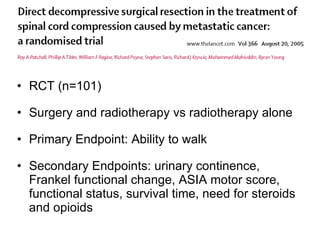
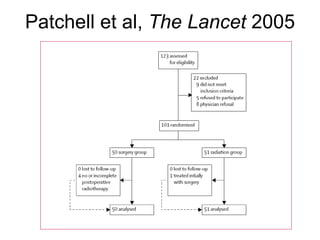
RCT (n=101) Surgery and radiotherapy vs radiotherapy alone Primary Endpoint: Ability to walk Secondary Endpoints: urinary continence, Frankel functional change, ASIA motor score, functional status, survival time, need for steroids and opioids
Patchell et al,  The Lancet  2005
Patchell et al,  The Lancet  2005 Post-treatment ability to walk: 84% in the surgery versus 57% in the radiation group (p=0.001) Patients retained the ability to walk for 122 days in the surgery group versus 13 days in the radiation group (p=0.003)
Patchell et al,  The Lancet  2005
However….
Patchell et al,  The Lancet  2005 Inclusion Criteria: > 18 yr, tissue-proven diagnosis of cancer MRI evidence of MESCC (metastatic epidural spinal cord compression) At least one neurological sign or symptom (e.g., pain) Not totally paraplegic for  >48 h  before study entry MESCC restricted to a single area, which could include several contiguous segments
Patchell et al,  The Lancet  2005 Exclusion Criteria: Certain radiosensitive tumors (lymphomas, leukemia, multiple myeloma, and germ-cell tumors) Mass compressed only cauda equina or spinal roots Multiple discrete compressive lesions Pre-existing neurological problems not related directly to their MESCC (e.g., brain metastases) Previous MESCC or previous spinal radiation
External Beam Radiotherapy (EBRT) Broad, unfocused energy beam Complications: wound healing, infection, fusion delay, bone marrow suppression, myelitis Logistics: small fractions over 2 weeks More interest in new modalities of radiotherapy Finn MA, Vrionis FD, Schmidt MH. Spinal radiosurgery for metastatic disease of the spine.  Cancer Control . 2007 Oct;14(4):405-11.
Radiotherapy Modalities Conventional External Beam Radiotherapy (EBRT) Intensity-modulated radiation therapy (IMRT) Stereotactic radiotherapy Stereotactic radiosurgery Radioisotopes Finn MA, Vrionis FD, Schmidt MH. Spinal radiosurgery for metastatic disease of the spine.  Cancer Control . 2007 Oct;14(4):405-11.
Indications of Radiotherapy  As Primary Treatment Radiosensitive tumor not previously irradiated Widespread spinal metastases with multilevel neural compression Total neurological deficits below the level of compression > 48 hours Patient’s condition (or prognosis) precludes surgery: high surgical risk or short life expectancy Penas-Prado M, Loghin ME. Spinal cord compression in cancer patients: review of diagnosis and treatment.  Curr Oncol Rep.  2008 Jan;10(1):78-85.
Adjuvant Radiotherapy Done after operative decompression Patchell et al study Wait 3 weeks for wound healing before starting radiation If allograft / autograft bone was used, wait 6/52 for incorporation before starting
Effects of radiation on spinal fusion 27 rabbits underwent posterior lumbar fusion with autogenous iliac crest graft, divided into Group 1 (n = 7): no irradiation  Group 2 (n = 6): preoperative irradiation Group 3 (n = 7): immediate (day 3) post-op irradiation Group 4 (n = 7): delayed (day 21) post-op irradiation The radiation protocol consisted of 480 cGy/fraction for 5 consecutive days.  Bouchard JA, Koka A, Bensusan JS, Stevenson S, Emery SE. Effects of irradiation on posterior spinal fusions. A rabbit model.  Spine . 1994 Aug 15;19(16):1836-41.
Effects of Radiation on Spinal Fusion Bouchard et al,  Spine  1994 Compared with the control group,  Group 2 (preoperatively irradiated) spines were less stiff in extension and in compression Group 3 (immediate postop irradiation) spines were less stiff in extension, flexion, compression, and left lateral bending  The  control group and the delayed irradiation  group had the highest histologic scores and more mature fusion mass The immediate postoperative irradiation group had the worst results, with consistent fibrous union of the graft
Frankel et. al.  Paraplegia  1969 Harrington  JBJS(A)  1986 Tokuhashi et. al.  Spine  1990 Tomita et. al.  Spine  2001 Decision Making  (Prognostic Decision Rules)
Frankel 1969 A: Complete sensory & motor loss B: Complete motor loss; incomplete sensory loss C: Some motor function below level of involvement; incomplete sensory loss D: Useful motor function below level of involvement; incomplete sensory loss E: Normal motor & sensory function
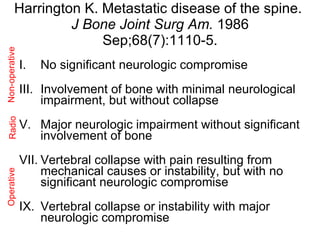
Harrington K. Metastatic disease of the spine.  J Bone Joint Surg Am.  1986 Sep;68(7):1110-5. No significant neurologic compromise Involvement of bone with minimal neurological impairment, but without collapse Major neurologic impairment without significant involvement of bone Vertebral collapse with pain resulting from mechanical causes or instability, but with no significant neurologic compromise Vertebral collapse or instability with major neurologic compromise Non-operative Operative Radio
Tokuhashi et. al. 1990 Retrospective analysis of 64 patients Scoring system for preoperative evaluation of metastatic spine prognosis Six parameters employed, each 0-2 Total score 0-12 predicts the surgical intervention (excisional vs. palliative)
Karnofsky (Frankel’s) ≥  9: Excision Survival > 12 months ≤   5: Palliative Survival < 3 months
Tomita et. al. 2001 Phase 1 (1987-1991): Retrospective analysis of 67 patients to evaluate predictors Hazard ratios were analyzed & standardized Phase 2 (1993-1996): Prospective validation of 61 patients Total Score 2-10, based on: Grade of malignancy of the primary tumor Visceral Metastases to vital organs Bone metastases
Tomita et. al. 2001
Predictive value of 7 preoperative prognostic scoring systems for spinal metastases Leithner et al,  Eur Spine J  2008 Prospective evaluation, 69 patients Tokuhashi (original and revised), Sioutos, Tomita, Van der Linden, and Bauer (original and modified) scores Of all seven scoring systems, the original Bauer score and a Bauer score without scoring for pathologic fracture had the best association with survival (P<0.001)
Predictive value of 7 preoperative prognostic scoring systems for spinal metastases Leithner et al,  Eur Spine J  2008
Indications for Surgery Spinal instability Spinal compression secondary to retropulsed bones or spinal deformity Radiation-resistant tumors (sarcoma, non-small cell lung cancer, colon, renal cell, melanoma) Failure of radiation (progression during treatment or recurrence) Intractable pain unresponsive to medical treatment Unknown primary tumor (histological diagnosis) Rapid progression of neurological deficits Penas-Prado M, Loghin ME. Spinal cord compression in cancer patients: review of diagnosis and treatment.  Curr Oncol Rep.  2008 Jan;10(1):78-85.
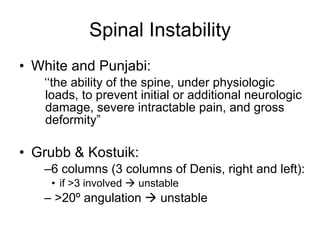
Spinal Instability White and Punjabi: ‘‘ the ability of the spine, under physiologic loads, to prevent initial or additional neurologic damage, severe intractable pain, and gross deformity” Grubb & Kostuik: 6 columns (3 columns of Denis, right and left): if >3 involved    unstable >20º angulation    unstable
Spinal Instability Local tumor Iatrogenic Post-radiation
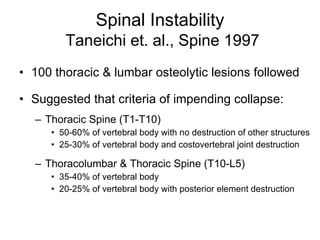
Spinal Instability   Taneichi et. al., Spine 1997 100 thoracic & lumbar osteolytic lesions followed Suggested that criteria of impending collapse: Thoracic Spine (T1-T10) 50-60% of vertebral body with no destruction of other structures 25-30% of vertebral body and costovertebral joint destruction Thoracolumbar & Thoracic Spine (T10-L5) 35-40% of vertebral body  20-25% of vertebral body with posterior element destruction
Principles of Surgical Treatment “Objectives” Establish diagnosis, if not done Decompression of neural structures Debulking of tumor Realignment Reconstructive stabilization
Boriani-Weinstein-Biagini Staging System Spine  1997
Surgical Options Approach: anterior, posterior, A+P, or posterolateral, MIS, kyphoplasty Reconstruction: bone graft, cement, or cages Pre-operative embolization (renal cell ca, thyroid) Postoperative radiotherapy: after 3-6 wks
Surgical Approaches Rothman-Simeone The Spine. 5 th  Edition. © Elsevier
Posterior Thoracic Approaches
Meta-analysis of  Surgery versus Radiotherapy 1980 to August 2003 24 surgical articles (999 patients) 4 radiation articles (543 patients) Mostly uncontrolled cohort studies (Class III) Klimo P Jr, Thompson CJ, Kestle JR, Schmidt MH. A meta-analysis of surgery versus conventional radiotherapy for the treatment of metastatic spinal epidural disease.  Neuro Oncol.  2005 Jan;7(1):64-76.
Surgical patients were 1.3 times more likely to be ambulatory after treatment and twice as likely to regain ambulatory function. Concludes that surgery should usually be the primary treatment with radiation given as adjuvant therapy. Meta-analysis of  Surgery versus Radiotherapy Klimo P Jr, Thompson CJ, Kestle JR, Schmidt MH. A meta-analysis of surgery versus conventional radiotherapy for the treatment of metastatic spinal epidural disease.  Neuro Oncol.  2005 Jan;7(1):64-76.
 
MIS for Spinal Metastases  Huang TJ, Hsu RW, Li YY, Cheng CC. Minimal access spinal surgery (MASS) in treating thoracic spine metastasis.  Spine.  2006 Jul 15;31(16):1860-3. Singh K, Samartzis D, Vaccaro AR, Andersson GB, An HS, Heller JG. Current concepts in the management of metastatic spinal disease. The role of minimally-invasive approaches.  J Bone Joint Surg Br.  2006 Apr;88(4):434-42. Binning MJ, Gottfried ON, Klimo P Jr, Schmidt MH. Minimally invasive treatments for metastatic tumors of the spine.  Neurosurg Clin N Am.  2004 Oct;15(4):459-65.
Kyphoplasty for Metastases Chi JH, Gokaslan ZL. Vertebroplasty and kyphoplasty for spinal metastases.  Curr Opin Support Palliat Care.  2008 Mar;2(1):9-13. Bròdano GB, Cappuccio M, Gasbarrini A, Bandiera S, De Salvo F, Cosco F, Boriani S. Vertebroplasty in the treatment of vertebral metastases: clinical cases and review of the literature.  Eur Rev Med Pharmacol Sci.  2007 Mar-Apr;11(2):91-100. Khanna AJ, Neubauer P, Togawa D, Kay Reinhardt M, Lieberman IH. Kyphoplasty and vertebroplasty for the treatment of spinal metastases.  Support Cancer Ther.  2005 Oct 1;3(1):21-5.
Walker MP, Yaszemski MJ, Kim CW, Talac R, Currier BL. Metastatic disease of the spine: evaluation and treatment.  Clin Orthop Relat Res . 2003 Oct;(415 Supp):S165-75.
Bartels RH, van der Linden YM, van der Graaf WT. Spinal extradural metastasis: review of current treatment options. CA Cancer J Clin. 2008 Jul-Aug;58(4):245-59.
Bottom Line Tumor Treatment Patient Tumor type Natural history Tumor location Extent of involvement Number of metastases Neurologic status Comorbid conditions Nutritional status Immune status Patient & family wishes Life expectancy Multi-disciplinary Supportive measures Surgery: front ± back,  MIS, kyphoplasty Radiotherapy: external beam, radiosurgery,  IMRT Chemotherapy Timing
Thank You Calgary Spine Tumor Day?

Spinal Metastases

  • 1.
    Spinal Metastases SohailBajammal, MBChB, MSc, FRCS(C) October 6, 2008 Spine Fellows Rounds
  • 2.
  • 3.
  • 4.
    Once upon atime… Comparison of laminectomy and external beam radiotherapy
  • 5.
  • 6.
    Total enbloc spondylectomy Tomita K, Kawahara N, Baba H, Tsuchiya H, Nagata S, Toribatake Y. Total en bloc spondylectomy for solitary spinal metastases. Int Orthop. 1994 Oct;18(5):291-8.
  • 7.
    On the otherhand, nowadays…. Finn MA, Vrionis FD, Schmidt MH. Spinal radiosurgery for metastatic disease of the spine. Cancer Control . 2007 Oct;14(4):405-11.
  • 8.
    Spinal Metastases EpidemiologyPathophysiology Presentation Treatment Options Decision Making
  • 9.
    Epidemiology 1.2 millionnew cancer per year in USA 40% of all patients will develop metastatic spinal disease 10-20% of these patients will develop spinal cord compression Spinal metastasis is the initial presentation of malignancy in 20% of patients White AP, Kwon BK, Lindskog DM, Friedlaender GE, Grauer JN. Metastatic disease of the spine. J Am Acad Orthop Surg. 2006 Oct;14(11):587-98.
  • 10.
    Significance The spineis the most common site for skeletal metastases Metastatic lesions are the most common tumors of the spine (95-98%) Vertebral body affected first Approximately 70% of patients who die of cancer have evidence of vertebral metastases on autopsy Harrington KD. Metastatic disease of the spine. J Bone Joint Surg Am. 1986 Sep;68(7):1110-5.
  • 11.
    Future Population agesBetter adjuvant therapy Patients surviving longer More patients developing metastatic disease
  • 12.
    Pathophysiology Hematogenous Spread:Batson’s plexus Arterial embolization Seed and Soil Theory Direct invasion
  • 13.
    Primary Sites MDAnderson 1984-1994 (n=11,884) Breast (30.2%) Lung (20.3%) Blood (10.2%) Prostate (9.6%) Urinary tract (4%) Skin (3.1%) Unknown 1° (2.9%) Colon (1.6%) Other (18.1%) Gokaslan ZL, York JE, Walsh GL, McCutcheon IE, Lang FF, Putnam JB Jr, Wildrick DM, Swisher SG, Abi-Said D, Sawaya R. Transthoracic vertebrectomy for metastatic spinal tumors. J Neurosurg. 1998 Oct;89(4):599-609.
  • 14.
    Level of MetastasesThoracic 70% Lumbar 20% Cervical 10%
  • 15.
    Clinical Presentation Pain(85%) Biologic: local release of cytokines, periosteal irritation, stimulation of intraosseous nerves, increased pressure or mass effect from tumor tissue in the bone Mechanical: nerve compression, pathologic fractures, instability Weakness (34%) Spinal cord compression in 20% Early: edema, venous congestion, and demyelination Late: secondary vascular injury and spinal infarction Mass (13%) Constitutional Symptoms
  • 16.
    Spine Surgeon’s Role20% of patients, the first presentation of a malignancy is a spinal problem Schiff D, O’Neill BP, Suman VJ. Spinal epidural metastasis as the initial manifestation of malignancy: clinical features and diagnostic approach. Neurology 1997;49:452–456.
  • 17.
    Evaluation History PhysicalExam Laboratory: CBC, ESR, CRP, Lytes, BUN, Creatinine Ca, PO4, Alk Phosph Urinalysis: routine, Bence-Jones Proteins Special: PSA, thyroid Fxn, serum and urine protein electrophoresis, liver function tests, stool guaiac, CEA Radiological Biopsy
  • 18.
    Radiological Evaluation Local:X-ray of spine: AP, lateral, oblique “ winking owl” sign: pedicle destruction Vertebral body destruction is not visible until 30-50% of trabeculae are involved Negative x-ray does not rule out tumor Bone Scan: screening, cold in MM CT: bony architecture MRI + gadolinium of the whole spine: gold standard
  • 19.
  • 20.
    Radiological Evaluation Staging:CT chest, abdomen and pelvis with oral and IV contrast Bone Scan Mammogram Angiogram: Pre-operative embolization Renal cell, thyroid
  • 21.
    Biopsy Indicated ifdiagnosis is unclear after workup: Remote history of cancer with long disease-free interval Options: CT-guided: most accessible lesion, minimal morbidity, tattoo tract for later excision Accuracy: 93% for lytic lesions, 76% for sclerotic lesions Open: cost, delay, definitive for benign tumors Culture every tumor and biopsy every infection Lis E, Bilsky MH, Pisinski L, Boland P, Healey JH, O'malley B, Krol G. Percutaneous CT-guided biopsy of osseous lesion of the spine in patients with known or suspected malignancy. AJNR Am J Neuroradiol 2 004;25:1583-1588.
  • 22.
    Goal of ManagementMaximize quality of life Curative in certain solitary metastasis
  • 23.
    To achieve thegoal…. Provide pain relief Improve or maintain neurologic function Restore or maintain the structural integrity of the spinal column
  • 24.
    Treatment Options Supportive:Orthotic, Steroids, Bisphosphonates Chemotherapy & Hormonal Therapy Radiotherapy Surgery Combination Multi-disciplinary approach
  • 25.
    Pitfall Aggressive chemotherapeuticregimens for patients with spinal pain not responding to conventional therapy without ruling out subtle mechanical etiology Severe depression of bone marrow that surgery or radiotherapy are no longer feasible
  • 26.
    Steroids Indicated incord compression Better ambulation and pain control Optimal dose is controversial Low-dose: 10mg IV blous dexamethasone, followed by 4mg PO q6 hours Sørensen S, Helweg-Larsen S, Mouridsen H, Hansen HH. Effect of high-dose dexamethasone in carcinomatous metastatic spinal cord compression treated with radiotherapy: a randomised trial. Eur J Cancer. 1994;30A(1):22-7. Vecht CJ, Haaxma-Reiche H, van Putten WL, de Visser M, Vries EP, Twijnstra A. Initial bolus of conventional versus high-dose dexamethasone in metastatic spinal cord compression. Neurology. 1989 Sep;39(9):1255-7.
  • 27.
    Bisphosphonates Efficacy intreatment of hypercalcemia, pain control, reduction in number and time to skeletal events, and improvement of quality of life in patients with multiple myeloma and bone metastases from solid tumors Pavlakis N, Schmidt RL, Stockler M: Bisphosphonates for breast cancer. Cochrane Database Syst Rev 2005, (3): CD003474. Penas-Prado M, Loghin ME. Spinal cord compression in cancer patients: review of diagnosis and treatment. Curr Oncol Rep. 2008 Jan;10(1):78-85.
  • 28.
    Radiotherapy Goal isto debulk, promote calcification or ossification (3 months), relieve pain Of patients that are ambulatory at presentation, 70% will remain so Can be used when myelopathy due to soft tissue but not if due to bone or deformity (Harrington III) Combine with surgery if failure of radiation at that level (deformity or neurological worsening)
  • 29.
    External Beam Radiotherapy(EBRT) Radiosensitivity Myeloma & Lymphoma: most radiosensitive Prostate, Breast, Lung and Colon: moderately Thyroid, Kidney, Melanoma: not radiosensitive Dose 5,000 cGy in 25 fractions over 5 weeks (C & L-spine) 4,500 cGy over 4½ -5 weeks in T-spine
  • 30.
    External Beam Radiotherapy(EBRT) RCT: 16 pts underwent laminectomy & radiation 13 pts underwent radiation alone Mean follow-up: 4 months No difference in pain relief, improved ambulation, or improved sphincter function Young RF, Post EM, King GA. Treatment of spinal epidural metastases. Randomized prospective comparison of laminectomy and radiotherapy. J Neurosurg 1980 Dec;53(6):741-8.
  • 31.
    Laminectomy is abad option Most of the pathology in the vertebral body is anteriorly Insufficient debulking and decompression Predisposes to spinal instability
  • 32.
  • 33.
    RCT (n=101) Surgeryand radiotherapy vs radiotherapy alone Primary Endpoint: Ability to walk Secondary Endpoints: urinary continence, Frankel functional change, ASIA motor score, functional status, survival time, need for steroids and opioids
  • 34.
    Patchell et al, The Lancet 2005
  • 35.
    Patchell et al, The Lancet 2005 Post-treatment ability to walk: 84% in the surgery versus 57% in the radiation group (p=0.001) Patients retained the ability to walk for 122 days in the surgery group versus 13 days in the radiation group (p=0.003)
  • 36.
    Patchell et al, The Lancet 2005
  • 37.
    Patchell et al, The Lancet 2005
  • 38.
  • 39.
    Patchell et al, The Lancet 2005 Inclusion Criteria: > 18 yr, tissue-proven diagnosis of cancer MRI evidence of MESCC (metastatic epidural spinal cord compression) At least one neurological sign or symptom (e.g., pain) Not totally paraplegic for >48 h before study entry MESCC restricted to a single area, which could include several contiguous segments
  • 40.
    Patchell et al, The Lancet 2005 Exclusion Criteria: Certain radiosensitive tumors (lymphomas, leukemia, multiple myeloma, and germ-cell tumors) Mass compressed only cauda equina or spinal roots Multiple discrete compressive lesions Pre-existing neurological problems not related directly to their MESCC (e.g., brain metastases) Previous MESCC or previous spinal radiation
  • 41.
    External Beam Radiotherapy(EBRT) Broad, unfocused energy beam Complications: wound healing, infection, fusion delay, bone marrow suppression, myelitis Logistics: small fractions over 2 weeks More interest in new modalities of radiotherapy Finn MA, Vrionis FD, Schmidt MH. Spinal radiosurgery for metastatic disease of the spine. Cancer Control . 2007 Oct;14(4):405-11.
  • 42.
    Radiotherapy Modalities ConventionalExternal Beam Radiotherapy (EBRT) Intensity-modulated radiation therapy (IMRT) Stereotactic radiotherapy Stereotactic radiosurgery Radioisotopes Finn MA, Vrionis FD, Schmidt MH. Spinal radiosurgery for metastatic disease of the spine. Cancer Control . 2007 Oct;14(4):405-11.
  • 43.
    Indications of Radiotherapy As Primary Treatment Radiosensitive tumor not previously irradiated Widespread spinal metastases with multilevel neural compression Total neurological deficits below the level of compression > 48 hours Patient’s condition (or prognosis) precludes surgery: high surgical risk or short life expectancy Penas-Prado M, Loghin ME. Spinal cord compression in cancer patients: review of diagnosis and treatment. Curr Oncol Rep. 2008 Jan;10(1):78-85.
  • 44.
    Adjuvant Radiotherapy Doneafter operative decompression Patchell et al study Wait 3 weeks for wound healing before starting radiation If allograft / autograft bone was used, wait 6/52 for incorporation before starting
  • 45.
    Effects of radiationon spinal fusion 27 rabbits underwent posterior lumbar fusion with autogenous iliac crest graft, divided into Group 1 (n = 7): no irradiation Group 2 (n = 6): preoperative irradiation Group 3 (n = 7): immediate (day 3) post-op irradiation Group 4 (n = 7): delayed (day 21) post-op irradiation The radiation protocol consisted of 480 cGy/fraction for 5 consecutive days. Bouchard JA, Koka A, Bensusan JS, Stevenson S, Emery SE. Effects of irradiation on posterior spinal fusions. A rabbit model. Spine . 1994 Aug 15;19(16):1836-41.
  • 46.
    Effects of Radiationon Spinal Fusion Bouchard et al, Spine 1994 Compared with the control group, Group 2 (preoperatively irradiated) spines were less stiff in extension and in compression Group 3 (immediate postop irradiation) spines were less stiff in extension, flexion, compression, and left lateral bending The control group and the delayed irradiation group had the highest histologic scores and more mature fusion mass The immediate postoperative irradiation group had the worst results, with consistent fibrous union of the graft
  • 47.
    Frankel et. al. Paraplegia 1969 Harrington JBJS(A) 1986 Tokuhashi et. al. Spine 1990 Tomita et. al. Spine 2001 Decision Making (Prognostic Decision Rules)
  • 48.
    Frankel 1969 A:Complete sensory & motor loss B: Complete motor loss; incomplete sensory loss C: Some motor function below level of involvement; incomplete sensory loss D: Useful motor function below level of involvement; incomplete sensory loss E: Normal motor & sensory function
  • 49.
    Harrington K. Metastaticdisease of the spine. J Bone Joint Surg Am. 1986 Sep;68(7):1110-5. No significant neurologic compromise Involvement of bone with minimal neurological impairment, but without collapse Major neurologic impairment without significant involvement of bone Vertebral collapse with pain resulting from mechanical causes or instability, but with no significant neurologic compromise Vertebral collapse or instability with major neurologic compromise Non-operative Operative Radio
  • 50.
    Tokuhashi et. al.1990 Retrospective analysis of 64 patients Scoring system for preoperative evaluation of metastatic spine prognosis Six parameters employed, each 0-2 Total score 0-12 predicts the surgical intervention (excisional vs. palliative)
  • 51.
    Karnofsky (Frankel’s) ≥ 9: Excision Survival > 12 months ≤ 5: Palliative Survival < 3 months
  • 52.
    Tomita et. al.2001 Phase 1 (1987-1991): Retrospective analysis of 67 patients to evaluate predictors Hazard ratios were analyzed & standardized Phase 2 (1993-1996): Prospective validation of 61 patients Total Score 2-10, based on: Grade of malignancy of the primary tumor Visceral Metastases to vital organs Bone metastases
  • 53.
  • 54.
    Predictive value of7 preoperative prognostic scoring systems for spinal metastases Leithner et al, Eur Spine J 2008 Prospective evaluation, 69 patients Tokuhashi (original and revised), Sioutos, Tomita, Van der Linden, and Bauer (original and modified) scores Of all seven scoring systems, the original Bauer score and a Bauer score without scoring for pathologic fracture had the best association with survival (P<0.001)
  • 55.
    Predictive value of7 preoperative prognostic scoring systems for spinal metastases Leithner et al, Eur Spine J 2008
  • 56.
    Indications for SurgerySpinal instability Spinal compression secondary to retropulsed bones or spinal deformity Radiation-resistant tumors (sarcoma, non-small cell lung cancer, colon, renal cell, melanoma) Failure of radiation (progression during treatment or recurrence) Intractable pain unresponsive to medical treatment Unknown primary tumor (histological diagnosis) Rapid progression of neurological deficits Penas-Prado M, Loghin ME. Spinal cord compression in cancer patients: review of diagnosis and treatment. Curr Oncol Rep. 2008 Jan;10(1):78-85.
  • 57.
    Spinal Instability Whiteand Punjabi: ‘‘ the ability of the spine, under physiologic loads, to prevent initial or additional neurologic damage, severe intractable pain, and gross deformity” Grubb & Kostuik: 6 columns (3 columns of Denis, right and left): if >3 involved  unstable >20º angulation  unstable
  • 58.
    Spinal Instability Localtumor Iatrogenic Post-radiation
  • 59.
    Spinal Instability Taneichi et. al., Spine 1997 100 thoracic & lumbar osteolytic lesions followed Suggested that criteria of impending collapse: Thoracic Spine (T1-T10) 50-60% of vertebral body with no destruction of other structures 25-30% of vertebral body and costovertebral joint destruction Thoracolumbar & Thoracic Spine (T10-L5) 35-40% of vertebral body 20-25% of vertebral body with posterior element destruction
  • 60.
    Principles of SurgicalTreatment “Objectives” Establish diagnosis, if not done Decompression of neural structures Debulking of tumor Realignment Reconstructive stabilization
  • 61.
  • 62.
    Surgical Options Approach:anterior, posterior, A+P, or posterolateral, MIS, kyphoplasty Reconstruction: bone graft, cement, or cages Pre-operative embolization (renal cell ca, thyroid) Postoperative radiotherapy: after 3-6 wks
  • 63.
    Surgical Approaches Rothman-SimeoneThe Spine. 5 th Edition. © Elsevier
  • 64.
  • 65.
    Meta-analysis of Surgery versus Radiotherapy 1980 to August 2003 24 surgical articles (999 patients) 4 radiation articles (543 patients) Mostly uncontrolled cohort studies (Class III) Klimo P Jr, Thompson CJ, Kestle JR, Schmidt MH. A meta-analysis of surgery versus conventional radiotherapy for the treatment of metastatic spinal epidural disease. Neuro Oncol. 2005 Jan;7(1):64-76.
  • 66.
    Surgical patients were1.3 times more likely to be ambulatory after treatment and twice as likely to regain ambulatory function. Concludes that surgery should usually be the primary treatment with radiation given as adjuvant therapy. Meta-analysis of Surgery versus Radiotherapy Klimo P Jr, Thompson CJ, Kestle JR, Schmidt MH. A meta-analysis of surgery versus conventional radiotherapy for the treatment of metastatic spinal epidural disease. Neuro Oncol. 2005 Jan;7(1):64-76.
  • 67.
  • 68.
    MIS for SpinalMetastases Huang TJ, Hsu RW, Li YY, Cheng CC. Minimal access spinal surgery (MASS) in treating thoracic spine metastasis. Spine. 2006 Jul 15;31(16):1860-3. Singh K, Samartzis D, Vaccaro AR, Andersson GB, An HS, Heller JG. Current concepts in the management of metastatic spinal disease. The role of minimally-invasive approaches. J Bone Joint Surg Br. 2006 Apr;88(4):434-42. Binning MJ, Gottfried ON, Klimo P Jr, Schmidt MH. Minimally invasive treatments for metastatic tumors of the spine. Neurosurg Clin N Am. 2004 Oct;15(4):459-65.
  • 69.
    Kyphoplasty for MetastasesChi JH, Gokaslan ZL. Vertebroplasty and kyphoplasty for spinal metastases. Curr Opin Support Palliat Care. 2008 Mar;2(1):9-13. Bròdano GB, Cappuccio M, Gasbarrini A, Bandiera S, De Salvo F, Cosco F, Boriani S. Vertebroplasty in the treatment of vertebral metastases: clinical cases and review of the literature. Eur Rev Med Pharmacol Sci. 2007 Mar-Apr;11(2):91-100. Khanna AJ, Neubauer P, Togawa D, Kay Reinhardt M, Lieberman IH. Kyphoplasty and vertebroplasty for the treatment of spinal metastases. Support Cancer Ther. 2005 Oct 1;3(1):21-5.
  • 70.
    Walker MP, YaszemskiMJ, Kim CW, Talac R, Currier BL. Metastatic disease of the spine: evaluation and treatment. Clin Orthop Relat Res . 2003 Oct;(415 Supp):S165-75.
  • 71.
    Bartels RH, vander Linden YM, van der Graaf WT. Spinal extradural metastasis: review of current treatment options. CA Cancer J Clin. 2008 Jul-Aug;58(4):245-59.
  • 72.
    Bottom Line TumorTreatment Patient Tumor type Natural history Tumor location Extent of involvement Number of metastases Neurologic status Comorbid conditions Nutritional status Immune status Patient & family wishes Life expectancy Multi-disciplinary Supportive measures Surgery: front ± back, MIS, kyphoplasty Radiotherapy: external beam, radiosurgery, IMRT Chemotherapy Timing
  • 73.
    Thank You CalgarySpine Tumor Day?

Editor's Notes

  • #24 TO achieve this goal, surgery or surgery combined with other modalities must be able to furnish tissue for diagnosis