Dr Sushil Dhungel
Assist. Professor
Department of Surgery
KIST MCTH
Surgical Site Infection
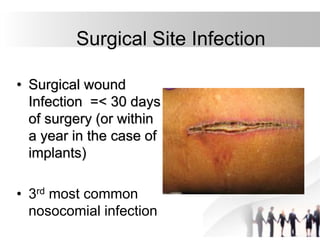
• Surgical wound
Infection =< 30 days
of surgery (or within
a year in the case of
implants)
• 3rd most common
nosocomial infection
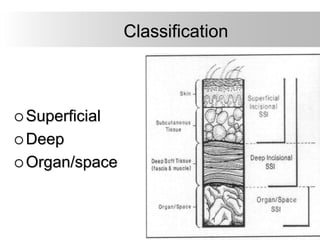
Classification
 Superficial
 Deep
 Organ/space
Superficial incisional surgical
site infections
 < 30 days of
procedure
 involve only the skin or
subcutaneous tissue
around the incision.
1. Stitch abscess (minimal inflammation and
discharge confined to the points of suture
penetration).
2. Infection of an episiotomy or newborn
circumcision site.
3. Infected burn wound.
Non- SSI:
Deep incisional surgical
site infections
 < 30 days of procedure (or
one year in the case of
implants)
 are related to the procedure
 involve deep soft tissues,
such as the fascia and
muscles.
Further Classification
• According to Etiology
a) Primary
The wound is the primary site of
infection
b)Secondary
Infection arises following a complication
that is not directly related to wound
• According to Time
a) Early
Infection presents within 30 days of
procedure
b) Intermediate
Occurs between one and three months
c) Late
Presents more than three months after
surgery
• According to Severity
a) Minor
Wound infection is described as minor
when there is discharge without cellulitis or
deep tissue destruction
b) Major
When there is pus discharge with tissue
breakdown , Partial or total dehiscence of
the deep fascial layers of wound or if
systemic illness is present.
Pathogenesis
Virulence
Bacterial dose
Impaired
host resistance
Risk Factors
 Surgical factors
 Patient-specific factors
local
systemic
Surgical Risk Factors
 Type of procedure
 Degree of contamination
 Duration of operation
 Urgency of operation
 skin preparation
 operating room environment
 Antibiotic prophylaxis
EWMA Journal 2005; 5(2): 11-15.
Patient Risk Factors
 Local:
 High bacterial load
 Wound hematoma
 Necrotic tissue
 Foreign body
 Obesity
 Systemic:
 Advanced age
 Shock
 Diabetes
 Malnutrition
 Alcoholism
 Steroids
 Chemotherapy
 Immuno-compromise
 Nicotine use
 Hospital stay 
 Transfusion
 Diabetes
 Controversial
 Patients underwent CABG
@ Increasing levels of HbA1c and SSI rates
@ Increased glucose levels (>200 mg/dL)
 Nicotine use
 Delays primary wound healing
 Increase the risk of SSI
 Steroid use
 Controversial
 Malnutrition
 Theoretical arguments: increase the SSI risk
 Two randomized clinical trials: preoperative
“nutritional therapy” did not reduce incisional and
organ/space SSI risk.
 Prolonged preoperative hospital stay
 Preoperative nares colonization with S. aureus
Mupirocin ointment: Controversial
 Perioperative transfusion
 No scientific basis
Preop factors
 Preoperative antiseptic showering
 Preoperative hair removal
 Patient skin preparation in the operating room
 Preoperative hand/forearm antisepsis
 Antimicrobial prophylaxis
 Preoperative antiseptic showering
 Decreases skin microbial colony counts
 No evidance of benefit to reduce SSI rates
 Preoperative hair removal
 Shaving:
@ immediately before the operation: SSI rates 3.1%
@ shaving within 24 hours preoperatively: 7.1%
@ having performed >24 hours: SSI rate > 20%.
 Depilatories:
@ lower SSI risk than shaving or clipping
@ hypersensitivity reactions
 Patient skin preparation in the operating room
 Most common used: Alcohol solutions
Chlorhexidine gluconate
Iodophors
 Preoperative hand/forearm antisepsis
Antimicrobial prophylaxis
1. Administer a prophylactic antimicrobial agent only when indicated, and
select it based on its efficacy agains the most common pathogens causing
SSI for a specifi operation and published recommendations.Category IA
2. Administer by the intravenous route the initialdose of prophylactic
antimicrobial agent, timed such that a bactericidal concentration of the drug
is established in serum and tissues when the incision is made. Maintain
therapeutic levels of the agent in serum and tissues throughout the
operation and until, at most, a few hours after the incision is closed in the
operating room. Category IA
3. Before elective colorectal operations in addition to d2 above, mechanically
prepare the colon by use of enemas and cathartic agents. Administer
nonabsorbable oral antimicrobial agents in divided doses on the day before
the operation. Category IA
4. For high-risk cesarean section, administer the prophylactic antimicrobial
agent immediately after the umbilical cord is clamped. Category IA
5. Do not routinely use vancomycin for antimicrobial prophylaxis. Category IB
Prophylactic antibiotics
• Class 1 = Clean
• Class 2 = Clean contaminated
• Class 3 = Contaminated
• Class 4 = Dirty infected
Prophylactic
antibiotics
indicated
Therapeutic antibiotics
Wound
Classification
Antibiotic PCN Allergy
I
1st generation
Cephalosporin
Vancomycin
Clindamycin
II-Biliary,GU,
Upper Digestive
1st generation
Cephalosporin
Vancomycin
Clindamycin
II-Distal
Digestive
2nd generation
Cephalosporin
Aztreonam and
Clindamycin/Flagyl
III/IV Generally Therapeutic
Operative characteristics
• Operating room environment
• Surgical attire and drapes
• Asepsis and surgical technique
 Operating room environment
 Ventilation
@ Positive pressure with respect to corridors and
adjacent areas
 Environmental surfaces
@ Rarely implicated as the sources of pathogens
important in the development of SSIs.
@ Important to perform routine cleaning of these surfaces
 Conventional sterilization of surgical instruments
@ Inadequate sterilization of surgical instruments has
resulted in SSI outbreaks
 Surgical attire and drapes
 The use of barriers:
@ patient: minimize exposure to the skin, mucous
membranes, or hair of surgical team members
@ surgical team members: protect from exposure to
blood and bloodborne pathogens.
 Asepsis and surgical technique
 Rigorous adherence to the principles of asepsis by all scrubbed
personnel
 Excellent surgical technique: reduce the risk of SSI.
 Drains: increase incisional SSI risk.
Postoperative issues
• Incision care
–  The type of postoperative incision care
– closed primarily: the incision is usually covered
– with a sterile dressing for 24 to 48 hours.
– left open to be closed later: the incision is packed
– with a sterile dressing.
– left open to heal by second intention: packed with
– sterile moist gauze and covered with a sterile
– dressing.
 Efflux of purulent material and pus
 Fascia is intact:
debridement
Irrigated with N/S and
packed to its base with saline-moistened gauze
 Fascia separated: drainage or reoperation
 Most SSIs: healing by secondary intention
Treatment
 The intent of discharge planning:
 maintain integrity of the healing incision,
 educate the patient about the signs and symptoms
of infection,
 advise the patient about whom to contact to report
any problems.
When to Discharge ???
Thank You

SSI 1.pptx

  • 1.
    Dr Sushil Dhungel Assist.Professor Department of Surgery KIST MCTH
  • 2.
    Surgical Site Infection •Surgical wound Infection =< 30 days of surgery (or within a year in the case of implants) • 3rd most common nosocomial infection
  • 3.
  • 4.
    Superficial incisional surgical siteinfections  < 30 days of procedure  involve only the skin or subcutaneous tissue around the incision.
  • 5.
    1. Stitch abscess(minimal inflammation and discharge confined to the points of suture penetration). 2. Infection of an episiotomy or newborn circumcision site. 3. Infected burn wound. Non- SSI:
  • 7.
    Deep incisional surgical siteinfections  < 30 days of procedure (or one year in the case of implants)  are related to the procedure  involve deep soft tissues, such as the fascia and muscles.
  • 10.
    Further Classification • Accordingto Etiology a) Primary The wound is the primary site of infection b)Secondary Infection arises following a complication that is not directly related to wound
  • 11.
    • According toTime a) Early Infection presents within 30 days of procedure b) Intermediate Occurs between one and three months c) Late Presents more than three months after surgery
  • 12.
    • According toSeverity a) Minor Wound infection is described as minor when there is discharge without cellulitis or deep tissue destruction b) Major When there is pus discharge with tissue breakdown , Partial or total dehiscence of the deep fascial layers of wound or if systemic illness is present.
  • 14.
  • 15.
    Risk Factors  Surgicalfactors  Patient-specific factors local systemic
  • 16.
    Surgical Risk Factors Type of procedure  Degree of contamination  Duration of operation  Urgency of operation  skin preparation  operating room environment  Antibiotic prophylaxis EWMA Journal 2005; 5(2): 11-15.
  • 17.
    Patient Risk Factors Local:  High bacterial load  Wound hematoma  Necrotic tissue  Foreign body  Obesity  Systemic:  Advanced age  Shock  Diabetes  Malnutrition  Alcoholism  Steroids  Chemotherapy  Immuno-compromise  Nicotine use  Hospital stay   Transfusion
  • 18.
     Diabetes  Controversial Patients underwent CABG @ Increasing levels of HbA1c and SSI rates @ Increased glucose levels (>200 mg/dL)  Nicotine use  Delays primary wound healing  Increase the risk of SSI  Steroid use  Controversial
  • 19.
     Malnutrition  Theoreticalarguments: increase the SSI risk  Two randomized clinical trials: preoperative “nutritional therapy” did not reduce incisional and organ/space SSI risk.  Prolonged preoperative hospital stay  Preoperative nares colonization with S. aureus Mupirocin ointment: Controversial  Perioperative transfusion  No scientific basis
  • 20.
    Preop factors  Preoperativeantiseptic showering  Preoperative hair removal  Patient skin preparation in the operating room  Preoperative hand/forearm antisepsis  Antimicrobial prophylaxis
  • 21.
     Preoperative antisepticshowering  Decreases skin microbial colony counts  No evidance of benefit to reduce SSI rates  Preoperative hair removal  Shaving: @ immediately before the operation: SSI rates 3.1% @ shaving within 24 hours preoperatively: 7.1% @ having performed >24 hours: SSI rate > 20%.  Depilatories: @ lower SSI risk than shaving or clipping @ hypersensitivity reactions
  • 22.
     Patient skinpreparation in the operating room  Most common used: Alcohol solutions Chlorhexidine gluconate Iodophors  Preoperative hand/forearm antisepsis
  • 23.
    Antimicrobial prophylaxis 1. Administera prophylactic antimicrobial agent only when indicated, and select it based on its efficacy agains the most common pathogens causing SSI for a specifi operation and published recommendations.Category IA 2. Administer by the intravenous route the initialdose of prophylactic antimicrobial agent, timed such that a bactericidal concentration of the drug is established in serum and tissues when the incision is made. Maintain therapeutic levels of the agent in serum and tissues throughout the operation and until, at most, a few hours after the incision is closed in the operating room. Category IA 3. Before elective colorectal operations in addition to d2 above, mechanically prepare the colon by use of enemas and cathartic agents. Administer nonabsorbable oral antimicrobial agents in divided doses on the day before the operation. Category IA 4. For high-risk cesarean section, administer the prophylactic antimicrobial agent immediately after the umbilical cord is clamped. Category IA 5. Do not routinely use vancomycin for antimicrobial prophylaxis. Category IB
  • 24.
    Prophylactic antibiotics • Class1 = Clean • Class 2 = Clean contaminated • Class 3 = Contaminated • Class 4 = Dirty infected Prophylactic antibiotics indicated Therapeutic antibiotics
  • 25.
    Wound Classification Antibiotic PCN Allergy I 1stgeneration Cephalosporin Vancomycin Clindamycin II-Biliary,GU, Upper Digestive 1st generation Cephalosporin Vancomycin Clindamycin II-Distal Digestive 2nd generation Cephalosporin Aztreonam and Clindamycin/Flagyl III/IV Generally Therapeutic
  • 26.
    Operative characteristics • Operatingroom environment • Surgical attire and drapes • Asepsis and surgical technique
  • 27.
     Operating roomenvironment  Ventilation @ Positive pressure with respect to corridors and adjacent areas  Environmental surfaces @ Rarely implicated as the sources of pathogens important in the development of SSIs. @ Important to perform routine cleaning of these surfaces  Conventional sterilization of surgical instruments @ Inadequate sterilization of surgical instruments has resulted in SSI outbreaks
  • 28.
     Surgical attireand drapes  The use of barriers: @ patient: minimize exposure to the skin, mucous membranes, or hair of surgical team members @ surgical team members: protect from exposure to blood and bloodborne pathogens.  Asepsis and surgical technique  Rigorous adherence to the principles of asepsis by all scrubbed personnel  Excellent surgical technique: reduce the risk of SSI.  Drains: increase incisional SSI risk.
  • 29.
    Postoperative issues • Incisioncare –  The type of postoperative incision care – closed primarily: the incision is usually covered – with a sterile dressing for 24 to 48 hours. – left open to be closed later: the incision is packed – with a sterile dressing. – left open to heal by second intention: packed with – sterile moist gauze and covered with a sterile – dressing.
  • 30.
     Efflux ofpurulent material and pus  Fascia is intact: debridement Irrigated with N/S and packed to its base with saline-moistened gauze  Fascia separated: drainage or reoperation  Most SSIs: healing by secondary intention Treatment
  • 31.
     The intentof discharge planning:  maintain integrity of the healing incision,  educate the patient about the signs and symptoms of infection,  advise the patient about whom to contact to report any problems. When to Discharge ???
  • 32.