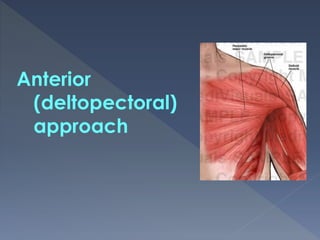
Anterior
(deltopectoral)
approach
Uses
 Any anterior shoulder
surgery, e.g.
› Capsular shift &
dislocation procedures
› Proximal humerus
fracture work
› Shoulder arthroplasty
› Long head of biceps
repair
› Subscapularis repair
Uses
 This approach is preferred for shoulder
arthroplasty and for plate-and-screw
fixation of proximal humeral fractures
because it affords greater visualization
than does the lateral approach.
Internervous Plane
 Deltoid (axillary)
 Pectoralis major (medial/lateral
pectoral)
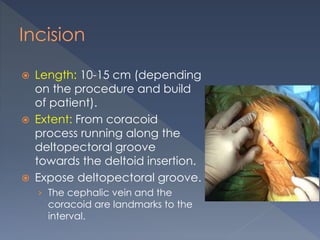
Incision
 Length: 10-15 cm (depending
on the procedure and build
of patient).
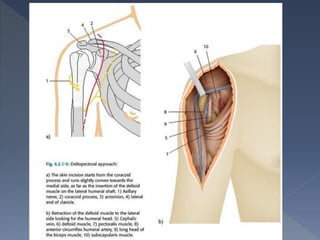
 Extent: From coracoid
process running along the
deltopectoral groove
towards the deltoid insertion.
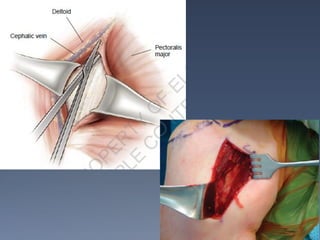
 Expose deltopectoral groove.
› The cephalic vein and the
coracoid are landmarks to the
interval.
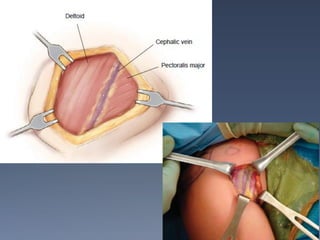
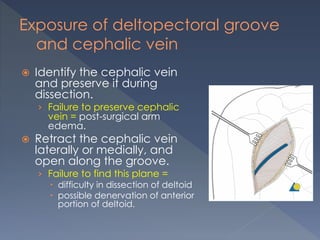
Exposure of deltopectoral groove
and cephalic vein
 Identify the cephalic vein
and preserve it during
dissection.
› Failure to preserve cephalic
vein = post-surgical arm
edema.
 Retract the cephalic vein
laterally or medially, and
open along the groove.
› Failure to find this plane =
 difficulty in dissection of deltoid
 possible denervation of anterior
portion of deltoid.
 Laterally reflect the anterior part of
deltoid to expose the underlying
coracoid process and joint capsule.
Identification of the tuberosities and
the humeral head fragments
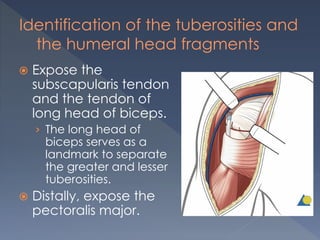
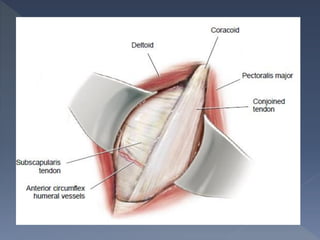
 Expose the
subscapularis tendon
and the tendon of
long head of biceps.
› The long head of
biceps serves as a
landmark to separate
the greater and lesser
tuberosities.
 Distally, expose the
pectoralis major.
Pearl:
 If a wider exposure is necessary, place
ethibond stay sutures (c.3) into the
medial aspect of the last centimeter of
the subscapuaris tendon, and partially
divide it laterally to this.
 External rotation of the shoulder during
subscapularis release moves the
dissection away from the axillary nerve
and decreases tension on the nerve.
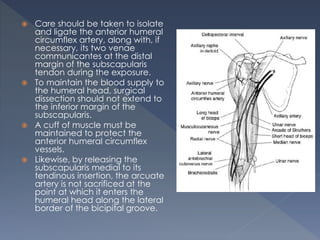
 Care should be taken to isolate
and ligate the anterior humeral
circumflex artery, along with, if
necessary, its two venae
communicantes at the distal
margin of the subscapularis
tendon during the exposure.
 To maintain the blood supply to
the humeral head, surgical
dissection should not extend to
the inferior margin of the
subscapularis.
 A cuff of muscle must be
maintained to protect the
anterior humeral circumflex
vessels.
 Likewise, by releasing the
subscapularis medial to its
tendinous insertion, the arcuate
artery is not sacrificed at the
point at which it enters the
humeral head along the lateral
border of the bicipital groove.
Pitfall:
 The musculocutaneous nerve enters the
coracobrachialis muscle as close as 2.5
cm distal to the tip of coracoid.
› Retractors placed under the conjoint tendon
can cause neuropraxia; therefore vigorous
retraction must be avoided.
 If more extensive exposure is required,
pre drill the coracoid and remove the tip
with an osteotome.
Structures at risk
 Superiorly: Acromial branch of
thoracoacromial artery:
› Lies in the medial aspect of coracoacromial
ligament.
 Inferiorly: Musculocutaneous nerve:
› Comes out and enters the biceps approx. 5 cm distal
to the coracoid.
› Usually not cut, but can be retracted and damaged
with the retraction.
› Dissection medial to the conjoint tendon should be
avoided because it places the musculocutaneous
nerve at risk.
Structures at risk
 Axillary nerve:
› The axillary nerve should be palpated as it passes
inferior to the subscapularis and the inferior capsule,
and it should be protected throughout the
procedure.
› A retractor placed below the subscapularis and the
capsule puts this nerve in grave danger.
 Cephalic vein:
› Can also be damaged if not identified and
protected as the deltopectoral groove is being
developed.
Tricks
 Find the deltopectoral groove and take
whichever vein seems easiest (typically
laterally).
 The coracoid is the best landmark for the
short head of biceps; split the fascia in
that direction, which will get you into the
interval between the 2 heads.
Tricks
 Put a stay suture in the subscapularis
prior to cutting it free from the humeral
head so that it does not retract out of
the way.
 Feel the shoulder joint and the glenoid
edge prior to doing the capsulotomy, so
you can place it correctly for whatever
procedure you are attempting to do.
› This is especially important when attempting
to do instability procedures.
Extension
 When a greater exposure of the lateral
humeral shaft is needed, less than one
fifth of the anterior deltoid insertion can
be released.
 Distal extension may be accomplished
via the anterolateral approach to the
humerus.
The deltopectoral approach

The deltopectoral approach

  • 1.
  • 2.
    Uses  Any anteriorshoulder surgery, e.g. › Capsular shift & dislocation procedures › Proximal humerus fracture work › Shoulder arthroplasty › Long head of biceps repair › Subscapularis repair
  • 3.
    Uses  This approachis preferred for shoulder arthroplasty and for plate-and-screw fixation of proximal humeral fractures because it affords greater visualization than does the lateral approach.
  • 4.
    Internervous Plane  Deltoid(axillary)  Pectoralis major (medial/lateral pectoral)
  • 5.
    Incision  Length: 10-15cm (depending on the procedure and build of patient).  Extent: From coracoid process running along the deltopectoral groove towards the deltoid insertion.  Expose deltopectoral groove. › The cephalic vein and the coracoid are landmarks to the interval.
  • 7.
    Exposure of deltopectoralgroove and cephalic vein  Identify the cephalic vein and preserve it during dissection. › Failure to preserve cephalic vein = post-surgical arm edema.  Retract the cephalic vein laterally or medially, and open along the groove. › Failure to find this plane =  difficulty in dissection of deltoid  possible denervation of anterior portion of deltoid.
  • 9.
     Laterally reflectthe anterior part of deltoid to expose the underlying coracoid process and joint capsule.
  • 11.
    Identification of thetuberosities and the humeral head fragments  Expose the subscapularis tendon and the tendon of long head of biceps. › The long head of biceps serves as a landmark to separate the greater and lesser tuberosities.  Distally, expose the pectoralis major.
  • 13.
    Pearl:  If awider exposure is necessary, place ethibond stay sutures (c.3) into the medial aspect of the last centimeter of the subscapuaris tendon, and partially divide it laterally to this.  External rotation of the shoulder during subscapularis release moves the dissection away from the axillary nerve and decreases tension on the nerve.
  • 14.
     Care shouldbe taken to isolate and ligate the anterior humeral circumflex artery, along with, if necessary, its two venae communicantes at the distal margin of the subscapularis tendon during the exposure.  To maintain the blood supply to the humeral head, surgical dissection should not extend to the inferior margin of the subscapularis.  A cuff of muscle must be maintained to protect the anterior humeral circumflex vessels.  Likewise, by releasing the subscapularis medial to its tendinous insertion, the arcuate artery is not sacrificed at the point at which it enters the humeral head along the lateral border of the bicipital groove.
  • 15.
    Pitfall:  The musculocutaneousnerve enters the coracobrachialis muscle as close as 2.5 cm distal to the tip of coracoid. › Retractors placed under the conjoint tendon can cause neuropraxia; therefore vigorous retraction must be avoided.
  • 16.
     If moreextensive exposure is required, pre drill the coracoid and remove the tip with an osteotome.
  • 17.
    Structures at risk Superiorly: Acromial branch of thoracoacromial artery: › Lies in the medial aspect of coracoacromial ligament.  Inferiorly: Musculocutaneous nerve: › Comes out and enters the biceps approx. 5 cm distal to the coracoid. › Usually not cut, but can be retracted and damaged with the retraction. › Dissection medial to the conjoint tendon should be avoided because it places the musculocutaneous nerve at risk.
  • 18.
    Structures at risk Axillary nerve: › The axillary nerve should be palpated as it passes inferior to the subscapularis and the inferior capsule, and it should be protected throughout the procedure. › A retractor placed below the subscapularis and the capsule puts this nerve in grave danger.  Cephalic vein: › Can also be damaged if not identified and protected as the deltopectoral groove is being developed.
  • 19.
    Tricks  Find thedeltopectoral groove and take whichever vein seems easiest (typically laterally).  The coracoid is the best landmark for the short head of biceps; split the fascia in that direction, which will get you into the interval between the 2 heads.
  • 20.
    Tricks  Put astay suture in the subscapularis prior to cutting it free from the humeral head so that it does not retract out of the way.  Feel the shoulder joint and the glenoid edge prior to doing the capsulotomy, so you can place it correctly for whatever procedure you are attempting to do. › This is especially important when attempting to do instability procedures.
  • 21.
    Extension  When agreater exposure of the lateral humeral shaft is needed, less than one fifth of the anterior deltoid insertion can be released.  Distal extension may be accomplished via the anterolateral approach to the humerus.