Damage Control Orthopaedics
Mohamed Abulsoud (M.D)
Lecturer of orthopedic surgery
Faculty of medicine – Al-Azhar university
Cairo- Egypt
Damage control orthopaedics is an approach that
contains and stabilizes orthopaedic injuries so that
the patient’s overall physiology can improve.
Its purpose is to avoid worsening of the patient’s
condition by the “second hit” of a major
orthopaedic procedure and to delay definitive
fracture repair until a time when the overall
condition of the patient is optimized.
Introduction
Damage control focuses
• control of hemorrhage,
• management of soft-tissue injury,
• achievement of provisional fracture stability,
while avoiding additional insults to the
patient.
Introduction
• The term damage control
was borrowed from a
traditional Navy term and
philosophy.
• Temporary measures are
used to limit further damage
and stabilize the ship to
allow for a thorough
assessment of the damage
and development of a
comprehensive strategy for
definitive repair
Historical overview
Evolution
• The advent of damage control orthopedics
(DCO) in the late 1990s and early 2000s
represented a major shift if philosophy for the
treatment of orthopedic injuries in severely
injured trauma patients.
• In the 1960s delayed fixation of long bone
fractures was recommended. Immediate
stabilization was associated with mortality rates
up to 50% due to perioperative pulmonary and
cardiovascular complication.
• Patients with long bone fractures were treated
with traction or splinting for 10–14 days, until the
effects of fat embolism syndrome resolved and
pulmonary, cardiovascular, neurovascular and
coagulation systems had stabilized.
Evolution
• In the 1980s, a major shift occurred in the
treatment of long bone fractures in multiply
injured trauma patients.
• There is a beneficial effect of early
stabilization of fractures on both mortality and
morbidity and length of hospital stay.
• This new philosophy in the management of
the patient with multiple injuries was named
Early Total Care ( ETC ).
Evolution
• In early 1990s, Outcome after ETC – increased
incidence of adult respiratory distress
syndrome ARDS and multiple organ failure
(M.O.F)
• These complications mainly developed in
patients with severe chest injuries, severe
hemodynamic shock and in cases post reamed
intramedullary nailing without thoracic
trauma.
Evolution
• Polytrauma
• Polytrauma is a syndrome of multiple injuries
exceeding a defined severity (ISS ≥ 17) with
sequential systemic reactions that may lead to
dysfunction or failure of remote organs and
vital systems, which have not themselves been
directly injured
Definitions
Definitions
Definitions
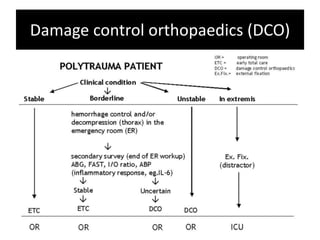
• Stable patients have no immediately life-threatening
injuries and respond to initial therapy.
• Borderline patients have stabilized in response to
initial resuscitative attempts but sustained injuries that
put them at risk of rapid deterioration .
• Unstable patients remain hemodynamically unstable
despite initial intervention and are at high risk for clinical
complications.
• Patients in extremis have ongoing uncontrolled blood
loss despite resuscitation and may die if blood loss is
not immediately stopped.
Definitions
Borderline patients
• Polytrauma + ISS > 20 + thoracic trauma (AIS > 2)
• Polytrauma + abdominal/pelvic trauma + hemorrhagic shock
(initial SBP < 90 mmHg)
• ISS > 40, without additional thoracic trauma
• Initial mean pulmonary arterial pressure > 24 mmHg
• Increase of pulmonary arterial pressure during
Intramedullary nailing of > 6 mmHg
• Bilateral femoral fractures
• Radiographic evidence of pulmonary contusion
• Hypothermia ( < 35C)
• Additional moderate or severe head injuries(AIS ≥ 3)
• Early total care (ETC): a concept implying the primary
definitive management of all major injuries within 24
hours after trauma
• Damage control orthopedics (DCO): minimally invasive
surgical techniques are used for the primary stabilization
of all major fractures. Based upon the patient’s
physiological status, temporary stabilization with external
fixation for certain fractures is used.
Definitions
Pathophysiology
• Traumatic injury leads to
systemic inflammation
(systemic inflammatory
response syndrome) followed
by a period of recovery
mediated by a counter-
regulatory anti-inflammatory
response.
• Within this inflammatory
process, there is a fine balance
between the inflammation
and the potential for the
process to cause and
aggravate tissue injury leading
to ARDS and MODS
• The First and Second-Hit Phenomena
• First hit phenomenon :- The body response by
stimulation of a variety of inflammatory
mediators in the immediate aftermath of
trauma
• IL-6 and HLA-DR class-II molecules(ICAM-1 e-
selectin and CD11b), accurately predict the
clinical course and outcome after trauma.
Pathophysiology
• the ratio of IL-6 to IL-10 was found to correlate
with injury severity after major trauma, and
this ratio was recommended as a useful
marker to predict the degree of injury
following trauma
Pathophysiology
• Second hit :-
• Another trauma during the acute phase
• major surgery
• adverse event during ICU treatment
• septic stimulus
Pathophysiology
Pathophysiology
The Lethal triad
Coagulopathy
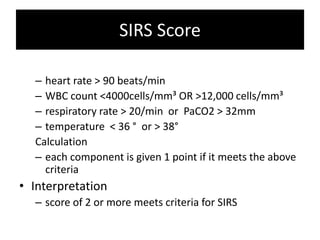
– heart rate > 90 beats/min
– WBC count <4000cells/mm³ OR >12,000 cells/mm³
– respiratory rate > 20/min or PaCO2 > 32mm
– temperature < 36 ° or > 38°
Calculation
– each component is given 1 point if it meets the above
criteria
• Interpretation
– score of 2 or more meets criteria for SIRS
SIRS Score
Management
Management
1-Resuscitation
Goals to be achieved by damage control surgery
Management
Damage control orthopaedics (DCO)
The general aims and scopes for fracture
management are:
• control of hemorrhage;
• control of sources of contamination, removal
of dead tissue,
• prevention of ischemia-reperfusion injury;
• pain relief;
• facilitation of intensive care.
Damage control orthopaedics (DCO)
• Damage Control and Pelvic Ring Injuries
• exsanguinating hemorrhage is the major cause
of death in multiply injured patients with
pelvic ring disruptions.
• Concomitant bowel injury places these
fractures at high risk for infection and the
need for access to the abdomen for visceral or
genitourinary system injuries may limit the
treatment options .
Damage control orthopaedics (DCO)
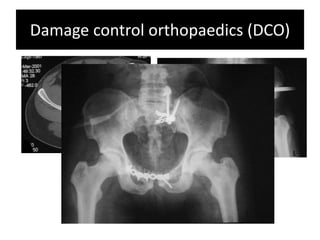
• Damage control treatment in
pelvic ring injury
• sheet or pelvic binder, placed at the level
of the greater trochanters
• External Fixator
• C-Clamp
• Iliosacral screw
• Sacral bar (in stable and borderline pts)
• Angiography and embolization
Damage control orthopaedics (DCO)
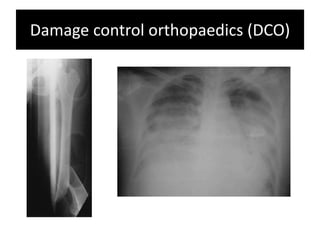
• Damage control treatment for long
bones fractures
• Long bones fractures in a multiply
injured patient are not automatically
treated with intramedullary nailing
because of concerns about the
second hit of such a procedure
• patients with pulmonary injury
should undergo unreamed nailing to
avoid increased risk of ARDS.
Damage control orthopaedics (DCO)
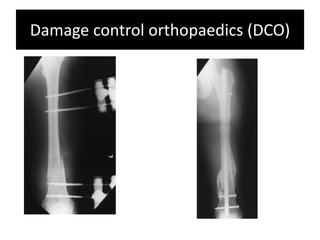
• Bilateral femoral fracture is a
unique scenario in polytrauma
that is associated with a higher
mortality rate and incidence of
ARDS than is a unilateral femoral
fracture.
• the use of external fixation as a
temporizing measure allows for
the advantages of rigid fixation
without the risk of hypotension
and hypoxia associated with IMN
in seriously injured patients.
Damage control orthopaedics (DCO)
• 776 patients with unilateral and 118 patients
with bilateral femoral shaft fractures.
• Patients with bilateral femoral shaft fractures had
• Higher Injury Severity Score (ISS) (29.5 vs. 25.7
points),
• Higher incidence of ARDS (34.7% vs. 20.6%)
multiple organ failure (25.0% vs. 14.6%)
• Higher mortality rate (16.9% vs. 9.4%).
• Early fixation of long-bone fractures—
especially of the femoral shaft—in
polytrauma:
• facilitation of nursing care;
• early mobilization with improved pulmonary
function;
• shorter time on the ventilator;
• reduced morbidity and mortality
Damage control orthopaedics (DCO)
• External fixation of femur-
• 35 minutes
• 90 ml blood loss
• Intramedullary nailing of
femur-
• 130 minutes
• 400 ml blood loss
• Scales et al., 2000
Damage control orthopaedics (DCO)
• Damage control in spine trauma
• Spinal trauma range from 13% to 30% of
spinal injuries in polytraumatized patients.
• Injuries of the spine originate from motor
vehicle accidents and incidental as well as fall
from height in most cases
Damage control orthopaedics (DCO)
EAP
• Early Appropriate Care
– Acceptance different patients respond differently
to first and second hits
– Consider severity of initial injury
– Consider response to resuscitation
– What further surgery required
– Continued re assessment and ability to change
from ETO TO DCO
• Damage control orthopaedics is an approach
that contains and stabilizes orthopaedic
injuries so that the patient’s overall
physiology can improve.
• In damage control for trauma patients, the
main target is to perform temporary
operative procedures to provide time for
physiologic stabilization before definitive
surgical care.
Take home message
• Acidosis,hypothermia and coagulopathy are
called The lethal triad
• Measures to prevent and revert those triad
are of priority
• The use of external fixators , pelvic
stabilization and percutaneus pedicle screw
fixation should be considered in
polytraumatized patients in the first 24 hours
Take home message

Damage control orthopaedic surgery

  • 1.
    Damage Control Orthopaedics MohamedAbulsoud (M.D) Lecturer of orthopedic surgery Faculty of medicine – Al-Azhar university Cairo- Egypt
  • 2.
    Damage control orthopaedicsis an approach that contains and stabilizes orthopaedic injuries so that the patient’s overall physiology can improve. Its purpose is to avoid worsening of the patient’s condition by the “second hit” of a major orthopaedic procedure and to delay definitive fracture repair until a time when the overall condition of the patient is optimized. Introduction
  • 3.
    Damage control focuses •control of hemorrhage, • management of soft-tissue injury, • achievement of provisional fracture stability, while avoiding additional insults to the patient. Introduction
  • 4.
    • The termdamage control was borrowed from a traditional Navy term and philosophy. • Temporary measures are used to limit further damage and stabilize the ship to allow for a thorough assessment of the damage and development of a comprehensive strategy for definitive repair Historical overview
  • 5.
    Evolution • The adventof damage control orthopedics (DCO) in the late 1990s and early 2000s represented a major shift if philosophy for the treatment of orthopedic injuries in severely injured trauma patients.
  • 6.
    • In the1960s delayed fixation of long bone fractures was recommended. Immediate stabilization was associated with mortality rates up to 50% due to perioperative pulmonary and cardiovascular complication. • Patients with long bone fractures were treated with traction or splinting for 10–14 days, until the effects of fat embolism syndrome resolved and pulmonary, cardiovascular, neurovascular and coagulation systems had stabilized. Evolution
  • 7.
    • In the1980s, a major shift occurred in the treatment of long bone fractures in multiply injured trauma patients. • There is a beneficial effect of early stabilization of fractures on both mortality and morbidity and length of hospital stay. • This new philosophy in the management of the patient with multiple injuries was named Early Total Care ( ETC ). Evolution
  • 8.
    • In early1990s, Outcome after ETC – increased incidence of adult respiratory distress syndrome ARDS and multiple organ failure (M.O.F) • These complications mainly developed in patients with severe chest injuries, severe hemodynamic shock and in cases post reamed intramedullary nailing without thoracic trauma. Evolution
  • 9.
    • Polytrauma • Polytraumais a syndrome of multiple injuries exceeding a defined severity (ISS ≥ 17) with sequential systemic reactions that may lead to dysfunction or failure of remote organs and vital systems, which have not themselves been directly injured Definitions
  • 11.
  • 12.
    Definitions • Stable patientshave no immediately life-threatening injuries and respond to initial therapy. • Borderline patients have stabilized in response to initial resuscitative attempts but sustained injuries that put them at risk of rapid deterioration . • Unstable patients remain hemodynamically unstable despite initial intervention and are at high risk for clinical complications. • Patients in extremis have ongoing uncontrolled blood loss despite resuscitation and may die if blood loss is not immediately stopped.
  • 13.
  • 14.
    Borderline patients • Polytrauma+ ISS > 20 + thoracic trauma (AIS > 2) • Polytrauma + abdominal/pelvic trauma + hemorrhagic shock (initial SBP < 90 mmHg) • ISS > 40, without additional thoracic trauma • Initial mean pulmonary arterial pressure > 24 mmHg • Increase of pulmonary arterial pressure during Intramedullary nailing of > 6 mmHg • Bilateral femoral fractures • Radiographic evidence of pulmonary contusion • Hypothermia ( < 35C) • Additional moderate or severe head injuries(AIS ≥ 3)
  • 15.
    • Early totalcare (ETC): a concept implying the primary definitive management of all major injuries within 24 hours after trauma • Damage control orthopedics (DCO): minimally invasive surgical techniques are used for the primary stabilization of all major fractures. Based upon the patient’s physiological status, temporary stabilization with external fixation for certain fractures is used. Definitions
  • 16.
    Pathophysiology • Traumatic injuryleads to systemic inflammation (systemic inflammatory response syndrome) followed by a period of recovery mediated by a counter- regulatory anti-inflammatory response. • Within this inflammatory process, there is a fine balance between the inflammation and the potential for the process to cause and aggravate tissue injury leading to ARDS and MODS
  • 17.
    • The Firstand Second-Hit Phenomena • First hit phenomenon :- The body response by stimulation of a variety of inflammatory mediators in the immediate aftermath of trauma • IL-6 and HLA-DR class-II molecules(ICAM-1 e- selectin and CD11b), accurately predict the clinical course and outcome after trauma. Pathophysiology
  • 18.
    • the ratioof IL-6 to IL-10 was found to correlate with injury severity after major trauma, and this ratio was recommended as a useful marker to predict the degree of injury following trauma Pathophysiology
  • 19.
    • Second hit:- • Another trauma during the acute phase • major surgery • adverse event during ICU treatment • septic stimulus Pathophysiology
  • 20.
  • 21.
  • 22.
    – heart rate> 90 beats/min – WBC count <4000cells/mm³ OR >12,000 cells/mm³ – respiratory rate > 20/min or PaCO2 > 32mm – temperature < 36 ° or > 38° Calculation – each component is given 1 point if it meets the above criteria • Interpretation – score of 2 or more meets criteria for SIRS SIRS Score
  • 23.
  • 24.
  • 25.
    Goals to beachieved by damage control surgery Management
  • 26.
  • 27.
  • 28.
    The general aimsand scopes for fracture management are: • control of hemorrhage; • control of sources of contamination, removal of dead tissue, • prevention of ischemia-reperfusion injury; • pain relief; • facilitation of intensive care. Damage control orthopaedics (DCO)
  • 29.
    • Damage Controland Pelvic Ring Injuries • exsanguinating hemorrhage is the major cause of death in multiply injured patients with pelvic ring disruptions. • Concomitant bowel injury places these fractures at high risk for infection and the need for access to the abdomen for visceral or genitourinary system injuries may limit the treatment options . Damage control orthopaedics (DCO)
  • 30.
    • Damage controltreatment in pelvic ring injury • sheet or pelvic binder, placed at the level of the greater trochanters • External Fixator • C-Clamp • Iliosacral screw • Sacral bar (in stable and borderline pts) • Angiography and embolization Damage control orthopaedics (DCO)
  • 31.
  • 32.
    • Damage controltreatment for long bones fractures • Long bones fractures in a multiply injured patient are not automatically treated with intramedullary nailing because of concerns about the second hit of such a procedure • patients with pulmonary injury should undergo unreamed nailing to avoid increased risk of ARDS. Damage control orthopaedics (DCO)
  • 33.
    • Bilateral femoralfracture is a unique scenario in polytrauma that is associated with a higher mortality rate and incidence of ARDS than is a unilateral femoral fracture. • the use of external fixation as a temporizing measure allows for the advantages of rigid fixation without the risk of hypotension and hypoxia associated with IMN in seriously injured patients. Damage control orthopaedics (DCO)
  • 34.
    • 776 patientswith unilateral and 118 patients with bilateral femoral shaft fractures. • Patients with bilateral femoral shaft fractures had • Higher Injury Severity Score (ISS) (29.5 vs. 25.7 points), • Higher incidence of ARDS (34.7% vs. 20.6%) multiple organ failure (25.0% vs. 14.6%) • Higher mortality rate (16.9% vs. 9.4%).
  • 35.
    • Early fixationof long-bone fractures— especially of the femoral shaft—in polytrauma: • facilitation of nursing care; • early mobilization with improved pulmonary function; • shorter time on the ventilator; • reduced morbidity and mortality Damage control orthopaedics (DCO)
  • 36.
    • External fixationof femur- • 35 minutes • 90 ml blood loss • Intramedullary nailing of femur- • 130 minutes • 400 ml blood loss • Scales et al., 2000 Damage control orthopaedics (DCO)
  • 37.
  • 38.
  • 41.
    • Damage controlin spine trauma • Spinal trauma range from 13% to 30% of spinal injuries in polytraumatized patients. • Injuries of the spine originate from motor vehicle accidents and incidental as well as fall from height in most cases Damage control orthopaedics (DCO)
  • 42.
  • 43.
    EAP • Early AppropriateCare – Acceptance different patients respond differently to first and second hits – Consider severity of initial injury – Consider response to resuscitation – What further surgery required – Continued re assessment and ability to change from ETO TO DCO
  • 44.
    • Damage controlorthopaedics is an approach that contains and stabilizes orthopaedic injuries so that the patient’s overall physiology can improve. • In damage control for trauma patients, the main target is to perform temporary operative procedures to provide time for physiologic stabilization before definitive surgical care. Take home message
  • 45.
    • Acidosis,hypothermia andcoagulopathy are called The lethal triad • Measures to prevent and revert those triad are of priority • The use of external fixators , pelvic stabilization and percutaneus pedicle screw fixation should be considered in polytraumatized patients in the first 24 hours Take home message