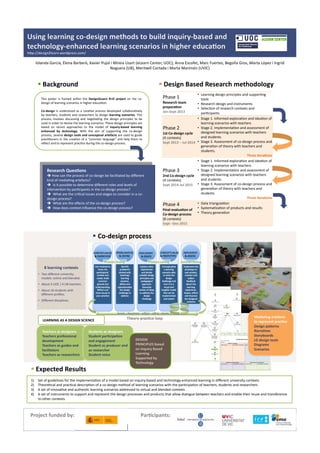
Iolanda	
  Garcia,	
  Elena	
  Barberà,	
  Xavier	
  Pujol	
  i	
  Mireia	
  Usart	
  (eLearn	
  Center,	
  UOC);	
  Anna	
  Escofet,	
  Marc	
  Fuertes,	
  Begoña	
  Gros,	
  Marta	
  López	
  i	
  Ingrid	
  
Noguera	
  (UB),	
  Meritxell	
  Cortada	
  i	
  Marta	
  Marimón	
  (UVIC)	


 	
  Design	
  Based	
  Research	
  methodology	
  

 	
  Background	
  
This	
   poster	
   is	
   framed	
   within	
   the	
   Design2Learn	
   R+D	
   project	
   on	
   the	
   co-­‐
design	
  of	
  learning	
  scenarios	
  in	
  higher	
  educaQon.	
  
Co-­‐design	
   is	
   understood	
   as	
   a	
   creaQve	
   process	
   developed	
   collaboraQvely	
  
by	
   teachers,	
   students	
   and	
   researchers	
   to	
   design	
   learning	
  scenarios.	
   This	
  
process	
   involves	
   discussing	
   and	
   negoQaQng	
   the	
   design	
   principles	
   to	
   be	
  
used	
  in	
  order	
  to	
  devise	
  the	
  learning	
  scenarios.	
  These	
  design	
  principles	
  are	
  
based	
   on	
   recent	
   approaches	
   to	
   the	
   model	
   of	
   inquiry-­‐based	
   learning	
  
enhanced	
   by	
   technology.	
   With	
   the	
   aim	
   of	
   supporQng	
   the	
   co-­‐design	
  
process,	
  several	
  design	
  tools	
  and	
  conceptual	
  artefacts	
  are	
  used	
  to	
  guide	
  
pracQQoners	
   in	
   the	
   creaQon	
   of	
   a	
   “common	
   language”	
   and	
   help	
   them	
   to	
  
reflect	
  and	
  to	
  represent	
  pracQce	
  during	
  the	
  co-­‐design	
  process.	
  

Research	
  Ques1ons	
  

	
  How	
  can	
  the	
  process	
  of	
  co-­‐design	
  be	
  facilitated	
  by	
  different	
  
kind	
  of	
  mediaQng	
  artefacts?	
  	
  
  Is	
  it	
  possible	
  to	
  determine	
  different	
  roles	
  and	
  levels	
  of	
  
intervenQon	
  by	
  parQcipants	
  in	
  the	
  co-­‐design	
  process?	
  
  What	
  are	
  the	
  criQcal	
  issues	
  and	
  stages	
  to	
  consider	
  in	
  a	
  co-­‐
design	
  process?	
  
  What	
  are	
  the	
  effects	
  of	
  the	
  co-­‐design	
  process?	
  
  How	
  does	
  context	
  influence	
  the	
  co-­‐design	
  process?	
  

Phase	
  1	
  

Research	
  team	
  
prepara1on	
  
Jan-­‐Sept	
  2013	
  

Phase	
  2	


1st	
  Co-­‐design	
  cycle	
  	
  
(4	
  contexts)	
  
Sept	
  2013	
  –	
  Jul	
  2014	
  

Phase	
  3	


2nd	
  Co-­‐design	
  cycle	
  
(4	
  contexts)	
  
Sept	
  2014-­‐Jul	
  2015	
  

Phase	
  4	


Final	
  evalua1on	
  of	


Co-­‐design	
  process	
  	
  
(8	
  contexts)	
  
Sept	
  –Des	
  2015	
  

•  Learning	
  design	
  principles	
  and	
  supporQng	
  
tools	
  
•  Research	
  design	
  and	
  instruments	
  
•  SelecQon	
  of	
  research	
  contexts	
  and	
  
parQcipants	
  
•  Stage	
  1.	
  Informed	
  exploraQon	
  and	
  ideaQon	
  of	
  
learning	
  scenarios	
  with	
  teachers	
  
•  Stage	
  2.	
  ImplementaQon	
  and	
  assessment	
  of	
  
designed	
  learning	
  scenarios	
  with	
  teachers	
  
and	
  students	
  
•  Stage	
  3.	
  Assessment	
  of	
  co-­‐design	
  process	
  and	
  
generaQon	
  of	
  theory	
  with	
  teachers	
  and	
  
students.	
  
Three	
  itera1ons	
  
•  Stage	
  1.	
  Informed	
  exploraQon	
  and	
  ideaQon	
  of	
  
learning	
  scenarios	
  with	
  teachers	
  
•  Stage	
  2.	
  ImplementaQon	
  and	
  assessment	
  of	
  
designed	
  learning	
  scenarios	
  with	
  teachers	
  
and	
  students	
  
•  Stage	
  3.	
  Assessment	
  of	
  co-­‐design	
  process	
  and	
  
generaQon	
  of	
  theory	
  with	
  teachers	
  and	
  
students	
  
Three	
  itera1ons	
  
•  Data	
  triangulaQon	
  
•  SystemaQzaQon	
  of	
  products	
  and	
  results	
  
•  Theory	
  generaQon	
  

  Co-­‐design	
  process	
  

8	
  learning	
  contexts	
  	
  
•  Two	
  different	
  university	
  
models:	
  online	
  and	
  blended.	


•  About	
  4	
  UOC	
  /	
  4	
  UB	
  teachers	
  .	
  
•  About	
  16	
  students	
  with	
  
different	
  profiles.	
  
•  Different	
  disciplines.	
  

Media1ng	
  artefacts	
  
to	
  represent	
  prac1ce	
  
Design	
  paSerns	


Narra1ves	
  
Storyboards	
  	
  
LD	
  design	
  tools	
  
Diagrams	
  
Scenarios	
  

LEARNING	
  AS	
  A	
  DESIGN	
  SCIENCE	
  
Teachers	
  as	
  designers	
  
Teachers	
  professional	
  
development	
  
Teachers	
  as	
  guides	
  and	
  
facilitators	
  
Teachers	
  as	
  researchers	
  

 	
  Expected	
  Results	
  
1) 
2) 
3) 
4) 

Students	
  as	
  designers	
  
Student	
  par1cipa1on	
  
and	
  engagement	
  
Student	
  as	
  producer	
  and	
  
as	
  researcher	
  
Student	
  voice	
  

DESIGN	
  
PRINCIPLES	
  based	
  
on	
  Inquiry	
  Based	
  
Learning	
  
Supported	
  by	
  
Technology	
  

Set	
  of	
  guidelines	
  for	
  the	
  implementaQon	
  of	
  a	
  model	
  based	
  on	
  inquiry-­‐based	
  and	
  technology-­‐enhanced	
  learning	
  in	
  different	
  university	
  contexts	
  
TheoreQcal	
  and	
  pracQcal	
  descripQon	
  of	
  a	
  co-­‐design	
  method	
  of	
  learning	
  scenarios	
  with	
  the	
  parQcipaQon	
  of	
  teachers,	
  students	
  and	
  researchers	
  
A	
  set	
  of	
  innovaQve	
  and	
  authenQc	
  learning	
  scenarios	
  addressed	
  to	
  virtual	
  and	
  blended	
  contexts	
  
A	
  set	
  of	
  instruments	
  to	
  support	
  and	
  represent	
  the	
  design	
  processes	
  and	
  products	
  that	
  allow	
  dialogue	
  between	
  teachers	
  and	
  enable	
  their	
  reuse	
  and	
  transference	
  
to	
  other	
  contexts.	


  Project	
  funded	
  by:


  Par1cipants::	


Poster Design2Learn Symposium UOC

  • 1.
    Iolanda  Garcia,  Elena  Barberà,  Xavier  Pujol  i  Mireia  Usart  (eLearn  Center,  UOC);  Anna  Escofet,  Marc  Fuertes,  Begoña  Gros,  Marta  López  i  Ingrid   Noguera  (UB),  Meritxell  Cortada  i  Marta  Marimón  (UVIC)        Design  Based  Research  methodology      Background   This   poster   is   framed   within   the   Design2Learn   R+D   project   on   the   co-­‐ design  of  learning  scenarios  in  higher  educaQon.   Co-­‐design   is   understood   as   a   creaQve   process   developed   collaboraQvely   by   teachers,   students   and   researchers   to   design   learning  scenarios.   This   process   involves   discussing   and   negoQaQng   the   design   principles   to   be   used  in  order  to  devise  the  learning  scenarios.  These  design  principles  are   based   on   recent   approaches   to   the   model   of   inquiry-­‐based   learning   enhanced   by   technology.   With   the   aim   of   supporQng   the   co-­‐design   process,  several  design  tools  and  conceptual  artefacts  are  used  to  guide   pracQQoners   in   the   creaQon   of   a   “common   language”   and   help   them   to   reflect  and  to  represent  pracQce  during  the  co-­‐design  process.   Research  Ques1ons     How  can  the  process  of  co-­‐design  be  facilitated  by  different   kind  of  mediaQng  artefacts?       Is  it  possible  to  determine  different  roles  and  levels  of   intervenQon  by  parQcipants  in  the  co-­‐design  process?     What  are  the  criQcal  issues  and  stages  to  consider  in  a  co-­‐ design  process?     What  are  the  effects  of  the  co-­‐design  process?     How  does  context  influence  the  co-­‐design  process?   Phase  1   Research  team   prepara1on   Jan-­‐Sept  2013   Phase  2     1st  Co-­‐design  cycle     (4  contexts)   Sept  2013  –  Jul  2014   Phase  3     2nd  Co-­‐design  cycle   (4  contexts)   Sept  2014-­‐Jul  2015   Phase  4     Final  evalua1on  of         Co-­‐design  process     (8  contexts)   Sept  –Des  2015   •  Learning  design  principles  and  supporQng   tools   •  Research  design  and  instruments   •  SelecQon  of  research  contexts  and   parQcipants   •  Stage  1.  Informed  exploraQon  and  ideaQon  of   learning  scenarios  with  teachers   •  Stage  2.  ImplementaQon  and  assessment  of   designed  learning  scenarios  with  teachers   and  students   •  Stage  3.  Assessment  of  co-­‐design  process  and   generaQon  of  theory  with  teachers  and   students.   Three  itera1ons   •  Stage  1.  Informed  exploraQon  and  ideaQon  of   learning  scenarios  with  teachers   •  Stage  2.  ImplementaQon  and  assessment  of   designed  learning  scenarios  with  teachers   and  students   •  Stage  3.  Assessment  of  co-­‐design  process  and   generaQon  of  theory  with  teachers  and   students   Three  itera1ons   •  Data  triangulaQon   •  SystemaQzaQon  of  products  and  results   •  Theory  generaQon     Co-­‐design  process   8  learning  contexts     •  Two  different  university   models:  online  and  blended.       •  About  4  UOC  /  4  UB  teachers  .   •  About  16  students  with   different  profiles.   •  Different  disciplines.   Media1ng  artefacts   to  represent  prac1ce   Design  paSerns                 Narra1ves   Storyboards     LD  design  tools   Diagrams   Scenarios   LEARNING  AS  A  DESIGN  SCIENCE   Teachers  as  designers   Teachers  professional   development   Teachers  as  guides  and   facilitators   Teachers  as  researchers      Expected  Results   1)  2)  3)  4)  Students  as  designers   Student  par1cipa1on   and  engagement   Student  as  producer  and   as  researcher   Student  voice   DESIGN   PRINCIPLES  based   on  Inquiry  Based   Learning   Supported  by   Technology   Set  of  guidelines  for  the  implementaQon  of  a  model  based  on  inquiry-­‐based  and  technology-­‐enhanced  learning  in  different  university  contexts   TheoreQcal  and  pracQcal  descripQon  of  a  co-­‐design  method  of  learning  scenarios  with  the  parQcipaQon  of  teachers,  students  and  researchers   A  set  of  innovaQve  and  authenQc  learning  scenarios  addressed  to  virtual  and  blended  contexts   A  set  of  instruments  to  support  and  represent  the  design  processes  and  products  that  allow  dialogue  between  teachers  and  enable  their  reuse  and  transference   to  other  contexts.      Project  funded  by:                                                        Par1cipants::