Impact of the explicit Feeling of Knowledge in the learners’ interaction and performance in collaborative Game Based LearningMireia Usart , Margarida Romero & EsteveAlmirallESADE Business SchoolDirection of Educational Innovation and  Academic Quality (DIPQA).Contact: mireia.usart@esade.edu
TABLE OF CONTENTSIntroductionCollaborative LearningCollaborative Game Based Learning (GBL)Advantages and challenges in Collaborative GBLKnowledge Group Awareness Support in Collaborative GBLDescription of Collaborative KGA toolsMethodologyGeneral Research designHypothesesGame designKGA tool designPanels designGame playParticipantsResultsDiscussion2
1. Introduction: theoretical background3
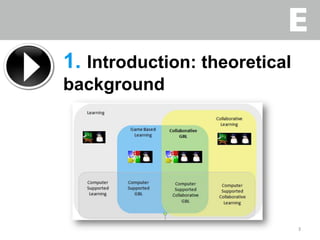
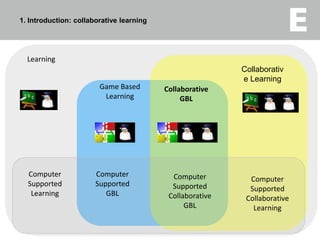
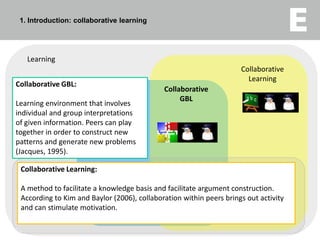
1. Introduction: collaborative learningLearningCollaborative LearningGame Based LearningCollaborative GBLComputer Supported LearningComputer Supported GBLComputer SupportedCollaborative GBLComputer Supported CollaborativeLearning4
1. Introduction: collaborative learningLearningCollaborative LearningCollaborative GBL:Learning environment that involves individual and group interpretations of given information. Peers can play together in order to construct new patterns and generate new problems (Jacques, 1995). Game Based LearningCollaborative GBLCollaborative Learning: A method to facilitate a knowledge basis and facilitate argument construction. According to Kim and Baylor (2006), collaboration within peers brings out activity and can stimulate motivation. Computer Supported LearningComputer Supported GBLComputer SupportedCollaborative GBLComputer Supported CollaborativeLearning5
1. Introduction: collaborative GBLAdvantages of Collaborative Game Based Learning (GBL) A high level of engagement (Herz, 2001).
Continuing motivation when designers incorporate feedback and collaboration(Malouf, 1988).Transform knowledge into social capital (Herz, 2001).
Players participate in the knowledge construction in a social context.
Games can enhance (Gee, 2003; Kirriemuir & McFarlane, 2004):
Problem solving skills, decision making, knowledge transfer and meta-analytic skills.
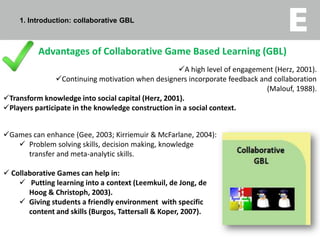
Collaborative Games can help in:
 Putting learning into a context (Leemkuil, de Jong, de Hoog & Christoph, 2003).
Giving students a friendly environment  with specific content and skills (Burgos, Tattersall & Koper, 2007).1. Introduction: collaborative GBL Challenges for Collaborative GBL Roberts and McInnerney (2007)  defends that some students have antipathy towards group work and the consequent lack of interest in this kind of educational activities.
Lack of effectiveness and poor learning results if no instructional measures or support are added in order to guide the learning process (Leemkuil et al., 2003; Kirschner, Sweller & Clark, 2006).
Need of regulation for both individual and collectiveactions in this kind of environments (Azevedo, 2008). It is quite possible that arguing does not lead to more understanding of the issue: people stick to their own viewpoints, or peers do not present very strong arguments (Munneke et al., 2007).
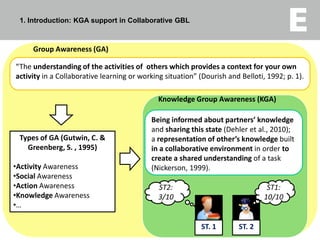
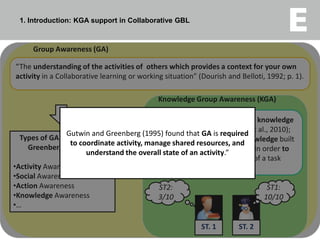
1. Introduction: KGA support in Collaborative GBLGroup Awareness (GA)“The understanding of the activities of  others which provides a context for your own activity in a Collaborative learning or working situation” (Dourish and Belloti, 1992; p. 1). Knowledge Group Awareness (KGA)Being informed about partners’ knowledge and sharing this state (Dehler et al., 2010); a representation of other’s knowledge built in a collaborative environment in order to create a shared understanding of a task (Nickerson, 1999).Types of GA (Gutwin, C. & Greenberg, S. , 1995)Activity Awareness
Social Awareness
Action Awareness
Knowledge Awareness
…ST2: 3/10ST1: 10/10ST. 2ST. 1
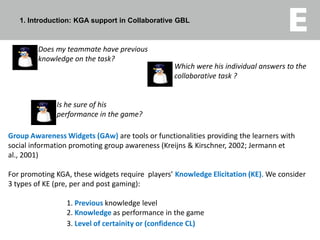
1. Introduction: KGA support in Collaborative GBLGroup Awareness (GA)“The understanding of the activities of  others which provides a context for your own activity in a Collaborative learning or working situation” (Dourish and Belloti, 1992; p. 1). Knowledge Group Awareness (KGA)Gutwin and Greenberg (1995) found that GA is required to coordinate activity, manage shared resources, and understand the overall state of an activity.” Being informed about partners’ knowledge and sharing this state (Dehler et al., 2010); a representation of other’s knowledge built in a collaborative environment in order to create a shared understanding of a task (Nickerson, 1999).Types of GA (Gutwin, C. & Greenberg, S. , 1995)Activity Awareness
Social Awareness
Action Awareness
Knowledge Awareness
…ST2: 3/10ST1: 10/10ST. 2ST. 1
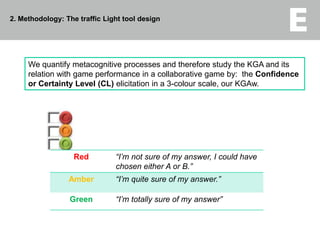
1. Introduction: KGA support in Collaborative GBLDoes my teammate have previous knowledge on the task?  Which were his individual answers to the collaborative task ?  Is he sure of his performance in the game?Group Awareness Widgets (GAw)are tools or functionalities providing the learners with social information promoting group awareness (Kreijns & Kirschner, 2002; Jermann et al., 2001)For promoting KGA, these widgets require  players’ Knowledge Elicitation (KE). We consider 3 types of KE (pre, per and post gaming):		1. Previousknowledge level		2. Knowledgeas performance in the game		3. Level of certainity or (confidence CL)
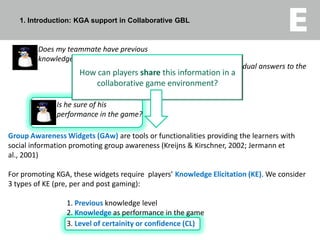
1. Introduction: KGA support in Collaborative GBLDoes my teammate have previous knowledge on the task?  Which were his individual answers to the collaborative task ?  How can players share this information in a collaborative game environment? Is he sure of his performance in the game?Group Awareness Widgets (GAw)are tools or functionalities providing the learners with social information promoting group awareness (Kreijns & Kirschner, 2002; Jermann et al., 2001)For promoting KGA, these widgets require  players’ Knowledge Elicitation (KE). We consider 3 types of KE (pre, per and post gaming):		1. Previousknowledge level		2. Knowledgeas performance in the game		3. Level of certainity or confidence (CL)
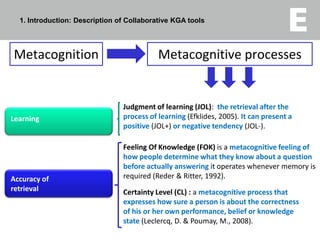
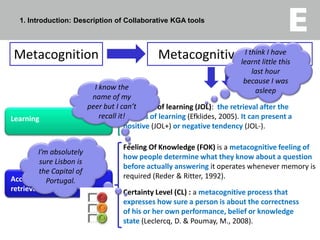
1. Introduction: Description of Collaborative KGA toolsMetacognitionMetacognitive processesJudgment of learning (JOL):  the retrieval after the process of learning (Efklides, 2005). It can present a positive (JOL+) or negative tendency (JOL-).  LearningFeeling Of Knowledge (FOK) is a metacognitive feeling of how people determine what they know about a question before actually answering it operates whenever memory is required (Reder & Ritter, 1992).Accuracy of retrievalCertainty Level (CL) : a metacognitive process that expresses how sure a person is about the correctness of his or her own performance, belief or knowledge state (Leclercq, D. & Poumay, M., 2008).
1. Introduction: Description of Collaborative KGA toolsI think I have learnt little this last hour because I was asleepMetacognitionMetacognitive processesI know the name of my peer but I can’t recall it!Judgment of learning (JOL):  the retrieval after the process of learning (Efklides, 2005). It can present a positive (JOL+) or negative tendency (JOL-).  LearningI’m absolutely sure Lisbon is the Capital of Portugal.Feeling Of Knowledge (FOK) is a metacognitive feeling of how people determine what they know about a question before actually answering it operates whenever memory is required (Reder & Ritter, 1992).Accuracy of retrievalCertainty Level (CL) : a metacognitive process that expresses how sure a person is about the correctness of his or her own performance, belief or knowledge state (Leclercq, D. & Poumay, M., 2008).
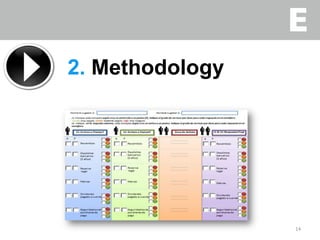
2. Methodology14
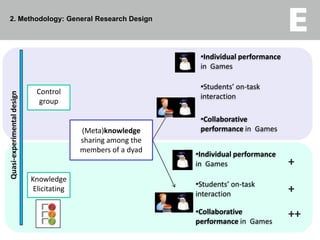
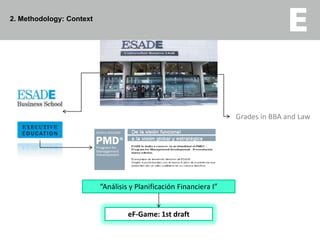
2. Methodology: General Research DesignIndividual performance in  Games

Confidence Level Explicitation in collaborative SG

  • 1.
    Impact of theexplicit Feeling of Knowledge in the learners’ interaction and performance in collaborative Game Based LearningMireia Usart , Margarida Romero & EsteveAlmirallESADE Business SchoolDirection of Educational Innovation and Academic Quality (DIPQA).Contact: mireia.usart@esade.edu
  • 2.
    TABLE OF CONTENTSIntroductionCollaborativeLearningCollaborative Game Based Learning (GBL)Advantages and challenges in Collaborative GBLKnowledge Group Awareness Support in Collaborative GBLDescription of Collaborative KGA toolsMethodologyGeneral Research designHypothesesGame designKGA tool designPanels designGame playParticipantsResultsDiscussion2
  • 3.
  • 4.
    1. Introduction: collaborativelearningLearningCollaborative LearningGame Based LearningCollaborative GBLComputer Supported LearningComputer Supported GBLComputer SupportedCollaborative GBLComputer Supported CollaborativeLearning4
  • 5.
    1. Introduction: collaborativelearningLearningCollaborative LearningCollaborative GBL:Learning environment that involves individual and group interpretations of given information. Peers can play together in order to construct new patterns and generate new problems (Jacques, 1995). Game Based LearningCollaborative GBLCollaborative Learning: A method to facilitate a knowledge basis and facilitate argument construction. According to Kim and Baylor (2006), collaboration within peers brings out activity and can stimulate motivation. Computer Supported LearningComputer Supported GBLComputer SupportedCollaborative GBLComputer Supported CollaborativeLearning5
  • 6.
    1. Introduction: collaborativeGBLAdvantages of Collaborative Game Based Learning (GBL) A high level of engagement (Herz, 2001).
  • 7.
    Continuing motivation whendesigners incorporate feedback and collaboration(Malouf, 1988).Transform knowledge into social capital (Herz, 2001).
  • 8.
    Players participate inthe knowledge construction in a social context.
  • 9.
    Games can enhance(Gee, 2003; Kirriemuir & McFarlane, 2004):
  • 10.
    Problem solving skills,decision making, knowledge transfer and meta-analytic skills.
  • 11.
  • 12.
    Putting learninginto a context (Leemkuil, de Jong, de Hoog & Christoph, 2003).
  • 13.
    Giving students afriendly environment with specific content and skills (Burgos, Tattersall & Koper, 2007).1. Introduction: collaborative GBL Challenges for Collaborative GBL Roberts and McInnerney (2007) defends that some students have antipathy towards group work and the consequent lack of interest in this kind of educational activities.
  • 14.
    Lack of effectivenessand poor learning results if no instructional measures or support are added in order to guide the learning process (Leemkuil et al., 2003; Kirschner, Sweller & Clark, 2006).
  • 15.
    Need of regulationfor both individual and collectiveactions in this kind of environments (Azevedo, 2008). It is quite possible that arguing does not lead to more understanding of the issue: people stick to their own viewpoints, or peers do not present very strong arguments (Munneke et al., 2007).
  • 16.
    1. Introduction: KGAsupport in Collaborative GBLGroup Awareness (GA)“The understanding of the activities of others which provides a context for your own activity in a Collaborative learning or working situation” (Dourish and Belloti, 1992; p. 1). Knowledge Group Awareness (KGA)Being informed about partners’ knowledge and sharing this state (Dehler et al., 2010); a representation of other’s knowledge built in a collaborative environment in order to create a shared understanding of a task (Nickerson, 1999).Types of GA (Gutwin, C. & Greenberg, S. , 1995)Activity Awareness
  • 17.
  • 18.
  • 19.
  • 20.
  • 21.
    1. Introduction: KGAsupport in Collaborative GBLGroup Awareness (GA)“The understanding of the activities of others which provides a context for your own activity in a Collaborative learning or working situation” (Dourish and Belloti, 1992; p. 1). Knowledge Group Awareness (KGA)Gutwin and Greenberg (1995) found that GA is required to coordinate activity, manage shared resources, and understand the overall state of an activity.” Being informed about partners’ knowledge and sharing this state (Dehler et al., 2010); a representation of other’s knowledge built in a collaborative environment in order to create a shared understanding of a task (Nickerson, 1999).Types of GA (Gutwin, C. & Greenberg, S. , 1995)Activity Awareness
  • 22.
  • 23.
  • 24.
  • 25.
  • 26.
    1. Introduction: KGAsupport in Collaborative GBLDoes my teammate have previous knowledge on the task? Which were his individual answers to the collaborative task ? Is he sure of his performance in the game?Group Awareness Widgets (GAw)are tools or functionalities providing the learners with social information promoting group awareness (Kreijns & Kirschner, 2002; Jermann et al., 2001)For promoting KGA, these widgets require players’ Knowledge Elicitation (KE). We consider 3 types of KE (pre, per and post gaming): 1. Previousknowledge level 2. Knowledgeas performance in the game 3. Level of certainity or (confidence CL)
  • 27.
    1. Introduction: KGAsupport in Collaborative GBLDoes my teammate have previous knowledge on the task? Which were his individual answers to the collaborative task ? How can players share this information in a collaborative game environment? Is he sure of his performance in the game?Group Awareness Widgets (GAw)are tools or functionalities providing the learners with social information promoting group awareness (Kreijns & Kirschner, 2002; Jermann et al., 2001)For promoting KGA, these widgets require players’ Knowledge Elicitation (KE). We consider 3 types of KE (pre, per and post gaming): 1. Previousknowledge level 2. Knowledgeas performance in the game 3. Level of certainity or confidence (CL)
  • 28.
    1. Introduction: Descriptionof Collaborative KGA toolsMetacognitionMetacognitive processesJudgment of learning (JOL): the retrieval after the process of learning (Efklides, 2005). It can present a positive (JOL+) or negative tendency (JOL-).  LearningFeeling Of Knowledge (FOK) is a metacognitive feeling of how people determine what they know about a question before actually answering it operates whenever memory is required (Reder & Ritter, 1992).Accuracy of retrievalCertainty Level (CL) : a metacognitive process that expresses how sure a person is about the correctness of his or her own performance, belief or knowledge state (Leclercq, D. & Poumay, M., 2008).
  • 29.
    1. Introduction: Descriptionof Collaborative KGA toolsI think I have learnt little this last hour because I was asleepMetacognitionMetacognitive processesI know the name of my peer but I can’t recall it!Judgment of learning (JOL): the retrieval after the process of learning (Efklides, 2005). It can present a positive (JOL+) or negative tendency (JOL-).  LearningI’m absolutely sure Lisbon is the Capital of Portugal.Feeling Of Knowledge (FOK) is a metacognitive feeling of how people determine what they know about a question before actually answering it operates whenever memory is required (Reder & Ritter, 1992).Accuracy of retrievalCertainty Level (CL) : a metacognitive process that expresses how sure a person is about the correctness of his or her own performance, belief or knowledge state (Leclercq, D. & Poumay, M., 2008).
  • 30.
  • 31.
    2. Methodology: GeneralResearch DesignIndividual performance in Games

Editor's Notes

  • #7 We suppose that some collaborative learning premises can be implemented in collaborative GBL, therefore:
  • #8 Challenges: list and highlight the LAST (Students collaborating in small groups need to monitor and adapt their metacognitive processes to possible changes in their motivational state, and therefore determine how much social support may be needed to perform the task.)As Munneke et al. say: there is therefore a need for enhancing metacognitive processes.
  • #9 Activity: where are my game partners in the game, race…Action: what are they clicking, etc.
  • #10 Activity: where are my game partners in the game, race…Action: what are they clicking, etc.
  • #13 CL implications for learning :CL is a very powerful cue regarding the reliability of one’s knowledge (Allwood&Granhag, 1996). Low levels of confidence can bring students to hesitation or to uncritically adoption of more confident people’s viewpoints (Schraw & Sperling Dennison, 1994). High feeling of confidence makes people more decisivebut at the same time less critical of one’s decisions. (Koriat et al., 2002).Koriat (2000): FOK accompanies the memory search processes. FOK is sometimes related to the “tip of the tongue” idea. It can be positive or negative and has been studied for individual and other’s FOK. According to Schwartz (1994), if a student has a high FOK for an issue, then he may choose to spend more time trying to retrieve that item later than if the FOK is low. These processes can be achieved through the expressions of FOK and the shared visualization of the inter-subjective FOK information. The self-monitoring that occurs during learning has a guiding role in the self-paced acquisition of information. In particular, accuracy in METACOGNITIVE PROCESSES (FOK; JOL AND CJ) is critical for students, because if they are inaccurate, the allocation of subsequent study time will not be optimal and therefore, learning results may be worst.
  • #14 CL implications for learning :CL is a very powerful cue regarding the reliability of one’s knowledge (Allwood&Granhag, 1996). Low levels of confidence can bring students to hesitation or to uncritically adoption of more confident people’s viewpoints (Schraw & Sperling Dennison, 1994). High feeling of confidence makes people more decisivebut at the same time less critical of one’s decisions. (Koriat et al., 2002).Koriat (2000): FOK accompanies the memory search processes. FOK is sometimes related to the “tip of the tongue” idea. It can be positive or negative and has been studied for individual and other’s FOK. According to Schwartz (1994), if a student has a high FOK for an issue, then he may choose to spend more time trying to retrieve that item later than if the FOK is low. These processes can be achieved through the expressions of FOK and the shared visualization of the inter-subjective FOK information. The self-monitoring that occurs during learning has a guiding role in the self-paced acquisition of information. In particular, accuracy in METACOGNITIVE PROCESSES (FOK; JOL AND CJ) is critical for students, because if they are inaccurate, the allocation of subsequent study time will not be optimal and therefore, learning results may be worst.
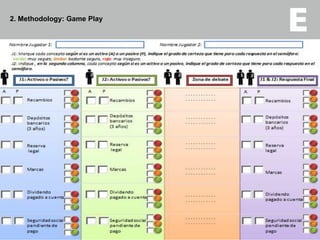
  • #16 In a structured knowledge elicitation context, both players in a dyad share knowledge through a KGA widget. COMMENT VARIABLES: IV CJ and DV performances and accuracy
  • #18 Spain, Barcelona
  • #19 According to Schwartz (1994), if a student has a high FOK for an item, then he may choose to spend more time trying to retrieve that item later. Brennan and Williams (1995) used the term Feeling of Anothers' Knowing (FOAK) to refer to the KGA. In their paper, they introduce the idea that some conversational aspects of the interactions could help to develop the FOAK within a pair or group of persons. Despite the conversational aspects introduced by Brennan and colleagues (2008), we consider the explicitness that could be introduced in the support system of the game to promote the declaration of the individuals FOK and their intersubjective perception. These processes can be achieved through the expressions of FOK and the shared visualization of the inter-subjective FOK information.
  • #28 We would be glad to share with you our game, so if you are interested, I can facilitate you the internet adress/ home page