Iolanda	
  Garcia,	
  Ingrid	
  Noguera,	
  Mireia	
  Usart	
  (eLearn	
  Center	
  UOC),	
  Xavier	
  Mas	
  (Programa	
  d’Innovació	
  UOC),	
  	
  
Teresa	
  Sancho	
  (Estudis	
  IMT	
  UOC),	
  Begoña	
  Gros	
  (Facultat	
  Pedagogia	
  UB)	
  
h=p://just4me.blogs.uoc.edu/

 	
  Background	
  

 	
  Method	
  

People	
   con)nuously	
   learn	
   through	
   their	
   par)cipa)on	
   in	
   different	
   contexts	
   (more	
   or	
   less	
   formalized)	
   depending	
  
on	
  their	
  competences.	
  Lifelong	
  learning,	
  conducted	
  in	
  both	
  formal	
  and	
  informal	
  environments,	
  becomes	
  a	
  key	
  
approach	
  for	
  adult	
  professionals	
  and	
  prac))oners	
  to	
  reach	
  their	
  goals.	
  
Self-­‐regulated	
  learners	
  control	
  their	
  learning	
  process	
  being	
  ac)vely	
  involved	
  in	
  metacogni)ve,	
  mo)va)onal	
  and	
  
cogni)ve	
  areas.	
  This	
  process	
  may	
  be	
  socially	
  supported	
  (seAng	
  objec)ves,	
  self-­‐monitoring	
  progress,	
  searching	
  
for	
   help,	
   feedback,	
   )me	
   management	
   and	
   planning	
   or	
   self-­‐directed	
   reflec)on).	
   Self-­‐direc)on	
   involves	
   being	
  
able	
   to	
   use	
   one’s	
   own	
   competences	
   and	
   resources	
   to	
   formulate	
   goals	
   strategically,	
   to	
   organize	
   and	
   structure	
  
informa)on	
  and	
  to	
  build	
  knowledge	
  that	
  is	
  meaningful	
  to	
  one’s	
  aims.	
  
PLEs	
  follow	
  a	
  learner-­‐centric	
  approach,	
  allowing	
  the	
  use	
  of	
  lightweight	
  services	
  and	
  tools	
  that	
  belong	
  to	
  and	
  
are	
   controlled	
   by	
   individuals.	
   PLEs	
   recognize	
   the	
   autonomy	
   of	
   learners	
   by	
   allowing	
   them	
   to	
   plan,	
   document,	
  
store	
   and	
   elaborate	
   their	
   reflec)ons	
   and	
   informa)on	
   that	
   is	
   significant	
   to	
   them.	
   PLEs	
   have	
   proved	
   to	
   be	
  
effec)ve	
  in	
  addressing	
  issues	
  related	
  to	
  learner	
  control,	
  agency	
  and	
  personaliza<on.	


Phase	
  1.	
  Literature	
  review	
  

Phase	
  	
  2.	
  Needs	
  analysis	
  

Ac<ons	
  
2012-­‐13	
  
Review	
  of	
  scien)fic	
  literature	
  	
  
•  Conceptualiza)on	
  of	
  PLEs	
  
•  Cases	
  implementa)on	
  of	
  PLEs	
  
Review	
  of	
  presenta)ons	
  	
  
•  Personal	
  PLE	
  diagrams	
  	
  
•  Development	
  of	
  PLEs	
  
Review	
  of	
  projects	
  	
  
•  University	
  context	
  
•  Lifelong	
  learning	
  context	
  	
  
•  Professional	
  context	
  
Phase	
  3.	
  Pedagogical	
  design	
  

The specific objectives are:
  To facilitate the planning and monitoring of learning activities with associated
learning resources configurable by the user.
  To provide different view screens to better meeting the needs of each user at
any given time.
  To allow social interaction and learning through the folksonomy system
generated by the PLE users.
  To develop an environment easy to access and use from various devices
(computer, Smartphones, Tablets).

• Pedagogical	
  approach	
  
• Defini)on	
  of	
  main	
  axes	
  	
  
• Pedagogical	
  model	
  structure	


Ac<ons	
  

Phase	
  	
  4.	
  Func)onal	
  design	
  
Ac<ons	
  	
  
• List	
  of	
  uses	
  and	
  func)onali)es	
  	
  
• Selec)on	
  of	
  uses	
  and	
  func)onali)es	
  based	
  
on	
  the	
  pedagogical	
  model	
  	
  
• Discussion	
  and	
  defini)on	
  of	
  Just4Me	
  uses	
  
and	
  func)onali)es	


Phase	
  5.	
  Interface	
  design	
  
2013-­‐14	
  

• Interface	
  basic	
  design	
  
• Naviga)on	
  system	
  design	
  	
  
• Access	
  and	
  configura)on	
  design	
  	
  
• Personal	
  profile	
  design	
  	
  
• Edi)on	
  possibili)es	
  design	
  	
  
• Display	
  screen	
  design	
  
• Interface	
  development	
  

 	
  Results	
  

Pedagogical	
  model	
  

Ques)onnaire	
  
•  Mailing	
  
•  Medical	
  social	
  networks	
  	
  
•  COMB	
  social	
  networks	
  
Interview	
  to	
  an	
  expert	
  

2013-­‐14	
  

Ac<ons	
  

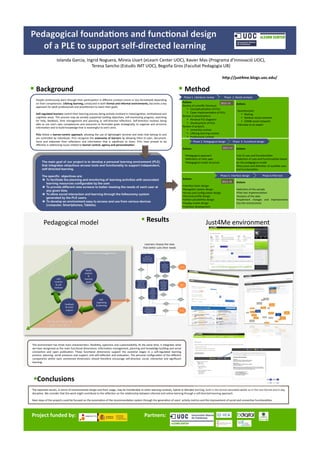
The main goal of our project is to develop a‬ ‪personal learning environment (PLE)
that integrates ubiquitous access tools and‬ ‪functionality to support independent,
self-directed learning.

Ac<ons	
  

Phase	
  6.Pilot	
  test	
  

Ac<ons	
  
• Selec)on	
  of	
  the	
  sample	
  
• Pilot	
  test	
  implementa)on	
  
• Analysis	
  of	
  the	
  data	
  
• Implement	
   changes	
   and	
   improvements	
  
into	
  the	
  environment	


Just4Me	
  environment	


Learners	
  choose	
  the	
  view	
  	
  
that	
  be`er	
  suits	
  their	
  needs	
  

The	
  environment	
  has	
  three	
  main	
  characteris)cs:	
  flexibility,	
  openness	
  and	
  customizability.	
  At	
  the	
  same	
  )me,	
  it	
  integrates	
  what	
  
we	
  have	
  recognized	
  as	
  the	
  main	
  func)onal	
  dimensions:	
  informa)on	
  management,	
  planning	
  and	
  knowledge	
  building	
  and	
  social	
  
connec)on	
   and	
   open	
   publica)on.	
   Those	
   func)onal	
   dimensions	
   support	
   the	
   essen)al	
   stages	
   in	
   a	
   self-­‐regulated	
   learning	
  
process:	
  planning,	
  social	
  presence	
  and	
  support,	
  and	
  self-­‐reflec)on	
  and	
  evalua)on.	
  The	
  personal	
  configura)on	
  of	
  the	
  different	
  
components	
   within	
   each	
   men)oned	
   dimensions	
   should	
   therefore	
   encourage	
   self-­‐directed,	
   social,	
   interac)ve	
   and	
   significant	
  
learning.	


 Conclusions	
  
The	
  expected	
  results,	
  in	
  terms	
  of	
  environmental	
  design	
  and	
  their	
  usage,	
  may	
  be	
  transferable	
  to	
  other	
  learning	
  contexts,	
  hybrid	
  or	
  blended	
  learning,	
  both	
  in	
  the	
  formal	
  educa)on	
  sector	
  as	
  in	
  the	
  non-­‐formal	
  and	
  in	
  any	
  
discipline.	
  We	
  consider	
  that	
  this	
  work	
  might	
  contribute	
  to	
  the	
  reflec)on	
  on	
  the	
  rela)onship	
  between	
  informal	
  and	
  online	
  learning	
  through	
  a	
  self-­‐directed	
  learning	
  approach.	
  	
  
Next	
  steps	
  of	
  the	
  projects	
  could	
  be	
  focused	
  on	
  the	
  automa)on	
  of	
  the	
  recommenda)on	
  system	
  through	
  the	
  genera)on	
  of	
  users’	
  ac)vity	
  metrics	
  and	
  the	
  improvement	
  of	
  social	
  and	
  connec)ve	
  func)onali)es.	


  Project	
  funded	
  by:


  Partners:	


Poster UOC Symposium Just4Me

  • 1.
    Iolanda  Garcia,  Ingrid  Noguera,  Mireia  Usart  (eLearn  Center  UOC),  Xavier  Mas  (Programa  d’Innovació  UOC),     Teresa  Sancho  (Estudis  IMT  UOC),  Begoña  Gros  (Facultat  Pedagogia  UB)   h=p://just4me.blogs.uoc.edu/    Background      Method   People   con)nuously   learn   through   their   par)cipa)on   in   different   contexts   (more   or   less   formalized)   depending   on  their  competences.  Lifelong  learning,  conducted  in  both  formal  and  informal  environments,  becomes  a  key   approach  for  adult  professionals  and  prac))oners  to  reach  their  goals.   Self-­‐regulated  learners  control  their  learning  process  being  ac)vely  involved  in  metacogni)ve,  mo)va)onal  and   cogni)ve  areas.  This  process  may  be  socially  supported  (seAng  objec)ves,  self-­‐monitoring  progress,  searching   for   help,   feedback,   )me   management   and   planning   or   self-­‐directed   reflec)on).   Self-­‐direc)on   involves   being   able   to   use   one’s   own   competences   and   resources   to   formulate   goals   strategically,   to   organize   and   structure   informa)on  and  to  build  knowledge  that  is  meaningful  to  one’s  aims.   PLEs  follow  a  learner-­‐centric  approach,  allowing  the  use  of  lightweight  services  and  tools  that  belong  to  and   are   controlled   by   individuals.   PLEs   recognize   the   autonomy   of   learners   by   allowing   them   to   plan,   document,   store   and   elaborate   their   reflec)ons   and   informa)on   that   is   significant   to   them.   PLEs   have   proved   to   be   effec)ve  in  addressing  issues  related  to  learner  control,  agency  and  personaliza<on.     Phase  1.  Literature  review   Phase    2.  Needs  analysis   Ac<ons   2012-­‐13   Review  of  scien)fic  literature     •  Conceptualiza)on  of  PLEs   •  Cases  implementa)on  of  PLEs   Review  of  presenta)ons     •  Personal  PLE  diagrams     •  Development  of  PLEs   Review  of  projects     •  University  context   •  Lifelong  learning  context     •  Professional  context   Phase  3.  Pedagogical  design   The specific objectives are:   To facilitate the planning and monitoring of learning activities with associated learning resources configurable by the user.   To provide different view screens to better meeting the needs of each user at any given time.   To allow social interaction and learning through the folksonomy system generated by the PLE users.   To develop an environment easy to access and use from various devices (computer, Smartphones, Tablets). • Pedagogical  approach   • Defini)on  of  main  axes     • Pedagogical  model  structure     Ac<ons   Phase    4.  Func)onal  design   Ac<ons     • List  of  uses  and  func)onali)es     • Selec)on  of  uses  and  func)onali)es  based   on  the  pedagogical  model     • Discussion  and  defini)on  of  Just4Me  uses   and  func)onali)es     Phase  5.  Interface  design   2013-­‐14   • Interface  basic  design   • Naviga)on  system  design     • Access  and  configura)on  design     • Personal  profile  design     • Edi)on  possibili)es  design     • Display  screen  design   • Interface  development      Results   Pedagogical  model   Ques)onnaire   •  Mailing   •  Medical  social  networks     •  COMB  social  networks   Interview  to  an  expert   2013-­‐14   Ac<ons   The main goal of our project is to develop a‬ ‪personal learning environment (PLE) that integrates ubiquitous access tools and‬ ‪functionality to support independent, self-directed learning. Ac<ons   Phase  6.Pilot  test   Ac<ons   • Selec)on  of  the  sample   • Pilot  test  implementa)on   • Analysis  of  the  data   • Implement   changes   and   improvements   into  the  environment     Just4Me  environment     Learners  choose  the  view     that  be`er  suits  their  needs   The  environment  has  three  main  characteris)cs:  flexibility,  openness  and  customizability.  At  the  same  )me,  it  integrates  what   we  have  recognized  as  the  main  func)onal  dimensions:  informa)on  management,  planning  and  knowledge  building  and  social   connec)on   and   open   publica)on.   Those   func)onal   dimensions   support   the   essen)al   stages   in   a   self-­‐regulated   learning   process:  planning,  social  presence  and  support,  and  self-­‐reflec)on  and  evalua)on.  The  personal  configura)on  of  the  different   components   within   each   men)oned   dimensions   should   therefore   encourage   self-­‐directed,   social,   interac)ve   and   significant   learning.      Conclusions   The  expected  results,  in  terms  of  environmental  design  and  their  usage,  may  be  transferable  to  other  learning  contexts,  hybrid  or  blended  learning,  both  in  the  formal  educa)on  sector  as  in  the  non-­‐formal  and  in  any   discipline.  We  consider  that  this  work  might  contribute  to  the  reflec)on  on  the  rela)onship  between  informal  and  online  learning  through  a  self-­‐directed  learning  approach.     Next  steps  of  the  projects  could  be  focused  on  the  automa)on  of  the  recommenda)on  system  through  the  genera)on  of  users’  ac)vity  metrics  and  the  improvement  of  social  and  connec)ve  func)onali)es.          Project  funded  by:    Partners: