THE STUDY OF DISTRIBUTED TEACHING PRESENCE IN CSCL SETTINGS:  temporal and organisational considerations C. Coll, A. Bustos & A. Engel EuroCat-CSCeL Workshop 5-6th February 2010
Objective To present a model oriented toward the analysis of Distributed Teaching Presence   (DTP) in on-line learning environments Discuss some issues identified by the organizers: the relevance of the temporal analysis   the relevance of organisational aspects of the activity the contextualized and situated nature of awareness tools   EuroCat-CSCeL Workshop
Distributed Teaching Presence Individual and collective learning   take   place thanks to the  educational influence  of others the set of supports provided by the participants –the teacher and the students— throughout the course of the joint activity to promote the cognitive and social processes  for realizing meaningful learning EuroCat-CSCeL Workshop
Distributed Teaching Presence The two relevant components of DTP: Educational influence  as a set of supports that can vary their modality, quality, quantity, intensity and distribution over time, and Support that is delivered throughout the process and in such a manner that is contingent to the task and closely related to  organisation  and meaning negotiation of the participants EuroCat-CSCeL Workshop
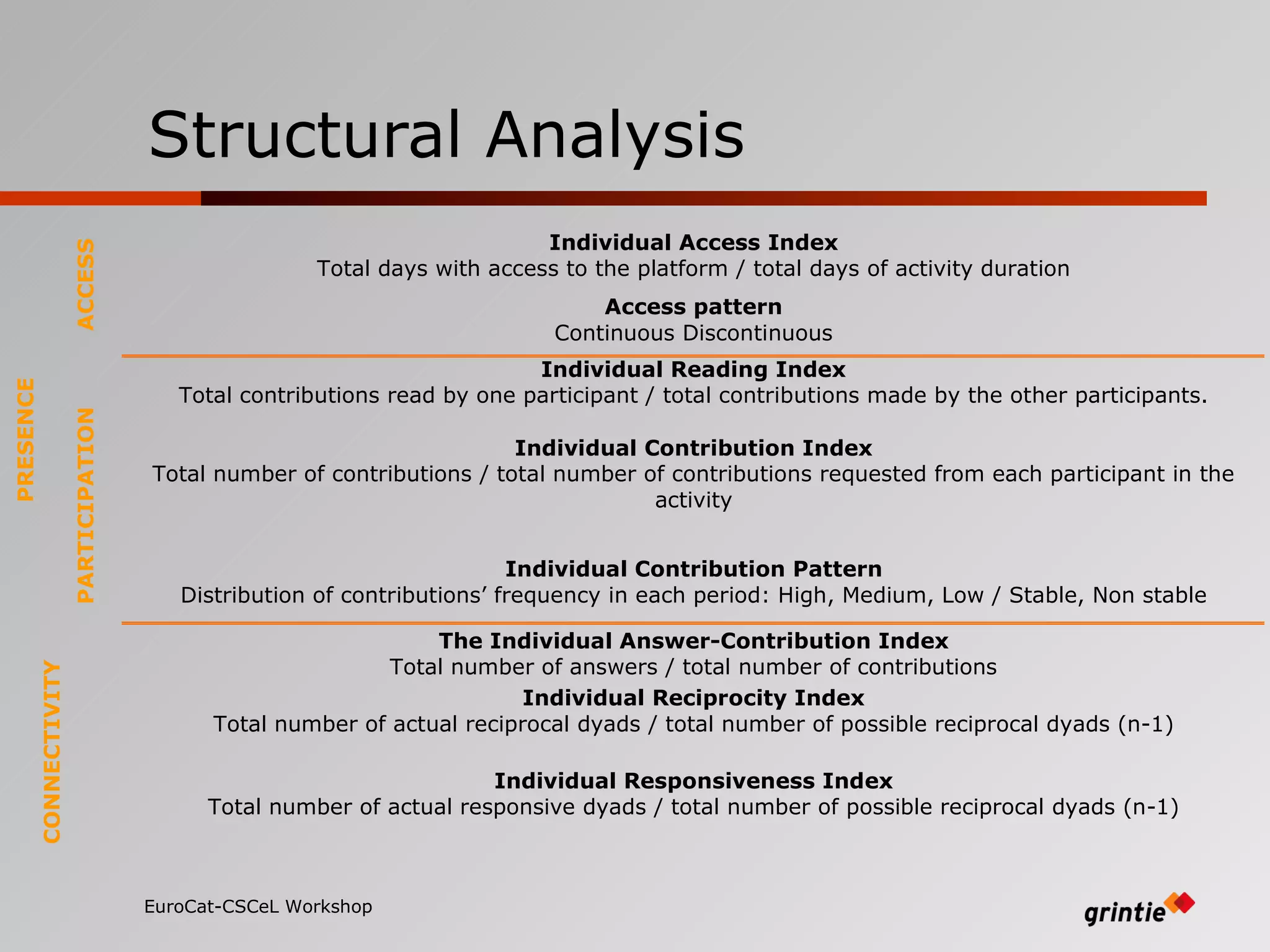
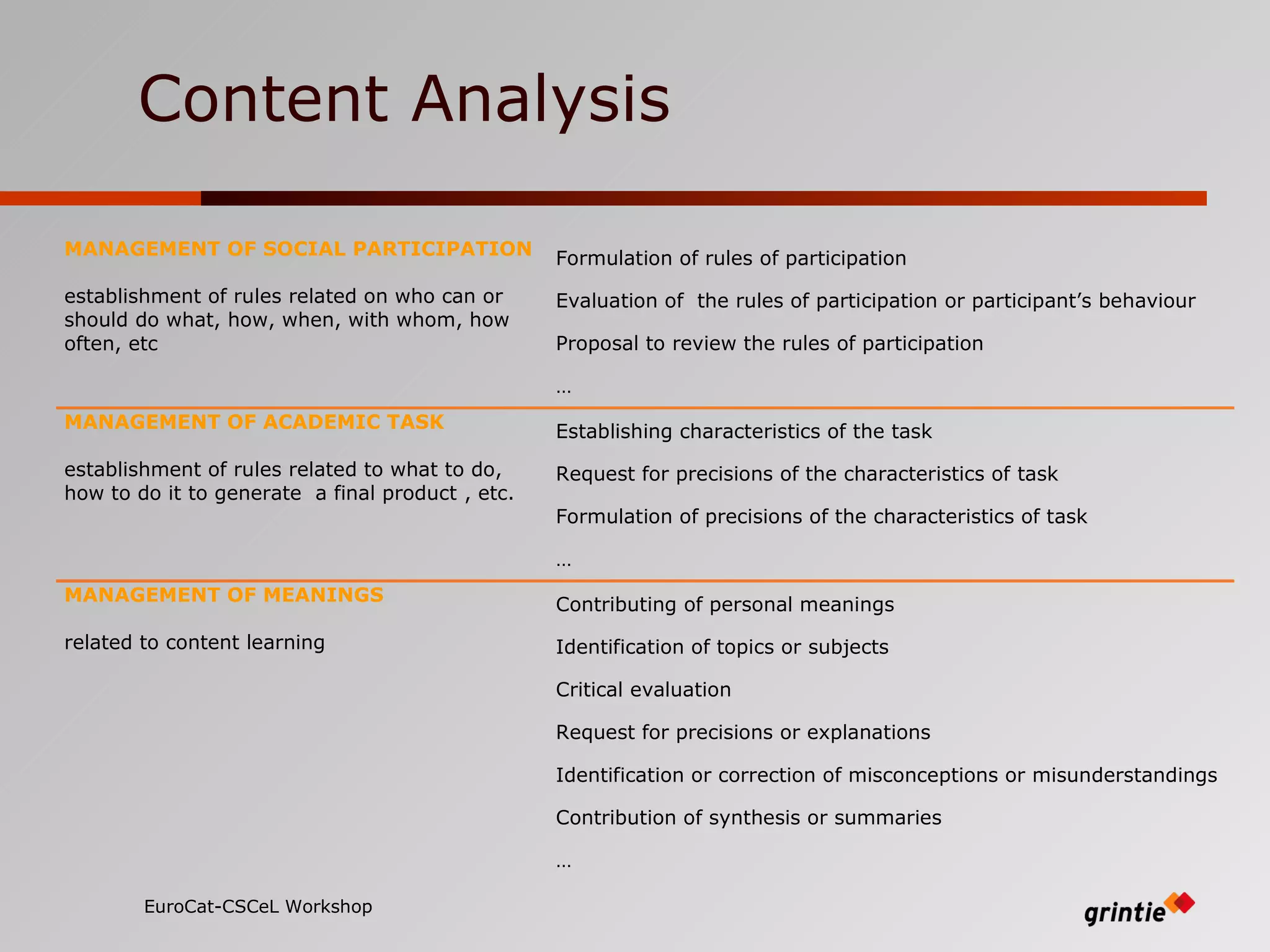
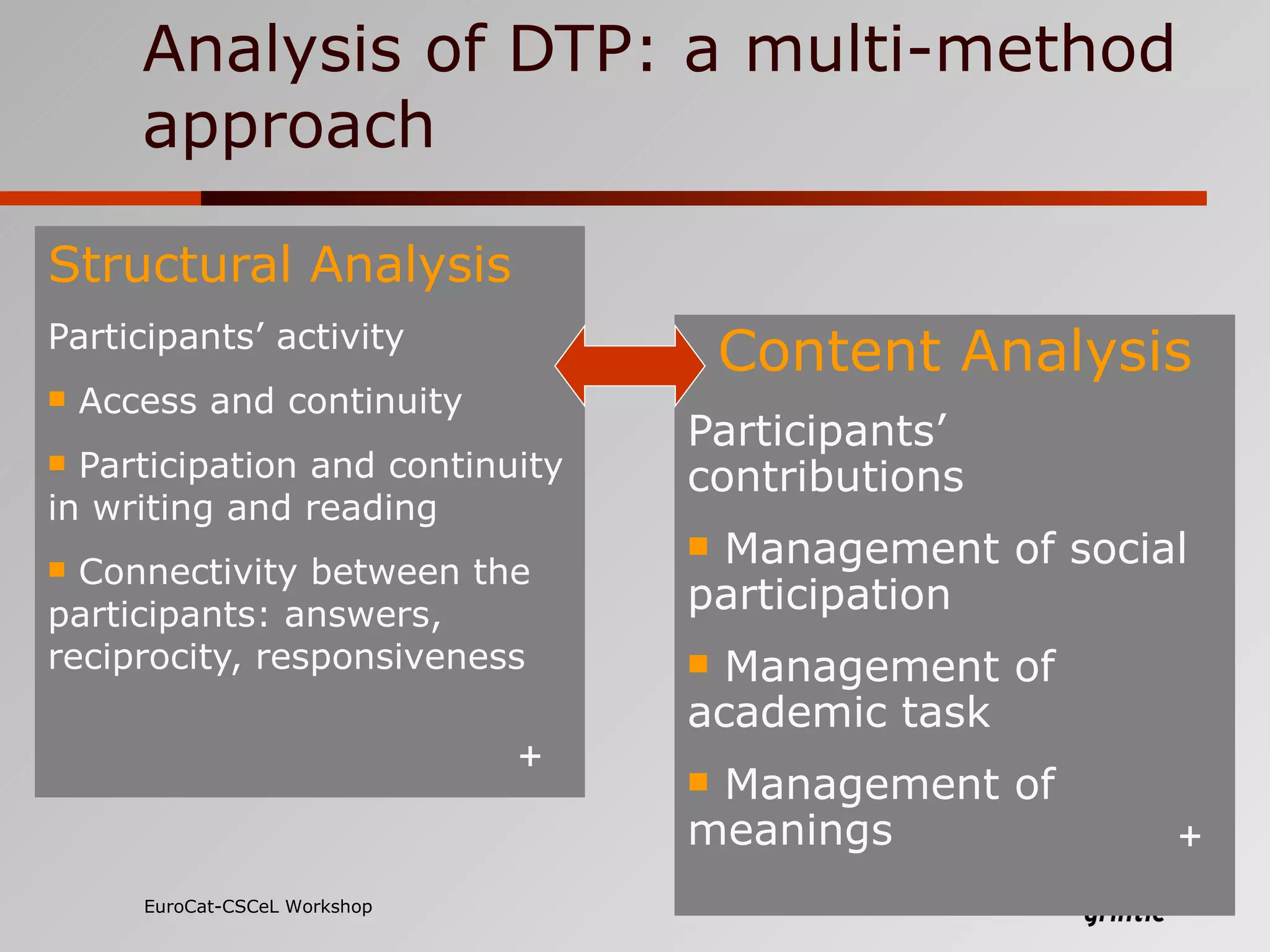
Analysis of DTP:  a multi-method approach Structural Analysis Participants’ activity Access and continuity Participation and continuity in  writing and reading  Connectivity between the participants: answers, reciprocity, responsiveness  Content Analysis Participants’ contributions Management of social participation  Management of academic task   Management of meanings   EuroCat-CSCeL Workshop   + +
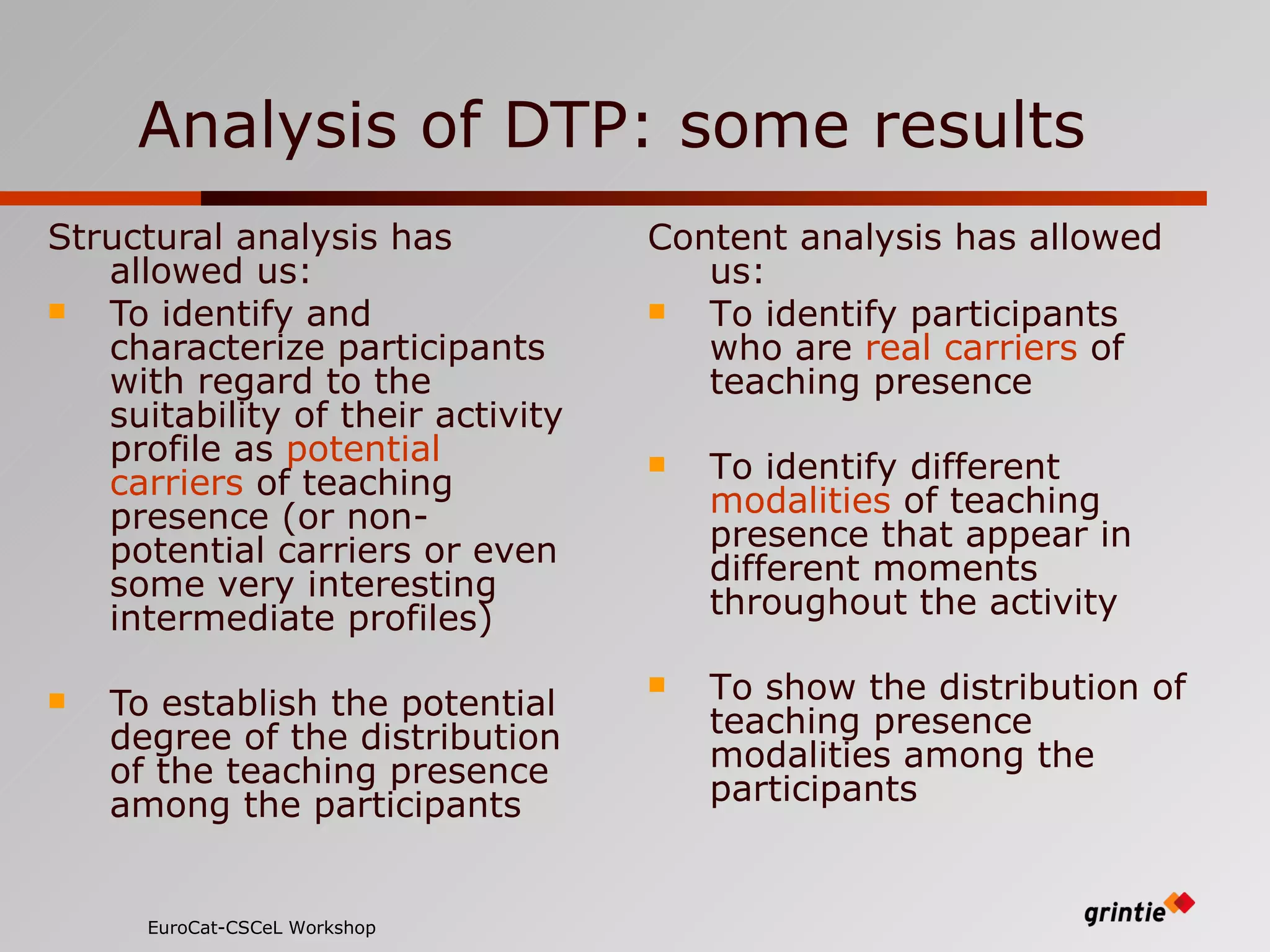
Analysis of DTP: some results Structural  analysis has allowed us: To identify and characterize participants with regard to the suitability of their activity profile as  potential carriers  of teaching presence (or non-potential carriers or even some very interesting intermediate profiles)  To establish the potential degree of the distribution of the teaching presence among the participants  EuroCat-CSCeL Workshop   Content analysis has allowed us: To identify participants who are  real carriers  of teaching presence   To identify different  modalities  of teaching presence that appear in different moments throughout the activity To show the distribution of teaching presence modalities among the participants
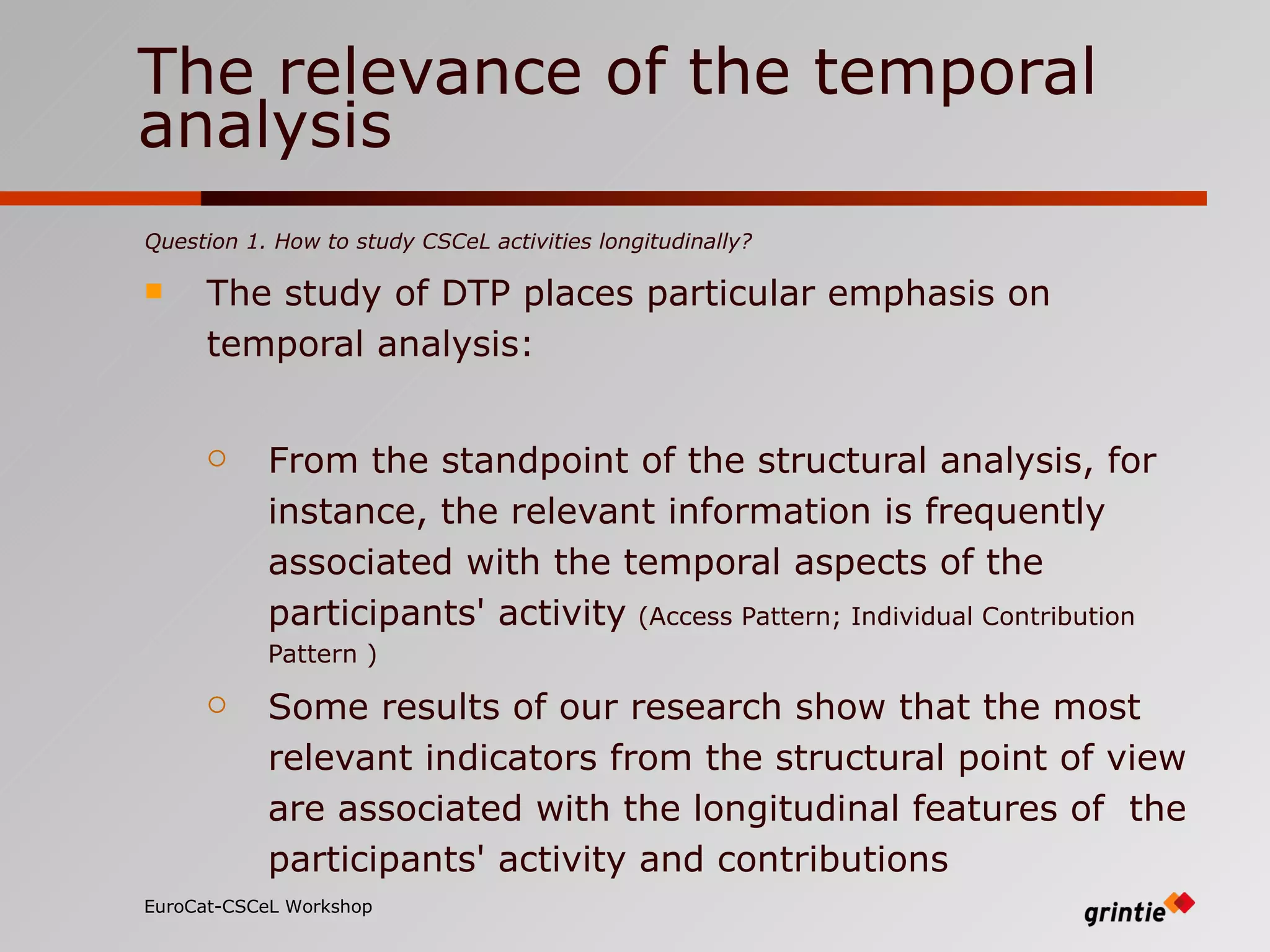
The relevance of the temporal analysis Question 1. How to study CSCeL activities longitudinally?  The study of DTP places particular emphasis on temporal analysis: From the standpoint of the structural analysis, for instance, the relevant information is frequently associated with the temporal aspects of the participants' activity   (Access Pattern; Individual Contribution Pattern ) Some results of our research show that the most relevant indicators from the structural point of view are associated with the longitudinal features of  the participants' activity and contributions   EuroCat-CSCeL Workshop
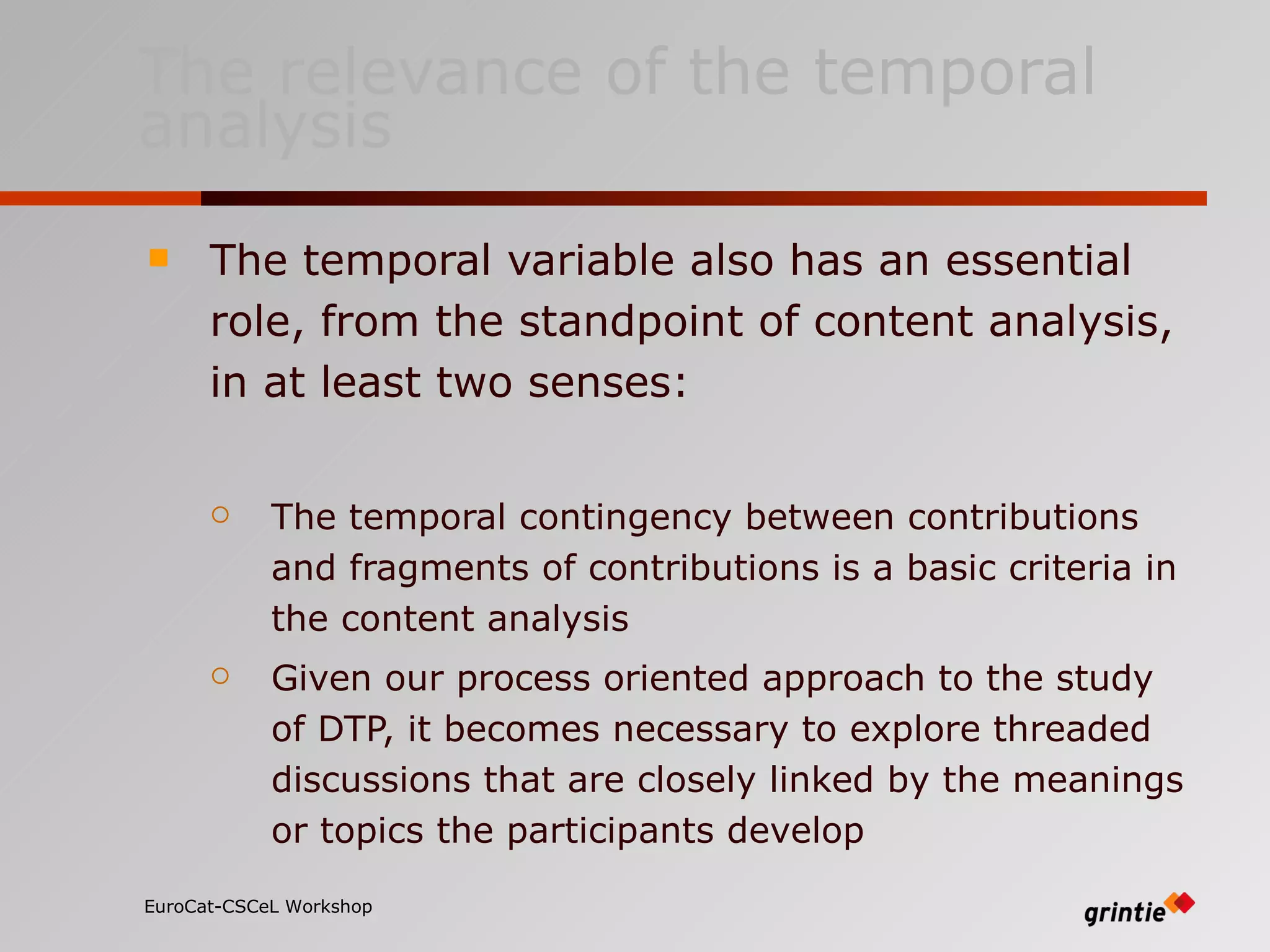
The relevance of the temporal analysis The temporal variable also has an essential role, from the standpoint of content analysis, in at least two senses: The temporal contingency between contributions and fragments of contributions is a basic criteria in the content analysis  Given our process oriented approach to the study of DTP, it becomes necessary to explore threaded discussions that are closely linked by the meanings or topics the participants develop   EuroCat-CSCeL Workshop
The relevance of the temporal analysis Finally, our results suggest that the “temporal variable” in on-line learning environments must be consider as “multi-dimensional” and not only as an isolated issue At least for the study of DTP, the temporal variable is in the  core  of the analysis: we can’t analyze and understand DTP without taking into account this dimension EuroCat-CSCeL Workshop
The relevance of the organisation Questions 2. How to study organisation convergence? 3. Is a certain level of organisation necessary for knowledge construction? 4. Are knowledge opportunities increasing when the organisation efforts are decreasing? 5. Which factors affect organisation convergence? The construction of shared meanings in collaborative learning cannot be dissociated from the management of the social participation and the management of the task From DTP analysis, the main issues are related with the opportunities to identify: the time spent managing the social participation / task, the participants carrying out this management  the moments when participants renegotiate the organisational aspects in order to restore the joint activity addressed  to meaningful learning EuroCat-CSCeL Workshop
The contextualized  and situated nature of awareness tools Question 9.  Could we increase “organisational group awareness” and “knowledge group awareness” through the longitudinal representation of the activity of the teammates? Our approach allow us to propose some specific criteria for design “activity tools” aimed to promote DTP: Should provide information about individual participant/for the participant and about the group as a whole / for the group Should deliver information during the ongoing process of learning and collaboration in progress (longitudinal dimension), and Should offer relevant and organized information about:  access, participation and connectivity   Organisation (social participation & task) Meaning making EuroCat-CSCeL Workshop
Challenge: How to build a tool taking into account  the contextual and situated nature of activity? The diversity of users/roles   (teachers, students, project managers, researchers, etc. ) The different types of guidance needs in order to achieve diverse goals   The diversity of scenarios   (formal education, informal education, on-the-job training, etc.) Different types of collaborative tasks   (discussions oriented to make collaborative decisions, to explore a topic or opposite alternatives; collaborative work aimed at developing a pre-defined product, etc.) Finally, without a tool “sensitive” to the contextual and situated nature of activity we can not obtain information about the processes that truly enable the understanding of DTP EuroCat-CSCeL Workshop   The contextualized  and situated nature of awareness tools
Gracias por su atención THE STUDY OF DISTRIBUTED TEACHING PRESENCE IN CSCL SETTINGS: temporal and organisational considerations   C. Coll, A. Bustos & A. Engel [email_address] www.psyed.edu.es/grintie
Structural Analysis EuroCat-CSCeL Workshop
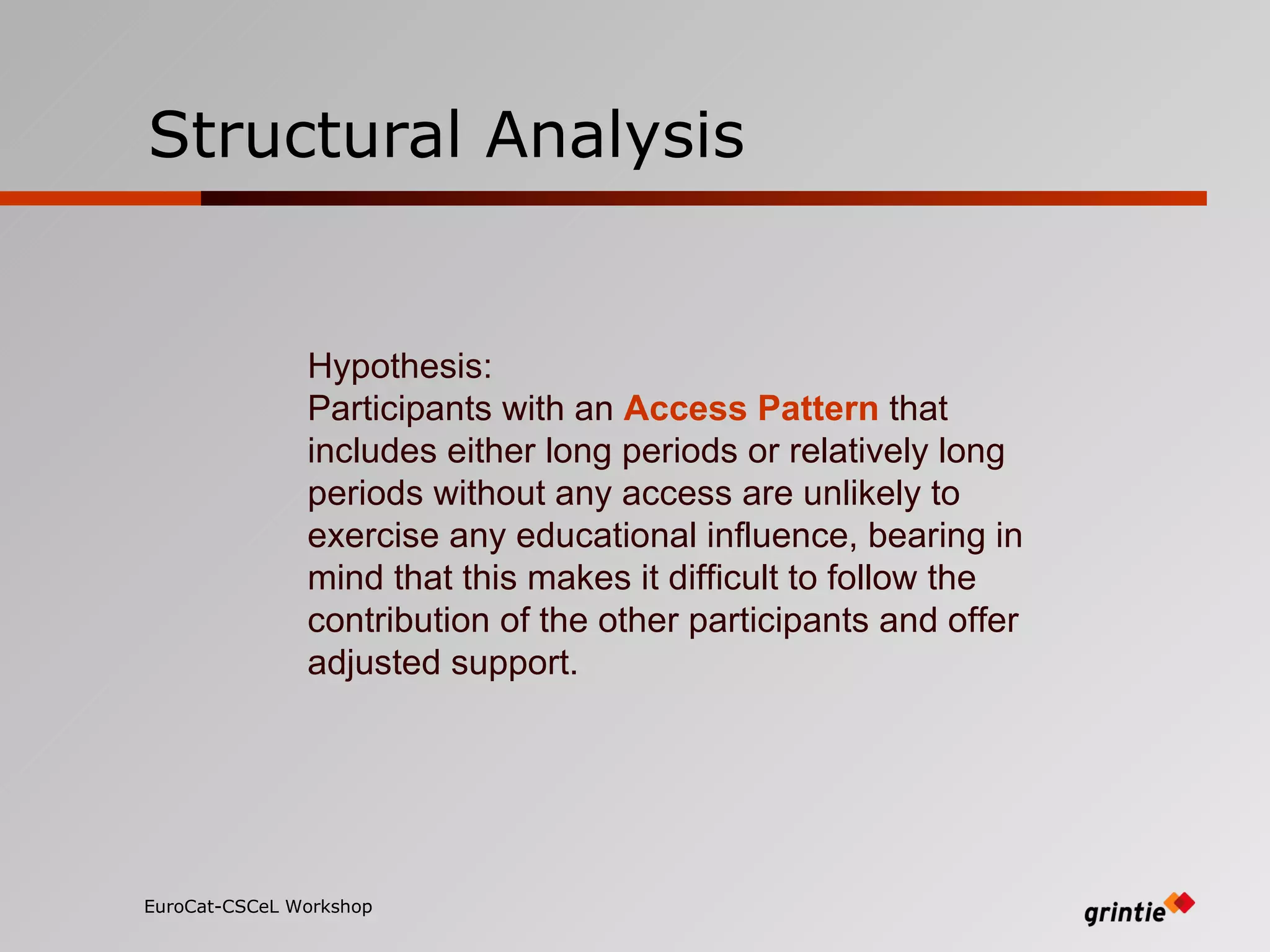
Structural Analysis EuroCat-CSCeL Workshop   Hypothesis:  Participants with an  Access Pattern  that includes either long periods or relatively long periods without any access are unlikely to exercise any educational influence, bearing in mind that this makes it difficult to follow the contribution of the other participants and offer adjusted support.
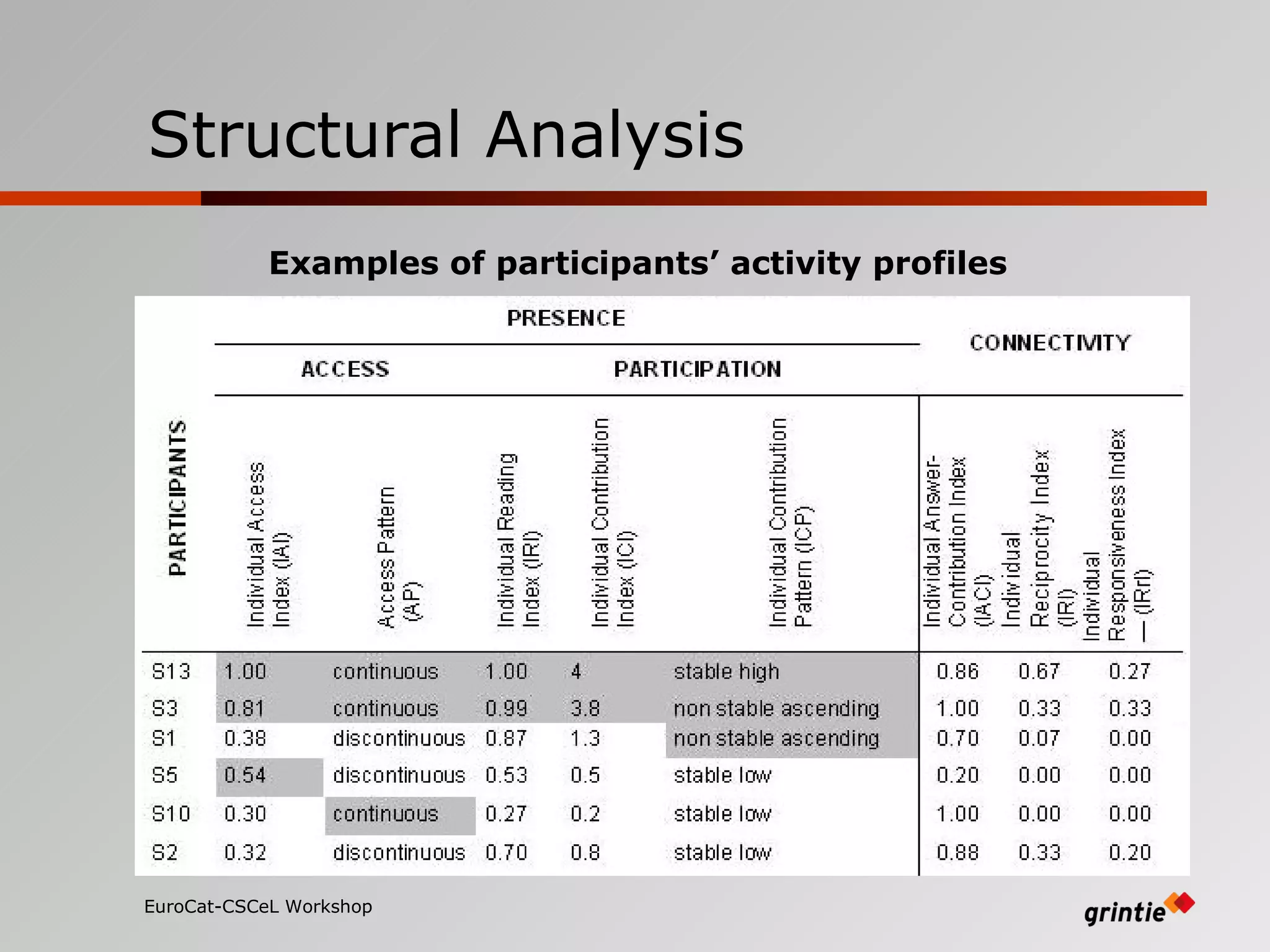
Structural Analysis EuroCat-CSCeL Workshop   Examples of participants’ activity profiles
Content Analysis EuroCat-CSCeL Workshop

Presentation at EuroCAT Workshop

  • 1.
    THE STUDY OFDISTRIBUTED TEACHING PRESENCE IN CSCL SETTINGS: temporal and organisational considerations C. Coll, A. Bustos & A. Engel EuroCat-CSCeL Workshop 5-6th February 2010
  • 2.
    Objective To presenta model oriented toward the analysis of Distributed Teaching Presence (DTP) in on-line learning environments Discuss some issues identified by the organizers: the relevance of the temporal analysis the relevance of organisational aspects of the activity the contextualized and situated nature of awareness tools EuroCat-CSCeL Workshop
  • 3.
    Distributed Teaching PresenceIndividual and collective learning take place thanks to the educational influence of others the set of supports provided by the participants –the teacher and the students— throughout the course of the joint activity to promote the cognitive and social processes for realizing meaningful learning EuroCat-CSCeL Workshop
  • 4.
    Distributed Teaching PresenceThe two relevant components of DTP: Educational influence as a set of supports that can vary their modality, quality, quantity, intensity and distribution over time, and Support that is delivered throughout the process and in such a manner that is contingent to the task and closely related to organisation and meaning negotiation of the participants EuroCat-CSCeL Workshop
  • 5.
    Analysis of DTP: a multi-method approach Structural Analysis Participants’ activity Access and continuity Participation and continuity in writing and reading Connectivity between the participants: answers, reciprocity, responsiveness Content Analysis Participants’ contributions Management of social participation Management of academic task Management of meanings EuroCat-CSCeL Workshop + +
  • 6.
    Analysis of DTP:some results Structural analysis has allowed us: To identify and characterize participants with regard to the suitability of their activity profile as potential carriers of teaching presence (or non-potential carriers or even some very interesting intermediate profiles) To establish the potential degree of the distribution of the teaching presence among the participants EuroCat-CSCeL Workshop Content analysis has allowed us: To identify participants who are real carriers of teaching presence To identify different modalities of teaching presence that appear in different moments throughout the activity To show the distribution of teaching presence modalities among the participants
  • 7.
    The relevance ofthe temporal analysis Question 1. How to study CSCeL activities longitudinally? The study of DTP places particular emphasis on temporal analysis: From the standpoint of the structural analysis, for instance, the relevant information is frequently associated with the temporal aspects of the participants' activity (Access Pattern; Individual Contribution Pattern ) Some results of our research show that the most relevant indicators from the structural point of view are associated with the longitudinal features of the participants' activity and contributions EuroCat-CSCeL Workshop
  • 8.
    The relevance ofthe temporal analysis The temporal variable also has an essential role, from the standpoint of content analysis, in at least two senses: The temporal contingency between contributions and fragments of contributions is a basic criteria in the content analysis Given our process oriented approach to the study of DTP, it becomes necessary to explore threaded discussions that are closely linked by the meanings or topics the participants develop EuroCat-CSCeL Workshop
  • 9.
    The relevance ofthe temporal analysis Finally, our results suggest that the “temporal variable” in on-line learning environments must be consider as “multi-dimensional” and not only as an isolated issue At least for the study of DTP, the temporal variable is in the core of the analysis: we can’t analyze and understand DTP without taking into account this dimension EuroCat-CSCeL Workshop
  • 10.
    The relevance ofthe organisation Questions 2. How to study organisation convergence? 3. Is a certain level of organisation necessary for knowledge construction? 4. Are knowledge opportunities increasing when the organisation efforts are decreasing? 5. Which factors affect organisation convergence? The construction of shared meanings in collaborative learning cannot be dissociated from the management of the social participation and the management of the task From DTP analysis, the main issues are related with the opportunities to identify: the time spent managing the social participation / task, the participants carrying out this management the moments when participants renegotiate the organisational aspects in order to restore the joint activity addressed to meaningful learning EuroCat-CSCeL Workshop
  • 11.
    The contextualized and situated nature of awareness tools Question 9. Could we increase “organisational group awareness” and “knowledge group awareness” through the longitudinal representation of the activity of the teammates? Our approach allow us to propose some specific criteria for design “activity tools” aimed to promote DTP: Should provide information about individual participant/for the participant and about the group as a whole / for the group Should deliver information during the ongoing process of learning and collaboration in progress (longitudinal dimension), and Should offer relevant and organized information about: access, participation and connectivity Organisation (social participation & task) Meaning making EuroCat-CSCeL Workshop
  • 12.
    Challenge: How tobuild a tool taking into account the contextual and situated nature of activity? The diversity of users/roles (teachers, students, project managers, researchers, etc. ) The different types of guidance needs in order to achieve diverse goals The diversity of scenarios (formal education, informal education, on-the-job training, etc.) Different types of collaborative tasks (discussions oriented to make collaborative decisions, to explore a topic or opposite alternatives; collaborative work aimed at developing a pre-defined product, etc.) Finally, without a tool “sensitive” to the contextual and situated nature of activity we can not obtain information about the processes that truly enable the understanding of DTP EuroCat-CSCeL Workshop The contextualized and situated nature of awareness tools
  • 13.
    Gracias por suatención THE STUDY OF DISTRIBUTED TEACHING PRESENCE IN CSCL SETTINGS: temporal and organisational considerations C. Coll, A. Bustos & A. Engel [email_address] www.psyed.edu.es/grintie
  • 14.
  • 15.
    Structural Analysis EuroCat-CSCeLWorkshop Hypothesis: Participants with an Access Pattern that includes either long periods or relatively long periods without any access are unlikely to exercise any educational influence, bearing in mind that this makes it difficult to follow the contribution of the other participants and offer adjusted support.
  • 16.
    Structural Analysis EuroCat-CSCeLWorkshop Examples of participants’ activity profiles
  • 17.

Editor's Notes

  • #2 First of all I want to thank your kind invitation to present our approach for the study of Distributed Teaching Presence.
  • #3 I will present a model for the analysis of Distributed Teaching Presence in online learning environments. More concretely, I’ll introduce DTP as a relevant concept for understanding some aspects related with teaching and learning in these environments. Furthermore, I will also include some references to our methodological approach for the study of DTP that combines the “structural analysis of the participants’ activity” with “content analysis of the participants’ contributions”. Introducing this approach, our proposal will be to discuss some issues identified by the organizers such as: the relevance of the temporal analysis , the relevance of organisational aspects of the activity and the contextualized and situated nature of awareness tools .
  • #4 From our perspective Individual and collective learning take place thanks to the educational influence of others. Then, we understand DTP as the set of supports provided by the participants –the teacher and the students- throughout the course of the join activity to promote the cognitive and social processes for realizing meaningful learning
  • #5 There two relevant components of DTP: First, the fact that supports can vary their modality, quality, quantity, intensity and distribution over time And Second the condition that support is delivered throughout the process and in such a manner that is contingent to the task and closely related to organisation and meaning negotiation of the participants
  • #6 With this perspective in mind, we identify two complementary data sources to analyze DTP ( of course, as Sanna said yesterday, in adittion to interviews, products, and so on…), : the participants’ activity in the digital context and the relevance of their contributions . On the one hand , Structural analysis is related with aspects as Access and continuity, participation and continuity in writing and reading and connectivity understood as answers between participants, reciprocity and responsiveness. As in your proposal, Niki, These aspects are partially related with Social Network Analysis. On the other hand, we analize the participants`contribution via content analys using Atlas.ti and our system of categories related with: management of social participation, academic task and meanings.
  • #7 While structural analysis informs us about the potential degree of exercise of teaching presence, content analysis, following the map drawn by structural analysis allows us to verify whether participants identified as potential carriers of the teaching presence are real carriers of teaching presence. Next, we will present a number of aspects that, following the results we have obtained in our research, appear relevant to address the questions proposed in this seminar
  • #9 the identification of topic and meaning-based threaded discussions -always longitudinally displayed- is one of the most relevant issues to the study of knowledge construction process in digital environments
  • #10 the identification of topic and meaning-based threaded discussions -always longitudinally displayed- is one of the most relevant issues to the study of knowledge construction process in digital environments
  • #11 In other words, the effort that participants must do in order to organize their activity cannot be separated from the efforts they must undertake with the purpose of constructing shared meanings.
  • #12 Although we have recently started with this issue, our approach for the analysis of DTP allow us to think in some relevant aspects:
  • #15 But in our case we calculate the indexes of these aspects taking into account the duration of the activity, the requirements, the phases. For instance, we identify the Individual Access Index, the Access Pattern or the Indiviudal Contribution Pattern. I think that in contrast with your approach, Niki, in our case the activity over time is very relevant. For each one of these indexes we have an hypothesis related with distributed teaching presence, for instance [leer] Furthermore, from our perspective none of these indexes is relevant by it self because we are interested in the participants’ activity profile it means that we define some criteria and to identify which participants meet these criteria related with pontential distribution or Teaching Presence.
  • #18 The management of social participation…. The