M. Ali Asghar
MB-12-34
Assessing the Relationship between
the Perceived Business Environment
and Firm’s
Entrepreneurial Orientation
ALARAPE, ADEREMI AYINLA
Purpose of the Debate
To shed light on the relationship between the variables and entrepreneurial
orientation and suggest ways of improving the EO by creating conducive
environment, thereby, enjoy the benefits improved performance associated
with high entrepreneurial orientation.
Entrepreneurial Orientation
ENTREPRENEURSHIP

ENTREPRENEURIAL ORIENTATION

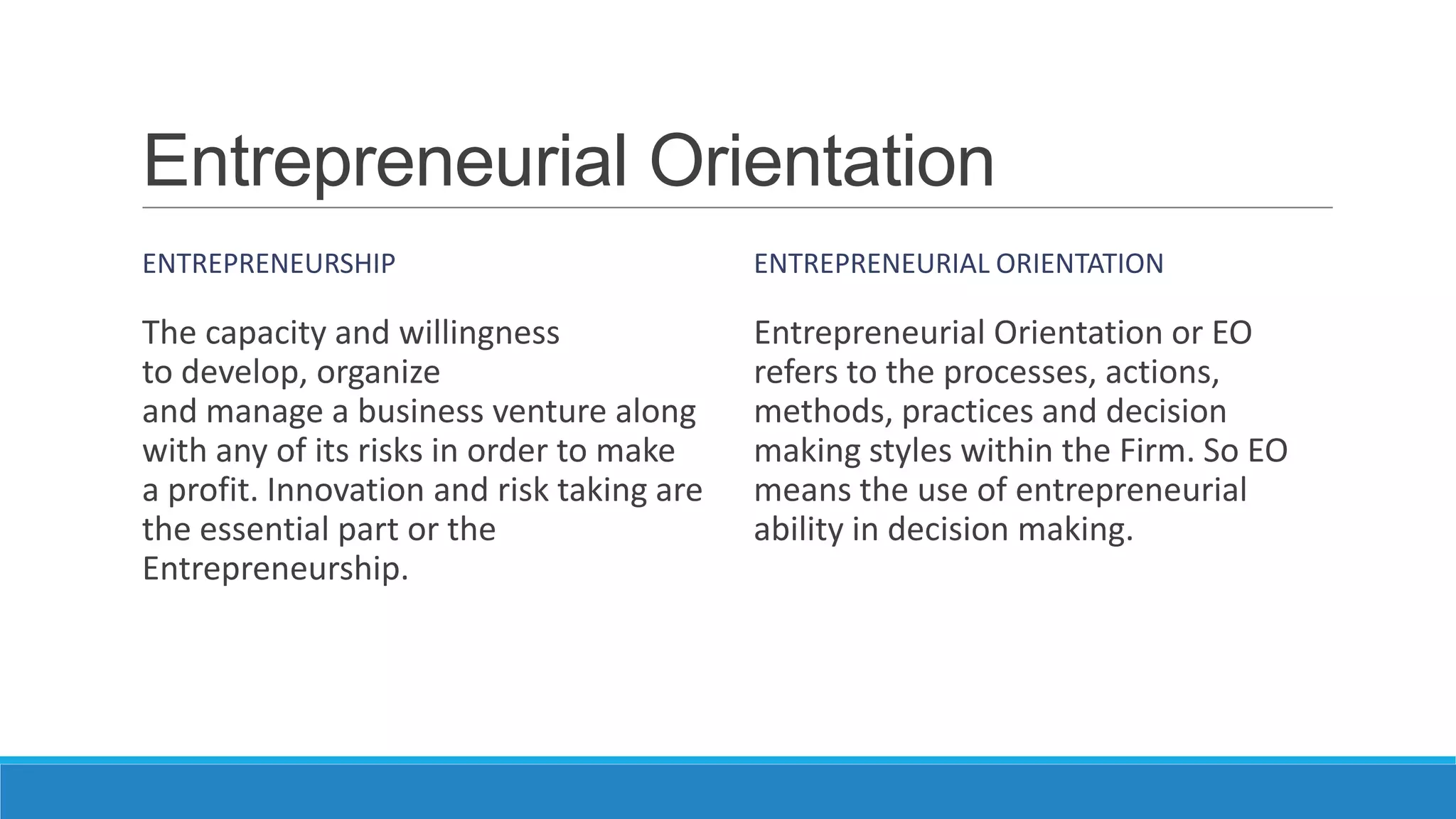
The capacity and willingness
to develop, organize
and manage a business venture along
with any of its risks in order to make
a profit. Innovation and risk taking are
the essential part or the
Entrepreneurship.

Entrepreneurial Orientation or EO
refers to the processes, actions,
methods, practices and decision
making styles within the Firm. So EO
means the use of entrepreneurial
ability in decision making.
Models of Entrepreneurial
Orientation
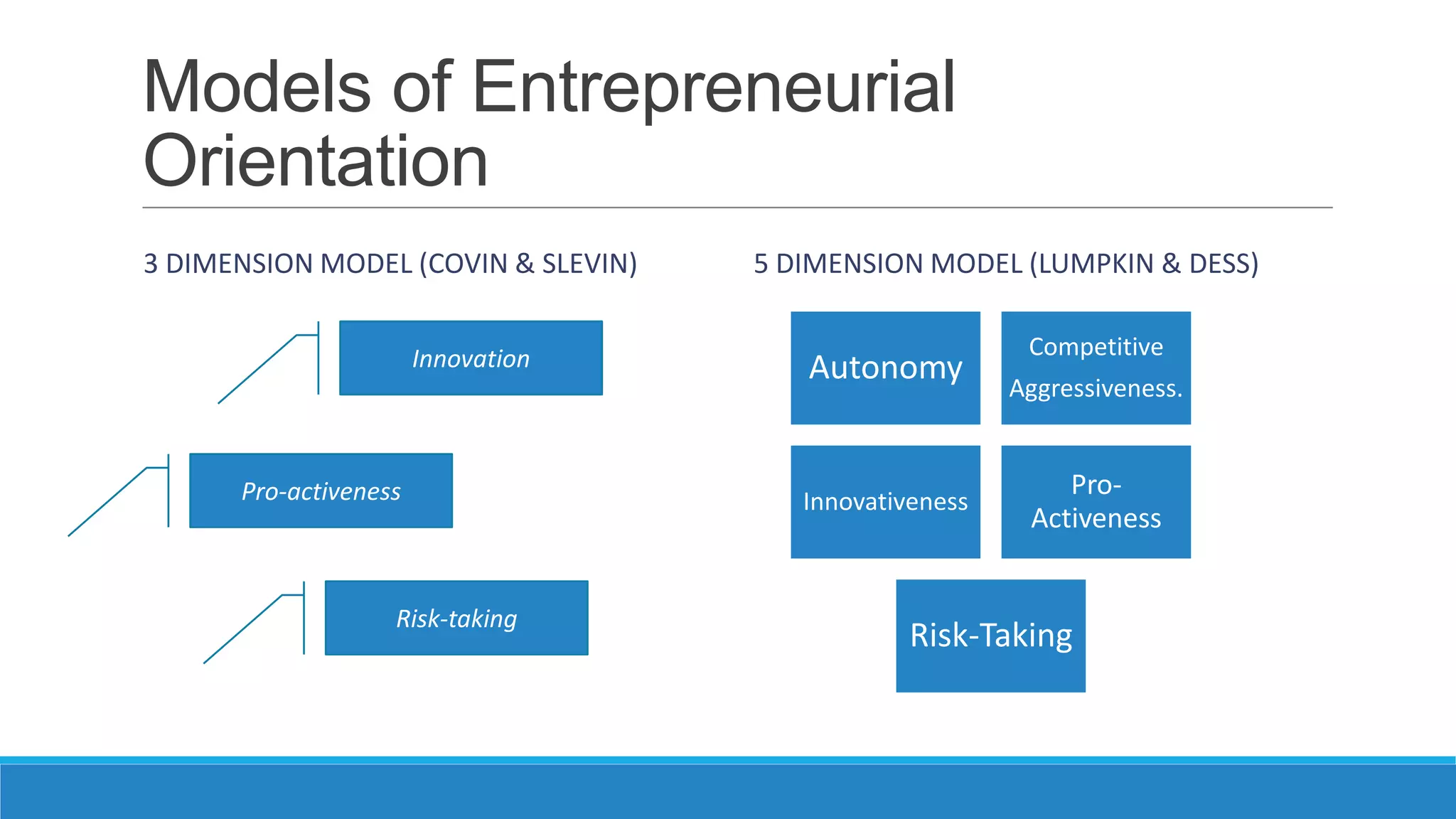
3 DIMENSION MODEL (COVIN & SLEVIN)
Innovation

Pro-activeness

Risk-taking

5 DIMENSION MODEL (LUMPKIN & DESS)

Autonomy

Innovativeness

Competitive
Aggressiveness.

ProActiveness

Risk-Taking
Models of Entrepreneurial
Orientation
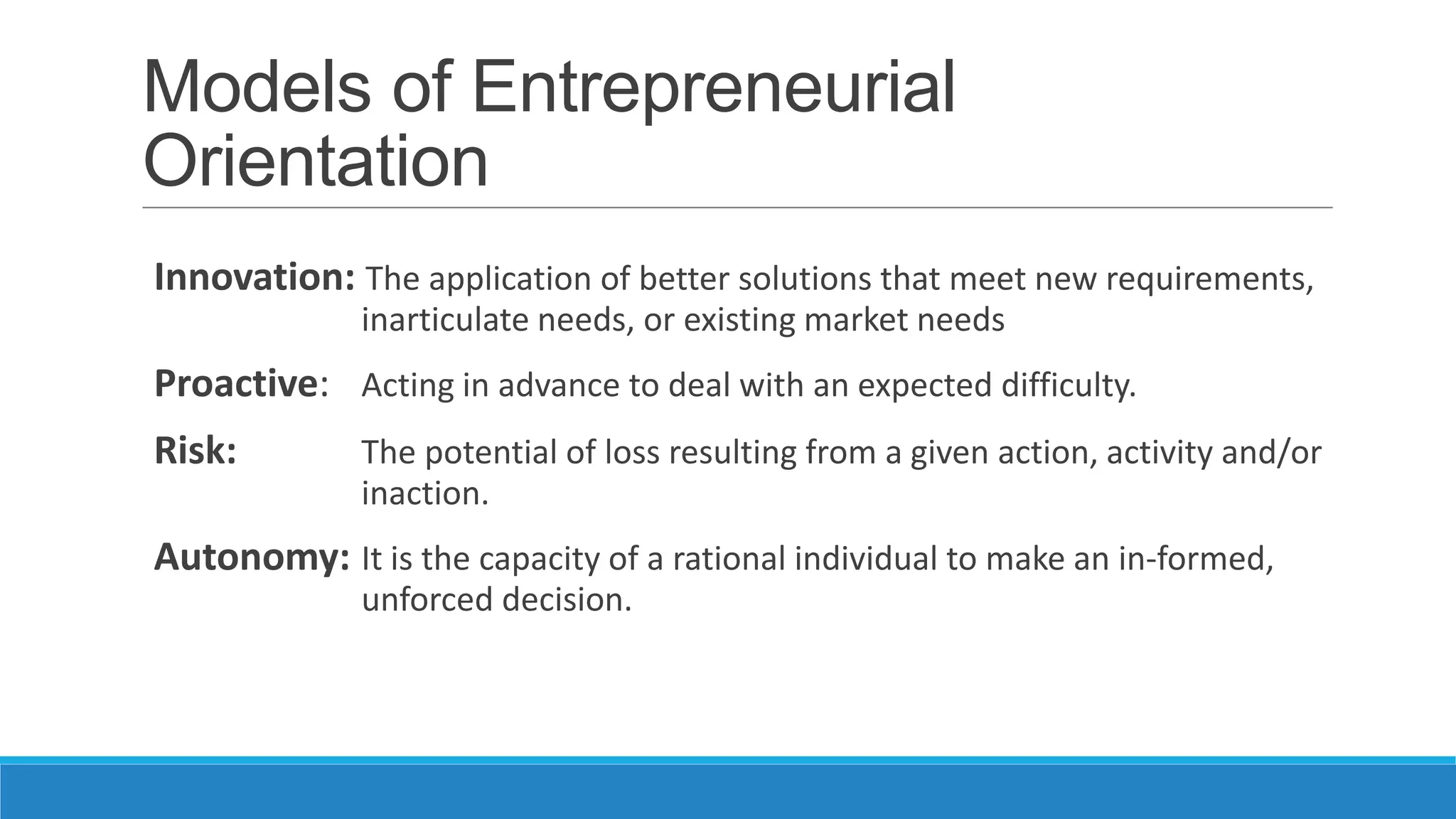
Innovation: The application of better solutions that meet new requirements,
inarticulate needs, or existing market needs

Proactive: Acting in advance to deal with an expected difficulty.
Risk:

The potential of loss resulting from a given action, activity and/or
inaction.

Autonomy: It is the capacity of a rational individual to make an in-formed,
unforced decision.
Theoretical Framework
Entrepreneurial
Orientation Units

Performance

Business
Environment
Measuring Entrepreneurial
Orientation
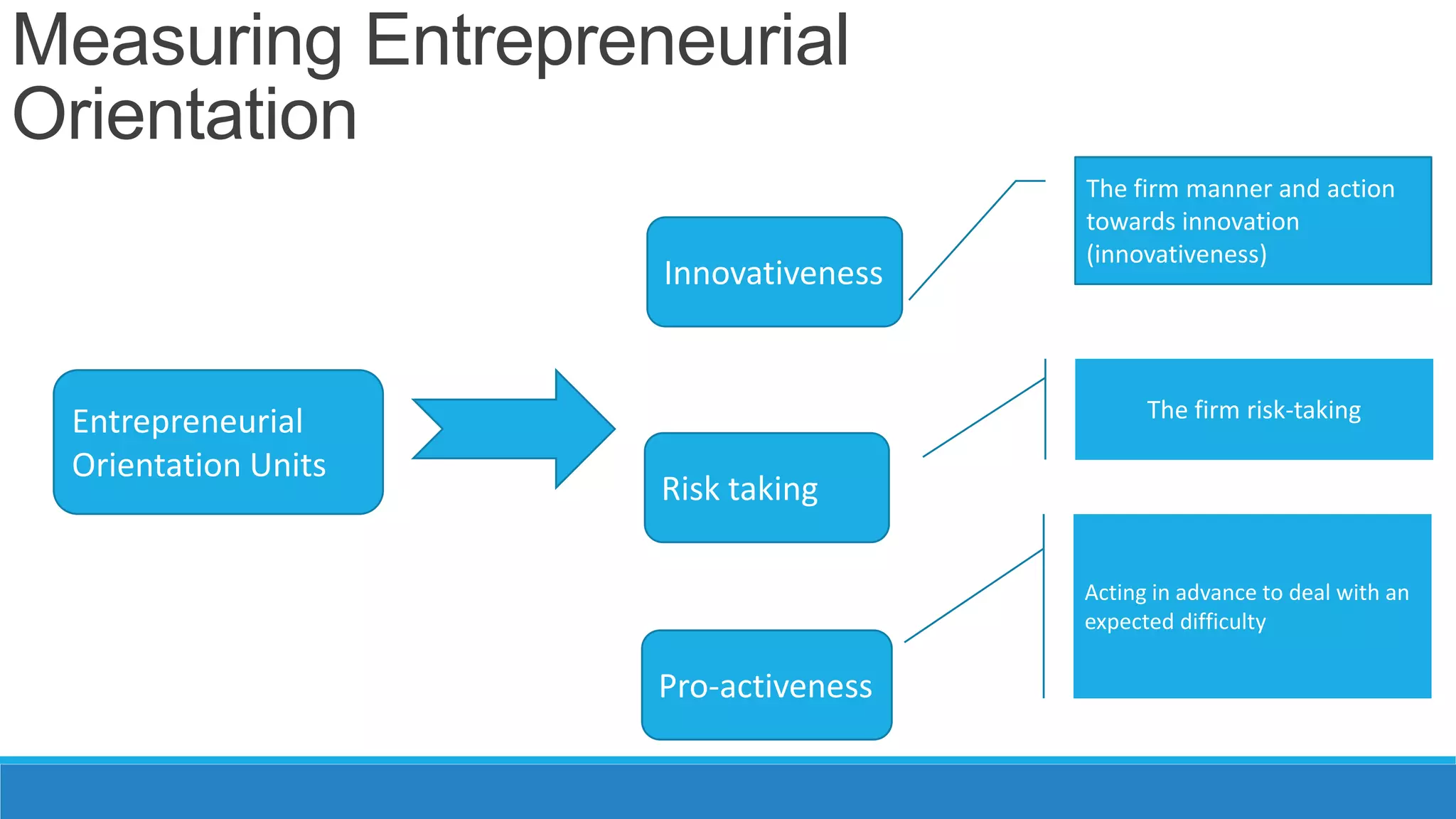
Innovativeness

Entrepreneurial
Orientation Units

The firm manner and action
towards innovation
(innovativeness)

The firm risk-taking

Risk taking
Acting in advance to deal with an
expected difficulty

Pro-activeness
Omer Shahzad
MB-12-08
Dynamic Environment
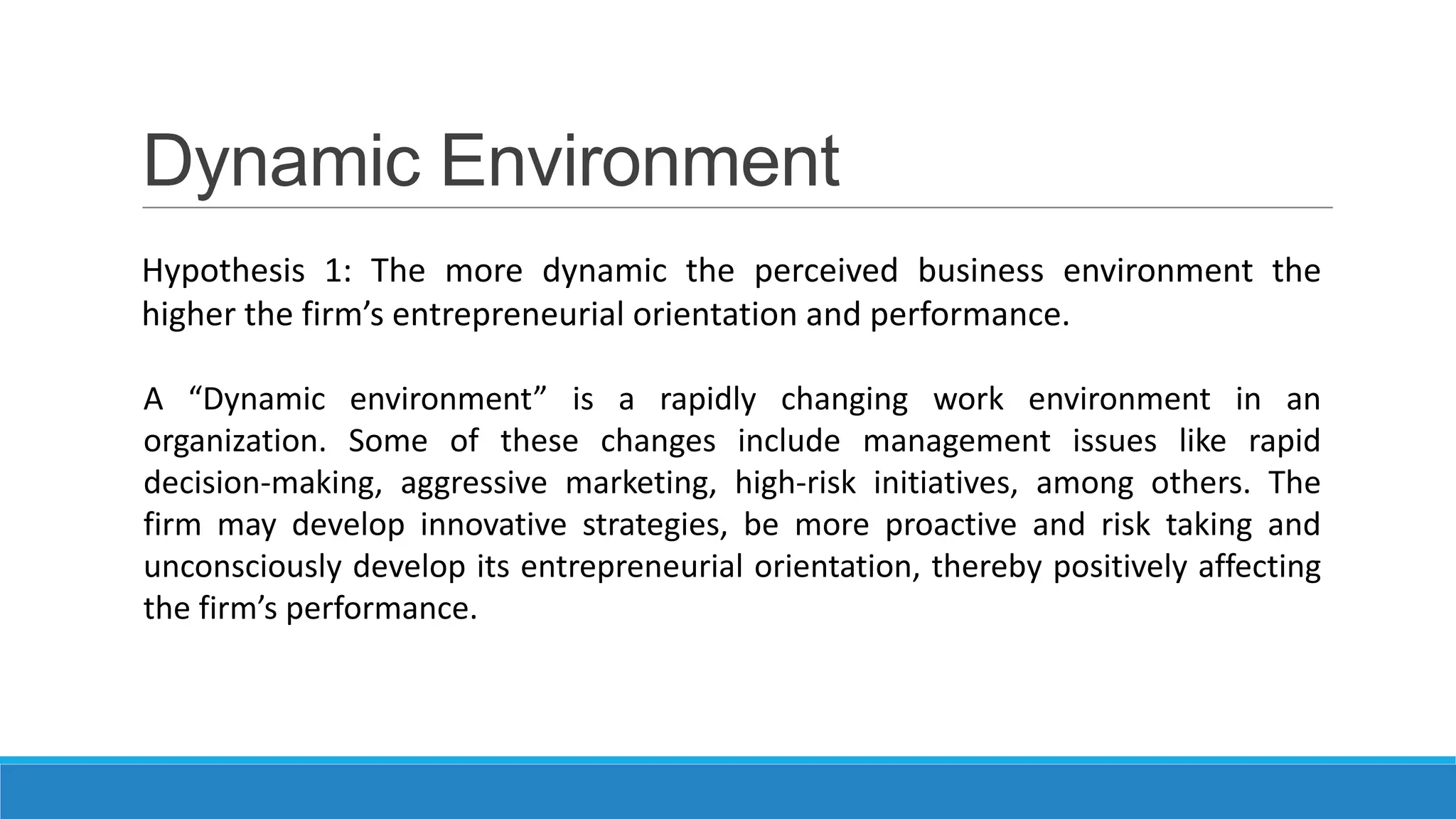
Hypothesis 1: The more dynamic the perceived business environment the
higher the firm’s entrepreneurial orientation and performance.
A “Dynamic environment” is a rapidly changing work environment in an
organization. Some of these changes include management issues like rapid
decision-making, aggressive marketing, high-risk initiatives, among others. The
firm may develop innovative strategies, be more proactive and risk taking and
unconsciously develop its entrepreneurial orientation, thereby positively affecting
the firm’s performance.
Hostile Environment
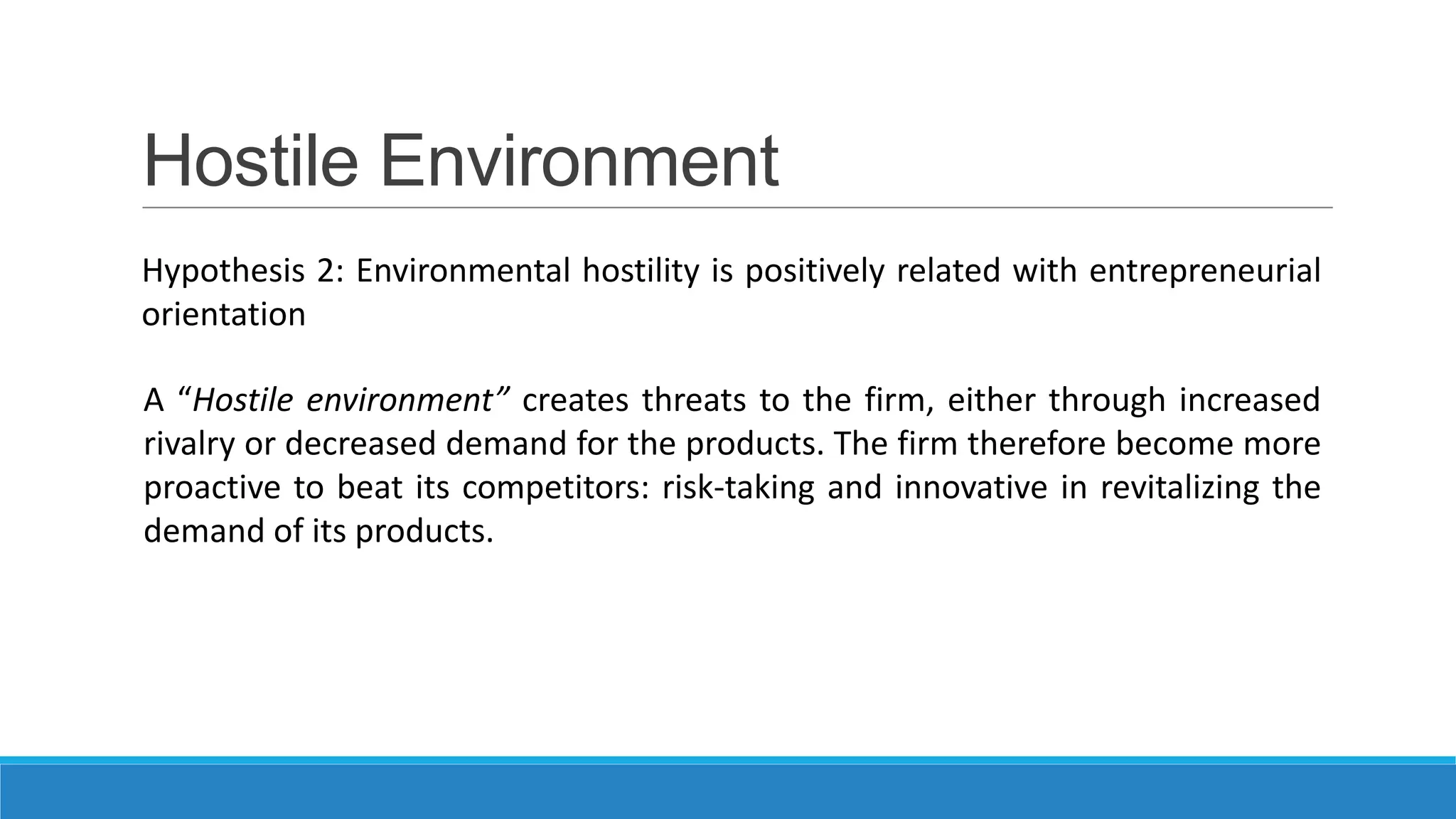
Hypothesis 2: Environmental hostility is positively related with entrepreneurial
orientation
A “Hostile environment” creates threats to the firm, either through increased
rivalry or decreased demand for the products. The firm therefore become more
proactive to beat its competitors: risk-taking and innovative in revitalizing the
demand of its products.
Environment Heterogeneity
Hypothesis 3: Environmental
entrepreneurial orientation

heterogeneity

is

positively

related

to

“Environmental heterogeneity” indicates that there are several different
segments of the market with varied characteristics and needs that is served by
the firm. In order to take advantage of the heterogeneity of the business
environment, the firm needs to be proactive and risk-taking and innovative in
order to take advantage of potential arbitrage and connect different markets.
Environment Munificence
Hypothesis 4: Environmental
entrepreneurial orientation.

munificence

is

positively

related

to

“Environmental munificence” means a great availability of resources in the
environment and great opportunity in access and acquirement of resources
needed. Munificence will significantly encourage innovativeness. Pro-activeness
will become unimportant as
the risk of failure is reduced.
Data Collection
 The study was conducted to analyze the relationship between the
entrepreneurial orientation (EO) and performance and the effect of the
perceived business environment (PBE) on the EO.
 Data was collected through questionnaires administered
owners/managers of small and medium enterprises (SMEs).

on
Research Method
 Multi-stage sampling technique was adopted in selecting the sample size.
 The first-stage involved the application of cluster sampling principle in
selecting Lagos area of Southwestern Nigeria
 In the second stage, the proportionate stratified sampling technique was
adopted in selecting 279 firms from a sample frame of 1,047 SMEs

 The questionnaires were distributed to the owners/mangers of SMEs
through experienced field assistants over a period of four months.
Evaluation of Entrepreneurial
Orientation
 The entrepreneurial orientation was evaluated via the entrepreneurial
orientation index (EOi). To calculate the entrepreneurial orientation index, an
eighteen-item entrepreneurial measurement scale (6-items measures each
of the dimensional variables of innovativeness, pro-activeness and risk
taking).
 The EO scale was constructed in “two-word” format on interval scale of “1 –
5”. As you move to the right of the scale the level of entrepreneurial
orientation increases and as you move to the left, the level of
entrepreneurial orientation decreases.
Perceived Business Environment
 The
combination
of
internal
and
external
factors
that
influence a company's operating situation is said to be the perceived
business environment. The business environment can include factors such
as: dynamism, hostility, heterogeneity and munificence.
 The questions drawn to get information on any of these variables were
carefully selected. The higher the score the more dynamic, hostile,
heterogeneity and munificence is the PBE and vice versa.
Data Analysis
 The Pearson correlation coefficient (r) was employed in examining the
relationship between the PBE variables (dynamism, hostility, heterogeneity
and munificence) and EO. Simple linear regression and multiple linear
regression that has the ability to estimate the direct linear effect of a single
or group of independent variable on a dependent variable was employed to
examine the effect of EO on growth performance of SMEs.
 This statistical method is used to detect and explain the differences that each
independent variable exercises on the dependent variable. The statistic
software SPSS (Statistical Package for the Social Sciences Version 14) was
used in analyzing the data for the study.
Results
Hypothesis 1: The more dynamic the perceived business environment the
higher the firm’s entrepreneurial orientation and performance.
The environmental dynamism is positively related to pro-activeness and risktaking but negatively related to innovativeness. However, it is positively related
to entrepreneurial orientation. Thus hypothesis 1 is upheld. This implies that as
the PBE is dynamic, the pro-activeness and risk-taking of the firm increases.
Results
Hypothesis 2: Environmental hostility is positively related with entrepreneurial
orientation
Environmental hostility has significant relationship only with pro-activeness but
not with innovativeness and risk-taking. This implies that as the environment
becomes hostile, the SMEs become proactive, risk-taking and innovativeness
are thus not related to the hostility in the PBE. The hostility is positively related
to entrepreneurial orientation because an average firm in hostile environment
adopts series of innovative, proactive and risk-taking strategies and acts in
order not to be washed away by the tide of “hostility”. Hypothesis 2 is therefore
upheld. Therefore as the business environment become hostile, the SMEs are
proactive and as it becomes Benign, they becomes non-proactive (i.e. passive).
Results
Hypothesis 3: Environmental heterogeneity is positively related to
entrepreneurial orientation
The heterogeneity of the PBE has significant relationship with all the EO’s
dimensional variables. It is positively related to pro-activeness and risk-taking;
negatively related to innovativeness. However, there is no significant relationship
between heterogeneity and entrepreneurial orientation. Thus, the PBE becomes
more heterogeneous, the pro-activeness and risk-taking of the firm increases and
as it becomes less heterogeneous the innovativeness of the firm increases,
however, not related to the overall EO of the firm. Therefore hypothesis 3 is not
accepted despite a significant relationship between the heterogeneity of the PBE
and the dimensional variables of EO that determines the overall EO of the firm.
Results
Hypothesis 4: Environmental munificence is positively related to
entrepreneurial orientation.
With respect to environmental munificence, there is a negative relationship with
risk taking. The relationship is neither significant with innovativeness nor proactiveness. Therefore hypothesis 4 is not upheld since there is no significant
relationship between environmental munificence and entrepreneurial orientation.
However, the significant relationship between the environmental munificence and
risk-taking implied that as the PBE becomes munificence the risk-taking proclivity
reduces and as it becomes less munificence. This is because the scarcity in the
environment put more challenges towards the firm, thus making them to be more
daring and thus more risk-taking.
Conclusion
 This study makes contribution to the literature on entrepreneurship examining
the relationship between EO and the nature of the perceived business
environment.
 The environmental variable of dynamism and hostility are positively related to
EO and its dimensional variables of pro-activeness and risk-taking. However,
Dynamism has negative relation with innovativeness, while hostility has no
significant relation with innovativeness.
 Entrepreneurial orientation of a firm has positive effect on their performance, it
becomes necessary to improve these environmental variables in order to
improve the EO and thus take advantage of the positive relationship between
the EO and firm performance to improve the performance of Nigerian SMEs.
Assessing the relationship between the perceived business environment

Assessing the relationship between the perceived business environment

  • 2.
  • 3.
    Assessing the Relationshipbetween the Perceived Business Environment and Firm’s Entrepreneurial Orientation ALARAPE, ADEREMI AYINLA
  • 4.
    Purpose of theDebate To shed light on the relationship between the variables and entrepreneurial orientation and suggest ways of improving the EO by creating conducive environment, thereby, enjoy the benefits improved performance associated with high entrepreneurial orientation.
  • 5.
    Entrepreneurial Orientation ENTREPRENEURSHIP ENTREPRENEURIAL ORIENTATION Thecapacity and willingness to develop, organize and manage a business venture along with any of its risks in order to make a profit. Innovation and risk taking are the essential part or the Entrepreneurship. Entrepreneurial Orientation or EO refers to the processes, actions, methods, practices and decision making styles within the Firm. So EO means the use of entrepreneurial ability in decision making.
  • 6.
    Models of Entrepreneurial Orientation 3DIMENSION MODEL (COVIN & SLEVIN) Innovation Pro-activeness Risk-taking 5 DIMENSION MODEL (LUMPKIN & DESS) Autonomy Innovativeness Competitive Aggressiveness. ProActiveness Risk-Taking
  • 7.
    Models of Entrepreneurial Orientation Innovation:The application of better solutions that meet new requirements, inarticulate needs, or existing market needs Proactive: Acting in advance to deal with an expected difficulty. Risk: The potential of loss resulting from a given action, activity and/or inaction. Autonomy: It is the capacity of a rational individual to make an in-formed, unforced decision.
  • 8.
  • 9.
    Measuring Entrepreneurial Orientation Innovativeness Entrepreneurial Orientation Units Thefirm manner and action towards innovation (innovativeness) The firm risk-taking Risk taking Acting in advance to deal with an expected difficulty Pro-activeness
  • 10.
  • 11.
    Dynamic Environment Hypothesis 1:The more dynamic the perceived business environment the higher the firm’s entrepreneurial orientation and performance. A “Dynamic environment” is a rapidly changing work environment in an organization. Some of these changes include management issues like rapid decision-making, aggressive marketing, high-risk initiatives, among others. The firm may develop innovative strategies, be more proactive and risk taking and unconsciously develop its entrepreneurial orientation, thereby positively affecting the firm’s performance.
  • 12.
    Hostile Environment Hypothesis 2:Environmental hostility is positively related with entrepreneurial orientation A “Hostile environment” creates threats to the firm, either through increased rivalry or decreased demand for the products. The firm therefore become more proactive to beat its competitors: risk-taking and innovative in revitalizing the demand of its products.
  • 13.
    Environment Heterogeneity Hypothesis 3:Environmental entrepreneurial orientation heterogeneity is positively related to “Environmental heterogeneity” indicates that there are several different segments of the market with varied characteristics and needs that is served by the firm. In order to take advantage of the heterogeneity of the business environment, the firm needs to be proactive and risk-taking and innovative in order to take advantage of potential arbitrage and connect different markets.
  • 14.
    Environment Munificence Hypothesis 4:Environmental entrepreneurial orientation. munificence is positively related to “Environmental munificence” means a great availability of resources in the environment and great opportunity in access and acquirement of resources needed. Munificence will significantly encourage innovativeness. Pro-activeness will become unimportant as the risk of failure is reduced.
  • 15.
    Data Collection  Thestudy was conducted to analyze the relationship between the entrepreneurial orientation (EO) and performance and the effect of the perceived business environment (PBE) on the EO.  Data was collected through questionnaires administered owners/managers of small and medium enterprises (SMEs). on
  • 16.
    Research Method  Multi-stagesampling technique was adopted in selecting the sample size.  The first-stage involved the application of cluster sampling principle in selecting Lagos area of Southwestern Nigeria  In the second stage, the proportionate stratified sampling technique was adopted in selecting 279 firms from a sample frame of 1,047 SMEs  The questionnaires were distributed to the owners/mangers of SMEs through experienced field assistants over a period of four months.
  • 17.
    Evaluation of Entrepreneurial Orientation The entrepreneurial orientation was evaluated via the entrepreneurial orientation index (EOi). To calculate the entrepreneurial orientation index, an eighteen-item entrepreneurial measurement scale (6-items measures each of the dimensional variables of innovativeness, pro-activeness and risk taking).  The EO scale was constructed in “two-word” format on interval scale of “1 – 5”. As you move to the right of the scale the level of entrepreneurial orientation increases and as you move to the left, the level of entrepreneurial orientation decreases.
  • 18.
    Perceived Business Environment The combination of internal and external factors that influence a company's operating situation is said to be the perceived business environment. The business environment can include factors such as: dynamism, hostility, heterogeneity and munificence.  The questions drawn to get information on any of these variables were carefully selected. The higher the score the more dynamic, hostile, heterogeneity and munificence is the PBE and vice versa.
  • 19.
    Data Analysis  ThePearson correlation coefficient (r) was employed in examining the relationship between the PBE variables (dynamism, hostility, heterogeneity and munificence) and EO. Simple linear regression and multiple linear regression that has the ability to estimate the direct linear effect of a single or group of independent variable on a dependent variable was employed to examine the effect of EO on growth performance of SMEs.  This statistical method is used to detect and explain the differences that each independent variable exercises on the dependent variable. The statistic software SPSS (Statistical Package for the Social Sciences Version 14) was used in analyzing the data for the study.
  • 20.
    Results Hypothesis 1: Themore dynamic the perceived business environment the higher the firm’s entrepreneurial orientation and performance. The environmental dynamism is positively related to pro-activeness and risktaking but negatively related to innovativeness. However, it is positively related to entrepreneurial orientation. Thus hypothesis 1 is upheld. This implies that as the PBE is dynamic, the pro-activeness and risk-taking of the firm increases.
  • 21.
    Results Hypothesis 2: Environmentalhostility is positively related with entrepreneurial orientation Environmental hostility has significant relationship only with pro-activeness but not with innovativeness and risk-taking. This implies that as the environment becomes hostile, the SMEs become proactive, risk-taking and innovativeness are thus not related to the hostility in the PBE. The hostility is positively related to entrepreneurial orientation because an average firm in hostile environment adopts series of innovative, proactive and risk-taking strategies and acts in order not to be washed away by the tide of “hostility”. Hypothesis 2 is therefore upheld. Therefore as the business environment become hostile, the SMEs are proactive and as it becomes Benign, they becomes non-proactive (i.e. passive).
  • 22.
    Results Hypothesis 3: Environmentalheterogeneity is positively related to entrepreneurial orientation The heterogeneity of the PBE has significant relationship with all the EO’s dimensional variables. It is positively related to pro-activeness and risk-taking; negatively related to innovativeness. However, there is no significant relationship between heterogeneity and entrepreneurial orientation. Thus, the PBE becomes more heterogeneous, the pro-activeness and risk-taking of the firm increases and as it becomes less heterogeneous the innovativeness of the firm increases, however, not related to the overall EO of the firm. Therefore hypothesis 3 is not accepted despite a significant relationship between the heterogeneity of the PBE and the dimensional variables of EO that determines the overall EO of the firm.
  • 23.
    Results Hypothesis 4: Environmentalmunificence is positively related to entrepreneurial orientation. With respect to environmental munificence, there is a negative relationship with risk taking. The relationship is neither significant with innovativeness nor proactiveness. Therefore hypothesis 4 is not upheld since there is no significant relationship between environmental munificence and entrepreneurial orientation. However, the significant relationship between the environmental munificence and risk-taking implied that as the PBE becomes munificence the risk-taking proclivity reduces and as it becomes less munificence. This is because the scarcity in the environment put more challenges towards the firm, thus making them to be more daring and thus more risk-taking.
  • 24.
    Conclusion  This studymakes contribution to the literature on entrepreneurship examining the relationship between EO and the nature of the perceived business environment.  The environmental variable of dynamism and hostility are positively related to EO and its dimensional variables of pro-activeness and risk-taking. However, Dynamism has negative relation with innovativeness, while hostility has no significant relation with innovativeness.  Entrepreneurial orientation of a firm has positive effect on their performance, it becomes necessary to improve these environmental variables in order to improve the EO and thus take advantage of the positive relationship between the EO and firm performance to improve the performance of Nigerian SMEs.