In-depth
                             Students as learning designers:
                             Using social media to scaffold the experience
Authors                        The ‘students as learning designers’ approach challenges transmission models of peda-
                               gogy and requires teachers to relinquish some control to their students so that they
Leanne Cameron
                               might have the space to experiment and discover how to learn.
Leanne.Cameron@acu.edu.
au
                               This paper outlines the findings of two studies that allowed students to explore new
Miriam Tanti                   ways of learning, where they were encouraged to take responsibility for their own
miriam.tanti@acu.edu.au
                               learning, and outlines what potential social media tools may have in facilitating this
Faculty of Education,
                               experience. These projects demonstrate that when students are empowered to design
Australian Catholic
University                     their own learning activities, they can deeply engage in the learning process.


Tags                         1. Introduction
students as learning         It has been stated that the field of learning design holds the promise of providing teachers
designers, social media,     with a framework that will enable them to design high quality, effective and innovative learn-
participatory media          ing experiences for their students (Cameron, 2009). By creating the possibility of deconstruct-
                             ing their existing teaching strategies; aiding reflection on their own practice; documenting
                             and scaffolding innovative learning activities; and sharing and reusing expert practice, the
                             field of learning design has the potential to improve the quality of teaching throughout the
                             higher education sector. Traditionally, the key stakeholder in the learning process, the stu-
                             dent, is not given a central design role, however, with the advent of web 2.0 tools, it has
                             never been easier to provide students with the opportunity to contribute to their own learn-
                             ing. Many students have already chosen to use social media, eg. Facebook, Twitter, for their
                             own communications and social interaction (November, 2011). In this paper, we report on
                             what happens when students are empowered to design their own learning, and how best to
                             scaffold the design process using the social media tools with which they are already familiar.


                             2. Overview
                             The paper describes two separate, but related, studies. The “Students as Learning Design-
                             ers Project” (Cameron & Gotlieb, 2009), involved five teachers and 165 students from five
                             elementary schools. A key element of the project was that the students were asked to take a
                             significant amount of responsibility in planning for, and creating, their own learning. During
                             the project, the students produced 230 learning designs. Research data was collected from
                             teachers and students via a pre-project survey and video recorded post-project interviews.
                             Throughout the project, the teachers took a problem-based learning approach and it be-
                             came quickly apparent that the students required significant scaffolding, particularly in the
                             early stages of the process.

                             In the subsequent project, “Scaffolding Student Learning Designers”, the potential of social
                             media to provide the identified need for scaffolding was explored. The support received by
                             students designing their learning, both from their teachers and their peers, was analysed.


       ing
  earn
                                                       eLearning Papers • ISSN: 1887-1542 • www.elearningpapers.eu
eL ers
                       27
                         u
                    ers.e
                gpap
   www
      .elea
            rnin                                                                                 n.º 27 • December 2011
Pap
                                                                                                                        1
In-depth

This study involved 206 Masters students at the Australian               Several studies indicate that the features of social media tools
Catholic University in their first year of study. Data was collected     may be used for educational purposes (Boling, et al., 2008;
from students’ Tweets, blog entries and a post-project online            Glass & Spiegelman, 2008; Haramiak, Boulton, & Irwin, 2009;
survey.                                                                  Kajder & Bull, 2004; Martindale & Wiley, 2005; Quible, 2005;
                                                                         Ray, 2006; Wassell & Crouch, 2008). Researchers argue that so-
3. 	Objectives                                                           cial media tools, namely blogs and microblogs can be used as
                                                                         effective instructional tools in which teachers and students can
The initial project, “Students as Learning Designers Project”,           communicate with each other and make connections between
was designed to determine the educational impact of students             content and pedagogy (Overby, 2009; Ray, 2006). Students can
to creating and sharing their own learning designs. It aimed to:         also utilise the technologies to collaborate and share their re-
  •	 Provide an opportunity for students to have ownership               sources.
     over the design and creation of their learning experiences;
                                                                         In the learning design environment in the “Scaffolding Student
  •	 Determine the key teaching and learning opportunities af-
                                                                         Learning Designers” study, students were not merely using the
     forded by student authoring projects;
                                                                         social media tools to receive information: they were engaging in
  •	 Analyse the depth and variety of the designs provided by
                                                                         a constructive learning design process with both their teachers
     students when access to authoring software is provided;
                                                                         and their peers.
  •	 Evaluate the tools that could provide an efficient means of
     involving students in learning.
                                                                         4.	 Students as learning designers
In the second project, “Scaffolding Student Learning Designers”,
the same project design was employed, but an additional aim              As learning designers, students are given the opportunity to
was included:                                                            be creative and pursue their goals actively (Lui & Hsiao, 2002).
                                                                         The initial project demonstrated that students are able to make
  •	 Analyse how social media tools were employed to scaffold
                                                                         decisions (with varying degrees of guidance) about both con-
     the learning design process.
                                                                         tent (what to learn) and pedagogy (how to learn it), (Reigeluth,
In each project, students and teachers were asked to look be-            1996).
yond their current approach to teaching and learning and ana-
                                                                         Designing learning is a complex task. Caver, Lehrer, Connell &
lyse the attitudes and conceptions that inform that approach.
                                                                         Erickson (1992) identified five categories of critical thinking
The project-based learning strategy adopted required students
                                                                         skills they observed students exhibiting when they were design-
to take a more active role in planning and creating their own
                                                                         ing learning environments and/or tools. These thinking skills
learning. Understanding how they might do this was a complex
                                                                         were also observed to be taking place in these projects:
and multi-faceted problem.
                                                                           •	   Project management;
Students generally understood how to structure a basic learning
                                                                           •	   Research;
task, eg. provide some information and then check learner un-
                                                                           •	   Organisation and representation;
derstanding using questions. However, they often needed lots
                                                                           •	   Presentation; and
of support in understanding the relationship between the learn-
                                                                           •	   Reflection.
ing activities and the pedagogy.
                                                                         When students were given the opportunity participate in a dis-
It was not just a matter of helping the students think up relevant       cussion with the researchers in their role as learning design-
and authentic learning tasks, their teacher’s role was to provide        ers (with equal status with their teachers), they rose to meet
students with carefully considered scaffolds that enabled them           the challenge and provided insightful comments, eg. How can
to achieve beyond what they could as individuals with the re-            groups be used to pull together individuals of similar of different
sources before them. In the “Scaffolding Student Learning De-            interest?; What constitutes a ‘good’ answer?; how and why we
signers” Project, the potential of social media tools to scaffold        provide feedback.
this experience was examined.
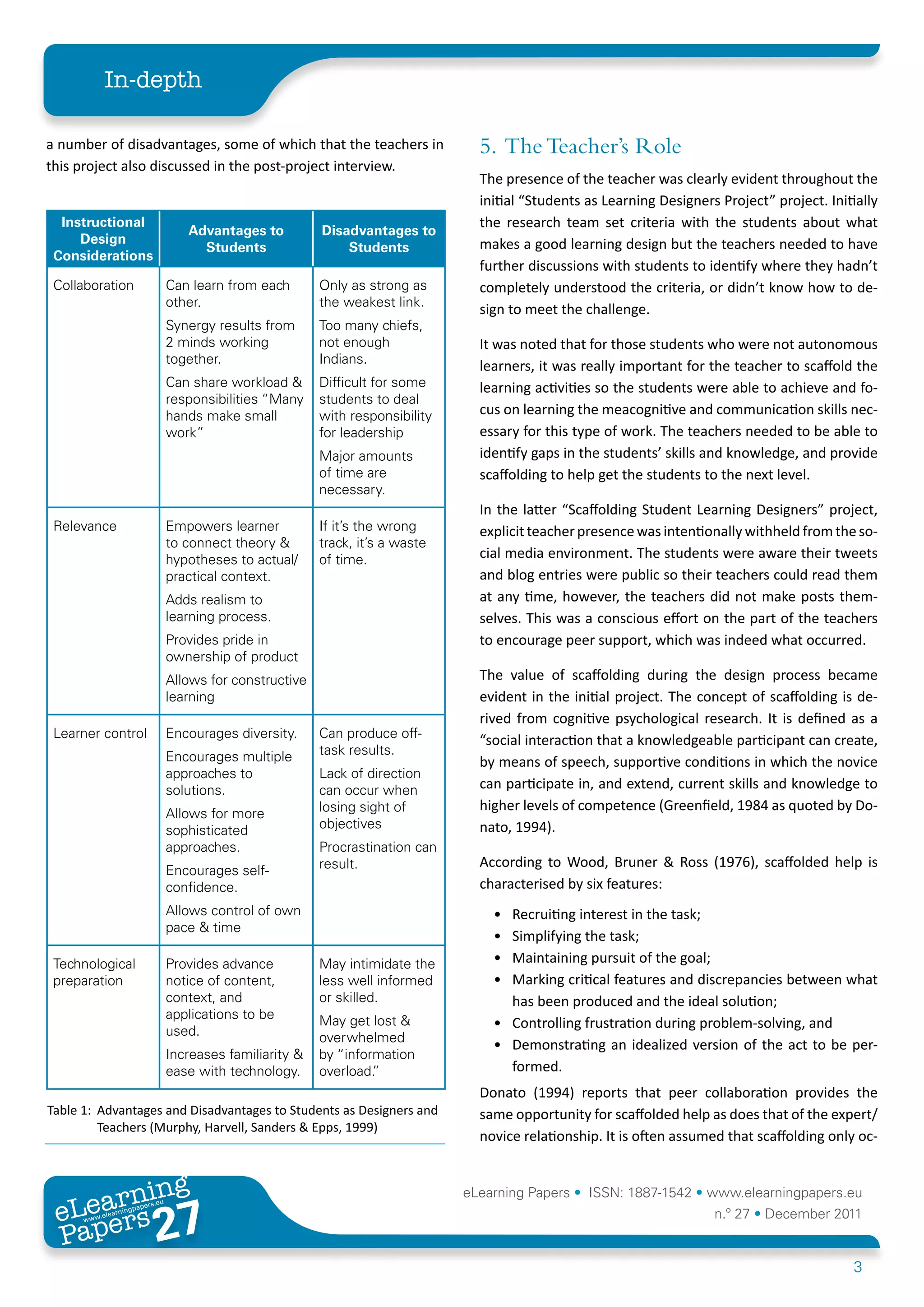
                                                                         The table below most effectively summarises the advantages
                                                                         of using students as designers of learning and it also outlines


        ing
   earn
                                                                       eLearning Papers • ISSN: 1887-1542 • www.elearningpapers.eu
 eL ers
                          27
                            u
                       ers.e
                   gpap
      www
         .elea
               rnin                                                                                             n.º 27 • December 2011
 Pap
                                                                                                                                       2
In-depth

a number of disadvantages, some of which that the teachers in                     5.	 The Teacher’s Role
this project also discussed in the post-project interview.
                                                                                  The presence of the teacher was clearly evident throughout the
                                                                                  initial “Students as Learning Designers Project” project. Initially
  Instructional                                                                   the research team set criteria with the students about what
                                   Advantages to          Disadvantages to
     Design                                                                       makes a good learning design but the teachers needed to have
                                     Students                 Students
 Considerations
                                                                                  further discussions with students to identify where they hadn’t
 Collaboration                  Can learn from each       Only as strong as       completely understood the criteria, or didn’t know how to de-
                                other.                    the weakest link.
                                                                                  sign to meet the challenge.
                                Synergy results from      Too many chiefs,
                                2 minds working           not enough              It was noted that for those students who were not autonomous
                                together.                 Indians.
                                                                                  learners, it was really important for the teacher to scaffold the
                                Can share workload &      Difficult for some      learning activities so the students were able to achieve and fo-
                                responsibilities “Many    students to deal
                                hands make small          with responsibility     cus on learning the meacognitive and communication skills nec-
                                work”                     for leadership          essary for this type of work. The teachers needed to be able to
                                                          Major amounts           identify gaps in the students’ skills and knowledge, and provide
                                                          of time are             scaffolding to help get the students to the next level.
                                                          necessary.
                                                                                  In the latter “Scaffolding Student Learning Designers” project,
 Relevance                      Empowers learner          If it’s the wrong       explicit teacher presence was intentionally withheld from the so-
                                to connect theory &       track, it’s a waste
                                hypotheses to actual/     of time.                cial media environment. The students were aware their tweets
                                practical context.                                and blog entries were public so their teachers could read them
                                Adds realism to                                   at any time, however, the teachers did not make posts them-
                                learning process.                                 selves. This was a conscious effort on the part of the teachers
                                Provides pride in                                 to encourage peer support, which was indeed what occurred.
                                ownership of product
                                Allows for constructive                           The value of scaffolding during the design process became
                                learning                                          evident in the initial project. The concept of scaffolding is de-
                                                                                  rived from cognitive psychological research. It is defined as a
 Learner control                Encourages diversity.     Can produce off-
                                                                                  “social interaction that a knowledgeable participant can create,
                                Encourages multiple       task results.
                                                                                  by means of speech, supportive conditions in which the novice
                                approaches to             Lack of direction
                                solutions.                can occur when          can participate in, and extend, current skills and knowledge to
                                                          losing sight of         higher levels of competence (Greenfield, 1984 as quoted by Do-
                                Allows for more
                                sophisticated             objectives              nato, 1994).
                                approaches.               Procrastination can
                                                          result.                 According to Wood, Bruner & Ross (1976), scaffolded help is
                                Encourages self-
                                confidence.                                       characterised by six features:
                                Allows control of own                               •	 Recruiting interest in the task;
                                pace & time
                                                                                    •	 Simplifying the task;
 Technological                  Provides advance          May intimidate the        •	 Maintaining pursuit of the goal;
 preparation                    notice of content,        less well informed        •	 Marking critical features and discrepancies between what
                                context, and              or skilled.                  has been produced and the ideal solution;
                                applications to be        May get lost &            •	 Controlling frustration during problem-solving, and
                                used.                     overwhelmed
                                                                                    •	 Demonstrating an idealized version of the act to be per-
                                Increases familiarity &   by “information
                                ease with technology.     overload.”                   formed.
                                                                                  Donato (1994) reports that peer collaboration provides the
Table 1:	 Advantages and Disadvantages to Students as Designers and               same opportunity for scaffolded help as does that of the expert/
          Teachers (Murphy, Harvell, Sanders & Epps, 1999)
                                                                                  novice relationship. It is often assumed that scaffolding only oc-


        ing
   earn
                                                                                eLearning Papers • ISSN: 1887-1542 • www.elearningpapers.eu
 eL ers
                          27
                            u
                       ers.e
                   gpap
      www
         .elea
               rnin                                                                                                      n.º 27 • December 2011
 Pap
                                                                                                                                                3
In-depth

curs in the presence of an identifiable expert and that this assist-     In order for the students to design their own learning activities,
ance is unidirectional, that is from the teacher to the student.         the teachers had to relinquish some control. This resulted in
                                                                         their students being:
In the initial “Students as Learning Designers Project” project
teachers sometimes saw a need to “formalise the informal” to               •	   Given the initiative;
realise the potential benefits of peer learning so that all stu-           •	   Allowed to choose from a diversity of sound methods;
dents could benefit from it, not just those who were already               •	   Work in teams on authentic, real-world tasks;
proficient learners. For example, the teachers provided criteria           •	   Utilise the features of advanced technologies; and
for the learning designs, taught metacognive and communica-                •	   Allowed to persevere until they reached appropriate
tion skills, provided feedback on the learning designs and pro-                 standards (Reigeluth, 1996).
vided some instruction on the use of the technology.                     There is no doubt the students were actively engaged, however,
                                                                         just being allowed to do something that is not a usual part of
Teachers often think that what they do is necessarily more im-
                                                                         formal learning, and/or being recognised for creating some-
portant for student learning that other activities in which they
                                                                         thing clever, is enough to keep students motivated and on task
engage. Although the importance of the teacher was clearly
                                                                         (Prensky, 2007). Hence novelty may have been a factor for the
demonstrated in both projects, teachers had to be careful not
                                                                         high level of student motivation observed.
to place themselves in the position of mediating all the students
needed to know. This may not only create unrealistic expecta-            Additionally, both projects observed similar student behaviour
tions, but teachers can potentially de-skill their students by pre-      to that reported by Liu & Rutledge (1997), and that was that
venting them from effectively learning from each other (Boud             while students were highly motivated in many respects and
et al, 2001).                                                            were on task, the critical design skills of planning and time man-
                                                                         agement were not easy for them to acquire.
6.	 Encouraging Student Engagement
Throughout both projects, the teachers and students devel-               7.	 Learning with Social Media
oped a highly engaging, customised learning environment that             These results of the initial “Students as Learning Design-
fostered student independence, initiative, teamwork, thinking            ers Project” were impressive but what emerged during the
skills, metacognitive skills and diversity. Within this environ-         study was that students required timely and effective support
ment, the students collaborated to design effective learning             throughout the learning design process. Hence the search be-
activities. Their design task required them to use higher or-            gan for tools to scaffold students’ learning without diminishing
der thinking processes and reflection, not just the lower order          the value of peer interaction and support that had been wit-
thinking skills normally used when they are simply required to           nessed in the initial study.
reproduce knowledge.
                                                                         The value of a blog to record work-in-progress and as a reflec-
Kimber & Wyatt-Smith (2006) cite eight strategies to foster deep         tion tool is well documented (Dawson, Murray, Parvis & Pater-
learning and encourage active engagement with students. All of           son, 2005; JISC, 2008). Blogging often increases student partici-
these were observed:                                                     pation in reflective activity, improves student engagement and
  •	 Independent learning, negotiated between student and                can change the dynamics of face-to-face sessions.
     teacher;
                                                                         However Twitter emerged as the social media tool of choice
  •	 Personal development;
                                                                         with which to provide scaffolding advice. Doggett (2009) out-
  •	 Problem-based learning;
                                                                         lines nine reasons why Twitter might be beneficial in an educa-
  •	 Explicit reflection by students on their learning;
                                                                         tional setting. Our project confirms that Twitter was an invalu-
  •	 Independent group work;
                                                                         able tool in our project.
  •	 Learning by doing;
  •	 Developing learning skills; and                                     Using Twitter, students were able to source a wide range of
  •	 Project work.                                                       views and resources from their peers anywhere, any time; share
                                                                         ideas, thoughts, reflections and support and challenge each


        ing
   earn
                                                                       eLearning Papers • ISSN: 1887-1542 • www.elearningpapers.eu
 eL ers
                          27
                            u
                       ers.e
                   gpap
      www
         .elea
               rnin                                                                                            n.º 27 • December 2011
 Pap
                                                                                                                                       4
In-depth

other. The question was often asked, “What can I do to make            design, discover how to learn and to deeply engage in the learn-
this better?” and they frequently got instant feedback. The 140        ing process. Additionally, the paper outlined the potential social
character limit was a challenge for some in this context but it        media tools have to facilitate this experience. In our projects
provided a discipline that was beneficial in many cases.               students were not merely using the social media tools to receive
                                                                       information: they were engaging in a constructive learning de-
The students excelled at picking up the new technology in dif-
                                                                       sign process with both their teachers and their peers.
ferent and interesting ways and the teachers found they learnt
from the students in this area. This also helped create an envi-
ronment where the control of the learning process was more
student-centred.


8.	 The Findings                                                         References
                                                                         Boud, D., Cohen, R. & Sampson, J. (eds). (2001). Peer learning
These projects clearly demonstrated the act of designing learn-          in higher education: Learning from and with each other. London: Kogan
ing can facilitate students’ engagement and deep learning in the         Page.
classroom. The findings were:                                            Boling, E., Castek, J., Zawilinski, L., Barton, K., & Nierlich,
                                                                         T. (2008). Collaborative literacy: Blogs and Internet projects. The
  •	 There was an increase in use of the language of metacogni-          Reading Teacher, 61(6), 504-506.
     tion and an increase in the use of and sharing of metacog-
                                                                         Cameron, L. (2009). How learning design can illuminate teaching
     nitive strategies;
                                                                         practice. Proceedings of The Future of Learning Design Conference,
  •	 The classroom dynamic changed. There was a recognition              December 10, 2009. Paper 3. Retrieved from http://ro.uow.edu.
     of teachers as co-learner and guide and an increased rec-           au/fld/09/Program/3.
     ognition of peers as co-learners and a source of support
                                                                         Cameron, L. & Gotlieb, C. (2009). Students Participating in
     and advice;                                                         the Learning Design Process Using LAMS. In L. Cameron & J.
  •	 Students developed highly diverse learning designs; and             Dalziel (Eds), Proceedings of the 4th International LAMS Conference
  •	 This project provided an opportunity for teachers to ex-            2009: Opening Up Learning Design., pp. 40-47. 3-4th December.
                                                                         2009, Sydney: LAMS Foundation. Retrieved from: http://
     plicitly reflect on metacognitive skills and rethink their          lamsfoundation.org/lams2009sydney/CD/pdfs/03_Cameron.pdf
     approach to the curriculum. Teachers began to look at
                                                                         Carver, S.M., Lehrer, R., Connell, T. & Erickson, J.
     curriculum frameworks for allowing student creation and
                                                                         (1992). Learning by hypermedia design: Issues of assessment and
     sharing                                                             implementation. Educational Psychologist, 27(3), pp. 385-404.
Chang et al (2008) noted that resistance to the change in the            Chang, R., Kennedy, G. & Petrovic, T. (2008). Web 2.0 and
teacher’s role is not only felt by the teachers. Students have           user-created content: Students negotiating shifts in academic
                                                                         authority. In Hello! Where are you in the landscape of educational
also voiced a reluctance to accept the shift away from teacher-
                                                                         technology? Proceedings ascilite Melbourne 2008. http://www.ascilite.
centred learning. Have students been conditioned to the status           org.au/conferences/melbourne08/procs/chang.pdf
quo, or are they at a time in their lives where they don’t want to
                                                                         Dawson, J., Murray, K., Parvis, S. & Paterson, J. (2005)
upset their peers?                                                       Using weblogs to encourage reflective learning in History and Classics –
                                                                         http://www2.warwick.ac.uk/fac/cross_fac/heahistory/elibrary/
                                                                         resources/CS_Dawson_Weblogs_200707xx.pdf
9.	 Conclusion
                                                                         Doggett, L. (2009). Nine great reasons why teachers should use Twitter.
The “students as learning designers” approach clearly demon-
                                                                         Retrieved from http://lauradoggett.com/2009/03/nine-great-
strated that the act of designing can facilitate deep learning           reasons-why-teachers-should-use-twitter/ on 21 October, 2011.
in the classroom. It enabled students to be independently en-
                                                                         Donato, R. (1994). “Collective scaffolding in second language
gaged in investigation, work autonomously and collaboratively,           learning” in Bygotskian approaches to second language research.
and it also provided their teachers with rich opportunities for          Norwood, J. J.: Ablex Pub. Corp.
key teaching moments. This approach challenges transmission
                                                                         Glass, R., & Spiegelman, M. (2008). Incorporating blogs
models of pedagogy and requires teachers to relinquish some              into the syllabus: Making their space a learning space. Journal of
control to their students so that they might be given the space to       Educational Technology Systems, 6(2), 145-155.


        ing
   earn
                                                                     eLearning Papers • ISSN: 1887-1542 • www.elearningpapers.eu
 eL ers
                          27
                            u
                       ers.e
                   gpap
      www
         .elea
               rnin                                                                                                  n.º 27 • December 2011
 Pap
                                                                                                                                                    5
In-depth


Haramiak, A., Boulton, H., & Irwin, B. (2009). Trainee                     November, A. (2011). Students as contributors:The digital learning
teachers’ use of blogs as private reflections for professional             farm. Retrieved from http://novemberlearning.com/wp-content/
development. Learning, Media and Technology, 34(3), 259-269.               uploads/2009/02/students-as-contributors.pdf on 21 October,
                                                                           2011.
JISC. (2008). Effective Practice with e-Portfolios, p.18 – www.jisc.
ac.uk/effectivepracticeeportfolios                                         Overby, A. (2009). The new conversation: Using weblogs for
                                                                           reflective practice in the studio art classroom. Art Education, 62(4),
Kajder, S. B., & Bull, G.. (2004). A space for “writing without            18-24.
writing. Learning & Leading with Technology, 31(6), 32-35.
                                                                           Prensky, M. (2007). Students as designers and creators of educational
Kimber, K. & Wyatt-Smith, C. (2006). Using and creating                    computer games:Who else? Retrieved from http://www.marcprensky.
knowledge with new technologies: A case for students-as designers.         com/writing/Prensky-Students_as_Game_Creators-.pdf.
Learning, Media and Technology,Vo. 31, No. 1, March 2006, pp. 19-34.
                                                                           Reigeluth, C.M. (1996). IT Forum Paper #17:What is the new
Liu, M. & Hsiao, Y. (2002). Middle School Students as                      paradigm of Instructional Theory. Indiana University.
Multimedia Designers: A Project-Based Learning Approach. Journal
of Interactive Learning Research, 13(4), 311-337. Norfolk,VA: AACE.        Quible, Z. K. (2005). Blogs: A natural in business communication
Retrieved from http://www.editlib.org/p/9529.                              courses. Business Communication Quarterly, 68(1), 73-76.

Liu, M. & Rutledge, K. (1997). The effect of a “learner as                 Ray, J. (2006). Welcome to the Blogoshere. The Educational Use
multimedia designer” environment on at-risk high school students’          of Blogs (aka Edublogs). Kappa Delta Pi Record, 42(4), 175-177.
motivation and learning of design knowledge. Journal of Educational
Computing Research. 16(2), pp. 145-177.                                    Wassell, B., & Crouch, C. (2008). Fostering critical engagement
                                                                           in preservice teachers: Incorporating weblogs into multicultural
Murphy, K.L., Harvell, T.J., Sanders, B. & Epps, M.L.                      education. Journal of Technology and Teacher Education, 16(2), 211-232.
(1999). Students as designers and teachers of their courses via
computer-mediated communication. Paper presented at the Annual             Wood, D., Bruner, J.S., & Ross, G. (1976). The role of tutoring
Convention of the Association for Educational Communications and           in problem solving. Journal of Child Psychology and Psychiatry. 17, pp.
Technology (AECT), Houston, Texas on February 13, 1999.                    89-100.


 Edition and production
 Name of the publication: eLearning Papers                               Copyrights
 ISSN: 1887-1542
                                                                         The texts published in this journal, unless otherwise indicated, are subject
 Publisher: elearningeuropa.info
                                                                         to a Creative Commons Attribution-Noncommercial-NoDerivativeWorks
 Edited by: P.A.U. Education, S.L.                                       3.0 Unported licence. They may be copied, distributed and broadcast pro-
 Postal address: c/Muntaner 262, 3r, 08021 Barcelona (Spain)             vided that the author and the e-journal that publishes them, eLearning
 Phone: +34 933 670 400                                                  Papers, are cited. Commercial use and derivative works are not permitted.
 Email: editorial@elearningeuropa.info                                   The full licence can be consulted on http://creativecommons.org/licens-
 Internet: www.elearningpapers.eu                                        es/by-nc-nd/3.0/


       ing
  earn
                                                                       eLearning Papers • ISSN: 1887-1542 • www.elearningpapers.eu
eL ers
                        27
                          u
                     ers.e
                 gpap
    www
       .elea
             rnin                                                                                                       n.º 27 • December 2011
Pap
                                                                                                                                                    6

Students as learning designers using social media to scaffold the experience

  • 1.
    In-depth Students as learning designers: Using social media to scaffold the experience Authors The ‘students as learning designers’ approach challenges transmission models of peda- gogy and requires teachers to relinquish some control to their students so that they Leanne Cameron might have the space to experiment and discover how to learn. Leanne.Cameron@acu.edu. au This paper outlines the findings of two studies that allowed students to explore new Miriam Tanti ways of learning, where they were encouraged to take responsibility for their own miriam.tanti@acu.edu.au learning, and outlines what potential social media tools may have in facilitating this Faculty of Education, experience. These projects demonstrate that when students are empowered to design Australian Catholic University their own learning activities, they can deeply engage in the learning process. Tags 1. Introduction students as learning It has been stated that the field of learning design holds the promise of providing teachers designers, social media, with a framework that will enable them to design high quality, effective and innovative learn- participatory media ing experiences for their students (Cameron, 2009). By creating the possibility of deconstruct- ing their existing teaching strategies; aiding reflection on their own practice; documenting and scaffolding innovative learning activities; and sharing and reusing expert practice, the field of learning design has the potential to improve the quality of teaching throughout the higher education sector. Traditionally, the key stakeholder in the learning process, the stu- dent, is not given a central design role, however, with the advent of web 2.0 tools, it has never been easier to provide students with the opportunity to contribute to their own learn- ing. Many students have already chosen to use social media, eg. Facebook, Twitter, for their own communications and social interaction (November, 2011). In this paper, we report on what happens when students are empowered to design their own learning, and how best to scaffold the design process using the social media tools with which they are already familiar. 2. Overview The paper describes two separate, but related, studies. The “Students as Learning Design- ers Project” (Cameron & Gotlieb, 2009), involved five teachers and 165 students from five elementary schools. A key element of the project was that the students were asked to take a significant amount of responsibility in planning for, and creating, their own learning. During the project, the students produced 230 learning designs. Research data was collected from teachers and students via a pre-project survey and video recorded post-project interviews. Throughout the project, the teachers took a problem-based learning approach and it be- came quickly apparent that the students required significant scaffolding, particularly in the early stages of the process. In the subsequent project, “Scaffolding Student Learning Designers”, the potential of social media to provide the identified need for scaffolding was explored. The support received by students designing their learning, both from their teachers and their peers, was analysed. ing earn eLearning Papers • ISSN: 1887-1542 • www.elearningpapers.eu eL ers 27 u ers.e gpap www .elea rnin n.º 27 • December 2011 Pap 1
  • 2.
    In-depth This study involved206 Masters students at the Australian Several studies indicate that the features of social media tools Catholic University in their first year of study. Data was collected may be used for educational purposes (Boling, et al., 2008; from students’ Tweets, blog entries and a post-project online Glass & Spiegelman, 2008; Haramiak, Boulton, & Irwin, 2009; survey. Kajder & Bull, 2004; Martindale & Wiley, 2005; Quible, 2005; Ray, 2006; Wassell & Crouch, 2008). Researchers argue that so- 3. Objectives cial media tools, namely blogs and microblogs can be used as effective instructional tools in which teachers and students can The initial project, “Students as Learning Designers Project”, communicate with each other and make connections between was designed to determine the educational impact of students content and pedagogy (Overby, 2009; Ray, 2006). Students can to creating and sharing their own learning designs. It aimed to: also utilise the technologies to collaborate and share their re- • Provide an opportunity for students to have ownership sources. over the design and creation of their learning experiences; In the learning design environment in the “Scaffolding Student • Determine the key teaching and learning opportunities af- Learning Designers” study, students were not merely using the forded by student authoring projects; social media tools to receive information: they were engaging in • Analyse the depth and variety of the designs provided by a constructive learning design process with both their teachers students when access to authoring software is provided; and their peers. • Evaluate the tools that could provide an efficient means of involving students in learning. 4. Students as learning designers In the second project, “Scaffolding Student Learning Designers”, the same project design was employed, but an additional aim As learning designers, students are given the opportunity to was included: be creative and pursue their goals actively (Lui & Hsiao, 2002). The initial project demonstrated that students are able to make • Analyse how social media tools were employed to scaffold decisions (with varying degrees of guidance) about both con- the learning design process. tent (what to learn) and pedagogy (how to learn it), (Reigeluth, In each project, students and teachers were asked to look be- 1996). yond their current approach to teaching and learning and ana- Designing learning is a complex task. Caver, Lehrer, Connell & lyse the attitudes and conceptions that inform that approach. Erickson (1992) identified five categories of critical thinking The project-based learning strategy adopted required students skills they observed students exhibiting when they were design- to take a more active role in planning and creating their own ing learning environments and/or tools. These thinking skills learning. Understanding how they might do this was a complex were also observed to be taking place in these projects: and multi-faceted problem. • Project management; Students generally understood how to structure a basic learning • Research; task, eg. provide some information and then check learner un- • Organisation and representation; derstanding using questions. However, they often needed lots • Presentation; and of support in understanding the relationship between the learn- • Reflection. ing activities and the pedagogy. When students were given the opportunity participate in a dis- It was not just a matter of helping the students think up relevant cussion with the researchers in their role as learning design- and authentic learning tasks, their teacher’s role was to provide ers (with equal status with their teachers), they rose to meet students with carefully considered scaffolds that enabled them the challenge and provided insightful comments, eg. How can to achieve beyond what they could as individuals with the re- groups be used to pull together individuals of similar of different sources before them. In the “Scaffolding Student Learning De- interest?; What constitutes a ‘good’ answer?; how and why we signers” Project, the potential of social media tools to scaffold provide feedback. this experience was examined. The table below most effectively summarises the advantages of using students as designers of learning and it also outlines ing earn eLearning Papers • ISSN: 1887-1542 • www.elearningpapers.eu eL ers 27 u ers.e gpap www .elea rnin n.º 27 • December 2011 Pap 2
  • 3.
    In-depth a number ofdisadvantages, some of which that the teachers in 5. The Teacher’s Role this project also discussed in the post-project interview. The presence of the teacher was clearly evident throughout the initial “Students as Learning Designers Project” project. Initially Instructional the research team set criteria with the students about what Advantages to Disadvantages to Design makes a good learning design but the teachers needed to have Students Students Considerations further discussions with students to identify where they hadn’t Collaboration Can learn from each Only as strong as completely understood the criteria, or didn’t know how to de- other. the weakest link. sign to meet the challenge. Synergy results from Too many chiefs, 2 minds working not enough It was noted that for those students who were not autonomous together. Indians. learners, it was really important for the teacher to scaffold the Can share workload & Difficult for some learning activities so the students were able to achieve and fo- responsibilities “Many students to deal hands make small with responsibility cus on learning the meacognitive and communication skills nec- work” for leadership essary for this type of work. The teachers needed to be able to Major amounts identify gaps in the students’ skills and knowledge, and provide of time are scaffolding to help get the students to the next level. necessary. In the latter “Scaffolding Student Learning Designers” project, Relevance Empowers learner If it’s the wrong explicit teacher presence was intentionally withheld from the so- to connect theory & track, it’s a waste hypotheses to actual/ of time. cial media environment. The students were aware their tweets practical context. and blog entries were public so their teachers could read them Adds realism to at any time, however, the teachers did not make posts them- learning process. selves. This was a conscious effort on the part of the teachers Provides pride in to encourage peer support, which was indeed what occurred. ownership of product Allows for constructive The value of scaffolding during the design process became learning evident in the initial project. The concept of scaffolding is de- rived from cognitive psychological research. It is defined as a Learner control Encourages diversity. Can produce off- “social interaction that a knowledgeable participant can create, Encourages multiple task results. by means of speech, supportive conditions in which the novice approaches to Lack of direction solutions. can occur when can participate in, and extend, current skills and knowledge to losing sight of higher levels of competence (Greenfield, 1984 as quoted by Do- Allows for more sophisticated objectives nato, 1994). approaches. Procrastination can result. According to Wood, Bruner & Ross (1976), scaffolded help is Encourages self- confidence. characterised by six features: Allows control of own • Recruiting interest in the task; pace & time • Simplifying the task; Technological Provides advance May intimidate the • Maintaining pursuit of the goal; preparation notice of content, less well informed • Marking critical features and discrepancies between what context, and or skilled. has been produced and the ideal solution; applications to be May get lost & • Controlling frustration during problem-solving, and used. overwhelmed • Demonstrating an idealized version of the act to be per- Increases familiarity & by “information ease with technology. overload.” formed. Donato (1994) reports that peer collaboration provides the Table 1: Advantages and Disadvantages to Students as Designers and same opportunity for scaffolded help as does that of the expert/ Teachers (Murphy, Harvell, Sanders & Epps, 1999) novice relationship. It is often assumed that scaffolding only oc- ing earn eLearning Papers • ISSN: 1887-1542 • www.elearningpapers.eu eL ers 27 u ers.e gpap www .elea rnin n.º 27 • December 2011 Pap 3
  • 4.
    In-depth curs in thepresence of an identifiable expert and that this assist- In order for the students to design their own learning activities, ance is unidirectional, that is from the teacher to the student. the teachers had to relinquish some control. This resulted in their students being: In the initial “Students as Learning Designers Project” project teachers sometimes saw a need to “formalise the informal” to • Given the initiative; realise the potential benefits of peer learning so that all stu- • Allowed to choose from a diversity of sound methods; dents could benefit from it, not just those who were already • Work in teams on authentic, real-world tasks; proficient learners. For example, the teachers provided criteria • Utilise the features of advanced technologies; and for the learning designs, taught metacognive and communica- • Allowed to persevere until they reached appropriate tion skills, provided feedback on the learning designs and pro- standards (Reigeluth, 1996). vided some instruction on the use of the technology. There is no doubt the students were actively engaged, however, just being allowed to do something that is not a usual part of Teachers often think that what they do is necessarily more im- formal learning, and/or being recognised for creating some- portant for student learning that other activities in which they thing clever, is enough to keep students motivated and on task engage. Although the importance of the teacher was clearly (Prensky, 2007). Hence novelty may have been a factor for the demonstrated in both projects, teachers had to be careful not high level of student motivation observed. to place themselves in the position of mediating all the students needed to know. This may not only create unrealistic expecta- Additionally, both projects observed similar student behaviour tions, but teachers can potentially de-skill their students by pre- to that reported by Liu & Rutledge (1997), and that was that venting them from effectively learning from each other (Boud while students were highly motivated in many respects and et al, 2001). were on task, the critical design skills of planning and time man- agement were not easy for them to acquire. 6. Encouraging Student Engagement Throughout both projects, the teachers and students devel- 7. Learning with Social Media oped a highly engaging, customised learning environment that These results of the initial “Students as Learning Design- fostered student independence, initiative, teamwork, thinking ers Project” were impressive but what emerged during the skills, metacognitive skills and diversity. Within this environ- study was that students required timely and effective support ment, the students collaborated to design effective learning throughout the learning design process. Hence the search be- activities. Their design task required them to use higher or- gan for tools to scaffold students’ learning without diminishing der thinking processes and reflection, not just the lower order the value of peer interaction and support that had been wit- thinking skills normally used when they are simply required to nessed in the initial study. reproduce knowledge. The value of a blog to record work-in-progress and as a reflec- Kimber & Wyatt-Smith (2006) cite eight strategies to foster deep tion tool is well documented (Dawson, Murray, Parvis & Pater- learning and encourage active engagement with students. All of son, 2005; JISC, 2008). Blogging often increases student partici- these were observed: pation in reflective activity, improves student engagement and • Independent learning, negotiated between student and can change the dynamics of face-to-face sessions. teacher; However Twitter emerged as the social media tool of choice • Personal development; with which to provide scaffolding advice. Doggett (2009) out- • Problem-based learning; lines nine reasons why Twitter might be beneficial in an educa- • Explicit reflection by students on their learning; tional setting. Our project confirms that Twitter was an invalu- • Independent group work; able tool in our project. • Learning by doing; • Developing learning skills; and Using Twitter, students were able to source a wide range of • Project work. views and resources from their peers anywhere, any time; share ideas, thoughts, reflections and support and challenge each ing earn eLearning Papers • ISSN: 1887-1542 • www.elearningpapers.eu eL ers 27 u ers.e gpap www .elea rnin n.º 27 • December 2011 Pap 4
  • 5.
    In-depth other. The questionwas often asked, “What can I do to make design, discover how to learn and to deeply engage in the learn- this better?” and they frequently got instant feedback. The 140 ing process. Additionally, the paper outlined the potential social character limit was a challenge for some in this context but it media tools have to facilitate this experience. In our projects provided a discipline that was beneficial in many cases. students were not merely using the social media tools to receive information: they were engaging in a constructive learning de- The students excelled at picking up the new technology in dif- sign process with both their teachers and their peers. ferent and interesting ways and the teachers found they learnt from the students in this area. This also helped create an envi- ronment where the control of the learning process was more student-centred. 8. The Findings References Boud, D., Cohen, R. & Sampson, J. (eds). (2001). Peer learning These projects clearly demonstrated the act of designing learn- in higher education: Learning from and with each other. London: Kogan ing can facilitate students’ engagement and deep learning in the Page. classroom. The findings were: Boling, E., Castek, J., Zawilinski, L., Barton, K., & Nierlich, T. (2008). Collaborative literacy: Blogs and Internet projects. The • There was an increase in use of the language of metacogni- Reading Teacher, 61(6), 504-506. tion and an increase in the use of and sharing of metacog- Cameron, L. (2009). How learning design can illuminate teaching nitive strategies; practice. Proceedings of The Future of Learning Design Conference, • The classroom dynamic changed. There was a recognition December 10, 2009. Paper 3. Retrieved from http://ro.uow.edu. of teachers as co-learner and guide and an increased rec- au/fld/09/Program/3. ognition of peers as co-learners and a source of support Cameron, L. & Gotlieb, C. (2009). Students Participating in and advice; the Learning Design Process Using LAMS. In L. Cameron & J. • Students developed highly diverse learning designs; and Dalziel (Eds), Proceedings of the 4th International LAMS Conference • This project provided an opportunity for teachers to ex- 2009: Opening Up Learning Design., pp. 40-47. 3-4th December. 2009, Sydney: LAMS Foundation. Retrieved from: http:// plicitly reflect on metacognitive skills and rethink their lamsfoundation.org/lams2009sydney/CD/pdfs/03_Cameron.pdf approach to the curriculum. Teachers began to look at Carver, S.M., Lehrer, R., Connell, T. & Erickson, J. curriculum frameworks for allowing student creation and (1992). Learning by hypermedia design: Issues of assessment and sharing implementation. Educational Psychologist, 27(3), pp. 385-404. Chang et al (2008) noted that resistance to the change in the Chang, R., Kennedy, G. & Petrovic, T. (2008). Web 2.0 and teacher’s role is not only felt by the teachers. Students have user-created content: Students negotiating shifts in academic authority. In Hello! Where are you in the landscape of educational also voiced a reluctance to accept the shift away from teacher- technology? Proceedings ascilite Melbourne 2008. http://www.ascilite. centred learning. Have students been conditioned to the status org.au/conferences/melbourne08/procs/chang.pdf quo, or are they at a time in their lives where they don’t want to Dawson, J., Murray, K., Parvis, S. & Paterson, J. (2005) upset their peers? Using weblogs to encourage reflective learning in History and Classics – http://www2.warwick.ac.uk/fac/cross_fac/heahistory/elibrary/ resources/CS_Dawson_Weblogs_200707xx.pdf 9. Conclusion Doggett, L. (2009). Nine great reasons why teachers should use Twitter. The “students as learning designers” approach clearly demon- Retrieved from http://lauradoggett.com/2009/03/nine-great- strated that the act of designing can facilitate deep learning reasons-why-teachers-should-use-twitter/ on 21 October, 2011. in the classroom. It enabled students to be independently en- Donato, R. (1994). “Collective scaffolding in second language gaged in investigation, work autonomously and collaboratively, learning” in Bygotskian approaches to second language research. and it also provided their teachers with rich opportunities for Norwood, J. J.: Ablex Pub. Corp. key teaching moments. This approach challenges transmission Glass, R., & Spiegelman, M. (2008). Incorporating blogs models of pedagogy and requires teachers to relinquish some into the syllabus: Making their space a learning space. Journal of control to their students so that they might be given the space to Educational Technology Systems, 6(2), 145-155. ing earn eLearning Papers • ISSN: 1887-1542 • www.elearningpapers.eu eL ers 27 u ers.e gpap www .elea rnin n.º 27 • December 2011 Pap 5
  • 6.
    In-depth Haramiak, A., Boulton,H., & Irwin, B. (2009). Trainee November, A. (2011). Students as contributors:The digital learning teachers’ use of blogs as private reflections for professional farm. Retrieved from http://novemberlearning.com/wp-content/ development. Learning, Media and Technology, 34(3), 259-269. uploads/2009/02/students-as-contributors.pdf on 21 October, 2011. JISC. (2008). Effective Practice with e-Portfolios, p.18 – www.jisc. ac.uk/effectivepracticeeportfolios Overby, A. (2009). The new conversation: Using weblogs for reflective practice in the studio art classroom. Art Education, 62(4), Kajder, S. B., & Bull, G.. (2004). A space for “writing without 18-24. writing. Learning & Leading with Technology, 31(6), 32-35. Prensky, M. (2007). Students as designers and creators of educational Kimber, K. & Wyatt-Smith, C. (2006). Using and creating computer games:Who else? Retrieved from http://www.marcprensky. knowledge with new technologies: A case for students-as designers. com/writing/Prensky-Students_as_Game_Creators-.pdf. Learning, Media and Technology,Vo. 31, No. 1, March 2006, pp. 19-34. Reigeluth, C.M. (1996). IT Forum Paper #17:What is the new Liu, M. & Hsiao, Y. (2002). Middle School Students as paradigm of Instructional Theory. Indiana University. Multimedia Designers: A Project-Based Learning Approach. Journal of Interactive Learning Research, 13(4), 311-337. Norfolk,VA: AACE. Quible, Z. K. (2005). Blogs: A natural in business communication Retrieved from http://www.editlib.org/p/9529. courses. Business Communication Quarterly, 68(1), 73-76. Liu, M. & Rutledge, K. (1997). The effect of a “learner as Ray, J. (2006). Welcome to the Blogoshere. The Educational Use multimedia designer” environment on at-risk high school students’ of Blogs (aka Edublogs). Kappa Delta Pi Record, 42(4), 175-177. motivation and learning of design knowledge. Journal of Educational Computing Research. 16(2), pp. 145-177. Wassell, B., & Crouch, C. (2008). Fostering critical engagement in preservice teachers: Incorporating weblogs into multicultural Murphy, K.L., Harvell, T.J., Sanders, B. & Epps, M.L. education. Journal of Technology and Teacher Education, 16(2), 211-232. (1999). Students as designers and teachers of their courses via computer-mediated communication. Paper presented at the Annual Wood, D., Bruner, J.S., & Ross, G. (1976). The role of tutoring Convention of the Association for Educational Communications and in problem solving. Journal of Child Psychology and Psychiatry. 17, pp. Technology (AECT), Houston, Texas on February 13, 1999. 89-100. Edition and production Name of the publication: eLearning Papers Copyrights ISSN: 1887-1542 The texts published in this journal, unless otherwise indicated, are subject Publisher: elearningeuropa.info to a Creative Commons Attribution-Noncommercial-NoDerivativeWorks Edited by: P.A.U. Education, S.L. 3.0 Unported licence. They may be copied, distributed and broadcast pro- Postal address: c/Muntaner 262, 3r, 08021 Barcelona (Spain) vided that the author and the e-journal that publishes them, eLearning Phone: +34 933 670 400 Papers, are cited. Commercial use and derivative works are not permitted. Email: editorial@elearningeuropa.info The full licence can be consulted on http://creativecommons.org/licens- Internet: www.elearningpapers.eu es/by-nc-nd/3.0/ ing earn eLearning Papers • ISSN: 1887-1542 • www.elearningpapers.eu eL ers 27 u ers.e gpap www .elea rnin n.º 27 • December 2011 Pap 6