Agnieszka (Aga) Palalas, Ed.D.
                 apalalas@georgebrown.ca


March 2013                                    1
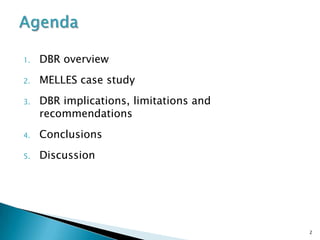
1.   DBR overview
2.   MELLES case study
3.   DBR implications, limitations and
     recommendations
4.   Conclusions
5.   Discussion


                                         2
   “Design experiments” > design-based research = design
    research = DBR = EDR = researching innovative educational
    designs in their naturalistic settings
                        (Brown, 1992; Collins, 1992)


   A systematic but flexible methodology aimed to improve
    educational practices through iterative analysis, design,
    development, and implementation, based on collaboration
    among researchers and practitioners in real-world settings, and
    leading to contextually-sensitive design principles and
    theories.
                            (Wang & Hannafin, 1999, p. 7)


                                                                      3
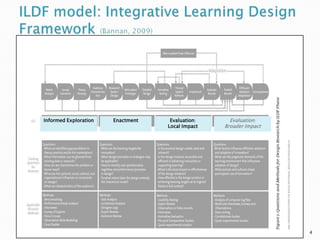
Informed Exploration   Enactment    Evaluation:     Evaluation:
                                   Local Impact   Broader Impact


                                                                   4
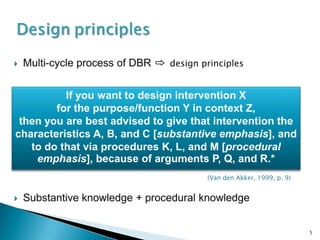
(Van den Akker, 1999, p. 9)


                              5
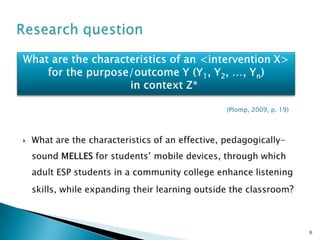
(Plomp, 2009, p. 19)


                       6
   Practice  research
   Drawing on engineering and technological research
   Focusing on design, construction, implementation
    and adoption of learning solutions
   Process focused and iterative
   Interventionist: applied solutions to real
    educational problems
   Contextual: real people, context, and cultural
    background, in-situ investigation/evaluation
   “Action Research on steroids”
   Applied
   Participatory
   Collaborative
   Utility oriented
   Theory driven
   Unifying theory and practice
   Evolving
   Systemic
   Rich feedback
   Responsive
   Flexible
   Agile


BUT
   Multileveled and multifaceted
   Complex
   Messy
   Co-developing theory and design in-situ
    Testing in real-world learning situations involving
     all actors/end users
    With people for people
    End-users as partners (active co-creators)
    Combination of motivation and efforts
    Students as researchers
    Diverse evaluation perspectives

“We are moving away from a passive information age towards an
active participation age” (Farmer & Gruba, 2006, p. 149)
   Diverse expertise of practitioners and researchers
   Collaboration and support
   Network of colleagues
    ◦ Flexible dialogue from whenever
    ◦ Online platform and tools (e.g., Wiggio, Collaborate)
   Dynamic feedback from actors
    ◦ at milestones and agile
Context is king


 Evolution   of theory

 Evolution   of practice
   Build foundational understanding of m-learning
    trends and needs
   Gain insight into learner m-learning behaviours
   Generate inspiration and ideas for appropriate
    design
   Define what functionality is most critical
   Improve the usability of infrastructure
   Inform future design solutions
   Provide professional development
   Raise awareness and understanding of m-learning
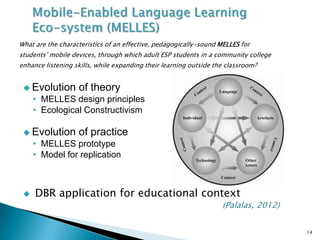
What are the characteristics of an effective, pedagogically-sound MELLES for
students’ mobile devices, through which adult ESP students in a community college
enhance listening skills, while expanding their learning outside the classroom?


  Evolution       of theory
     • MELLES design principles
     • Ecological Constructivism

  Evolution       of practice
     • MELLES prototype
     • Model for replication


    DBR application for educational context
                                                                   (Palalas, 2012)


                                                                                     14
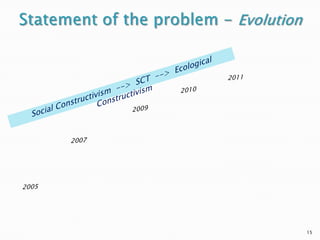
15
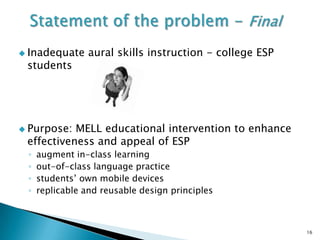
 Inadequate     aural skills instruction - college ESP
 students


 Purpose: MELL educational intervention to enhance
 effectiveness and appeal of ESP
 ◦   augment in-class learning
 ◦   out-of-class language practice
 ◦   students’ own mobile devices
 ◦   replicable and reusable design principles


                                                          16
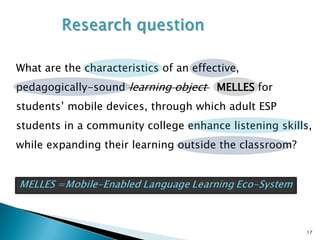
What are the characteristics of an effective,
pedagogically-sound learning object MELLES for
students’ mobile devices, through which adult ESP
students in a community college enhance listening skills,
while expanding their learning outside the classroom?


                                                        17
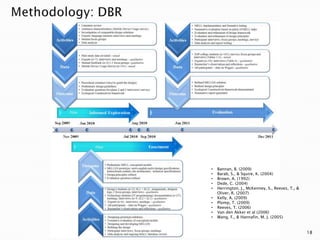
•   Bannan, B. (2009)
•   Barab, S., & Squire, K. (2004)
•   Brown, A. (1992)
•   Dede, C. (2004)
•   Herrington, J., McKenney, S., Reeves, T., &
    Oliver, R. (2007)
•   Kelly, A. (2009)
•   Plomp, T. (2009)
•   Reeves, T. (2006)
•   Van den Akker et al (2006)
•   Wang, F., & Hannafin, M. J. (2005)


                                                  18
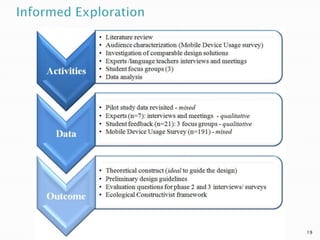
19
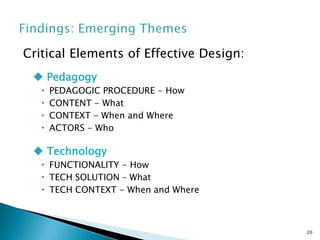
Critical Elements of Effective Design:
  Pedagogy
      PEDAGOGIC PROCEDURE - How
      CONTENT - What
      CONTEXT - When and Where
      ACTORS - Who

  Technology
    FUNCTIONALITY - How
    TECH SOLUTION – What
    TECH CONTEXT - When and Where


                                         20
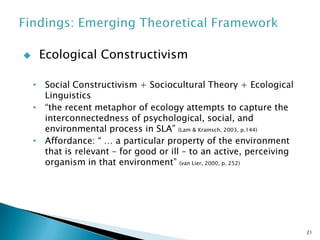
    Ecological Constructivism

    • Social Constructivism + Sociocultural Theory + Ecological
      Linguistics
    • “the recent metaphor of ecology attempts to capture the
      interconnectedness of psychological, social, and
      environmental process in SLA” (Lam & Kramsch, 2003, p.144)
    • Affordance: “ … a particular property of the environment
      that is relevant – for good or ill – to an active, perceiving
      organism in that environment” (van Lier, 2000, p. 252)


                                                                      21
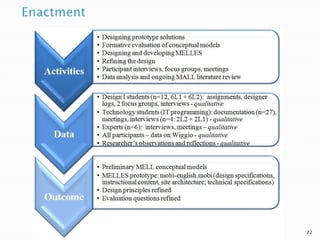
22
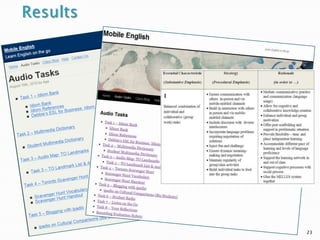
23
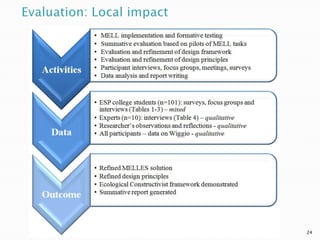
24
(Palalas & Hoven, 2013)

The intervention “embod[ied] specific theoretical claims about teaching and learning,
and reflect[ed] a commitment to understanding the relationships among theory,
designed artifacts, and practice. […] research on specific interventions can contribute
to theories of learning and teaching.”
                                     (Design-Based Research Collective, 2003, p.6)
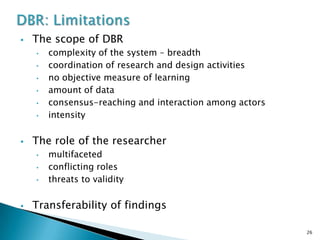
   The scope of DBR
    •   complexity of the system – breadth
    •   coordination of research and design activities
    •   no objective measure of learning
    •   amount of data
    •   consensus-reaching and interaction among actors
    •   intensity

   The role of the researcher
    •   multifaceted
    •   conflicting roles
    •   threats to validity

   Transferability of findings

                                                          26
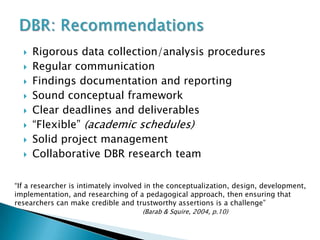
   Rigorous data collection/analysis procedures
     Regular communication
     Findings documentation and reporting
     Sound conceptual framework
     Clear deadlines and deliverables
     “Flexible” (academic schedules)
     Solid project management
     Collaborative DBR research team

“If a researcher is intimately involved in the conceptualization, design, development,
implementation, and researching of a pedagogical approach, then ensuring that
researchers can make credible and trustworthy assertions is a challenge”
                                     (Barab & Squire, 2004, p.10)
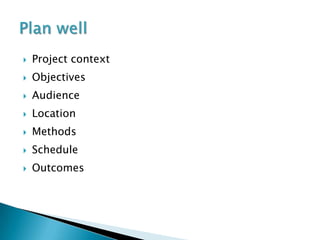
   Project context
   Objectives
   Audience
   Location
   Methods
   Schedule
   Outcomes
apalalas@georgebrown.ca
http://mobi-learning.com/
Twitter: @agaiza
LinkedIn: http://www.linkedin.com/in/apalalas
Presentations: http://www.slideshare.net/agaiza
Publications: http://georgebrown.academia.edu/apalalas

                                                         29
   Bannan, B. (2009). The Integrative Learning Design Framework: An illustrated example from the domain of instructional
    technology. In T. Plomp & N. Nieveen (Eds.), An introduction to educational design research (pp. 53-73). SLO: Netherlands
    Institute for Curriculum Development.

   Barab, S., & Squire, K. (2004). Design-Based Research: Putting a stake in the ground. The Journal of the Learning Sciences,
    13(1), 1-14. doi:10.1207/s15327809jls1301_1

   Brown, A. L. (1992). Design experiments: Theoretical and methodological challenges in creating complex interventions in
    classroom settings. Journal of the Learning Sciences, 2(2), 141–178.

   Collins, A. (1992). Towards a design science of education. In E. Scanlon and T. O’Shea (Eds.), New directions in educational
    technology (pp. 15–22). Berlin: Springer.

   Dede, C. (2004). If Design-Based Research is the answer, what is the question? The Journal of the Instructional Sciences, 13 (1).

   Design-Based Research Collective. (2003). Design-Based Research: An emerging paradigm for educational inquiry. Educational
    Researcher, 32(1), 5-8. Retrieved from http://www.designbasedresearch.org/reppubs/DBRC2003.pdf

   Farmer, R., & Gruba, P. (2006). Towards model-driven end-user development in CALL. Computer Assisted Language Learning,
    19(2 & 3), 149-191.

   Palalas, A. (2012). Design guidelines for a Mobile-Enabled Language Learning system supporting the development of ESP
    listening skills (Doctoral dissertation, Athabasca University). Retrieved from http://hdl.handle.net/10791/17

   Palalas, A., & Hoven, D. (2013). Implications of using DBR to investigate the iterative design of a mobile-enabled language
    learning system. CALICO

   Plomp, T. (2009). Educational design research: An introduction. In T. Plomp & N. Nieveen (Eds.), An introduction to educational
    design research (pp. 9-36). SLO: Netherlands Institute for Curriculum Development.

   Reeves, T. (2006). Design research from a technology perspective. In J. van den Akker, K. Gravemeijer, S. McKenney & N.
    Nieveen (Eds.), Educational design research: The design, development and evaluation of programs, processes and products (pp.
    52-66). New York: Routledge.

   Van den Akker, J. (1999). Principles and Methods of Development Research. In J. van den Akker, R.M. Branch, K. Gustafson, N.
    Nieveen, & T. Plomp (Eds.), Design approaches and tools in education and training (pp. 1-14). Boston: Kluwer Academic.

   Wang, F., & Hannafin, M. J. (2005). Design-based research and technology-enhanced learning environments. Educational
    Technology Research and Development, 53(4), 5-23.


                                                                                                                                        30

DBR in the m-learning context (A. Palalas), March 2013

  • 1.
    Agnieszka (Aga) Palalas,Ed.D. apalalas@georgebrown.ca March 2013 1
  • 2.
    1. DBR overview 2. MELLES case study 3. DBR implications, limitations and recommendations 4. Conclusions 5. Discussion 2
  • 3.
    “Design experiments” > design-based research = design research = DBR = EDR = researching innovative educational designs in their naturalistic settings (Brown, 1992; Collins, 1992)  A systematic but flexible methodology aimed to improve educational practices through iterative analysis, design, development, and implementation, based on collaboration among researchers and practitioners in real-world settings, and leading to contextually-sensitive design principles and theories. (Wang & Hannafin, 1999, p. 7) 3
  • 4.
    Informed Exploration Enactment Evaluation: Evaluation: Local Impact Broader Impact 4
  • 5.
    (Van den Akker,1999, p. 9) 5
  • 6.
  • 7.
    Practice  research  Drawing on engineering and technological research  Focusing on design, construction, implementation and adoption of learning solutions  Process focused and iterative  Interventionist: applied solutions to real educational problems  Contextual: real people, context, and cultural background, in-situ investigation/evaluation  “Action Research on steroids”
  • 8.
    Applied  Participatory  Collaborative  Utility oriented  Theory driven  Unifying theory and practice  Evolving  Systemic
  • 9.
    Rich feedback  Responsive  Flexible  Agile BUT  Multileveled and multifaceted  Complex  Messy
  • 10.
    Co-developing theory and design in-situ  Testing in real-world learning situations involving all actors/end users  With people for people  End-users as partners (active co-creators)  Combination of motivation and efforts  Students as researchers  Diverse evaluation perspectives “We are moving away from a passive information age towards an active participation age” (Farmer & Gruba, 2006, p. 149)
  • 11.
    Diverse expertise of practitioners and researchers  Collaboration and support  Network of colleagues ◦ Flexible dialogue from whenever ◦ Online platform and tools (e.g., Wiggio, Collaborate)  Dynamic feedback from actors ◦ at milestones and agile
  • 12.
    Context is king Evolution of theory  Evolution of practice
  • 13.
    Build foundational understanding of m-learning trends and needs  Gain insight into learner m-learning behaviours  Generate inspiration and ideas for appropriate design  Define what functionality is most critical  Improve the usability of infrastructure  Inform future design solutions  Provide professional development  Raise awareness and understanding of m-learning
  • 14.
    What are thecharacteristics of an effective, pedagogically-sound MELLES for students’ mobile devices, through which adult ESP students in a community college enhance listening skills, while expanding their learning outside the classroom?  Evolution of theory • MELLES design principles • Ecological Constructivism  Evolution of practice • MELLES prototype • Model for replication  DBR application for educational context (Palalas, 2012) 14
  • 15.
  • 16.
     Inadequate aural skills instruction - college ESP students  Purpose: MELL educational intervention to enhance effectiveness and appeal of ESP ◦ augment in-class learning ◦ out-of-class language practice ◦ students’ own mobile devices ◦ replicable and reusable design principles 16
  • 17.
    What are thecharacteristics of an effective, pedagogically-sound learning object MELLES for students’ mobile devices, through which adult ESP students in a community college enhance listening skills, while expanding their learning outside the classroom? 17
  • 18.
    Bannan, B. (2009) • Barab, S., & Squire, K. (2004) • Brown, A. (1992) • Dede, C. (2004) • Herrington, J., McKenney, S., Reeves, T., & Oliver, R. (2007) • Kelly, A. (2009) • Plomp, T. (2009) • Reeves, T. (2006) • Van den Akker et al (2006) • Wang, F., & Hannafin, M. J. (2005) 18
  • 19.
  • 20.
    Critical Elements ofEffective Design:  Pedagogy  PEDAGOGIC PROCEDURE - How  CONTENT - What  CONTEXT - When and Where  ACTORS - Who  Technology  FUNCTIONALITY - How  TECH SOLUTION – What  TECH CONTEXT - When and Where 20
  • 21.
    Ecological Constructivism • Social Constructivism + Sociocultural Theory + Ecological Linguistics • “the recent metaphor of ecology attempts to capture the interconnectedness of psychological, social, and environmental process in SLA” (Lam & Kramsch, 2003, p.144) • Affordance: “ … a particular property of the environment that is relevant – for good or ill – to an active, perceiving organism in that environment” (van Lier, 2000, p. 252) 21
  • 22.
  • 23.
  • 24.
  • 25.
    (Palalas & Hoven,2013) The intervention “embod[ied] specific theoretical claims about teaching and learning, and reflect[ed] a commitment to understanding the relationships among theory, designed artifacts, and practice. […] research on specific interventions can contribute to theories of learning and teaching.” (Design-Based Research Collective, 2003, p.6)
  • 26.
    The scope of DBR • complexity of the system – breadth • coordination of research and design activities • no objective measure of learning • amount of data • consensus-reaching and interaction among actors • intensity  The role of the researcher • multifaceted • conflicting roles • threats to validity  Transferability of findings 26
  • 27.
    Rigorous data collection/analysis procedures  Regular communication  Findings documentation and reporting  Sound conceptual framework  Clear deadlines and deliverables  “Flexible” (academic schedules)  Solid project management  Collaborative DBR research team “If a researcher is intimately involved in the conceptualization, design, development, implementation, and researching of a pedagogical approach, then ensuring that researchers can make credible and trustworthy assertions is a challenge” (Barab & Squire, 2004, p.10)
  • 28.
    Project context  Objectives  Audience  Location  Methods  Schedule  Outcomes
  • 29.
    apalalas@georgebrown.ca http://mobi-learning.com/ Twitter: @agaiza LinkedIn: http://www.linkedin.com/in/apalalas Presentations:http://www.slideshare.net/agaiza Publications: http://georgebrown.academia.edu/apalalas 29
  • 30.
    Bannan, B. (2009). The Integrative Learning Design Framework: An illustrated example from the domain of instructional technology. In T. Plomp & N. Nieveen (Eds.), An introduction to educational design research (pp. 53-73). SLO: Netherlands Institute for Curriculum Development.  Barab, S., & Squire, K. (2004). Design-Based Research: Putting a stake in the ground. The Journal of the Learning Sciences, 13(1), 1-14. doi:10.1207/s15327809jls1301_1  Brown, A. L. (1992). Design experiments: Theoretical and methodological challenges in creating complex interventions in classroom settings. Journal of the Learning Sciences, 2(2), 141–178.  Collins, A. (1992). Towards a design science of education. In E. Scanlon and T. O’Shea (Eds.), New directions in educational technology (pp. 15–22). Berlin: Springer.  Dede, C. (2004). If Design-Based Research is the answer, what is the question? The Journal of the Instructional Sciences, 13 (1).  Design-Based Research Collective. (2003). Design-Based Research: An emerging paradigm for educational inquiry. Educational Researcher, 32(1), 5-8. Retrieved from http://www.designbasedresearch.org/reppubs/DBRC2003.pdf  Farmer, R., & Gruba, P. (2006). Towards model-driven end-user development in CALL. Computer Assisted Language Learning, 19(2 & 3), 149-191.  Palalas, A. (2012). Design guidelines for a Mobile-Enabled Language Learning system supporting the development of ESP listening skills (Doctoral dissertation, Athabasca University). Retrieved from http://hdl.handle.net/10791/17  Palalas, A., & Hoven, D. (2013). Implications of using DBR to investigate the iterative design of a mobile-enabled language learning system. CALICO  Plomp, T. (2009). Educational design research: An introduction. In T. Plomp & N. Nieveen (Eds.), An introduction to educational design research (pp. 9-36). SLO: Netherlands Institute for Curriculum Development.  Reeves, T. (2006). Design research from a technology perspective. In J. van den Akker, K. Gravemeijer, S. McKenney & N. Nieveen (Eds.), Educational design research: The design, development and evaluation of programs, processes and products (pp. 52-66). New York: Routledge.  Van den Akker, J. (1999). Principles and Methods of Development Research. In J. van den Akker, R.M. Branch, K. Gustafson, N. Nieveen, & T. Plomp (Eds.), Design approaches and tools in education and training (pp. 1-14). Boston: Kluwer Academic.  Wang, F., & Hannafin, M. J. (2005). Design-based research and technology-enhanced learning environments. Educational Technology Research and Development, 53(4), 5-23. 30