More Related Content


![Teacher Formation - Hong Kong Workshop [Peter Knight and Jo Tait]](https://cdn.slidesharecdn.com/ss_thumbnails/teacher-formation-hong-kong-workshop-peter-knight-and-jo-tait-12317-thumbnail.jpg?width=640&height=640&fit=bounds)


Desing as inquiry
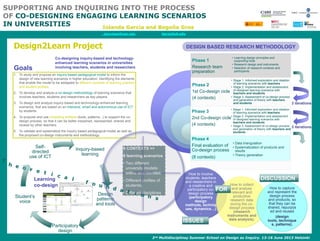
- 1. Phase 1 Research team preparation Phase2 1st Co-design cicle (4 contexts) Phase 3 2nd Co-design cicle (4 contexts) Phase 4 Final evaluation of Co-design process (8 contexts) • Learning design principles and supporting tools • Research design and instruments • Selection of research contexts and participants • Stage 1. Informed exploration and ideation of learning scenarios with teachers • Stage 2. Implementation and assessment of designed learning scenarios with teachers and students • Stage 3. Assessment of co-design process and generation of theory with teachers and students • Stage 1. Informed exploration and ideation of learning scenarios with teachers • Stage 2. Implementation and assessment of designed learning scenarios with teachers and students • Stage 3. Assessment of co-design process and generation of theory with teachers and students • Data triangulation • Systematization of products and results • Theory generation SUPPORTING AND INQUIRING INTO THE PROCESS OF CO-DESIGNING ENGAGING LEARNING SCENARIOS IN UNIVERSITIES Design2Learn Project 1. To study and propose an inquiry-based pedagogical model to inform the design of new learning scenarios in higher education, identifying the elements that enable the model to be addapted to different contexts of learning practice and student profiles. 2. To develop and analyze a co-design methodology of learning scenarios that involves teachers, students and researchers as key players. 3. To design and analyze inquiry-based and technnology-enhanced learning scenarios, that are based on an intensive, smart and autonomous use of ICT by students. 4. To propose and use mediating artifacts (tools, patterns...) to support the co- design process, so that it can be better explained, represented, shared and reused by other teachers. 5. To validate and systematize the inquiry based pedagogical model as well as the proposed co-design instruments and methodology. Goals Co-designing inquiry-based and technology- enhanced learning scenarios in universities involving teachers, students and researchers 2nd Multidisciplinay Summer School on Design as Inquiry. 13-16 June 2013 Helsinki DESIGN BASED RESEARCH METHODOLOGY Iolanda Garcia and Begoña Gros igarciago@uoc.edu bgros@ub.edu 3 iterations 3 iterations How to involve students, teachers and researchers in a creative and participatory co- design process (participatory design methods, techniq ues, dynamics…) . How to collect and analyse relevant and productive research data during the co- design process (research instruments and data analysis). How to capture and represent the design process and products, so that they can be shared, repurpos ed and reused (design tools, technique s, patterns). ISSUES DISCUSSION FOR Inquiry-based learning Design patterns and tools Participatory design Student’s voice Self- directed use of ICT Learning co-design 8 CONTEXTS => 8 learning scenarios • Two different university models: online and blended. • Different profiles of students. • Different disciplines