PROJECT-BASED
LEARNING AND
MULTIMEDIA: WHAT IT
IS?
BACKGROUND
INFORMATION
Project-based learning is not a new educational method.
The use of multimedia is a dynamic new form of communication.
 The merging of project-based learning and multimedia represents an
extra ordinary teaching strategy that we call project-based multimedia
learning.
 Guidelines for implementing and developing your own units based
on this strategy.
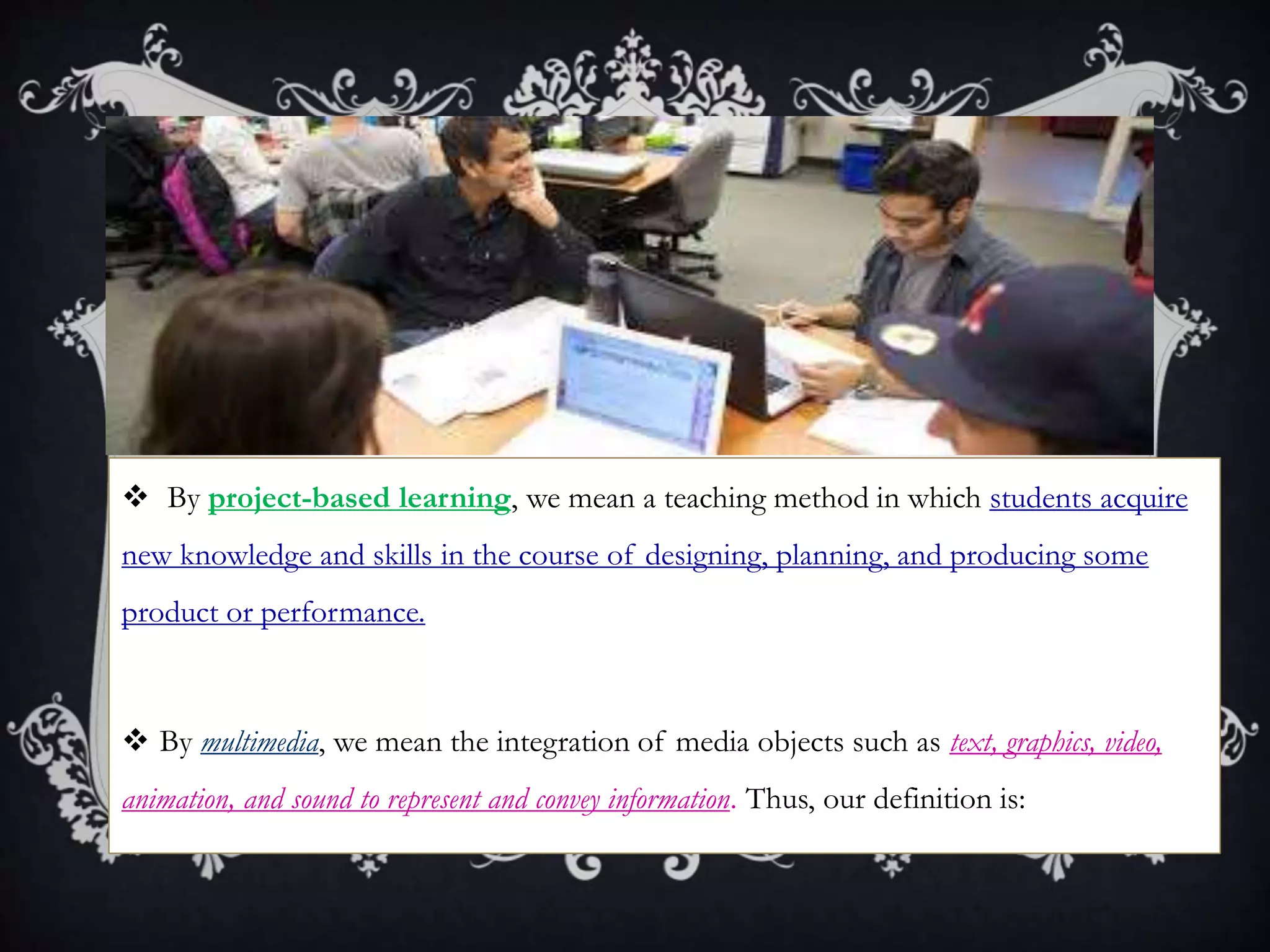
 By project-based learning, we mean a teaching method in which students acquire
new knowledge and skills in the course of designing, planning, and producing some
product or performance.
 By multimedia, we mean the integration of media objects such as text, graphics, video,
animation, and sound to represent and convey information. Thus, our definition is:
 Project-based multimedia learning is a method of teaching in which students acquire new
knowledge and skills in the course of designing, planning, and producing a multimedia product.
students' multimedia products will be technology-based presentations, such as a
computerized slide show, a Web site, or a video. These presentations will include evidence that
your students have mastered key concepts and processes.
DIMENSIONS OF PROJECT-BASED
MULTIMEDIA LEARNING
 Core Curriculum
 Real-world Connection
 Extended Time Frame
 Student Decision Making
 Collaboration
 Assessment
 Multimedia
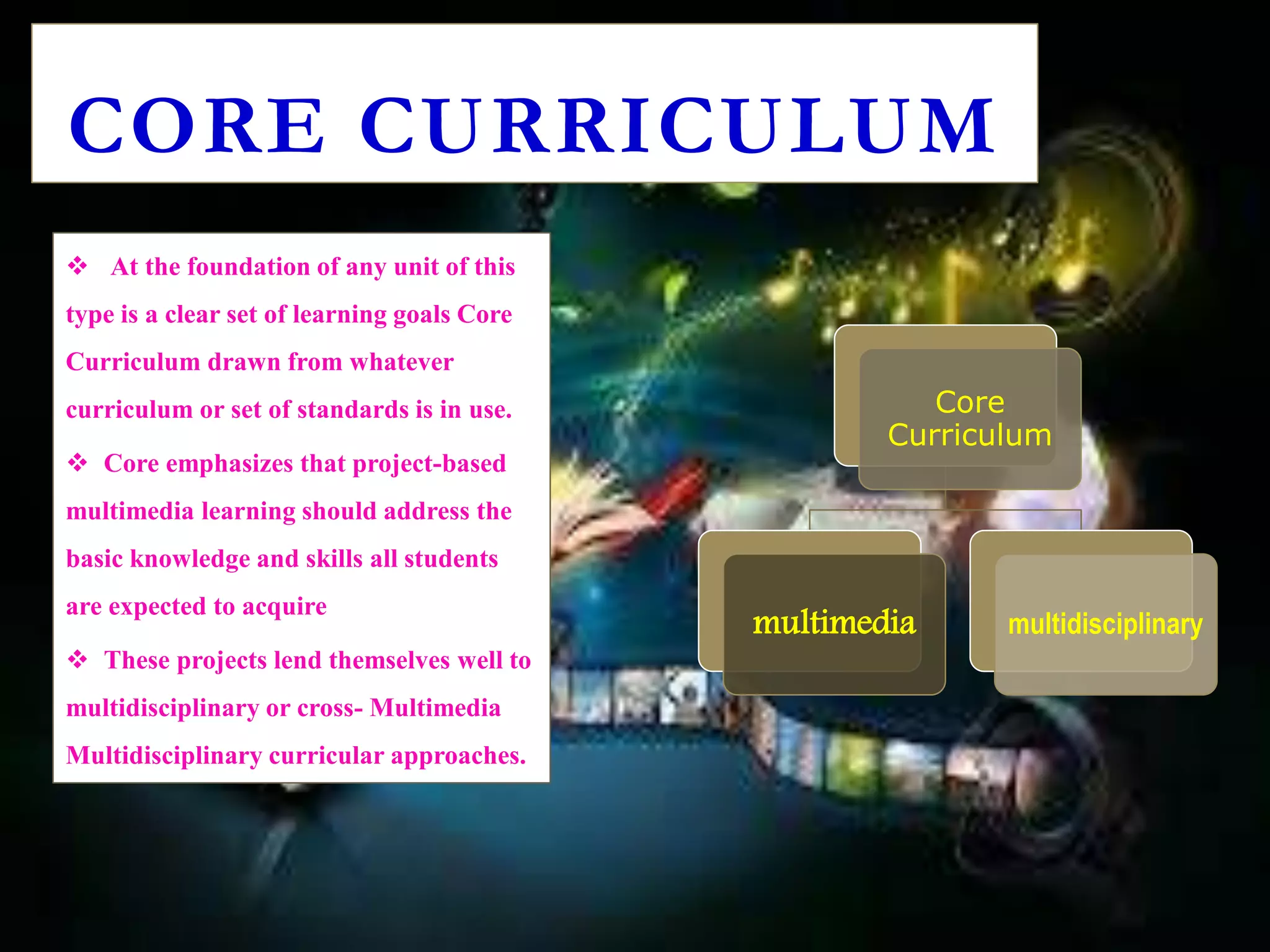
 At the foundation of any unit of this
type is a clear set of learning goals Core
Curriculum drawn from whatever
curriculum or set of standards is in use.
 Core emphasizes that project-based
multimedia learning should address the
basic knowledge and skills all students
are expected to acquire
 These projects lend themselves well to
multidisciplinary or cross- Multimedia
Multidisciplinary curricular approaches.
CORE CURRICULUM
Core
Curriculum
multimedia multidisciplinary
REAL-WORLD CONNECTION
 project-based multimedia learning strives to be real.
 It seeks to connect students' work in school with the wider world in which students live.
 You may design this feature into a project by means of the content chosen, the types of
activities, the types of products, or in other ways.
 What is critical is that the students—not only the teacher—perceive what is real about
the project.
EXTENDED TIME FRAME
 A good project is not a one-shot lesson;
 It extends over a significant period of time.
 The actual length of a project may vary with the age of
the students and the nature of the project.
 It may be days, weeks, or months.
 What's important is that students experience a
succession of challenges that culminates in a substantial
final product from which they can derive pride and a clear
sense of accomplishment.
STUDENT DECISION MAKING
 Students have an opinion.
 Divide them into “teachers” and “students” based on a clear
rationale (decisions)
 Example: A teacher might limit students to a single authoring
program to minimize complications
 The teacher can allow students to determine what substantive
content would be included in their projects.
 Students can make decisions about the form and content of their
final products, as well as the process for producing them.
COLLABORATION
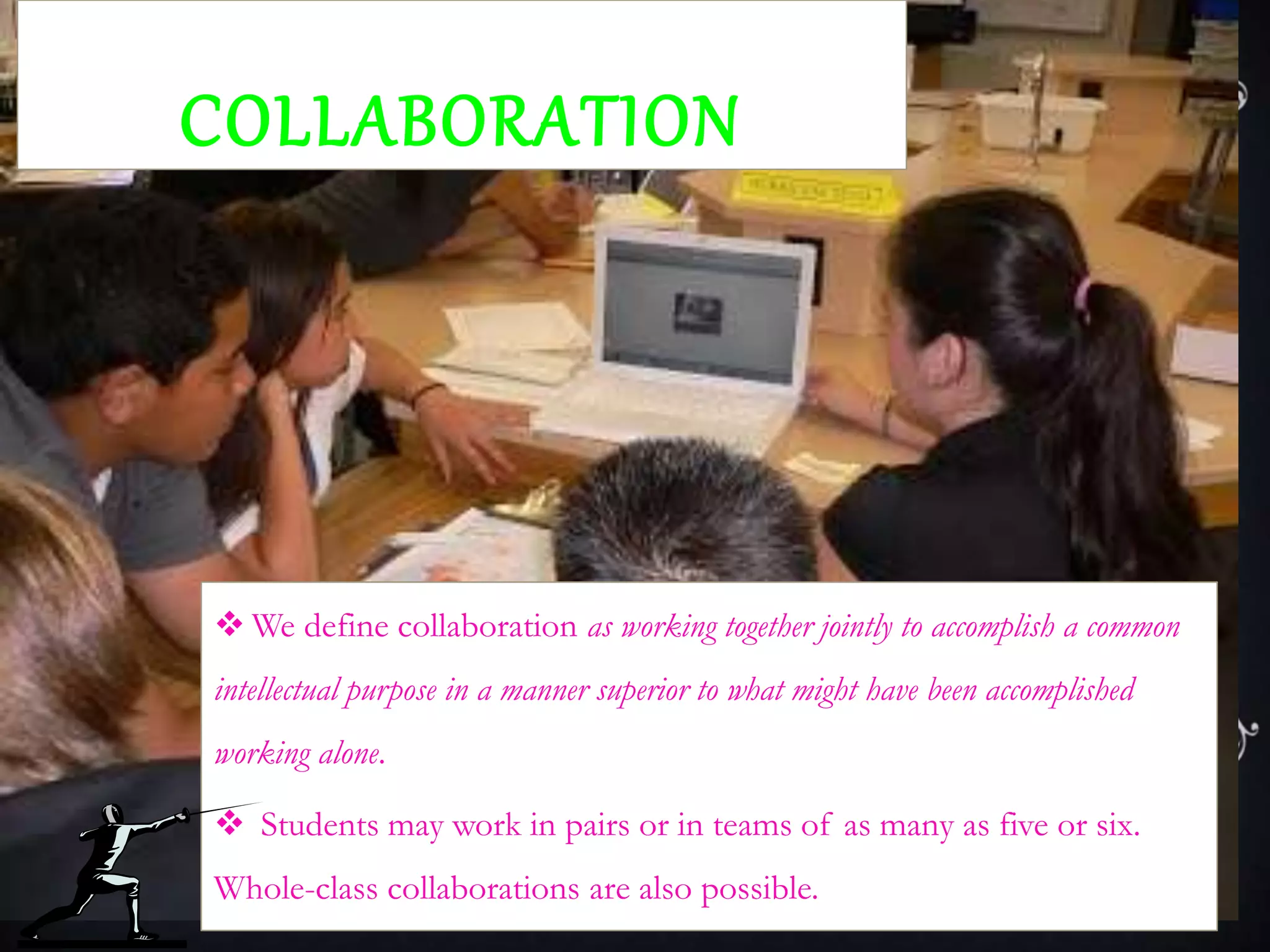
 We define collaboration as working together jointly to accomplish a common
intellectual purpose in a manner superior to what might have been accomplished
working alone.
 Students may work in pairs or in teams of as many as five or six.
Whole-class collaborations are also possible.
ASSESSMENT
 Regardless of the teaching method used, data
must be gathered on what students have learned.
 When using project-based multimedia
learning, teachers face additional assessment
challenges because multimedia products by
themselves do not represent a full picture of
student learning.
Students are gaining content information,
becoming better team members, solving problems,
and making choices about what new information
to show in their presentations.
ASSESSMENT HAVE THREE
DIFFERENT ROLES IN THE
PROJECT-BASED MULTIMEDIA
CONTEXT:
 Activities for developing expectations;
 Activities for improving the media products; and
 Activities for compiling and disseminating evidence of learning.
MULTIMEDIA
In multimedia projects, students do not learn simply by
"using” multimedia produced by others; they learn by
creating it themselves.
 As students design and research their projects, instead of
gathering only written notes, they also gather—and create—
pictures, video clips, recordings, and other media objects
that will later serve as the raw material for their final
product.
WHY USE PROJECT-
BASED LEARNING?
 Identifying, organizing, planning, and allocating time,
money, materials, and workers.
 Negotiating, exercising leadership, working with diversity,
teaching others new skills, serving clients and customers,
and participating as a team member.
 Selecting technology, applying technology to a task, and
maintaining and troubleshooting technology.
TEACHING THE NEW BAS IC S KILLS , RICHARD
MURNANE AND FRANK LEVY (1996) DESCRIBE
THRE E SK IL L SE TS STUDE NTS NE E D TO BE
COMPE TITIVE FOR TODAY 'S J OBS:
 Hard skills (math, reading, and problem-solving skills mastered at a
much higher level than previously expected of high school graduates);
 Soft skills (for example, the ability to work in a group and to make
effective oral and written presentations); and
 The ability to use a personal computer to carry out routine tasks (for
example, word processing, data management, and creating multimedia
presentations).
SUMMARY
 Project-basedmultimedialearningis one instructionalstrategythatyou canuse in a school
year thatmay alsoincludenon-technicalprojects, lectureandnote-taking,rotepractice, writing,
and artisticor creative work.
 Whattheywillbe doingincludes:Planningand organizationalskills
 Learningto presentinformationin compellingways.
 Synthesizingand analyzingcomplexcontentand data.
 Practicingresearchand technicalskills.
 Learninghow academicsubjectmatterappliesto therealworld.
RELATED URLS TO
PBL:
 http://www.edutopia.org /project-based-learning
http://www.rmcdenver.com/useguide/p
http://www.rmcdenver.com/useguide/
END...Thank You!!!!
And God bless.☺
Prepared by:
Marissa C. Rocco
Reynaldo Z. Tubieron
Ma. Arcel Victor
Gen.ed 2a

Lesson 15 Project based learning and multimedia

  • 1.
  • 2.
    BACKGROUND INFORMATION Project-based learning isnot a new educational method. The use of multimedia is a dynamic new form of communication.  The merging of project-based learning and multimedia represents an extra ordinary teaching strategy that we call project-based multimedia learning.  Guidelines for implementing and developing your own units based on this strategy.
  • 3.
     By project-basedlearning, we mean a teaching method in which students acquire new knowledge and skills in the course of designing, planning, and producing some product or performance.  By multimedia, we mean the integration of media objects such as text, graphics, video, animation, and sound to represent and convey information. Thus, our definition is:
  • 4.
     Project-based multimedialearning is a method of teaching in which students acquire new knowledge and skills in the course of designing, planning, and producing a multimedia product.
  • 5.
    students' multimedia productswill be technology-based presentations, such as a computerized slide show, a Web site, or a video. These presentations will include evidence that your students have mastered key concepts and processes.
  • 6.
    DIMENSIONS OF PROJECT-BASED MULTIMEDIALEARNING  Core Curriculum  Real-world Connection  Extended Time Frame  Student Decision Making  Collaboration  Assessment  Multimedia
  • 7.
     At thefoundation of any unit of this type is a clear set of learning goals Core Curriculum drawn from whatever curriculum or set of standards is in use.  Core emphasizes that project-based multimedia learning should address the basic knowledge and skills all students are expected to acquire  These projects lend themselves well to multidisciplinary or cross- Multimedia Multidisciplinary curricular approaches. CORE CURRICULUM Core Curriculum multimedia multidisciplinary
  • 8.
    REAL-WORLD CONNECTION  project-basedmultimedia learning strives to be real.  It seeks to connect students' work in school with the wider world in which students live.  You may design this feature into a project by means of the content chosen, the types of activities, the types of products, or in other ways.  What is critical is that the students—not only the teacher—perceive what is real about the project.
  • 9.
    EXTENDED TIME FRAME A good project is not a one-shot lesson;  It extends over a significant period of time.  The actual length of a project may vary with the age of the students and the nature of the project.  It may be days, weeks, or months.  What's important is that students experience a succession of challenges that culminates in a substantial final product from which they can derive pride and a clear sense of accomplishment.
  • 10.
    STUDENT DECISION MAKING Students have an opinion.  Divide them into “teachers” and “students” based on a clear rationale (decisions)  Example: A teacher might limit students to a single authoring program to minimize complications  The teacher can allow students to determine what substantive content would be included in their projects.  Students can make decisions about the form and content of their final products, as well as the process for producing them.
  • 11.
    COLLABORATION  We definecollaboration as working together jointly to accomplish a common intellectual purpose in a manner superior to what might have been accomplished working alone.  Students may work in pairs or in teams of as many as five or six. Whole-class collaborations are also possible.
  • 12.
    ASSESSMENT  Regardless ofthe teaching method used, data must be gathered on what students have learned.  When using project-based multimedia learning, teachers face additional assessment challenges because multimedia products by themselves do not represent a full picture of student learning. Students are gaining content information, becoming better team members, solving problems, and making choices about what new information to show in their presentations.
  • 13.
    ASSESSMENT HAVE THREE DIFFERENTROLES IN THE PROJECT-BASED MULTIMEDIA CONTEXT:  Activities for developing expectations;  Activities for improving the media products; and  Activities for compiling and disseminating evidence of learning.
  • 14.
    MULTIMEDIA In multimedia projects,students do not learn simply by "using” multimedia produced by others; they learn by creating it themselves.  As students design and research their projects, instead of gathering only written notes, they also gather—and create— pictures, video clips, recordings, and other media objects that will later serve as the raw material for their final product.
  • 15.
    WHY USE PROJECT- BASEDLEARNING?  Identifying, organizing, planning, and allocating time, money, materials, and workers.  Negotiating, exercising leadership, working with diversity, teaching others new skills, serving clients and customers, and participating as a team member.  Selecting technology, applying technology to a task, and maintaining and troubleshooting technology.
  • 16.
    TEACHING THE NEWBAS IC S KILLS , RICHARD MURNANE AND FRANK LEVY (1996) DESCRIBE THRE E SK IL L SE TS STUDE NTS NE E D TO BE COMPE TITIVE FOR TODAY 'S J OBS:  Hard skills (math, reading, and problem-solving skills mastered at a much higher level than previously expected of high school graduates);  Soft skills (for example, the ability to work in a group and to make effective oral and written presentations); and  The ability to use a personal computer to carry out routine tasks (for example, word processing, data management, and creating multimedia presentations).
  • 17.
    SUMMARY  Project-basedmultimedialearningis oneinstructionalstrategythatyou canuse in a school year thatmay alsoincludenon-technicalprojects, lectureandnote-taking,rotepractice, writing, and artisticor creative work.  Whattheywillbe doingincludes:Planningand organizationalskills  Learningto presentinformationin compellingways.  Synthesizingand analyzingcomplexcontentand data.  Practicingresearchand technicalskills.  Learninghow academicsubjectmatterappliesto therealworld.
  • 18.
    RELATED URLS TO PBL: http://www.edutopia.org /project-based-learning http://www.rmcdenver.com/useguide/p http://www.rmcdenver.com/useguide/
  • 19.
    END...Thank You!!!! And Godbless.☺ Prepared by: Marissa C. Rocco Reynaldo Z. Tubieron Ma. Arcel Victor Gen.ed 2a