PsycholinguisticsandCognitiveProcesses
SentenceProcessing
by: Muhammad Saleem
Outline
 Models of Parsing: Two-Stage Models
 Models of Parsing: Constraint-Based Models
 Story context effects
 Subcategory frequency effects
 Cross-linguistic frequency data
 Semantic effects
 Prosody
 Visual context effects
 Interim Summary
 Argument Structure Hypothesis
 Limitations, Criticisms, and Some Alternative Parsing
Theories
 Construal
 Race-based parsing
 Good-enough parsing
 Parsing Long-Distance
 Dependencies
 Summary and Conclusions
 Test Yourself
Introduction
 When people speak, they produce sequences of
words. When people listen or read, they also deal with
sequences of words. Speakers systematically
organize those sequences of words into phrases,
clauses, and sentences.
 The study of syntax involves discovering the cues that
languages provide that show how words in sentences
relate to one another.
 The study of syntactic parsing involves discovering
how comprehenders use those cues to determine how
words in sentences relate to one another during the
process of interpreting sentence.
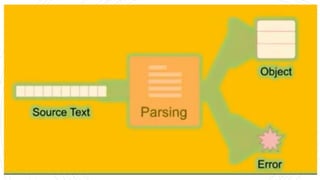
Parsing
Parsing means to breaking down a
sentence into its component parts
so that the meaning of the sentence
can be understood.
This can either be the category of
words (Nouns, Pronouns, verbs,
adjectives. Etc.)
Or other elements such as verbs
tense (present, past, future)
Sentence
processing
 Refers to the subfield of psycholinguistics
focusing on the interpretation of
sentences (Cokal, 2018).
Phrase
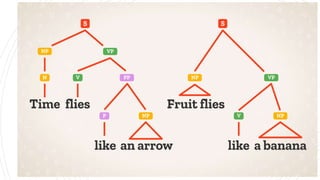
structure tree
(or tree
diagram)
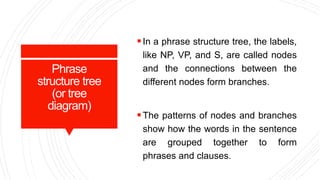
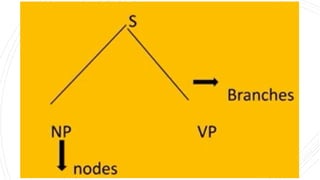
In a phrase structure tree, the labels,
like NP, VP, and S, are called nodes
and the connections between the
different nodes form branches.
The patterns of nodes and branches
show how the words in the sentence
are grouped together to form
phrases and clauses.
Onebasic
question
language scientists have asked is, are
ambiguous sentences harder to
understand than less ambiguous
sentences that express about the
same meaning? In other words, does
ambiguity impose processing costs on
the listener (or reader)?
Answer
 The short answer to this question is: Yes, ambiguity
leads to longer reading times, lower comprehension
accuracy, and different patterns of brain activity in
comprehenders than unambiguous sentences that say
the same thing (see, e.g., Frazier & Rayner, 1982;
Kutas, van Petten, & Kluender, 2006; Trueswell,
Tanenhaus, & Garnsey, 1994).
 The longer and more complicated answer to the
question is: There are cases where ambiguity doesn’t
produce noticeable processing costs, and ultimately
processing cost depends on a variety of factors,
including what information the listener has just
processed, and what contextual information is
available (see Traxler & Tooley, 2007, for a review).
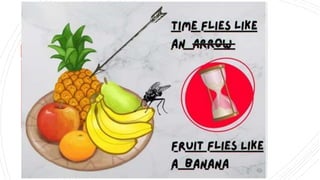
Gardenpath
model
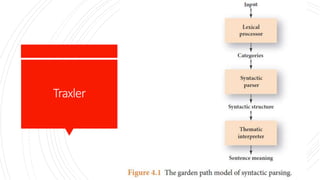
 Garden path model or the two stage model Parsing
takes two distinct processing stages or steps.
 Frazier’s garden path theory is considered a two-stage
model of syntactic parsing, because she proposes that
syntactic parsing takes place in two distinct processing
stages or steps.
 The first stage is analyzing the incoming sequence of
words to determine what categories of words it belongs.
 Second is building a syntactic structure for the
sequence.
 The word category is used in the initial structure
building process.
Traxler
Gardenpath
theory
Two main points to remember in
garden path theory.
First, garden path theory assumes
that people can only build one
syntactic structure at a time.
Second, garden path theory says
the predominant principle that the
parser relies on is simplicity.
Constraint-
basedmodel
The second model is the constraint- based
model
 Constraint-based parsers are capable of
pursuing multiple structural possibilities
simultaneously.
 Constraint-based parsers draw on much
wider variety of cues to decide what
structure to build and the relative
emphasis to place on each alternative
structure.
 Constraint-based parsers are often
referred to as one-stage models because
lexical, syntactic and semantic processes
are all taking place simultaneously.
Storycontext
effects
 Story context effect uses the information
in the sentence to make semantic
assumption or a mini story based on the
information given in the sentence.
Subcategory
frequency effects
Words, as it is dynamic, it can
provide more information.
For instance a specific category
such as -verbs - can either be
intransitive, transitive,
ditransitive.
Cross-linguistic
frequencydata
 Parsing focus has been entirely on
English.
 Studies have been done in other
languages that enlightens how people
parse and interpret sentences.
 Cross-linguistic research (research that
compares how different languages are
processed).
 Structural preferences in different
language match the frequencies with
which different structure occur in those
languages.
Semantic
effects
Semantic (meaning) information
associated with specific words in
the sentences.
Constraint based model differs
from the garden path because, the
garden path theory ignores
semantic information.
Prosody
Prosody is defined as the rhythm,
stress, and intonation of speech -
provides important information
beyond a sentence's literal word
meaning.
Example: "Yeah, that
was a great movie."
Twocategories of
speechpatterns in
prosody
 Non-linguistic prosody -provides cues to
the speaker's general mental state.
Answers the question, "Is the speaker
happy, angry or depressed.
 Linguistic prosody-provides cues to how
the words are organized into
phrases and clauses.
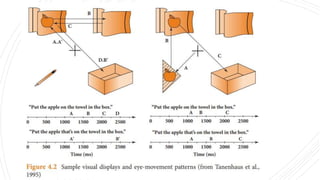
Visualcontext
Effects
 Visual context effects states that
information outside language processing
system can influence syntactic parsing.
 Information in the visual scene will
increase the parsers preference for a
complex syntactic structure.
Interim
Summary
 Sentence interpretation involves a parser
that makes decisions about how words in
the sentences relate to one another.
 Two models of parsing.
 We also learned that human behaviors
are not fully compatible with the garden
path theory.
 As a result, some studies have favored
the use of constraint-based versions of
sentence processing theory.
Limitations,
Criticisms, and
SomeAlternative
Parsing Theories
 The first criticism is based on the
suggestion that the parser may not
always favor likely structures over
less likely, but simpler structures
(e.g., Clifton, Kennison, & Albrecht,
1997).
 The second criticism of the constraint-
based approach relates to the absence
of evidence that sentences with simple
syntactic structures are ever hard to
process.
Construal
 The construal account is essentially a
refinement of the classic garden path
parsing theory (Frazier & Clifton, 1996).
 Construal retains the idea that parsing
occurs in discrete stages, but it adopts
the idea that context can influence which
structure the parser prefers and the idea
that the parser can sometimes build
multiple structures simultaneously.
Race-based
parsing
 The race-based account represents a
different refinement of the parallel
processing approach to parsing (Traxler
et al., 1998; van Gompel, Pickering, &
Traxler, 2000).
 Like constraint based parsers, the race-
based account stipulates that the parser
can build multiple syntactic structures in
parallel. And like the garden path and
construal accounts, the race-based
approach to parsing advocates a two-
stage process.
Race-based
parsing
Example
This morning, I shot an elephant in
my pajamas. (minimal attachment)
This morning, I shot an elephant
with great big tusks. (non-minimal
attachment)
This morning, I shot a poacher
with a rifle. (ambiguous)
Good-enough
parsing
 Fernanda Ferreira’s good-enough parsing
hypothesis represents a recent, more
radical departure from the classical
approaches to parsing and interpretation
(Christianson, Williams, Zacks, &
Ferreira, 2006; Ferreira, Bailey, &
Ferraro, 2002; Ferreira, Christianson, &
Hollingworth, 2001; Ferreira & Patson,
2007).
Good-enough
parsing
Good-enough parsing starts by
asking, “What good is parsing,
anyway?
Do we really need it?”
The short answer to these
questions is:
Sometimes we don’t need syntax
and parsing at all.
For example, if you know someone
is communicating about cheese, a
mouse, and an act of eating,
Good-enough
parsing
The words by themselves tell you
everything you need to know, and
there is no need to compute
syntactic structure to recover the
speaker’s intentions or the event
that inspired the act of
communication.
Parsing Long-
Distance
Dependencies
 We have been considering the processing
of sentences where the words that go
together to make phrases appear right
next to one another as the sentences are
produced.
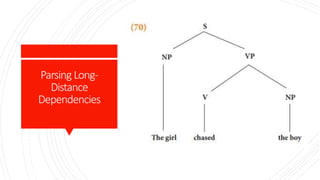
 For example, in a simple active sentence
like (68), the subject, verb, and direct
object are all adjacent to one another.
 (68) The girl chased the boy.
Parsing Long-
Distance
Dependencies
 Thus, the relationships between the
words in the sentence are classified as
local dependencies.
 Many sentences have long-distance
dependencies (sometimes called non-
local, sometimes called unbounded
dependencies), where the words that
have close syntactic relationships appear
in separate locations in the sentence.
 Sentence (69) has a meaning very similar
to sentence (68), but instead of having all
local dependencies, it has some long-
distance dependencies.
 (69) It was the boy whom the girl chased.
Parsing Long-
Distance
Dependencies
In sentence (69) the boy is the
object argument of the verb chased,
but rather than coming right after
the verb (which is the normal
pattern in English), the boy
appears before the verb chased.
As a result, the boy and chased
together form a long-distance
dependency.
Parsing Long-
Distance
Dependencies
Summaryand
Conclusions
 Parsing is an important aspect of
interpreting sentences. This chapter has
reviewed evidence for and against two-stage
and one-stage theories of human parsing
processes.
 The available evidence suggests that the
parser makes use of a wide variety of
information very quickly as it is figuring out
how words in sentences relate to one
another. As a result, many researchers have
adopted some version of the constraint-based
processing framework to explain how parsing
is accomplished.
Summaryand
Conclusions
 They view syntactic parsing as resulting
from the operation of distributed neural
networks.
 Alternative parsing accounts agree with
some of the theoretical claims made by
constraint-based advocates, such as
simultaneous consideration of different
syntactic structures, but without
agreeing that current neural network
models capture all of the key aspects of
people’s parsing processes.
Summaryand
Conclusions
The chapter also described the
difference between local and long-
distance dependencies and showed
that the direct-association
hypothesis could explain how both
local and long-distance
dependencies are parsed and
account for experimental results in
each domain.
TestYourself
 Describe the relationship between
sentence structure and sentence
meaning. How does the way that we
organize words in sentences influence the
meanings we assign to those sentences?
 Describe how long-distance dependencies
differ from local dependencies. Describe
two accounts of long-distance dependency
processing.
Thinkaboutit
 Draw phrase-structure diagrams for the
following sentences. (Hint: (c) may be
better represented using a dependency
diagram than a phrase-structure tree.
 Ask your professor for help if you get
stuck.)
 a. Hungry monkeys ate tasty bananas.
 b. Bananas tasty monkeys hungry ate.
 c. Tasty bananas ate monkeys hungry.
Note
 Although some theorists contend that
phrase structure representations apply
universally, they may not be particularly
good descriptions for languages that
allow words from different phrases to be
intermixed. These scrambling languages
may be better described in terms of
dependencies, rather than phrase
structures (Evans & Levinson, 2009).
References
 Adams, B. C., Clifton, C., Jr., & Mitchell, D. C. (1998).
Lexical guidance in sentence processing. Psychonomic
Bulletin & Review, 5, 265–270.
 Altmann, G. T. M., Garnham, A., & Dennis, Y. (1992).
Avoiding the garden path: Eye movements in context.
Journal of Memory and Language, 31, 685–712.
 Altmann, G. T. M., Garnham, A., & Henstra, J. A.
(1994). Effects of syntax in human sentence parsing:
Evidence against a structure-based proposal
mechanism. Journal of Experimental Psychology:
Learning, Memory, and Cognition, 20, 209–216.
 Altmann, G. T. M., & Steedman, M. (1988). Interaction
with context during human sentence processing.
Cognition, 30, 191–238.
Links
 Sentence Processing. Garden Path and
Constraint-Based Model. – YouTube
 An Introduction to Psycholinguistics with Dr.
Matt Traxler (Chasing Leviathan) #podcast
#language – YouTube
 noc19-hs14 Lecture 25 - Parsing Sentences - 4
(youtube.com)
Thankyou Questions, please.

Sentence Processing by Muhammad Saleem.pptx

  • 1.
  • 2.
    Outline  Models ofParsing: Two-Stage Models  Models of Parsing: Constraint-Based Models  Story context effects  Subcategory frequency effects  Cross-linguistic frequency data  Semantic effects  Prosody  Visual context effects  Interim Summary  Argument Structure Hypothesis  Limitations, Criticisms, and Some Alternative Parsing Theories  Construal  Race-based parsing  Good-enough parsing  Parsing Long-Distance  Dependencies  Summary and Conclusions  Test Yourself
  • 5.
    Introduction  When peoplespeak, they produce sequences of words. When people listen or read, they also deal with sequences of words. Speakers systematically organize those sequences of words into phrases, clauses, and sentences.  The study of syntax involves discovering the cues that languages provide that show how words in sentences relate to one another.  The study of syntactic parsing involves discovering how comprehenders use those cues to determine how words in sentences relate to one another during the process of interpreting sentence.
  • 6.
    Parsing Parsing means tobreaking down a sentence into its component parts so that the meaning of the sentence can be understood. This can either be the category of words (Nouns, Pronouns, verbs, adjectives. Etc.) Or other elements such as verbs tense (present, past, future)
  • 8.
    Sentence processing  Refers tothe subfield of psycholinguistics focusing on the interpretation of sentences (Cokal, 2018).
  • 9.
    Phrase structure tree (or tree diagram) Ina phrase structure tree, the labels, like NP, VP, and S, are called nodes and the connections between the different nodes form branches. The patterns of nodes and branches show how the words in the sentence are grouped together to form phrases and clauses.
  • 11.
    Onebasic question language scientists haveasked is, are ambiguous sentences harder to understand than less ambiguous sentences that express about the same meaning? In other words, does ambiguity impose processing costs on the listener (or reader)?
  • 12.
    Answer  The shortanswer to this question is: Yes, ambiguity leads to longer reading times, lower comprehension accuracy, and different patterns of brain activity in comprehenders than unambiguous sentences that say the same thing (see, e.g., Frazier & Rayner, 1982; Kutas, van Petten, & Kluender, 2006; Trueswell, Tanenhaus, & Garnsey, 1994).  The longer and more complicated answer to the question is: There are cases where ambiguity doesn’t produce noticeable processing costs, and ultimately processing cost depends on a variety of factors, including what information the listener has just processed, and what contextual information is available (see Traxler & Tooley, 2007, for a review).
  • 13.
    Gardenpath model  Garden pathmodel or the two stage model Parsing takes two distinct processing stages or steps.  Frazier’s garden path theory is considered a two-stage model of syntactic parsing, because she proposes that syntactic parsing takes place in two distinct processing stages or steps.  The first stage is analyzing the incoming sequence of words to determine what categories of words it belongs.  Second is building a syntactic structure for the sequence.  The word category is used in the initial structure building process.
  • 14.
  • 15.
    Gardenpath theory Two main pointsto remember in garden path theory. First, garden path theory assumes that people can only build one syntactic structure at a time. Second, garden path theory says the predominant principle that the parser relies on is simplicity.
  • 17.
    Constraint- basedmodel The second modelis the constraint- based model  Constraint-based parsers are capable of pursuing multiple structural possibilities simultaneously.  Constraint-based parsers draw on much wider variety of cues to decide what structure to build and the relative emphasis to place on each alternative structure.  Constraint-based parsers are often referred to as one-stage models because lexical, syntactic and semantic processes are all taking place simultaneously.
  • 18.
    Storycontext effects  Story contexteffect uses the information in the sentence to make semantic assumption or a mini story based on the information given in the sentence.
  • 19.
    Subcategory frequency effects Words, asit is dynamic, it can provide more information. For instance a specific category such as -verbs - can either be intransitive, transitive, ditransitive.
  • 20.
    Cross-linguistic frequencydata  Parsing focushas been entirely on English.  Studies have been done in other languages that enlightens how people parse and interpret sentences.  Cross-linguistic research (research that compares how different languages are processed).  Structural preferences in different language match the frequencies with which different structure occur in those languages.
  • 21.
    Semantic effects Semantic (meaning) information associatedwith specific words in the sentences. Constraint based model differs from the garden path because, the garden path theory ignores semantic information.
  • 22.
    Prosody Prosody is definedas the rhythm, stress, and intonation of speech - provides important information beyond a sentence's literal word meaning. Example: "Yeah, that was a great movie."
  • 23.
    Twocategories of speechpatterns in prosody Non-linguistic prosody -provides cues to the speaker's general mental state. Answers the question, "Is the speaker happy, angry or depressed.  Linguistic prosody-provides cues to how the words are organized into phrases and clauses.
  • 24.
    Visualcontext Effects  Visual contexteffects states that information outside language processing system can influence syntactic parsing.  Information in the visual scene will increase the parsers preference for a complex syntactic structure.
  • 27.
    Interim Summary  Sentence interpretationinvolves a parser that makes decisions about how words in the sentences relate to one another.  Two models of parsing.  We also learned that human behaviors are not fully compatible with the garden path theory.  As a result, some studies have favored the use of constraint-based versions of sentence processing theory.
  • 28.
    Limitations, Criticisms, and SomeAlternative Parsing Theories The first criticism is based on the suggestion that the parser may not always favor likely structures over less likely, but simpler structures (e.g., Clifton, Kennison, & Albrecht, 1997).  The second criticism of the constraint- based approach relates to the absence of evidence that sentences with simple syntactic structures are ever hard to process.
  • 29.
    Construal  The construalaccount is essentially a refinement of the classic garden path parsing theory (Frazier & Clifton, 1996).  Construal retains the idea that parsing occurs in discrete stages, but it adopts the idea that context can influence which structure the parser prefers and the idea that the parser can sometimes build multiple structures simultaneously.
  • 30.
    Race-based parsing  The race-basedaccount represents a different refinement of the parallel processing approach to parsing (Traxler et al., 1998; van Gompel, Pickering, & Traxler, 2000).  Like constraint based parsers, the race- based account stipulates that the parser can build multiple syntactic structures in parallel. And like the garden path and construal accounts, the race-based approach to parsing advocates a two- stage process.
  • 31.
    Race-based parsing Example This morning, Ishot an elephant in my pajamas. (minimal attachment) This morning, I shot an elephant with great big tusks. (non-minimal attachment) This morning, I shot a poacher with a rifle. (ambiguous)
  • 32.
    Good-enough parsing  Fernanda Ferreira’sgood-enough parsing hypothesis represents a recent, more radical departure from the classical approaches to parsing and interpretation (Christianson, Williams, Zacks, & Ferreira, 2006; Ferreira, Bailey, & Ferraro, 2002; Ferreira, Christianson, & Hollingworth, 2001; Ferreira & Patson, 2007).
  • 33.
    Good-enough parsing Good-enough parsing startsby asking, “What good is parsing, anyway? Do we really need it?” The short answer to these questions is: Sometimes we don’t need syntax and parsing at all. For example, if you know someone is communicating about cheese, a mouse, and an act of eating,
  • 34.
    Good-enough parsing The words bythemselves tell you everything you need to know, and there is no need to compute syntactic structure to recover the speaker’s intentions or the event that inspired the act of communication.
  • 35.
    Parsing Long- Distance Dependencies  Wehave been considering the processing of sentences where the words that go together to make phrases appear right next to one another as the sentences are produced.  For example, in a simple active sentence like (68), the subject, verb, and direct object are all adjacent to one another.  (68) The girl chased the boy.
  • 36.
    Parsing Long- Distance Dependencies  Thus,the relationships between the words in the sentence are classified as local dependencies.  Many sentences have long-distance dependencies (sometimes called non- local, sometimes called unbounded dependencies), where the words that have close syntactic relationships appear in separate locations in the sentence.  Sentence (69) has a meaning very similar to sentence (68), but instead of having all local dependencies, it has some long- distance dependencies.  (69) It was the boy whom the girl chased.
  • 37.
    Parsing Long- Distance Dependencies In sentence(69) the boy is the object argument of the verb chased, but rather than coming right after the verb (which is the normal pattern in English), the boy appears before the verb chased. As a result, the boy and chased together form a long-distance dependency.
  • 38.
  • 39.
    Summaryand Conclusions  Parsing isan important aspect of interpreting sentences. This chapter has reviewed evidence for and against two-stage and one-stage theories of human parsing processes.  The available evidence suggests that the parser makes use of a wide variety of information very quickly as it is figuring out how words in sentences relate to one another. As a result, many researchers have adopted some version of the constraint-based processing framework to explain how parsing is accomplished.
  • 40.
    Summaryand Conclusions  They viewsyntactic parsing as resulting from the operation of distributed neural networks.  Alternative parsing accounts agree with some of the theoretical claims made by constraint-based advocates, such as simultaneous consideration of different syntactic structures, but without agreeing that current neural network models capture all of the key aspects of people’s parsing processes.
  • 41.
    Summaryand Conclusions The chapter alsodescribed the difference between local and long- distance dependencies and showed that the direct-association hypothesis could explain how both local and long-distance dependencies are parsed and account for experimental results in each domain.
  • 42.
    TestYourself  Describe therelationship between sentence structure and sentence meaning. How does the way that we organize words in sentences influence the meanings we assign to those sentences?  Describe how long-distance dependencies differ from local dependencies. Describe two accounts of long-distance dependency processing.
  • 43.
    Thinkaboutit  Draw phrase-structurediagrams for the following sentences. (Hint: (c) may be better represented using a dependency diagram than a phrase-structure tree.  Ask your professor for help if you get stuck.)  a. Hungry monkeys ate tasty bananas.  b. Bananas tasty monkeys hungry ate.  c. Tasty bananas ate monkeys hungry.
  • 44.
    Note  Although sometheorists contend that phrase structure representations apply universally, they may not be particularly good descriptions for languages that allow words from different phrases to be intermixed. These scrambling languages may be better described in terms of dependencies, rather than phrase structures (Evans & Levinson, 2009).
  • 45.
    References  Adams, B.C., Clifton, C., Jr., & Mitchell, D. C. (1998). Lexical guidance in sentence processing. Psychonomic Bulletin & Review, 5, 265–270.  Altmann, G. T. M., Garnham, A., & Dennis, Y. (1992). Avoiding the garden path: Eye movements in context. Journal of Memory and Language, 31, 685–712.  Altmann, G. T. M., Garnham, A., & Henstra, J. A. (1994). Effects of syntax in human sentence parsing: Evidence against a structure-based proposal mechanism. Journal of Experimental Psychology: Learning, Memory, and Cognition, 20, 209–216.  Altmann, G. T. M., & Steedman, M. (1988). Interaction with context during human sentence processing. Cognition, 30, 191–238.
  • 46.
    Links  Sentence Processing.Garden Path and Constraint-Based Model. – YouTube  An Introduction to Psycholinguistics with Dr. Matt Traxler (Chasing Leviathan) #podcast #language – YouTube  noc19-hs14 Lecture 25 - Parsing Sentences - 4 (youtube.com)
  • 47.