CURRICULUM FOR GRADE
4
It is easier to change the
location of a cemetery,
than to change the
school curriculum
(Woodrow T Wilson)
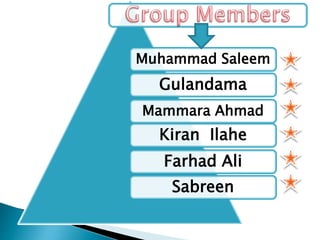
Muhammad Saleem
Gulandama
Kiran Ilahe
Mammara Ahmad
Farhad Ali
Sabreen
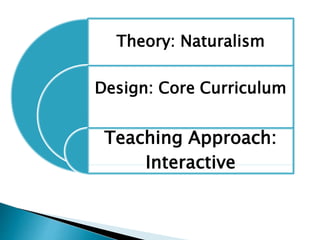
Theory: Naturalism
Design: Core Curriculum
Teaching Approach:
Interactive
Medium of Instruction
English
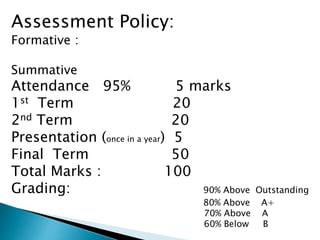
Assessment Policy:
Formative :
Summative
Attendance 95% 5 marks
1st Term 20
2nd Term 20
Presentation (once in a year) 5
Final Term 50
Total Marks : 100
Grading: 90% Above Outstanding
80% Above A+
70% Above A
60% Below B
Social Studies
Gulandama
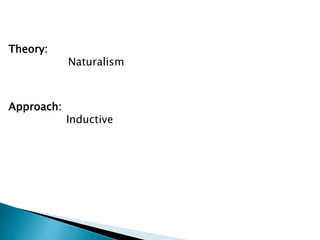
Theory:
Naturalism
Approach:
Inductive
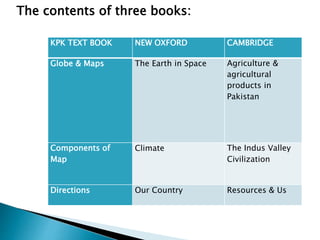
KPK TEXT BOOK NEW OXFORD CAMBRIDGE
Globe & Maps The Earth in Space Agriculture &
agricultural
products in
Pakistan
Components of
Map
Climate The Indus Valley
Civilization
Directions Our Country Resources & Us
The contents of three books:
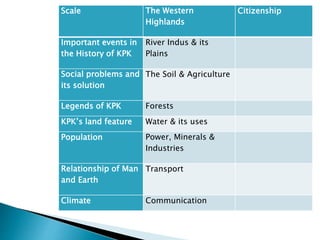
Scale The Western
Highlands
Citizenship
Important events in
the History of KPK
River Indus & its
Plains
Social problems and
its solution
The Soil & Agriculture
Legends of KPK Forests
KPK’s land feature Water & its uses
Population Power, Minerals &
Industries
Relationship of Man
and Earth
Transport
Climate Communication
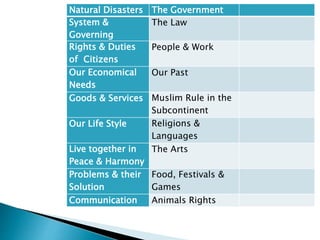
Natural Disasters The Government
System &
Governing
The Law
Rights & Duties
of Citizens
People & Work
Our Economical
Needs
Our Past
Goods & Services Muslim Rule in the
Subcontinent
Our Life Style Religions &
Languages
Live together in
Peace & Harmony
The Arts
Problems & their
Solution
Food, Festivals &
Games
Communication Animals Rights
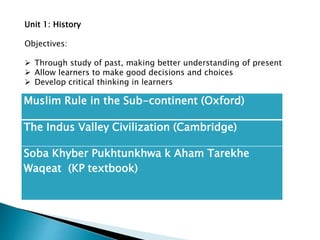
Unit 1: History
Objectives:
 Through study of past, making better understanding of present
 Allow learners to make good decisions and choices
 Develop critical thinking in learners
Muslim Rule in the Sub-continent (Oxford)
The Indus Valley Civilization (Cambridge)
Soba Khyber Pukhtunkhwa k Aham Tarekhe
Waqeat (KP textbook)
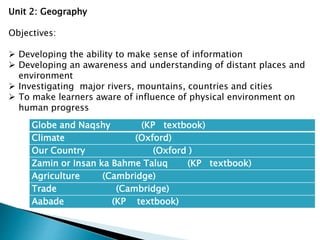
Unit 2: Geography
Objectives:
 Developing the ability to make sense of information
 Developing an awareness and understanding of distant places and
environment
 Investigating major rivers, mountains, countries and cities
 To make learners aware of influence of physical environment on
human progress
Globe and Naqshy (KP textbook)
Climate (Oxford)
Our Country (Oxford )
Zamin or Insan ka Bahme Taluq (KP textbook)
Agriculture (Cambridge)
Trade (Cambridge)
Aabade (KP textbook)
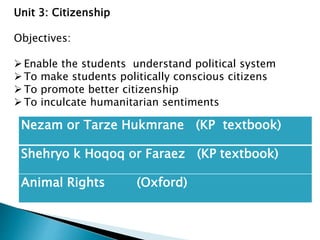
Unit 3: Citizenship
Objectives:
Enable the students understand political system
To make students politically conscious citizens
To promote better citizenship
To inculcate humanitarian sentiments
Nezam or Tarze Hukmrane (KP textbook)
Shehryo k Hoqoq or Faraez (KP textbook)
Animal Rights (Oxford)
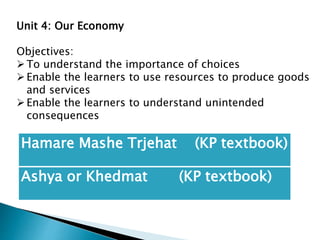
Unit 4: Our Economy
Objectives:
To understand the importance of choices
Enable the learners to use resources to produce goods
and services
Enable the learners to understand unintended
consequences
Hamare Mashe Trjehat (KP textbook)
Ashya or Khedmat (KP textbook)
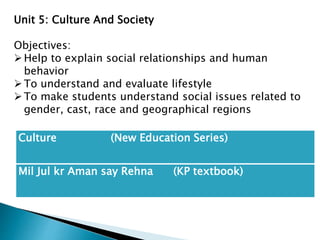
Unit 5: Culture And Society
Objectives:
Help to explain social relationships and human
behavior
To understand and evaluate lifestyle
To make students understand social issues related to
gender, cast, race and geographical regions
Culture (New Education Series)
Mil Jul kr Aman say Rehna (KP textbook)
Islamiyat
Mammara Ahmad
 Theory:
Idealism
 The aims of this syllabus are to enable to learn
about their religion.
Acquire knowledge of the major sources of
Islam .Its main belief and history Islam.
Developing an enquiring approach to the study
of Islam.
Identify and explore religion.
 This curriculum is made for class 4th .These
books are based on the basics of Islam, which
every child learn and follow their religion .Focus
on certain displine and basics rules for learners.
Emaniyat wa Ibadaat ( KP text book )
Bando k Haqook (Oxford)
Unit 1: Al Quran (oxford)
Objectives:
 Help learners to make good Hafiz.
 Develop learners memory.
Adaab e Ekhlak ( KP text book )
Wakt ki pabandi (Oxford)
Adaab e majlis ( KP text book)
Saadgi (Oxford)
Unit 2: Pyary Nabi ki pyari batai (Cambridge)
Objectives:
Increase the learners interest in Holy Prpohet(
PBUH)
Help to make good human beings.
Unit:3 Deen
Objectives:
Help learners to make honest
Simplicity in life style.
Develop the learners belief at Arkan e islam
Wazoo ,Nimaz (Cambridge)
Eman dari (Oxford)
English
Kiran Ilahe
Theory:
Naturalism
Design:
Core design
Teaching Approach:
Interactive
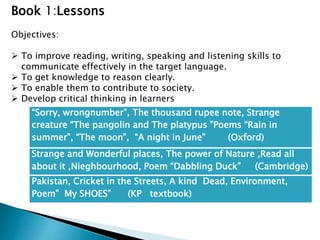
Book 1:Lessons
Objectives:
 To improve reading, writing, speaking and listening skills to
communicate effectively in the target language.
 To get knowledge to reason clearly.
 To enable them to contribute to society.
 Develop critical thinking in learners
“Sorry, wrongnumber”, The thousand rupee note, Strange
creature “The pangolin and The platypus ”Poems “Rain in
summer”, “The moon”, “A night in June” (Oxford)
Strange and Wonderful places, The power of Nature ,Read all
about it ,Nieghbourhood, Poem “Dabbling Duck” (Cambridge)
Pakistan, Cricket in the Streets, A kind Dead, Environment,
Poem” My SHOES” (KP textbook)
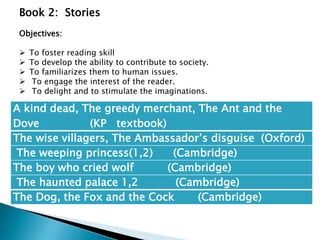
Book 2: Stories
Objectives:
 To foster reading skill
 To develop the ability to contribute to society.
 To familiarizes them to human issues.
 To engage the interest of the reader.
 To delight and to stimulate the imaginations.
A kind dead, The greedy merchant, The Ant and the
Dove (KP textbook)
The wise villagers, The Ambassador’s disguise (Oxford)
The weeping princess(1,2) (Cambridge)
The boy who cried wolf (Cambridge)
The haunted palace 1,2 (Cambridge)
The Dog, the Fox and the Cock (Cambridge)
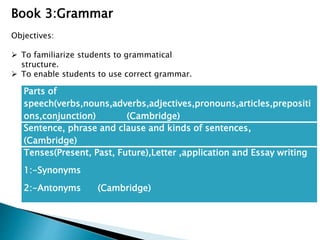
Book 3:Grammar
Objectives:
 To familiarize students to grammatical
structure.
 To enable students to use correct grammar.
Parts of
speech(verbs,nouns,adverbs,adjectives,pronouns,articles,prepositi
ons,conjunction) (Cambridge)
Sentence, phrase and clause and kinds of sentences,
(Cambridge)
Tenses(Present, Past, Future),Letter ,application and Essay writing
1:-Synonyms
2:-Antonyms (Cambridge)
Mathematics
Farhad Ali
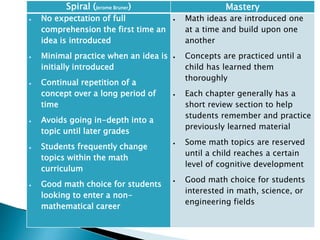
Spiral (Jerome Bruner) Mastery
 No expectation of full
comprehension the first time an
idea is introduced
 Minimal practice when an idea is
initially introduced
 Continual repetition of a
concept over a long period of
time
 Avoids going in-depth into a
topic until later grades
 Students frequently change
topics within the math
curriculum
 Good math choice for students
looking to enter a non-
mathematical career
 Math ideas are introduced one
at a time and build upon one
another
 Concepts are practiced until a
child has learned them
thoroughly
 Each chapter generally has a
short review section to help
students remember and practice
previously learned material
 Some math topics are reserved
until a child reaches a certain
level of cognitive development
 Good math choice for students
interested in math, science, or
engineering fields
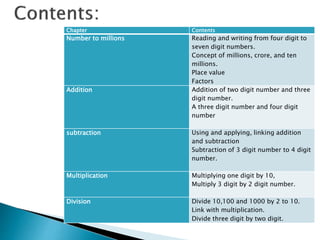
Chapter Contents
Number to millions Reading and writing from four digit to
seven digit numbers.
Concept of millions, crore, and ten
millions.
Place value
Factors
Addition Addition of two digit number and three
digit number.
A three digit number and four digit
number
subtraction Using and applying, linking addition
and subtraction
Subtraction of 3 digit number to 4 digit
number.
Multiplication Multiplying one digit by 10,
Multiply 3 digit by 2 digit number.
Division Divide 10,100 and 1000 by 2 to 10.
Link with multiplication.
Divide three digit by two digit.
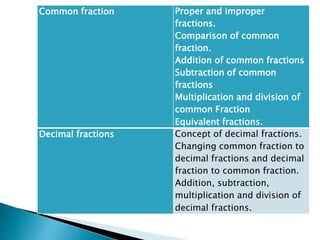
Common fraction Proper and improper
fractions.
Comparison of common
fraction.
Addition of common fractions
Subtraction of common
fractions
Multiplication and division of
common Fraction
Equivalent fractions.
Decimal fractions Concept of decimal fractions.
Changing common fraction to
decimal fractions and decimal
fraction to common fraction.
Addition, subtraction,
multiplication and division of
decimal fractions.
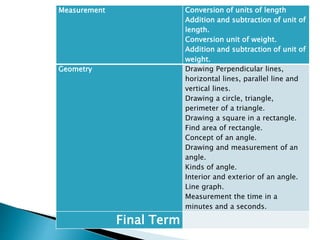
Measurement Conversion of units of length
Addition and subtraction of unit of
length.
Conversion unit of weight.
Addition and subtraction of unit of
weight.
Geometry Drawing Perpendicular lines,
horizontal lines, parallel line and
vertical lines.
Drawing a circle, triangle,
perimeter of a triangle.
Drawing a square in a rectangle.
Find area of rectangle.
Concept of an angle.
Drawing and measurement of an
angle.
Kinds of angle.
Interior and exterior of an angle.
Line graph.
Measurement the time in a
minutes and a seconds.
Final Term
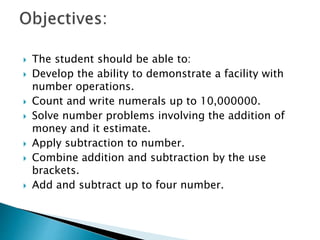
 The student should be able to:
 Develop the ability to demonstrate a facility with
number operations.
 Count and write numerals up to 10,000000.
 Solve number problems involving the addition of
money and it estimate.
 Apply subtraction to number.
 Combine addition and subtraction by the use
brackets.
 Add and subtract up to four number.
 Develop fluency with multiplication up to three
by two digit division.
 Analyze information collected by statistical
methods and draw conclusion.
 Fraction
 Graphs and line
 Geometry
 Angles
 Find the area of rectangle, triangle
 Use the protectors to measure and draw
angles.
Science
Muhammad Saleem
 To arouse pupils’ curiosity about the world.
around them.
 To motivate pupils to learn scientific
concept
 Developing critical thinking
Food for energy (Oxford)
Food Groups ( KP textbook)
A balanced diet (Oxford)
Stay fit (Oxford)
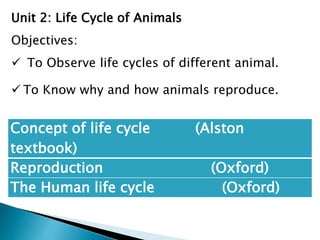
Concept of life cycle (Alston
textbook)
Reproduction (Oxford)
The Human life cycle (Oxford)
Unit 2: Life Cycle of Animals
Objectives:
 To Observe life cycles of different animal.
 To Know why and how animals reproduce.
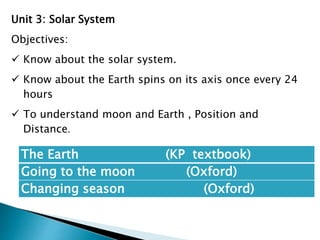
The Earth (KP textbook)
Going to the moon (Oxford)
Changing season (Oxford)
Unit 3: Solar System
Objectives:
 Know about the solar system.
 Know about the Earth spins on its axis once every 24
hours
 To understand moon and Earth , Position and
Distance.
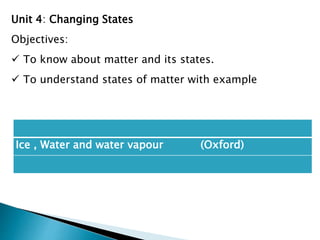
Ice , Water and water vapour (Oxford)
Unit 4: Changing States
Objectives:
 To know about matter and its states.
 To understand states of matter with example
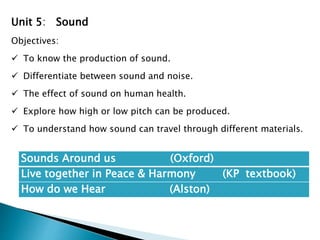
Sounds Around us (Oxford)
Live together in Peace & Harmony (KP textbook)
How do we Hear (Alston)
Unit 5: Sound
Objectives:
 To know the production of sound.
 Differentiate between sound and noise.
 The effect of sound on human health.
 Explore how high or low pitch can be produced.
 To understand how sound can travel through different materials.
Pashto
Gulandama
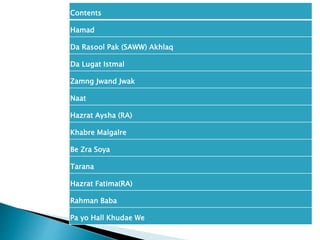
Contents
Hamad
Da Rasool Pak (SAWW) Akhlaq
Da Lugat Istmal
Zamng Jwand Jwak
Naat
Hazrat Aysha (RA)
Khabre Malgalre
Be Zra Soya
Tarana
Hazrat Fatima(RA)
Rahman Baba
Pa yo Hall Khudae We
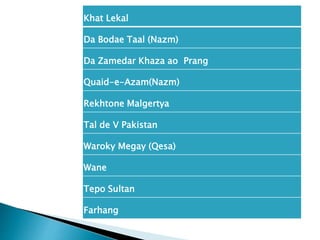
Khat Lekal
Da Bodae Taal (Nazm)
Da Zamedar Khaza ao Prang
Quaid-e-Azam(Nazm)
Rekhtone Malgertya
Tal de V Pakistan
Waroky Megay (Qesa)
Wane
Tepo Sultan
Farhang
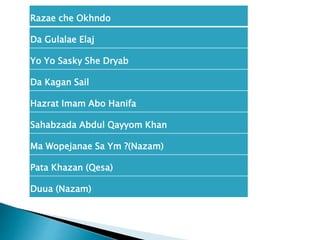
Razae che Okhndo
Da Gulalae Elaj
Yo Yo Sasky She Dryab
Da Kagan Sail
Hazrat Imam Abo Hanifa
Sahabzada Abdul Qayyom Khan
Ma Wopejanae Sa Ym ?(Nazam)
Pata Khazan (Qesa)
Duua (Nazam)
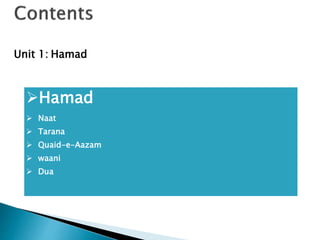
Hamad
 Naat
 Tarana
 Quaid-e-Aazam
 waani
 Dua
Unit 1: Hamad
Unit 2 Da RAsool (S.A.W)
 Akhlaq
 Hazrat Ayesha (R.A)
 Hazrat Fatima (R.A)
 Tepo Sultan
 Sahib zada Abdul Qayum Khan
Unit 3: Rahman BABA
 Darkhwast likal
 Khaat likal
 Mazmoon lokal
 Qisi likal
Unit 4: Grammar
Urdu
Sabreen
Theory:
Naturalism.
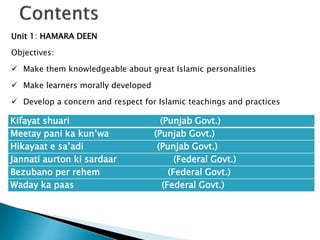
Kifayat shuari (Punjab Govt.)
Meetay pani ka kun’wa (Punjab Govt.)
Hikayaat e sa’adi (Punjab Govt.)
Jannati aurton ki sardaar (Federal Govt.)
Bezubano per rehem (Federal Govt.)
Waday ka paas (Federal Govt.)
Unit 1: HAMARA DEEN
Objectives:
 Make them knowledgeable about great Islamic personalities
 Make learners morally developed
 Develop a concern and respect for Islamic teachings and practices
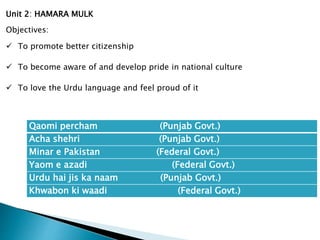
Qaomi percham (Punjab Govt.)
Acha shehri (Punjab Govt.)
Minar e Pakistan (Federal Govt.)
Yaom e azadi (Federal Govt.)
Urdu hai jis ka naam (Punjab Govt.)
Khwabon ki waadi (Federal Govt.)
Unit 2: HAMARA MULK
Objectives:
 To promote better citizenship
 To become aware of and develop pride in national culture
 To love the Urdu language and feel proud of it
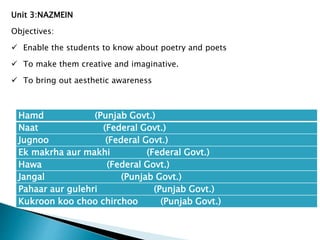
Hamd (Punjab Govt.)
Naat (Federal Govt.)
Jugnoo (Federal Govt.)
Ek makrha aur makhi (Federal Govt.)
Hawa (Federal Govt.)
Jangal (Punjab Govt.)
Pahaar aur gulehri (Punjab Govt.)
Kukroon koo choo chirchoo (Punjab Govt.)
Unit 3:NAZMEIN
Objectives:
 Enable the students to know about poetry and poets
 To make them creative and imaginative.
 To bring out aesthetic awareness
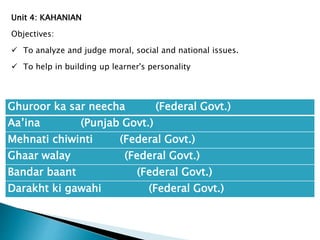
Ghuroor ka sar neecha (Federal Govt.)
Aa’ina (Punjab Govt.)
Mehnati chiwinti (Federal Govt.)
Ghaar walay (Federal Govt.)
Bandar baant (Federal Govt.)
Darakht ki gawahi (Federal Govt.)
Unit 4: KAHANIAN
Objectives:
 To analyze and judge moral, social and national issues.
 To help in building up learner's personality
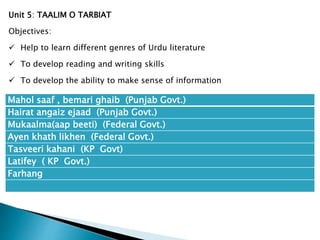
Mahol saaf , bemari ghaib (Punjab Govt.)
Hairat angaiz ejaad (Punjab Govt.)
Mukaalma(aap beeti) (Federal Govt.)
Ayen khath likhen (Federal Govt.)
Tasveeri kahani (KP Govt)
Latifey ( KP Govt.)
Farhang
Unit 5: TAALIM O TARBIAT
Objectives:
 Help to learn different genres of Urdu literature
 To develop reading and writing skills
 To develop the ability to make sense of information
Computer
Muhammad Saleem
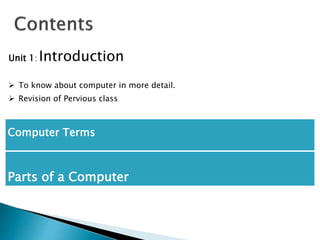
Computer Terms
Parts of a Computer
Unit 1: Introduction
 To know about computer in more detail.
 Revision of Pervious class
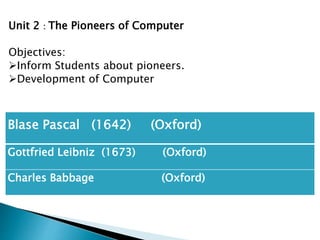
Blase Pascal (1642) (Oxford)
Gottfried Leibniz (1673) (Oxford)
Charles Babbage (Oxford)
Unit 2 : The Pioneers of Computer
Objectives:
Inform Students about pioneers.
Development of Computer
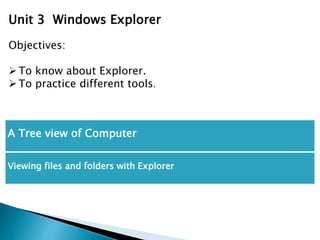
A Tree view of Computer
Viewing files and folders with Explorer
Unit 3 Windows Explorer
Objectives:
To know about Explorer.
To practice different tools.
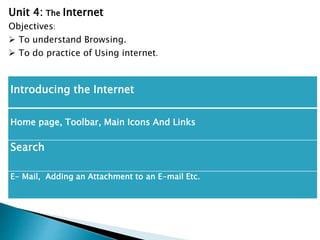
Introducing the Internet
Home page, Toolbar, Main Icons And Links
Search
E- Mail, Adding an Attachment to an E-mail Etc.
Unit 4: The Internet
Objectives:
 To understand Browsing.
 To do practice of Using internet.
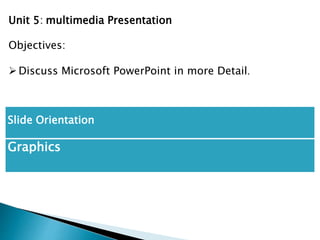
Slide Orientation
Graphics
Unit 5: multimedia Presentation
Objectives:
Discuss Microsoft PowerPoint in more Detail.
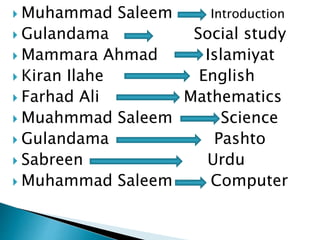
 Muhammad Saleem Introduction
 Gulandama Social study
 Mammara Ahmad Islamiyat
 Kiran Ilahe English
 Farhad Ali Mathematics
 Muahmmad Saleem Science
 Gulandama Pashto
 Sabreen Urdu
 Muhammad Saleem Computer

Saleem curriculum presentation1

  • 1.
  • 2.
    It is easierto change the location of a cemetery, than to change the school curriculum (Woodrow T Wilson)
  • 4.
  • 5.
    Theory: Naturalism Design: CoreCurriculum Teaching Approach: Interactive
  • 6.
  • 7.
    Assessment Policy: Formative : Summative Attendance95% 5 marks 1st Term 20 2nd Term 20 Presentation (once in a year) 5 Final Term 50 Total Marks : 100 Grading: 90% Above Outstanding 80% Above A+ 70% Above A 60% Below B
  • 8.
  • 9.
  • 10.
    KPK TEXT BOOKNEW OXFORD CAMBRIDGE Globe & Maps The Earth in Space Agriculture & agricultural products in Pakistan Components of Map Climate The Indus Valley Civilization Directions Our Country Resources & Us The contents of three books:
  • 11.
    Scale The Western Highlands Citizenship Importantevents in the History of KPK River Indus & its Plains Social problems and its solution The Soil & Agriculture Legends of KPK Forests KPK’s land feature Water & its uses Population Power, Minerals & Industries Relationship of Man and Earth Transport Climate Communication
  • 12.
    Natural Disasters TheGovernment System & Governing The Law Rights & Duties of Citizens People & Work Our Economical Needs Our Past Goods & Services Muslim Rule in the Subcontinent Our Life Style Religions & Languages Live together in Peace & Harmony The Arts Problems & their Solution Food, Festivals & Games Communication Animals Rights
  • 13.
    Unit 1: History Objectives: Through study of past, making better understanding of present  Allow learners to make good decisions and choices  Develop critical thinking in learners Muslim Rule in the Sub-continent (Oxford) The Indus Valley Civilization (Cambridge) Soba Khyber Pukhtunkhwa k Aham Tarekhe Waqeat (KP textbook)
  • 14.
    Unit 2: Geography Objectives: Developing the ability to make sense of information  Developing an awareness and understanding of distant places and environment  Investigating major rivers, mountains, countries and cities  To make learners aware of influence of physical environment on human progress Globe and Naqshy (KP textbook) Climate (Oxford) Our Country (Oxford ) Zamin or Insan ka Bahme Taluq (KP textbook) Agriculture (Cambridge) Trade (Cambridge) Aabade (KP textbook)
  • 15.
    Unit 3: Citizenship Objectives: Enablethe students understand political system To make students politically conscious citizens To promote better citizenship To inculcate humanitarian sentiments Nezam or Tarze Hukmrane (KP textbook) Shehryo k Hoqoq or Faraez (KP textbook) Animal Rights (Oxford)
  • 16.
    Unit 4: OurEconomy Objectives: To understand the importance of choices Enable the learners to use resources to produce goods and services Enable the learners to understand unintended consequences Hamare Mashe Trjehat (KP textbook) Ashya or Khedmat (KP textbook)
  • 17.
    Unit 5: CultureAnd Society Objectives: Help to explain social relationships and human behavior To understand and evaluate lifestyle To make students understand social issues related to gender, cast, race and geographical regions Culture (New Education Series) Mil Jul kr Aman say Rehna (KP textbook)
  • 18.
  • 19.
  • 20.
     The aimsof this syllabus are to enable to learn about their religion. Acquire knowledge of the major sources of Islam .Its main belief and history Islam. Developing an enquiring approach to the study of Islam. Identify and explore religion.  This curriculum is made for class 4th .These books are based on the basics of Islam, which every child learn and follow their religion .Focus on certain displine and basics rules for learners.
  • 21.
    Emaniyat wa Ibadaat( KP text book ) Bando k Haqook (Oxford) Unit 1: Al Quran (oxford) Objectives:  Help learners to make good Hafiz.  Develop learners memory.
  • 22.
    Adaab e Ekhlak( KP text book ) Wakt ki pabandi (Oxford) Adaab e majlis ( KP text book) Saadgi (Oxford) Unit 2: Pyary Nabi ki pyari batai (Cambridge) Objectives: Increase the learners interest in Holy Prpohet( PBUH) Help to make good human beings.
  • 23.
    Unit:3 Deen Objectives: Help learnersto make honest Simplicity in life style. Develop the learners belief at Arkan e islam Wazoo ,Nimaz (Cambridge) Eman dari (Oxford)
  • 24.
  • 25.
  • 26.
    Book 1:Lessons Objectives:  Toimprove reading, writing, speaking and listening skills to communicate effectively in the target language.  To get knowledge to reason clearly.  To enable them to contribute to society.  Develop critical thinking in learners “Sorry, wrongnumber”, The thousand rupee note, Strange creature “The pangolin and The platypus ”Poems “Rain in summer”, “The moon”, “A night in June” (Oxford) Strange and Wonderful places, The power of Nature ,Read all about it ,Nieghbourhood, Poem “Dabbling Duck” (Cambridge) Pakistan, Cricket in the Streets, A kind Dead, Environment, Poem” My SHOES” (KP textbook)
  • 27.
    Book 2: Stories Objectives: To foster reading skill  To develop the ability to contribute to society.  To familiarizes them to human issues.  To engage the interest of the reader.  To delight and to stimulate the imaginations. A kind dead, The greedy merchant, The Ant and the Dove (KP textbook) The wise villagers, The Ambassador’s disguise (Oxford) The weeping princess(1,2) (Cambridge) The boy who cried wolf (Cambridge) The haunted palace 1,2 (Cambridge) The Dog, the Fox and the Cock (Cambridge)
  • 28.
    Book 3:Grammar Objectives:  Tofamiliarize students to grammatical structure.  To enable students to use correct grammar. Parts of speech(verbs,nouns,adverbs,adjectives,pronouns,articles,prepositi ons,conjunction) (Cambridge) Sentence, phrase and clause and kinds of sentences, (Cambridge) Tenses(Present, Past, Future),Letter ,application and Essay writing 1:-Synonyms 2:-Antonyms (Cambridge)
  • 29.
  • 30.
    Spiral (Jerome Bruner)Mastery  No expectation of full comprehension the first time an idea is introduced  Minimal practice when an idea is initially introduced  Continual repetition of a concept over a long period of time  Avoids going in-depth into a topic until later grades  Students frequently change topics within the math curriculum  Good math choice for students looking to enter a non- mathematical career  Math ideas are introduced one at a time and build upon one another  Concepts are practiced until a child has learned them thoroughly  Each chapter generally has a short review section to help students remember and practice previously learned material  Some math topics are reserved until a child reaches a certain level of cognitive development  Good math choice for students interested in math, science, or engineering fields
  • 31.
    Chapter Contents Number tomillions Reading and writing from four digit to seven digit numbers. Concept of millions, crore, and ten millions. Place value Factors Addition Addition of two digit number and three digit number. A three digit number and four digit number subtraction Using and applying, linking addition and subtraction Subtraction of 3 digit number to 4 digit number. Multiplication Multiplying one digit by 10, Multiply 3 digit by 2 digit number. Division Divide 10,100 and 1000 by 2 to 10. Link with multiplication. Divide three digit by two digit.
  • 32.
    Common fraction Properand improper fractions. Comparison of common fraction. Addition of common fractions Subtraction of common fractions Multiplication and division of common Fraction Equivalent fractions. Decimal fractions Concept of decimal fractions. Changing common fraction to decimal fractions and decimal fraction to common fraction. Addition, subtraction, multiplication and division of decimal fractions.
  • 33.
    Measurement Conversion ofunits of length Addition and subtraction of unit of length. Conversion unit of weight. Addition and subtraction of unit of weight. Geometry Drawing Perpendicular lines, horizontal lines, parallel line and vertical lines. Drawing a circle, triangle, perimeter of a triangle. Drawing a square in a rectangle. Find area of rectangle. Concept of an angle. Drawing and measurement of an angle. Kinds of angle. Interior and exterior of an angle. Line graph. Measurement the time in a minutes and a seconds. Final Term
  • 34.
     The studentshould be able to:  Develop the ability to demonstrate a facility with number operations.  Count and write numerals up to 10,000000.  Solve number problems involving the addition of money and it estimate.  Apply subtraction to number.  Combine addition and subtraction by the use brackets.  Add and subtract up to four number.
  • 35.
     Develop fluencywith multiplication up to three by two digit division.  Analyze information collected by statistical methods and draw conclusion.  Fraction  Graphs and line  Geometry  Angles  Find the area of rectangle, triangle  Use the protectors to measure and draw angles.
  • 36.
  • 37.
     To arousepupils’ curiosity about the world. around them.  To motivate pupils to learn scientific concept  Developing critical thinking
  • 38.
    Food for energy(Oxford) Food Groups ( KP textbook) A balanced diet (Oxford) Stay fit (Oxford)
  • 39.
    Concept of lifecycle (Alston textbook) Reproduction (Oxford) The Human life cycle (Oxford) Unit 2: Life Cycle of Animals Objectives:  To Observe life cycles of different animal.  To Know why and how animals reproduce.
  • 40.
    The Earth (KPtextbook) Going to the moon (Oxford) Changing season (Oxford) Unit 3: Solar System Objectives:  Know about the solar system.  Know about the Earth spins on its axis once every 24 hours  To understand moon and Earth , Position and Distance.
  • 41.
    Ice , Waterand water vapour (Oxford) Unit 4: Changing States Objectives:  To know about matter and its states.  To understand states of matter with example
  • 42.
    Sounds Around us(Oxford) Live together in Peace & Harmony (KP textbook) How do we Hear (Alston) Unit 5: Sound Objectives:  To know the production of sound.  Differentiate between sound and noise.  The effect of sound on human health.  Explore how high or low pitch can be produced.  To understand how sound can travel through different materials.
  • 43.
  • 44.
    Contents Hamad Da Rasool Pak(SAWW) Akhlaq Da Lugat Istmal Zamng Jwand Jwak Naat Hazrat Aysha (RA) Khabre Malgalre Be Zra Soya Tarana Hazrat Fatima(RA) Rahman Baba Pa yo Hall Khudae We
  • 45.
    Khat Lekal Da BodaeTaal (Nazm) Da Zamedar Khaza ao Prang Quaid-e-Azam(Nazm) Rekhtone Malgertya Tal de V Pakistan Waroky Megay (Qesa) Wane Tepo Sultan Farhang
  • 46.
    Razae che Okhndo DaGulalae Elaj Yo Yo Sasky She Dryab Da Kagan Sail Hazrat Imam Abo Hanifa Sahabzada Abdul Qayyom Khan Ma Wopejanae Sa Ym ?(Nazam) Pata Khazan (Qesa) Duua (Nazam)
  • 47.
    Hamad  Naat  Tarana Quaid-e-Aazam  waani  Dua Unit 1: Hamad
  • 48.
    Unit 2 DaRAsool (S.A.W)  Akhlaq  Hazrat Ayesha (R.A)  Hazrat Fatima (R.A)
  • 49.
     Tepo Sultan Sahib zada Abdul Qayum Khan Unit 3: Rahman BABA  Darkhwast likal  Khaat likal  Mazmoon lokal  Qisi likal Unit 4: Grammar
  • 50.
  • 51.
  • 52.
    Kifayat shuari (PunjabGovt.) Meetay pani ka kun’wa (Punjab Govt.) Hikayaat e sa’adi (Punjab Govt.) Jannati aurton ki sardaar (Federal Govt.) Bezubano per rehem (Federal Govt.) Waday ka paas (Federal Govt.) Unit 1: HAMARA DEEN Objectives:  Make them knowledgeable about great Islamic personalities  Make learners morally developed  Develop a concern and respect for Islamic teachings and practices
  • 53.
    Qaomi percham (PunjabGovt.) Acha shehri (Punjab Govt.) Minar e Pakistan (Federal Govt.) Yaom e azadi (Federal Govt.) Urdu hai jis ka naam (Punjab Govt.) Khwabon ki waadi (Federal Govt.) Unit 2: HAMARA MULK Objectives:  To promote better citizenship  To become aware of and develop pride in national culture  To love the Urdu language and feel proud of it
  • 54.
    Hamd (Punjab Govt.) Naat(Federal Govt.) Jugnoo (Federal Govt.) Ek makrha aur makhi (Federal Govt.) Hawa (Federal Govt.) Jangal (Punjab Govt.) Pahaar aur gulehri (Punjab Govt.) Kukroon koo choo chirchoo (Punjab Govt.) Unit 3:NAZMEIN Objectives:  Enable the students to know about poetry and poets  To make them creative and imaginative.  To bring out aesthetic awareness
  • 55.
    Ghuroor ka sarneecha (Federal Govt.) Aa’ina (Punjab Govt.) Mehnati chiwinti (Federal Govt.) Ghaar walay (Federal Govt.) Bandar baant (Federal Govt.) Darakht ki gawahi (Federal Govt.) Unit 4: KAHANIAN Objectives:  To analyze and judge moral, social and national issues.  To help in building up learner's personality
  • 56.
    Mahol saaf ,bemari ghaib (Punjab Govt.) Hairat angaiz ejaad (Punjab Govt.) Mukaalma(aap beeti) (Federal Govt.) Ayen khath likhen (Federal Govt.) Tasveeri kahani (KP Govt) Latifey ( KP Govt.) Farhang Unit 5: TAALIM O TARBIAT Objectives:  Help to learn different genres of Urdu literature  To develop reading and writing skills  To develop the ability to make sense of information
  • 57.
  • 58.
    Computer Terms Parts ofa Computer Unit 1: Introduction  To know about computer in more detail.  Revision of Pervious class
  • 59.
    Blase Pascal (1642)(Oxford) Gottfried Leibniz (1673) (Oxford) Charles Babbage (Oxford) Unit 2 : The Pioneers of Computer Objectives: Inform Students about pioneers. Development of Computer
  • 60.
    A Tree viewof Computer Viewing files and folders with Explorer Unit 3 Windows Explorer Objectives: To know about Explorer. To practice different tools.
  • 61.
    Introducing the Internet Homepage, Toolbar, Main Icons And Links Search E- Mail, Adding an Attachment to an E-mail Etc. Unit 4: The Internet Objectives:  To understand Browsing.  To do practice of Using internet.
  • 62.
    Slide Orientation Graphics Unit 5:multimedia Presentation Objectives: Discuss Microsoft PowerPoint in more Detail.
  • 65.
     Muhammad SaleemIntroduction  Gulandama Social study  Mammara Ahmad Islamiyat  Kiran Ilahe English  Farhad Ali Mathematics  Muahmmad Saleem Science  Gulandama Pashto  Sabreen Urdu  Muhammad Saleem Computer