




Teachers’ Perceptions and Practices
of Post Method Pedagogy
in EFL Online Learning
Novi Dyah Arisanti
20716251028
Table of Contents
01 Introduction
Conclusion
03
Literature Review
02
References
04
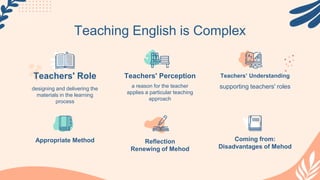
Teaching English is Complex
Appropriate Method Reflection
Renewing of Mehod
Coming from:
Disadvantages of Mehod
designing and delivering the
materials in the learning
process
Teachers' Role
a reason for the teacher
applies a particular teaching
approach
Teachers' Perception
supporting teachers' roles
Teachers’ Understanding
–Someone Famous
A great deal of attention has been
paid to the conceptual shifting of the
absence of the method as a reflection
of the various uses of each method.
Allwright R. L, (1991)
What happened in Pandemic Covid-19?
The movement from face-to-face learning into distance-learning (online learning)
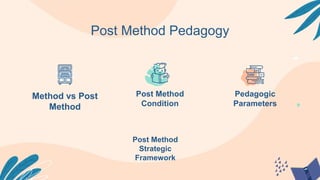
Post Method Pedagogy
Method vs Post
Method
Post Method
Condition
Pedagogic
Parameters
Post Method
Strategic
Framework
Method
Nunan (2003) mentions, a method can be an idea and
a series of perspectives about the nature of language
and learning.
According to Brown (2000), method is defined as the
generalized and prescribed classroom requirements
for the implementation of the linguistics objectives
used to generalize across various contexts and
audiences.
Post Method Pedagogy
Post Method Pedagogy is crucial for teacher growth involving
teachers’ constructing “classroom-oriented” theories of practice
(Kumaravadivelu, 1994) and values teachers’ potential by
emphasizing their experiences as teachers (Prabu, 1990).
Post Method Pedagogy states that none of the traditional
strategies or approaches is complete or individually absolute for
second or foreign language teaching.
Post Method Pedagogy argues that EFL learning is a complex
process and various factors should be considered. Rather than
relying on a specific method, it is suggested that language
teachers can create their own method.
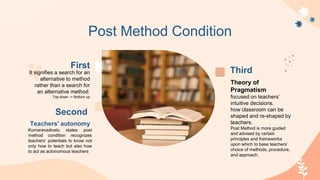
Second
Teachers' autonomy
Kumaravadivelu states post
method condition recognizes
teachers’ potentials to know not
only how to teach but also how
to act as autonomous teachers
Third
Theory of
Pragmatism
focused on teachers’
intuitive decisions.
how classroom can be
shaped and re-shaped by
teachers.
Post Method is more guided
and advised by certain
principles and frameworks
upon which to base teachers’
choice of methods, procedure,
and approach.
First
It signifies a search for an
alternative to method
rather than a search for
an alternative method.
Top-down -> Bottom up
Post Method Condition
Pedagogic Parameters
Particularity, practicality, and
possibility
Particularity, it comes from a particular
teacher’s experience, purpose, and social
context (known as situational understanding)
Practicality is linked to the way teacher
combines methodological theory and practice.
Possibility concerns the way the teacher faces
the complexity or diversity of students’
background or identity.
These three criteria emphasized learners or
students, teachers, and teacher educators to
look at their own context (Benages, 2014).
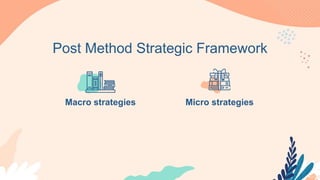
Post Method Strategic Framework
Macro strategies Micro strategies
1. maximize the learning process
2. minimize perceptual mismatches
3. facilitate negotiated interaction
4. promote learners or students autonomy
5. foster language awareness
6. activate intuitive heuristics
7. contextualize linguistic input
8. integrate language skills
9. ensure social relevance
10. raise cultural consciousness
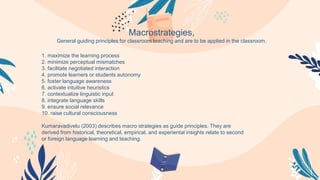
Kumaravadivelu (2003) describes macro strategies as guide principles. They are
derived from historical, theoretical, empirical, and experiental insights relate to second
or foreign language learning and teaching.
Macrostrategies,
General guiding principles for classroom teaching and are to be applied in the classroom.
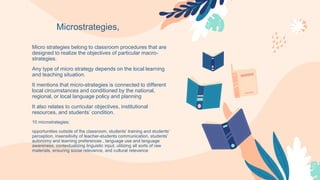
Microstrategies,
Micro strategies belong to classroom procedures that are
designed to realize the objectives of particular macro-
strategies.
Any type of micro strategy depends on the local learning
and teaching situation.
It mentions that micro-strategies is connected to different
local circumstances and conditioned by the national,
regional, or local language policy and planning
It also relates to curricular objectives, institutional
resources, and students’ condition.
10 microstrategies:
opportunities outside of the classroom, students’ training and students’
perception, insensitivity of teacher-students communication, students’
autonomy and learning preferences , language use and language
awareness, contextualizing linguistic input, utilizing all sorts of raw
materials, ensuring social relevance, and cultural relevance
Teachers should think:In addition,
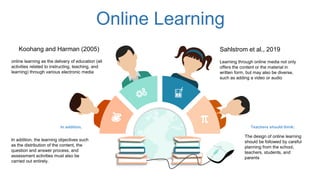
Online Learning
Koohang and Harman (2005)
online learning as the delivery of education (all
activities related to instructing, teaching, and
learning) through various electronic media
Learning through online media not only
offers the content or the material in
written form, but may also be diverse,
such as adding a video or audio
Sahlstrom et al., 2019
The design of online learning
should be followed by careful
planning from the school,
teachers, students, and
parents
In addition, the learning objectives such
as the distribution of the content, the
question and answer process, and
assessment activities must also be
carried out entirely.
Convenience,
students can carry out
learning process from
their own places
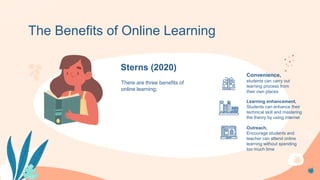
There are three benefits of
online learning;
The Benefits of Online Learning
Sterns (2020)
Learning enhancement,
Students can enhance their
technical skill and mastering
the theory by using internet
Outreach,
Encourage students and
teacher can attend online
learning without spending
too much time
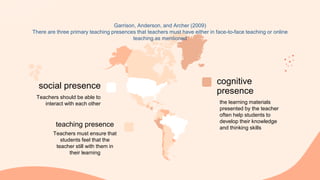
teaching presence
Teachers must ensure that
students feel that the
teacher still with them in
their learning
cognitive
presence
the learning materials
presented by the teacher
often help students to
develop their knowledge
and thinking skills
social presence
Teachers should be able to
interact with each other
Garrison, Anderson, and Archer (2009)
There are three primary teaching presences that teachers must have either in face-to-face teaching or online
teaching as mentioned
Think about
Teachers' perception Students' perception
Teachers' perception vs Students' perception
three primary teaching presences
The differences of students’ condition will
make students see the online learning from
different perspective
urban environment rural environment
they prefer online learning look interesting &
able to accommodate their learning needs.
Lee at al. (2014) and Ulfa et al. (2017)
visual appearance is also very influential on
students’ acceptance in utilizing the platform
chosen by the teacher as a distance
learning tool
some students really feel that the teacher
is only oriented towards some task by
using WhatsApp class group
(Churiyah et al, 2020)
Students hope the teacher not only give
assignment, but also explain via Voice
note in WAGroup
Conclusion
Facing some problems in EFL online learning, especially in the pandemic era, it can be
achieved by thorough Post Method Pedagogy.
Post Method Pedagogy allows teacher to take more chance to make learning process
suitable with the students’ need and students’ condition. It is an alternative so that
teachers can innovate their teaching practices which taken from their teaching
experiences.
Surprisingly, the study about Post Method Pedagogy is rarely used in Indonesia. Some
journals about Post Method Pedagogy in the Indonesian context are hard to find.
● To know the effect of Post Method Pedagogy in Indonesian context, we need some
research to prove it.
● This study aims to discuss EFL Teachers’ Perceptions and Practices of Post Method
proposed by Kumaravadivelu (1994; 2003; 2006).
● As suggestion, further studies should be carried out by another researcher to other
English teachers in all levels to know the teachers’ perceptions through the
implementation of Post Method Pedagogy in Indonesia
REFERENCES
Allwright, R. L. (1991). The death of the method. The Exploratory Practice Center, The University of Lancaster, England.
Benages, D. L. (2014). Of Methods and Postmethods.: A view from Argentina.
Federation Argentina de Asociation de Profesores de Ingles (FAAPI). 15-27.
Brown, D. (2002). English language teaching in post-method era: Toward better diagnosis, traetment, and assessment. In
J. C. Richards & W., Renandya (Eds.), Methodology in language teaching, 9-18. Cambridge, England:
Cambridge University Press.
Chen, M. (2014). Postmethod pedagogy and Its Influence on EFL Teaching Strategies. English Language Teaching, 7, 17-
25. doi:10.5539/elt.v7n5p17
Churiyah, M., Sholikhan, S., Filianti, F., Sakdiyah, A. D., (2020). Indonesia Education Readiness Conducting Distance
Learning in Covid-19 Pandemic Situation. International Journal of Multicultural and Multireligious
Understanding, 7, no 6. http://dx.doi.org/10.18415/ijmmu.v7i6.1833
Finch, D., & Jacobs, K. (2012) Online Education: Best Practices to promote learning. Proceedings of the Human Factors
and Ergonomics 56th Annual Meeting.
Freeman, D. (1991). Mistaken constructs. Re-examining the nature and the assumptions of language teacher education.
Linguistics and Language Pedagogy: The state of art, 25-39, Washington, DC: Georgetown University Press.
Garrison, D. R., Anderson, T., & Archer, W. (2009). Criical Thinking, cognitive presence, and computer conferencing in
distance education. American journal of Distance Education, 15 (1), 7-23.
Harmer, J. (2007). The Practice of English Language Teaching: Malaysia: Pearson Education Limited.
Kumaravadivelu, B. (1994). The postmethod condition: (E)merging strategies for second/ foreign language teaching.
TESOL Quarterly, 28.
Kumaravadivelu, B. (2001). Toward postmethod pedagogy. TESOL Quarterly, 35.
Kumaravadivelu, B. (2003). Critical language pedagogy: a postmethod perspective on English language teaching. World
Englishes, 22 (4), 539-550. http://dx.doi.org/10.1111/j.1467-971X.2003.003.17.x
Kumaravadivelu, B. (2003). Beyond Method: Macrostrategies for Language Teaching. New Haven, CT: Yale University Press.
Kumaravadivelu, B. (2006). Understanding Language Teaching From Method to Post Method. Mahwah: Erlbaum.
Lee Y.-H., Hsiao, C., & Ho, C.-H. (2014). The effects of various multimedia instructional materials on students’ learning
responses and outcomes: A comparative experimental study. Computers in Human Behavior, 40, 119–132.
https://doi.org/10.1016/j.chb.2014.07.041
Molthaka, H. A. (2015). Exploring postmethod pedagogy in teaching English as second language in South African higher
education. Mediterranean Journal of Sciences. 6 (1), 517-524.
Nunan, D. (2003). Practical English Language Teaching. New York: McGraw Hill.
Prabhu, N. S. (1990). There is no best method. Why? TESOL Quarterly, 24.
Ulfa, A. M., Sugiyarto, K. H., & Ikhsan, J. (2017). The effect of the use of android-based application in learning together to
improve students’ academic performance. 050008. https://doi.org/10.1063/1.4983910
Saengbon, S. (2013). Thai English Teachers’ Understanding of “Postmethod Pedagogy”: Case study of University Lecturers.
Canadian Center of Science and Education. 6(12), 156-166.
Sahlström, F., Tanner, M., & Valasmo, V. (2019). Connected youth, connected classrooms. Smartphone use, student, teacher
participation during plenary teaching.
Learning, Culture and Social Interaction, 21, 311–331. https://doi.org/10.1016/j.lcsi.2019.03.008
Sterns, J. (2020). Introduction to Online Teaching and Learning. http://www.sloan-c.org/resources/index.asp Retrieved at 05.00
a.m . 24th November 2020.
REFERENCES
Q & A?
Thanks!

Post Method Pedagogy in EFL Online Learning

  • 1.
    Teachers’ Perceptions andPractices of Post Method Pedagogy in EFL Online Learning Novi Dyah Arisanti 20716251028
  • 2.
    Table of Contents 01Introduction Conclusion 03 Literature Review 02 References 04
  • 3.
    Teaching English isComplex Appropriate Method Reflection Renewing of Mehod Coming from: Disadvantages of Mehod designing and delivering the materials in the learning process Teachers' Role a reason for the teacher applies a particular teaching approach Teachers' Perception supporting teachers' roles Teachers’ Understanding
  • 4.
    –Someone Famous A greatdeal of attention has been paid to the conceptual shifting of the absence of the method as a reflection of the various uses of each method. Allwright R. L, (1991)
  • 5.
    What happened inPandemic Covid-19? The movement from face-to-face learning into distance-learning (online learning)
  • 6.
    Post Method Pedagogy Methodvs Post Method Post Method Condition Pedagogic Parameters Post Method Strategic Framework
  • 7.
    Method Nunan (2003) mentions,a method can be an idea and a series of perspectives about the nature of language and learning. According to Brown (2000), method is defined as the generalized and prescribed classroom requirements for the implementation of the linguistics objectives used to generalize across various contexts and audiences.
  • 8.
    Post Method Pedagogy PostMethod Pedagogy is crucial for teacher growth involving teachers’ constructing “classroom-oriented” theories of practice (Kumaravadivelu, 1994) and values teachers’ potential by emphasizing their experiences as teachers (Prabu, 1990). Post Method Pedagogy states that none of the traditional strategies or approaches is complete or individually absolute for second or foreign language teaching. Post Method Pedagogy argues that EFL learning is a complex process and various factors should be considered. Rather than relying on a specific method, it is suggested that language teachers can create their own method.
  • 9.
    Second Teachers' autonomy Kumaravadivelu statespost method condition recognizes teachers’ potentials to know not only how to teach but also how to act as autonomous teachers Third Theory of Pragmatism focused on teachers’ intuitive decisions. how classroom can be shaped and re-shaped by teachers. Post Method is more guided and advised by certain principles and frameworks upon which to base teachers’ choice of methods, procedure, and approach. First It signifies a search for an alternative to method rather than a search for an alternative method. Top-down -> Bottom up Post Method Condition
  • 10.
    Pedagogic Parameters Particularity, practicality,and possibility Particularity, it comes from a particular teacher’s experience, purpose, and social context (known as situational understanding) Practicality is linked to the way teacher combines methodological theory and practice. Possibility concerns the way the teacher faces the complexity or diversity of students’ background or identity. These three criteria emphasized learners or students, teachers, and teacher educators to look at their own context (Benages, 2014).
  • 11.
    Post Method StrategicFramework Macro strategies Micro strategies
  • 12.
    1. maximize thelearning process 2. minimize perceptual mismatches 3. facilitate negotiated interaction 4. promote learners or students autonomy 5. foster language awareness 6. activate intuitive heuristics 7. contextualize linguistic input 8. integrate language skills 9. ensure social relevance 10. raise cultural consciousness Kumaravadivelu (2003) describes macro strategies as guide principles. They are derived from historical, theoretical, empirical, and experiental insights relate to second or foreign language learning and teaching. Macrostrategies, General guiding principles for classroom teaching and are to be applied in the classroom.
  • 13.
    Microstrategies, Micro strategies belongto classroom procedures that are designed to realize the objectives of particular macro- strategies. Any type of micro strategy depends on the local learning and teaching situation. It mentions that micro-strategies is connected to different local circumstances and conditioned by the national, regional, or local language policy and planning It also relates to curricular objectives, institutional resources, and students’ condition. 10 microstrategies: opportunities outside of the classroom, students’ training and students’ perception, insensitivity of teacher-students communication, students’ autonomy and learning preferences , language use and language awareness, contextualizing linguistic input, utilizing all sorts of raw materials, ensuring social relevance, and cultural relevance
  • 14.
    Teachers should think:Inaddition, Online Learning Koohang and Harman (2005) online learning as the delivery of education (all activities related to instructing, teaching, and learning) through various electronic media Learning through online media not only offers the content or the material in written form, but may also be diverse, such as adding a video or audio Sahlstrom et al., 2019 The design of online learning should be followed by careful planning from the school, teachers, students, and parents In addition, the learning objectives such as the distribution of the content, the question and answer process, and assessment activities must also be carried out entirely.
  • 15.
    Convenience, students can carryout learning process from their own places There are three benefits of online learning; The Benefits of Online Learning Sterns (2020) Learning enhancement, Students can enhance their technical skill and mastering the theory by using internet Outreach, Encourage students and teacher can attend online learning without spending too much time
  • 16.
    teaching presence Teachers mustensure that students feel that the teacher still with them in their learning cognitive presence the learning materials presented by the teacher often help students to develop their knowledge and thinking skills social presence Teachers should be able to interact with each other Garrison, Anderson, and Archer (2009) There are three primary teaching presences that teachers must have either in face-to-face teaching or online teaching as mentioned
  • 17.
    Think about Teachers' perceptionStudents' perception Teachers' perception vs Students' perception three primary teaching presences The differences of students’ condition will make students see the online learning from different perspective urban environment rural environment they prefer online learning look interesting & able to accommodate their learning needs. Lee at al. (2014) and Ulfa et al. (2017) visual appearance is also very influential on students’ acceptance in utilizing the platform chosen by the teacher as a distance learning tool some students really feel that the teacher is only oriented towards some task by using WhatsApp class group (Churiyah et al, 2020) Students hope the teacher not only give assignment, but also explain via Voice note in WAGroup
  • 18.
    Conclusion Facing some problemsin EFL online learning, especially in the pandemic era, it can be achieved by thorough Post Method Pedagogy. Post Method Pedagogy allows teacher to take more chance to make learning process suitable with the students’ need and students’ condition. It is an alternative so that teachers can innovate their teaching practices which taken from their teaching experiences. Surprisingly, the study about Post Method Pedagogy is rarely used in Indonesia. Some journals about Post Method Pedagogy in the Indonesian context are hard to find. ● To know the effect of Post Method Pedagogy in Indonesian context, we need some research to prove it. ● This study aims to discuss EFL Teachers’ Perceptions and Practices of Post Method proposed by Kumaravadivelu (1994; 2003; 2006). ● As suggestion, further studies should be carried out by another researcher to other English teachers in all levels to know the teachers’ perceptions through the implementation of Post Method Pedagogy in Indonesia
  • 19.
    REFERENCES Allwright, R. L.(1991). The death of the method. The Exploratory Practice Center, The University of Lancaster, England. Benages, D. L. (2014). Of Methods and Postmethods.: A view from Argentina. Federation Argentina de Asociation de Profesores de Ingles (FAAPI). 15-27. Brown, D. (2002). English language teaching in post-method era: Toward better diagnosis, traetment, and assessment. In J. C. Richards & W., Renandya (Eds.), Methodology in language teaching, 9-18. Cambridge, England: Cambridge University Press. Chen, M. (2014). Postmethod pedagogy and Its Influence on EFL Teaching Strategies. English Language Teaching, 7, 17- 25. doi:10.5539/elt.v7n5p17 Churiyah, M., Sholikhan, S., Filianti, F., Sakdiyah, A. D., (2020). Indonesia Education Readiness Conducting Distance Learning in Covid-19 Pandemic Situation. International Journal of Multicultural and Multireligious Understanding, 7, no 6. http://dx.doi.org/10.18415/ijmmu.v7i6.1833 Finch, D., & Jacobs, K. (2012) Online Education: Best Practices to promote learning. Proceedings of the Human Factors and Ergonomics 56th Annual Meeting. Freeman, D. (1991). Mistaken constructs. Re-examining the nature and the assumptions of language teacher education. Linguistics and Language Pedagogy: The state of art, 25-39, Washington, DC: Georgetown University Press. Garrison, D. R., Anderson, T., & Archer, W. (2009). Criical Thinking, cognitive presence, and computer conferencing in distance education. American journal of Distance Education, 15 (1), 7-23. Harmer, J. (2007). The Practice of English Language Teaching: Malaysia: Pearson Education Limited. Kumaravadivelu, B. (1994). The postmethod condition: (E)merging strategies for second/ foreign language teaching. TESOL Quarterly, 28.
  • 20.
    Kumaravadivelu, B. (2001).Toward postmethod pedagogy. TESOL Quarterly, 35. Kumaravadivelu, B. (2003). Critical language pedagogy: a postmethod perspective on English language teaching. World Englishes, 22 (4), 539-550. http://dx.doi.org/10.1111/j.1467-971X.2003.003.17.x Kumaravadivelu, B. (2003). Beyond Method: Macrostrategies for Language Teaching. New Haven, CT: Yale University Press. Kumaravadivelu, B. (2006). Understanding Language Teaching From Method to Post Method. Mahwah: Erlbaum. Lee Y.-H., Hsiao, C., & Ho, C.-H. (2014). The effects of various multimedia instructional materials on students’ learning responses and outcomes: A comparative experimental study. Computers in Human Behavior, 40, 119–132. https://doi.org/10.1016/j.chb.2014.07.041 Molthaka, H. A. (2015). Exploring postmethod pedagogy in teaching English as second language in South African higher education. Mediterranean Journal of Sciences. 6 (1), 517-524. Nunan, D. (2003). Practical English Language Teaching. New York: McGraw Hill. Prabhu, N. S. (1990). There is no best method. Why? TESOL Quarterly, 24. Ulfa, A. M., Sugiyarto, K. H., & Ikhsan, J. (2017). The effect of the use of android-based application in learning together to improve students’ academic performance. 050008. https://doi.org/10.1063/1.4983910 Saengbon, S. (2013). Thai English Teachers’ Understanding of “Postmethod Pedagogy”: Case study of University Lecturers. Canadian Center of Science and Education. 6(12), 156-166. Sahlström, F., Tanner, M., & Valasmo, V. (2019). Connected youth, connected classrooms. Smartphone use, student, teacher participation during plenary teaching. Learning, Culture and Social Interaction, 21, 311–331. https://doi.org/10.1016/j.lcsi.2019.03.008 Sterns, J. (2020). Introduction to Online Teaching and Learning. http://www.sloan-c.org/resources/index.asp Retrieved at 05.00 a.m . 24th November 2020. REFERENCES
  • 21.