EDUCATIONAL
TECHNOLOGY IN
NUTSHELL
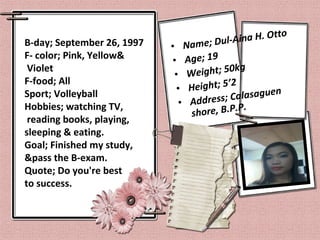
B-day; September 26, 1997
F- color; Pink, Yellow&
Violet
F-food; All
Sport; Volleyball
Hobbies; watching TV,
reading books, playing,
sleeping & eating.
Goal; Finished my study,
&pass the B-exam.
Quote; Do you're best
to success.
• Name; Dul-Aina H. Otto
• Age; 19
• Weight; 50kg
• Height; 5’2
• Address; Calasaguen
shore, B.P.P.
Name: Nely Joy T. Sunico
Age: 27 years old
Father: Kisme o B. Sunicoῆ
Mother: Thelma S. Sunico
Address: Pangobilian, Brooke’s
Point, Palawan
Hobbies: Cooking and Reading
Goal: To be successful in the field of
Education.
F- color: Blue and White
F-food: Pasta and Ice Cream
Height: 5’1’’
Weight: 55 kilo
B-day: April 27, 1988
Sports: Badminton
EDUCATIONAL
TECHNOLOGY- II
WHAT IS EDUCATIONAL
TECHNOLOGY?
•Educational technology as practice refers
to any form of teaching and learning that makes
use of technology. Nevertheless, there are a few
features on which most researchers and
practitioners might agree:
•Use of technology is principled:
Technology means the systematic application of
scientific knowledge to practical tasks. Therefore,
educational technology is based on theoretical
knowledge drawn from different disciplines
(communication, education, psychology, sociology,
philosophy, artificial intelligence, computer
science, etc.) plus experiential knowledge drawn
from educational practice.
•Educational technology aims to
improve education. Technology should facilitate
learning processes and increase performance of
the educational system(s) as it regards to
effectiveness and/or efficiency.
TECHNOLOGY;
BOON OR BANE
EDUCATION
AL
TECHNOLOG
Y IS BANE
WHEN;
●The learners is made to accept as Gospel truth
information they get from the internet.
The learners surfs the internet for pornography.●
The learners has a uncritical mind on images floating●
on televisions and computers that represent modernity and
progress.
When not used properly, technology becomes a●
detriment to learning and development.
IN EDUCATION,
TECHNOLOGY IS BOON
WHEN;
● Technology is a blessing for man, with technology
there is a lot that we can do which we could not do then.
Contributes much to the improvement of the●
teaching-learning process and to the humanization of life.
With TV, you can watch events as they happen all over●
the globe.
Many human lives saved, because of speedy●
notifications via cell phones.
SYSTEMATIC
APPROUCH TO
TEACHING.
WHAT IS SYSTEMATIC?
Methodical-● procedure or plan.
Organize-● relating to or consisting of a
system.
Logical-● formulated as a coherent body
of ideas or principle.
Efficient-● effective in class that is
marked by thoroughness and regularity.
SYSTEMATIC APPROUCH
TO TEACHING
●It is a network of elements or parts different
from each other but each one is special in the sense
that each performs a unique function for the life and
effectiveness of the instructional system.
The focus of systematic instructional planning●
is the student.
SYSTEMATIZED
INSTRUCTION
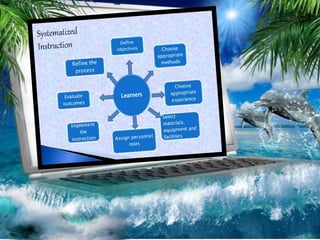
●Instruction begins with the
definition of instructional objectives
that consider the students needs,
interest, and readiness.
DEFIN
E
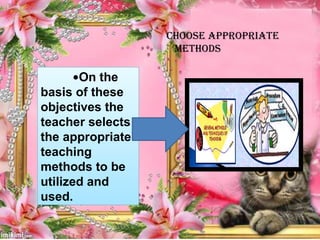
CHOOSE APPROPRIATE
METHODS
•On the
basis of these
objectives the
teacher selects
the appropriate
teaching
methods to be
utilized and
used.
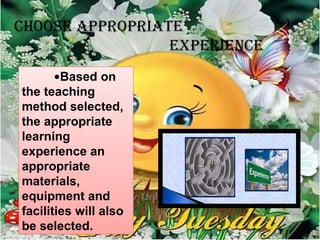
CHOOSE APPROPRIATE
EXPERIENCE
•Based on
the teaching
method selected,
the appropriate
learning
experience an
appropriate
materials,
equipment and
facilities will also
be selected.
SELECT
MATERIALS,
EQUIPMENT,
AND FACILITIES
•The use of
learning materials,
equipment and
facilities necessitates
assigning the
personnel to assist
the teacher.
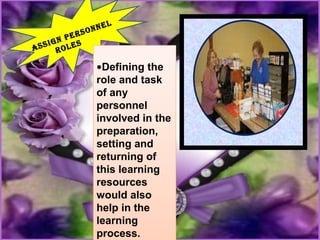
ASSIGN PERSONNEL
ROLES
•Defining the
role and task
of any
personnel
involved in the
preparation,
setting and
returning of
this learning
resources
would also
help in the
learning
process.
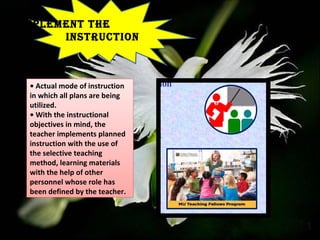
IMPLEMENT THE
INSTRUCTION
• Actual mode of instruction
in which all plans are being
utilized.
• With the instructional
objectives in mind, the
teacher implements planned
instruction with the use of
the selective teaching
method, learning materials
with the help of other
personnel whose role has
been defined by the teacher.
EVALUATE OUTCOMES•With the instructional
objectives in mind , the
teacher implements
planned instructions
with the use of the
selective teaching
method, learning
activities, and learning
materials with the help
of other personnel
whose defined by the
teacher.
• Examining if the
instructional objectives
was attained or not.
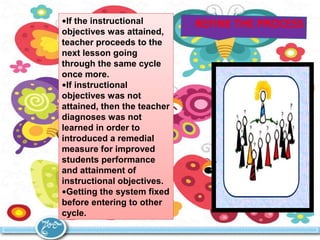
REFINE THE PROCESS•If the instructional
objectives was attained,
teacher proceeds to the
next lesson going
through the same cycle
once more.
•If instructional
objectives was not
attained, then the teacher
diagnoses was not
learned in order to
introduced a remedial
measure for improved
students performance
and attainment of
instructional objectives.
•Getting the system fixed
before entering to other
cycle.
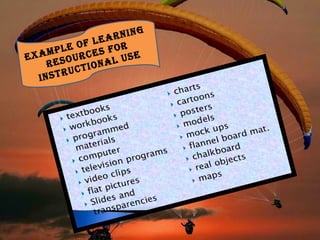
Some examples of learning
resources for instructional use
are :
EXAMPLE OF LEARNING
RESOURCES FOR
INSTRUCTIONAL USE
Examples of learning
activities that the teacher can
choose from, depending on
his/her instructional objectives,
nature of the lesson content,
readiness of the student are :
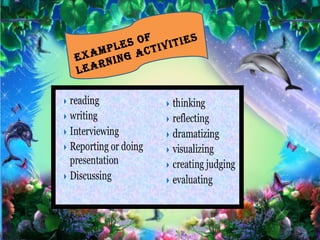
EXAMPLES OF
LEARNING ACTIVITIES
After instructions, teacher
evaluates the outcome of instruction.
From the evaluation results, teacher
comes to know if the instructional
objective was attained. If the
instructional objective was attained,
teacher proceeds to the next lesson
going through the same cycle once
more. If instructional objectives was
not attained ,
THE ROLES
OF
EDUCATIONA
L
TECHNOLOGY
IN LEARNING
•Teachers can even specify the
learning intentions, select the topic, identify
the stimulus situation, determine media,
manage teaching and finally conduct
evaluation and modify the instructions in
the light of evaluation results.
•Educational process can’t proceed
systematically without the help of
educational technology. Every aspect of
educational system is fully enlightened with
educational technology.
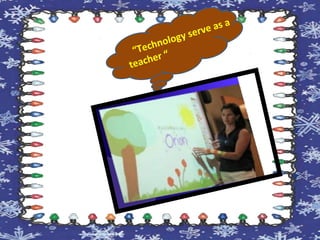
“Technology serve as a
teacher “
Technology makes the world a new
place”
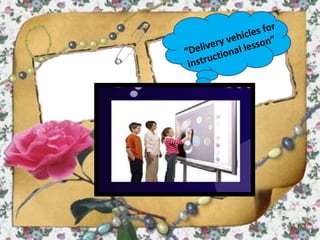
“Delivery vehicles for
instructional lesson”
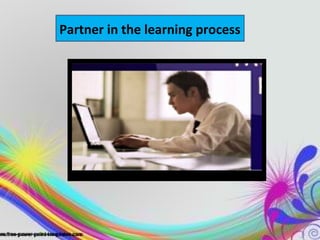
Partner in the learning process
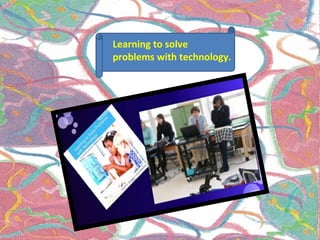
Learning to solve
problems with technology.
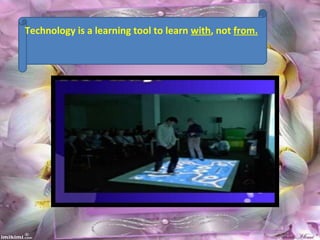
Technology is a learning tool to learn with, not from.
*Technology as intellectual partner
(Jonassen 1996) to support learning-by-
reflecting:
•For helping others to
articulate and represent what they
know.
•For reflecting on what they
have learned and how they came to
know it.
•For supporting learners
internal negotiations and meaning
making.
•For constructing personal
representation of meaning for
supporting mindful thinking.
*Technology as information
vehicles for exploring
knowledge to support
learning-by-constructing:
•For accessing
needed information.
•For comparing
perspectives beliefs and
world views.
*Technology as a social medium to
support learning by conversing:
•For collaboration with others.
•For discussing, arguing, and
building consensus among members of
community.
•For supporting discourse
among knowledge-building
communities.
*Technology as context
to support learning-by-
doing:
•For representing and
stimulating meaningful
real-world problems,
situations and context
•For representing beliefs,
perspectives, arguments
and stories of others
•For defining a safe,
controllable problem
space for student thinking
*Technology as tools to
support knowledge
construction:
•For representing
learner’s ideas,
understanding and beliefs
•For producing organized,
multimedia knowledge
bases by learner’s
*Technology as information
vehicles for exploring
knowledge to support
learning-by-constructing:
•For assessing needed
information
•For comparing perspective,
beliefs and world views
Roles of technology in
education
•Methods used within the classroom
not only need to keep evolving, but also
harness the effects of the digital revolution
in a positive and constructive manner.
Creating a curriculum that appreciates the
power of technology in the learning process
can serve to increase engagement in the
classroom and make learning easier and
more efficient.
•A common misperception surrounding the
impact of technology on learning is that the
Internet, with all its factual data, has served to
render our long-term memory as useless. Why
commit to learning something if a simple press of a
button will give you the answers you are looking
for? Proponents of this argument therefore believe
that the need to remember facts is no longer
essential to our education. However, these
arguments often ignore the dynamic between long-
term memory and working memory.
•A person’s long-term memory has much
more capacity than their working memory that can
only remember between 4-7 items before it
becomes overloaded. Therefore, working memory
space is premium, in order for it to be free on a
regular basis we have to commit certain facts to
our long-term memory. This is perhaps why
researchers label long-term memory as ‘the seat of
human intellectual skill.’
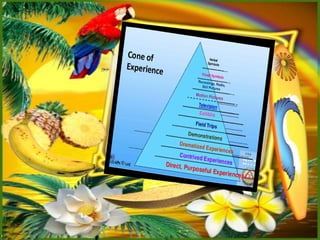
CONE OF
EXPERIENCE
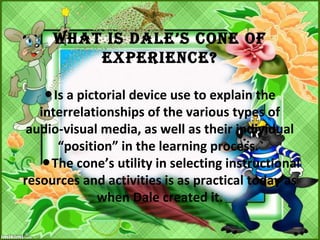
What Is DalE’s CONE OF
EXPERIENCE?
Is a pictorial device use to explain the●
interrelationships of the various types of
audio-visual media, as well as their individual
“position” in the learning process.
The cone’s utility in selecting instructional●
resources and activities is as practical today as
when Dale created it.
PRINCIPlEs OF thE
CONE EXPERIENCE
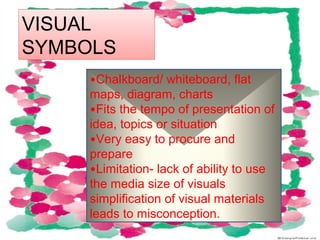
•Chalkboard/ whiteboard, flat
maps, diagram, charts
•Fits the tempo of presentation of
idea, topics or situation
•Very easy to procure and
prepare
•Limitation- lack of ability to use
the media size of visuals
simplification of visual materials
leads to misconception.
VISUAL
SYMBOLS
VERBAL
SYMBOLS
•Principal medium of
communication
•Bear no physical
resemblance to the objects
or ideas for which they stand
•May be a word of
concretion, ideas, scientific
principle, formula or
philosophic aphorism.
•Disadvantage: highly
abstract.
RECORDINGS, RADIO, STILL
PICTURES
•Attention- getting,
particularly projected views
•Concretize verbal
abstraction
•Limitation: Size of pictures
or illustrations expensiveness
of projected materials and
equipment timing difficulties
between radio shows and
classroom lessons.
CONTRIVED
EXPERIENCE
• An “editing” of reality
•Substitutes for confusing or unmanageable
first-hand experience
•Easier to handle, manipulate or operate
•Disadvantage: Simplification leads to
misconceptions, distorted views, and
incomplete pictures of reality no freedom to
handle expensive or fragile models, mock-
up, specimens, etc.
•Help get closer to certain
reliabilities are no longer available
at first hand.
•Stirring and attention getting
•Participants learns to understand
intimately the character he portrays
•Teaches cooperative work
•Disadvantage- time consuming
with out commensurate results
participation is limited to few
individuals.
DRaMatIZED
EXPERIENCE
DIRECT, PURPOSEFUL
EXPERIENCE
•Unabridged version of life itself
•Direct participation with
responsibility for the outcomes
•The basis for the most effective
and lasting learning
•Disadvantage: not all things can
be learned through direct, first
hand experience.
EXHIBIT
S
Present objectives or
processes otherwise
impossible inside the
classroom.
Exposure to new ideas,
discoveries, inventions
Problems that may be
encountered:
too little space
time-consuming
maintenance
TELEVISION AND MOTION
PICTURES
•A solution to time and space
constraints
•Provides “windows to the world”
•Effective for presenting movements,
continuity of ideas or events
•Substitute for dangerous direct
learning experiences
•Limitation:
Expensive
Viewing problems
Timing with classroom lessons
Misconception about time,
size, and ideas.
DEMONSTRATI
ON
•Visualized
explanation of an
important fact or
ideas or process.
•May require nothing
more than
observation or
students may be asked
to do what has been
show how to do.
•Disadvantage: Ideas
or processes might not
be interpreted or
conceived very well
visibility to all
learners.
FIELD TRIPS
•Undertaken primarily for the
purpose of experiencing
something that cannot be
encountered within the
classroom.
•A rich experience in learning about
objects, system, and situations.
CONCEPTUAL MODEL
OF LEARNING
●There exist a number of models
and theories about learning that is ideal
in achieving instructional goals though
preferred application of Educational
Technology.
These are;
Meaningful learning
●
Discovery learning
●
Generating learning
●
Constructivism
●
MEANINGFUL LEARNING
●If the traditional learning
environment gives stress to rote
learning and simple memorization,
meaningful learning gives focus to
new experience that departs from
learning of sequence of words but
gives attention to meaning.
DISCOVERY
LEARNING
●This is differentiated from
reception in which ideas are presented
to students in a well-organize way, such
as through detailed set of instructions
to complete an experiment.
●Students perform task to
uncover what is to be learned. New
ideas and new decision are generated
in learning process, regardless of the
need to move on and depart from the
structured lesson previously set.
GENERATING LEARNING
●This is viewed as different from thesimple process of storing information.
Motivation and responsibility are crucial to thisdomain of learning. This gives emphasis towhat can be done with the pieces of
information not only on access to them.
CONSTRUCTIVISM
●The learners builds a personal
understanding through appropriate
learning activities and a good learning
environment . The most accepted
constructivism principles are.
●Learning consist in what a person
can actively assemble for himself and
not what he can just ask from someone
else.
●Role of learning is to help the
individual live to his personal world.
LEARNING
THROUGH
ED-TECH-II
THE COURSE ObjECTIVES ARE:
•To provide education in the use of
technology in instruction;
•To impart learning experiences in
instructional technology supported instructional
planning;
•To acquaint students on information
technology;
•To learn to use and evaluate computer-
based educational resources;
•To engage learners on practical
technology; and
•To inculcate higher-level thinking and
creativity among students.
“Integrating Technology into Teaching
and Learning”
•Which is putting together technology into
teaching and learning so that these will become
one in learner’s education. To specify- focused on
introducing, reinforcing, supplementing, and
extending the knowledge and skills to learners so
that they can become exemplary users of
educational technology.
FOUR TYPES
OF IT-bASED
PROjECT
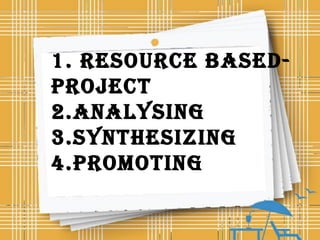
1. RESOURCE bASED-
PROjECT
2.ANALYSING
3.SYNTHESIzING
4.PROMOTING
RESOURCE bASED-PROjECT
• In these projects, the teacher steps
out of the traditional role of being a
content expert and information provider,
and instead lets the students find their
own facts and information. Only when
necessary for the active learning process
does the teacher step in to supply data or
information.
ANALYzING
•Distinguishing similarities
and differences/ seeing the
project as a problem to be solved.
•Making spontaneous connections among ideas, thus
generating interesting or new ideas.
SYNTHESIzING
PROMOTING
•Selling of new ideas to allow
the public to test the ideas
themselves.
REFLECTION
IN
EDUCATIONAL
TECHNOLOGY-II
REFLECTION
bY:
OTTO, DUL-AINA H.
●Is concerned with integrating technology into teaching
and learning. Specially this is focused on introducing,
reinforcing, supplementing, and extending the knowledge and
skills to learners so that they can become exemplary users of
educational technology.
Educational Technology II will involve a deeper●
understanding of the computer a well as hands-on application
of computer skills.
In this lesson we are being aware the importance of●
the technology like computer in our learning and teaching,
because as a future educators we need this to make our
classroom meaningful every day.
REFLECTION
bY;
SUNICO, NELLY jOY
●Educational Technology is
indeed very helpful to us. But it
should not be abused nor be used
in a wrong
way, because I believe that these
technologies are not invented to
destroy nor to degrade all
humanity rather these are being
invented to help us in all aspect of
our lives.
END!

Slideshare - otto&sunico

  • 1.
  • 2.
    B-day; September 26,1997 F- color; Pink, Yellow& Violet F-food; All Sport; Volleyball Hobbies; watching TV, reading books, playing, sleeping & eating. Goal; Finished my study, &pass the B-exam. Quote; Do you're best to success. • Name; Dul-Aina H. Otto • Age; 19 • Weight; 50kg • Height; 5’2 • Address; Calasaguen shore, B.P.P.
  • 3.
    Name: Nely JoyT. Sunico Age: 27 years old Father: Kisme o B. Sunicoῆ Mother: Thelma S. Sunico Address: Pangobilian, Brooke’s Point, Palawan Hobbies: Cooking and Reading Goal: To be successful in the field of Education. F- color: Blue and White F-food: Pasta and Ice Cream Height: 5’1’’ Weight: 55 kilo B-day: April 27, 1988 Sports: Badminton
  • 4.
  • 5.
  • 6.
    •Educational technology aspractice refers to any form of teaching and learning that makes use of technology. Nevertheless, there are a few features on which most researchers and practitioners might agree:
  • 7.
    •Use of technologyis principled: Technology means the systematic application of scientific knowledge to practical tasks. Therefore, educational technology is based on theoretical knowledge drawn from different disciplines (communication, education, psychology, sociology, philosophy, artificial intelligence, computer science, etc.) plus experiential knowledge drawn from educational practice. •Educational technology aims to improve education. Technology should facilitate learning processes and increase performance of the educational system(s) as it regards to effectiveness and/or efficiency.
  • 8.
  • 9.
  • 10.
    ●The learners ismade to accept as Gospel truth information they get from the internet. The learners surfs the internet for pornography.● The learners has a uncritical mind on images floating● on televisions and computers that represent modernity and progress. When not used properly, technology becomes a● detriment to learning and development.
  • 11.
  • 12.
    ● Technology isa blessing for man, with technology there is a lot that we can do which we could not do then. Contributes much to the improvement of the● teaching-learning process and to the humanization of life. With TV, you can watch events as they happen all over● the globe. Many human lives saved, because of speedy● notifications via cell phones.
  • 13.
  • 14.
    WHAT IS SYSTEMATIC? Methodical-●procedure or plan. Organize-● relating to or consisting of a system. Logical-● formulated as a coherent body of ideas or principle. Efficient-● effective in class that is marked by thoroughness and regularity.
  • 15.
  • 16.
    ●It is anetwork of elements or parts different from each other but each one is special in the sense that each performs a unique function for the life and effectiveness of the instructional system. The focus of systematic instructional planning● is the student.
  • 17.
  • 19.
    ●Instruction begins withthe definition of instructional objectives that consider the students needs, interest, and readiness. DEFIN E
  • 20.
    CHOOSE APPROPRIATE METHODS •On the basisof these objectives the teacher selects the appropriate teaching methods to be utilized and used.
  • 21.
    CHOOSE APPROPRIATE EXPERIENCE •Based on theteaching method selected, the appropriate learning experience an appropriate materials, equipment and facilities will also be selected.
  • 22.
    SELECT MATERIALS, EQUIPMENT, AND FACILITIES •The useof learning materials, equipment and facilities necessitates assigning the personnel to assist the teacher.
  • 23.
    ASSIGN PERSONNEL ROLES •Defining the roleand task of any personnel involved in the preparation, setting and returning of this learning resources would also help in the learning process.
  • 24.
    IMPLEMENT THE INSTRUCTION • Actualmode of instruction in which all plans are being utilized. • With the instructional objectives in mind, the teacher implements planned instruction with the use of the selective teaching method, learning materials with the help of other personnel whose role has been defined by the teacher.
  • 25.
    EVALUATE OUTCOMES•With theinstructional objectives in mind , the teacher implements planned instructions with the use of the selective teaching method, learning activities, and learning materials with the help of other personnel whose defined by the teacher. • Examining if the instructional objectives was attained or not.
  • 26.
    REFINE THE PROCESS•Ifthe instructional objectives was attained, teacher proceeds to the next lesson going through the same cycle once more. •If instructional objectives was not attained, then the teacher diagnoses was not learned in order to introduced a remedial measure for improved students performance and attainment of instructional objectives. •Getting the system fixed before entering to other cycle.
  • 27.
    Some examples oflearning resources for instructional use are :
  • 28.
    EXAMPLE OF LEARNING RESOURCESFOR INSTRUCTIONAL USE
  • 29.
    Examples of learning activitiesthat the teacher can choose from, depending on his/her instructional objectives, nature of the lesson content, readiness of the student are :
  • 30.
  • 31.
    After instructions, teacher evaluatesthe outcome of instruction. From the evaluation results, teacher comes to know if the instructional objective was attained. If the instructional objective was attained, teacher proceeds to the next lesson going through the same cycle once more. If instructional objectives was not attained ,
  • 32.
  • 33.
    •Teachers can evenspecify the learning intentions, select the topic, identify the stimulus situation, determine media, manage teaching and finally conduct evaluation and modify the instructions in the light of evaluation results. •Educational process can’t proceed systematically without the help of educational technology. Every aspect of educational system is fully enlightened with educational technology.
  • 34.
  • 35.
    Technology makes theworld a new place”
  • 36.
  • 37.
    Partner in thelearning process
  • 38.
  • 39.
    Technology is alearning tool to learn with, not from.
  • 40.
    *Technology as intellectualpartner (Jonassen 1996) to support learning-by- reflecting: •For helping others to articulate and represent what they know. •For reflecting on what they have learned and how they came to know it. •For supporting learners internal negotiations and meaning making. •For constructing personal representation of meaning for supporting mindful thinking.
  • 41.
    *Technology as information vehiclesfor exploring knowledge to support learning-by-constructing: •For accessing needed information. •For comparing perspectives beliefs and world views.
  • 42.
    *Technology as asocial medium to support learning by conversing: •For collaboration with others. •For discussing, arguing, and building consensus among members of community. •For supporting discourse among knowledge-building communities.
  • 43.
    *Technology as context tosupport learning-by- doing: •For representing and stimulating meaningful real-world problems, situations and context •For representing beliefs, perspectives, arguments and stories of others •For defining a safe, controllable problem space for student thinking
  • 44.
    *Technology as toolsto support knowledge construction: •For representing learner’s ideas, understanding and beliefs •For producing organized, multimedia knowledge bases by learner’s
  • 45.
    *Technology as information vehiclesfor exploring knowledge to support learning-by-constructing: •For assessing needed information •For comparing perspective, beliefs and world views
  • 46.
    Roles of technologyin education
  • 47.
    •Methods used withinthe classroom not only need to keep evolving, but also harness the effects of the digital revolution in a positive and constructive manner. Creating a curriculum that appreciates the power of technology in the learning process can serve to increase engagement in the classroom and make learning easier and more efficient.
  • 48.
    •A common misperceptionsurrounding the impact of technology on learning is that the Internet, with all its factual data, has served to render our long-term memory as useless. Why commit to learning something if a simple press of a button will give you the answers you are looking for? Proponents of this argument therefore believe that the need to remember facts is no longer essential to our education. However, these arguments often ignore the dynamic between long- term memory and working memory.
  • 49.
    •A person’s long-termmemory has much more capacity than their working memory that can only remember between 4-7 items before it becomes overloaded. Therefore, working memory space is premium, in order for it to be free on a regular basis we have to commit certain facts to our long-term memory. This is perhaps why researchers label long-term memory as ‘the seat of human intellectual skill.’
  • 50.
  • 51.
    What Is DalE’sCONE OF EXPERIENCE? Is a pictorial device use to explain the● interrelationships of the various types of audio-visual media, as well as their individual “position” in the learning process. The cone’s utility in selecting instructional● resources and activities is as practical today as when Dale created it.
  • 53.
  • 54.
    •Chalkboard/ whiteboard, flat maps,diagram, charts •Fits the tempo of presentation of idea, topics or situation •Very easy to procure and prepare •Limitation- lack of ability to use the media size of visuals simplification of visual materials leads to misconception. VISUAL SYMBOLS
  • 55.
    VERBAL SYMBOLS •Principal medium of communication •Bearno physical resemblance to the objects or ideas for which they stand •May be a word of concretion, ideas, scientific principle, formula or philosophic aphorism. •Disadvantage: highly abstract.
  • 56.
    RECORDINGS, RADIO, STILL PICTURES •Attention-getting, particularly projected views •Concretize verbal abstraction •Limitation: Size of pictures or illustrations expensiveness of projected materials and equipment timing difficulties between radio shows and classroom lessons.
  • 57.
    CONTRIVED EXPERIENCE • An “editing”of reality •Substitutes for confusing or unmanageable first-hand experience •Easier to handle, manipulate or operate •Disadvantage: Simplification leads to misconceptions, distorted views, and incomplete pictures of reality no freedom to handle expensive or fragile models, mock- up, specimens, etc.
  • 58.
    •Help get closerto certain reliabilities are no longer available at first hand. •Stirring and attention getting •Participants learns to understand intimately the character he portrays •Teaches cooperative work •Disadvantage- time consuming with out commensurate results participation is limited to few individuals. DRaMatIZED EXPERIENCE
  • 59.
    DIRECT, PURPOSEFUL EXPERIENCE •Unabridged versionof life itself •Direct participation with responsibility for the outcomes •The basis for the most effective and lasting learning •Disadvantage: not all things can be learned through direct, first hand experience.
  • 60.
    EXHIBIT S Present objectives or processesotherwise impossible inside the classroom. Exposure to new ideas, discoveries, inventions Problems that may be encountered: too little space time-consuming maintenance
  • 61.
    TELEVISION AND MOTION PICTURES •Asolution to time and space constraints •Provides “windows to the world” •Effective for presenting movements, continuity of ideas or events •Substitute for dangerous direct learning experiences •Limitation: Expensive Viewing problems Timing with classroom lessons Misconception about time, size, and ideas.
  • 62.
    DEMONSTRATI ON •Visualized explanation of an importantfact or ideas or process. •May require nothing more than observation or students may be asked to do what has been show how to do. •Disadvantage: Ideas or processes might not be interpreted or conceived very well visibility to all learners.
  • 63.
    FIELD TRIPS •Undertaken primarilyfor the purpose of experiencing something that cannot be encountered within the classroom. •A rich experience in learning about objects, system, and situations.
  • 64.
  • 65.
    ●There exist anumber of models and theories about learning that is ideal in achieving instructional goals though preferred application of Educational Technology. These are; Meaningful learning ● Discovery learning ● Generating learning ● Constructivism ●
  • 66.
    MEANINGFUL LEARNING ●If thetraditional learning environment gives stress to rote learning and simple memorization, meaningful learning gives focus to new experience that departs from learning of sequence of words but gives attention to meaning.
  • 67.
    DISCOVERY LEARNING ●This is differentiatedfrom reception in which ideas are presented to students in a well-organize way, such as through detailed set of instructions to complete an experiment. ●Students perform task to uncover what is to be learned. New ideas and new decision are generated in learning process, regardless of the need to move on and depart from the structured lesson previously set.
  • 68.
    GENERATING LEARNING ●This isviewed as different from thesimple process of storing information. Motivation and responsibility are crucial to thisdomain of learning. This gives emphasis towhat can be done with the pieces of information not only on access to them.
  • 69.
    CONSTRUCTIVISM ●The learners buildsa personal understanding through appropriate learning activities and a good learning environment . The most accepted constructivism principles are. ●Learning consist in what a person can actively assemble for himself and not what he can just ask from someone else. ●Role of learning is to help the individual live to his personal world.
  • 70.
  • 71.
    THE COURSE ObjECTIVESARE: •To provide education in the use of technology in instruction; •To impart learning experiences in instructional technology supported instructional planning; •To acquaint students on information technology; •To learn to use and evaluate computer- based educational resources; •To engage learners on practical technology; and •To inculcate higher-level thinking and creativity among students.
  • 72.
    “Integrating Technology intoTeaching and Learning” •Which is putting together technology into teaching and learning so that these will become one in learner’s education. To specify- focused on introducing, reinforcing, supplementing, and extending the knowledge and skills to learners so that they can become exemplary users of educational technology.
  • 73.
  • 74.
  • 75.
    RESOURCE bASED-PROjECT • Inthese projects, the teacher steps out of the traditional role of being a content expert and information provider, and instead lets the students find their own facts and information. Only when necessary for the active learning process does the teacher step in to supply data or information.
  • 76.
    ANALYzING •Distinguishing similarities and differences/seeing the project as a problem to be solved.
  • 77.
    •Making spontaneous connectionsamong ideas, thus generating interesting or new ideas. SYNTHESIzING
  • 78.
    PROMOTING •Selling of newideas to allow the public to test the ideas themselves.
  • 79.
  • 80.
  • 81.
    ●Is concerned withintegrating technology into teaching and learning. Specially this is focused on introducing, reinforcing, supplementing, and extending the knowledge and skills to learners so that they can become exemplary users of educational technology. Educational Technology II will involve a deeper● understanding of the computer a well as hands-on application of computer skills. In this lesson we are being aware the importance of● the technology like computer in our learning and teaching, because as a future educators we need this to make our classroom meaningful every day.
  • 82.
  • 83.
    ●Educational Technology is indeedvery helpful to us. But it should not be abused nor be used in a wrong way, because I believe that these technologies are not invented to destroy nor to degrade all humanity rather these are being invented to help us in all aspect of our lives.
  • 84.