The Student
What is Educational Technology?
Is technology a Boon or Bane?
The roles of Educational Technology in
Learning
Roles of Technology in Learning
Systematic Approach to Teaching
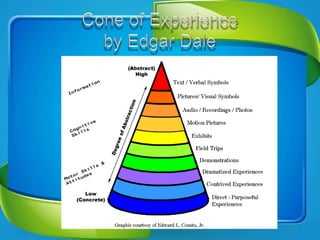
Cone of Experience
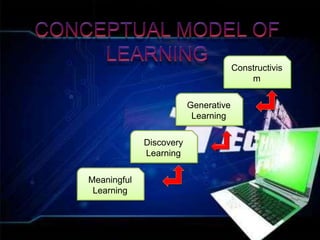
Conceptual Model of Learning
I am Shiela P.
Patriarca. I was born
on January 02, 1990.
26 years of age. I'm a
third year student
taking up Bachelor of
Elementary
Education at Cebu
Technological
University- Moalboal
Campus.
EDUCATIONAL
TECHNOLOGY
Is a complex, integrated process
involving people, procedures, ideas,
devices and organization for analyzing
problems and devising, implementing,
evaluating and managing solutions to
those problems involved in all aspects of
human learning.
Is a field study which is
concerned with the practice of
using educational methods and
resources for the ultimate goal of
the facilitating learning process.
Consists of the designs and
environment that engage learners
and reliable techniques or method
for engaging learning: cognitive
learning and critical thinking skills.
Is a field involved in applying a complex,
integrated process to analyze and solve
problems in human learning.
Is a profession like teaching. It is
made up of organized effort to
implement the theory, intellectual
technique and practical application
of educational technology.
Is a theory about how problems in
human learning are identified and
solved.
For presenting learner’s ideas,
understanding and beliefs.
For producing organized, multimedia
knowledge bases by learners.
For accessing needed information.
For comparing perspectives, beliefs and
world views
For representing and simulating
meaningful real-world problems, situations
and contexts.
For representing beliefs, perspectives,
arguments and stories of others.
For defining a safe, controllable problem
space for student thinking.
For collaborating with others.
For discussing, arguing and building
consensus among members of a
community.
For supporting discourse among
knowledge-building communities.
For helping what learners to articulate and
represent what they know.
For reflecting on what they have learned
and how they came to know it.
For supporting learners internal
negotiations and meaning making.
For constructing personal representations
of meaning.
For supporting mindful thinking.
Traditional Way
i.e. as a delivery vehicles for
instructional lessons.
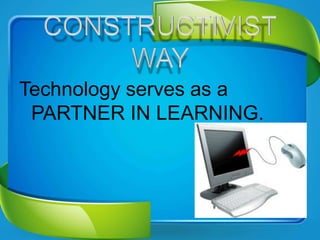
Constructivist Way
i.e. as partner in the learning process
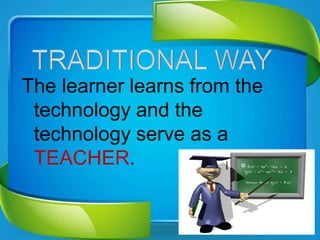
The learner learns from the
technology and the
technology serve as a
TEACHER.
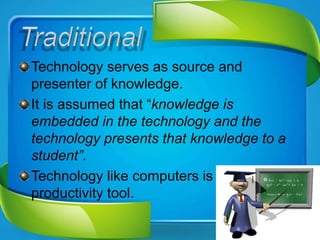
Technology serves as source and
presenter of knowledge.
It is assumed that “knowledge is
embedded in the technology and the
technology presents that knowledge to a
student”.
Technology like computers is seen as
productivity tool.
Technology serves as a
PARTNER IN LEARNING.
Educational technology serves as
learning tools to learn with.
It engages learners in active,
constructive, intentional, authentic
and cooperative learning.
It provides opportunities for
technology and learner interaction
for meaningful learning.
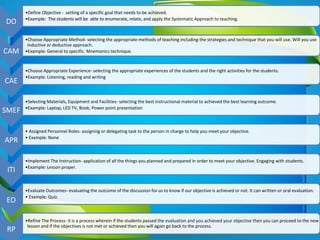
DO
•Define Objective - setting of a specific goal that needs to be achieved.
•Example: The students will be able to enumerate, relate, and apply the Systematic Approach to teaching.
CAM
•Choose Appropriate Method- selecting the appropriate methods of teaching including the strategies and technique that you will use. Will you use
inductive or deductive approach.
•Example: General to specific. Mnemonics technique.
CAE
•Choose Appropriate Experience- selecting the appropriate experiences of the students and the right activities for the students.
•Example: Listening, reading and writing
SMEF
•Selecting Materials, Equipment and Facilities- selecting the best instructional material to achieved the best learning outcome.
•Example: Laptop, LED TV, Book, Power point presentation
APR
• Assigned Personnel Roles- assigning or delegating task to the person in charge to help you meet your objective.
• Example: None
ITI
•Implement The Instruction- application of all the things you planned and prepared in order to meet your objective. Engaging with students.
•Example: Lesson proper.
EO
•Evaluate Outcomes- evaluating the outcome of the discussion for us to know if our objective is achieved or not. It can written or oral evaluation.
• Example: Quiz.
RP
•Refine The Process- it is a process wherein if the students passed the evaluation and you achieved your objective then you can proceed to the new
lesson and if the objectives is not met or achieved then you will again go back to the process.
Constructivis
m
Generative
Learning
Discovery
Learning
Meaningful
Learning
Constructivism
Is a learning theory found in psychology which explains how
people might acquire knowledge and learn.
Here, the learner builds a personal understanding through
appropriate learning activities and a good learning
environment.
The most accepted constructivism principles are:
Learning consists in what a person can actively
assemble for himself and not what he can just ask for
someone else.
Role of learning is to help the individuals to live his
personal world.
Generative Learning
Is a theory that involves the active integration of
new ideas with the learners existing schemata.
Here, we have active listeners who attend to
learning events and generate meaning from his
experience and draw inferences thereby creating a
personal model of explanation to the new
experience in the context of existing knowledge.
This is viewed as different from the simple process
of storing information. Motivation an d responsibility
are crucial to this domain of learning.
Examples are result driven; creativity and resiliency.
Discovery Learning
Is a technique of inquiry-based learning and is
considered a constructivist based approach to
education.
In discovery learning, students perform tasks to
uncover what is to be learned. New ideas and new
decisions are generated in the learning process.
Meaningful Learning
It is learning with a purpose, learning which allows
those who engage in it to attach more meaning to the
world around them, learning in which things make
more sense.
With educational technology one could learn
more about computers- not only merely about
computer itself but with how this thing could be
very useful in our daily lives. It will serve as an
eye opener and mind booster on making thing
work more effectively. Technology could be a
very effective and convenient tool in letting
younger students gain and receive the ideas
and knowledge we want to impart to them since
the younger generations today belong to the
21st century learners. They are more engage
with the modern life as well as the latest
gadgets invented by the experts. We should
help them realize that these valuable things are
not just for fun but could also be a great help in
their learning and development.
E dtech.slideshare final

E dtech.slideshare final

  • 2.
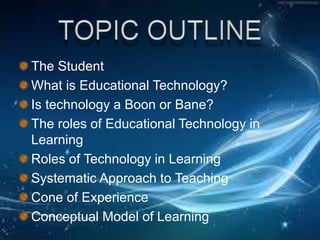
    The Student What isEducational Technology? Is technology a Boon or Bane? The roles of Educational Technology in Learning Roles of Technology in Learning Systematic Approach to Teaching Cone of Experience Conceptual Model of Learning
  • 4.
    I am ShielaP. Patriarca. I was born on January 02, 1990. 26 years of age. I'm a third year student taking up Bachelor of Elementary Education at Cebu Technological University- Moalboal Campus.
  • 6.
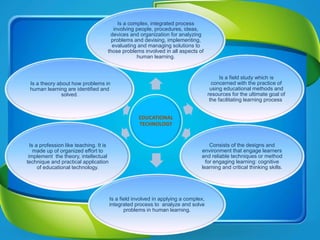
    EDUCATIONAL TECHNOLOGY Is a complex,integrated process involving people, procedures, ideas, devices and organization for analyzing problems and devising, implementing, evaluating and managing solutions to those problems involved in all aspects of human learning. Is a field study which is concerned with the practice of using educational methods and resources for the ultimate goal of the facilitating learning process. Consists of the designs and environment that engage learners and reliable techniques or method for engaging learning: cognitive learning and critical thinking skills. Is a field involved in applying a complex, integrated process to analyze and solve problems in human learning. Is a profession like teaching. It is made up of organized effort to implement the theory, intellectual technique and practical application of educational technology. Is a theory about how problems in human learning are identified and solved.
  • 12.
    For presenting learner’sideas, understanding and beliefs. For producing organized, multimedia knowledge bases by learners.
  • 13.
    For accessing neededinformation. For comparing perspectives, beliefs and world views
  • 14.
    For representing andsimulating meaningful real-world problems, situations and contexts. For representing beliefs, perspectives, arguments and stories of others. For defining a safe, controllable problem space for student thinking.
  • 15.
    For collaborating withothers. For discussing, arguing and building consensus among members of a community. For supporting discourse among knowledge-building communities.
  • 16.
    For helping whatlearners to articulate and represent what they know. For reflecting on what they have learned and how they came to know it. For supporting learners internal negotiations and meaning making. For constructing personal representations of meaning. For supporting mindful thinking.
  • 17.
    Traditional Way i.e. asa delivery vehicles for instructional lessons. Constructivist Way i.e. as partner in the learning process
  • 18.
    The learner learnsfrom the technology and the technology serve as a TEACHER.
  • 19.
    Technology serves assource and presenter of knowledge. It is assumed that “knowledge is embedded in the technology and the technology presents that knowledge to a student”. Technology like computers is seen as productivity tool.
  • 20.
    Technology serves asa PARTNER IN LEARNING.
  • 21.
    Educational technology servesas learning tools to learn with. It engages learners in active, constructive, intentional, authentic and cooperative learning. It provides opportunities for technology and learner interaction for meaningful learning.
  • 23.
    DO •Define Objective -setting of a specific goal that needs to be achieved. •Example: The students will be able to enumerate, relate, and apply the Systematic Approach to teaching. CAM •Choose Appropriate Method- selecting the appropriate methods of teaching including the strategies and technique that you will use. Will you use inductive or deductive approach. •Example: General to specific. Mnemonics technique. CAE •Choose Appropriate Experience- selecting the appropriate experiences of the students and the right activities for the students. •Example: Listening, reading and writing SMEF •Selecting Materials, Equipment and Facilities- selecting the best instructional material to achieved the best learning outcome. •Example: Laptop, LED TV, Book, Power point presentation APR • Assigned Personnel Roles- assigning or delegating task to the person in charge to help you meet your objective. • Example: None ITI •Implement The Instruction- application of all the things you planned and prepared in order to meet your objective. Engaging with students. •Example: Lesson proper. EO •Evaluate Outcomes- evaluating the outcome of the discussion for us to know if our objective is achieved or not. It can written or oral evaluation. • Example: Quiz. RP •Refine The Process- it is a process wherein if the students passed the evaluation and you achieved your objective then you can proceed to the new lesson and if the objectives is not met or achieved then you will again go back to the process.
  • 25.
  • 26.
    Constructivism Is a learningtheory found in psychology which explains how people might acquire knowledge and learn. Here, the learner builds a personal understanding through appropriate learning activities and a good learning environment. The most accepted constructivism principles are: Learning consists in what a person can actively assemble for himself and not what he can just ask for someone else. Role of learning is to help the individuals to live his personal world.
  • 27.
    Generative Learning Is atheory that involves the active integration of new ideas with the learners existing schemata. Here, we have active listeners who attend to learning events and generate meaning from his experience and draw inferences thereby creating a personal model of explanation to the new experience in the context of existing knowledge. This is viewed as different from the simple process of storing information. Motivation an d responsibility are crucial to this domain of learning. Examples are result driven; creativity and resiliency.
  • 28.
    Discovery Learning Is atechnique of inquiry-based learning and is considered a constructivist based approach to education. In discovery learning, students perform tasks to uncover what is to be learned. New ideas and new decisions are generated in the learning process. Meaningful Learning It is learning with a purpose, learning which allows those who engage in it to attach more meaning to the world around them, learning in which things make more sense.
  • 30.
    With educational technologyone could learn more about computers- not only merely about computer itself but with how this thing could be very useful in our daily lives. It will serve as an eye opener and mind booster on making thing work more effectively. Technology could be a very effective and convenient tool in letting younger students gain and receive the ideas and knowledge we want to impart to them since the younger generations today belong to the 21st century learners. They are more engage with the modern life as well as the latest gadgets invented by the experts. We should help them realize that these valuable things are not just for fun but could also be a great help in their learning and development.