1
Running head: IMPACT OF TECHNOLOGY ON CONSTRUCTIVIST LEARNING THEORY
The Impact of Technology on the Constructivist Learning Theory
Kathryn Booth
Boise State University
2
IMPACT OF TECHNOLOGY ON CONSTRUCTIVIST LEARNING THEORY
Abstract
As technology infuses society at exponential rates, educational institutions are challenged
as never before. Constructivist approaches in the classroom have found great success in
integrating emerging technologies and promoting student learning gains. However, as new
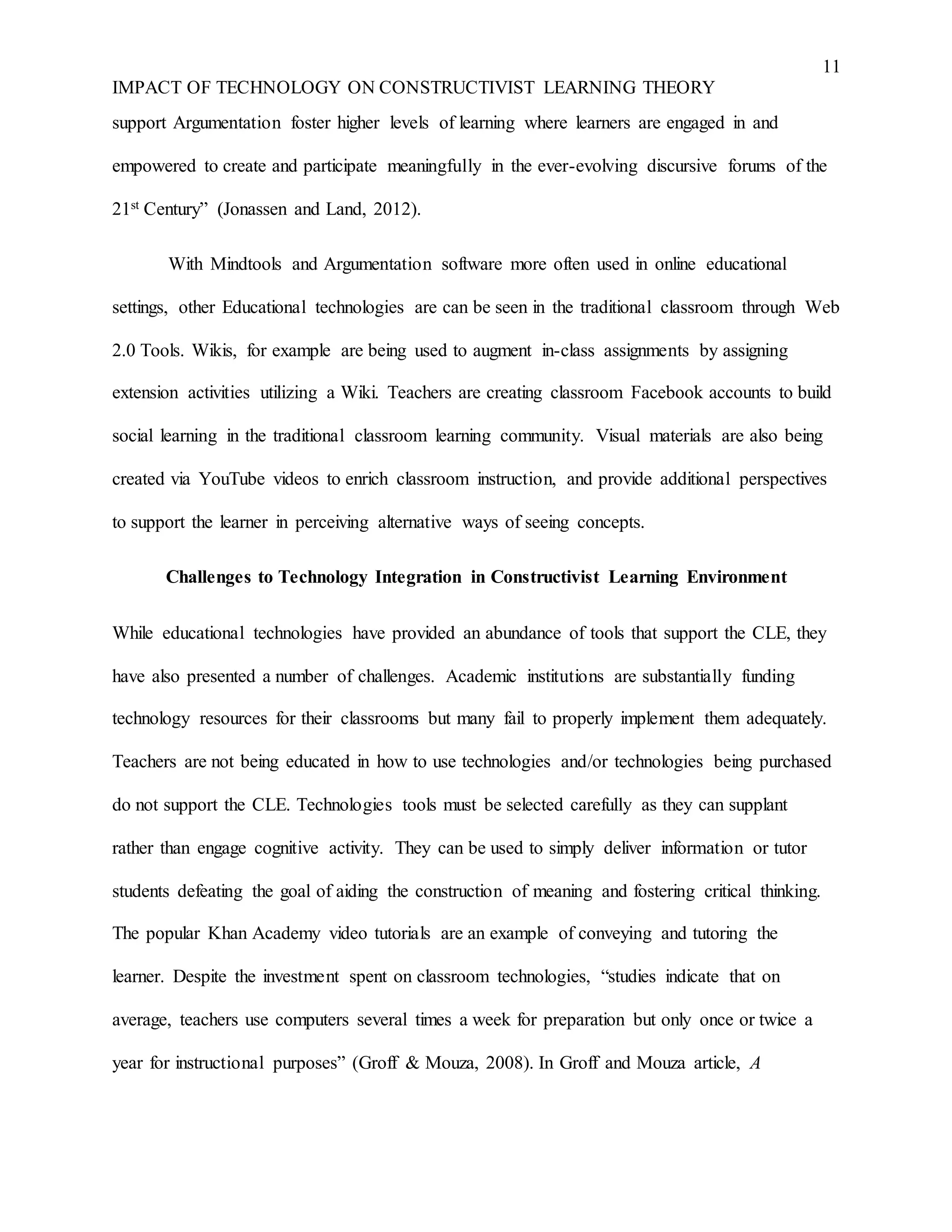
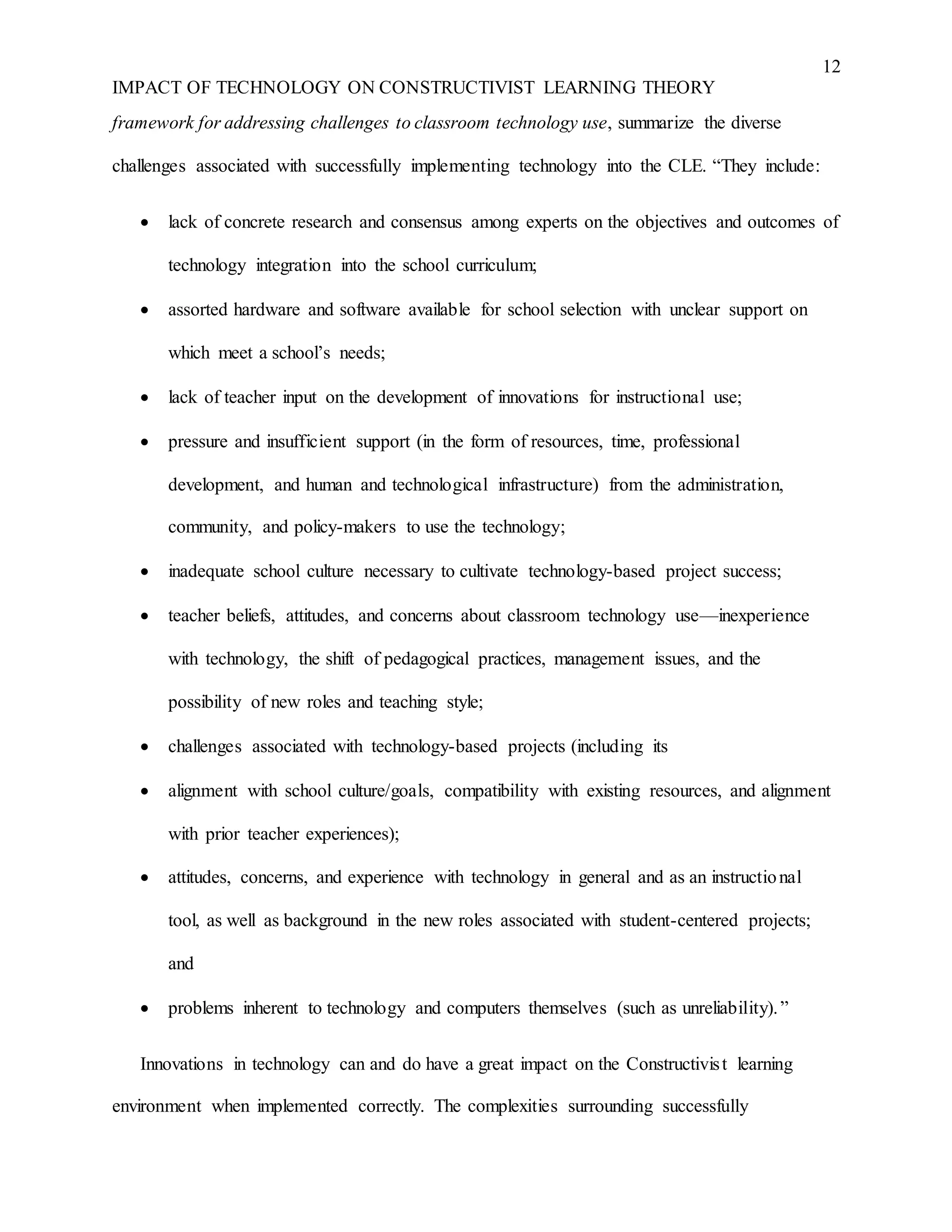
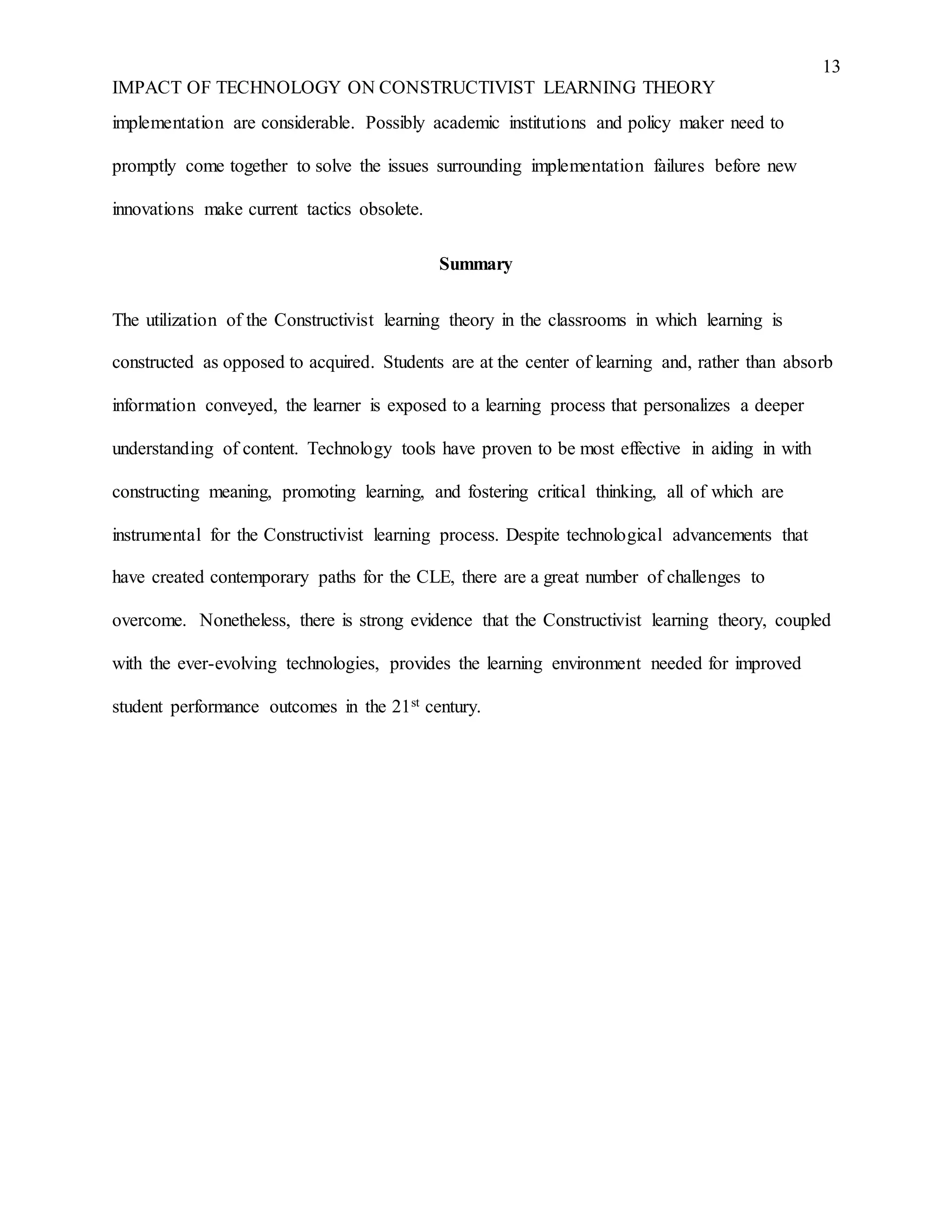
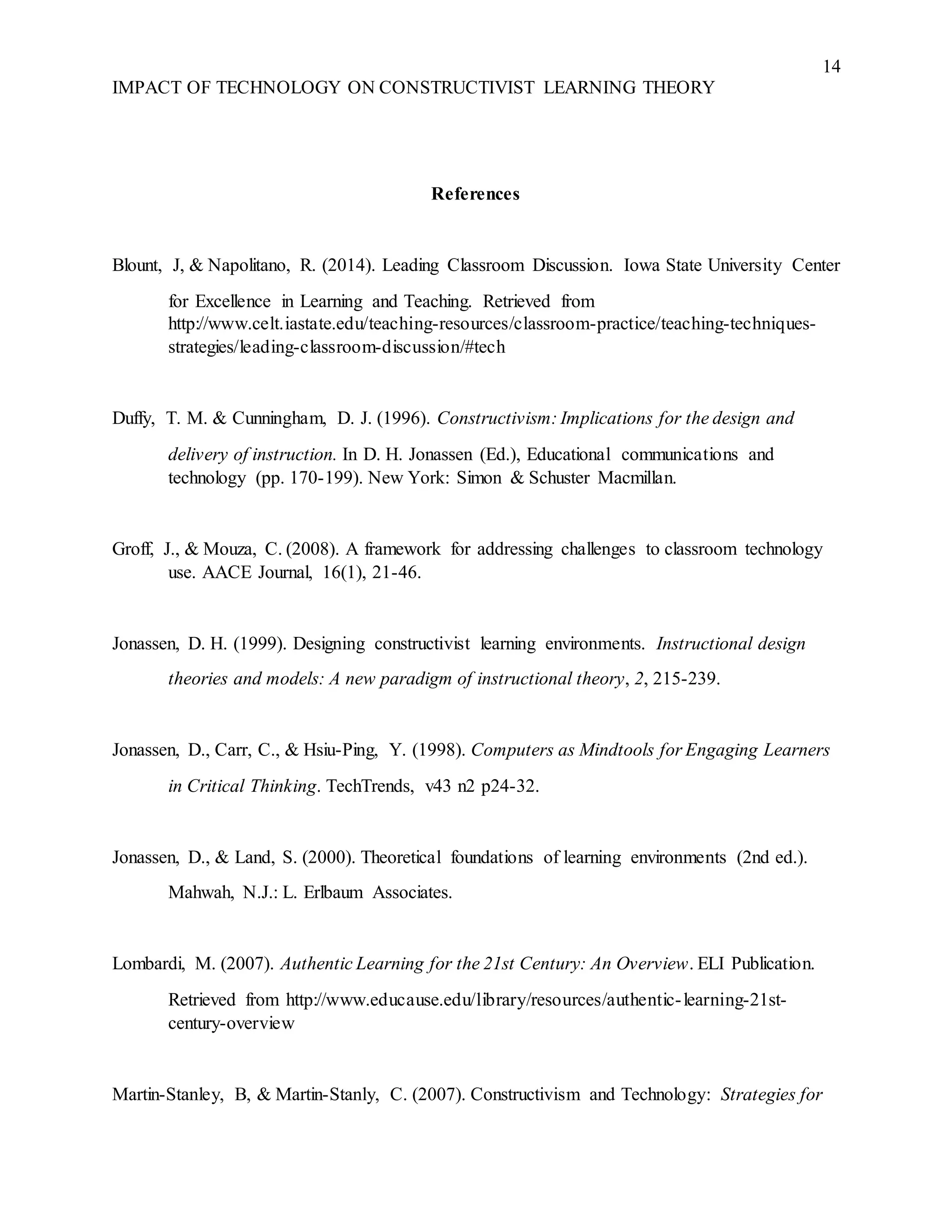
technologies are developed, educators are increasingly challenged with how to integrate them
into instruction. As new technologies drive instruction, educators are finding the student-
centered approach of the constructivist theory makes the integration of technology less
complicated and is easily adapted as new technologies are developed. This research paper
provides a summary of research related to the relationship between constructivist learning theory
and educational technology.
Constructivist Learning Theory
Rooted in the work of Socrates and his questioning techniques, the post-modern
Constructivist learning theory is best associated with major contributors such as Jean Piaget,
John Dewey, Lev Vygotsky, and Jerome Bruner. Constructivism is a theory in which learning is
constructed as opposed to acquired. In a student-centered environment, learners form an
understanding of the world by experiencing, reflecting, and then modifying previous perceptions.
With a focus on the process of learning, constructivism espouses that the evolution of
understanding takes place when a concept is related to past experience then applied in a different
and meaningful context. Constructivists believe the key to learning is in combining knowledge,
practice, and context. The more experiences the learner has in applying knowledge in different
and meaning contexts, the deeper the understanding.
The major principles, or core values, of constructivist learning theory include: “(a) the
centrality of the learner in defining meaning; (b) scaffolded participation in authentic tasks and
3
IMPACT OF TECHNOLOGY ON CONSTRUCTIVIST LEARNING THEORY
sociocultural practices; (c) importance of prior and everyday experiences in meaning
construction; and (d) access to multiple perspectives, resources, and representations” (Jonassen
and Land, 2012).
Constructivist Learning Environment
The constructivist learning environment (CLE) provides a foundation that allows a
learner to be an active participant where they build on what they know about the topic and
develop deeper meaning. Learners are encouraged to test and refine their ideas and to
increasingly build upon prior understanding. Essential components of the CLE include an ill-
defined or ill-structured problem and a question or project as the focus of the environment. The
goal is for the learner(s) to take ownership of the learning and be able to solve the problem or
complete the project.
Ill-structured problems in the CLE:
 have unstated goals and constraints,
 possess multiple solution, solution paths, or no solution at all
 present uncertainty about which concepts, rules, and principles ae necessary for the
solution or show how they are organized,
 offer no general rules, or principles for describing or predicting the outcome of most
cases, and
 require learners to make judgments about the problem and to defend their judgments by
expressing personal opinions or beliefs (Jonassen, 1999).
Scaffolding in real-world, meaningful, context is also essential to the constructivist learning
environment. Learners begin with an everyday context in which complexity level of the task or
4
IMPACT OF TECHNOLOGY ON CONSTRUCTIVIST LEARNING THEORY
problem builds as the practice moves forward. Activities are arranged in fashion to compliment
the learners’ developmental progression. The prior, everyday experiences of the learner provides
a foundation for new understanding to build on. Individual beliefs and experiences “influence
what they perceive, organize, and interpret. Understanding continuously and dynamically
evolves, as ideas are generated, expanded, tested, and revised.” (Jonassen & Land, 2012).
Personal experiences are often used as an anchor to new learning thus facilitating transfer. A
major principal of the constructivist learning environment, “access to multiple perspectives,
resources, and representations,” provides the alternate representation of concepts not normally
available to the learner. These perspectives have traditionally been in the form of expert in the
field, field-related personnel, teacher, or peer. Visual ideas is an additional method used to aid
the learner in perceiving alternative ways of seeing concepts. In the constructivist classroom,
learners are genuinely engaged in the learning and exploration process, planning and carrying out
investigation, communicating using various methods, proposing explanations and solutions,
raising questions, observing and critiquing. Some instructional models based on constructivist
learning theory include, inquiry-based design-based, project-based learning, case studies, and
argumentation.
Technology Integration in a Constructivist Learning Environment
With new technologies being developed exponentially, educators scramble to keep pace.
While the latest technologies have challenged the teaching-learning process, the Constructivist
learning approach has adapted well to today’s technologies and environmental influences. It can
be considered that technology assists with in the implementation of Constructivist strategies
rather than the technology driving the strategies; technology and constructivism are
complimentary of each other. “By providing ongoing information and tools for student creativity
5
IMPACT OF TECHNOLOGY ON CONSTRUCTIVIST LEARNING THEORY
and development, [technology] contributes significantly to an increase in student learning
outcomes” (Martin-Stanley, & Martin-Stanley, 2007).
Duffy & Cunningham (1996) have suggested that constructivist methods exploit
educational technologies for the greatest impact on learning outcomes. They state:
Technology is seen as an integral part of the cognitive activity…This view of distributed
cognition significantly impacts how we think of the role of technology in education and
training, the focus is not on the individual in isolation and what he or she knows, but on
the activity in the environment. It is the activity- focused and contextualized- that is
central… The process of construction is directed towards creating a world that makes
sense to us, that is adequate for our everyday functioning (p. 187-188)
Technology can be a powerful instrument for the fundamental principles of
Constructivism. Technology is a catalyst to collaboration, participation in authentic tasks,
learning by doing, offering access to multiple perspectives, resources, and representations. In
line with the Constructivist learning theory framework, individuals build from prior experience
and personalize meaning through new experiences. Informal settings of the Internet and other
technologies provide the individual experience, indirectly at times, to construct their own
meaning. Technology provides a mechanism for learners to acquire, and practice their new
experience/knowledge, mold it into an earlier schema and then fit the new knowledge into their
own understanding of the world.
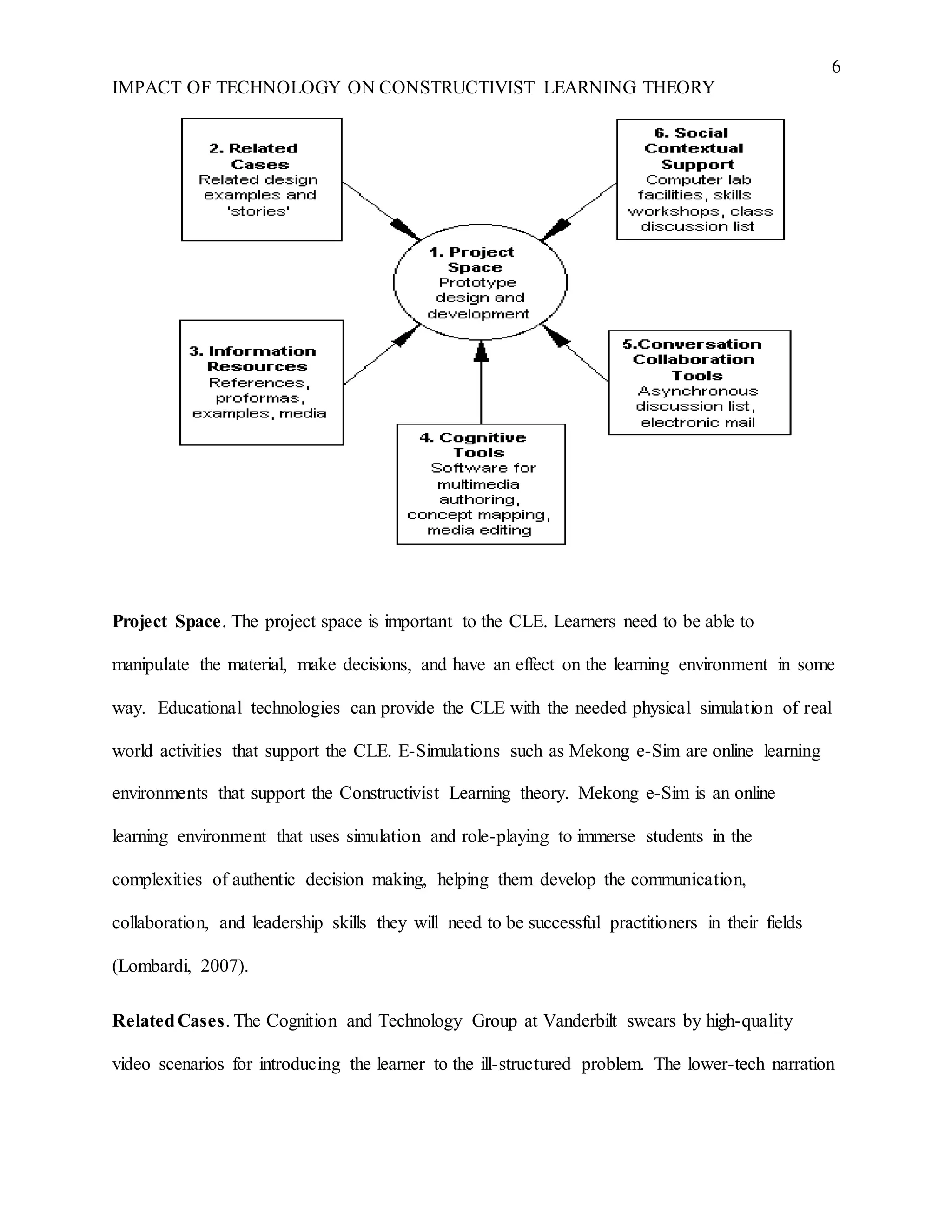
The figure below reflects Jonassen's (1999) model for a constructivist learning
environment (CLE) where technology supports learners as they work on their own design
problems.
6
IMPACT OF TECHNOLOGY ON CONSTRUCTIVIST LEARNING THEORY
Project Space. The project space is important to the CLE. Learners need to be able to
manipulate the material, make decisions, and have an effect on the learning environment in some
way. Educational technologies can provide the CLE with the needed physical simulation of real
world activities that support the CLE. E-Simulations such as Mekong e-Sim are online learning
environments that support the Constructivist Learning theory. Mekong e-Sim is an online
learning environment that uses simulation and role-playing to immerse students in the
complexities of authentic decision making, helping them develop the communication,
collaboration, and leadership skills they will need to be successful practitioners in their fields
(Lombardi, 2007).
RelatedCases. The Cognition and Technology Group at Vanderbilt swears by high-quality
video scenarios for introducing the learner to the ill-structured problem. The lower-tech narration
7
IMPACT OF TECHNOLOGY ON CONSTRUCTIVIST LEARNING THEORY
method of presenting a problem via related cases is quickly being replaced with its higher-tech
cousin the virtual reality method.
Information Resources. Educational technologies used as information resources can be
extensive. A predominate method in the CLE is the use of sophisticated search engines that filter
information specific to the problem and/or project. The use of filtering tools allows the learners
to focus on problem solving as opposed to focusing on what information is relevant to the
problem or not. Other e-information tools include media, and video interviews with field experts.
Cognitive Tools. Cognitive tools are essential to the CLE and a plethora of educational
technologies are being used in support of this. Cognitive tools are necessary to promote learner
performance. Cognitive tools help learners interact with CLEs in that they (a) “provide better
representation through visualization, (b) help representation what learners know or what they are
learning, (c) may offload some cognitive activity by automating low-level task or supplanting
some task (task-support), (d) may help the learner gather information needed to solve the
problem” (Jonassen, 1999). An example can be as simple as a calculator to automate the basic
mathematics in the process of solving the problem or completing the project.
Conversation Collaborative Tools. The constructivist learning theory advocates team work as
an essential component to learning. Learning occurs through collaborative efforts to solve
problems. Educational technology conversation collaborative tools support this component.
“Shared information and shared knowledge-building tools [should be provided] to help learners
to collaboratively construct socially shared knowledge” (Jonassen, 1999). Computer networking
tools such as listservs, electronic mail, bulletin boards, Net News services, chats, MUDs
(multiuser dimensions) and MOO (object oriented MUDD) support conversation on a wide range
of topics thus supporting the collaborative element of the CLE. (Jonassen, 1999).
8
IMPACT OF TECHNOLOGY ON CONSTRUCTIVIST LEARNING THEORY
Social Contextual Support. Social contextual support can be found in virtual learning labs,
electronic discussion boards, mobile devices, Classroom responseware (e.g. clickers, etc.). For
technology integration into the CLE it is vital that facilitators have the training necessary for
implementation to be successful. Technologies used for professional development include
Teachscope and CoVis. Teachscope delivers K-12 teachers professional development in a remote
setting using web-based video case studies. CoVis, or Collaborative Visualization, provides
training and workshops to instructors where video teleconferencing is utilized.
More sophisticated technology integration tools are also being issued to support the CLE.
In the article Computers as mindtools for engaging learners in critical thinking, the authors
explain that traditional technologies in education have served more as “conveyors of information
and tutors of students” (Jonassen, Carr, Hsiu-Ping, 1998). Technology, rather than instruct the
learner, should be used to aid the learner in constructing meaning during the learning process.
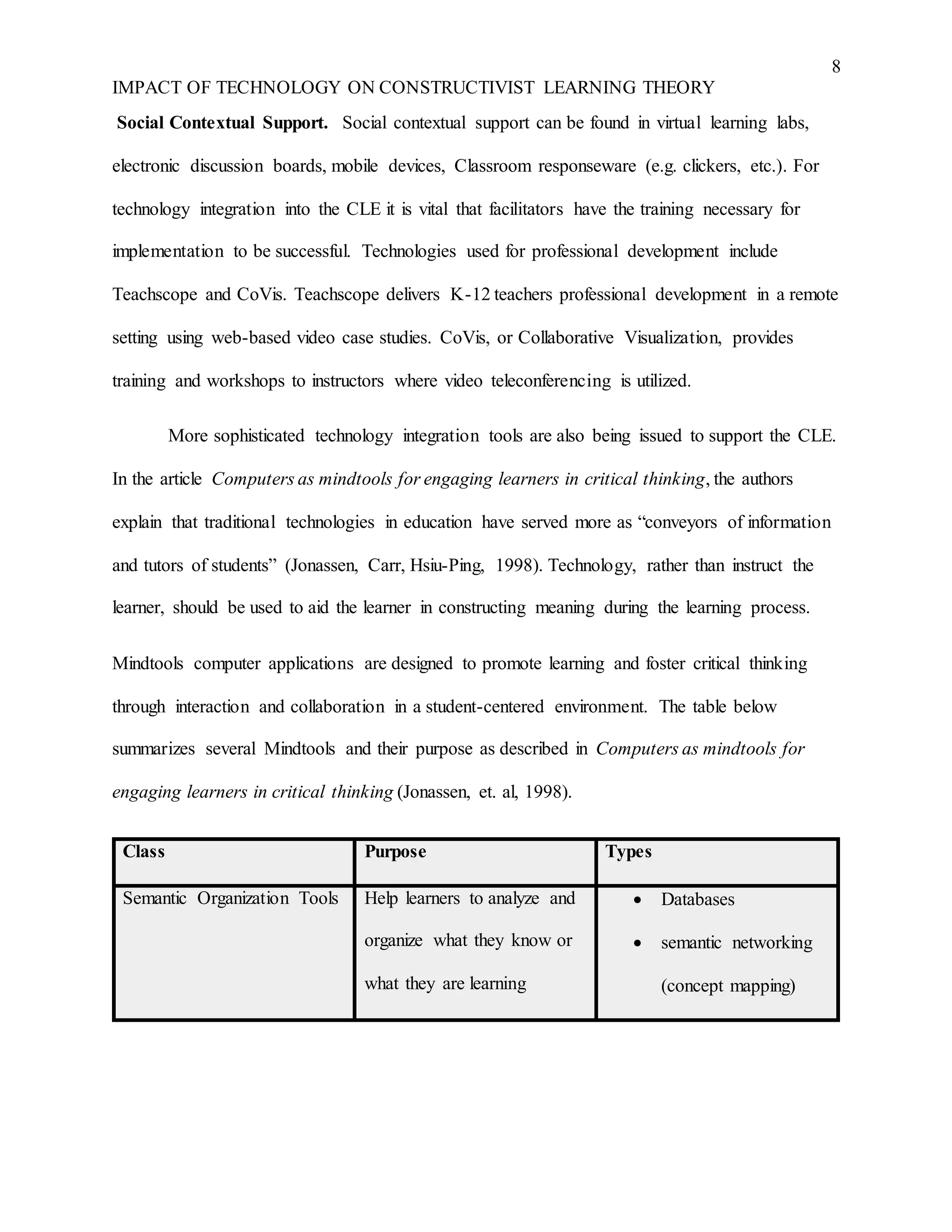
Mindtools computer applications are designed to promote learning and foster critical thinking
through interaction and collaboration in a student-centered environment. The table below
summarizes several Mindtools and their purpose as described in Computers as mindtools for
engaging learners in critical thinking (Jonassen, et. al, 1998).
Class Purpose Types
Semantic Organization Tools Help learners to analyze and
organize what they know or
what they are learning
 Databases
 semantic networking
(concept mapping)
9
IMPACT OF TECHNOLOGY ON CONSTRUCTIVIST LEARNING THEORY
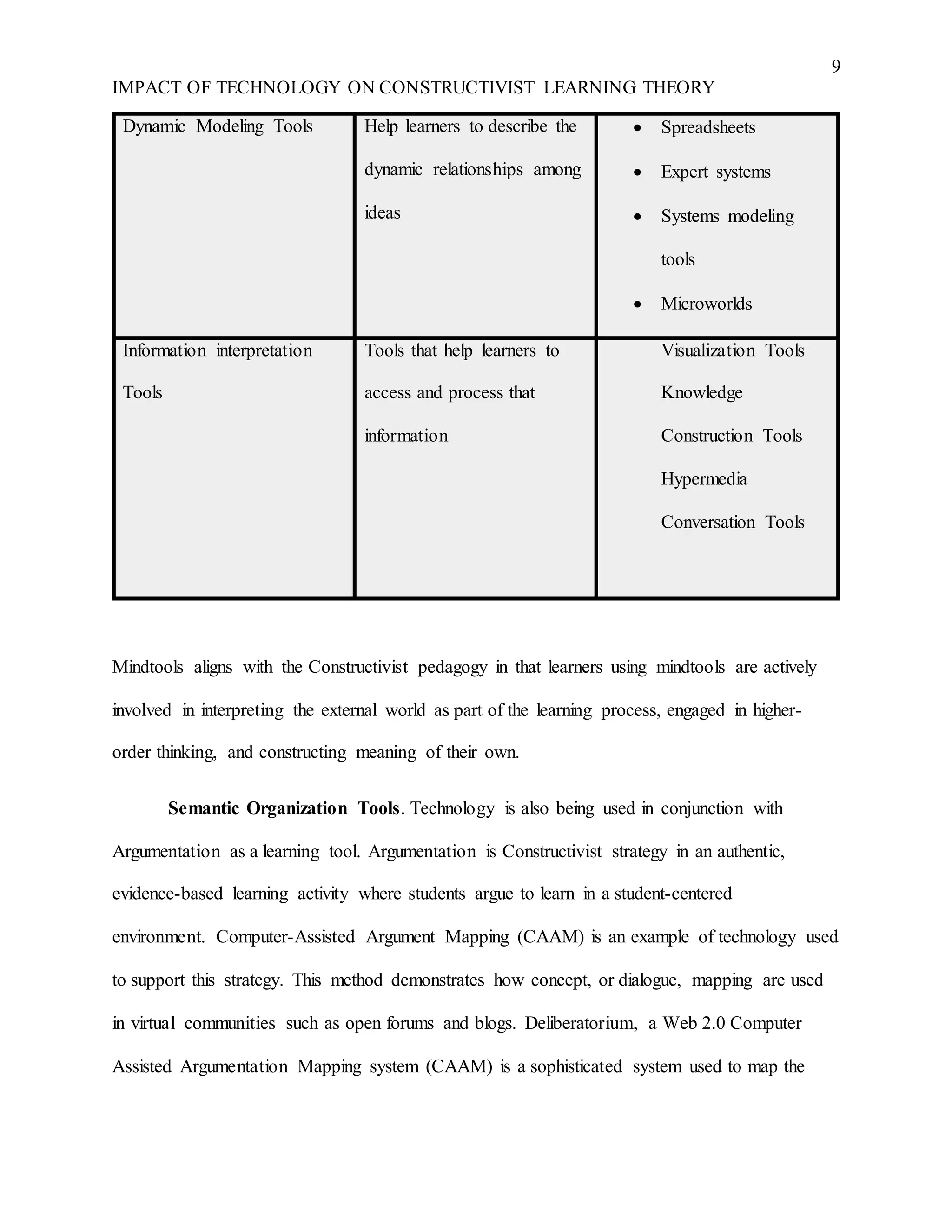
Dynamic Modeling Tools Help learners to describe the
dynamic relationships among
ideas
 Spreadsheets
 Expert systems
 Systems modeling
tools
 Microworlds
Information interpretation
Tools
Tools that help learners to
access and process that
information
Visualization Tools
Knowledge
Construction Tools
Hypermedia
Conversation Tools
Mindtools aligns with the Constructivist pedagogy in that learners using mindtools are actively
involved in interpreting the external world as part of the learning process, engaged in higher-
order thinking, and constructing meaning of their own.
Semantic Organization Tools. Technology is also being used in conjunction with
Argumentation as a learning tool. Argumentation is Constructivist strategy in an authentic,
evidence-based learning activity where students argue to learn in a student-centered
environment. Computer-Assisted Argument Mapping (CAAM) is an example of technology used
to support this strategy. This method demonstrates how concept, or dialogue, mapping are used
in virtual communities such as open forums and blogs. Deliberatorium, a Web 2.0 Computer
Assisted Argumentation Mapping system (CAAM) is a sophisticated system used to map the
10
IMPACT OF TECHNOLOGY ON CONSTRUCTIVIST LEARNING THEORY
structure of arguments in order to improve students’ quality of arguments in a virtual
community.
Dynamic Modeling Tools. Related efforts include Rationale and Compendium.
Rationale is a system that maps the structure of learners’ written articles and has been “found to
increase standardized test scores in critical thinking by almost one standard deviation” (Jonassen
and Land, 2012). Compendium targets the scaffolding component of Constructivist pedagogy.
Users create and organize dialogue maps in argumentation. Rationale and Compendium are
typically used when multiple perspectives, resources, and representations are the goal. Both
sophisticated mapping systems like Deliberatorium and more simple mapping systems are used
to facilitate discussion and reflection.
Information interpretation Tools. Collaborative Reasoning (CR) too is a Constructivist
approach using Argumentation. Computer-Supported Collaborative Learning (CSCL)
incorporates technology into the CR strategy. In this scenario, students discuss content both
synchronously and asynchronously, often facilitated by a moderator. CSCL can also take the
form of video-based worked examples of the type of discussion expected. Academic Talk and
InterLoc are two computer applications that promote CSCL. These application provide menus of
discussion openers that learners can use to start a response as well as links to web resources so
users can search for more evidence to support their position. These systems have been found to
result in higher quality argument.
Argumentation is a key characteristic of the student-centered learning environment and
technology is being used to facilitate valuable social practice and collaboration opportunities for
a vast group of learners. Argumentation strategies also provide scaffolding to help balance and
combine reasons with evidence. These technology-based learning environments that successfully
11
IMPACT OF TECHNOLOGY ON CONSTRUCTIVIST LEARNING THEORY
support Argumentation foster higher levels of learning where learners are engaged in and
empowered to create and participate meaningfully in the ever-evolving discursive forums of the
21st Century” (Jonassen and Land, 2012).
With Mindtools and Argumentation software more often used in online educational
settings, other Educational technologies are can be seen in the traditional classroom through Web
2.0 Tools. Wikis, for example are being used to augment in-class assignments by assigning
extension activities utilizing a Wiki. Teachers are creating classroom Facebook accounts to build
social learning in the traditional classroom learning community. Visual materials are also being
created via YouTube videos to enrich classroom instruction, and provide additional perspectives
to support the learner in perceiving alternative ways of seeing concepts.
Challenges to Technology Integration in Constructivist Learning Environment
While educational technologies have provided an abundance of tools that support the CLE, they
have also presented a number of challenges. Academic institutions are substantially funding
technology resources for their classrooms but many fail to properly implement them adequately.
Teachers are not being educated in how to use technologies and/or technologies being purchased
do not support the CLE. Technologies tools must be selected carefully as they can supplant
rather than engage cognitive activity. They can be used to simply deliver information or tutor
students defeating the goal of aiding the construction of meaning and fostering critical thinking.
The popular Khan Academy video tutorials are an example of conveying and tutoring the
learner. Despite the investment spent on classroom technologies, “studies indicate that on
average, teachers use computers several times a week for preparation but only once or twice a
year for instructional purposes” (Groff & Mouza, 2008). In Groff and Mouza article, A
12
IMPACT OF TECHNOLOGY ON CONSTRUCTIVIST LEARNING THEORY
framework for addressing challenges to classroom technology use, summarize the diverse
challenges associated with successfully implementing technology into the CLE. “They include:
 lack of concrete research and consensus among experts on the objectives and outcomes of
technology integration into the school curriculum;
 assorted hardware and software available for school selection with unclear support on
which meet a school’s needs;
 lack of teacher input on the development of innovations for instructional use;
 pressure and insufficient support (in the form of resources, time, professional
development, and human and technological infrastructure) from the administration,
community, and policy-makers to use the technology;
 inadequate school culture necessary to cultivate technology-based project success;
 teacher beliefs, attitudes, and concerns about classroom technology use—inexperience
with technology, the shift of pedagogical practices, management issues, and the
possibility of new roles and teaching style;
 challenges associated with technology-based projects (including its
 alignment with school culture/goals, compatibility with existing resources, and alignment
with prior teacher experiences);
 attitudes, concerns, and experience with technology in general and as an instructional
tool, as well as background in the new roles associated with student-centered projects;
and
 problems inherent to technology and computers themselves (such as unreliability).”
Innovations in technology can and do have a great impact on the Constructivist learning
environment when implemented correctly. The complexities surrounding successfully
13
IMPACT OF TECHNOLOGY ON CONSTRUCTIVIST LEARNING THEORY
implementation are considerable. Possibly academic institutions and policy maker need to
promptly come together to solve the issues surrounding implementation failures before new
innovations make current tactics obsolete.
Summary
The utilization of the Constructivist learning theory in the classrooms in which learning is
constructed as opposed to acquired. Students are at the center of learning and, rather than absorb
information conveyed, the learner is exposed to a learning process that personalizes a deeper
understanding of content. Technology tools have proven to be most effective in aiding in with
constructing meaning, promoting learning, and fostering critical thinking, all of which are
instrumental for the Constructivist learning process. Despite technological advancements that
have created contemporary paths for the CLE, there are a great number of challenges to
overcome. Nonetheless, there is strong evidence that the Constructivist learning theory, coupled
with the ever-evolving technologies, provides the learning environment needed for improved
student performance outcomes in the 21st century.
14
IMPACT OF TECHNOLOGY ON CONSTRUCTIVIST LEARNING THEORY
References
Blount, J, & Napolitano, R. (2014). Leading Classroom Discussion. Iowa State University Center
for Excellence in Learning and Teaching. Retrieved from
http://www.celt.iastate.edu/teaching-resources/classroom-practice/teaching-techniques-
strategies/leading-classroom-discussion/#tech
Duffy, T. M. & Cunningham, D. J. (1996). Constructivism: Implications for the design and
delivery of instruction. In D. H. Jonassen (Ed.), Educational communications and
technology (pp. 170-199). New York: Simon & Schuster Macmillan.
Groff, J., & Mouza, C. (2008). A framework for addressing challenges to classroom technology
use. AACE Journal, 16(1), 21-46.
Jonassen, D. H. (1999). Designing constructivist learning environments. Instructional design
theories and models: A new paradigm of instructional theory, 2, 215-239.
Jonassen, D., Carr, C., & Hsiu-Ping, Y. (1998). Computers as Mindtools for Engaging Learners
in Critical Thinking. TechTrends, v43 n2 p24-32.
Jonassen, D., & Land, S. (2000). Theoretical foundations of learning environments (2nd ed.).
Mahwah, N.J.: L. Erlbaum Associates.
Lombardi, M. (2007). Authentic Learning for the 21st Century: An Overview. ELI Publication.
Retrieved from http://www.educause.edu/library/resources/authentic-learning-21st-
century-overview
Martin-Stanley, B, & Martin-Stanly, C. (2007). Constructivism and Technology: Strategies for
15
IMPACT OF TECHNOLOGY ON CONSTRUCTIVIST LEARNING THEORY
Increasing Student Learning Outcomes. National Social Science Association. Retrieved
from http://www.nssa.us/journals/2007-29-1/2007-29-1-15.htm
Wilson, B. (1996). Constructivism in the Collaboratory. In Constructivist learning environments:
Case studies in instructional design. Englewood Cliffs, N.J.: Educational Technology
Publications.

Edtech 504 final synthesis paper booth

  • 1.
    1 Running head: IMPACTOF TECHNOLOGY ON CONSTRUCTIVIST LEARNING THEORY The Impact of Technology on the Constructivist Learning Theory Kathryn Booth Boise State University
  • 2.
    2 IMPACT OF TECHNOLOGYON CONSTRUCTIVIST LEARNING THEORY Abstract As technology infuses society at exponential rates, educational institutions are challenged as never before. Constructivist approaches in the classroom have found great success in integrating emerging technologies and promoting student learning gains. However, as new technologies are developed, educators are increasingly challenged with how to integrate them into instruction. As new technologies drive instruction, educators are finding the student- centered approach of the constructivist theory makes the integration of technology less complicated and is easily adapted as new technologies are developed. This research paper provides a summary of research related to the relationship between constructivist learning theory and educational technology. Constructivist Learning Theory Rooted in the work of Socrates and his questioning techniques, the post-modern Constructivist learning theory is best associated with major contributors such as Jean Piaget, John Dewey, Lev Vygotsky, and Jerome Bruner. Constructivism is a theory in which learning is constructed as opposed to acquired. In a student-centered environment, learners form an understanding of the world by experiencing, reflecting, and then modifying previous perceptions. With a focus on the process of learning, constructivism espouses that the evolution of understanding takes place when a concept is related to past experience then applied in a different and meaningful context. Constructivists believe the key to learning is in combining knowledge, practice, and context. The more experiences the learner has in applying knowledge in different and meaning contexts, the deeper the understanding. The major principles, or core values, of constructivist learning theory include: “(a) the centrality of the learner in defining meaning; (b) scaffolded participation in authentic tasks and
  • 3.
    3 IMPACT OF TECHNOLOGYON CONSTRUCTIVIST LEARNING THEORY sociocultural practices; (c) importance of prior and everyday experiences in meaning construction; and (d) access to multiple perspectives, resources, and representations” (Jonassen and Land, 2012). Constructivist Learning Environment The constructivist learning environment (CLE) provides a foundation that allows a learner to be an active participant where they build on what they know about the topic and develop deeper meaning. Learners are encouraged to test and refine their ideas and to increasingly build upon prior understanding. Essential components of the CLE include an ill- defined or ill-structured problem and a question or project as the focus of the environment. The goal is for the learner(s) to take ownership of the learning and be able to solve the problem or complete the project. Ill-structured problems in the CLE:  have unstated goals and constraints,  possess multiple solution, solution paths, or no solution at all  present uncertainty about which concepts, rules, and principles ae necessary for the solution or show how they are organized,  offer no general rules, or principles for describing or predicting the outcome of most cases, and  require learners to make judgments about the problem and to defend their judgments by expressing personal opinions or beliefs (Jonassen, 1999). Scaffolding in real-world, meaningful, context is also essential to the constructivist learning environment. Learners begin with an everyday context in which complexity level of the task or
  • 4.
    4 IMPACT OF TECHNOLOGYON CONSTRUCTIVIST LEARNING THEORY problem builds as the practice moves forward. Activities are arranged in fashion to compliment the learners’ developmental progression. The prior, everyday experiences of the learner provides a foundation for new understanding to build on. Individual beliefs and experiences “influence what they perceive, organize, and interpret. Understanding continuously and dynamically evolves, as ideas are generated, expanded, tested, and revised.” (Jonassen & Land, 2012). Personal experiences are often used as an anchor to new learning thus facilitating transfer. A major principal of the constructivist learning environment, “access to multiple perspectives, resources, and representations,” provides the alternate representation of concepts not normally available to the learner. These perspectives have traditionally been in the form of expert in the field, field-related personnel, teacher, or peer. Visual ideas is an additional method used to aid the learner in perceiving alternative ways of seeing concepts. In the constructivist classroom, learners are genuinely engaged in the learning and exploration process, planning and carrying out investigation, communicating using various methods, proposing explanations and solutions, raising questions, observing and critiquing. Some instructional models based on constructivist learning theory include, inquiry-based design-based, project-based learning, case studies, and argumentation. Technology Integration in a Constructivist Learning Environment With new technologies being developed exponentially, educators scramble to keep pace. While the latest technologies have challenged the teaching-learning process, the Constructivist learning approach has adapted well to today’s technologies and environmental influences. It can be considered that technology assists with in the implementation of Constructivist strategies rather than the technology driving the strategies; technology and constructivism are complimentary of each other. “By providing ongoing information and tools for student creativity
  • 5.
    5 IMPACT OF TECHNOLOGYON CONSTRUCTIVIST LEARNING THEORY and development, [technology] contributes significantly to an increase in student learning outcomes” (Martin-Stanley, & Martin-Stanley, 2007). Duffy & Cunningham (1996) have suggested that constructivist methods exploit educational technologies for the greatest impact on learning outcomes. They state: Technology is seen as an integral part of the cognitive activity…This view of distributed cognition significantly impacts how we think of the role of technology in education and training, the focus is not on the individual in isolation and what he or she knows, but on the activity in the environment. It is the activity- focused and contextualized- that is central… The process of construction is directed towards creating a world that makes sense to us, that is adequate for our everyday functioning (p. 187-188) Technology can be a powerful instrument for the fundamental principles of Constructivism. Technology is a catalyst to collaboration, participation in authentic tasks, learning by doing, offering access to multiple perspectives, resources, and representations. In line with the Constructivist learning theory framework, individuals build from prior experience and personalize meaning through new experiences. Informal settings of the Internet and other technologies provide the individual experience, indirectly at times, to construct their own meaning. Technology provides a mechanism for learners to acquire, and practice their new experience/knowledge, mold it into an earlier schema and then fit the new knowledge into their own understanding of the world. The figure below reflects Jonassen's (1999) model for a constructivist learning environment (CLE) where technology supports learners as they work on their own design problems.
  • 6.
    6 IMPACT OF TECHNOLOGYON CONSTRUCTIVIST LEARNING THEORY Project Space. The project space is important to the CLE. Learners need to be able to manipulate the material, make decisions, and have an effect on the learning environment in some way. Educational technologies can provide the CLE with the needed physical simulation of real world activities that support the CLE. E-Simulations such as Mekong e-Sim are online learning environments that support the Constructivist Learning theory. Mekong e-Sim is an online learning environment that uses simulation and role-playing to immerse students in the complexities of authentic decision making, helping them develop the communication, collaboration, and leadership skills they will need to be successful practitioners in their fields (Lombardi, 2007). RelatedCases. The Cognition and Technology Group at Vanderbilt swears by high-quality video scenarios for introducing the learner to the ill-structured problem. The lower-tech narration
  • 7.
    7 IMPACT OF TECHNOLOGYON CONSTRUCTIVIST LEARNING THEORY method of presenting a problem via related cases is quickly being replaced with its higher-tech cousin the virtual reality method. Information Resources. Educational technologies used as information resources can be extensive. A predominate method in the CLE is the use of sophisticated search engines that filter information specific to the problem and/or project. The use of filtering tools allows the learners to focus on problem solving as opposed to focusing on what information is relevant to the problem or not. Other e-information tools include media, and video interviews with field experts. Cognitive Tools. Cognitive tools are essential to the CLE and a plethora of educational technologies are being used in support of this. Cognitive tools are necessary to promote learner performance. Cognitive tools help learners interact with CLEs in that they (a) “provide better representation through visualization, (b) help representation what learners know or what they are learning, (c) may offload some cognitive activity by automating low-level task or supplanting some task (task-support), (d) may help the learner gather information needed to solve the problem” (Jonassen, 1999). An example can be as simple as a calculator to automate the basic mathematics in the process of solving the problem or completing the project. Conversation Collaborative Tools. The constructivist learning theory advocates team work as an essential component to learning. Learning occurs through collaborative efforts to solve problems. Educational technology conversation collaborative tools support this component. “Shared information and shared knowledge-building tools [should be provided] to help learners to collaboratively construct socially shared knowledge” (Jonassen, 1999). Computer networking tools such as listservs, electronic mail, bulletin boards, Net News services, chats, MUDs (multiuser dimensions) and MOO (object oriented MUDD) support conversation on a wide range of topics thus supporting the collaborative element of the CLE. (Jonassen, 1999).
  • 8.
    8 IMPACT OF TECHNOLOGYON CONSTRUCTIVIST LEARNING THEORY Social Contextual Support. Social contextual support can be found in virtual learning labs, electronic discussion boards, mobile devices, Classroom responseware (e.g. clickers, etc.). For technology integration into the CLE it is vital that facilitators have the training necessary for implementation to be successful. Technologies used for professional development include Teachscope and CoVis. Teachscope delivers K-12 teachers professional development in a remote setting using web-based video case studies. CoVis, or Collaborative Visualization, provides training and workshops to instructors where video teleconferencing is utilized. More sophisticated technology integration tools are also being issued to support the CLE. In the article Computers as mindtools for engaging learners in critical thinking, the authors explain that traditional technologies in education have served more as “conveyors of information and tutors of students” (Jonassen, Carr, Hsiu-Ping, 1998). Technology, rather than instruct the learner, should be used to aid the learner in constructing meaning during the learning process. Mindtools computer applications are designed to promote learning and foster critical thinking through interaction and collaboration in a student-centered environment. The table below summarizes several Mindtools and their purpose as described in Computers as mindtools for engaging learners in critical thinking (Jonassen, et. al, 1998). Class Purpose Types Semantic Organization Tools Help learners to analyze and organize what they know or what they are learning  Databases  semantic networking (concept mapping)
  • 9.
    9 IMPACT OF TECHNOLOGYON CONSTRUCTIVIST LEARNING THEORY Dynamic Modeling Tools Help learners to describe the dynamic relationships among ideas  Spreadsheets  Expert systems  Systems modeling tools  Microworlds Information interpretation Tools Tools that help learners to access and process that information Visualization Tools Knowledge Construction Tools Hypermedia Conversation Tools Mindtools aligns with the Constructivist pedagogy in that learners using mindtools are actively involved in interpreting the external world as part of the learning process, engaged in higher- order thinking, and constructing meaning of their own. Semantic Organization Tools. Technology is also being used in conjunction with Argumentation as a learning tool. Argumentation is Constructivist strategy in an authentic, evidence-based learning activity where students argue to learn in a student-centered environment. Computer-Assisted Argument Mapping (CAAM) is an example of technology used to support this strategy. This method demonstrates how concept, or dialogue, mapping are used in virtual communities such as open forums and blogs. Deliberatorium, a Web 2.0 Computer Assisted Argumentation Mapping system (CAAM) is a sophisticated system used to map the
  • 10.
    10 IMPACT OF TECHNOLOGYON CONSTRUCTIVIST LEARNING THEORY structure of arguments in order to improve students’ quality of arguments in a virtual community. Dynamic Modeling Tools. Related efforts include Rationale and Compendium. Rationale is a system that maps the structure of learners’ written articles and has been “found to increase standardized test scores in critical thinking by almost one standard deviation” (Jonassen and Land, 2012). Compendium targets the scaffolding component of Constructivist pedagogy. Users create and organize dialogue maps in argumentation. Rationale and Compendium are typically used when multiple perspectives, resources, and representations are the goal. Both sophisticated mapping systems like Deliberatorium and more simple mapping systems are used to facilitate discussion and reflection. Information interpretation Tools. Collaborative Reasoning (CR) too is a Constructivist approach using Argumentation. Computer-Supported Collaborative Learning (CSCL) incorporates technology into the CR strategy. In this scenario, students discuss content both synchronously and asynchronously, often facilitated by a moderator. CSCL can also take the form of video-based worked examples of the type of discussion expected. Academic Talk and InterLoc are two computer applications that promote CSCL. These application provide menus of discussion openers that learners can use to start a response as well as links to web resources so users can search for more evidence to support their position. These systems have been found to result in higher quality argument. Argumentation is a key characteristic of the student-centered learning environment and technology is being used to facilitate valuable social practice and collaboration opportunities for a vast group of learners. Argumentation strategies also provide scaffolding to help balance and combine reasons with evidence. These technology-based learning environments that successfully
  • 11.
    11 IMPACT OF TECHNOLOGYON CONSTRUCTIVIST LEARNING THEORY support Argumentation foster higher levels of learning where learners are engaged in and empowered to create and participate meaningfully in the ever-evolving discursive forums of the 21st Century” (Jonassen and Land, 2012). With Mindtools and Argumentation software more often used in online educational settings, other Educational technologies are can be seen in the traditional classroom through Web 2.0 Tools. Wikis, for example are being used to augment in-class assignments by assigning extension activities utilizing a Wiki. Teachers are creating classroom Facebook accounts to build social learning in the traditional classroom learning community. Visual materials are also being created via YouTube videos to enrich classroom instruction, and provide additional perspectives to support the learner in perceiving alternative ways of seeing concepts. Challenges to Technology Integration in Constructivist Learning Environment While educational technologies have provided an abundance of tools that support the CLE, they have also presented a number of challenges. Academic institutions are substantially funding technology resources for their classrooms but many fail to properly implement them adequately. Teachers are not being educated in how to use technologies and/or technologies being purchased do not support the CLE. Technologies tools must be selected carefully as they can supplant rather than engage cognitive activity. They can be used to simply deliver information or tutor students defeating the goal of aiding the construction of meaning and fostering critical thinking. The popular Khan Academy video tutorials are an example of conveying and tutoring the learner. Despite the investment spent on classroom technologies, “studies indicate that on average, teachers use computers several times a week for preparation but only once or twice a year for instructional purposes” (Groff & Mouza, 2008). In Groff and Mouza article, A
  • 12.
    12 IMPACT OF TECHNOLOGYON CONSTRUCTIVIST LEARNING THEORY framework for addressing challenges to classroom technology use, summarize the diverse challenges associated with successfully implementing technology into the CLE. “They include:  lack of concrete research and consensus among experts on the objectives and outcomes of technology integration into the school curriculum;  assorted hardware and software available for school selection with unclear support on which meet a school’s needs;  lack of teacher input on the development of innovations for instructional use;  pressure and insufficient support (in the form of resources, time, professional development, and human and technological infrastructure) from the administration, community, and policy-makers to use the technology;  inadequate school culture necessary to cultivate technology-based project success;  teacher beliefs, attitudes, and concerns about classroom technology use—inexperience with technology, the shift of pedagogical practices, management issues, and the possibility of new roles and teaching style;  challenges associated with technology-based projects (including its  alignment with school culture/goals, compatibility with existing resources, and alignment with prior teacher experiences);  attitudes, concerns, and experience with technology in general and as an instructional tool, as well as background in the new roles associated with student-centered projects; and  problems inherent to technology and computers themselves (such as unreliability).” Innovations in technology can and do have a great impact on the Constructivist learning environment when implemented correctly. The complexities surrounding successfully
  • 13.
    13 IMPACT OF TECHNOLOGYON CONSTRUCTIVIST LEARNING THEORY implementation are considerable. Possibly academic institutions and policy maker need to promptly come together to solve the issues surrounding implementation failures before new innovations make current tactics obsolete. Summary The utilization of the Constructivist learning theory in the classrooms in which learning is constructed as opposed to acquired. Students are at the center of learning and, rather than absorb information conveyed, the learner is exposed to a learning process that personalizes a deeper understanding of content. Technology tools have proven to be most effective in aiding in with constructing meaning, promoting learning, and fostering critical thinking, all of which are instrumental for the Constructivist learning process. Despite technological advancements that have created contemporary paths for the CLE, there are a great number of challenges to overcome. Nonetheless, there is strong evidence that the Constructivist learning theory, coupled with the ever-evolving technologies, provides the learning environment needed for improved student performance outcomes in the 21st century.
  • 14.
    14 IMPACT OF TECHNOLOGYON CONSTRUCTIVIST LEARNING THEORY References Blount, J, & Napolitano, R. (2014). Leading Classroom Discussion. Iowa State University Center for Excellence in Learning and Teaching. Retrieved from http://www.celt.iastate.edu/teaching-resources/classroom-practice/teaching-techniques- strategies/leading-classroom-discussion/#tech Duffy, T. M. & Cunningham, D. J. (1996). Constructivism: Implications for the design and delivery of instruction. In D. H. Jonassen (Ed.), Educational communications and technology (pp. 170-199). New York: Simon & Schuster Macmillan. Groff, J., & Mouza, C. (2008). A framework for addressing challenges to classroom technology use. AACE Journal, 16(1), 21-46. Jonassen, D. H. (1999). Designing constructivist learning environments. Instructional design theories and models: A new paradigm of instructional theory, 2, 215-239. Jonassen, D., Carr, C., & Hsiu-Ping, Y. (1998). Computers as Mindtools for Engaging Learners in Critical Thinking. TechTrends, v43 n2 p24-32. Jonassen, D., & Land, S. (2000). Theoretical foundations of learning environments (2nd ed.). Mahwah, N.J.: L. Erlbaum Associates. Lombardi, M. (2007). Authentic Learning for the 21st Century: An Overview. ELI Publication. Retrieved from http://www.educause.edu/library/resources/authentic-learning-21st- century-overview Martin-Stanley, B, & Martin-Stanly, C. (2007). Constructivism and Technology: Strategies for
  • 15.
    15 IMPACT OF TECHNOLOGYON CONSTRUCTIVIST LEARNING THEORY Increasing Student Learning Outcomes. National Social Science Association. Retrieved from http://www.nssa.us/journals/2007-29-1/2007-29-1-15.htm Wilson, B. (1996). Constructivism in the Collaboratory. In Constructivist learning environments: Case studies in instructional design. Englewood Cliffs, N.J.: Educational Technology Publications.