Decision Making Process
By: Colin Benford
Becoming a
better
decision
maker
● Understand the objectives so you can
make a clear and precise decision
● You can make decisions quickly and
efficiently , trust your gut.
● Although never jump to conclusions,
each has its own sets of problems and
issues.
● Ask colleagues or friends for help when
having trouble deciding, it allows for a
new view on the subject.
● Prioritize the decisions, don't stress
over meaningless ones.
Decision - A conclusion or resolution reached after
consideration
Decision Making is made constantly , in and out of your
professional and personal life
Good decision making takes skills and time, prioritizing and
logical reasoning are the best ways to be confident in your
choice
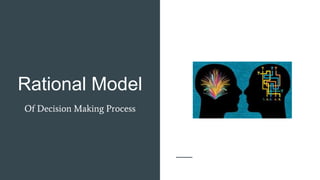
Rational Model
Of Decision Making Process
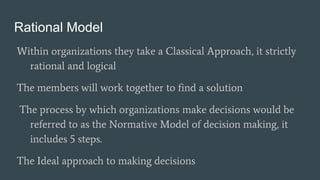
Rational Model
Within organizations they take a Classical Approach, it strictly
rational and logical
The members will work together to find a solution
The process by which organizations make decisions would be
referred to as the Normative Model of decision making, it
includes 5 steps.
The Ideal approach to making decisions
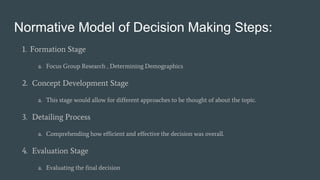
Normative Model of Decision Making Steps:
1. Formation Stage
a. Focus Group Research , Determining Demographics
2. Concept Development Stage
a. This stage would allow for different approaches to be thought of about the topic.
3. Detailing Process
a. Comprehending how efficient and effective the decision was overall.
4. Evaluation Stage
a. Evaluating the final decision
Alternative
Model
Of Decision Making Process
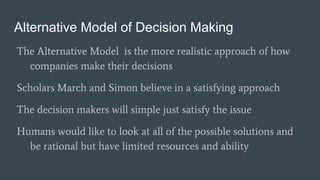
Alternative Model of Decision Making
The Alternative Model is the more realistic approach of how
companies make their decisions
Scholars March and Simon believe in a satisfying approach
The decision makers will simple just satisfy the issue
Humans would like to look at all of the possible solutions and
be rational but have limited resources and ability
Alternative Model of Decision Making
Bounded Rationality
Attempting to make logical decisions but
restricted or limited to cognitively and
to the limited resources around them
Intuitive Decision Making
Accessing relevant information and
experience in order to make decisions
Rational and Alternative Model Summary
Overall, organizations would like to use a rational approach
when making decision but it not always possible so decision
makers typically use truncated decision procedures and rely on
intuition or satisficing solutions.
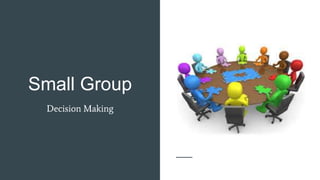
Small Group
Decision Making
Small Group Decision Making
Phase Model Decision Making
Orientation
Meet each other and understand the problem
Conflict
Possible Solution are introduced and
discussed
Emergence
Group has came to agreement
Multiple Sequence Model
● Unitary Sequence Path
○ Groups that use traditional
methods
● Complex Cyclic Path
○ Multiple Problem Solution Cycle
● Solution Oriented Path
○ No activity related to the
problem
Small Group Decision Making
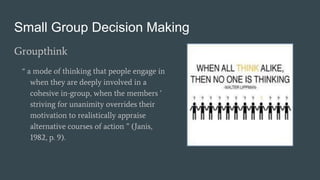
Groupthink
“ a mode of thinking that people engage in
when they are deeply involved in a
cohesive in-group, when the members ’
striving for unanimity overrides their
motivation to realistically appraise
alternative courses of action ” (Janis,
1982, p. 9).
Small Group Decision Making
Groupthink Continued
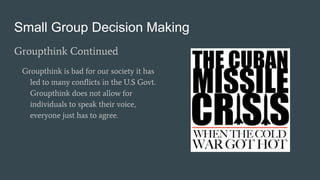
Groupthink is bad for our society it has
led to many conflicts in the U.S Govt.
Groupthink does not allow for
individuals to speak their voice,
everyone just has to agree.
Participation
and
Collaboration
Participation and Collaboration
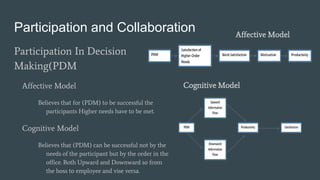
Participation In Decision
Making(PDM
Affective Model
Believes that for (PDM) to be successful the
participants Higher needs have to be met.
Cognitive Model
Believes that (PDM) can be successful not by the
needs of the participant but by the order in the
office. Both Upward and Downward so from
the boss to employee and vise versa.
Cognitive Model
Affective Model
Participation and Collaboration
Collaboration
Collaboration is more of a
contemporary look into
organizations . With the increase of
technology, collaboration with
organizations all over the world
are now able to work together.
Questions
How do companies balance rational decision making while still keeping their
values intact?
How does the dynamics of different departments in an organization affect
decision making?
How is groupthink incorporated or used in smaller organizations or small
businesses? How has that hurt or improve their decisions?
Thoughts
Understanding the Decision-Making Process of the corporations
allows me to get an idea of how to work under those
situations.
Group Decision making and Individual decision making are
almost parallel
Collaboration and Participation allows for two different views of
working together to understand how to work efficiently
Work Cited
http://99u.com/articles/7043/dont-overthink-it-5-tips-for-daily-decision-making
http://www.mckinsey.com/business-functions/strategy-and-corporate-finance/our-
insights/how-companies-make-good-decisions-mckinsey-global-survey-results
Miller, Katherine. Organizational Communication: Approaches and Processes.
Belmont, CA: Thomson/Wadsworth, 2006. Print.

Decision Making Process

  • 1.
  • 2.
    Becoming a better decision maker ● Understandthe objectives so you can make a clear and precise decision ● You can make decisions quickly and efficiently , trust your gut. ● Although never jump to conclusions, each has its own sets of problems and issues. ● Ask colleagues or friends for help when having trouble deciding, it allows for a new view on the subject. ● Prioritize the decisions, don't stress over meaningless ones.
  • 3.
    Decision - Aconclusion or resolution reached after consideration Decision Making is made constantly , in and out of your professional and personal life Good decision making takes skills and time, prioritizing and logical reasoning are the best ways to be confident in your choice
  • 4.
  • 5.
    Rational Model Within organizationsthey take a Classical Approach, it strictly rational and logical The members will work together to find a solution The process by which organizations make decisions would be referred to as the Normative Model of decision making, it includes 5 steps. The Ideal approach to making decisions
  • 6.
    Normative Model ofDecision Making Steps: 1. Formation Stage a. Focus Group Research , Determining Demographics 2. Concept Development Stage a. This stage would allow for different approaches to be thought of about the topic. 3. Detailing Process a. Comprehending how efficient and effective the decision was overall. 4. Evaluation Stage a. Evaluating the final decision
  • 7.
  • 8.
    Alternative Model ofDecision Making The Alternative Model is the more realistic approach of how companies make their decisions Scholars March and Simon believe in a satisfying approach The decision makers will simple just satisfy the issue Humans would like to look at all of the possible solutions and be rational but have limited resources and ability
  • 9.
    Alternative Model ofDecision Making Bounded Rationality Attempting to make logical decisions but restricted or limited to cognitively and to the limited resources around them Intuitive Decision Making Accessing relevant information and experience in order to make decisions
  • 10.
    Rational and AlternativeModel Summary Overall, organizations would like to use a rational approach when making decision but it not always possible so decision makers typically use truncated decision procedures and rely on intuition or satisficing solutions.
  • 11.
  • 12.
    Small Group DecisionMaking Phase Model Decision Making Orientation Meet each other and understand the problem Conflict Possible Solution are introduced and discussed Emergence Group has came to agreement Multiple Sequence Model ● Unitary Sequence Path ○ Groups that use traditional methods ● Complex Cyclic Path ○ Multiple Problem Solution Cycle ● Solution Oriented Path ○ No activity related to the problem
  • 13.
    Small Group DecisionMaking Groupthink “ a mode of thinking that people engage in when they are deeply involved in a cohesive in-group, when the members ’ striving for unanimity overrides their motivation to realistically appraise alternative courses of action ” (Janis, 1982, p. 9).
  • 14.
    Small Group DecisionMaking Groupthink Continued Groupthink is bad for our society it has led to many conflicts in the U.S Govt. Groupthink does not allow for individuals to speak their voice, everyone just has to agree.
  • 15.
  • 16.
    Participation and Collaboration ParticipationIn Decision Making(PDM Affective Model Believes that for (PDM) to be successful the participants Higher needs have to be met. Cognitive Model Believes that (PDM) can be successful not by the needs of the participant but by the order in the office. Both Upward and Downward so from the boss to employee and vise versa. Cognitive Model Affective Model
  • 17.
    Participation and Collaboration Collaboration Collaborationis more of a contemporary look into organizations . With the increase of technology, collaboration with organizations all over the world are now able to work together.
  • 18.
    Questions How do companiesbalance rational decision making while still keeping their values intact? How does the dynamics of different departments in an organization affect decision making? How is groupthink incorporated or used in smaller organizations or small businesses? How has that hurt or improve their decisions?
  • 19.
    Thoughts Understanding the Decision-MakingProcess of the corporations allows me to get an idea of how to work under those situations. Group Decision making and Individual decision making are almost parallel Collaboration and Participation allows for two different views of working together to understand how to work efficiently
  • 20.