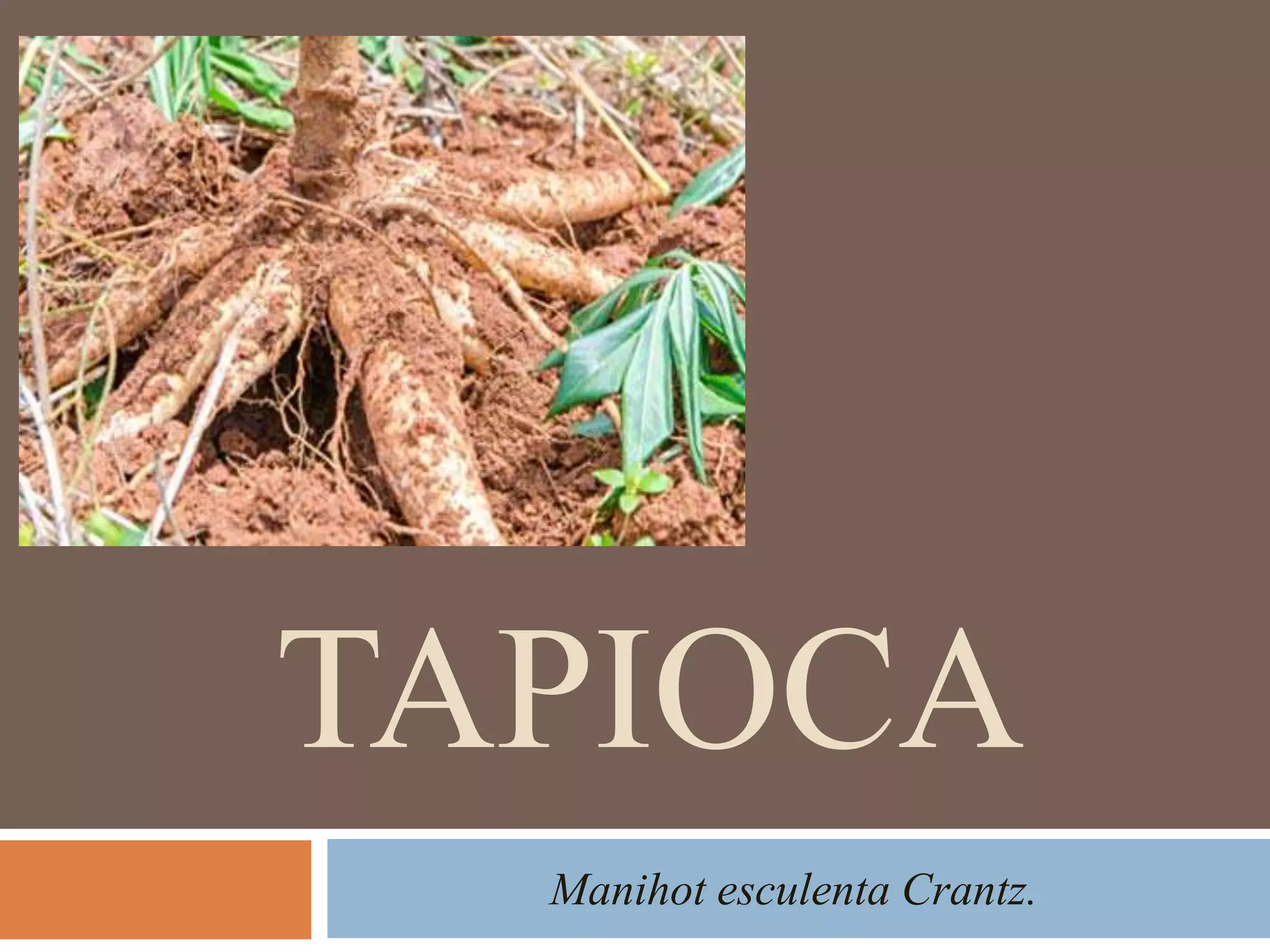
TAPIOCA
Manihot esculenta Crantz.
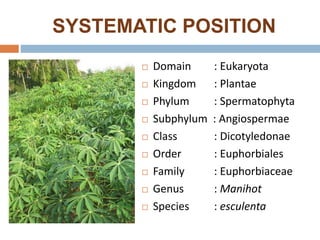
SYSTEMATIC POSITION
 Domain : Eukaryota
 Kingdom : Plantae
 Phylum : Spermatophyta
 Subphylum : Angiospermae
 Class : Dicotyledonae
 Order : Euphorbiales
 Family : Euphorbiaceae
 Genus : Manihot
 Species : esculenta
CASSAVA / TAPIOCA
 2n=2x=36
 Center of origin : North-East Brazil
 Most important starchy root crop grown in tropics
 King of tropical tuber crops
 Introduced to India during 17th century by Portugese
 Major tropical root crop in India, occupying 63% of
total area under root & tuber crops- occupies about
0.26mha of land producing 5.868mt of fresh roots.
 Mainly cultivated in Southern peninsular India – Kerala,
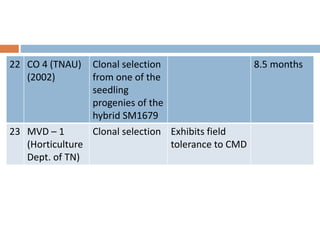
Tamil Nadu & Karnataka
 Kerala accounts for about 55% of cassava
cultivated area (1,42,000ha) in India
 Important alternate source of energy to meet the
demands of increasing population
 Produce more food per unit area, capacity to
withstand biotic & abiotic stresses and adaptability
to conditions of drought and marginal lands
 Cassava not known in wild state
 98 species in genus Manihot ranging from
subshrubs to shrubs and trees, majority producing
latex and containing cyanogenic glucosides
 Roots of wild species are fibrous and slender
 Wild progenitors : M. flabellifolia
M. peruviana
RELATED SPECIES
 M. anomala
 M. caerulescence
 M. euprinosa
 M. flabellifolia – wild progenitor
 M. glaziovii
 M. grahami
 M. tristis
 M. peruviana – wild progenitor
 M. pruinosa – closest wild relative
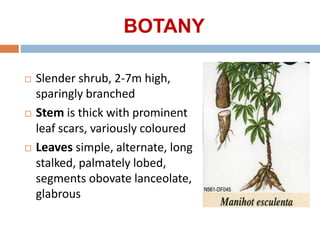
BOTANY
 Slender shrub, 2-7m high,
sparingly branched
 Stem is thick with prominent
leaf scars, variously coloured
 Leaves simple, alternate, long
stalked, palmately lobed,
segments obovate lanceolate,
glabrous
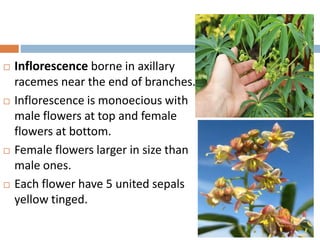
 Inflorescence borne in axillary
racemes near the end of branches.
 Inflorescence is monoecious with
male flowers at top and female
flowers at bottom.
 Female flowers larger in size than
male ones.
 Each flower have 5 united sepals
yellow tinged.
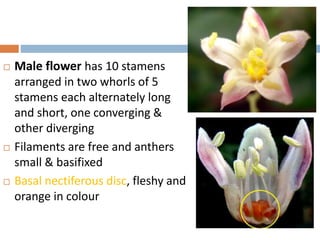
 Male flower has 10 stamens
arranged in two whorls of 5
stamens each alternately long
and short, one converging &
other diverging
 Filaments are free and anthers
small & basifixed
 Basal nectiferous disc, fleshy and
orange in colour
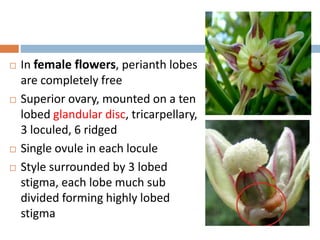
 In female flowers, perianth lobes
are completely free
 Superior ovary, mounted on a ten
lobed glandular disc, tricarpellary,
3 loculed, 6 ridged
 Single ovule in each locule
 Style surrounded by 3 lobed
stigma, each lobe much sub
divided forming highly lobed
stigma
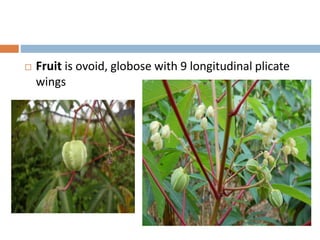
 Fruit is ovoid, globose with 9 longitudinal plicate
wings
Pollination
 Cross pollination, predominantly entomophilous
ADAPTATIONS:
 Unisexual nature of flowers
 Protogynous condition (female flowers open 10 days
before anthesis of male flowers)
 Distinct interphase
 Presence of secretary glands
 Pollen grains heavy and sticky
 Female flowers opened fully, sticky stigma & highly
branched
 Pollen grains viable for even one week
BREEDING OBJECTIVES
 High yield (>35 t/ha fresh root)
 High starch (> 25%)
 Short duration
 High harvest index
 Responsive to additional inputs
 Non-branching plant type
 Low HCN content
 Good cooking and eating quality
 Early harvestability
 Better root storage quality
 Shade tolerance for use as an intercrop under
coconut etc.
 Wide adaptation
 Compact branches
 Compact root system
 Resistance to major diseases (cassava bacterial
blight, anthracnose, brown leaf spot, cassava
mosaic virus)
 Tolerance to adverse soil and climatic conditions
BREEDING METHODS
 Clonal selection
 Hybridization and selection
 Interspecific hybridisation
 Heterosis breeding
 Polyploidy breeding
 Mutation breeding
 Biotechnological approaches
1. CLONAL SELECTION
 Considerable amount of variability exists in crop in
India & much more available in other cassava
growing regions, esp. in tropical south Latin
America (COO for cassava).
 Number of cassava germplasm accessions in CTCRI
is about 1654 including 60 hybrids, 8 wild species,
806 indigenous cultivars and 781 exotic collections
the latter received from CIAT, Brazil, IITA,
Madagascar, Malaysia, Sri Lanka, etc.
 Achievements:
 M4 and M6 from Malaysia
 Sree Prakash (S-856, indigenous selection) CTCRI
 Sree Jaya, Sree Vijaya, Nidhi, Kalpaka
 Vellayani Hraswa
 Acc. S-1309, S-1310, S-315, S-2407 and S-2331
 CO-1, CO-2, CO-3 & CO-4 from TNAU
2. HYBRIDISATION & SELECTION
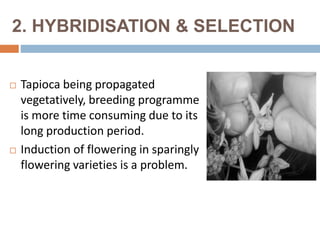
 Tapioca being propagated
vegetatively, breeding programme
is more time consuming due to its
long production period.
 Induction of flowering in sparingly
flowering varieties is a problem.
 It can be done by increasing day length,
since long day condition favours induction of more
flowering.
 Foliar application of IAA, NAA and Ascorbic acid at
50 ppm is also recommended to increase the
intensity of flowering.
 Achievements:
 H-97
 H-165
 H-226
 Sree Visakham (H-1687)
 Sree Prakash (S-856)
 Sree Sahya (H-2304) – Multiple hybrid
 Sree Rekha
 Sree Prabha
3. INTERSPECIFIC HYBRIDISATION
 To enhance the protein content and to incorporate
disease resistance into cultivated cassava,
hybridization between cera rubber (Manihot
glaziovii) and selected clones of cassava was
attempted at CTCRI, Thiruvananthapuram.
 Repeated back crossing of interspecific hybrid of
cassava was carried out, but acceptable root
quality was not recovered.
4. HETEROSIS BREEDING
 Cassava is highly heterozygous and this
heterozygosity is perpetuated through years of
asexual propagation. Through selfing, good inbred
lines could be developed and promising hybrids
could be obtained by crossing of superior inbreds.
 To exploit the hybrid vigour in cassava, work done
at CTCRI, Thiruvananthapuram revealed that some
hybrids are performing better than their parents
and even existing varieties in terms of tuber yield,
quality etc.
5. POLYPLOIDY BREEDING
 Induced tetraploids by colchicine treatment are poor
yielding and less adapted to normal field conditions.
 Triploids developed by crossing tetraploids and diploids
are reported to be promising and therefore it is
possible to improve cassava by producing new
chromosomal lines, in which chromosome number
does not go beyond an optimum level.
 To produce triploids, a number of tetraploid clones are
crossed with diploids.
 Successful production of triploids in large enough
numbers to be able to exert selection pressure, is
possible only in a limited number of combinations,
probably due to the operation of cytological
diploidization over a period of time in some
tetraploids.
 Achievement:
 Sree Harsha [OP4 (2X) х H-2304 (4X)]
 Sree Athulya
 Sree Apoorva
4. MUTATION BREEDING
 Mutagen used is gamma radiation
 Successful induction and recovery of more than 50
mutants could be accomplished at CTCRI by
gamma irradiation of single node cuttings.
 Mutants showed considerable variation from
control in terms of root yield, DM, starch content,
HCN content, chlorophyll content, proline content,
etc.
 No economic mutants isolated so far.
5. BIOTECHNOLOGICAL
APPROACHES
 Techniques for elimination of CMD, developed first
in Canada by Kartha and Gamborg in 1978 were
modified by scientists to suit the local conditions.
 Disease- free plants of M4, H-97, H-165, H-226,
Sree Visakham, Sree Sahya and Sree Prakash are
produced and multiplied, and are now being
distributed to farmers in India.
 In field trials these plants out-yielded normal
symptom-free plants to the extent of 10 to 25%,
depending on cultivars.
 Sero-diagnostic tests showed that the meristem
derived plants were free from CMD during the
initial stages.
 Marker Assisted Selection(MAS) and genetic
transformation studies are under progress in CIAT.
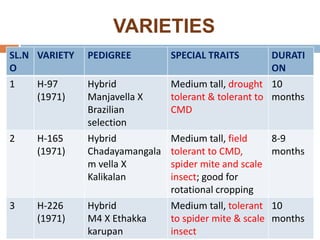
VARIETIES
SL.N
O
VARIETY PEDIGREE SPECIAL TRAITS DURATI
ON
1 H-97
(1971)
Hybrid
Manjavella X
Brazilian
selection
Medium tall, drought
tolerant & tolerant to
CMD
10
months
2 H-165
(1971)
Hybrid
Chadayamangala
m vella X
Kalikalan
Medium tall, field
tolerant to CMD,
spider mite and scale
insect; good for
rotational cropping
8-9
months
3 H-226
(1971)
Hybrid
M4 X Ethakka
karupan
Medium tall, tolerant
to spider mite & scale
insect
10
months
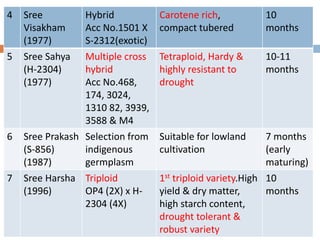
4 Sree
Visakham
(1977)
Hybrid
Acc No.1501 X
S-2312(exotic)
Carotene rich,
compact tubered
10
months
5 Sree Sahya
(H-2304)
(1977)
Multiple cross
hybrid
Acc No.468,
174, 3024,
1310 82, 3939,
3588 & M4
Tetraploid, Hardy &
highly resistant to
drought
10-11
months
6 Sree Prakash
(S-856)
(1987)
Selection from
indigenous
germplasm
Suitable for lowland
cultivation
7 months
(early
maturing)
7 Sree Harsha
(1996)
Triploid
OP4 (2X) х H-
2304 (4X)
1st triploid variety.High
yield & dry matter,
high starch content,
drought tolerant &
robust variety
10
months
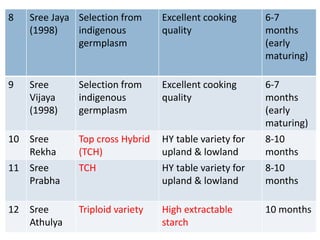
8 Sree Jaya
(1998)
Selection from
indigenous
germplasm
Excellent cooking
quality
6-7
months
(early
maturing)
9 Sree
Vijaya
(1998)
Selection from
indigenous
germplasm
Excellent cooking
quality
6-7
months
(early
maturing)
10 Sree
Rekha
Top cross Hybrid
(TCH)
HY table variety for
upland & lowland
8-10
months
11 Sree
Prabha
TCH HY table variety for
upland & lowland
8-10
months
12 Sree
Athulya
Triploid variety High extractable
starch
10 months
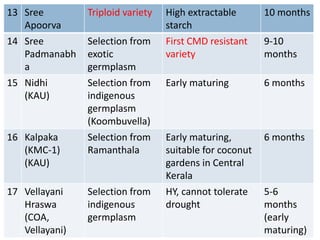
13 Sree
Apoorva
Triploid variety High extractable
starch
10 months
14 Sree
Padmanabh
a
Selection from
exotic
germplasm
First CMD resistant
variety
9-10
months
15 Nidhi
(KAU)
Selection from
indigenous
germplasm
(Koombuvella)
Early maturing 6 months
16 Kalpaka
(KMC-1)
(KAU)
Selection from
Ramanthala
Early maturing,
suitable for coconut
gardens in Central
Kerala
6 months
17 Vellayani
Hraswa
(COA,
Vellayani)
Selection from
indigenous
germplasm
HY, cannot tolerate
drought
5-6
months
(early
maturing)
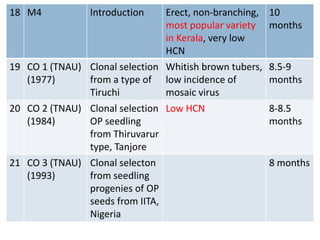
18 M4 Introduction Erect, non-branching,
most popular variety
in Kerala, very low
HCN
10
months
19 CO 1 (TNAU)
(1977)
Clonal selection
from a type of
Tiruchi
Whitish brown tubers,
low incidence of
mosaic virus
8.5-9
months
20 CO 2 (TNAU)
(1984)
Clonal selection
OP seedling
from Thiruvarur
type, Tanjore
Low HCN 8-8.5
months
21 CO 3 (TNAU)
(1993)
Clonal selecton
from seedling
progenies of OP
seeds from IITA,
Nigeria
8 months
22 CO 4 (TNAU)
(2002)
Clonal selection
from one of the
seedling
progenies of the
hybrid SM1679
8.5 months
23 MVD – 1
(Horticulture
Dept. of TN)
Clonal selection Exhibits field
tolerance to CMD
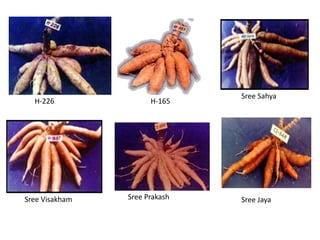
H-226 H-165
Sree Sahya
Sree Visakham Sree Prakash Sree Jaya
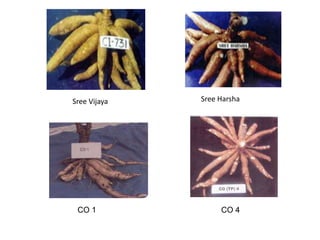
Sree Vijaya Sree Harsha
CO 1 CO 4
CENTERS
 IITA (International Institute of Tropical Agriculture),
Nigeria
 CIAT(International Centre for Tropical Agriculture),
Colombia
 CTCRI(Central Tuber Crops Research Institute),
Sreekariyam, Trivandrum
(Regional Centre at Bhubaneshwar)
 Tapioca and Castor Research Station, Yethapur, Selam,
TamilNadu
THANK
YOU

Tapioca

  • 1.
  • 2.
    SYSTEMATIC POSITION  Domain: Eukaryota  Kingdom : Plantae  Phylum : Spermatophyta  Subphylum : Angiospermae  Class : Dicotyledonae  Order : Euphorbiales  Family : Euphorbiaceae  Genus : Manihot  Species : esculenta
  • 3.
    CASSAVA / TAPIOCA 2n=2x=36  Center of origin : North-East Brazil  Most important starchy root crop grown in tropics  King of tropical tuber crops  Introduced to India during 17th century by Portugese  Major tropical root crop in India, occupying 63% of total area under root & tuber crops- occupies about 0.26mha of land producing 5.868mt of fresh roots.  Mainly cultivated in Southern peninsular India – Kerala, Tamil Nadu & Karnataka
  • 4.
     Kerala accountsfor about 55% of cassava cultivated area (1,42,000ha) in India  Important alternate source of energy to meet the demands of increasing population  Produce more food per unit area, capacity to withstand biotic & abiotic stresses and adaptability to conditions of drought and marginal lands
  • 5.
     Cassava notknown in wild state  98 species in genus Manihot ranging from subshrubs to shrubs and trees, majority producing latex and containing cyanogenic glucosides  Roots of wild species are fibrous and slender  Wild progenitors : M. flabellifolia M. peruviana
  • 6.
    RELATED SPECIES  M.anomala  M. caerulescence  M. euprinosa  M. flabellifolia – wild progenitor  M. glaziovii  M. grahami  M. tristis  M. peruviana – wild progenitor  M. pruinosa – closest wild relative
  • 7.
    BOTANY  Slender shrub,2-7m high, sparingly branched  Stem is thick with prominent leaf scars, variously coloured  Leaves simple, alternate, long stalked, palmately lobed, segments obovate lanceolate, glabrous
  • 8.
     Inflorescence bornein axillary racemes near the end of branches.  Inflorescence is monoecious with male flowers at top and female flowers at bottom.  Female flowers larger in size than male ones.  Each flower have 5 united sepals yellow tinged.
  • 9.
     Male flowerhas 10 stamens arranged in two whorls of 5 stamens each alternately long and short, one converging & other diverging  Filaments are free and anthers small & basifixed  Basal nectiferous disc, fleshy and orange in colour
  • 10.
     In femaleflowers, perianth lobes are completely free  Superior ovary, mounted on a ten lobed glandular disc, tricarpellary, 3 loculed, 6 ridged  Single ovule in each locule  Style surrounded by 3 lobed stigma, each lobe much sub divided forming highly lobed stigma
  • 11.
     Fruit isovoid, globose with 9 longitudinal plicate wings
  • 12.
    Pollination  Cross pollination,predominantly entomophilous ADAPTATIONS:  Unisexual nature of flowers  Protogynous condition (female flowers open 10 days before anthesis of male flowers)  Distinct interphase  Presence of secretary glands  Pollen grains heavy and sticky  Female flowers opened fully, sticky stigma & highly branched  Pollen grains viable for even one week
  • 13.
    BREEDING OBJECTIVES  Highyield (>35 t/ha fresh root)  High starch (> 25%)  Short duration  High harvest index  Responsive to additional inputs  Non-branching plant type  Low HCN content  Good cooking and eating quality  Early harvestability
  • 14.
     Better rootstorage quality  Shade tolerance for use as an intercrop under coconut etc.  Wide adaptation  Compact branches  Compact root system  Resistance to major diseases (cassava bacterial blight, anthracnose, brown leaf spot, cassava mosaic virus)  Tolerance to adverse soil and climatic conditions
  • 15.
    BREEDING METHODS  Clonalselection  Hybridization and selection  Interspecific hybridisation  Heterosis breeding  Polyploidy breeding  Mutation breeding  Biotechnological approaches
  • 16.
    1. CLONAL SELECTION Considerable amount of variability exists in crop in India & much more available in other cassava growing regions, esp. in tropical south Latin America (COO for cassava).  Number of cassava germplasm accessions in CTCRI is about 1654 including 60 hybrids, 8 wild species, 806 indigenous cultivars and 781 exotic collections the latter received from CIAT, Brazil, IITA, Madagascar, Malaysia, Sri Lanka, etc.
  • 17.
     Achievements:  M4and M6 from Malaysia  Sree Prakash (S-856, indigenous selection) CTCRI  Sree Jaya, Sree Vijaya, Nidhi, Kalpaka  Vellayani Hraswa  Acc. S-1309, S-1310, S-315, S-2407 and S-2331  CO-1, CO-2, CO-3 & CO-4 from TNAU
  • 18.
    2. HYBRIDISATION &SELECTION  Tapioca being propagated vegetatively, breeding programme is more time consuming due to its long production period.  Induction of flowering in sparingly flowering varieties is a problem.
  • 19.
     It canbe done by increasing day length, since long day condition favours induction of more flowering.  Foliar application of IAA, NAA and Ascorbic acid at 50 ppm is also recommended to increase the intensity of flowering.
  • 20.
     Achievements:  H-97 H-165  H-226  Sree Visakham (H-1687)  Sree Prakash (S-856)  Sree Sahya (H-2304) – Multiple hybrid  Sree Rekha  Sree Prabha
  • 21.
    3. INTERSPECIFIC HYBRIDISATION To enhance the protein content and to incorporate disease resistance into cultivated cassava, hybridization between cera rubber (Manihot glaziovii) and selected clones of cassava was attempted at CTCRI, Thiruvananthapuram.  Repeated back crossing of interspecific hybrid of cassava was carried out, but acceptable root quality was not recovered.
  • 22.
    4. HETEROSIS BREEDING Cassava is highly heterozygous and this heterozygosity is perpetuated through years of asexual propagation. Through selfing, good inbred lines could be developed and promising hybrids could be obtained by crossing of superior inbreds.  To exploit the hybrid vigour in cassava, work done at CTCRI, Thiruvananthapuram revealed that some hybrids are performing better than their parents and even existing varieties in terms of tuber yield, quality etc.
  • 23.
    5. POLYPLOIDY BREEDING Induced tetraploids by colchicine treatment are poor yielding and less adapted to normal field conditions.  Triploids developed by crossing tetraploids and diploids are reported to be promising and therefore it is possible to improve cassava by producing new chromosomal lines, in which chromosome number does not go beyond an optimum level.  To produce triploids, a number of tetraploid clones are crossed with diploids.
  • 24.
     Successful productionof triploids in large enough numbers to be able to exert selection pressure, is possible only in a limited number of combinations, probably due to the operation of cytological diploidization over a period of time in some tetraploids.  Achievement:  Sree Harsha [OP4 (2X) х H-2304 (4X)]  Sree Athulya  Sree Apoorva
  • 25.
    4. MUTATION BREEDING Mutagen used is gamma radiation  Successful induction and recovery of more than 50 mutants could be accomplished at CTCRI by gamma irradiation of single node cuttings.  Mutants showed considerable variation from control in terms of root yield, DM, starch content, HCN content, chlorophyll content, proline content, etc.  No economic mutants isolated so far.
  • 26.
    5. BIOTECHNOLOGICAL APPROACHES  Techniquesfor elimination of CMD, developed first in Canada by Kartha and Gamborg in 1978 were modified by scientists to suit the local conditions.  Disease- free plants of M4, H-97, H-165, H-226, Sree Visakham, Sree Sahya and Sree Prakash are produced and multiplied, and are now being distributed to farmers in India.  In field trials these plants out-yielded normal symptom-free plants to the extent of 10 to 25%, depending on cultivars.
  • 27.
     Sero-diagnostic testsshowed that the meristem derived plants were free from CMD during the initial stages.  Marker Assisted Selection(MAS) and genetic transformation studies are under progress in CIAT.
  • 28.
    VARIETIES SL.N O VARIETY PEDIGREE SPECIALTRAITS DURATI ON 1 H-97 (1971) Hybrid Manjavella X Brazilian selection Medium tall, drought tolerant & tolerant to CMD 10 months 2 H-165 (1971) Hybrid Chadayamangala m vella X Kalikalan Medium tall, field tolerant to CMD, spider mite and scale insect; good for rotational cropping 8-9 months 3 H-226 (1971) Hybrid M4 X Ethakka karupan Medium tall, tolerant to spider mite & scale insect 10 months
  • 29.
    4 Sree Visakham (1977) Hybrid Acc No.1501X S-2312(exotic) Carotene rich, compact tubered 10 months 5 Sree Sahya (H-2304) (1977) Multiple cross hybrid Acc No.468, 174, 3024, 1310 82, 3939, 3588 & M4 Tetraploid, Hardy & highly resistant to drought 10-11 months 6 Sree Prakash (S-856) (1987) Selection from indigenous germplasm Suitable for lowland cultivation 7 months (early maturing) 7 Sree Harsha (1996) Triploid OP4 (2X) х H- 2304 (4X) 1st triploid variety.High yield & dry matter, high starch content, drought tolerant & robust variety 10 months
  • 30.
    8 Sree Jaya (1998) Selectionfrom indigenous germplasm Excellent cooking quality 6-7 months (early maturing) 9 Sree Vijaya (1998) Selection from indigenous germplasm Excellent cooking quality 6-7 months (early maturing) 10 Sree Rekha Top cross Hybrid (TCH) HY table variety for upland & lowland 8-10 months 11 Sree Prabha TCH HY table variety for upland & lowland 8-10 months 12 Sree Athulya Triploid variety High extractable starch 10 months
  • 31.
    13 Sree Apoorva Triploid varietyHigh extractable starch 10 months 14 Sree Padmanabh a Selection from exotic germplasm First CMD resistant variety 9-10 months 15 Nidhi (KAU) Selection from indigenous germplasm (Koombuvella) Early maturing 6 months 16 Kalpaka (KMC-1) (KAU) Selection from Ramanthala Early maturing, suitable for coconut gardens in Central Kerala 6 months 17 Vellayani Hraswa (COA, Vellayani) Selection from indigenous germplasm HY, cannot tolerate drought 5-6 months (early maturing)
  • 32.
    18 M4 IntroductionErect, non-branching, most popular variety in Kerala, very low HCN 10 months 19 CO 1 (TNAU) (1977) Clonal selection from a type of Tiruchi Whitish brown tubers, low incidence of mosaic virus 8.5-9 months 20 CO 2 (TNAU) (1984) Clonal selection OP seedling from Thiruvarur type, Tanjore Low HCN 8-8.5 months 21 CO 3 (TNAU) (1993) Clonal selecton from seedling progenies of OP seeds from IITA, Nigeria 8 months
  • 33.
    22 CO 4(TNAU) (2002) Clonal selection from one of the seedling progenies of the hybrid SM1679 8.5 months 23 MVD – 1 (Horticulture Dept. of TN) Clonal selection Exhibits field tolerance to CMD
  • 34.
    H-226 H-165 Sree Sahya SreeVisakham Sree Prakash Sree Jaya
  • 35.
    Sree Vijaya SreeHarsha CO 1 CO 4
  • 36.
    CENTERS  IITA (InternationalInstitute of Tropical Agriculture), Nigeria  CIAT(International Centre for Tropical Agriculture), Colombia  CTCRI(Central Tuber Crops Research Institute), Sreekariyam, Trivandrum (Regional Centre at Bhubaneshwar)  Tapioca and Castor Research Station, Yethapur, Selam, TamilNadu
  • 37.

Editor's Notes

  • #37 Contributns on cassava rsrch in India is made almost entirely by CTCRI, Tvpm and its regional centre at Bhubaneshwar. Contributions on varietal dvlpmt also made by Agrl Universities of Kerala & TN.And also All India Coordinated Research Project on Tubercrops with its 11 centers, also contributes to varietal imprvmt by regional testing of varieties.