Polynomials
Polynomials
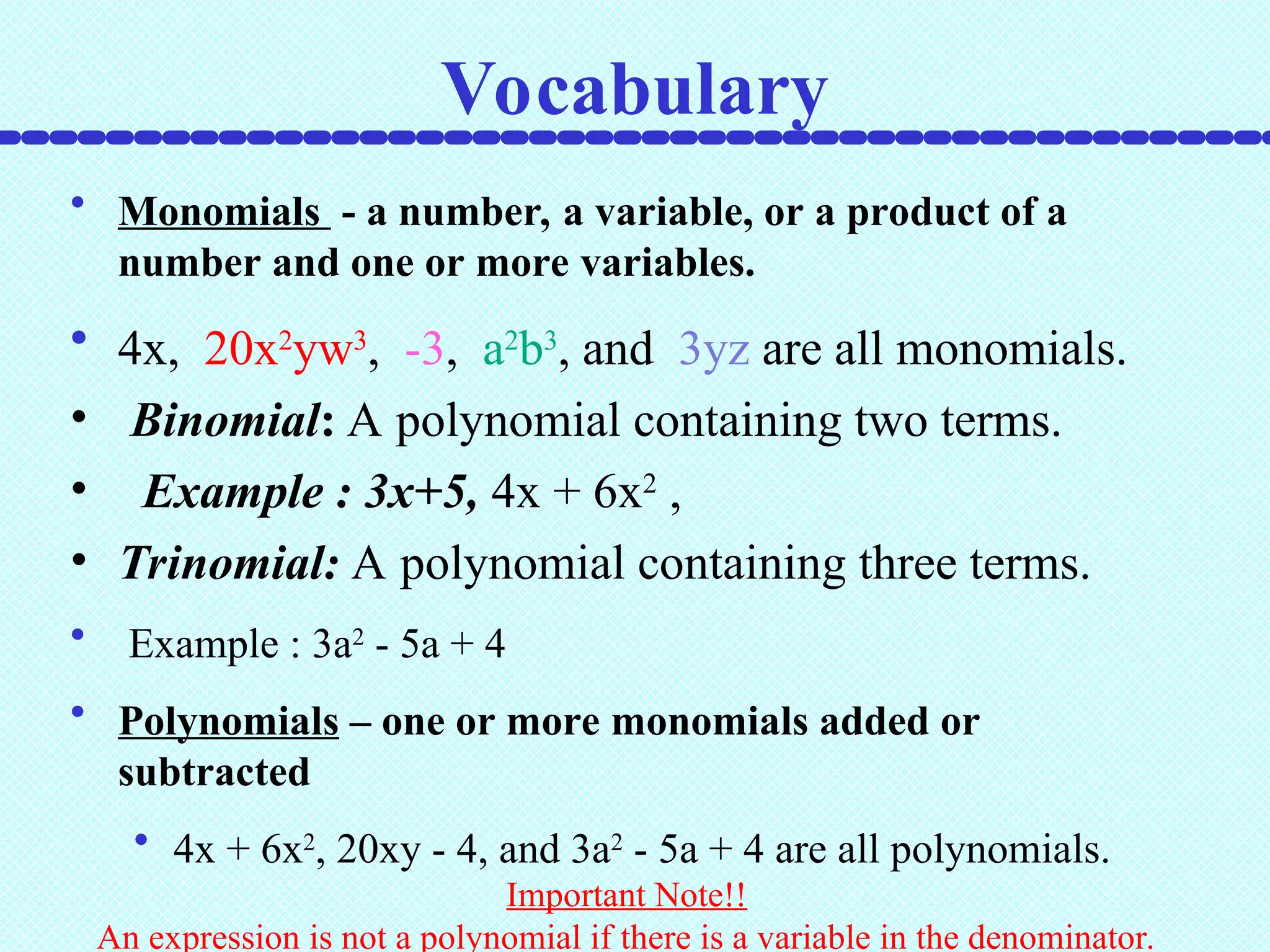
• Monomials - a number, a variable, or a product of a
number and one or more variables.
• 4x, 20x2
yw3
, -3, a2
b3
, and 3yz are all monomials.
• Binomial: A polynomial containing two terms.
• Example : 3x+5, 4x + 6x2
,
• Trinomial: A polynomial containing three terms.
• Example : 3a2
- 5a + 4
• Polynomials – one or more monomials added or
subtracted
• 4x + 6x2
, 20xy - 4, and 3a2
- 5a + 4 are all polynomials.
Important Note!!
An expression is not a polynomial if there is a variable in the denominator.
Vocabulary
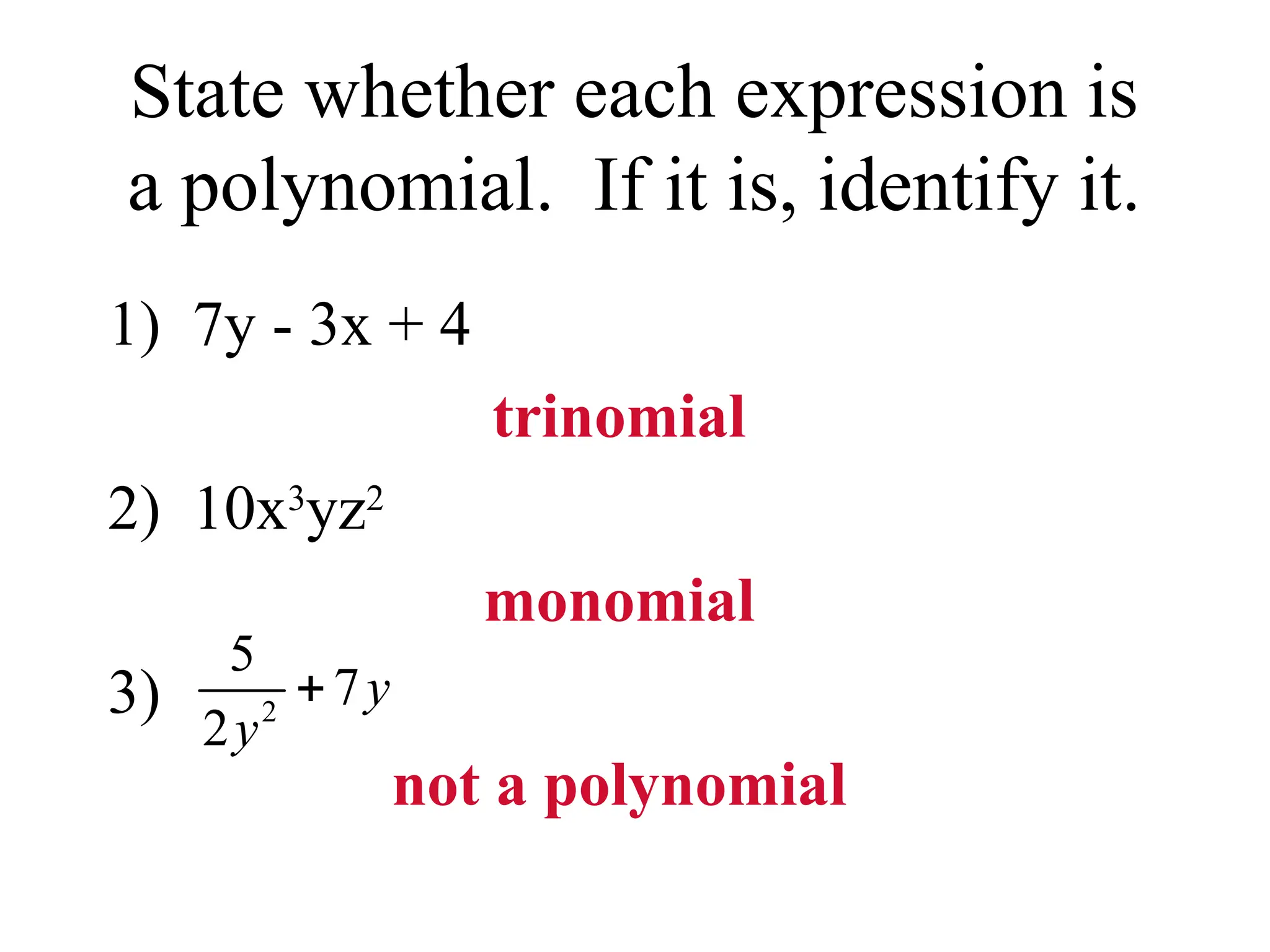
State whether each expression is
a polynomial. If it is, identify it.
1) 7y - 3x + 4
trinomial
2) 10x3
yz2
monomial
3)
not a polynomial
2
5
7
2
y
y

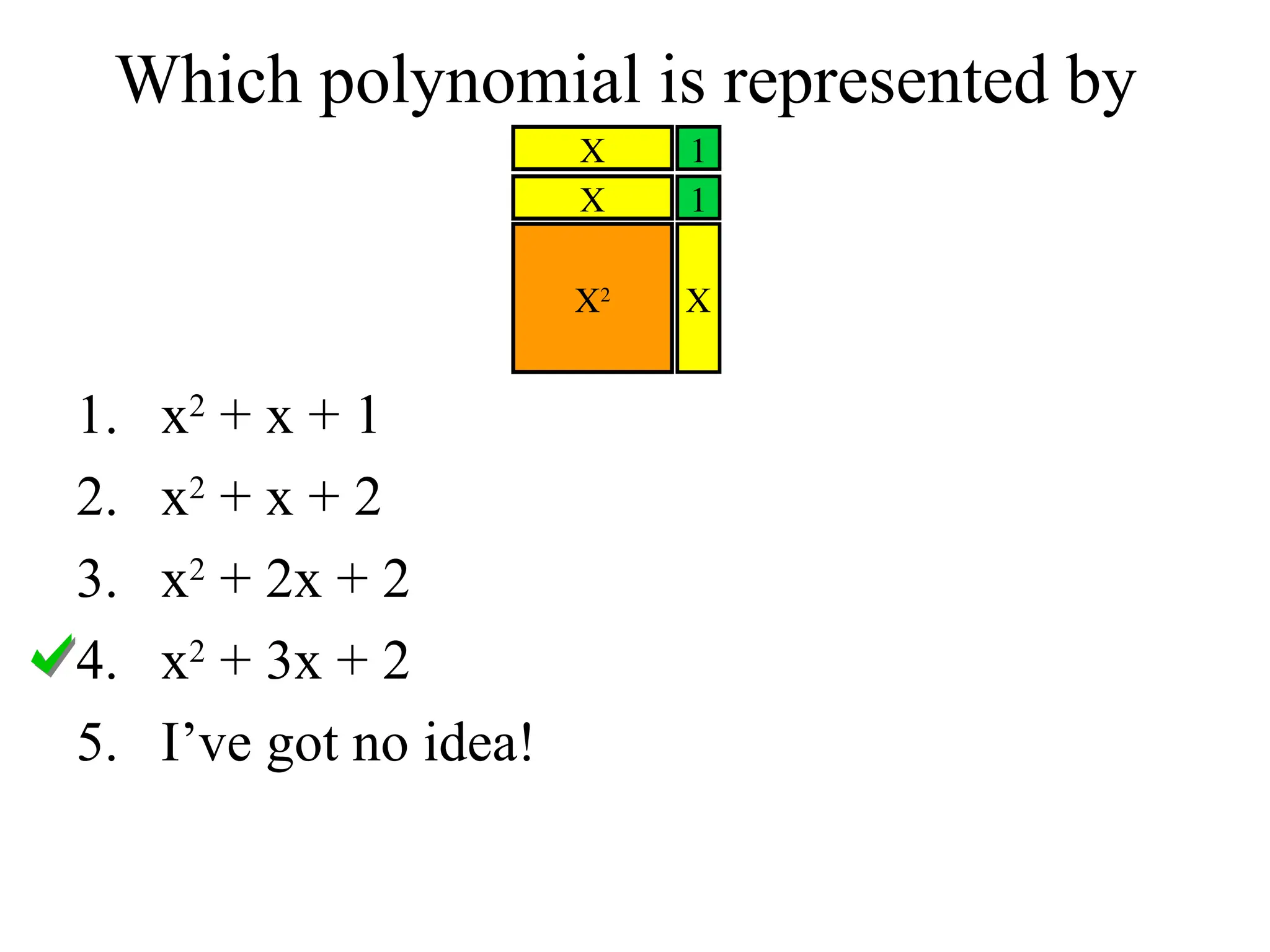
Which polynomial is represented by
X2
1
1
X
X
X
1. x2
+ x + 1
2. x2
+ x + 2
3. x2
+ 2x + 2
4. x2
+ 3x + 2
5. I’ve got no idea!
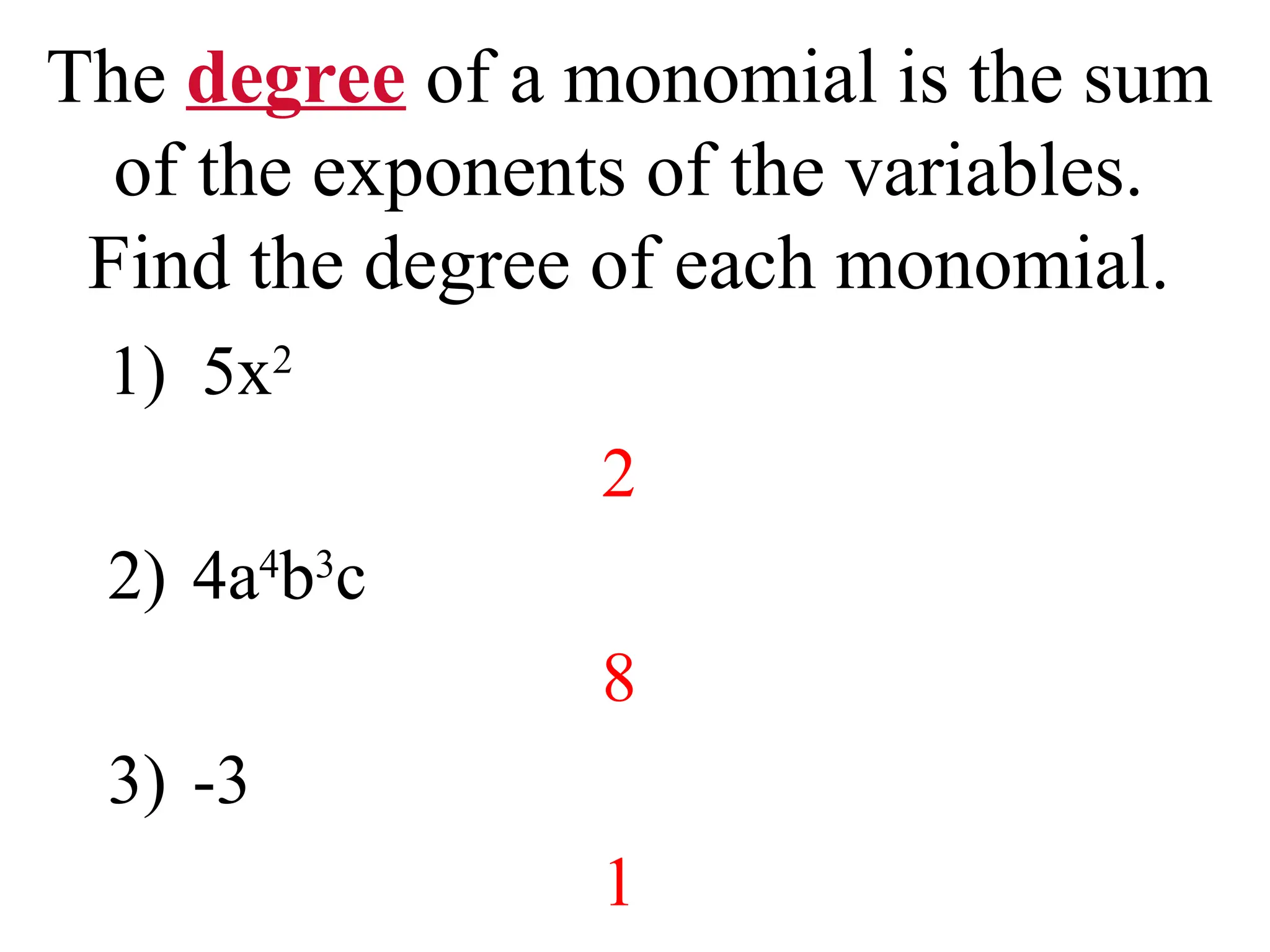
The degree of a monomial is the sum
of the exponents of the variables.
Find the degree of each monomial.
1) 5x2
2
2) 4a4
b3
c
8
3) -3
1
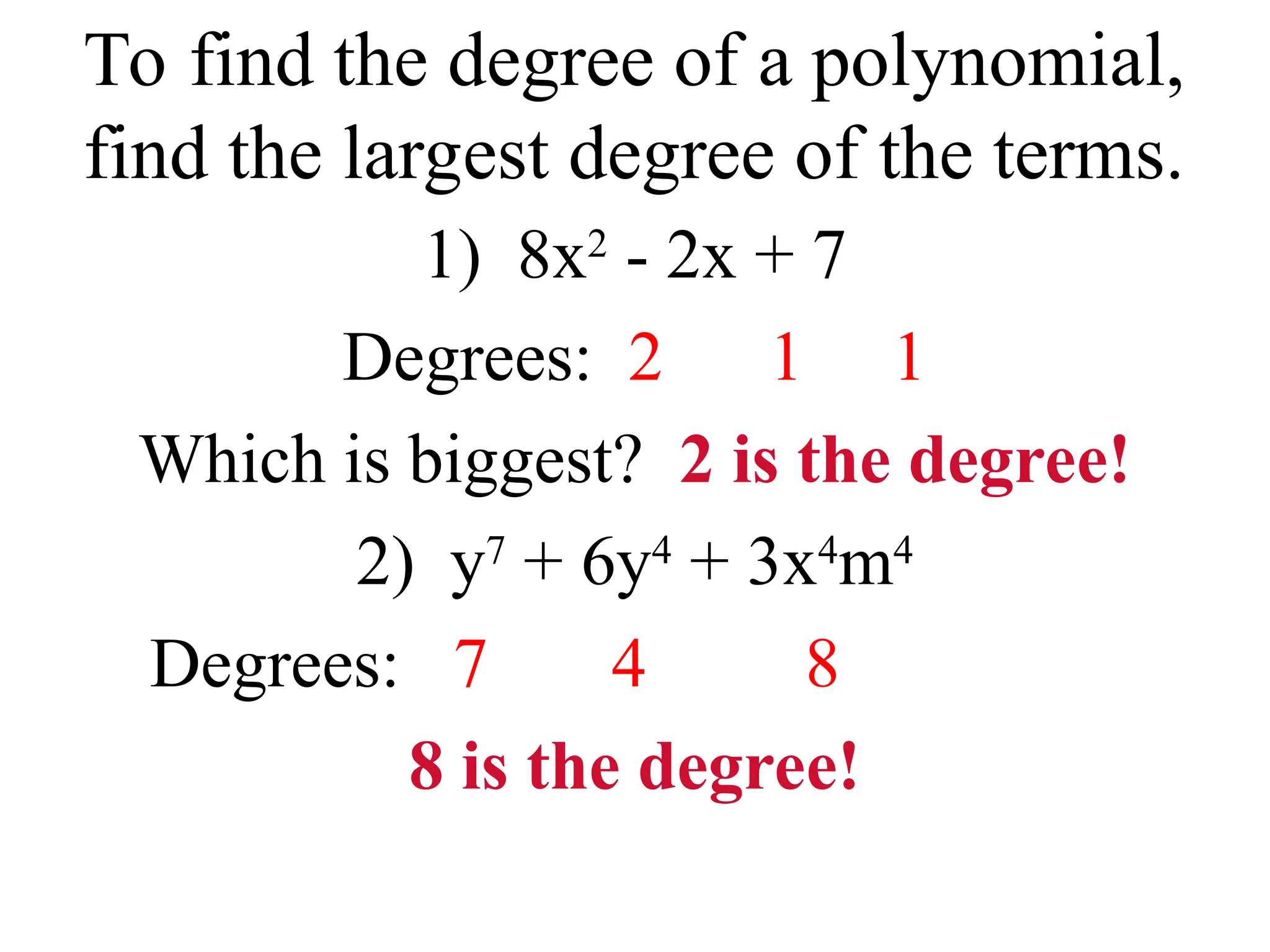
To find the degree of a polynomial,
find the largest degree of the terms.
1) 8x2
- 2x + 7
Degrees: 2 1 1
Which is biggest? 2 is the degree!
2) y7
+ 6y4
+ 3x4
m4
Degrees: 7 4 8
8 is the degree!
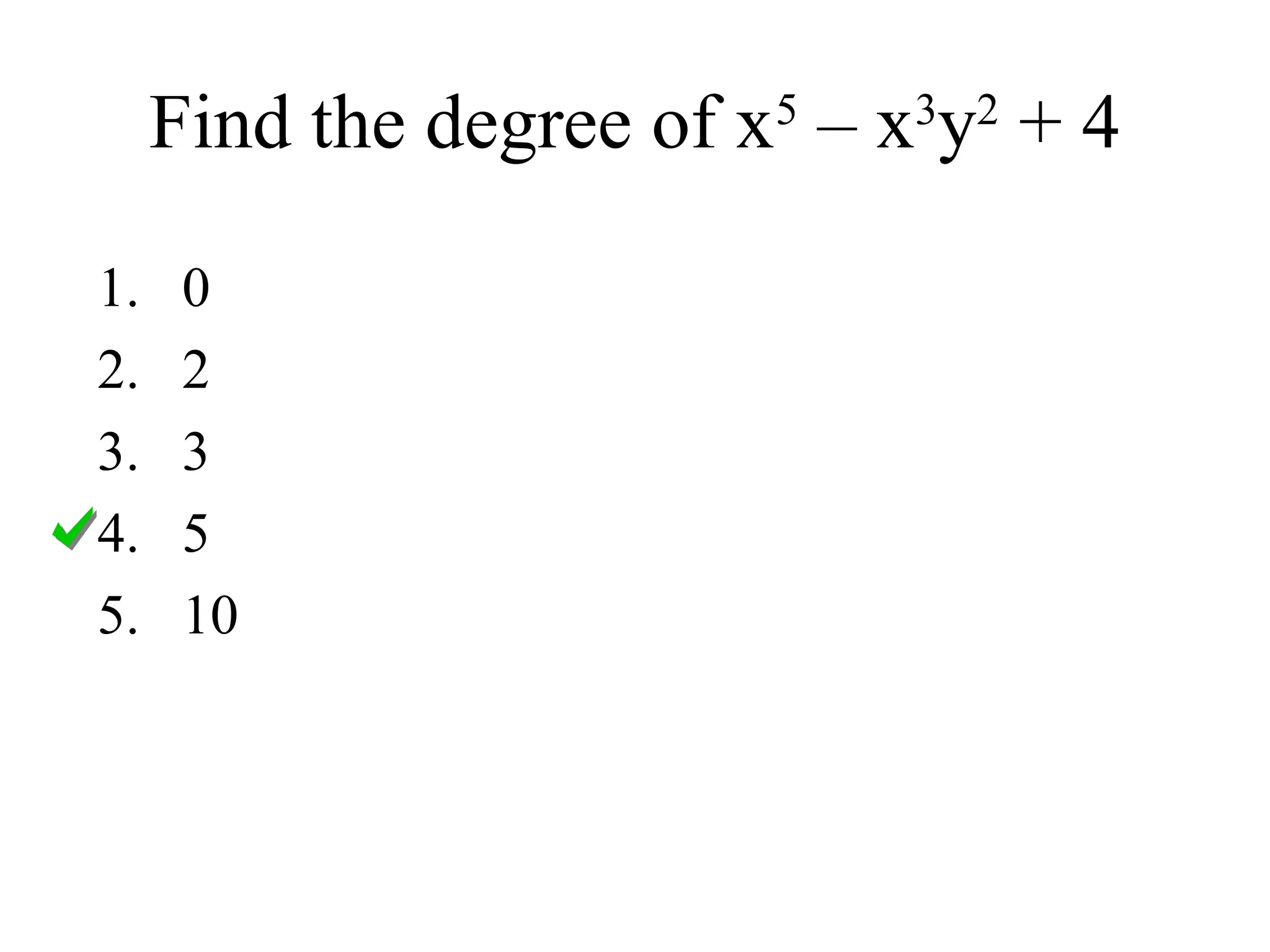
Find the degree of x5
– x3
y2
+ 4
1. 0
2. 2
3. 3
4. 5
5. 10
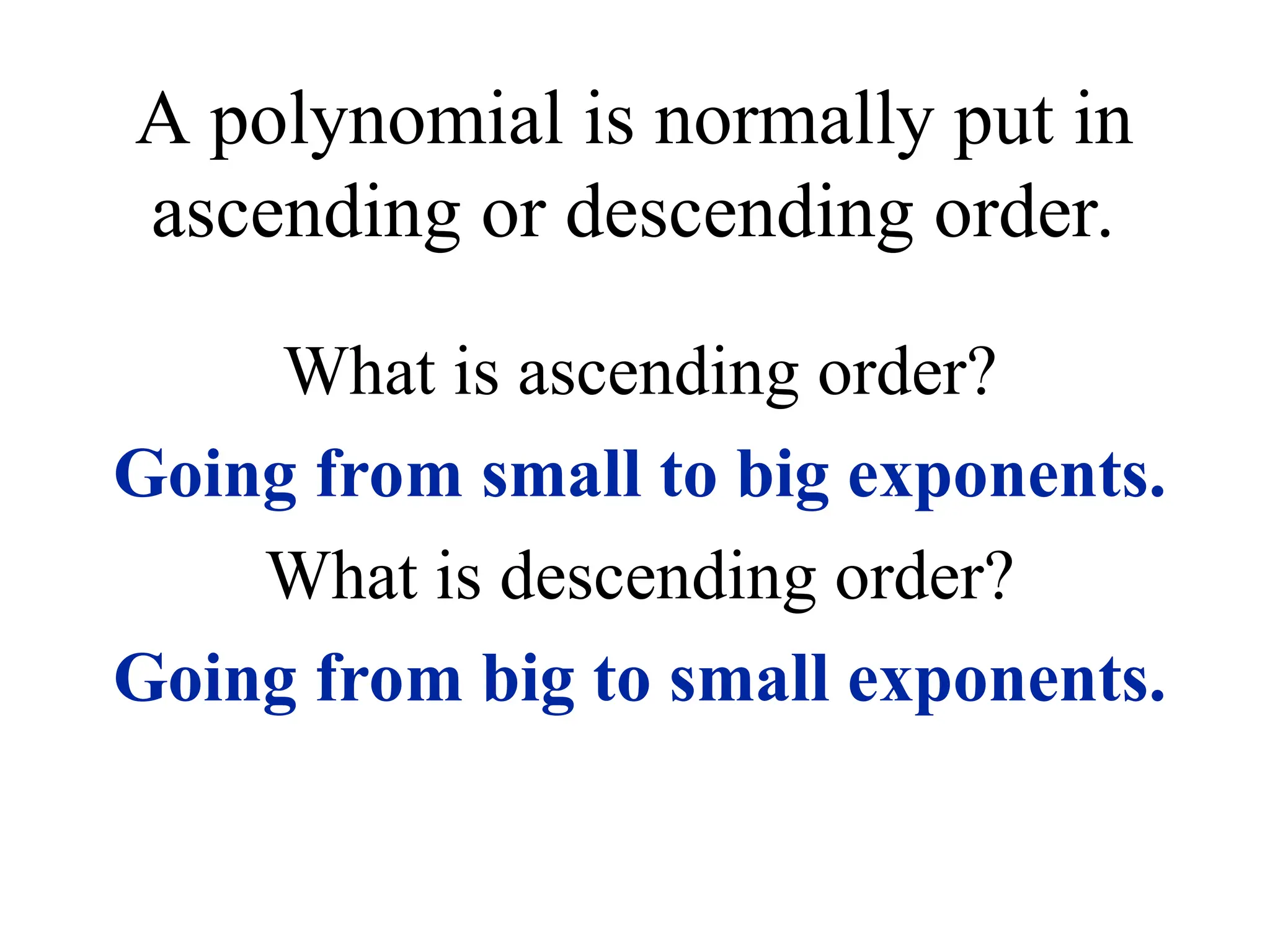
A polynomial is normally put in
ascending or descending order.
What is ascending order?
Going from small to big exponents.
What is descending order?
Going from big to small exponents.
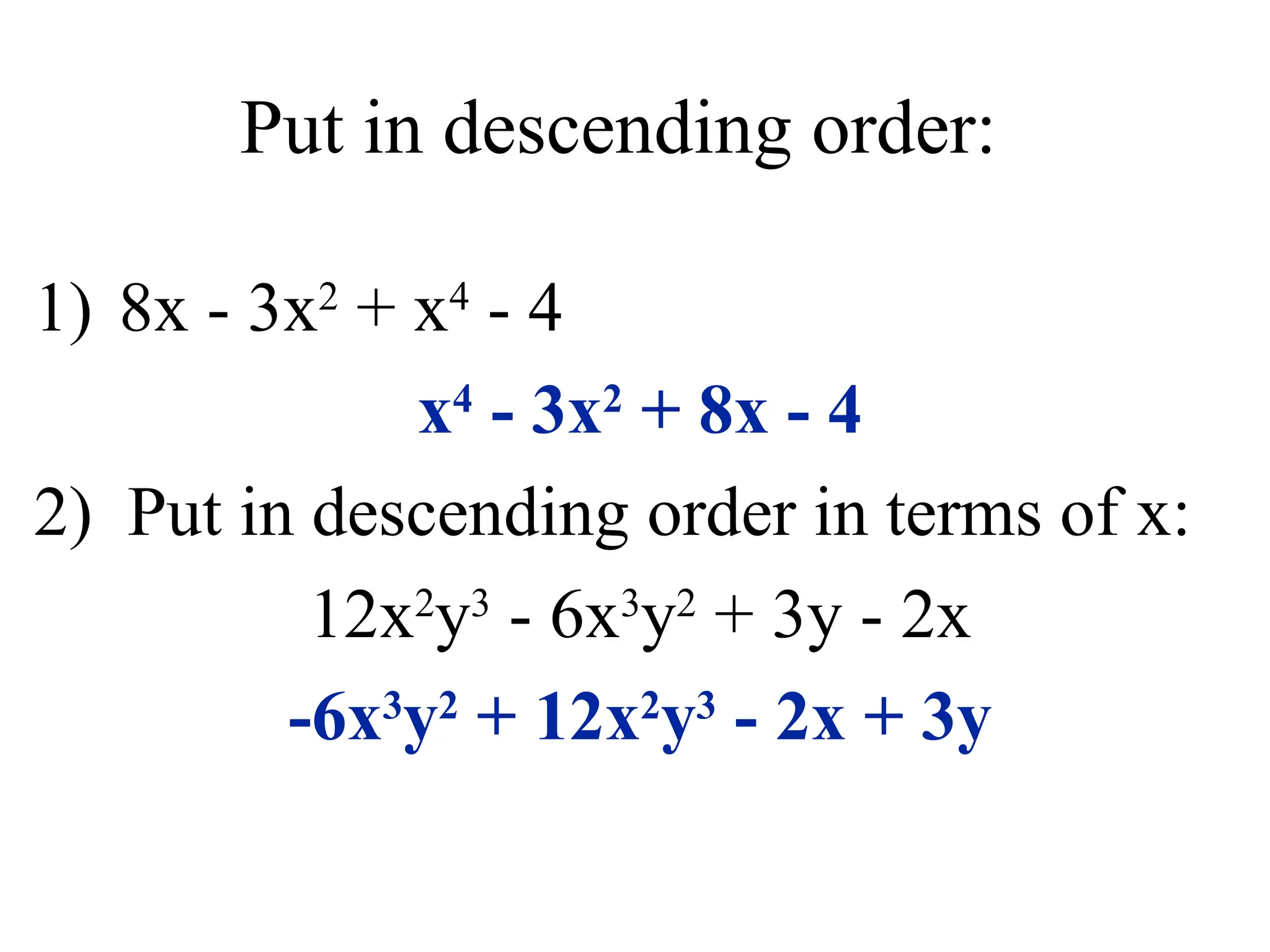
Put in descending order:
1) 8x - 3x2
+ x4
- 4
x4
- 3x2
+ 8x - 4
2) Put in descending order in terms of x:
12x2
y3
- 6x3
y2
+ 3y - 2x
-6x3
y2
+ 12x2
y3
- 2x + 3y
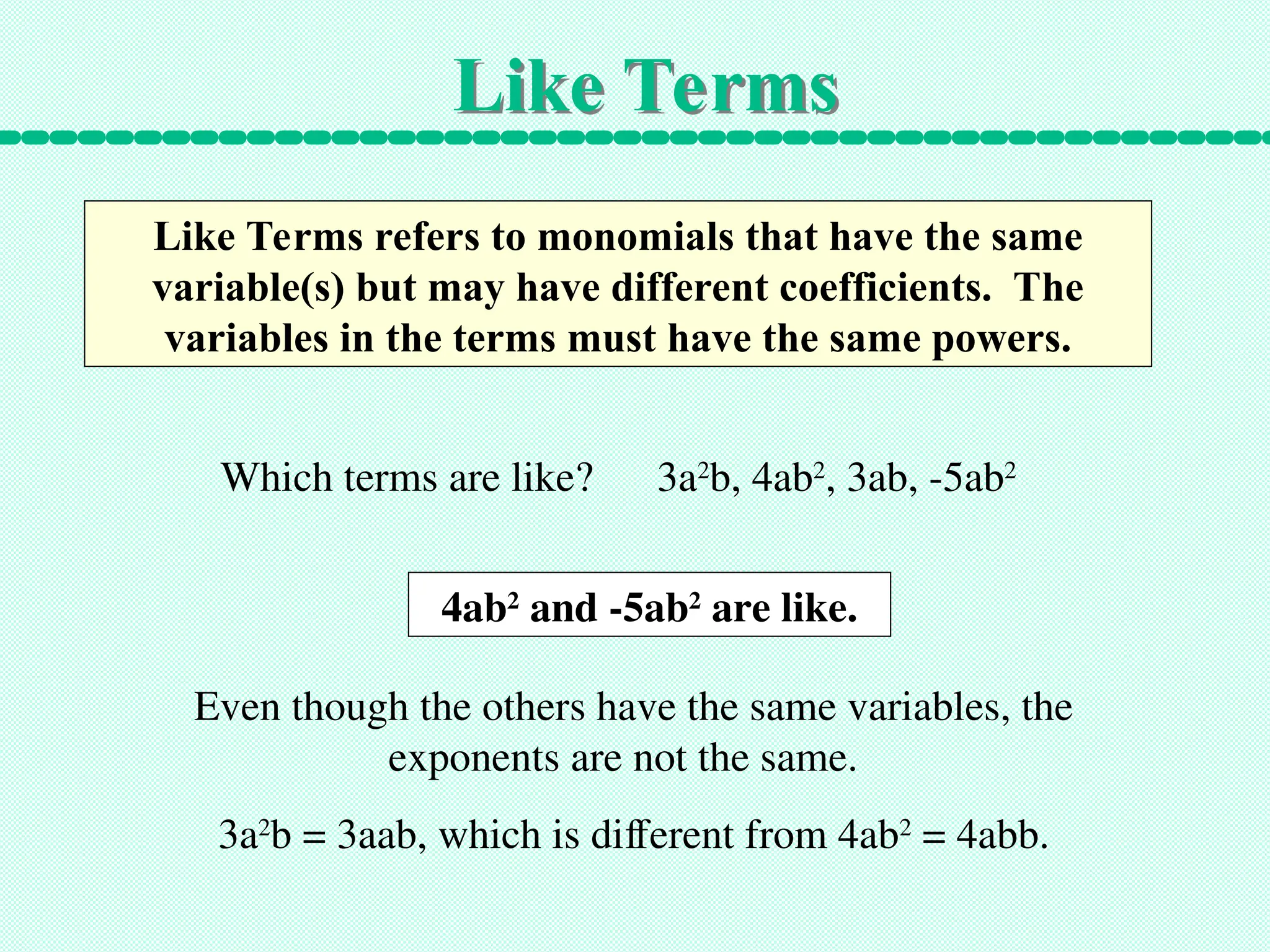
Like Terms
Like Terms refers to monomials that have the same
variable(s) but may have different coefficients. The
variables in the terms must have the same powers.
Which terms are like? 3a2
b, 4ab2
, 3ab, -5ab2
4ab2
and -5ab2
are like.
Even though the others have the same variables, the
exponents are not the same.
3a2
b = 3aab, which is different from 4ab2
= 4abb.
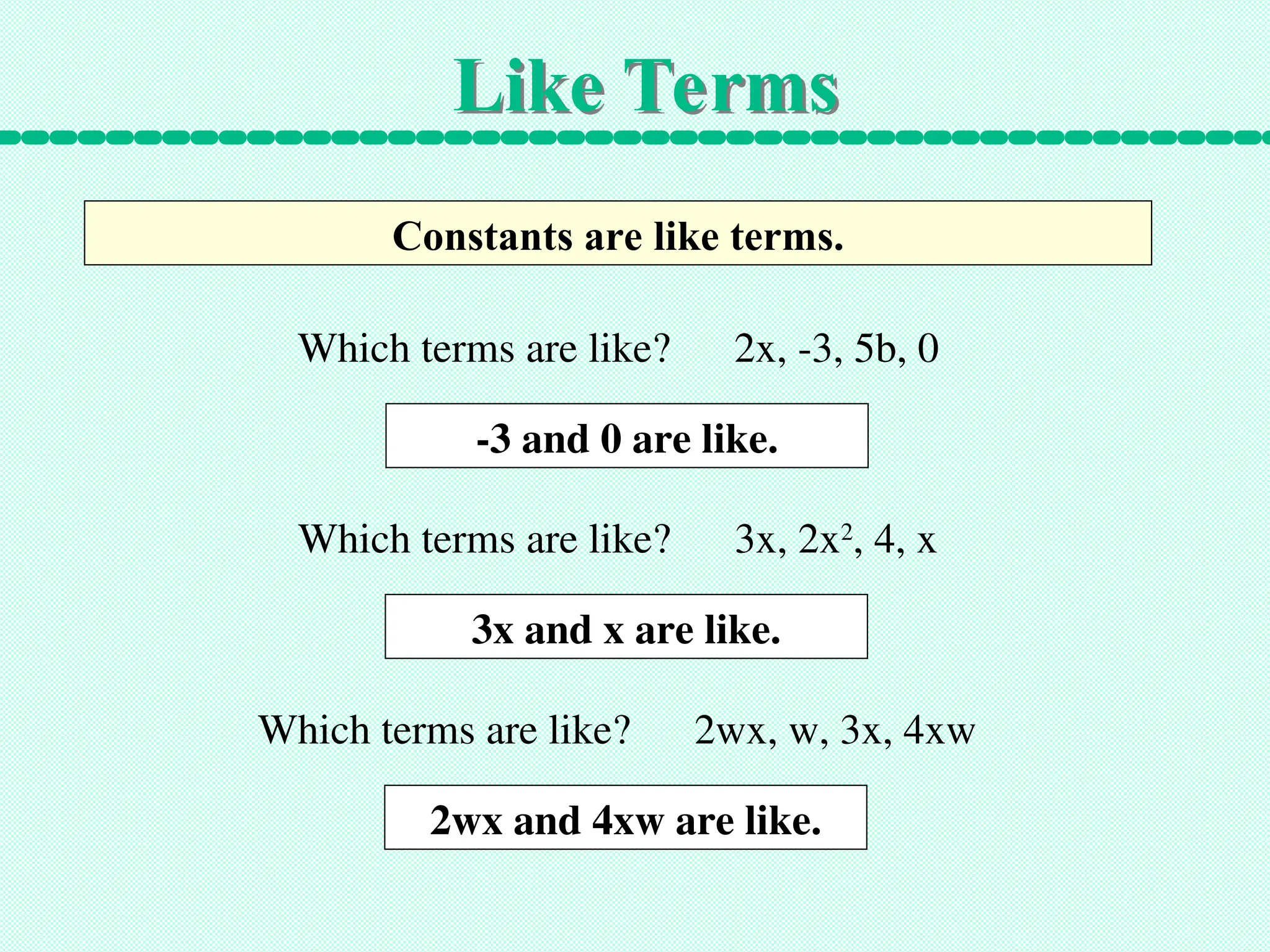
Like Terms
Constants are like terms.
Which terms are like? 2x, -3, 5b, 0
-3 and 0 are like.
Which terms are like? 3x, 2x2
, 4, x
3x and x are like.
Which terms are like? 2wx, w, 3x, 4xw
2wx and 4xw are like.
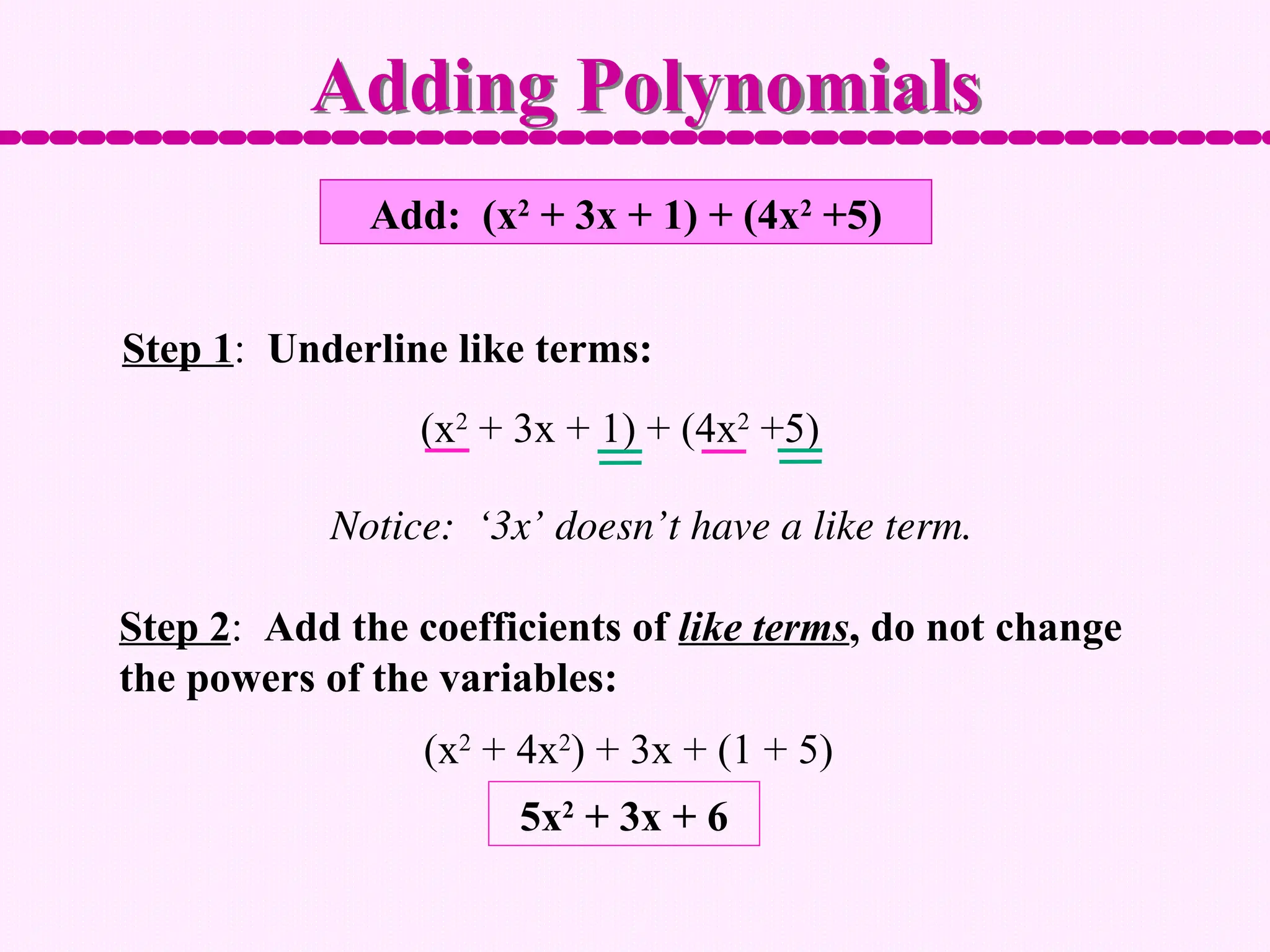
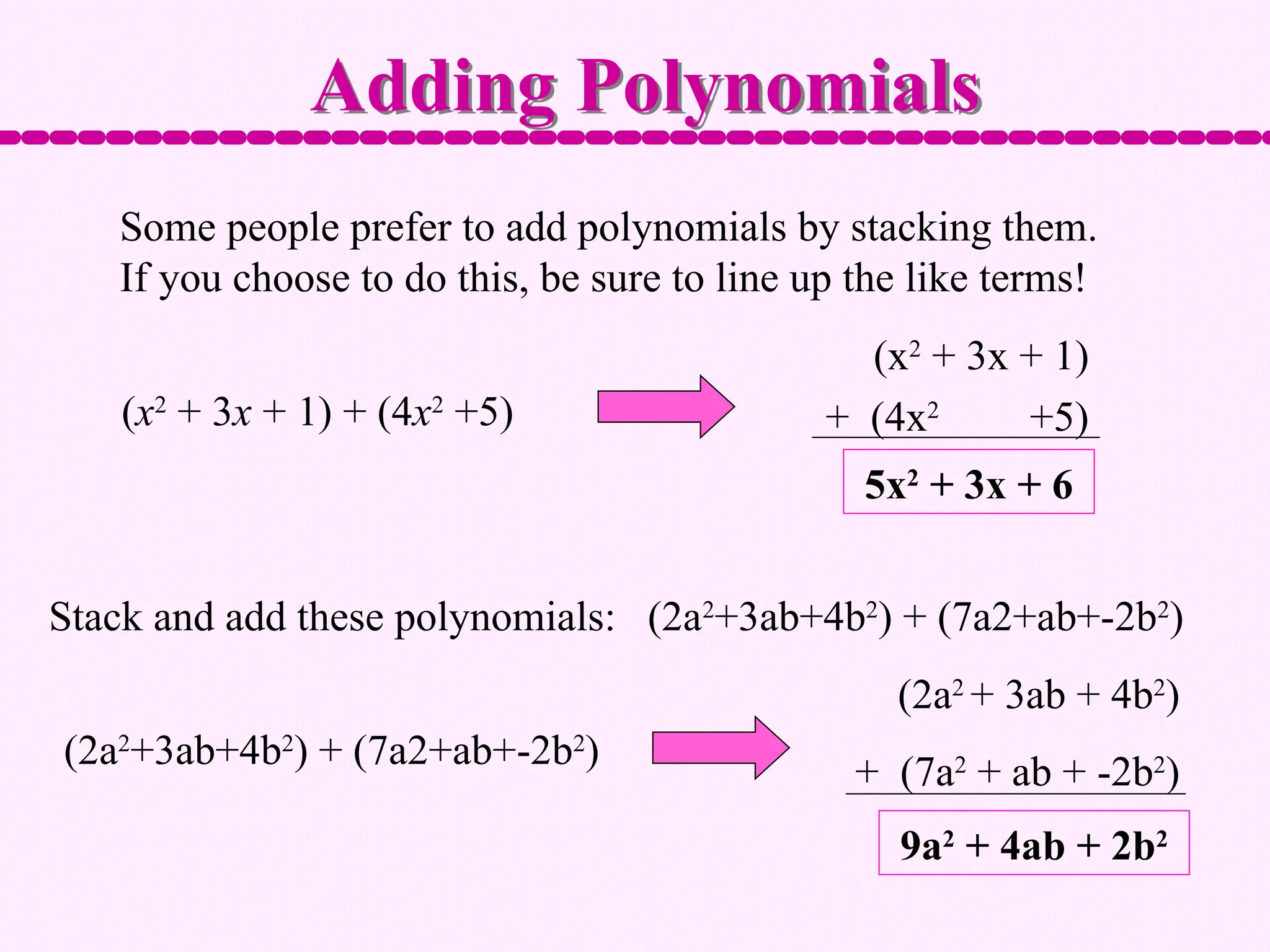
Add: (x2
+ 3x + 1) + (4x2
+5)
Step 1: Underline like terms:
Step 2: Add the coefficients of like terms, do not change
the powers of the variables:
Adding Polynomials
(x2
+ 3x + 1) + (4x2
+5)
Notice: ‘3x’ doesn’t have a like term.
(x2
+ 4x2
) + 3x + (1 + 5)
5x2
+ 3x + 6
Some people prefer to add polynomials by stacking them.
If you choose to do this, be sure to line up the like terms!
Adding Polynomials
(x2
+ 3x + 1) + (4x2
+5)
5x2
+ 3x + 6
(x2
+ 3x + 1)
+ (4x2
+5)
Stack and add these polynomials: (2a2
+3ab+4b2
) + (7a2+ab+-2b2
)
(2a2
+3ab+4b2
) + (7a2+ab+-2b2
)
(2a2
+ 3ab + 4b2
)
+ (7a2
+ ab + -2b2
)
9a2
+ 4ab + 2b2
Adding Polynomials
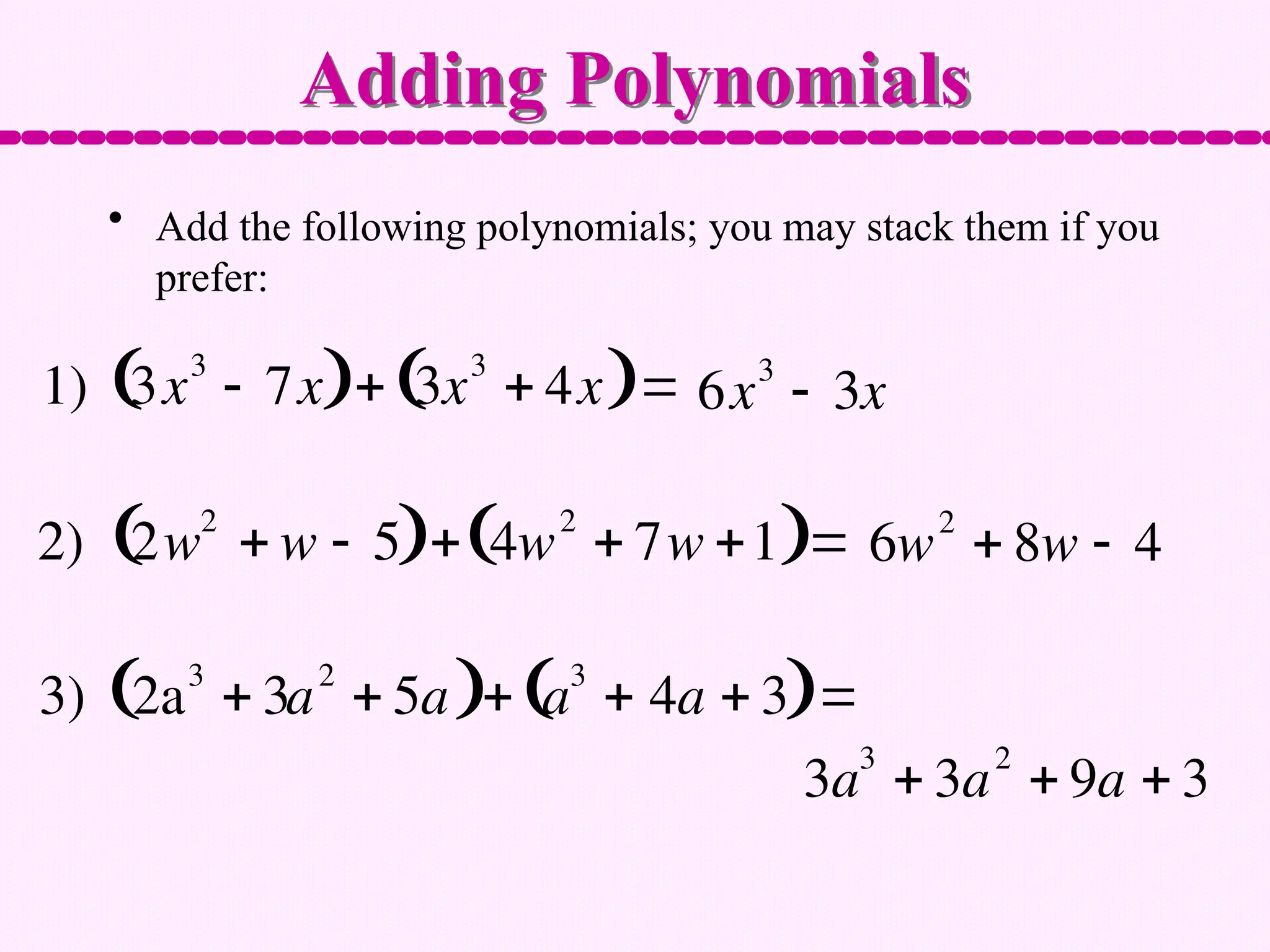
1) 3x3
 7x
  3x3
 4x
  6x3
 3x
2) 2w2
 w  5
  4w2
 7w 1
  6w2
 8w  4
3) 2a3
 3a2
 5a
  a3
 4a  3
 
3a3
 3a2
 9a  3
• Add the following polynomials; you may stack them if you
prefer:
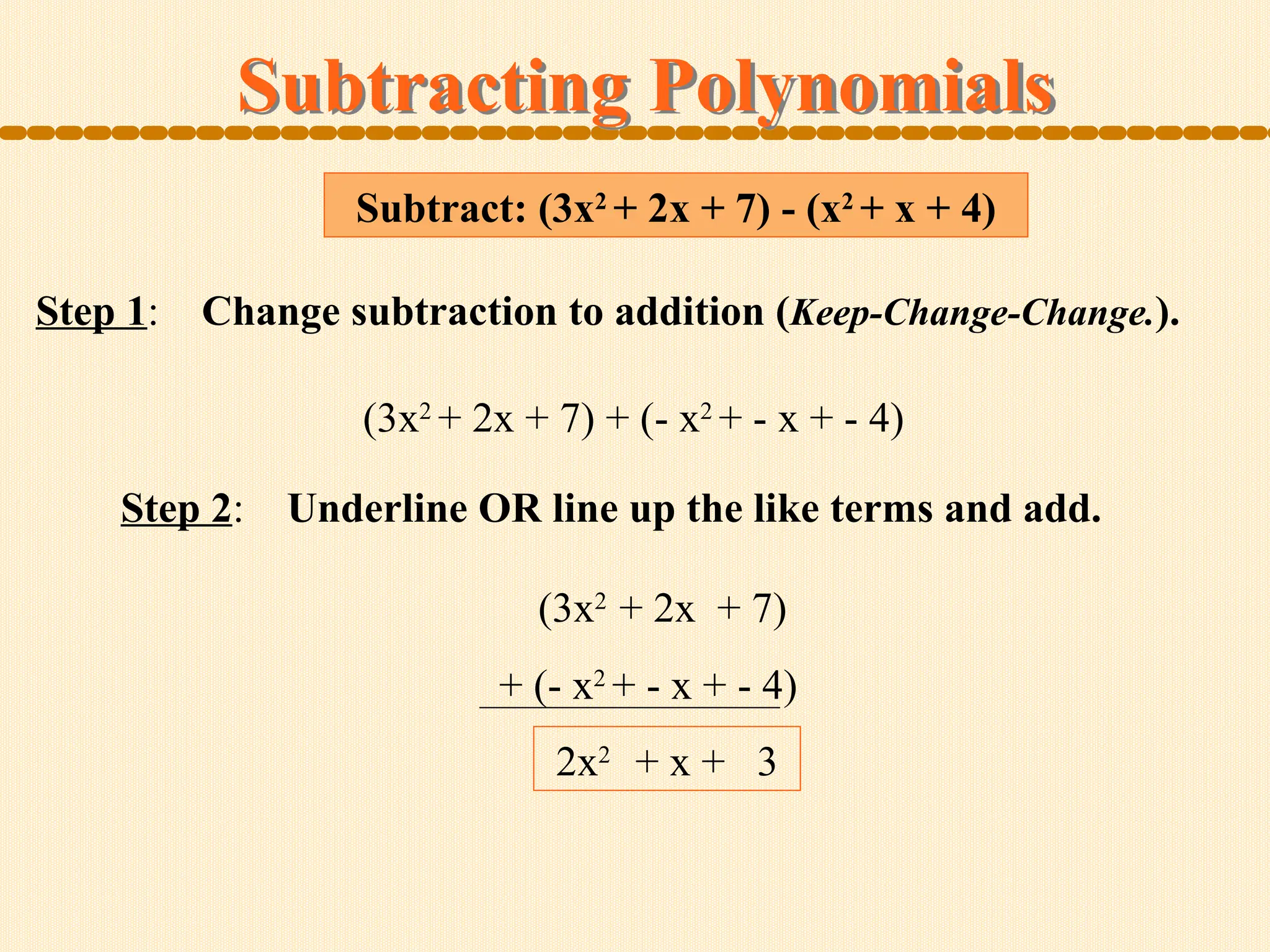
Subtract: (3x2
+ 2x + 7) - (x2
+ x + 4)
Subtracting Polynomials
Step 1: Change subtraction to addition (Keep-Change-Change.).
Step 2: Underline OR line up the like terms and add.
(3x2
+ 2x + 7) + (- x2
+ - x + - 4)
(3x2
+ 2x + 7)
+ (- x2
+ - x + - 4)
2x2
+ x + 3
Subtracting Polynomials
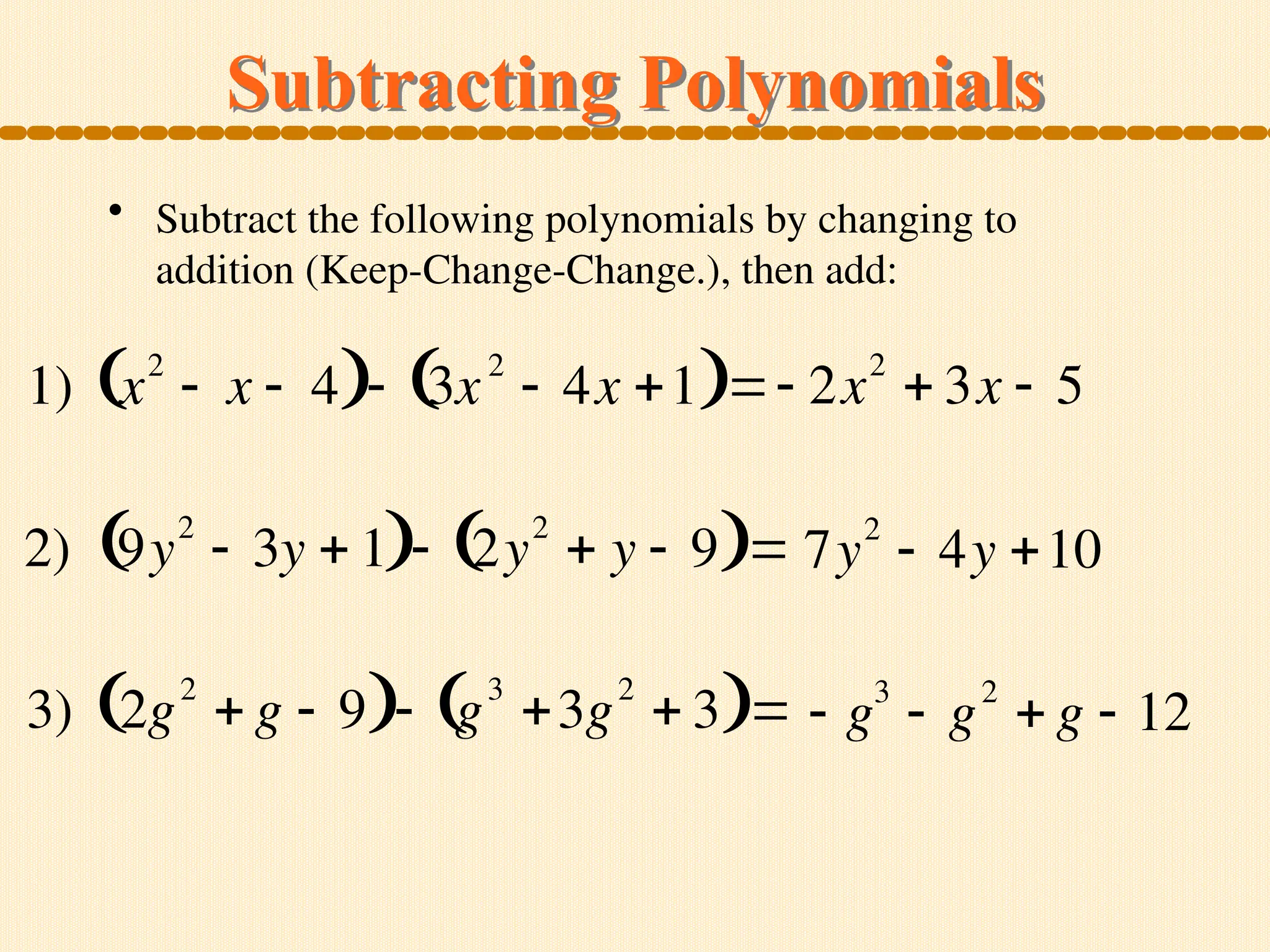
1) x2
 x  4
  3x2
 4x 1
  2x2
 3x  5
2) 9y
2
 3y  1
  2y
2
 y  9
  7y2
 4y 10
3) 2g2
 g  9
  g3
3g2
 3
   g3
 g2
 g  12
• Subtract the following polynomials by changing to
addition (Keep-Change-Change.), then add:
Objective
The student will be able to:
multiply two polynomials using the
FOIL method, Box method and the
distributive property.
Designed by Skip Tyler, Varina High School
There are three techniques you can
use for multiplying polynomials.
The best part about it is that they are all the
same! Huh? Whaddaya mean?
It’s all about how you write it…Here they are!
1)Distributive Property
2)FOIL
3)Box Method
Sit back, relax (but make sure to write this
down), and I’ll show ya!
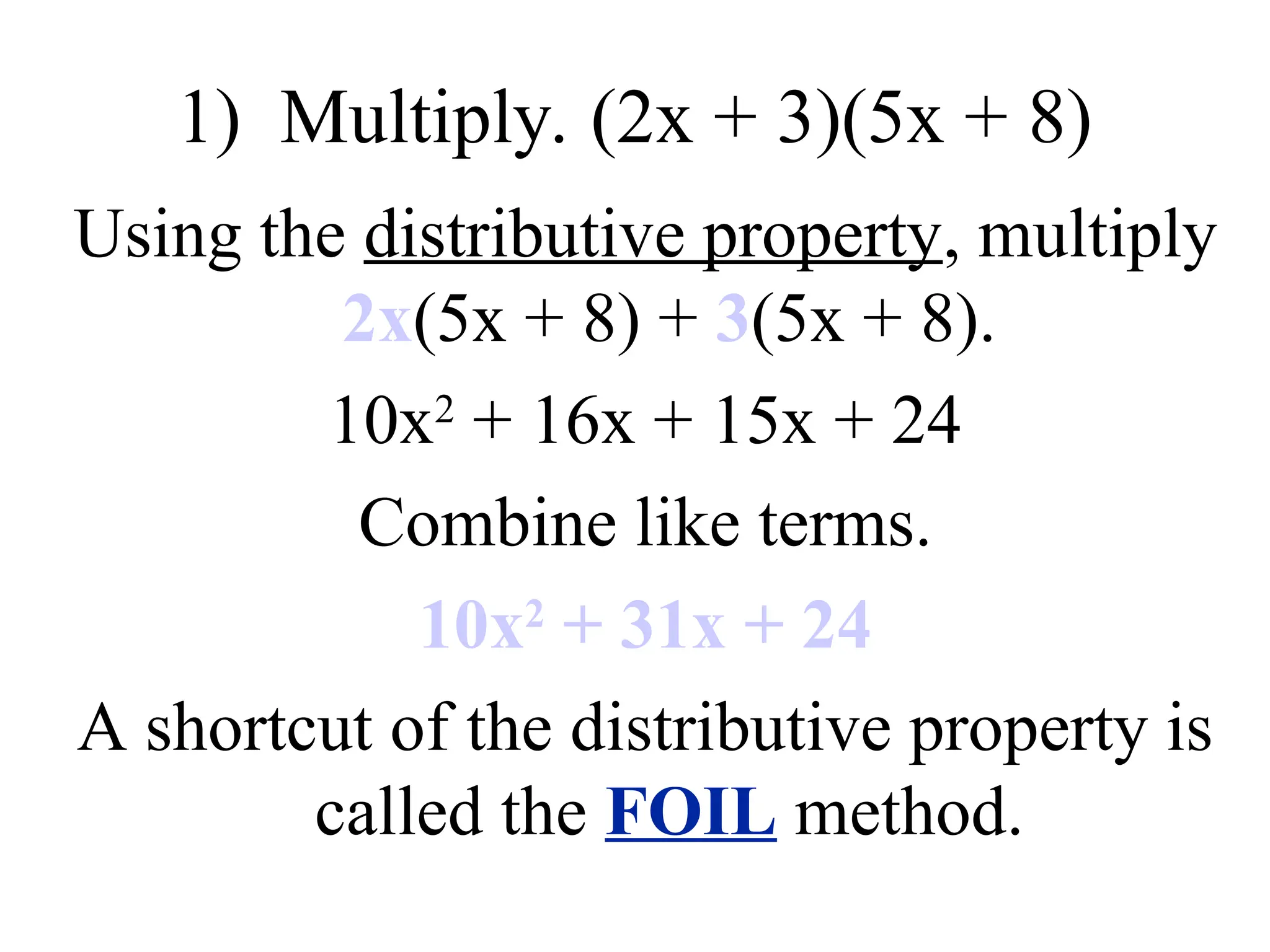
1) Multiply. (2x + 3)(5x + 8)
Using the distributive property, multiply
2x(5x + 8) + 3(5x + 8).
10x2
+ 16x + 15x + 24
Combine like terms.
10x2
+ 31x + 24
A shortcut of the distributive property is
called the FOIL method.
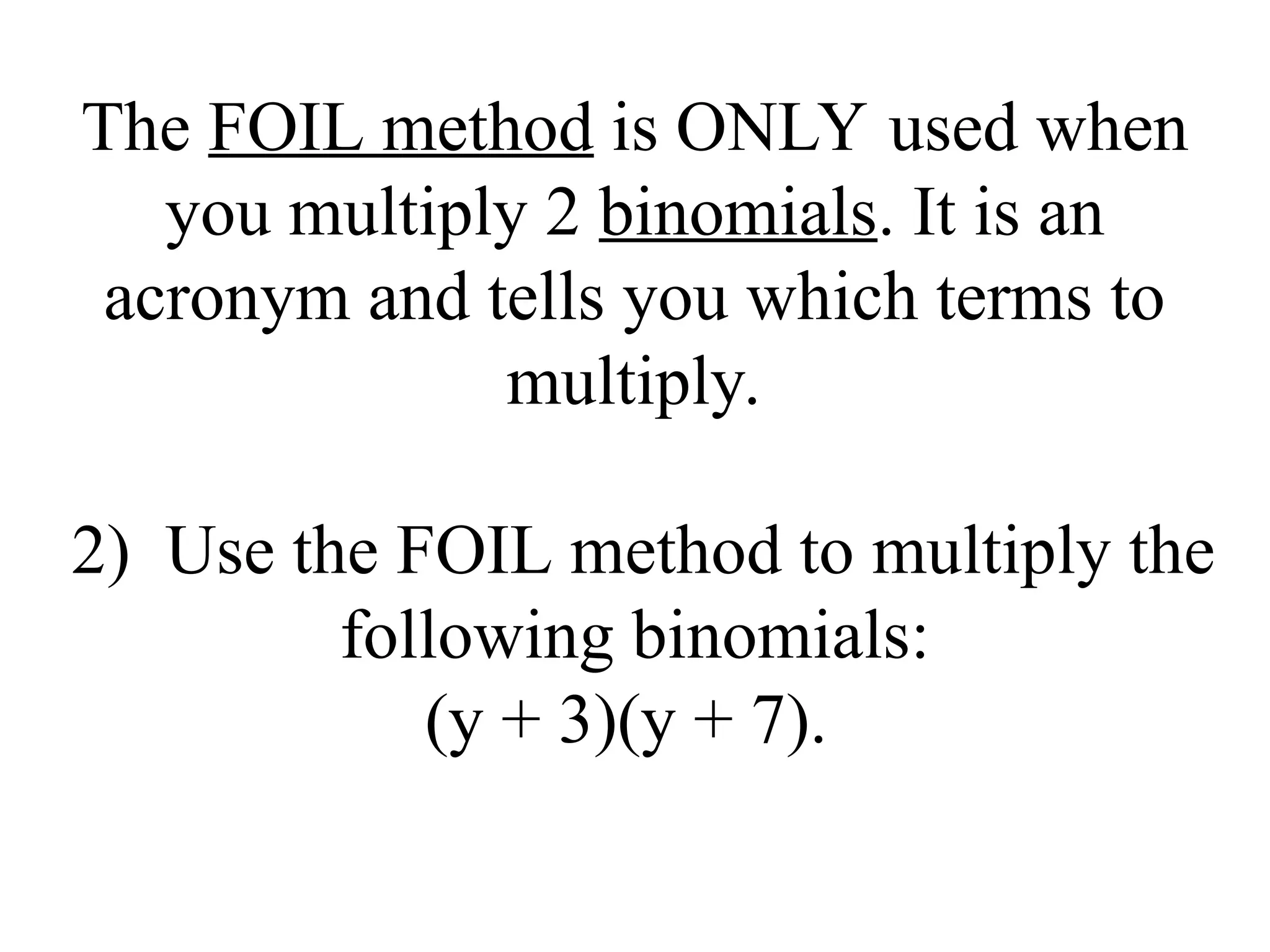
The FOIL method is ONLY used when
you multiply 2 binomials. It is an
acronym and tells you which terms to
multiply.
2) Use the FOIL method to multiply the
following binomials:
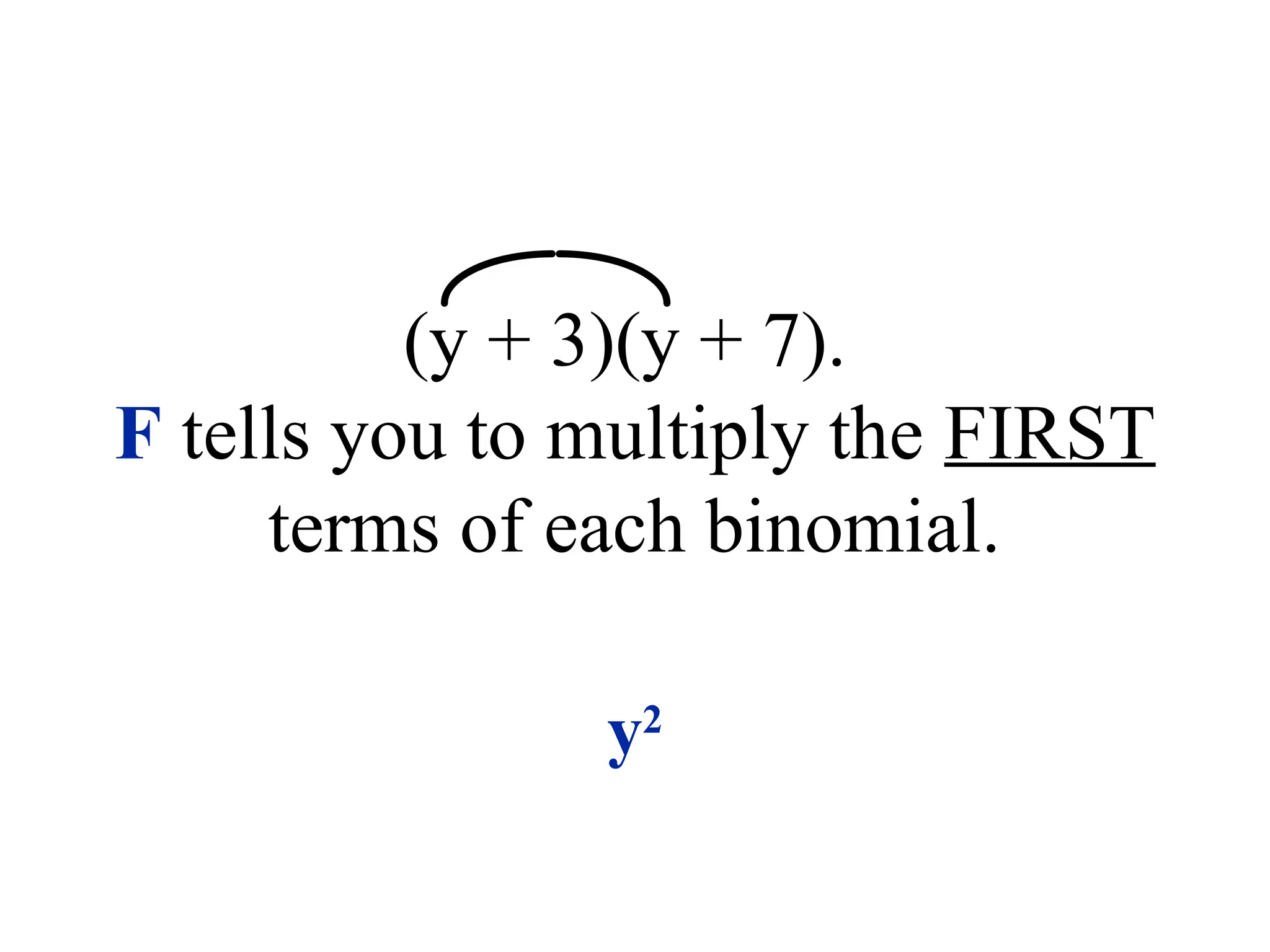
(y + 3)(y + 7).
(y + 3)(y + 7).
F tells you to multiply the FIRST
terms of each binomial.
y2
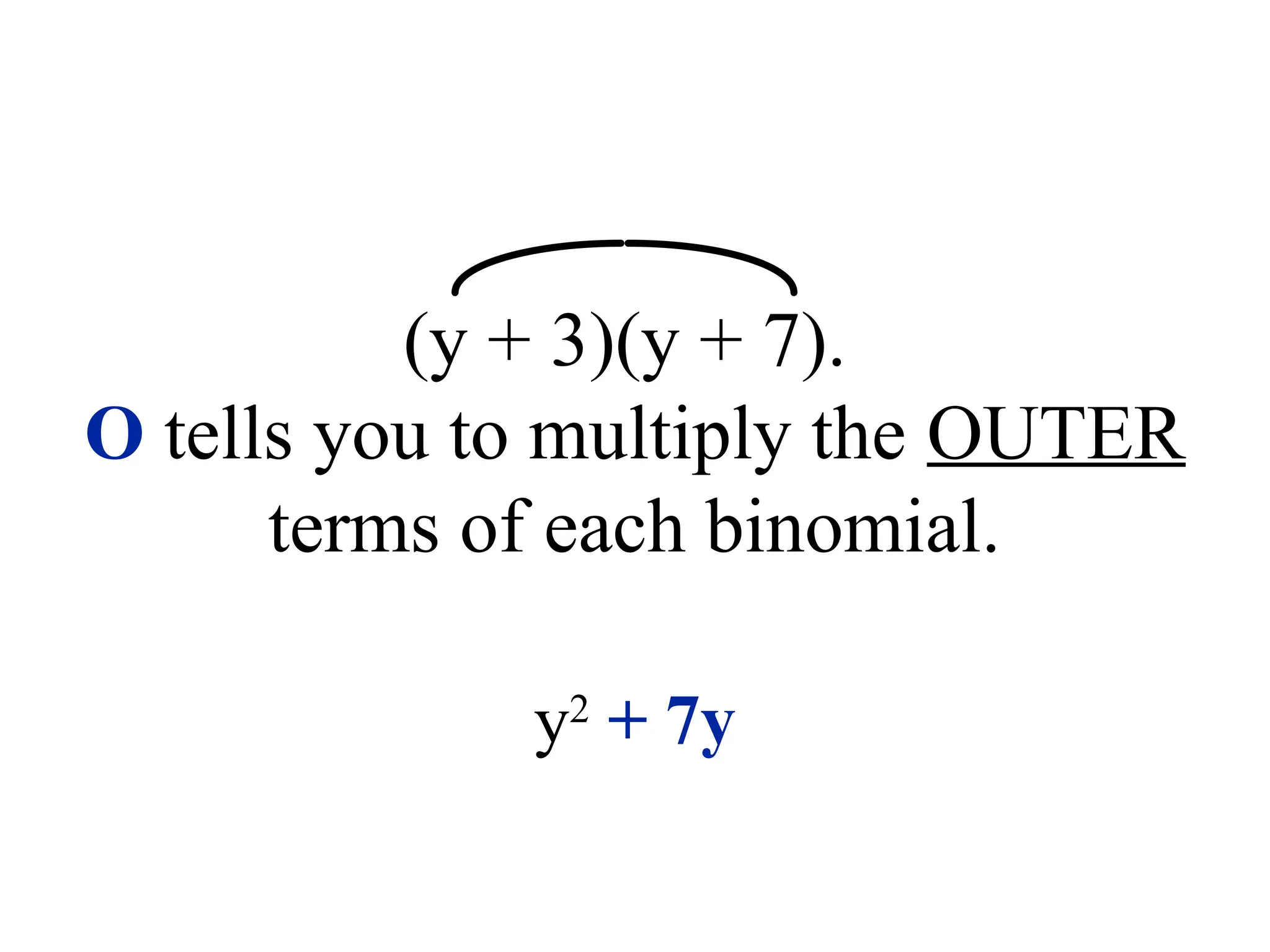
(y + 3)(y + 7).
O tells you to multiply the OUTER
terms of each binomial.
y2
+ 7y
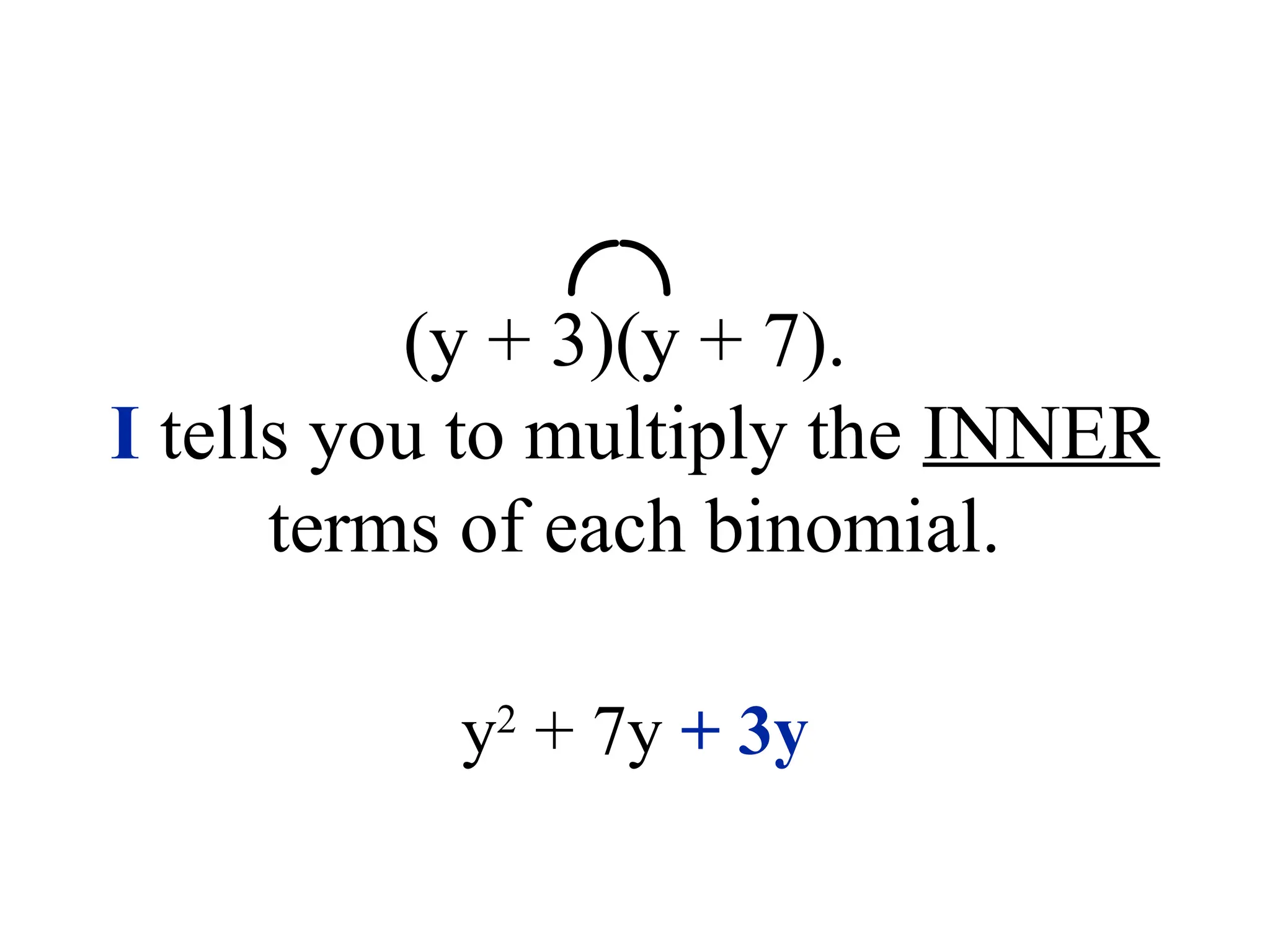
(y + 3)(y + 7).
I tells you to multiply the INNER
terms of each binomial.
y2
+ 7y + 3y
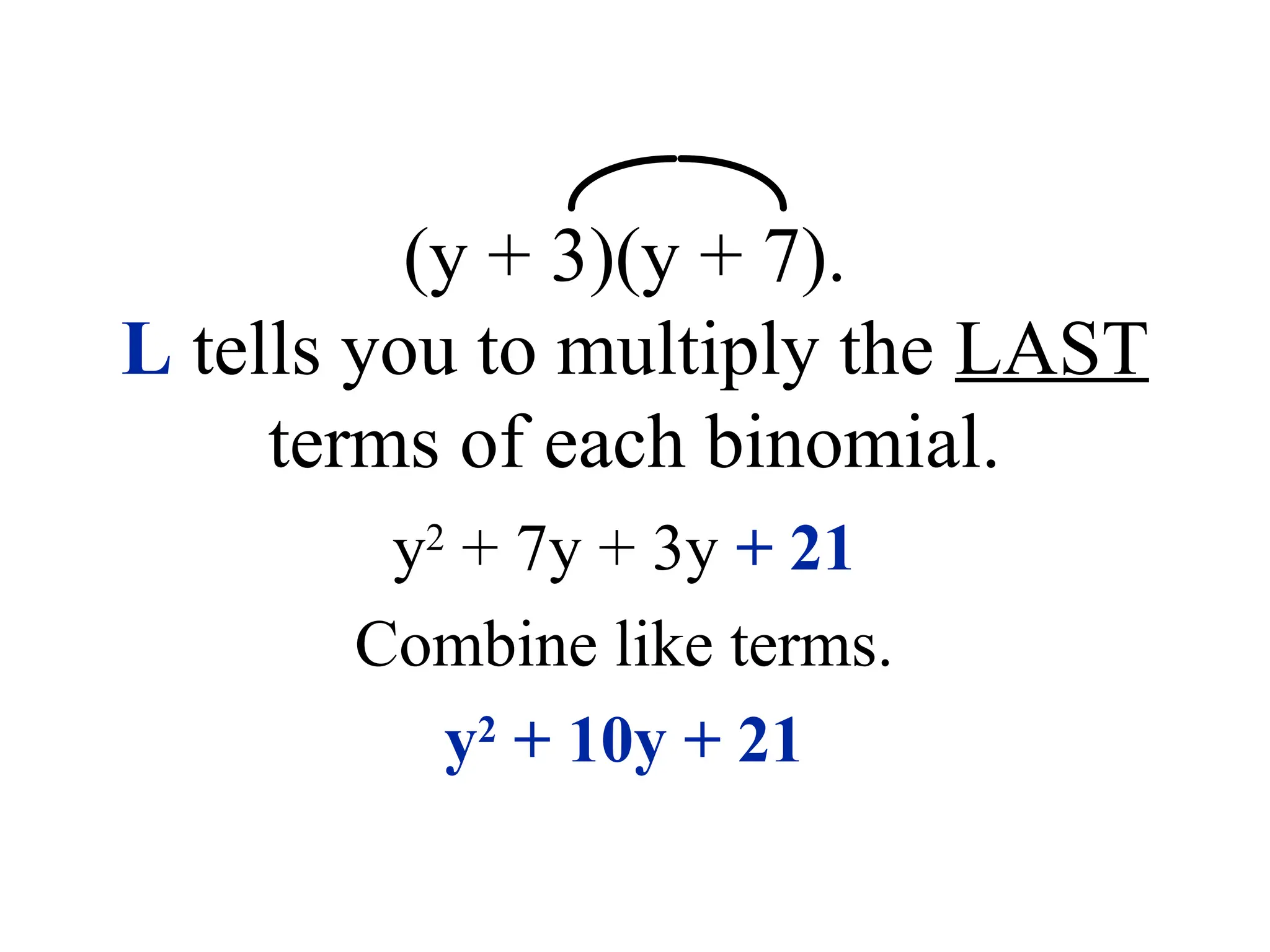
(y + 3)(y + 7).
L tells you to multiply the LAST
terms of each binomial.
y2
+ 7y + 3y + 21
Combine like terms.
y2
+ 10y + 21
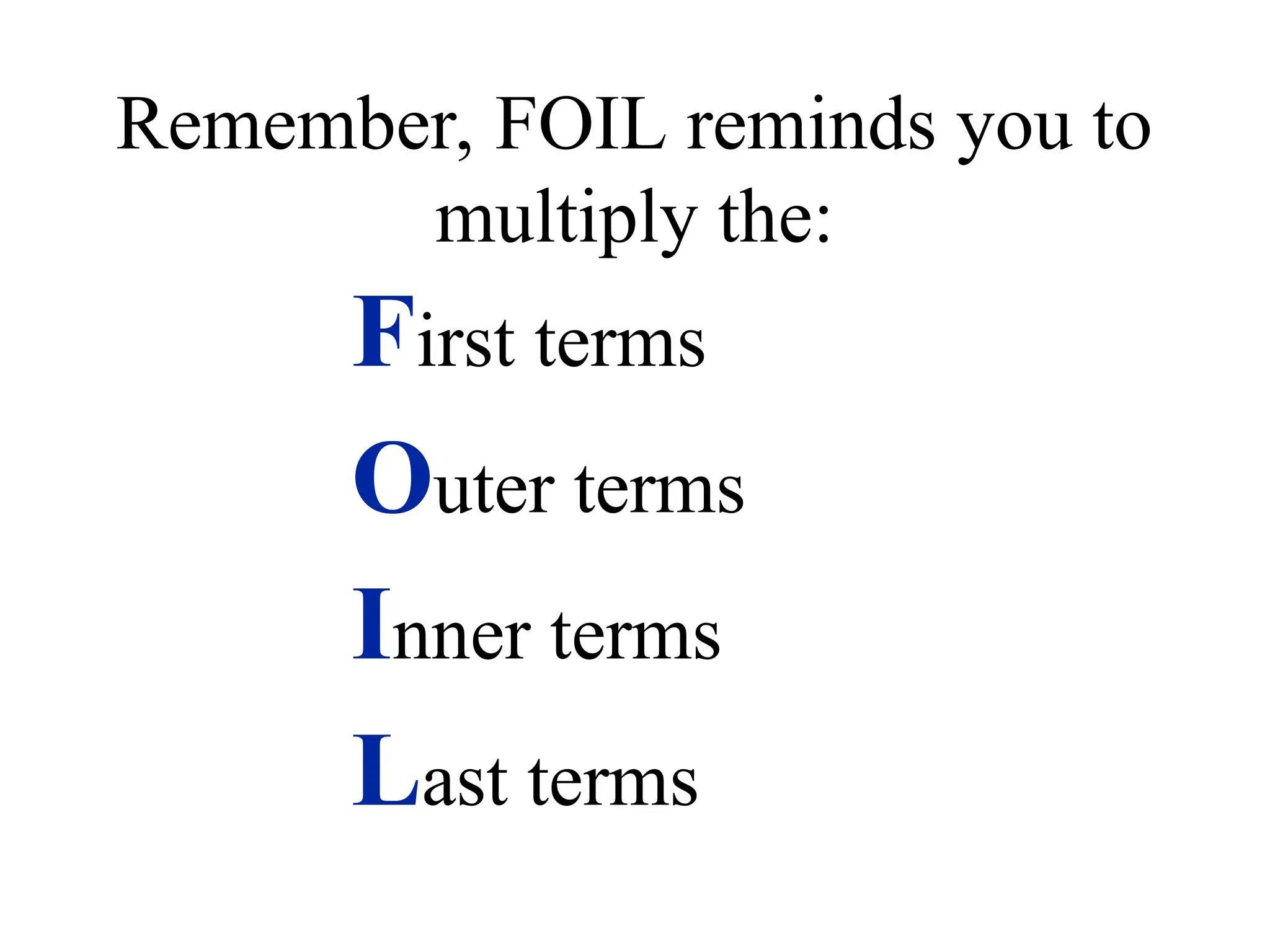
Remember, FOIL reminds you to
multiply the:
First terms
Outer terms
Inner terms
Last terms
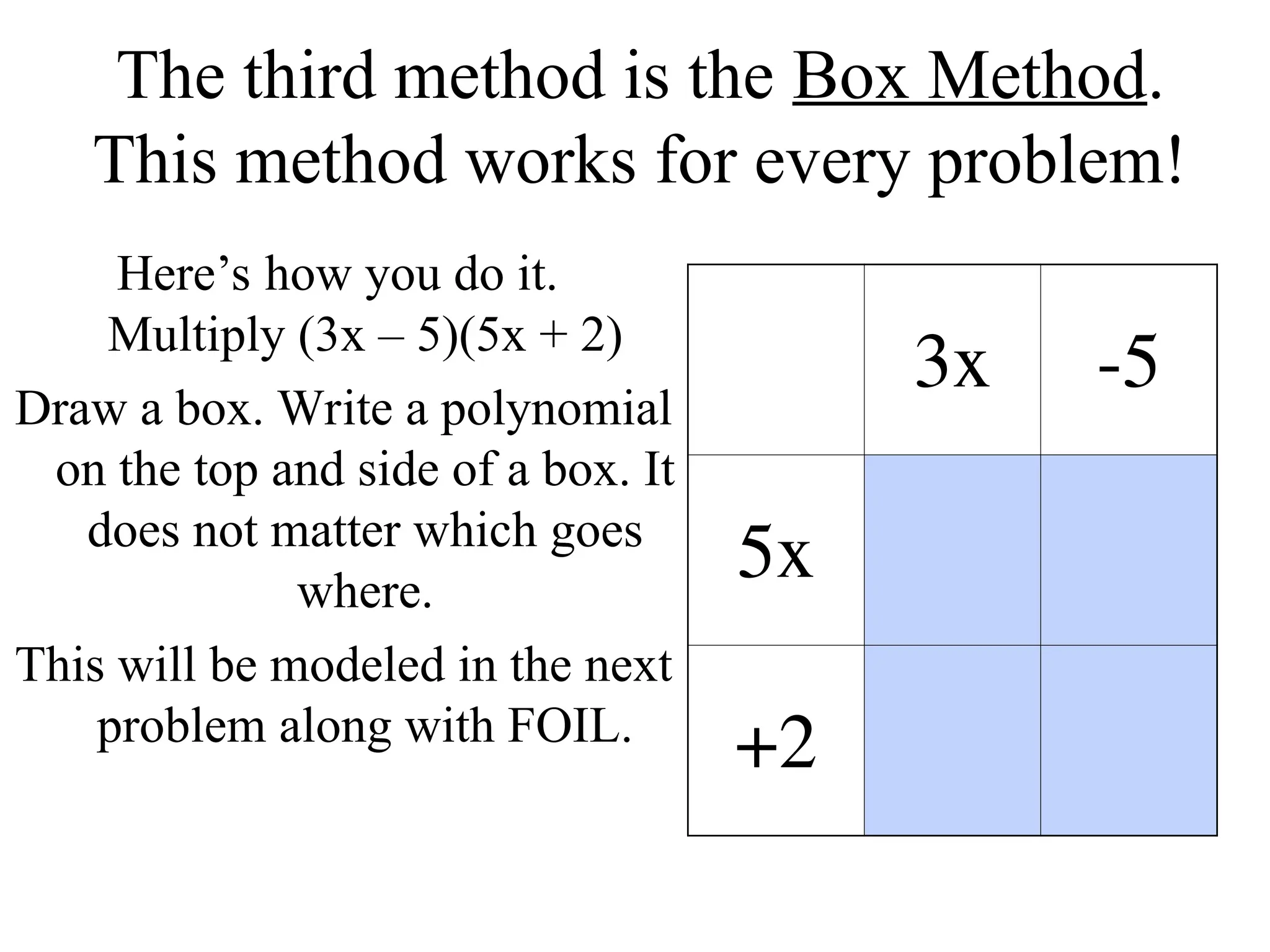
The third method is the Box Method.
This method works for every problem!
Here’s how you do it.
Multiply (3x – 5)(5x + 2)
Draw a box. Write a polynomial
on the top and side of a box. It
does not matter which goes
where.
This will be modeled in the next
problem along with FOIL.
3x -5
5x
+2
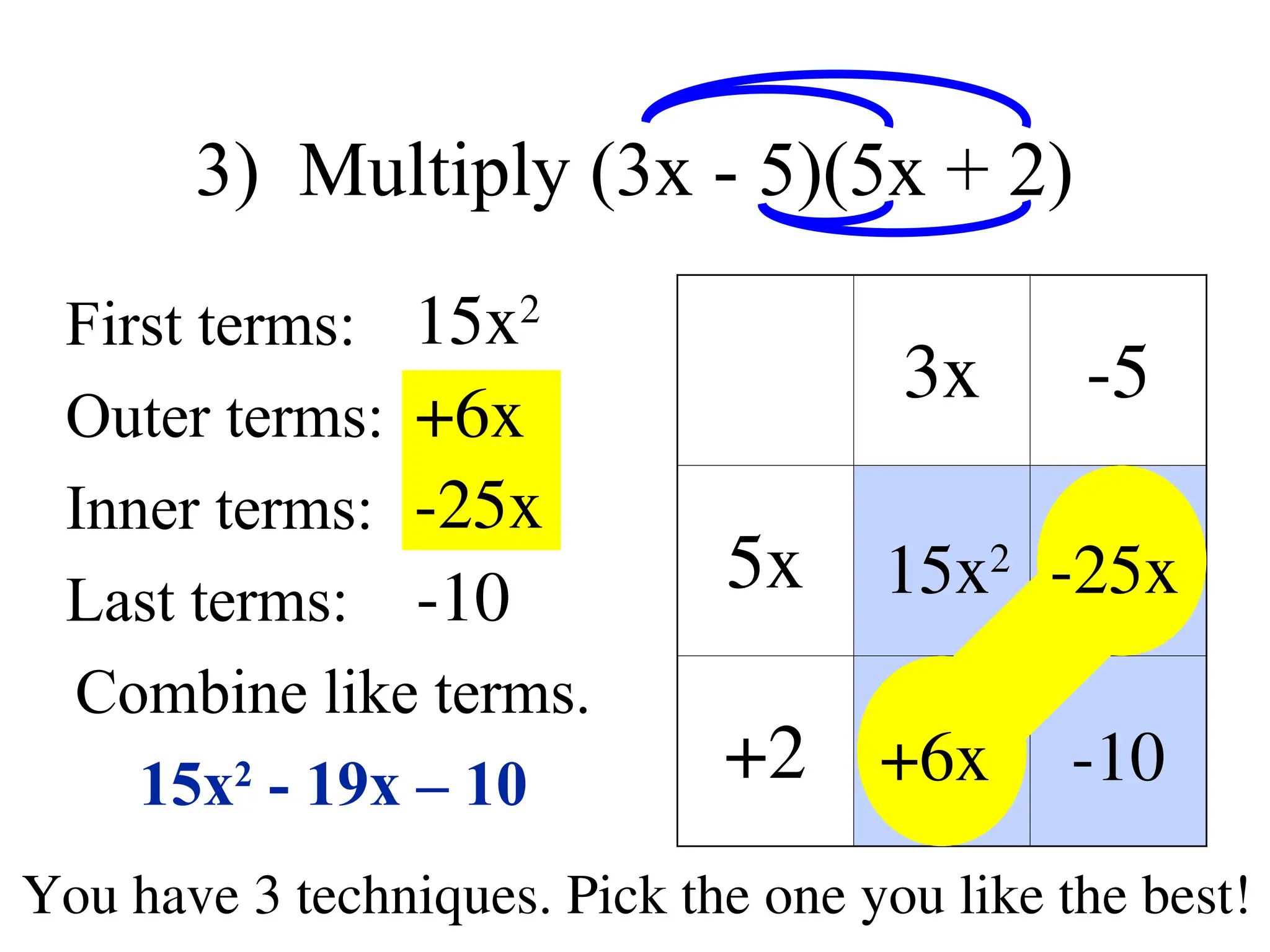
3) Multiply (3x - 5)(5x + 2)
First terms:
Outer terms:
Inner terms:
Last terms:
Combine like terms.
15x2
- 19x – 10
3x -5
5x
+2
15x2
+6x
-25x
-10
You have 3 techniques. Pick the one you like the best!
15x2
+6x
-25x
-10
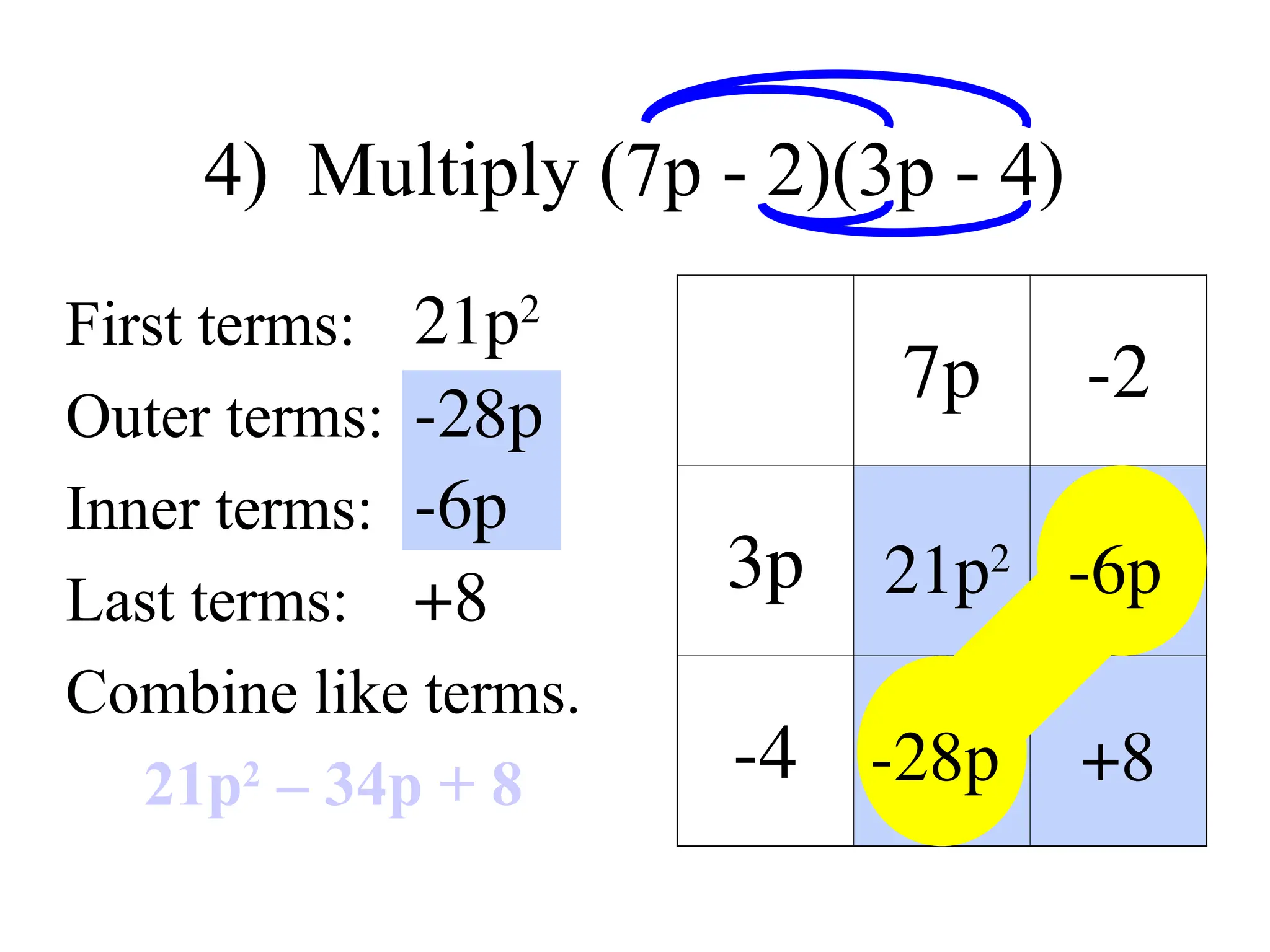
4) Multiply (7p - 2)(3p - 4)
First terms:
Outer terms:
Inner terms:
Last terms:
Combine like terms.
21p2
– 34p + 8
7p -2
3p
-4
21p2
-28p
-6p
+8
21p2
-28p
-6p
+8
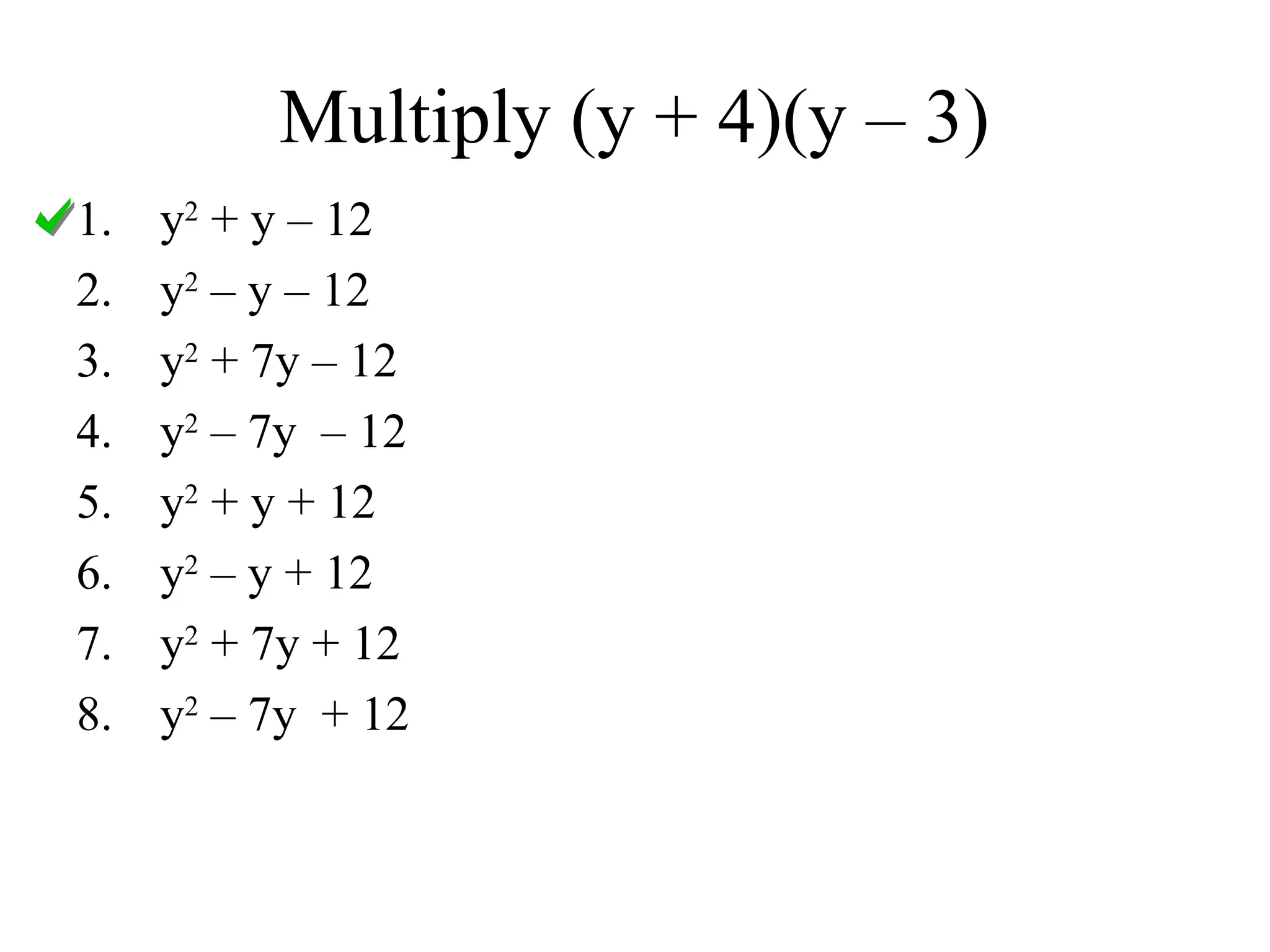
Multiply (y + 4)(y – 3)
1. y2
+ y – 12
2. y2
– y – 12
3. y2
+ 7y – 12
4. y2
– 7y – 12
5. y2
+ y + 12
6. y2
– y + 12
7. y2
+ 7y + 12
8. y2
– 7y + 12
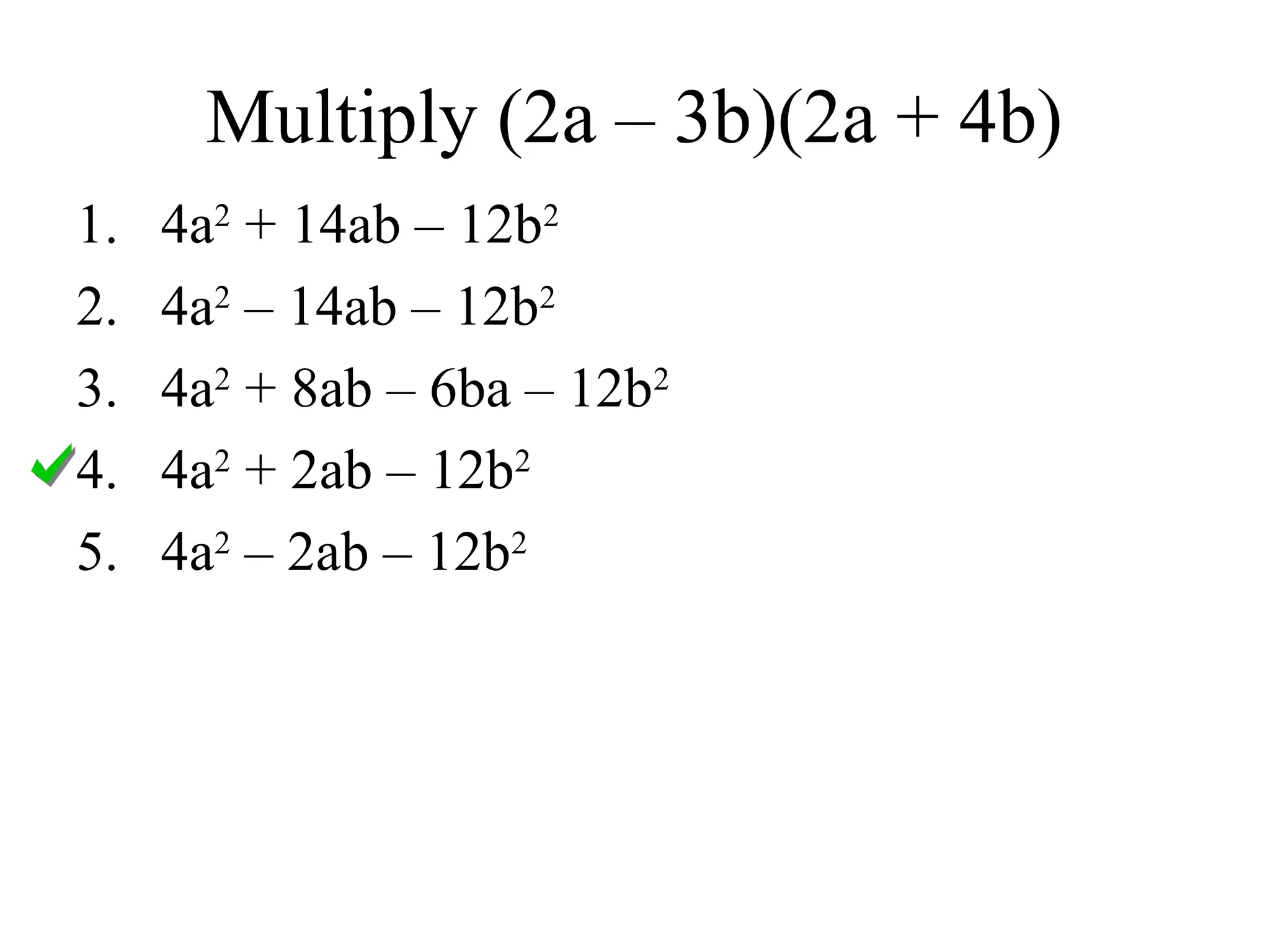
Multiply (2a – 3b)(2a + 4b)
1. 4a2
+ 14ab – 12b2
2. 4a2
– 14ab – 12b2
3. 4a2
+ 8ab – 6ba – 12b2
4. 4a2
+ 2ab – 12b2
5. 4a2
– 2ab – 12b2
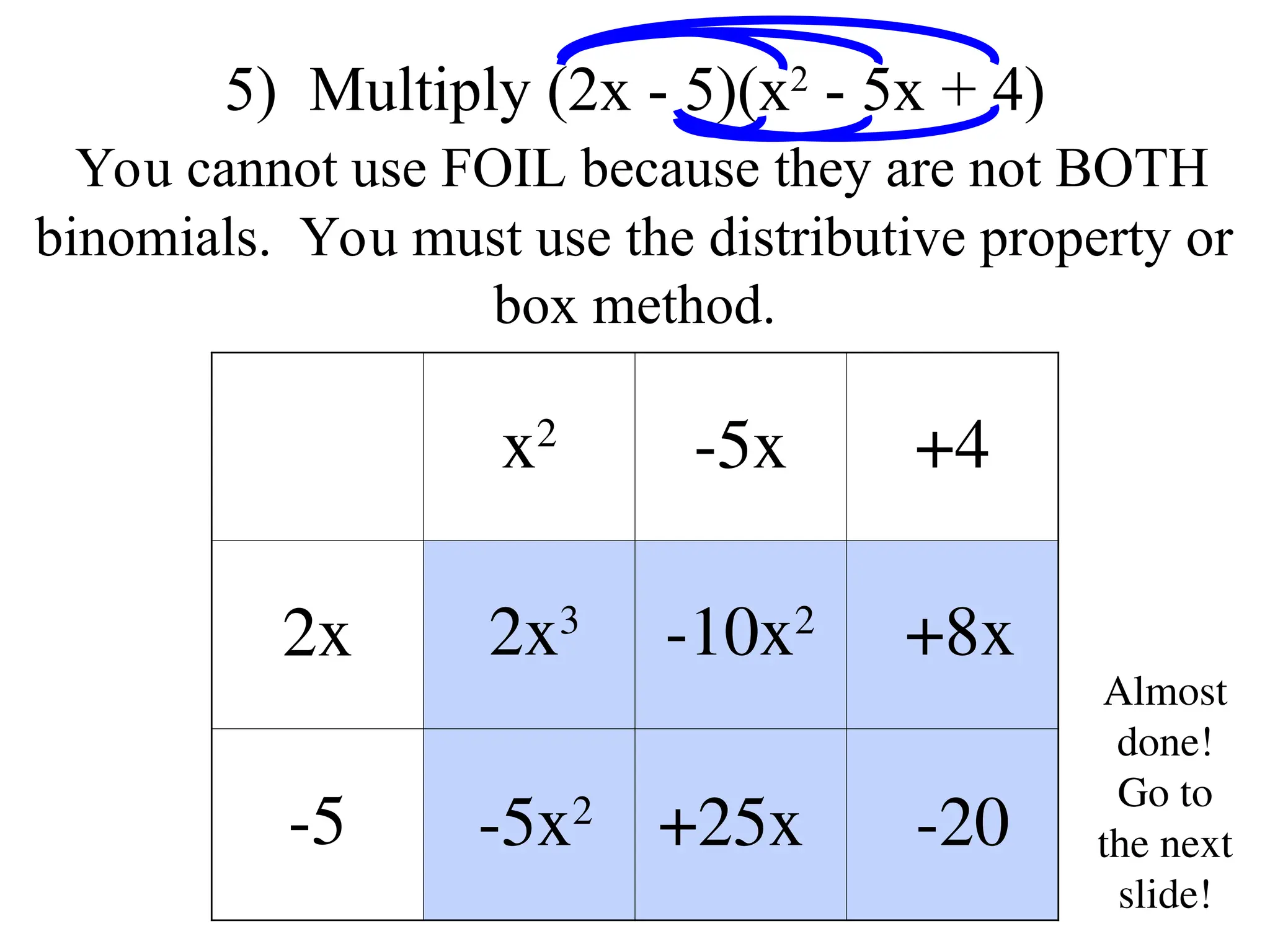
5) Multiply (2x - 5)(x2
- 5x + 4)
You cannot use FOIL because they are
not BOTH binomials. You must use the
distributive property.
2x(x2
- 5x + 4) - 5(x2
- 5x + 4)
2x3
- 10x2
+ 8x - 5x2
+ 25x - 20
Group and combine like terms.
2x3
- 10x2
- 5x2
+ 8x + 25x - 20
2x3
- 15x2
+ 33x - 20
x2
-5x +4
2x
-5
5) Multiply (2x - 5)(x2
- 5x + 4)
You cannot use FOIL because they are not BOTH
binomials. You must use the distributive property or
box method.
2x3
-5x2
-10x2
+25x
+8x
-20
Almost
done!
Go to
the next
slide!
x2
-5x +4
2x
-5
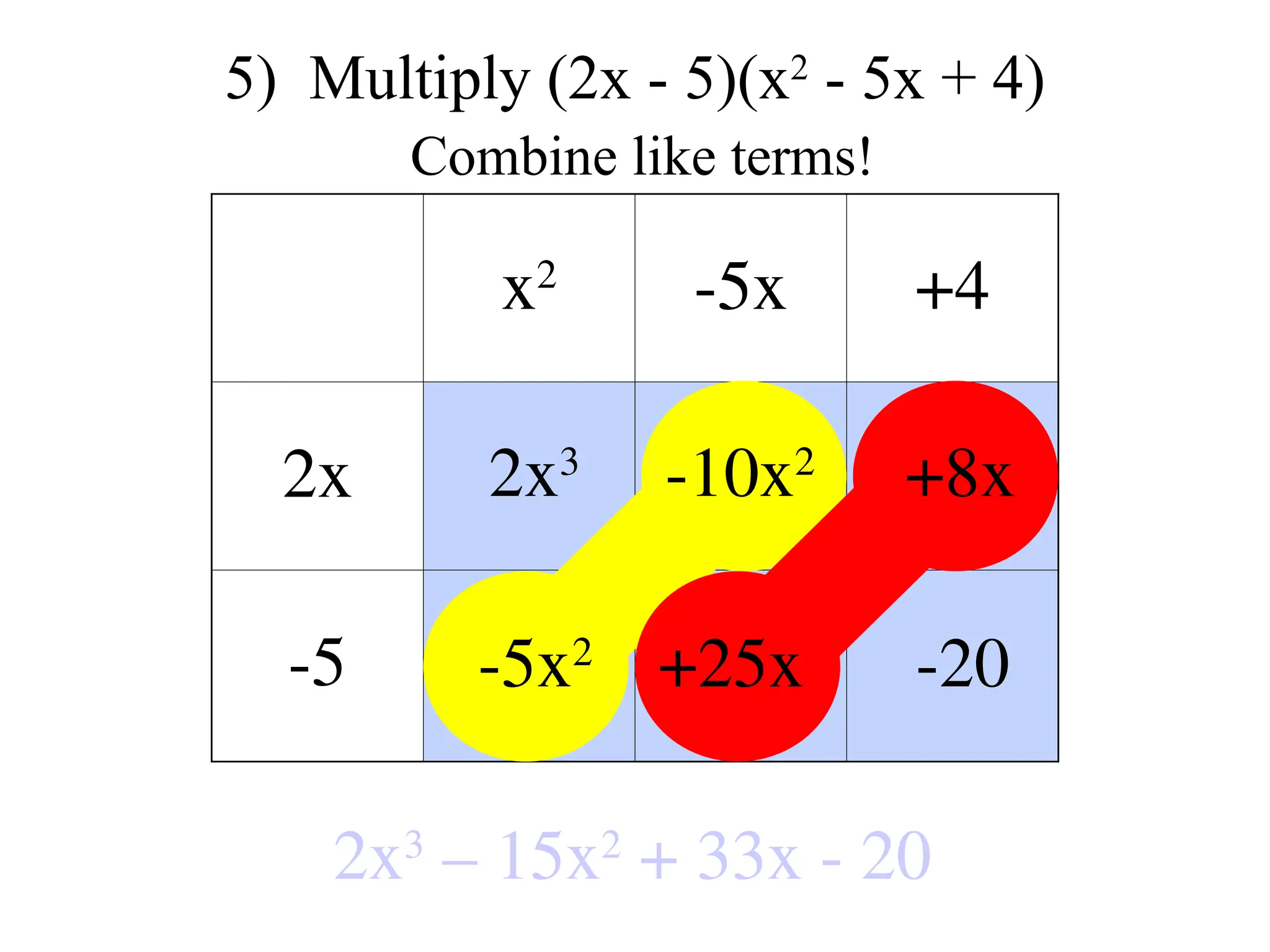
5) Multiply (2x - 5)(x2
- 5x + 4)
Combine like terms!
2x3
-5x2
-10x2
+25x
+8x
-20
2x3
– 15x2
+ 33x - 20
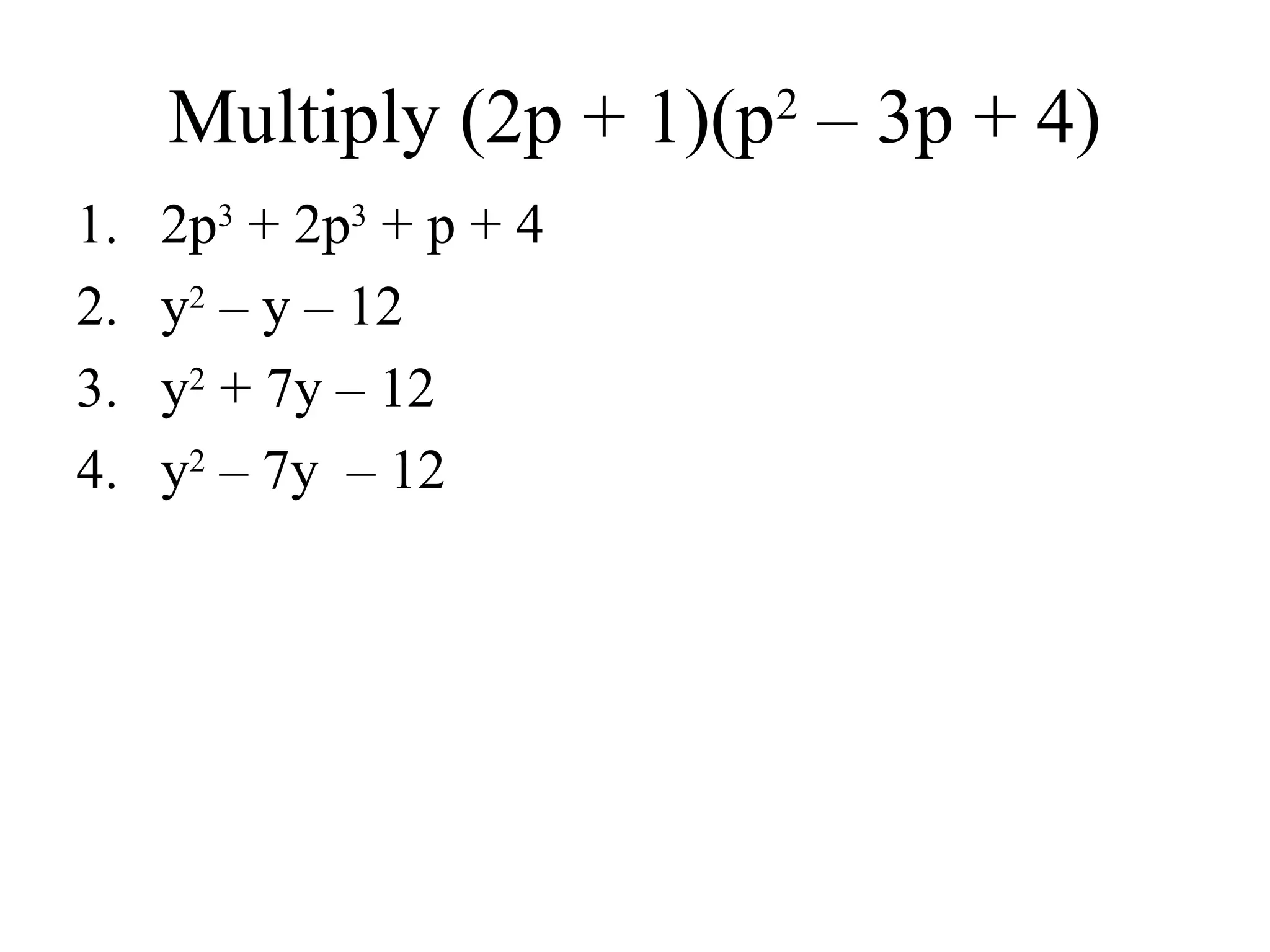
Multiply (2p + 1)(p2
– 3p + 4)
1. 2p3
+ 2p3
+ p + 4
2. y2
– y – 12
3. y2
+ 7y – 12
4. y2
– 7y – 12

polynomials.ppt new class VIII maths lesson

  • 1.
  • 2.
    • Monomials -a number, a variable, or a product of a number and one or more variables. • 4x, 20x2 yw3 , -3, a2 b3 , and 3yz are all monomials. • Binomial: A polynomial containing two terms. • Example : 3x+5, 4x + 6x2 , • Trinomial: A polynomial containing three terms. • Example : 3a2 - 5a + 4 • Polynomials – one or more monomials added or subtracted • 4x + 6x2 , 20xy - 4, and 3a2 - 5a + 4 are all polynomials. Important Note!! An expression is not a polynomial if there is a variable in the denominator. Vocabulary
  • 3.
    State whether eachexpression is a polynomial. If it is, identify it. 1) 7y - 3x + 4 trinomial 2) 10x3 yz2 monomial 3) not a polynomial 2 5 7 2 y y 
  • 4.
    Which polynomial isrepresented by X2 1 1 X X X 1. x2 + x + 1 2. x2 + x + 2 3. x2 + 2x + 2 4. x2 + 3x + 2 5. I’ve got no idea!
  • 5.
    The degree ofa monomial is the sum of the exponents of the variables. Find the degree of each monomial. 1) 5x2 2 2) 4a4 b3 c 8 3) -3 1
  • 6.
    To find thedegree of a polynomial, find the largest degree of the terms. 1) 8x2 - 2x + 7 Degrees: 2 1 1 Which is biggest? 2 is the degree! 2) y7 + 6y4 + 3x4 m4 Degrees: 7 4 8 8 is the degree!
  • 7.
    Find the degreeof x5 – x3 y2 + 4 1. 0 2. 2 3. 3 4. 5 5. 10
  • 8.
    A polynomial isnormally put in ascending or descending order. What is ascending order? Going from small to big exponents. What is descending order? Going from big to small exponents.
  • 9.
    Put in descendingorder: 1) 8x - 3x2 + x4 - 4 x4 - 3x2 + 8x - 4 2) Put in descending order in terms of x: 12x2 y3 - 6x3 y2 + 3y - 2x -6x3 y2 + 12x2 y3 - 2x + 3y
  • 10.
    Like Terms Like Termsrefers to monomials that have the same variable(s) but may have different coefficients. The variables in the terms must have the same powers. Which terms are like? 3a2 b, 4ab2 , 3ab, -5ab2 4ab2 and -5ab2 are like. Even though the others have the same variables, the exponents are not the same. 3a2 b = 3aab, which is different from 4ab2 = 4abb.
  • 11.
    Like Terms Constants arelike terms. Which terms are like? 2x, -3, 5b, 0 -3 and 0 are like. Which terms are like? 3x, 2x2 , 4, x 3x and x are like. Which terms are like? 2wx, w, 3x, 4xw 2wx and 4xw are like.
  • 12.
    Add: (x2 + 3x+ 1) + (4x2 +5) Step 1: Underline like terms: Step 2: Add the coefficients of like terms, do not change the powers of the variables: Adding Polynomials (x2 + 3x + 1) + (4x2 +5) Notice: ‘3x’ doesn’t have a like term. (x2 + 4x2 ) + 3x + (1 + 5) 5x2 + 3x + 6
  • 13.
    Some people preferto add polynomials by stacking them. If you choose to do this, be sure to line up the like terms! Adding Polynomials (x2 + 3x + 1) + (4x2 +5) 5x2 + 3x + 6 (x2 + 3x + 1) + (4x2 +5) Stack and add these polynomials: (2a2 +3ab+4b2 ) + (7a2+ab+-2b2 ) (2a2 +3ab+4b2 ) + (7a2+ab+-2b2 ) (2a2 + 3ab + 4b2 ) + (7a2 + ab + -2b2 ) 9a2 + 4ab + 2b2
  • 14.
    Adding Polynomials 1) 3x3 7x   3x3  4x   6x3  3x 2) 2w2  w  5   4w2  7w 1   6w2  8w  4 3) 2a3  3a2  5a   a3  4a  3   3a3  3a2  9a  3 • Add the following polynomials; you may stack them if you prefer:
  • 15.
    Subtract: (3x2 + 2x+ 7) - (x2 + x + 4) Subtracting Polynomials Step 1: Change subtraction to addition (Keep-Change-Change.). Step 2: Underline OR line up the like terms and add. (3x2 + 2x + 7) + (- x2 + - x + - 4) (3x2 + 2x + 7) + (- x2 + - x + - 4) 2x2 + x + 3
  • 16.
    Subtracting Polynomials 1) x2 x  4   3x2  4x 1   2x2  3x  5 2) 9y 2  3y  1   2y 2  y  9   7y2  4y 10 3) 2g2  g  9   g3 3g2  3    g3  g2  g  12 • Subtract the following polynomials by changing to addition (Keep-Change-Change.), then add:
  • 17.
    Objective The student willbe able to: multiply two polynomials using the FOIL method, Box method and the distributive property. Designed by Skip Tyler, Varina High School
  • 18.
    There are threetechniques you can use for multiplying polynomials. The best part about it is that they are all the same! Huh? Whaddaya mean? It’s all about how you write it…Here they are! 1)Distributive Property 2)FOIL 3)Box Method Sit back, relax (but make sure to write this down), and I’ll show ya!
  • 19.
    1) Multiply. (2x+ 3)(5x + 8) Using the distributive property, multiply 2x(5x + 8) + 3(5x + 8). 10x2 + 16x + 15x + 24 Combine like terms. 10x2 + 31x + 24 A shortcut of the distributive property is called the FOIL method.
  • 20.
    The FOIL methodis ONLY used when you multiply 2 binomials. It is an acronym and tells you which terms to multiply. 2) Use the FOIL method to multiply the following binomials: (y + 3)(y + 7).
  • 21.
    (y + 3)(y+ 7). F tells you to multiply the FIRST terms of each binomial. y2
  • 22.
    (y + 3)(y+ 7). O tells you to multiply the OUTER terms of each binomial. y2 + 7y
  • 23.
    (y + 3)(y+ 7). I tells you to multiply the INNER terms of each binomial. y2 + 7y + 3y
  • 24.
    (y + 3)(y+ 7). L tells you to multiply the LAST terms of each binomial. y2 + 7y + 3y + 21 Combine like terms. y2 + 10y + 21
  • 25.
    Remember, FOIL remindsyou to multiply the: First terms Outer terms Inner terms Last terms
  • 26.
    The third methodis the Box Method. This method works for every problem! Here’s how you do it. Multiply (3x – 5)(5x + 2) Draw a box. Write a polynomial on the top and side of a box. It does not matter which goes where. This will be modeled in the next problem along with FOIL. 3x -5 5x +2
  • 27.
    3) Multiply (3x- 5)(5x + 2) First terms: Outer terms: Inner terms: Last terms: Combine like terms. 15x2 - 19x – 10 3x -5 5x +2 15x2 +6x -25x -10 You have 3 techniques. Pick the one you like the best! 15x2 +6x -25x -10
  • 28.
    4) Multiply (7p- 2)(3p - 4) First terms: Outer terms: Inner terms: Last terms: Combine like terms. 21p2 – 34p + 8 7p -2 3p -4 21p2 -28p -6p +8 21p2 -28p -6p +8
  • 29.
    Multiply (y +4)(y – 3) 1. y2 + y – 12 2. y2 – y – 12 3. y2 + 7y – 12 4. y2 – 7y – 12 5. y2 + y + 12 6. y2 – y + 12 7. y2 + 7y + 12 8. y2 – 7y + 12
  • 30.
    Multiply (2a –3b)(2a + 4b) 1. 4a2 + 14ab – 12b2 2. 4a2 – 14ab – 12b2 3. 4a2 + 8ab – 6ba – 12b2 4. 4a2 + 2ab – 12b2 5. 4a2 – 2ab – 12b2
  • 31.
    5) Multiply (2x- 5)(x2 - 5x + 4) You cannot use FOIL because they are not BOTH binomials. You must use the distributive property. 2x(x2 - 5x + 4) - 5(x2 - 5x + 4) 2x3 - 10x2 + 8x - 5x2 + 25x - 20 Group and combine like terms. 2x3 - 10x2 - 5x2 + 8x + 25x - 20 2x3 - 15x2 + 33x - 20
  • 32.
    x2 -5x +4 2x -5 5) Multiply(2x - 5)(x2 - 5x + 4) You cannot use FOIL because they are not BOTH binomials. You must use the distributive property or box method. 2x3 -5x2 -10x2 +25x +8x -20 Almost done! Go to the next slide!
  • 33.
    x2 -5x +4 2x -5 5) Multiply(2x - 5)(x2 - 5x + 4) Combine like terms! 2x3 -5x2 -10x2 +25x +8x -20 2x3 – 15x2 + 33x - 20
  • 34.
    Multiply (2p +1)(p2 – 3p + 4) 1. 2p3 + 2p3 + p + 4 2. y2 – y – 12 3. y2 + 7y – 12 4. y2 – 7y – 12