INTRODUCTION TO POLYMERS
POLYMER
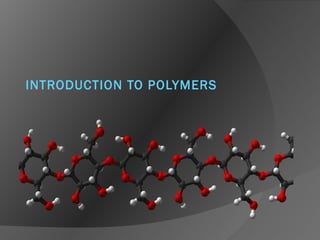
 A polymer is define as the substance having very
high molecular weight and is made by joining of
large number of simple molecules .
 These are the molecules having certain structural
unit repeating large number of times .
TYPES OF POLYMERS
 Natural Polymers
 Synthetic Polymers
 Linear Polymers
 Commercial Polymers
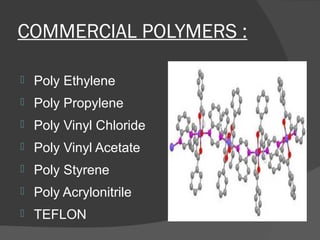
COMMERCIAL POLYMERS :
 Poly Ethylene
 Poly Propylene
 Poly Vinyl Chloride
 Poly Vinyl Acetate
 Poly Styrene
 Poly Acrylonitrile
 TEFLON
POLY VINYL CHLORIDE{PVC} :
 Polyvinyl Chloride is obtained by heating a water-emulsion of
vinyl chloride in presence of a small amount of benzyl peroxide.
 PVC is generally prepared by treating acetylene at 1 to 1.5 atm
with hydrogen chloride at 60-80 degree.
PROPERTIES :
 PVC is colourless odourless,non-
inflammable and resistant light,inorganic
acids and alkalis.
 Pure resin possesses a high softening
point and a greater stifness and rigidity
compared to polyethylene, but is brittle.
 It is the mostly widely used in synthetic
plastic.
USES OF PVC :
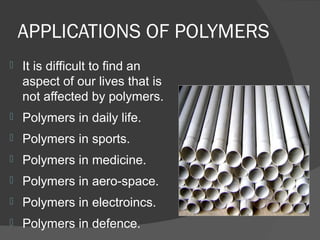
 PVC is mainly used in PVC pipes.
 It is used in making sheets, light-fittings,
refrigerator parts.
 It is also used in cycles, tyres, motor cycle
parts, toys, aero-planes parts.
APPLICATIONS OF POLYMERS
 It is difficult to find an
aspect of our lives that is
not affected by polymers.
 Polymers in daily life.
 Polymers in sports.
 Polymers in medicine.
 Polymers in aero-space.
 Polymers in electroincs.
 Polymers in defence.
Top Polymer Companies:
 Dow, Dupont, Basf, Bayer, Mitsubishi.
 Mercedes-benz, Audi, Maruti.
 SABIC, Shell, Braskem, Ticona.
 PPG Industries and Eastman.
THANK YOU

Polymers,PVC

  • 1.
  • 3.
    POLYMER  A polymeris define as the substance having very high molecular weight and is made by joining of large number of simple molecules .  These are the molecules having certain structural unit repeating large number of times .
  • 4.
    TYPES OF POLYMERS Natural Polymers  Synthetic Polymers  Linear Polymers  Commercial Polymers
  • 5.
    COMMERCIAL POLYMERS : Poly Ethylene  Poly Propylene  Poly Vinyl Chloride  Poly Vinyl Acetate  Poly Styrene  Poly Acrylonitrile  TEFLON
  • 6.
    POLY VINYL CHLORIDE{PVC}:  Polyvinyl Chloride is obtained by heating a water-emulsion of vinyl chloride in presence of a small amount of benzyl peroxide.  PVC is generally prepared by treating acetylene at 1 to 1.5 atm with hydrogen chloride at 60-80 degree.
  • 7.
    PROPERTIES :  PVCis colourless odourless,non- inflammable and resistant light,inorganic acids and alkalis.  Pure resin possesses a high softening point and a greater stifness and rigidity compared to polyethylene, but is brittle.  It is the mostly widely used in synthetic plastic.
  • 8.
    USES OF PVC:  PVC is mainly used in PVC pipes.  It is used in making sheets, light-fittings, refrigerator parts.  It is also used in cycles, tyres, motor cycle parts, toys, aero-planes parts.
  • 9.
    APPLICATIONS OF POLYMERS It is difficult to find an aspect of our lives that is not affected by polymers.  Polymers in daily life.  Polymers in sports.  Polymers in medicine.  Polymers in aero-space.  Polymers in electroincs.  Polymers in defence.
  • 10.
    Top Polymer Companies: Dow, Dupont, Basf, Bayer, Mitsubishi.  Mercedes-benz, Audi, Maruti.  SABIC, Shell, Braskem, Ticona.  PPG Industries and Eastman.
  • 11.