Std. Mat Unit -2 Polymer EngineeringChemistry.pptx
1.
EN3BS14 T 2-0-2
EngineeringChemistry
THEORY SYLLABUS
Unit No.2 Polymer
🞂 Introduction and Classification of polymer,
🞂 Preparation, Properties and Uses of the following-
🞂 Polythene,
🞂 PVC,
🞂 Teflon,
🞂 Nylon 66,
🞂 Bakelite,
🞂 Silicone resin,
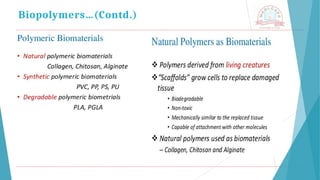
🞂 Natural and
🞂 Synthetic Rubber,
🞂 Vulcanization of Rubber,
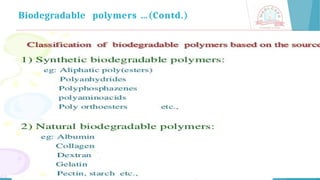
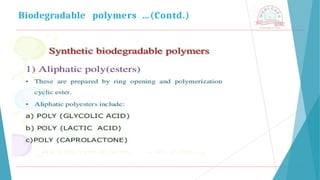
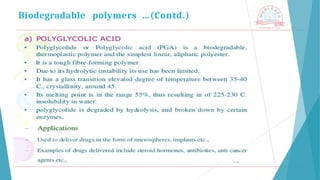
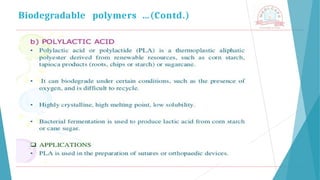
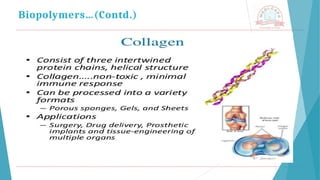
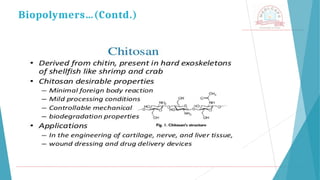
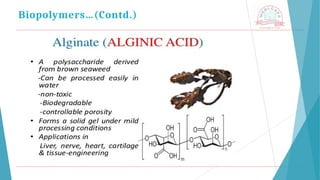
🞂 Biopolymers,
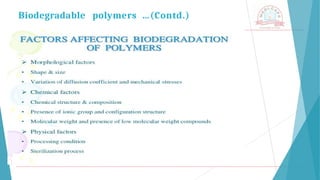
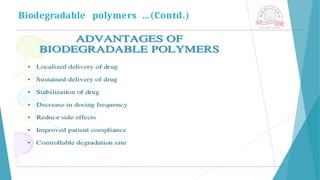
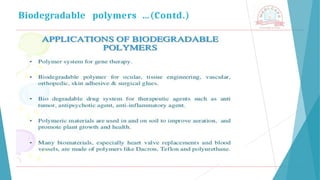
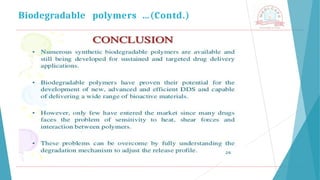
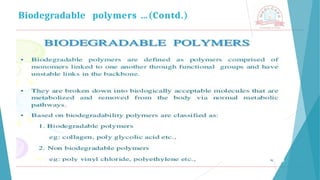
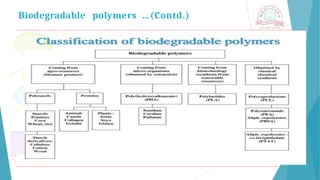
🞂 Biodegradable polymers.
2.
Introduction of Polymer:
🞂
Apolymer is a large molecule or a macromolecule which essentially is a combination o
f
many subunits.
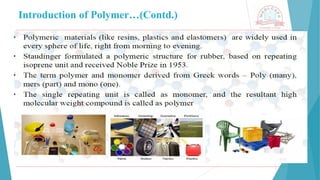
🞂 The term polymer in Greek means ‘many parts’. Polymers can be found all around
us.
🞂
From the strand of our DNA which is a naturally occurring biopolymer to polypropylene
which is used throughout the world as plastic.
🞂
Polymers may be naturally found in plants and animals (natural polymers) or may be man-
made (synthetic polymers). Different polymers have a number of unique physical and
chemical properties due to which they find usage in everyday life.
🞂
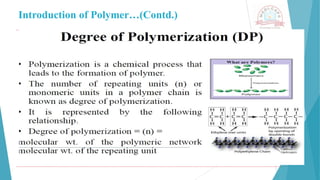
Polymers are all created by the process of polymerization wherein their constituent elements
called monomers, are reacted together to form polymer chains, i.e 3-dimensional networks
forming the polymer bonds.
🞂
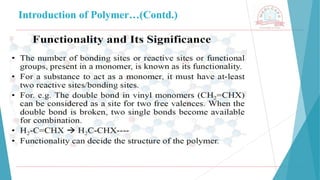
The type of polymerization mechanism used depends on the type of functional groups
attached to the reactants. In the biological context, almost all macromolecules are
3.
Introduction of Polymer…(Contd.)
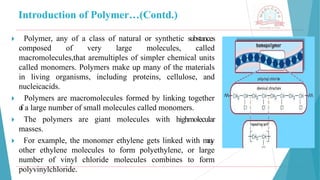
🞂 Polymer, any of a class of natural or synthetic substances
composed of very large molecules, called
macromolecules,that aremultiples of simpler chemical units
called monomers. Polymers make up many of the materials
in living organisms, including proteins, cellulose, and
nucleicacids.
🞂 Polymers are macromolecules formed by linking together
o
f a large number of small molecules called monomers.
🞂 The polymers are giant molecules with highmolecular
masses.
🞂 For example, the monomer ethylene gets linked with m
a
n
y
other ethylene molecules to form polyethylene, or large
number of vinyl chloride molecules combines to form
polyvinylchloride.
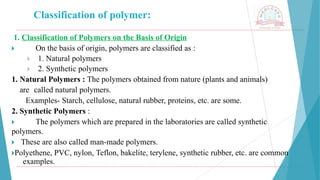
Classification of polymer:
1.Classification of Polymers on the Basis of Origin
🞂 On the basis of origin, polymers are classified as :
🞂 1. Natural polymers
🞂 2. Synthetic polymers
1. Natural Polymers : The polymers obtained from nature (plants and animals)
are called natural polymers.
Examples- Starch, cellulose, natural rubber, proteins, etc. are some.
2. Synthetic Polymers :
🞂 The polymers which are prepared in the laboratories are called synthetic
polymers.
🞂 These are also called man-made polymers.
🞂
Polyethene, PVC, nylon, Teflon, bakelite, terylene, synthetic rubber, etc. are common
examples.
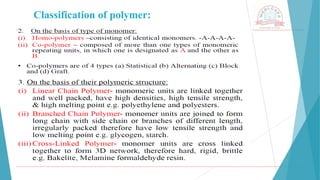
Classification of polymer…(Contd.)
3.Classification of Polymers on the Basis of structure
🞂 On the basis of structure of polymers, these can be classified as :
1. Linear polymers 2. Branched chain polymers3. Cross-linked polymers.
Linear polymers :
🞂 These are polymers in which monomeric units are linked together to form
linear chains.
🞂 These linear polymers are well packed and therefore, have high
densities, high tensile (pulling) strength and high melting points.
🞂 Examples: polyethelene, nylons and polyesters are examples of linear polymers.
Branched chain polymers :
🞂
These are polymers in which the monomers are joined to form long chain with side chains o
r
branches of different lengths [Fig. ON NEXT PPT]. These
10.
Classification of polymer…(Contd.)
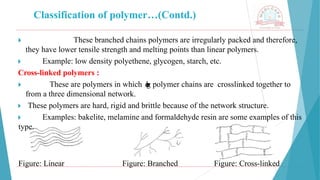
🞂 These branched chains polymers are irregularly packed and therefore,
they have lower tensile strength and melting points than linear polymers.
🞂 Example: low density polyethene, glycogen, starch, etc.
Cross-linked polymers :
🞂 These are polymers in which l
o
n
g polymer chains are crosslinked together to
from a three dimensional network.
🞂 These polymers are hard, rigid and brittle because of the network structure.
🞂 Examples: bakelite, melamine and formaldehyde resin are some examples of this
type.
Figure: Linear Figure: Branched Figure: Cross-linked
Classification of polymer…(Contd.)
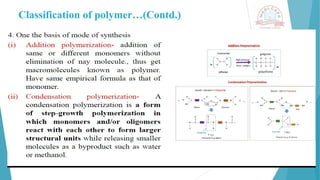
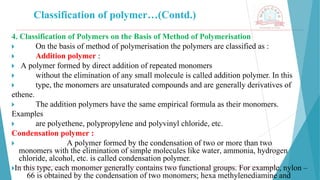
4.Classification of Polymers on the Basis of Method of Polymerisation
🞂 On the basis of method of polymerisation the polymers are classified as :
🞂 Addition polymer :
🞂 A polymer formed by direct addition of repeated monomers
🞂 without the elimination of any small molecule is called addition polymer. In this
🞂 type, the monomers are unsaturated compounds and are generally derivatives of
ethene.
🞂 The addition polymers have the same empirical formula as their monomers.
Examples
🞂 are polyethene, polypropylene and polyvinyl chloride, etc.
Condensation polymer :
🞂 A polymer formed by the condensation of two or more than two
monomers with the elimination of simple molecules like water, ammonia, hydrogen
chloride, alcohol, etc. is called condensation polymer.
🞂
In this type, each monomer generally contains two functional groups. For example, nylon –
66 is obtained by the condensation of two monomers; hexa methylenediamine and
Classification of polymer…(Contd.)
(7)Classification of Polymers on the Basis of Molecular Forces
🞂 Depending upon the intermolecular forces between monomer molecules, the polymers
🞂 have been classified into four types.
🞂 1. Elastomers 2. Fibers 3. Thermoplastics 4. Thermosetting
1. Elastomers :.
🞂 In case of elastomers the polymer chains are held together by weak van der waals forces
🞂
Due to weak forces, the polymers can be easily stretched on applying small stress and they regain their original shape
when the stress is removed.
🞂 This is due to the presence of few- ‘cross links’ between the chains, which help the polymer to retract to its original
position after the force is removed,
🞂 Example: vulcanized rubber. most important example of elastomer is natural rubber.
2. Fibres :
🞂 These are the polymers which have strong intermolecular forces between
🞂 the chains. These forces are either hydrogen bonds or dipole-dipole interactions.
🞂 Because of the strong forces, the chains are closely packed, giving them high tensile strength and less elasticity.
🞂 These polymers can be drawn into long, thin and threade fibres and therefore can be woven into fabrics.
🞂 The common examples are nylon66, dacron, silk, etc.
17.
Classification of polymer…(Contd.)
3.Thermoplastics :
🞂 These are linear polymers with very few cross linkages or no cross linkages at all. The
polymeric chains are held by weak VANDER WAAL forces and slide over one another.
🞂
Due to lack of cross linkages these polymers soften on heating and harden or become rigid o
n
cooling.
🞂 Thus they can be moulded to any shape.
🞂
Examples- Polythene, PVC, polystyrene are addition type thermoplastics and Terylene, nylon
are condensation type thermoplastics.
🞂
Plasticizers : Certain plastics do not soften much on heating. These can be easily softened b
y
the addition of some organic compounds which are called plasticizers.
🞂 These have intermediate forces of attraction. For example, polyvinyl
chloride.
🞂
For example, polyvinyl chloride (PVC) is very stiff and hard but is made soft by adding di-n
-
butylphthalate (a plasticizer). Some other common plasticizers are dialkyl phthalates and
18.
Classification of polymer…(Contd.)
4.Thermosetting polymers :
🞂 Usually thermosetting polymer can be heated only once when it permanently sets into
a
solid which can not be remelted and remoulded.
🞂
Thermosetting polymers are produced from relatively low molecular mass semi fluid
polymers (called polymers) which on heating develop extensive cross-linking by
themselves or by adding some cross-linking agents and become infusible and insoluble
hard mass.
🞂 The cross linkshold the molecules in place so that heating does not allow them
to move freely.
🞂 Therefore, a thermosetting plastic is cross linked and is permanently rigid.
🞂 The common example are bakelite, melamine, formaldehyde resin, etc.
19.
Classification of polymer…(Contd.)
8.Classification of Polymers based on the Source of Availability
🞂 There are three types of classification under this category, namely, Natural, Synthetic, and Semi-
synthetic Polymers.
Natural Polymers:
🞂
They occur naturally and are found in plants and animals. For example proteins, starch, cellulose, and
rubber. To add up, we also have biodegradable polymers which are called biopolymers.
Semi-synthetic Polymers:
🞂
They are derived from naturally occurring polymers and undergo further chemical modification. For
example, cellulose nitrate, cellulose acetate.
Synthetic Polymers:
🞂
These are man-made polymers. Plastic is the most common and widely used synthetic polymer. It is
used in industries and various dairy products. For example, nylon-6, 6, polyether’s etc.
20.
Polymer:
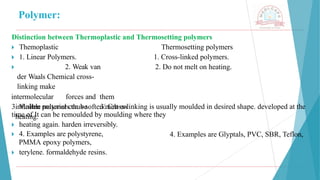
Distinction between Thermoplasticand Thermosetting polymers
Thermosetting polymers
1. Cross-linked polymers.
2. Do not melt on heating.
🞂 Themoplastic
🞂 1. Linear Polymers.
🞂 2. Weak van
der Waals Chemical cross-
linking make
intermolecular forces and them
infusible materials thus soften/melt on
heating.
3. Molten polymer can be 3. Cross-linking is usually moulded in desired shape. developed at the
4. Examples are Glyptals, PVC, SBR, Teflon,
time of It can be remoulded by moulding where they
🞂 heating again. harden irreversibly.
🞂 4. Examples are polystyrene,
PMMA epoxy polymers,
🞂 terylene. formaldehyde resins.
Polythene:
🞂
A polymer isa large molecule or a macromolecule formed by joining many repeated
subuniAts. They may be naturally found in plants and animals (known as the natural
polymer) or may be man-made (called the synthetic polymer). Different polymers have a
number of unique physical and chemical properties due to which they have become part and
parcel of our life.
🞂 This is a addition type polymers like polyethylene, Teflon, and polyacrylonitrile.
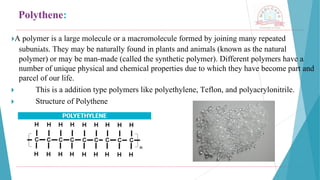
🞂 Structure of Polythene
23.
Polythene…(Contd.)
Types Of Polythene
🞂
Polythene is the most common plastic used broadly in the packaging industry. Based on the
density, polythene can be classified in to two types:
Low-density polythene:
🞂 It has a density range of 0.910–0.940 g/cm3
🞂 Prepared by the free-radical polymerization of ethene.
🞂 The reaction is carried out at a temperature of 350 K to 570 K under the
pressure of 1000 to 2000 atmospheres in the presence of a catalyst, dioxygen (in traces) or a
peroxide initiator.
🞂 The highly branched structure of LDP gives it a unique flow property in the molten state.
🞂 It is a poor conductor of electricity and is chemically inert.
• The LDPs are used for making plastic bags and film wrap.
24.
Polythene…(Contd.)
🞂
High-density polythene:
🞂
It has a density greater than or equal to 0.941 g/cm3
🞂
It has a low degree of branching.
🞂
It is obtained when addition polymerization of ethene takes place in a hydrocarbon
solvent.
🞂 The reaction is carried out under a pressure of 6 to 7 atmospheres and at a
temperature of 333 K to 343 K in the presence of Ziegler-Natta catalysts or metallocene
catalysts.
🞂
HDPs are chemically inert as well and are used in making bottles, butter tubs, milk jugs,
water pipes and garbage containers.
25.
Polythene…(Contd.)
Uses of Polythene
🞂Polythene having lower density have the ability to deform without breaking and better
gives
elongation with stretching up to six times the length before breaking.
🞂 It is a useful plastic for moulding and extruding in various shapes such as
bottle, sheets and pipes etc.
🞂 It is used for plastic bags, stretch films because of its clear and crystalline nature.
🞂 Life expectancy of these on outside condition is found to be 25 years but
degrades from ultraviolet radiation.
🞂 Polythene have greater chemical resistance which covers a wide ranges of chemicals.
26.
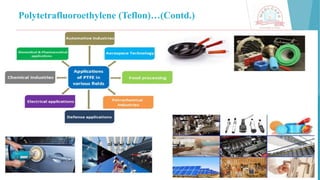
Polytetrafluoroethylene (Teflon) :
🞂
T
e
f
l
o
n (PTFE) is manufactured by free-radical polymerization of tetrafluoroethylene or
1,1,1,1-tetrafluoroethene (TFE).
🞂
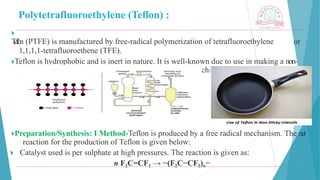
Teflon is hydrophobic and is inert in nature. It is well-known due to use in making a non-
stick coating for cookware and also as a lubricant in machinery to reduce friction.
🞂
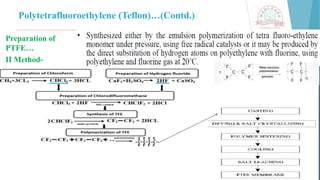
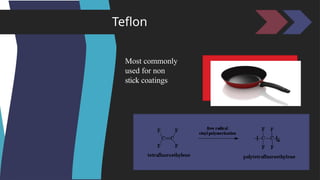
Preparation/Synthesis: I Method-Teflon is produced by a free radical mechanism. The net
reaction for the production of Teflon is given below:
🞂 Catalyst used is per sulphate at high pressures. The reaction is given as:
n F2C=CF2 → −(F2C−CF2)n−
Polytetrafluoroethylene (Teflon)…(Contd.)
Properties ofTeflon
🞂 It is a white solid compound at room temperature.
🞂 Its density is about 2200 kg/m3.
🞂 Its melting point is 600 K.
🞂 It is a chemical resistance compound, the only chemicals that can affect these compounds are alkali metals.
🞂 It shows good resistance towards heat and low temperature.
🞂 It has a low water absorption capacity.
🞂 It has strong anti-adhesion ability due to which it is used as non-stick kitchen utensils.
🞂 Good electrical insulating power in hot and wet environments
🞂 Good resistance to light, UV and weathering
🞂 Low coefficient of friction -0.1 or less, which is the lowest of any known solid materials.
🞂 Good fatigue resistance under low stress
🞂 Availability of food, medical and high-purity grades.
🞂 Low dielectric constant/dissipation factor (2.0) due to the highly symmetric structure of the macromolecules.
🞂 High thermal stability without obvious degradation below 440 °C
🞂 Good flexibility.
29.
Polytetrafluoroethylene (Teflon)…(Contd.)
Applications ofTeflon
🞂 It is used in making waterproof fabric.
🞂 It is used in making non-stick cookware.
🞂 It is used in making an anti-friction device.
🞂 Thermally stable.
🞂 It is used for coating medical appliances (surgical devices).
🞂
Due to its high resistance towards corrosion, it is used for coating the lining of the
laboratory appliances.
🞂 Due to low coefficient of friction it is used in coating of balls of ball bearing as a
lubricant
coating.
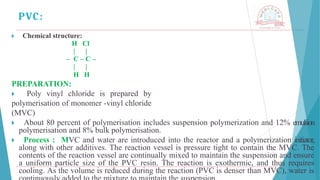
🞂 Chemicalstructure:
H Cl
| |
– C – C –
| |
H H
PREPARATION:
🞂 Poly vinyl chloride is prepared by
polymerisation of monomer -vinyl chloride
(MVC)
🞂 About 80 percent of polymerisation includes suspension polymerization and 12% emulsion
polymerisation and 8% bulk polymerisation.
🞂 Process : MVC and water are introduced into the reactor and a polymerization initiator,
along with other additives. The reaction vessel is pressure tight to contain the MVC. The
contents of the reaction vessel are continually mixed to maintain the suspension and ensure
a uniform particle size of the PVC resin. The reaction is exothermic, and thus requires
cooling. As the volume is reduced during the reaction (PVC is denser than MVC), water is
PVC:
32.
🞂
The polymerization ofMVC is started by compounds called initiators that are mixed into the
droplets. These compounds break down to start the radical chain reaction.
🞂
Typical initators include dioctanoyl peroxide and diacetyl peroxydicarbonate, both of
which have fragile O-O bonds. Some initiators start the reaction rapidly but decay
quickly and other initiators have the opposite effect.
🞂
A combination of two different initiators is often used to give a uniform rate of
polymerization. After the polymer has grown by about 10x, the short polymer
precipitates inside the droplet of MVC, and polymerization continues with the
precipitated, solvent- swollen particles.
🞂
Once the reaction has run its course, the resulting PVC slurry is degassed and stripped to
remove excess MVC, which is recycled. The polymer is then passed though a centrifuge to
remove water. The slurry is further dried in a hot air bed, and the resulting powder sieved
before storage or pelletization. Normally, the resulting PVC has a MVC content of less than
1 part per million.
PVC…(Contd.)
33.
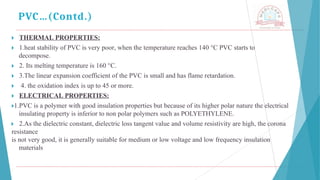
PROPERTIES
🞂 1. White,brittle solid
🞂 2.Insoluble in alcohol
🞂 3.Soluble in tetrahydrofuran
🞂 PHYSICAL PROPERTIES:
🞂
1.Thermoplastic
polymer
🞂 2.Rigid and
flexible
🞂
MECHANICAL
PROPERTIES:
🞂 1.High
hardness
🞂
2.Mechanical properties enhance with the molecular weight increasing, but decrease with the temperature
increasing.
🞂 3.Elastic modulus can reach to 1500-3,000 MPa., Elongation at break is up to 200% -
450%.
🞂 4.PVC friction is ordinary
PVC…(Contd.)
34.
🞂 THERMAL PROPERTIES:
🞂1.heat stability of PVC is very poor, when the temperature reaches 140 °C PVC starts to
decompose.
🞂 2. Its melting temperature is 160 °C.
🞂 3.The linear expansion coefficient of the PVC is small and has flame retardation.
🞂 4. the oxidation index is up to 45 or more.
🞂 ELECTRICAL PROPERTIES:
🞂
1.PVC is a polymer with good insulation properties but because of its higher polar nature the electrical
insulating property is inferior to non polar polymers such as POLYETHYLENE.
🞂 2.As the dielectric constant, dielectric loss tangent value and volume resistivity are high, the corona
resistance
is not very good, it is generally suitable for medium or low voltage and low frequency insulation
materials
PVC…(Contd.)
35.
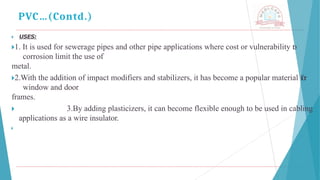
🞂 USES:
🞂
1.It is used for sewerage pipes and other pipe applications where cost or vulnerability t
o
corrosion limit the use of
metal.
🞂
2.With the addition of impact modifiers and stabilizers, it has become a popular material for
window and door
frames.
🞂 3.By adding plasticizers, it can become flexible enough to be used in cabling
applications as a wire insulator.
🞂
PVC…(Contd.)
36.
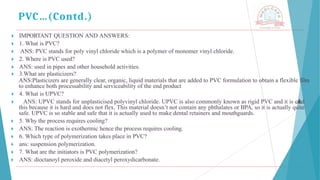
🞂 IMPORTANT QUESTIONAND ANSWERS:
🞂 1. What is PVC?
🞂 ANS: PVC stands for poly vinyl chloride which is a polymer of monomer vinyl chloride.
🞂 2. Where is PVC used?
🞂 ANS: used in pipes and other household activities.
🞂 3.What are plasticizers?
ANS:Plasticizers are generally clear, organic, liquid materials that are added to PVC formulation to obtain a flexible film
to enhance both processability and serviceability of the end product
🞂 4. What is UPVC?
🞂 ANS: UPVC stands for unplasticised polyvinyl chloride. UPVC is also commonly known as rigid PVC and it is called
this because it is hard and does not flex. This material doesn’t not contain any phthalates or BPA, so it is actually quite
safe. UPVC is so stable and safe that it is actually used to make dental retainers and mouthguards.
🞂 5. Why the process requires cooling?
🞂 ANS: The reaction is exothermic hence the process requires cooling.
🞂 6. Which type of polymerization takes place in PVC?
🞂 ans: suspension polymerization.
🞂 7. What are the initiators is PVC polymerization?
🞂 ANS: dioctanoyl peroxide and diacetyl peroxydicarbonate.
PVC…(Contd.)
37.
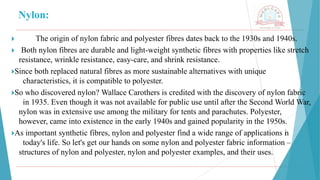
Nylon:
🞂 Theorigin of nylon fabric and polyester fibres dates back to the 1930s and 1940s.
🞂 Both nylon fibres are durable and light-weight synthetic fibres with properties like stretch
resistance, wrinkle resistance, easy-care, and shrink resistance.
🞂
Since both replaced natural fibres as more sustainable alternatives with unique
characteristics, it is compatible to polyester.
🞂
So who discovered nylon? Wallace Carothers is credited with the discovery of nylon fabric
in 1935. Even though it was not available for public use until after the Second World War,
nylon was in extensive use among the military for tents and parachutes. Polyester,
however, came into existence in the early 1940s and gained popularity in the 1950s.
🞂
As important synthetic fibres, nylon and polyester find a wide range of applications i
n
today's life. So let's get our hands on some nylon and polyester fabric information –
structures of nylon and polyester, nylon and polyester examples, and their uses.
38.
Nylon…(Contd.)
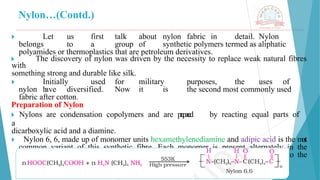
🞂 Letus first talk about nylon fabric in detail. Nylon
belongs to a group of synthetic polymers termed as aliphatic
polyamides or thermoplastics that are petroleum derivatives.
🞂 The discovery of nylon was driven by the necessity to replace weak natural fibres
with
something strong and durable like silk.
🞂 Initially used for military purposes, the uses of
nylon h
ave diversified. Now it is the second most commonly used
fabric after cotton.
Preparation of Nylon
🞂
Nylons are condensation copolymers and are p
r
e
p
a
r
e
d by reacting equal parts of
a
dicarboxylic acid and a diamine.
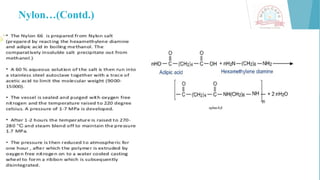
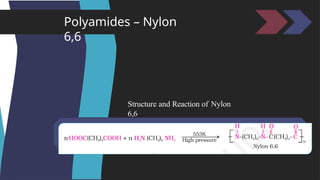
🞂 Nylon 6, 6, made up of monomer units hexamethylenediamine and adipic acid is the m
o
s
t
common variant of this synthetic fibre. Each monomer is present alternately in the
copolymer forming the repeating unit and each contributing six carbon atoms to the
polymer chain. The final nylon structure is the result of the following reaction:
Nylon…(Contd.)
Properties of Nylon-Someof the significant features of nylon include:
🞂 Dense molecular structure.
🞂 Extremely elastic.
🞂 Resilient and durable.
🞂 Abrasion-resistant.
🞂 Water-resistant.
🞂 Resistant to stains, UV rays, heat, and chemicals.
🞂 Resistant to mould and mildew.
🞂 Dries quickly
🞂
41.
Nylon…(Contd.)
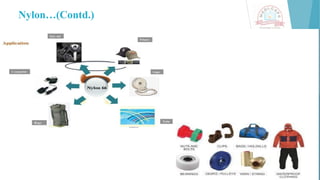
Applications of Nylon
🞂 Nylon has many applications. Some of them are:
🞂 Car components close to the engine
🞂 For making toys and plastic utilities
🞂 For making swim wears (due to its waterproof
nature)
🞂 Nylon resins are used in food packaging
🞂 Ropes, tents, tires and other military supplies
Bakelite:
🞂
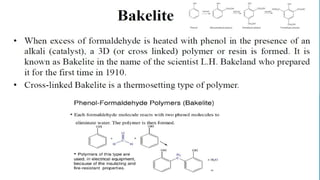
Bakelite is apolymer made up of the monomers phenol and formaldehyde. This phenol-
formaldehyde resin is a thermosetting polymer.
🞂
We cannot deny the presence of polymers in our lives. We are surrounded by objects, most o
f
which, some way or the other have a polymer associated with them. The ease of molding
polymers into different shapes and their relatively low cost of production has been the main
reason for their universal usage. As such, Bakelite is one of the commercially manufactured
polymers that we witness in our daily lives.
🞂
Bakelite is the commercial name for the polymer obtained by the polymerization of phenol
and formaldehyde. These are one of the oldest polymers that were synthesized by man.
Phenol is made to react with formaldehyde. The condensation reaction of the two reactants
in a controlled acidic or basic medium results in the formation of ortho and para
hydroxymethyl phenols and their derivatives.
44.
Bakelite…(Contd.)
Preparation of Bakelite
🞂
Whenthe phenol is taken in excess and the reaction medium is made acidic, the product of the
condensation reaction obtained is acidic. Whereas, when the quantity of formaldehyde taken is
more than that of phenol in the reacting mixture, and the reaction occurs in a basic medium, the
condensation product is known as Resol.
🞂 Novolac and Resol
🞂
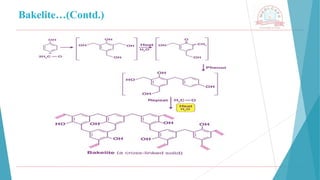
These intermediate condensation products are used as resins in different industries. Bakelite is
obtained when Novolac is allowed to undergo cross-linking in the presence of a cross-
linking agent.
🞂 In general, phenol taken in excess acts as the cross-linking agent.
🞂 The preparation of bakelite involves several steps, as illustrated on next page.
🞂
Bakelite Preparation’s initial methods of preparing bakelite involved the heating of formaldehyde
and phenol in the presence of one of the following catalysts -zinc chloride (ZnCl2), hydrochloric
acid (HCl), or ammonia (NH3)
🞂 The chemical formula of bakelite can be written as (C6H6O-CH2OH)n.
Bakelite…(Contd.)
Properties of Bakelite
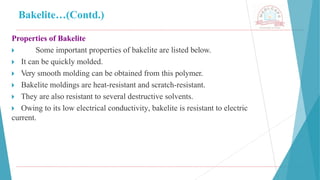
🞂 Some important properties of bakelite are listed below.
🞂 It can be quickly molded.
🞂 Very smooth molding can be obtained from this polymer.
🞂 Bakelite moldings are heat-resistant and scratch-resistant.
🞂 They are also resistant to several destructive solvents.
🞂 Owing to its low electrical conductivity, bakelite is resistant to electric
current.
48.
Bakelite…(Contd.)
Uses of Bakelite
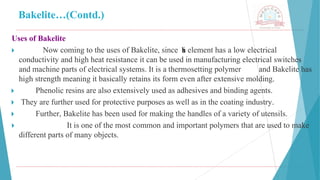
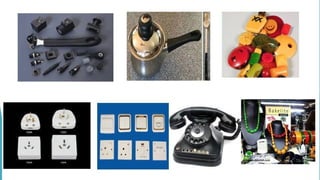
🞂 Now coming to the uses of Bakelite, since t
h
i
s element has a low electrical
conductivity and high heat resistance it can be used in manufacturing electrical switches
and machine parts of electrical systems. It is a thermosetting polymer and Bakelite has
high strength meaning it basically retains its form even after extensive molding.
🞂 Phenolic resins are also extensively used as adhesives and binding agents.
🞂 They are further used for protective purposes as well as in the coating industry.
🞂 Further, Bakelite has been used for making the handles of a variety of utensils.
🞂 It is one of the most common and important polymers that are used to make
different parts of many objects.
Bakelite…(Contd.)
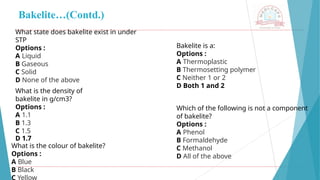
What state doesbakelite exist in under
STP
Options :
A Liquid
B Gaseous
C Solid
D None of the above
What is the density of
bakelite in g/cm3?
Options :
A 1.1
B 1.3
C 1.5
D 1.7
What is the colour of bakelite?
Options :
A Blue
B Black
C Yellow
Bakelite is a:
Options :
A Thermoplastic
B Thermosetting polymer
C Neither 1 or 2
D Both 1 and 2
Which of the following is not a component
of bakelite?
Options :
A Phenol
B Formaldehyde
C Methanol
D All of the above
59.
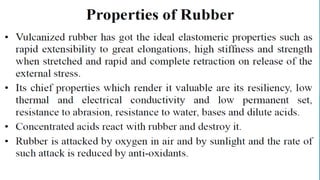
Rubber…(Contd.)
Vulcanization:
🞂 The crosslinkingprocess in elastomers is called vulcanization
🞂 It is achieved by a non-reversible chemical reaction, ordinarily carried out at an elevated temperature.
🞂
In most vulcanization reactions, sulphur compounds are added to the heated elastomer; sulphur atoms bond
with adjacent chains and crosslinks them.
🞂
Useful rubbers result when about 1 to 5 parts (by weight) of sulphur is added to 100 parts of rubber. Increasing
the sulphur content further hardness the rubber and also reduces its extensibility.
🞂
Unvulcanized rubber is soft and tacky, and has poor resistance to abrasion. Vulcanization enhances modulus of
elasticity, tensile strength and resistance to gradation. The magnitude of modulus of elasticity is directly
proportional to the density of the crosslinks.
🞂
Vulcanization normally results in increased elasticity and strength, increased durability and increased resistance
to adverse effect of weather and chemical agents.
🞂 Vulcanized rubber has low electrical and thermal conductivity and is resistant to abrasion and action of
chemical reagents and weather.
🞂
The process of vulcanization, in the manufacture of rubber goods, is carried out after calendering and extrusion.
When the rubber goods are to be manufactured by the process of moulding, vulcanization is performed
simultaneously with moulding.
🞂 Fabricating operations and lathe cutting are performed after the vulcanization process.
60.
Rubber…(Contd.)
Types of Rubber:
🞂 There are generally two types of rubber:
1. Natural rubber
2. Synthetic rubber
1. Natural Rubber:
🞂 Natural rubber is an elastic material present in the latex of certain plants. More than 95 p
e
r
cent of this rubber is obtained from the latex of rubber trees. Hevea brasiliensis, grows on
plantations, mainly in Sri Lanka and Malaya Peninsula. Small quantities of rubber are
produced in Brazil from uncultivated trees and from the guagle shrub in Mexico and south
western United States.
61.
Rubber…(Contd.)
Types of Rubber…
🞂 Latex is a milky colloidal fluid containing from 30 to 40 percent of the rubber,
the remaining being mainly water and a small amount of protein and resinous
material. It oozes from superficial cuts in rubber trees and is collected in containers.
A plantation grown tree continues to yield for about 40 years and give enough latex to
make from 1.5 kg to 3 kg of rubber each year.
🞂 Latex is treated in two ways to obtain rubber goods. The crude rubber is either co-agulated
from it by acids of heat and then processed; or the latex itself is mixed with appropriate
compounding materials and then precipitated directly with appropriate compounding
materials and then precipitated directly from solution in the shape to be used, such as
rubber glove.
62.
Rubber…(Contd.)
🞂
The recovery ofrubber from guayule is carried out in different manner. The entire plant,
which may contain as much as 20 percent by weight of rubber, is harvested after 4 years
growth, ground up and soaked in water. The latex comes at the surface and is skinned off;
the woody material becomes water logged and sink to the bottom. The resin content of
guayule rubber is 18 to 20 percent compared to about 4 percent for hevea rubber. This resin
may be extracted by means of solvents and can be recovered and utilized.
🞂
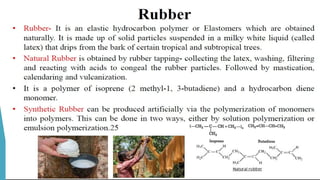
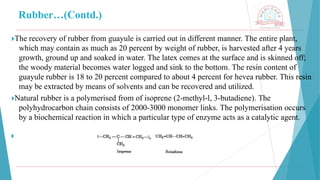
Natural rubber is a polymerised from of isoprene (2-methyl-l, 3-butadiene). The
polyhydrocarbon chain consists of 2000-3000 monomer links. The polymerisation occurs
by a biochemical reaction in which a particular type of enzyme acts as a catalytic agent.
🞂
63.
Rubber…(Contd.)
Crude Rubber:
🞂
It isusually obtained from latex by coagulation with organic acids, washing and coagulum with water
as it passes between rolls, and finally drying the washed sheet as it comes from the rolls.
🞂
i. If the rough rolls rotating at high speeds are used and the rubber is then hung in the air to dry, the
product is known as pale “crepe rubber”.
🞂
ii. If smooth rolls rotating at the same speed are used and the rubber is then dried in a smoke house,
the product is known as smoke sheets. It is tougher than pale crepe.
🞂 Crude rubber is tough, strong, elastic substance made up of 92% or more of a hydrocarbon chain
polymer (C5H8).
🞂
Crude rubber does not possess the properties that cause the familiar manufactured articles to be
considered so valuable. At the temperature of very hot summer weather, pure rubber becomes soft
and sticky, during very cold weather it becomes hard and brittle. In either of these conditions, it is
useless for the purposes to which it is commonly put. However its properties are greatly improved by
addition of other materials followed by suitable heat or other treatment
64.
Rubber…(Contd.)
Physical Properties ofCrude Natural Rubber:
🞂 The physical properties of crude natural rubber are indicated below:
🞂 1. At low temperature rubber becomes stiff and when it frozen, it attains fibrous structure.
🞂 2. Raw rubber when heated to 130°C becomes soft and plastic. The plasticity can be varied
within certain ranges by chemicals.
🞂 3. Co-efficient of cubical expansion is 670 x 10-8. When rubber is extended heat is produced.
This is called Joule’s effect. When rubber is stretched to 82% it generates 680 calories/gm of
heat.
🞂 4. Heat of combustion of raw rubber is 10547 calories/gm.
🞂 5. Specific gravity of raw rubber at 0°C is 0.95 and 0.934 at 20°C.
🞂 6. Specific heat of raw rubber at room temperature is 0.502.
65.
Rubber…(Contd.)
2. Synthetic Rubber:
🞂 Rubber produced by artificial chemical process is known as “synthetic rubber”.
🞂
Synthetic rubbers, or “elastomes” are derived from such raw materials as coke, limestone,
petroleum, natural gas, salt, alcohol, sulphur, ammonia and coal tar.
🞂
Elastomers are not strictly speaking synthetic rubber, for rubber has never been synthesized.
They are rubber like materials which have many of the characteristic properties of rubber
and some of which resemble rubber in their chemical nature.
🞂
The processing of synthetic rubbers involves approximately the same steps and equipments
as that of crude rubber. Their properties while similar to those of rubber, are capable of
wider variation. Some elastomers are more resistant that rubber to sunlight, others have
greater solvent resistance; and some have greater elasticity.
66.
Rubber…(Contd.)
The important formsof rubber are described below:
1. Gutta Percha Rubber:
🞂
It is a variety of natural rubber, prepared from the leaves of tress known as the dichopsis
gutta and palaginum gutta (mostly grown in Malaya peninsula).
🞂 It becomes soft and sticky at a temperature of about 100°C.
🞂 As compared to other varieties of rubber, it absorbs less water.
Uses:
🞂
It is extensively used for preparing ropes of submarine and as an insulating material i
n
electrical works.
67.
Rubber…(Contd.)
2. Foam Rubber:
🞂
Itis prepared by adding the chemically producing gases in the liquid latex and stirring the
mixture till foam is formed. It is then converted into solid foam and is given the desired
shape.
🞂 Uses:
🞂 It is wisely used for packing pads, pillows etc.
3. Sponge Rubber:
🞂
It is prepared by adding sodium bicarbonate during the process of vulcanisation. The
evaporation of moisture leaves pores which result in sponge rubber.
🞂 Uses:
🞂 It is used as a heat and sound insulating material.
68.
Rubber…(Contd.)
4. Guayle Rubber:
🞂It is a variety of natural rubber available in North America.
🞂
It is prepared from the branches of guayule, contains 70 percent of hydrocarbon, 20 percent of resin, 10
percent of insoluble materials, cellulose, liquid etc.
5. Smoked Rubber:
🞂 It is a variety of crude rubber which is obtained by drying rubber pieces after coagulation in room
filled with
smoke at a temperature of about 40°C to 50°C.
🞂 It is so named as drying is carried out in a smoke room.
6. Polybutadiene Rubber:
🞂 It is a variety of synthetic rubber (produced by The Indian Petrochemicals Corporation Ltd., near
Baroda);
commercially known as Cisrub.
🞂 It has high abrasion resistance and strength.
🞂 Uses:
🞂 It is nicely used in producing beltings, floor tiles, automotive moulded goods, hoses, tyres, seals,
69.
Rubber…(Contd.)
Plasticization:
🞂
In order tomake crude rubber workable, it is kneaded to a plastic mass by passing it through
heated rollers which travel towards each other at different speeds. By this process the rubber
is subjected to both compression and shearing stresses which cause the rubber to twist,
crack or tear and become plastic. Other ingredients can also be added into the rubber mass
during the process.
Compounding:
🞂
The rubber available in plastic state is compounded with other ingredients to modify its
properties.
70.
Rubber…(Contd.)
A number ofdifferent substances which can be mixed with rubber to give it
definite properties are classified as follows:
(i) Vulcanates:
🞂
These are the substances (e.g., sulphur etc.) which are added to crude rubber to reduce its plasticity while
maintaining its elasticity.
🞂 These are essentially required for carrying out the process of vulcanization.
(ii) Plasticizers:
🞂 These are the materials (e.g., vegetable oils, waxes, stearic acid, etc.) which are used to soften the crude
rubber.
(iii) Accelerators:
🞂
These are the substances (e.g., lime, magnesia, litharge, white lead etc.) which are used to reduce the time
required for the completion of the process of vulcanization.
🞂 With their use, the quantity of sulphur required for vulcanization is also reduced.
(iv) Antioxidants:
🞂
These are the materials (e.g., phenols, amines, waxes etc.) which when added in small quantities to rubber
decrease the rate of its deterioration by agencies like light, heat and by the presence of copper or
manganese, salts or soaps etc.
71.
Rubber…(Contd.)
(v) Fillers, ReinforcingAgents and Colouring Agents:
🞂 The addition of fillers is made to modify the properties of rubber and to lower the cost of rubber
product.
🞂
“A reinforcing agent “is one which when added to rubber increases its tensile strength. Materials like
zinc oxide and carbon black serve both as fillers and reinforcing agents. Some other reinforcing
agents are magnesium carbonate, calcium carbonate and barium sulphate.
🞂 “Colouring agents” are added to obtain the rubber in desired shade.
🞂 Example: Ferric oxide-red colour; “Lithophone”-white colour; “Lead chromate”-yellow colour etc.
Calendering:
🞂
A calendering machine is used to obtain rubber in the form of sheets of definite thickness. The rubber
mass is made to pass between large steel rollers of the machine, at carefully controlled temperature
and pressure. The rollers press the rubber mass into sheets of uniform thickness and desired finish.
72.
Rubber…(Contd.)
Vulcanization:
🞂 The crosslinkingprocess in elastomers is called vulcanization
🞂 It is achieved by a non-reversible chemical reaction, ordinarily carried out at an elevated temperature.
🞂
In most vulcanization reactions, sulphur compounds are added to the heated elastomer; sulphur atoms bond
with adjacent chains and crosslinks them.
🞂
Useful rubbers result when about 1 to 5 parts (by weight) of sulphur is added to 100 parts of rubber. Increasing
the sulphur content further hardness the rubber and also reduces its extensibility.
🞂
Unvulcanized rubber is soft and tacky, and has poor resistance to abrasion. Vulcanization enhances modulus of
elasticity, tensile strength and resistance to gradation. The magnitude of modulus of elasticity is directly
proportional to the density of the crosslinks.
🞂
Vulcanization normally results in increased elasticity and strength, increased durability and increased resistance
to adverse effect of weather and chemical agents.
🞂 Vulcanized rubber has low electrical and thermal conductivity and is resistant to abrasion and action of
chemical reagents and weather.
🞂
The process of vulcanization, in the manufacture of rubber goods, is carried out after calendering and extrusion.
When the rubber goods are to be manufactured by the process of moulding, vulcanization is performed
simultaneously with moulding.
🞂 Fabricating operations and lathe cutting are performed after the vulcanization process.
73.
Rubber…(Contd.)
Extruding:
🞂 By thisprocess rubber goods of constant cross-section like tubes, insulation on wire etc. can be
manufactured.
🞂 In this process, this rubber compound is fed into the extrusion die by means of a screw fed and’ t
h
e
extruded products are either coiled or laid in lengths in large flat trays and vulcanized in open stem
heaters.
Moulding:
🞂 In this process the rubber is forced into the mould (of heavy metallic construction) under high
pressure (rubber is not melted and poured like metal).
🞂
For getting non-porous uniform product, the process of moulding is performed in heated moulds in
which the rubber compound is forced under high pressure.
Reclaimed Rubber:
🞂 Reclaimed rubber is the rubber recovered from worn-out rubber articles and rubber wastes from
factories and then treated suitably for re-use.
🞂
For reclaiming rubber, the metal and fabric contents of the worn-out rubber are first removed and
then it is heated in a closed iron vessel which contains an alkali solution. This treatment makes
the rubber free from the remaining fabric contents and free sulphur. The treated rubber is washed
and dried.
Free Radical Mechanism
🞂 A variety of alkanes or dienes and their derivatives a
r
e
polymerised in the presence of free radical
generating initiator.
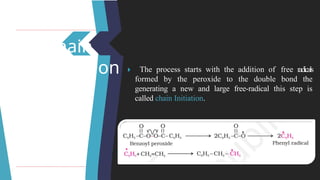
🞂 The polymerization of ethene to polythene consists
of heating or exposing to light a mixture of ethene
with a small amount of benzoyl peroxide initiator.
Chain
Initiation 🞂 The process starts with the addition of free radicals
formed by the peroxide to the double bond the
generating a new and large free-radical this step is
called chain Initiation.
153.
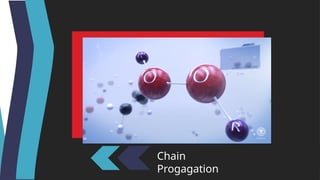
Chain
Propagation
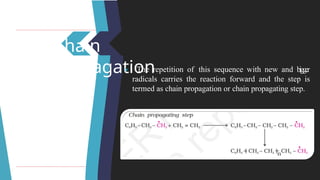
🞂 Therepetition of this sequence with new and bigger
radicals carries the reaction forward and the step is
termed as chain propagation or chain propagating step.
154.
Chain
Termination
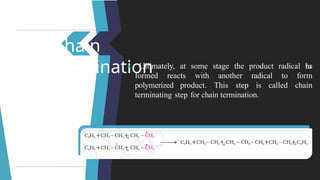
🞂 Ultimately,at some stage the product radical t
h
u
s
formed reacts with another radical to form
polymerized product. This step is called chain
terminating step for chain termination.
155.
Condensation
polymerization
🞂 Also calledstep growth polymerization.
🞂
This type of polymerization generally involves the
repetitive condensation reaction between two bi functional
monomer.
🞂 Loss of some simple molecules.
🞂 Leads to formation of high molecular masses.
🞂 Each step produces a distinct f
u
n
c
t
i
o
n
a
l
i
s
e
d species and
is
156.
Copolymerizatio
n Copolymerization isa polymerization reaction in which a
mixture of more than one monomeric species is allowed to
polymerase and former copolymer.
The copolymer can be made not only by the Chain growth
polymerization but by step growth polymerization also.
Copolymer properties quite different from homopolymers.
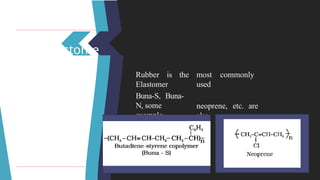
For example butadiene styrene copolymer is quite tough and
is a good substitute for natural rubber it is also used
for manufacturing of auto tyres floor tiles footwear cable
insulation etc.
Polythen
e There aretwo types of polythene
–
🞂 Low density polythene
🞂 High density polythene
159.
Low density
polythene
🞂 It is obtained by polymerization of ethene under high pressure
of 1000-2000 atmosphere at a temperature of 350 Kelvin to
570 Kelvin in the presence of trace of dioxygen or peroxide
initiator.
🞂 The low density polythene obtained through the free
radical
addition and h atom abstraction has highly branched structure.
🞂 Low density polythene is chemically inert and tough but flexible
and a poor conductor of electricity.
🞂 It is used in the insulation of electronics wire manufacture o
f
squeeze bottle, toys and flexible pipe.
160.
High density
polythene
It isformed when addition polymerisation of ethene takes
place in a hydrocarbon solvent in the presence of catalyst such
as dry clean aluminium and Titanium tetrachloride (Ziegler-
Natta) catalyst at a temperature of 333 Kelvin to 453 Kelvin
and under a pressure of 6-7 atmosphere.
High density polythene consists of linear molecules and has a
high density due to close packing.
It is also chemically inert and more tough and hard.
It is used for manufacturing buckets dustbins bottle pipe etc.
161.
Polytetrafluoroethylene (Teflon)
Teflon ismanufactured by heating tetrafluoroethane with
a free radical or facial fade catalyst at high pressure.
It is chemicallyinert and resistant to attack by corrosive
reagents.
It is used in making oil seals and gaskets and also used
for non stick surface coated utensils.
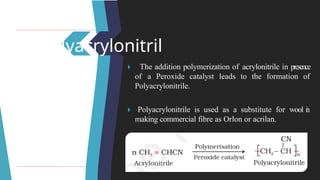
Polyacrylonitril
e 🞂 The addition polymerization of acrylonitrile in presence
of a Peroxide catalyst leads to the formation of
Polyacrylonitrile.
🞂 Polyacrylonitrile is used as a substitute for wool i
n
making commercial fibre as Orlon or acrilan.
Polyamide
s 🞂 These Polymers are the important example of synthetic
fibres and are termed as nylons.
🞂 The general method of preparation consists of t
h
e
condensation polymerization of amines and carboxylic
acids and also of amino acids and their lactams.
🞂 Latest discuss the preparation of nylon.
166.
6,
6 🞂 It is prepared by the condensation polymerization
o
f hexamethylenediamine with adipic acid under
high pressure and at high temperature.
🞂 It is used in making sheets results for brushes and
i
n textile industries.
Polyester
dicarboxylic
🞂
These arethe p
o
l
y
c
o
n
d
e
n
s
a
t
i
o
n products
of acids and diols.
🞂 Dacron or terylene is the best known example of polyester.
🞂 It is manufactured by heating a mixture of Ethylene g
l
y
c
o
l
and Terephthalic acid at 422 460 Kelvin in the presence of
zinc acetate antimony trioxide catalyst as for the reaction
given earlier.
🞂 Deccan fibre is crease resistant and is used in blending w
i
t
h
cotton and wool fibre and also as glass for ceiling material in
safety helmets etc.
171.
Melamine formaldehyde
polymer 🞂 Mile mine formaldehyde polymer is found by t
h
e
condensation polymerization of melamine and
formaldehyde.
🞂 It is used in the manufacture of unbreakable
crockery.
172.
Phenol formaldehyde polymer( Bakelite and related
polymer )
🞂 Phenol-formaldehyde Polymers are the oldest synthetic
polymer
🞂 These are obtained by the condensation reaction of phenol w
i
t
h
formaldehyde in the presence of either and acid or base catalyst
the reaction is start with the initial formation of and para
hydroxy methyl phenol derivatives which for the reacts with the
phenol to form compounds having ring join together to each
other through ch2 group the initial product would be a linear
product novolac used in paints.
173.
Bakelite
🞂
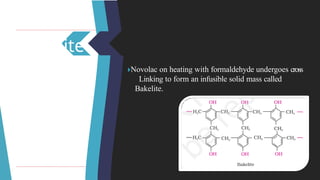
Novolac on heatingwith formaldehyde undergoes cross
Linking to form an infusible solid mass called
Bakelite.
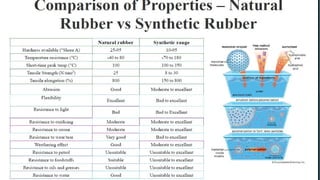
URAL RUBBER
DESCRIPTION
• Elasticpolymer.
• It comes from latex.
• Trees: Hevea Brasiliensis and Castilloa
Elastica.
• Elastic, water repellent and electric resistant.
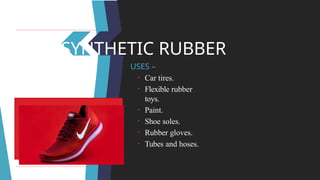
YNTHETIC RUBBER
DESCRIPTION –
🞂 Artificial elastomer
🞂 Obtained mainly from
petroleum
🞂 Elastic material
🞂 Good qualities and cheap
🞂 It is recyclable
180.
SYNTHETIC RUBBER
PROPERTIES –
🞂 Solid, flexible, durable.
🞂 It hardens when it's cooled.
🞂 It can be molded when heated.
🞂 Resistant to heat, light and
chemicals.
🞂 Heat and electrical insulator.
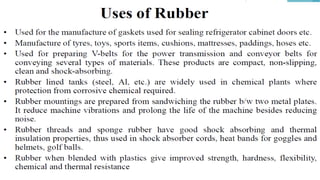
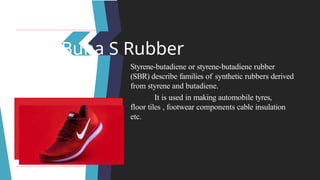
Buna S Rubber
Styrene-butadieneor styrene-butadiene rubber
(SBR) describe families of synthetic rubbers derived
from styrene and butadiene.
It is used in making automobile tyres,
floor tiles , footwear components cable insulation
etc.
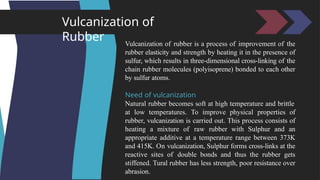
Vulcanization of
Rubber Vulcanizationof rubber is a process of improvement of the
rubber elasticity and strength by heating it in the presence of
sulfur, which results in three-dimensional cross-linking of the
chain rubber molecules (polyisoprene) bonded to each other
by sulfur atoms.
Need of vulcanization
Natural rubber becomes soft at high temperature and brittle
at low temperatures. To improve physical properties of
rubber, vulcanization is carried out. This process consists of
heating a mixture of raw rubber with Sulphur and an
appropriate additive at a temperature range between 373K
and 415K. On vulcanization, Sulphur forms cross-links at the
reactive sites of double bonds and thus the rubber gets
stiffened. Tural rubber has less strength, poor resistance over
abrasion.
185.
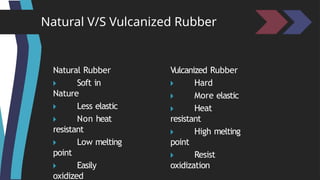
Natural V/S VulcanizedRubber
Natural Rubber
🞂 Soft in
Nature
🞂 Less elastic
🞂 Non heat
resistant
🞂 Low melting
point
🞂 Easily
oxidized
Vulcanized Rubber
🞂 Hard
🞂 More elastic
🞂 Heat
resistant
🞂 High melting
point
🞂 Resist
oxidization
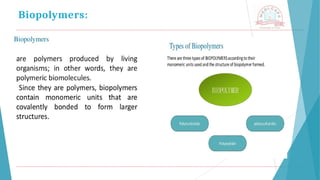
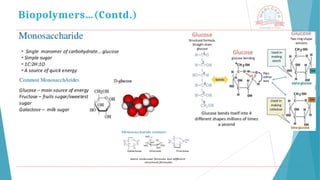
What are
Biopolymers?
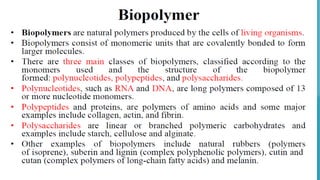
Biopolymers arepolymers produced by living organisms; in other words,
they are polymeric biomolecules.
Since they are polymers, biopolymers contain monomeric units that
are covalently bonded to form larger structures.
Examples of Bio-Polymers
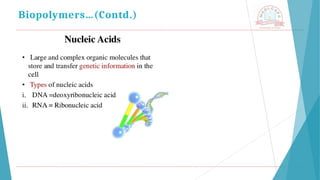
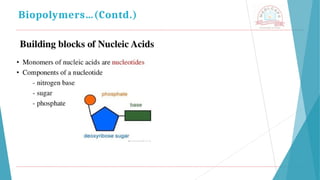
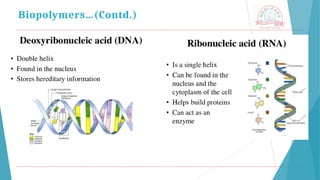
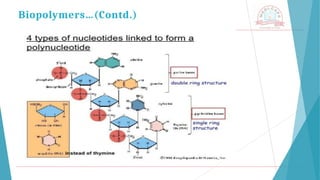
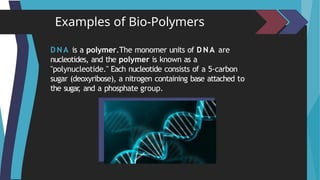
DN A is a polymer.The monomer units of D NA are
nucleotides, and the polymer is known as a
"polynucleotide." Each nucleotide consists of a 5-carbon
sugar (deoxyribose), a nitrogen containing base attached to
the sugar
, and a phosphate group.
190.
Examples of Bio-Polymers
RNApolymerase, is an enzyme that synthesizes RNA from a
DNA template. Using the enzyme helicase, RNAP locally
opens the double-stranded DNA so that one strand of the
exposed nucleotides can be used as a template for the
synthesis of RNA, a process called transcription.
191.
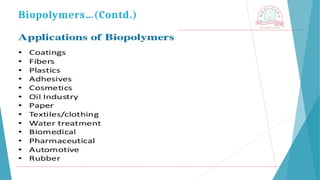
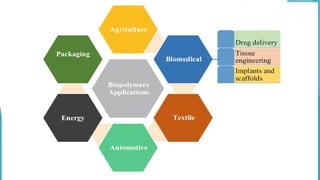
Applications of
Biopolymer
• Coatings
•Fibers
• Plastics
• Adhesives
• Cosmetics
• Oil
Industry
• Paper
• Textiles/clothing
• Water treatment
• Biomedical
• Pharmaceutical
• Automotive
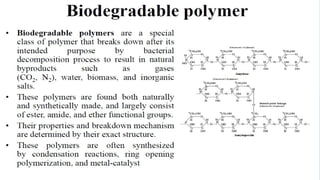
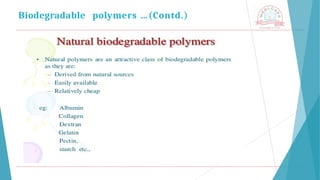
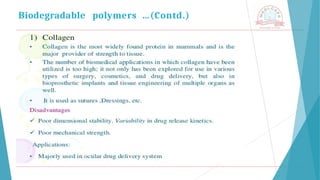
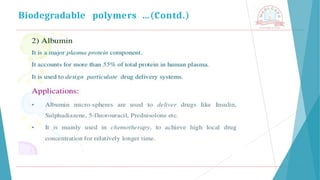
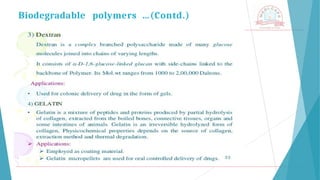
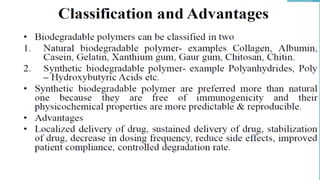
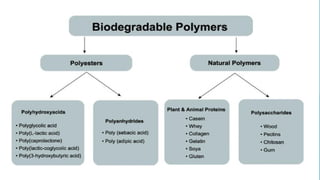
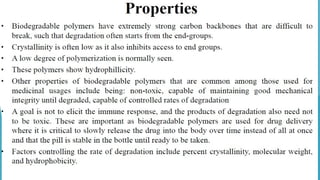
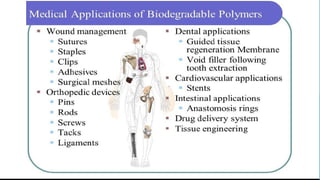
Biodegradable
Polymers
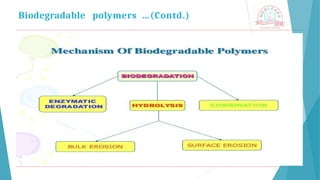
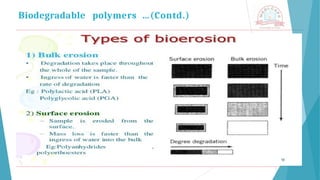
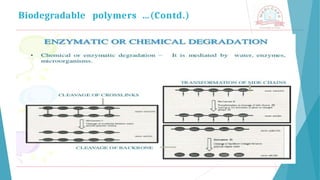
are a specialclass of polymer that breaks down after its intended
purpose by bacterial decomposition process to result in natural byproducts such
as gases (CO2, N2), water, biomass, and inorganic salts.
These polymers are found both naturally and synthetically made,
and largely consist of ester, amide, and ether functional groups.
Their properties and breakdown mechanism are determined by their
exact structure.
These polymers are often synthesized by condensation reactions, ring
opening polymerization,
and metal catalysts. There are vast examples and applications of
biodegradable polymers.
194.
Impact on our
Environment
Plasticis harmful because it is 'Non-Biodegradable'. When thrown on land it makes the soil
less fertile. When thrown in water it chokes our ponds, rivers and oceans and harms the sea life.
We can also help by using cloth bags for shopping instead of plastic bags.
Recycling plastic is tricky business, and many plastics are better off as garbage.
Recycling is generally far better than sending waste to landfills and relying on new raw materials
to drive the consumer economy. It takes two-thirds less energy to make products from recycled
plastic than from virgin plastic.
The most obvious form of pollution associated with plastic packaging is wasted
plastic sent to landfills. Plastics are very stable and therefore stay in the environment a long
time after they are discarded, especially if they are shielded from direct sunlight by being buried
in landfills.
This waste rots and decomposes, and produces harmful gases (CO2 and
Methane) which
195.
Impact on our
Environment
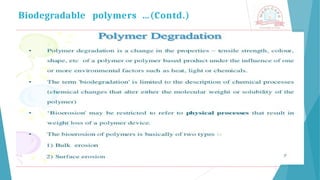
Landfillsalso pollute the local environment, including the water and the soil. ... It also affect the
global warming and the environment.
The waste can harm humans, animals, and plants if they encounter these toxins buried
in the ground, in stream runoff, in groundwater that supplies drinking water, or in floodwaters,
as happened after Hurricane Katrina.
Some toxins, such as mercury, persist in the environment and accumulate. Chlorinated
plastic can release harmful chemicals into the surrounding soil, which can then seep into
groundwater or other surrounding water sources and also the ecosystem of the world. This
can cause serious harm to the species that drink the water. Landfill areas contain many different
types of plastics.
Burning of plastic in the open air, leads to environmental pollution due to the release of
poisonous chemicals. The polluted air when inhaled by humans and animals affect their health
and can cause respiratory problems.
![Classification of polymer…(Contd.)
3. Classification of Polymers on the Basis of structure
🞂 On the basis of structure of polymers, these can be classified as :
1. Linear polymers 2. Branched chain polymers3. Cross-linked polymers.
Linear polymers :
🞂 These are polymers in which monomeric units are linked together to form
linear chains.
🞂 These linear polymers are well packed and therefore, have high
densities, high tensile (pulling) strength and high melting points.
🞂 Examples: polyethelene, nylons and polyesters are examples of linear polymers.
Branched chain polymers :
🞂
These are polymers in which the monomers are joined to form long chain with side chains o
r
branches of different lengths [Fig. ON NEXT PPT]. These](https://image.slidesharecdn.com/std-250411092938-21c9170f/85/Std-Mat-Unit-2-Polymer-EngineeringChemistry-pptx-9-320.jpg)