

Guided by- Miss Bhagyashree
Prepared by:-
• Amrit samal
• Sunita behera
• Sunil kumar sahoo
• Truptimayee moharana
• Chandan mohapatra
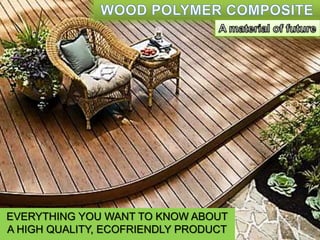
EVERYTHING YOU WANT TO KNOW ABOUT
A HIGH QUALITY, ECOFRIENDLY PRODUCT
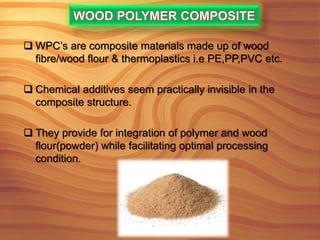
 WPC’s are composite materials made up of wood
fibre/wood flour & thermoplastics i.e PE,PP,PVC etc.
 Chemical additives seem practically invisible in the
composite structure.
 They provide for integration of polymer and wood
flour(powder) while facilitating optimal processing
condition.
FROM HISTORICAL PERSPECTIVE
 More than 30 years ago in Japan an engineering company
invented and developed a substitute for wood made from
soft wood waste and recycled polymer resin.
 This material had the appearance and qualities of the
rarest species of wood offering a truly ecofriendly
alternative
 In 1900s an earlier commercial composite material
marketed under the tradename ‘Bakelite’ was made of
phenol formaldehyde and wood flour
 Its first commercial use was reportedly as gear shaft
knob for ROLLS ROYCE in 1916.
CURRENT SCENARIO
 The most widespread use of WPCs are in north
america is in outdoor deck floors.
 It is used for railings, fences, landscaping
timbers, cladding and siding, park benches, mold
trim, window and door frames, and indoor furniture.
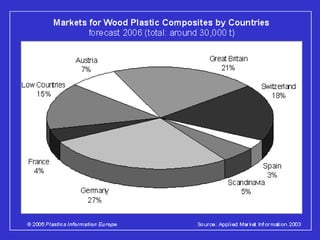
 Although the WPC industry is still only a fraction of a
percent of the total wood products industry, it has
made significant in roads in certain markets.
According to estimates, the WPC market was
320,000 MT in 2001 and the volume is expected to
more than double by today.
THERMOPLASTICS MATERIALS & WOOD FILLER
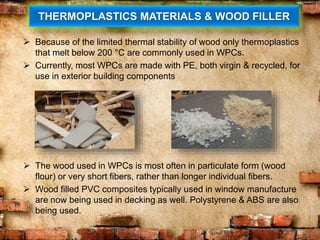
 Because of the limited thermal stability of wood only thermoplastics
that melt below 200 °C are commonly used in WPCs.
 Currently, most WPCs are made with PE, both virgin & recycled, for
use in exterior building components
 The wood used in WPCs is most often in particulate form (wood
flour) or very short fibers, rather than longer individual fibers.
 Wood filled PVC composites typically used in window manufacture
are now being used in decking as well. Polystyrene & ABS are also
being used.
 Since the early 1990's, the wood – plastic composite industry
has grown significantly.
 Today, wood & other natural fibres account for 7% of the total
2.5 billion kilograms filler & reinforcement used.
 This represents a 135 % increase in natural fibre demand since
1990 with most of the growth in the past five years.
 The use of natural fibres such as flax, hemp, sisal etc.; is also
increasing particularly in the automotive sector, both in Europe
& USA.
 Despite lower strength compared to glass fibre, natural fibres
are attractive due to their lower density.
CRITERIA FOR A WPCs
 High mechanical strength
 Higher interface.
 High strength to weight ratio
 High modulus to weight ratio
 High specific strength & specific stiffness.
SIGNIFICANCE OF REINFORCEMENT
(WOOD FLOUR)
Carries 70-90% of applied load on composite
Provides strength, stiffness & thermal
stability
Provides either insulation or conductive
property.
SIGNIFICANCE OF MATRIX
(PP)
 Matrix constitutes 60-90% of composite.
 Responsible for equal distribution of applied load.
 Provides structural stability & toughness.
 Acts as a binding agent.
 Protects the reinforcement from environmental
degradation.
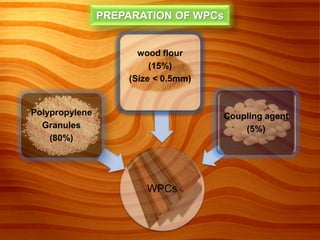
PREPARATION OF WPCs
WPCs
Polypropylene
Granules
(80%)
wood flour
(15%)
(Size < 0.5mm)
Coupling agent
(5%)
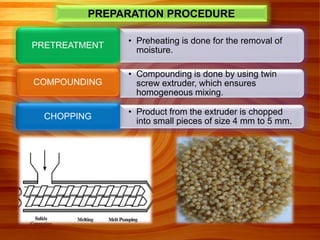
• Preheating is done for the removal of
moisture.
PRETREATMENT
• Compounding is done by using twin
screw extruder, which ensures
homogeneous mixing.
COMPOUNDING
• Product from the extruder is chopped
into small pieces of size 4 mm to 5 mm.
CHOPPING
PREPARATION PROCEDURE
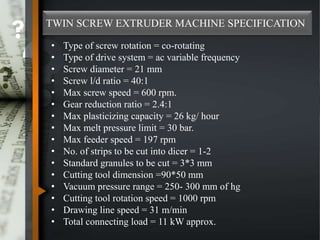
TWIN SCREW EXTRUDER MACHINE SPECIFICATION
• Type of screw rotation = co-rotating
• Type of drive system = ac variable frequency
• Screw diameter = 21 mm
• Screw l/d ratio = 40:1
• Max screw speed = 600 rpm.
• Gear reduction ratio = 2.4:1
• Max plasticizing capacity = 26 kg/ hour
• Max melt pressure limit = 30 bar.
• Max feeder speed = 197 rpm
• No. of strips to be cut into dicer = 1-2
• Standard granules to be cut = 3*3 mm
• Cutting tool dimension =90*50 mm
• Vacuum pressure range = 250- 300 mm of hg
• Cutting tool rotation speed = 1000 rpm
• Drawing line speed = 31 m/min
• Total connecting load = 11 kW approx.
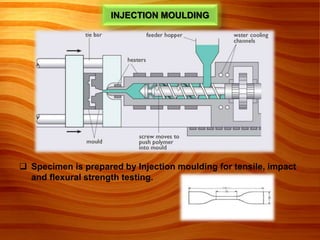
INJECTION MOULDING
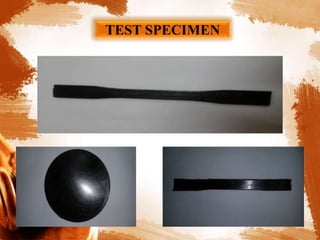
 Specimen is prepared by Injection moulding for tensile, impact
and flexural strength testing.
TEST SPECIMEN
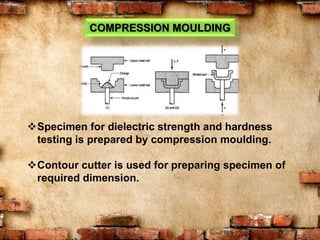
COMPRESSION MOULDING
Specimen for dielectric strength and hardness
testing is prepared by compression moulding.
Contour cutter is used for preparing specimen of
required dimension.
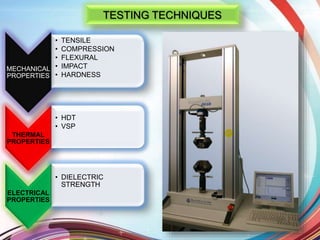
TESTING TECHNIQUES
MECHANICAL
PROPERTIES
• TENSILE
• COMPRESSION
• FLEXURAL
• IMPACT
• HARDNESS
THERMAL
PROPERTIES
• HDT
• VSP
ELECTRICAL
PROPERTIES
• DIELECTRIC
STRENGTH
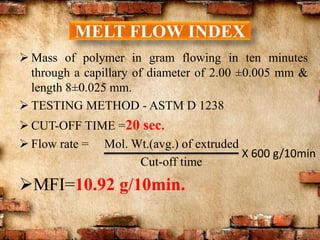
MELT FLOW INDEX
 Mass of polymer in gram flowing in ten minutes
through a capillary of diameter of 2.00 ±0.005 mm &
length 8±0.025 mm.
 TESTING METHOD - ASTM D 1238
 CUT-OFF TIME =20 sec.
 Flow rate = Mol. Wt.(avg.) of extruded
Cut-off time
MFI=10.92 g/10min.
X 600 g/10min
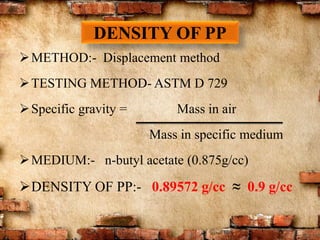
DENSITY OF PP
METHOD:- Displacement method
TESTING METHOD- ASTM D 729
Specific gravity = Mass in air
Mass in specific medium
MEDIUM:- n-butyl acetate (0.875g/cc)
DENSITY OF PP:- 0.89572 g/cc ≈ 0.9 g/cc
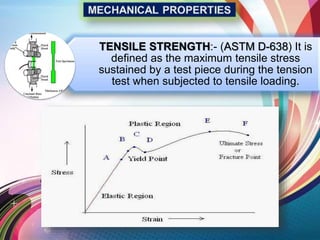
TENSILE STRENGTH:- (ASTM D-638) It is
defined as the maximum tensile stress
sustained by a test piece during the tension
test when subjected to tensile loading.
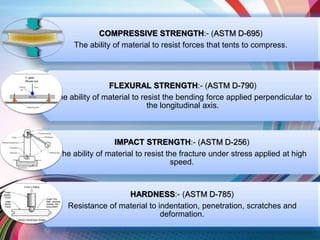
COMPRESSIVE STRENGTH:- (ASTM D-695)
The ability of material to resist forces that tents to compress.
FLEXURAL STRENGTH:- (ASTM D-790)
The ability of material to resist the bending force applied perpendicular to
the longitudinal axis.
IMPACT STRENGTH:- (ASTM D-256)
The ability of material to resist the fracture under stress applied at high
speed.
HARDNESS:- (ASTM D-785)
Resistance of material to indentation, penetration, scratches and
deformation.
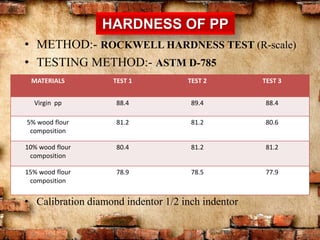
HARDNESS OF PP
• METHOD:- ROCKWELL HARDNESS TEST (R-scale)
• TESTING METHOD:- ASTM D-785
• Calibration diamond indentor 1/2 inch indentor
MATERIALS TEST 1 TEST 2 TEST 3
Virgin pp 88.4 89.4 88.4
5% wood flour
composition
81.2 81.2 80.6
10% wood flour
composition
80.4 81.2 81.2
15% wood flour
composition
78.9 78.5 77.9
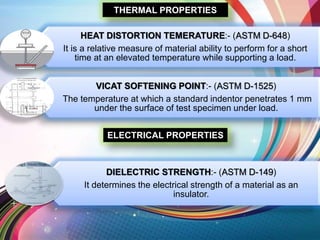
THERMAL PROPERTIES
HEAT DISTORTION TEMERATURE:- (ASTM D-648)
It is a relative measure of material ability to perform for a short
time at an elevated temperature while supporting a load.
VICAT SOFTENING POINT:- (ASTM D-1525)
The temperature at which a standard indentor penetrates 1 mm
under the surface of test specimen under load.
ELECTRICAL PROPERTIES
DIELECTRIC STRENGTH:- (ASTM D-149)
It determines the electrical strength of a material as an
insulator.
ADVANTAGES
 They have good workability and can be shaped using
conventional woodworking tools.
 WPCs do not corrode and are highly resistant to rot, decay, and
MARINE BORER ATTACK, though they do absorb water into the
wood fibres embedded within the material.
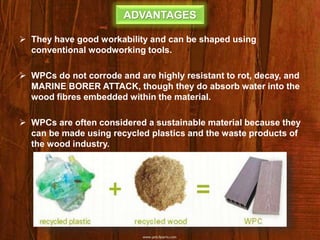
 WPCs are often considered a sustainable material because they
can be made using recycled plastics and the waste products of
the wood industry.
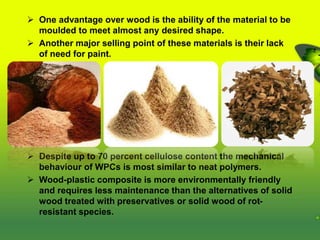
 One advantage over wood is the ability of the material to be
moulded to meet almost any desired shape.
 Another major selling point of these materials is their lack
of need for paint.
 Despite up to 70 percent cellulose content the mechanical
behaviour of WPCs is most similar to neat polymers.
 Wood-plastic composite is more environmentally friendly
and requires less maintenance than the alternatives of solid
wood treated with preservatives or solid wood of rot-
resistant species.
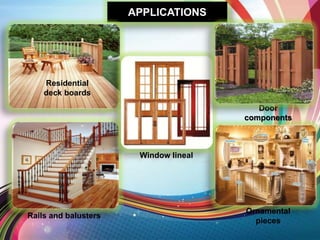
APPLICATIONS
Residential
deck boards
Rails and balusters
Ornamental
pieces
Door
components
Window lineal
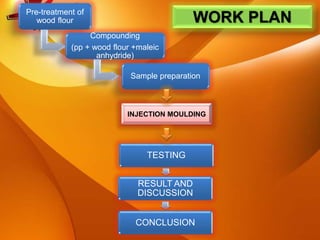
Pre-treatment of
wood flour
Compounding
(pp + wood flour +maleic
anhydride)
Sample preparation
WORK PLAN
TESTING
RESULT AND
DISCUSSION
CONCLUSION
INJECTION MOULDING
SUMMARY
 Many applications exist using current WPC
technology.
 Improvements in stiffness, creep, fire and weather
ability will open more applications.
 Education of engineers, architects, and other users
is crucial.
wood polymer composite

wood polymer composite

  • 1.
    Guided by- MissBhagyashree Prepared by:- • Amrit samal • Sunita behera • Sunil kumar sahoo • Truptimayee moharana • Chandan mohapatra
  • 2.
    EVERYTHING YOU WANTTO KNOW ABOUT A HIGH QUALITY, ECOFRIENDLY PRODUCT
  • 3.
     WPC’s arecomposite materials made up of wood fibre/wood flour & thermoplastics i.e PE,PP,PVC etc.  Chemical additives seem practically invisible in the composite structure.  They provide for integration of polymer and wood flour(powder) while facilitating optimal processing condition.
  • 4.
    FROM HISTORICAL PERSPECTIVE More than 30 years ago in Japan an engineering company invented and developed a substitute for wood made from soft wood waste and recycled polymer resin.  This material had the appearance and qualities of the rarest species of wood offering a truly ecofriendly alternative  In 1900s an earlier commercial composite material marketed under the tradename ‘Bakelite’ was made of phenol formaldehyde and wood flour  Its first commercial use was reportedly as gear shaft knob for ROLLS ROYCE in 1916.
  • 5.
    CURRENT SCENARIO  Themost widespread use of WPCs are in north america is in outdoor deck floors.  It is used for railings, fences, landscaping timbers, cladding and siding, park benches, mold trim, window and door frames, and indoor furniture.  Although the WPC industry is still only a fraction of a percent of the total wood products industry, it has made significant in roads in certain markets. According to estimates, the WPC market was 320,000 MT in 2001 and the volume is expected to more than double by today.
  • 7.
    THERMOPLASTICS MATERIALS &WOOD FILLER  Because of the limited thermal stability of wood only thermoplastics that melt below 200 °C are commonly used in WPCs.  Currently, most WPCs are made with PE, both virgin & recycled, for use in exterior building components  The wood used in WPCs is most often in particulate form (wood flour) or very short fibers, rather than longer individual fibers.  Wood filled PVC composites typically used in window manufacture are now being used in decking as well. Polystyrene & ABS are also being used.
  • 8.
     Since theearly 1990's, the wood – plastic composite industry has grown significantly.  Today, wood & other natural fibres account for 7% of the total 2.5 billion kilograms filler & reinforcement used.  This represents a 135 % increase in natural fibre demand since 1990 with most of the growth in the past five years.  The use of natural fibres such as flax, hemp, sisal etc.; is also increasing particularly in the automotive sector, both in Europe & USA.  Despite lower strength compared to glass fibre, natural fibres are attractive due to their lower density.
  • 9.
    CRITERIA FOR AWPCs  High mechanical strength  Higher interface.  High strength to weight ratio  High modulus to weight ratio  High specific strength & specific stiffness.
  • 10.
    SIGNIFICANCE OF REINFORCEMENT (WOODFLOUR) Carries 70-90% of applied load on composite Provides strength, stiffness & thermal stability Provides either insulation or conductive property.
  • 11.
    SIGNIFICANCE OF MATRIX (PP) Matrix constitutes 60-90% of composite.  Responsible for equal distribution of applied load.  Provides structural stability & toughness.  Acts as a binding agent.  Protects the reinforcement from environmental degradation.
  • 12.
    PREPARATION OF WPCs WPCs Polypropylene Granules (80%) woodflour (15%) (Size < 0.5mm) Coupling agent (5%)
  • 13.
    • Preheating isdone for the removal of moisture. PRETREATMENT • Compounding is done by using twin screw extruder, which ensures homogeneous mixing. COMPOUNDING • Product from the extruder is chopped into small pieces of size 4 mm to 5 mm. CHOPPING PREPARATION PROCEDURE
  • 14.
    TWIN SCREW EXTRUDERMACHINE SPECIFICATION • Type of screw rotation = co-rotating • Type of drive system = ac variable frequency • Screw diameter = 21 mm • Screw l/d ratio = 40:1 • Max screw speed = 600 rpm. • Gear reduction ratio = 2.4:1 • Max plasticizing capacity = 26 kg/ hour • Max melt pressure limit = 30 bar. • Max feeder speed = 197 rpm • No. of strips to be cut into dicer = 1-2 • Standard granules to be cut = 3*3 mm • Cutting tool dimension =90*50 mm • Vacuum pressure range = 250- 300 mm of hg • Cutting tool rotation speed = 1000 rpm • Drawing line speed = 31 m/min • Total connecting load = 11 kW approx.
  • 15.
    INJECTION MOULDING  Specimenis prepared by Injection moulding for tensile, impact and flexural strength testing.
  • 16.
  • 17.
    COMPRESSION MOULDING Specimen fordielectric strength and hardness testing is prepared by compression moulding. Contour cutter is used for preparing specimen of required dimension.
  • 18.
    TESTING TECHNIQUES MECHANICAL PROPERTIES • TENSILE •COMPRESSION • FLEXURAL • IMPACT • HARDNESS THERMAL PROPERTIES • HDT • VSP ELECTRICAL PROPERTIES • DIELECTRIC STRENGTH
  • 19.
    MELT FLOW INDEX Mass of polymer in gram flowing in ten minutes through a capillary of diameter of 2.00 ±0.005 mm & length 8±0.025 mm.  TESTING METHOD - ASTM D 1238  CUT-OFF TIME =20 sec.  Flow rate = Mol. Wt.(avg.) of extruded Cut-off time MFI=10.92 g/10min. X 600 g/10min
  • 20.
    DENSITY OF PP METHOD:-Displacement method TESTING METHOD- ASTM D 729 Specific gravity = Mass in air Mass in specific medium MEDIUM:- n-butyl acetate (0.875g/cc) DENSITY OF PP:- 0.89572 g/cc ≈ 0.9 g/cc
  • 21.
    TENSILE STRENGTH:- (ASTMD-638) It is defined as the maximum tensile stress sustained by a test piece during the tension test when subjected to tensile loading.
  • 22.
    COMPRESSIVE STRENGTH:- (ASTMD-695) The ability of material to resist forces that tents to compress. FLEXURAL STRENGTH:- (ASTM D-790) The ability of material to resist the bending force applied perpendicular to the longitudinal axis. IMPACT STRENGTH:- (ASTM D-256) The ability of material to resist the fracture under stress applied at high speed. HARDNESS:- (ASTM D-785) Resistance of material to indentation, penetration, scratches and deformation.
  • 23.
    HARDNESS OF PP •METHOD:- ROCKWELL HARDNESS TEST (R-scale) • TESTING METHOD:- ASTM D-785 • Calibration diamond indentor 1/2 inch indentor MATERIALS TEST 1 TEST 2 TEST 3 Virgin pp 88.4 89.4 88.4 5% wood flour composition 81.2 81.2 80.6 10% wood flour composition 80.4 81.2 81.2 15% wood flour composition 78.9 78.5 77.9
  • 24.
    THERMAL PROPERTIES HEAT DISTORTIONTEMERATURE:- (ASTM D-648) It is a relative measure of material ability to perform for a short time at an elevated temperature while supporting a load. VICAT SOFTENING POINT:- (ASTM D-1525) The temperature at which a standard indentor penetrates 1 mm under the surface of test specimen under load. ELECTRICAL PROPERTIES DIELECTRIC STRENGTH:- (ASTM D-149) It determines the electrical strength of a material as an insulator.
  • 25.
    ADVANTAGES  They havegood workability and can be shaped using conventional woodworking tools.  WPCs do not corrode and are highly resistant to rot, decay, and MARINE BORER ATTACK, though they do absorb water into the wood fibres embedded within the material.  WPCs are often considered a sustainable material because they can be made using recycled plastics and the waste products of the wood industry.
  • 26.
     One advantageover wood is the ability of the material to be moulded to meet almost any desired shape.  Another major selling point of these materials is their lack of need for paint.  Despite up to 70 percent cellulose content the mechanical behaviour of WPCs is most similar to neat polymers.  Wood-plastic composite is more environmentally friendly and requires less maintenance than the alternatives of solid wood treated with preservatives or solid wood of rot- resistant species.
  • 27.
    APPLICATIONS Residential deck boards Rails andbalusters Ornamental pieces Door components Window lineal
  • 28.
    Pre-treatment of wood flour Compounding (pp+ wood flour +maleic anhydride) Sample preparation WORK PLAN TESTING RESULT AND DISCUSSION CONCLUSION INJECTION MOULDING
  • 29.
    SUMMARY  Many applicationsexist using current WPC technology.  Improvements in stiffness, creep, fire and weather ability will open more applications.  Education of engineers, architects, and other users is crucial.