Why Plastics?
(1)- Light in weight.
(2)- Low cost.
(3)- Available in variety of colours.
(4)- Easy process ability.
(5)- Easy assembly of parts to get final product.
(6)- Low co-efficient of friction.
(7)- Self Lubricating.
(8)- Corrosion Resistant.
Why Plastics?
(9)- Modification of polymer properties with additives
incorporation or blending of polymer.
(10)- Less manpower requirement.
(11)- Less Electricity requirement.
(12)-These are available in flexible, semi-rigid, and rigid form.
(13)- These are available in Transparent / Translucent
/opaque form.
(14)- Plastics have very long shelf life of product.
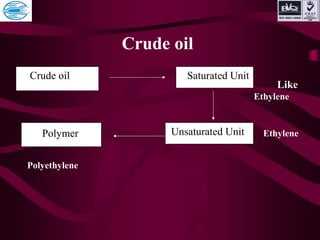
Crude oil
Crude oil Saturated Unit
Unsaturated UnitPolymer
Like
Ethylene
Ethylene
Polyethylene
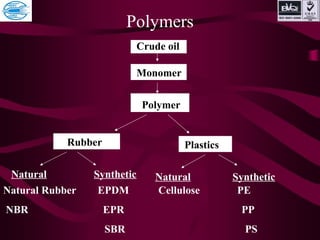
Polymers
Crude oil
Monomer
Polymer
Rubber Plastics
Natural Synthetic Natural Synthetic
Natural Rubber EPDM Cellulose PE
NBR EPR PP
SBR PS
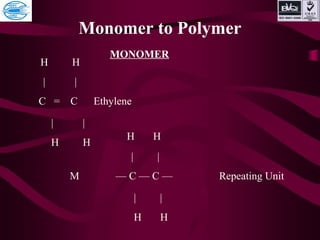
Monomer to Polymer
MONOMER
H H
| |
C = C Ethylene
| |
H H
H H
| |
M — C — C — Repeating Unit
| |
H H
Chemical unit should unsaturated like double or triple bond
between C — C atom.
Polymerization
n M —[M]n
—
Monomer Polymer
n No. of repeating unit
Monomer to Polymer
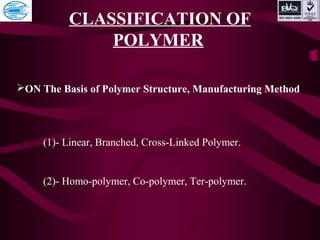
CLASSIFICATION OF
POLYMER
ON The Basis of Polymer Structure, Manufacturing Method
(1)- Linear, Branched, Cross-Linked Polymer.
(2)- Homo-polymer, Co-polymer, Ter-polymer.
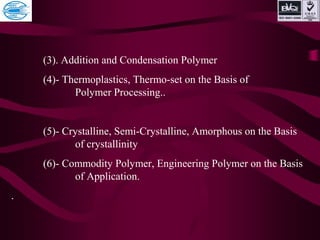
(3). Addition and Condensation Polymer
(4)- Thermoplastics, Thermo-set on the Basis of
Polymer Processing..
(5)- Crystalline, Semi-Crystalline, Amorphous on the Basis
of crystallinity
(6)- Commodity Polymer, Engineering Polymer on the Basis
of Application.
.
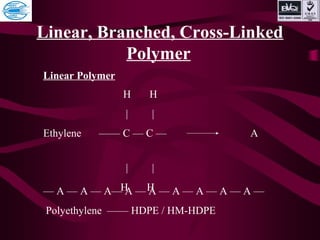
Linear, Branched, Cross-Linked
Polymer
Linear Polymer
H H
| |
Ethylene —— C — C — A
| |
H H— A — A — A— A — A — A — A — A — A —
Polyethylene —— HDPE / HM-HDPE
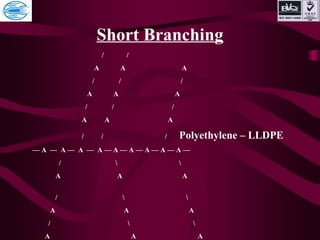
Short Branching
/ /
A A A
/ / /
A A A
/ / /
A A A
/ / / Polyethylene – LLDPE
— A — A — A — A — A — A — A — A — A —
/  
A A A
/  
A A A
/  
A A A
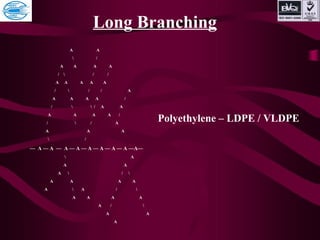
Long Branching
A A
 /
A A A A
/  / /
A A A A A
/  / / A
A A A A /
/   / A A
A A A A /
/  / A
A A A
 /
— A — A — A — A — A — A — A — A —A—
 A
A A
A  / 
A A A A
A  A / 
A A A A
A / 
A A
A
Polyethylene – LDPE / VLDPE
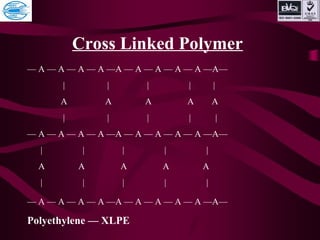
Cross Linked Polymer
— A — A — A — A —A — A — A — A — A —A—
| | | | |
A A A A A
| | | | |
— A — A — A — A —A — A — A — A — A —A—
| | | | |
A A A A A
| | | | |
— A — A — A — A —A — A — A — A — A —A—
Polyethylene — XLPE
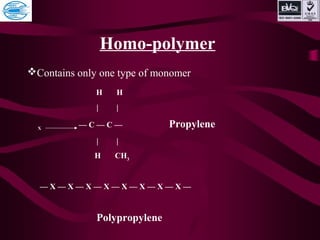
Homo-polymer
Contains only one type of monomer
H H
| |
X
— C — C — Propylene
| |
H CH3
— X — X — X — X — X — X — X — X —
Polypropylene
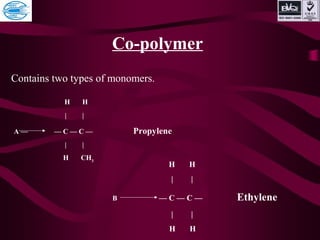
Co-polymer
Contains two types of monomers.
H H
| |
A — — C — C — Propylene
| |
H CH3
H H
| |
B — C — C — Ethylene
| |
H H
Types of Co-polymer
Alternative Co-polymer
— A — B — A — B —A — B — A — B — —PP
Random Co-Polymer
— A — B — A — A — A — B — B — A — A — A — A —
Block Co-Polymer
[— A — A — A — A — A — A —]n
[— B — B — B — B — B —]m
For example, PS-b-PMMA
Types of Co-polymer
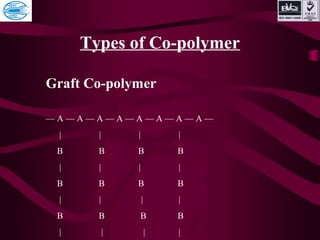
Graft Co-polymer
— A — A — A — A — A — A — A — A —
| | | |
B B B B
| | | |
B B B B
| | | |
B B B B
| | | |
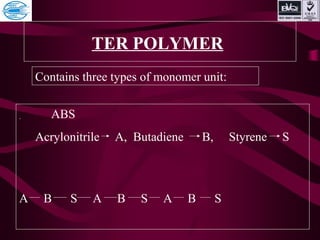
TER POLYMER
Contains three types of monomer unit:
ABS
Acrylonitrile A, Butadiene B, Styrene S
A B S A B S A B S
ADDITION POLYMER
1. nM Polymerization [M]n
2. No by-product are formed.
• 3. Total molecular weight of monomer is
equivalent to molecular weight of polymer.
4. EXAMPLE
PE
PP
PVC
PS
CONDENSATION POLYMER
• n MA
+ n MB
[Polymer] + nH2
O
• During reaction by-products are formed e.g.
Water etc..
• Molecular weight of polymer is less than
molecular weight of total monomer.
• These polymer require pre-drying before
processing
EXAMPLE
• Nylon
• Polyester PET, PBT
• PC
• Thermoset
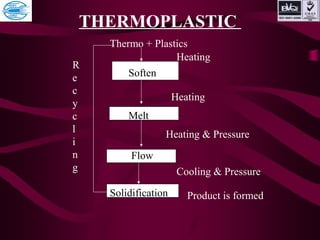
THERMOPLASTIC
Thermo + Plastics
Soften
Melt
Flow
Solidification
Heating
Heating
Heating & Pressure
Cooling & Pressure
Product is formed
R
e
c
y
c
l
i
n
g
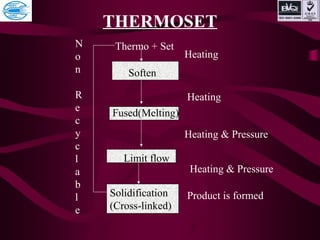
THERMOSET
Thermo + Set
Soften
Fused(Melting)
Limit flow
Solidification
(Cross-linked)
Heating
Heating
Heating & Pressure
Heating & Pressure
Product is formed
N
o
n
R
e
c
y
c
l
a
b
l
e
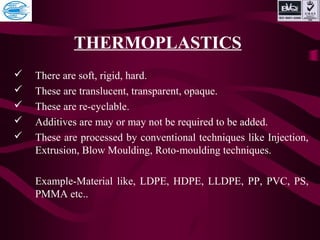
THERMOPLASTICS
 There are soft, rigid, hard.
 These are translucent, transparent, opaque.
 These are re-cyclable.
 Additives are may or may not be required to be added.
 These are processed by conventional techniques like Injection,
Extrusion, Blow Moulding, Roto-moulding techniques.
Example-Material like, LDPE, HDPE, LLDPE, PP, PVC, PS,
PMMA etc..
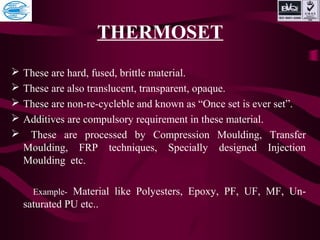
THERMOSET
 These are hard, fused, brittle material.
 These are also translucent, transparent, opaque.
 These are non-re-cycleble and known as “Once set is ever set”.
 Additives are compulsory requirement in these material.
 These are processed by Compression Moulding, Transfer
Moulding, FRP techniques, Specially designed Injection
Moulding etc.
Example- Material like Polyesters, Epoxy, PF, UF, MF, Un-
saturated PU etc..
CRYSTALLINE, SEMI
CRYSTALLINE, AMORPHOUS
POLYMER
 Crystalline polymers are opaque in nature. These are arranged
structure.

Semi crystalline polymers are translucent in nature.These are
having crystalline and amorphous regions.
 Amorphous polymers are transparent in nature. These are
random or un-arranged structure.
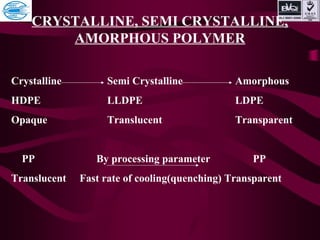
CRYSTALLINE, SEMI CRYSTALLINE,
AMORPHOUS POLYMER
Crystalline Semi Crystalline Amorphous
HDPE LLDPE LDPE
Opaque Translucent Transparent
PP By processing parameter PP
Translucent Fast rate of cooling(quenching) Transparent
COMMODITY PLASTIC
(Polymer)
 These are used for all plastics products which are used
for personnel purpose.
 Polymer used in these application fullfils the following
props.
 Aesthetic surface.
 Variety of colours.
 Various design versatility.
COMMODITY PLASTIC
(Polymer)
 Low cost.
 Gloss, shiny surface.
 Light in weight.
 Recyclability
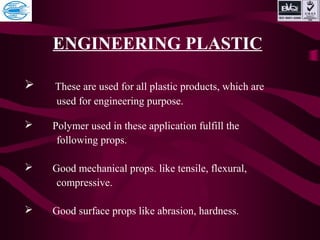
ENGINEERING PLASTIC
 These are used for all plastic products, which are
used for engineering purpose.
 Polymer used in these application fulfill the
following props.
 Good mechanical props. like tensile, flexural,
compressive.
 Good surface props like abrasion, hardness.
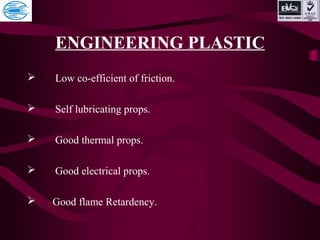
ENGINEERING PLASTIC
 Low co-efficient of friction.
 Self lubricating props.
 Good thermal props.
 Good electrical props.
 Good flame Retardency.
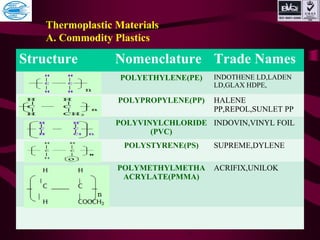
Structure Nomenclature Trade Names
POLYETHYLENE(PE) INDOTHENE LD,LADEN
LD,GLAX HDPE,
POLYPROPYLENE(PP) HALENE
PP,REPOL,SUNLET PP
POLYVINYLCHLORIDE
(PVC)
INDOVIN,VINYL FOIL
POLYSTYRENE(PS) SUPREME,DYLENE
POLYMETHYLMETHA
ACRYLATE(PMMA)
ACRIFIX,UNILOK
Thermoplastic Materials
A. Commodity Plastics
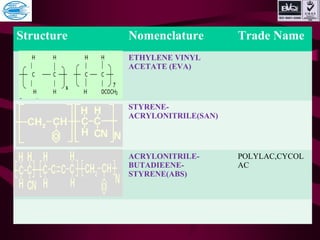
Structure Nomenclature Trade Name
ETHYLENE VINYL
ACETATE (EVA)
STYRENE-
ACRYLONITRILE(SAN)
ACRYLONITRILE-
BUTADIEENE-
STYRENE(ABS)
POLYLAC,CYCOL
AC
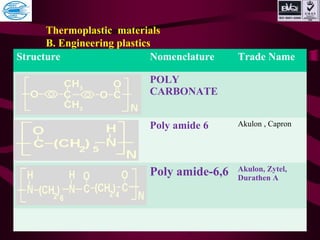
Structure Nomenclature Trade Name
POLY
CARBONATE
Poly amide 6 Akulon , Capron
Poly amide-6,6 Akulon, Zytel,
Durathen A
Thermoplastic materials
B. Engineering plastics
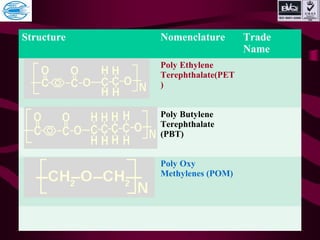
Structure Nomenclature Trade
Name
Poly Ethylene
Terephthalate(PET
)
Poly Butylene
Terephthalate
(PBT)
Poly Oxy
Methylenes (POM)
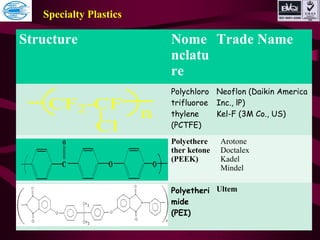
Specialty PlasticsStructure Nome
nclatu
re
Trade Name
Polychloro
trifluoroe
thylene
(PCTFE)
Neoflon (Daikin America
Inc., lP)
Kel-F (3M Co., US)
Polyethere
ther ketone
(PEEK)
Arotone
Doctalex
Kadel
Mindel
Polyetheri
mide
(PEI)
Ultem
CF2-CF
Cl
n
Specialty Plastics
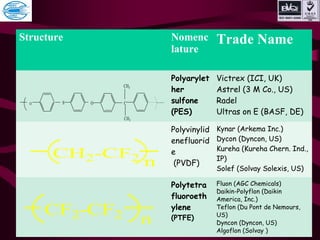
Structure Nomenc
lature
Trade Name
Polyarylet
her
sulfone
(PES)
Victrex (ICI, UK)
Astrel (3 M Co., US)
Radel
Ultras on E (BASF, DE)
Polyvinylid
enefluorid
e
(PVDF)
Kynar (Arkema Inc.)
Dycon (Dyncon, US)
Kureha (Kureha Chern. Ind.,
IP)
Solef (Solvay Solexis, US)
Polytetra
fluoroeth
ylene
(PTFE)
Fluon (AGC Chemicals)
Daikin-Polyflon (Daikin
America, Inc.)
Teflon (Du Pont de Nemours,
US)
Dyncon (Dyncon, US)
Algoflon (Solvay )
CO
CH3
CH3
SO
CH2-CF2 n
CF2-CF2 n
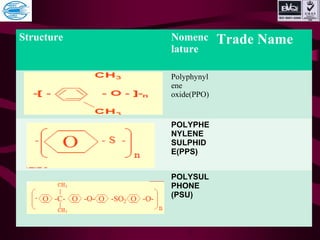
Structure Nomenc
lature
Trade Name
Polyphynyl
ene
oxide(PPO)
POLYPHE
NYLENE
SULPHID
E(PPS)
POLYSUL
PHONE
(PSU)
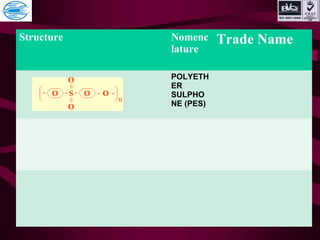
Structure Nomenc
lature
Trade Name
POLYETH
ER
SULPHO
NE (PES)
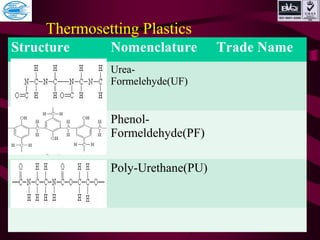
Structure Nomenclature Trade Name
Urea-
Formelehyde(UF)
Phenol-
Formeldehyde(PF)
Poly-Urethane(PU)
Thermosetting Plastics
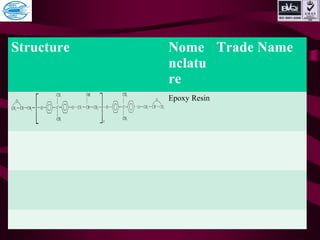
Structure Nome
nclatu
re
Trade Name
Epoxy Resin
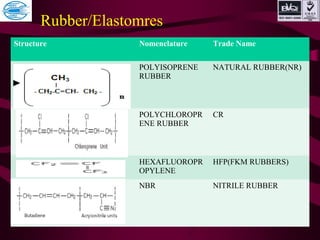
Structure Nomenclature Trade Name
POLYISOPRENE
RUBBER
NATURAL RUBBER(NR)
POLYCHLOROPR
ENE RUBBER
CR
HEXAFLUOROPR
OPYLENE
HFP(FKM RUBBERS)
NBR NITRILE RUBBER
Rubber/Elastomres
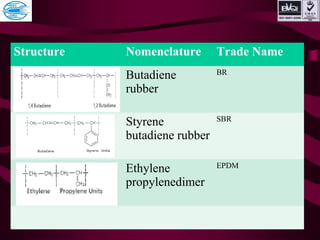
Structure Nomenclature Trade Name
Butadiene
rubber
BR
Styrene
butadiene rubber
SBR
Ethylene
propylenedimer
EPDM

Basic of polymer

  • 1.
    Why Plastics? (1)- Lightin weight. (2)- Low cost. (3)- Available in variety of colours. (4)- Easy process ability. (5)- Easy assembly of parts to get final product. (6)- Low co-efficient of friction. (7)- Self Lubricating. (8)- Corrosion Resistant.
  • 2.
    Why Plastics? (9)- Modificationof polymer properties with additives incorporation or blending of polymer. (10)- Less manpower requirement. (11)- Less Electricity requirement. (12)-These are available in flexible, semi-rigid, and rigid form. (13)- These are available in Transparent / Translucent /opaque form. (14)- Plastics have very long shelf life of product.
  • 3.
    Crude oil Crude oilSaturated Unit Unsaturated UnitPolymer Like Ethylene Ethylene Polyethylene
  • 4.
    Polymers Crude oil Monomer Polymer Rubber Plastics NaturalSynthetic Natural Synthetic Natural Rubber EPDM Cellulose PE NBR EPR PP SBR PS
  • 5.
    Monomer to Polymer MONOMER HH | | C = C Ethylene | | H H H H | | M — C — C — Repeating Unit | | H H
  • 6.
    Chemical unit shouldunsaturated like double or triple bond between C — C atom. Polymerization n M —[M]n — Monomer Polymer n No. of repeating unit Monomer to Polymer
  • 7.
    CLASSIFICATION OF POLYMER ON TheBasis of Polymer Structure, Manufacturing Method (1)- Linear, Branched, Cross-Linked Polymer. (2)- Homo-polymer, Co-polymer, Ter-polymer.
  • 8.
    (3). Addition andCondensation Polymer (4)- Thermoplastics, Thermo-set on the Basis of Polymer Processing.. (5)- Crystalline, Semi-Crystalline, Amorphous on the Basis of crystallinity (6)- Commodity Polymer, Engineering Polymer on the Basis of Application. .
  • 9.
    Linear, Branched, Cross-Linked Polymer LinearPolymer H H | | Ethylene —— C — C — A | | H H— A — A — A— A — A — A — A — A — A — Polyethylene —— HDPE / HM-HDPE
  • 10.
    Short Branching / / AA A / / / A A A / / / A A A / / / Polyethylene – LLDPE — A — A — A — A — A — A — A — A — A — / A A A / A A A / A A A
  • 11.
    Long Branching A A / A A A A / / / A A A A A / / / A A A A A / / / A A A A A A / / / A A A A / — A — A — A — A — A — A — A — A —A— A A A A / A A A A A A / A A A A A / A A A Polyethylene – LDPE / VLDPE
  • 12.
    Cross Linked Polymer —A — A — A — A —A — A — A — A — A —A— | | | | | A A A A A | | | | | — A — A — A — A —A — A — A — A — A —A— | | | | | A A A A A | | | | | — A — A — A — A —A — A — A — A — A —A— Polyethylene — XLPE
  • 13.
    Homo-polymer Contains only onetype of monomer H H | | X — C — C — Propylene | | H CH3 — X — X — X — X — X — X — X — X — Polypropylene
  • 14.
    Co-polymer Contains two typesof monomers. H H | | A — — C — C — Propylene | | H CH3 H H | | B — C — C — Ethylene | | H H
  • 15.
    Types of Co-polymer AlternativeCo-polymer — A — B — A — B —A — B — A — B — —PP Random Co-Polymer — A — B — A — A — A — B — B — A — A — A — A — Block Co-Polymer [— A — A — A — A — A — A —]n [— B — B — B — B — B —]m For example, PS-b-PMMA
  • 16.
    Types of Co-polymer GraftCo-polymer — A — A — A — A — A — A — A — A — | | | | B B B B | | | | B B B B | | | | B B B B | | | |
  • 17.
    TER POLYMER Contains threetypes of monomer unit: ABS Acrylonitrile A, Butadiene B, Styrene S A B S A B S A B S
  • 18.
    ADDITION POLYMER 1. nMPolymerization [M]n 2. No by-product are formed. • 3. Total molecular weight of monomer is equivalent to molecular weight of polymer. 4. EXAMPLE PE PP PVC PS
  • 19.
    CONDENSATION POLYMER • nMA + n MB [Polymer] + nH2 O • During reaction by-products are formed e.g. Water etc.. • Molecular weight of polymer is less than molecular weight of total monomer. • These polymer require pre-drying before processing EXAMPLE • Nylon • Polyester PET, PBT • PC • Thermoset
  • 20.
    THERMOPLASTIC Thermo + Plastics Soften Melt Flow Solidification Heating Heating Heating& Pressure Cooling & Pressure Product is formed R e c y c l i n g
  • 21.
    THERMOSET Thermo + Set Soften Fused(Melting) Limitflow Solidification (Cross-linked) Heating Heating Heating & Pressure Heating & Pressure Product is formed N o n R e c y c l a b l e
  • 22.
    THERMOPLASTICS  There aresoft, rigid, hard.  These are translucent, transparent, opaque.  These are re-cyclable.  Additives are may or may not be required to be added.  These are processed by conventional techniques like Injection, Extrusion, Blow Moulding, Roto-moulding techniques. Example-Material like, LDPE, HDPE, LLDPE, PP, PVC, PS, PMMA etc..
  • 23.
    THERMOSET  These arehard, fused, brittle material.  These are also translucent, transparent, opaque.  These are non-re-cycleble and known as “Once set is ever set”.  Additives are compulsory requirement in these material.  These are processed by Compression Moulding, Transfer Moulding, FRP techniques, Specially designed Injection Moulding etc. Example- Material like Polyesters, Epoxy, PF, UF, MF, Un- saturated PU etc..
  • 24.
    CRYSTALLINE, SEMI CRYSTALLINE, AMORPHOUS POLYMER Crystalline polymers are opaque in nature. These are arranged structure.  Semi crystalline polymers are translucent in nature.These are having crystalline and amorphous regions.  Amorphous polymers are transparent in nature. These are random or un-arranged structure.
  • 25.
    CRYSTALLINE, SEMI CRYSTALLINE, AMORPHOUSPOLYMER Crystalline Semi Crystalline Amorphous HDPE LLDPE LDPE Opaque Translucent Transparent PP By processing parameter PP Translucent Fast rate of cooling(quenching) Transparent
  • 26.
    COMMODITY PLASTIC (Polymer)  Theseare used for all plastics products which are used for personnel purpose.  Polymer used in these application fullfils the following props.  Aesthetic surface.  Variety of colours.  Various design versatility.
  • 27.
    COMMODITY PLASTIC (Polymer)  Lowcost.  Gloss, shiny surface.  Light in weight.  Recyclability
  • 28.
    ENGINEERING PLASTIC  Theseare used for all plastic products, which are used for engineering purpose.  Polymer used in these application fulfill the following props.  Good mechanical props. like tensile, flexural, compressive.  Good surface props like abrasion, hardness.
  • 29.
    ENGINEERING PLASTIC  Lowco-efficient of friction.  Self lubricating props.  Good thermal props.  Good electrical props.  Good flame Retardency.
  • 30.
    Structure Nomenclature TradeNames POLYETHYLENE(PE) INDOTHENE LD,LADEN LD,GLAX HDPE, POLYPROPYLENE(PP) HALENE PP,REPOL,SUNLET PP POLYVINYLCHLORIDE (PVC) INDOVIN,VINYL FOIL POLYSTYRENE(PS) SUPREME,DYLENE POLYMETHYLMETHA ACRYLATE(PMMA) ACRIFIX,UNILOK Thermoplastic Materials A. Commodity Plastics
  • 31.
    Structure Nomenclature TradeName ETHYLENE VINYL ACETATE (EVA) STYRENE- ACRYLONITRILE(SAN) ACRYLONITRILE- BUTADIEENE- STYRENE(ABS) POLYLAC,CYCOL AC
  • 32.
    Structure Nomenclature TradeName POLY CARBONATE Poly amide 6 Akulon , Capron Poly amide-6,6 Akulon, Zytel, Durathen A Thermoplastic materials B. Engineering plastics
  • 33.
    Structure Nomenclature Trade Name PolyEthylene Terephthalate(PET ) Poly Butylene Terephthalate (PBT) Poly Oxy Methylenes (POM)
  • 34.
    Specialty PlasticsStructure Nome nclatu re TradeName Polychloro trifluoroe thylene (PCTFE) Neoflon (Daikin America Inc., lP) Kel-F (3M Co., US) Polyethere ther ketone (PEEK) Arotone Doctalex Kadel Mindel Polyetheri mide (PEI) Ultem CF2-CF Cl n Specialty Plastics
  • 35.
    Structure Nomenc lature Trade Name Polyarylet her sulfone (PES) Victrex(ICI, UK) Astrel (3 M Co., US) Radel Ultras on E (BASF, DE) Polyvinylid enefluorid e (PVDF) Kynar (Arkema Inc.) Dycon (Dyncon, US) Kureha (Kureha Chern. Ind., IP) Solef (Solvay Solexis, US) Polytetra fluoroeth ylene (PTFE) Fluon (AGC Chemicals) Daikin-Polyflon (Daikin America, Inc.) Teflon (Du Pont de Nemours, US) Dyncon (Dyncon, US) Algoflon (Solvay ) CO CH3 CH3 SO CH2-CF2 n CF2-CF2 n
  • 36.
  • 37.
  • 38.
    Structure Nomenclature TradeName Urea- Formelehyde(UF) Phenol- Formeldehyde(PF) Poly-Urethane(PU) Thermosetting Plastics
  • 39.
  • 40.
    Structure Nomenclature TradeName POLYISOPRENE RUBBER NATURAL RUBBER(NR) POLYCHLOROPR ENE RUBBER CR HEXAFLUOROPR OPYLENE HFP(FKM RUBBERS) NBR NITRILE RUBBER Rubber/Elastomres
  • 41.
    Structure Nomenclature TradeName Butadiene rubber BR Styrene butadiene rubber SBR Ethylene propylenedimer EPDM