RESEARCH POSTER PRESENTATION DESIGN © 2015
www.PosterPresentations.com
Plastics and natural materials such as rubber or cellulose are composed of very large
molecules called polymers. Polymers are constructed from relatively small
molecular fragments known as monomers that are joined together. Wool, cotton,
silk, wood and leather are examples of natural polymers that have been known
and used since ancient times. Through our experiments, we hope to highlight the
various modern day uses for polymers and methods used to both create and
dispose of said substances.
Abstract
The term Polymer was first mentioned by scientist Pierre Berthelot in 1866 in
regards to the heating of styrene which he described as a “resinous polymer”.
However, Hermann Staudinger was the first to suggest that larger molecules were
composed of a chain of smaller molecules. Man-made polymers were created in
order to replace the usage of natural polymers, thus Celluloid was created as a
replacement for materials such as ivory or silk. Around 1907, Belgian-born
American chemist Leo H. Baekeland took two ordinary chemicals, phenol and
formaldehyde, mixed them in a sealed vessel, and subjected them to heat and
pressure. The sticky, amber-colored resin he produced was the first plastic ever to
be created entirely from chemicals, and the first material to be made entirely by
man. Bakelite could be molded quickly into different shapes, an enormous
advantage in mass production processes, and retained its shape even when heated
or subjected to solvents. Bakelite was particularly suitable for the emerging
electrical and automobile industries because of its extraordinarily high resistance
—not only to electricity, but to heat and chemical action. It was soon used for all
non-conducting parts of radios and other electrical devices, such as light bulb
sockets, distributor caps and other insulators. Bakelite found a place in almost
every area of modern life. From novelty jewelry to radios and telephones,
Bakelite was everywhere. Ultimately, Bakelite was replaced by other plastics that
had greater qualities of strength, flexibility and appearance. However
Baekeland's new material opened the door to the Age of Plastics and seeded the
growth of worldwide production of synthetic plastics that are just as familiar to
us as wood or metal.
Introduction
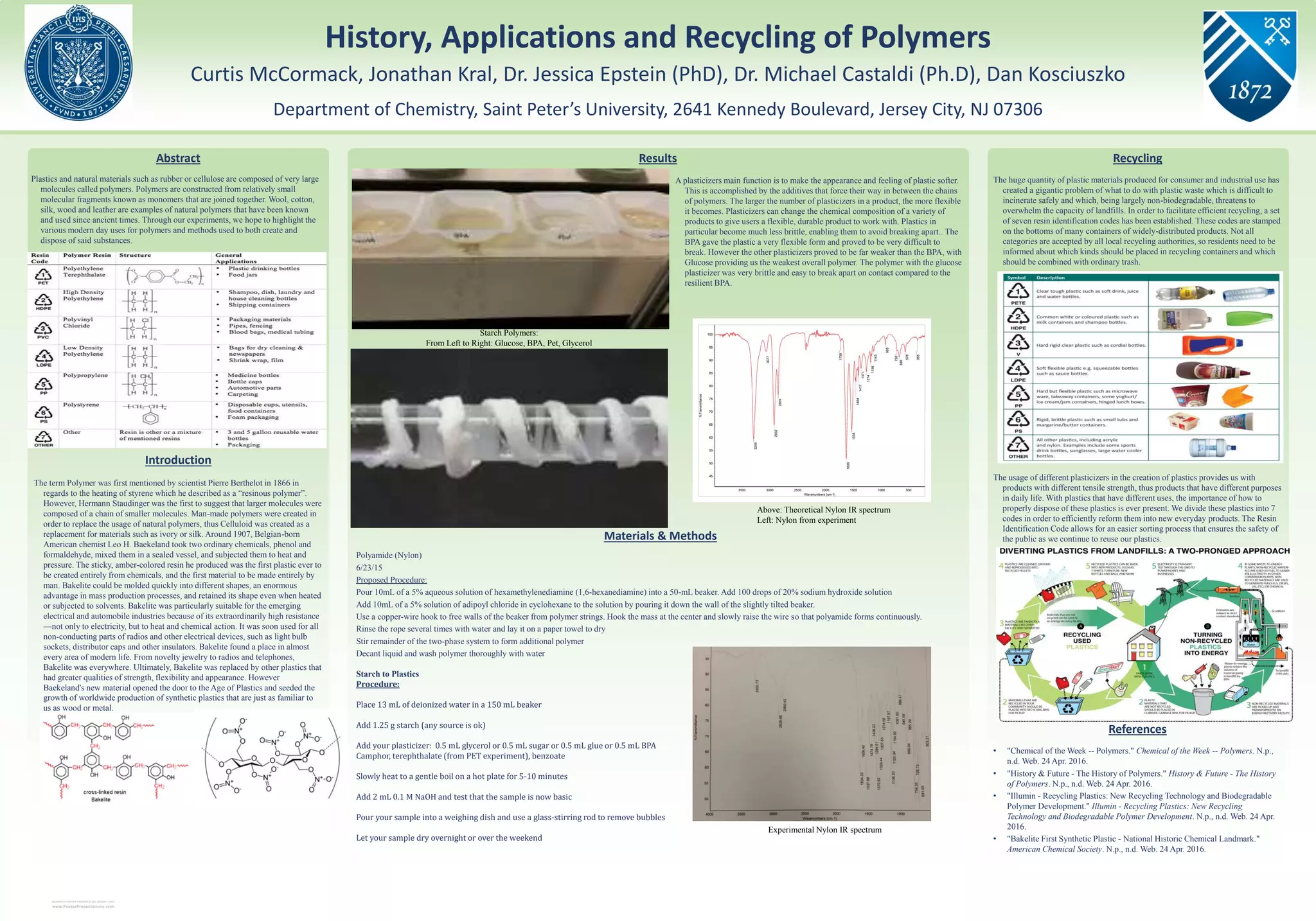
A plasticizers main function is to make the appearance and feeling of plastic softer.
This is accomplished by the additives that force their way in between the chains
of polymers. The larger the number of plasticizers in a product, the more flexible
it becomes. Plasticizers can change the chemical composition of a variety of
products to give users a flexible, durable product to work with. Plastics in
particular become much less brittle, enabling them to avoid breaking apart.. The
BPA gave the plastic a very flexible form and proved to be very difficult to
break. However the other plasticizers proved to be far weaker than the BPA, with
Glucose providing us the weakest overall polymer. The polymer with the glucose
plasticizer was very brittle and easy to break apart on contact compared to the
resilient BPA.
Results
Polyamide (Nylon)
6/23/15
Proposed Procedure:
Pour 10mL of a 5% aqueous solution of hexamethylenediamine (1,6-hexanediamine) into a 50-mL beaker. Add 100 drops of 20% sodium hydroxide solution
Add 10mL of a 5% solution of adipoyl chloride in cyclohexane to the solution by pouring it down the wall of the slightly tilted beaker.
Use a copper-wire hook to free walls of the beaker from polymer strings. Hook the mass at the center and slowly raise the wire so that polyamide forms continuously.
Rinse the rope several times with water and lay it on a paper towel to dry
Stir remainder of the two-phase system to form additional polymer
Decant liquid and wash polymer thoroughly with water
Starch to Plastics
Procedure:
Place 13 mL of deionized water in a 150 mL beaker
Add 1.25 g starch (any source is ok)
Add your plasticizer: 0.5 mL glycerol or 0.5 mL sugar or 0.5 mL glue or 0.5 mL BPA
Camphor, terephthalate (from PET experiment), benzoate
Slowly heat to a gentle boil on a hot plate for 5-10 minutes
Add 2 mL 0.1 M NaOH and test that the sample is now basic
Pour your sample into a weighing dish and use a glass-stirring rod to remove bubbles
Let your sample dry overnight or over the weekend
Materials & Methods
Recycling
The huge quantity of plastic materials produced for consumer and industrial use has
created a gigantic problem of what to do with plastic waste which is difficult to
incinerate safely and which, being largely non-biodegradable, threatens to
overwhelm the capacity of landfills. In order to facilitate efficient recycling, a set
of seven resin identification codes has been established. These codes are stamped
on the bottoms of many containers of widely-distributed products. Not all
categories are accepted by all local recycling authorities, so residents need to be
informed about which kinds should be placed in recycling containers and which
should be combined with ordinary trash.
Conclusions
The usage of different plasticizers in the creation of plastics provides us with
products with different tensile strength, thus products that have different purposes
in daily life. With plastics that have different uses, the importance of how to
properly dispose of these plastics is ever present. We divide these plastics into 7
codes in order to efficiently reform them into new everyday products. The Resin
Identification Code allows for an easier sorting process that ensures the safety of
the public as we continue to reuse our plastics.
References
• "Chemical of the Week -- Polymers." Chemical of the Week -- Polymers. N.p.,
n.d. Web. 24 Apr. 2016.
• "History & Future - The History of Polymers." History & Future - The History
of Polymers. N.p., n.d. Web. 24 Apr. 2016.
• "Illumin - Recycling Plastics: New Recycling Technology and Biodegradable
Polymer Development." Illumin - Recycling Plastics: New Recycling
Technology and Biodegradable Polymer Development. N.p., n.d. Web. 24 Apr.
2016.
• "Bakelite First Synthetic Plastic - National Historic Chemical Landmark."
American Chemical Society. N.p., n.d. Web. 24 Apr. 2016.
Curtis McCormack, Jonathan Kral, Dr. Jessica Epstein (PhD), Dr. Michael Castaldi (Ph.D), Dan Kosciuszko
Department of Chemistry, Saint Peter’s University, 2641 Kennedy Boulevard, Jersey City, NJ 07306
History, Applications and Recycling of Polymers
Above: Theoretical Nylon IR spectrum
Left: Nylon from experiment
Starch Polymers:
From Left to Right: Glucose, BPA, Pet, Glycerol
Experimental Nylon IR spectrum

polymer poster

  • 1.
    RESEARCH POSTER PRESENTATIONDESIGN © 2015 www.PosterPresentations.com Plastics and natural materials such as rubber or cellulose are composed of very large molecules called polymers. Polymers are constructed from relatively small molecular fragments known as monomers that are joined together. Wool, cotton, silk, wood and leather are examples of natural polymers that have been known and used since ancient times. Through our experiments, we hope to highlight the various modern day uses for polymers and methods used to both create and dispose of said substances. Abstract The term Polymer was first mentioned by scientist Pierre Berthelot in 1866 in regards to the heating of styrene which he described as a “resinous polymer”. However, Hermann Staudinger was the first to suggest that larger molecules were composed of a chain of smaller molecules. Man-made polymers were created in order to replace the usage of natural polymers, thus Celluloid was created as a replacement for materials such as ivory or silk. Around 1907, Belgian-born American chemist Leo H. Baekeland took two ordinary chemicals, phenol and formaldehyde, mixed them in a sealed vessel, and subjected them to heat and pressure. The sticky, amber-colored resin he produced was the first plastic ever to be created entirely from chemicals, and the first material to be made entirely by man. Bakelite could be molded quickly into different shapes, an enormous advantage in mass production processes, and retained its shape even when heated or subjected to solvents. Bakelite was particularly suitable for the emerging electrical and automobile industries because of its extraordinarily high resistance —not only to electricity, but to heat and chemical action. It was soon used for all non-conducting parts of radios and other electrical devices, such as light bulb sockets, distributor caps and other insulators. Bakelite found a place in almost every area of modern life. From novelty jewelry to radios and telephones, Bakelite was everywhere. Ultimately, Bakelite was replaced by other plastics that had greater qualities of strength, flexibility and appearance. However Baekeland's new material opened the door to the Age of Plastics and seeded the growth of worldwide production of synthetic plastics that are just as familiar to us as wood or metal. Introduction A plasticizers main function is to make the appearance and feeling of plastic softer. This is accomplished by the additives that force their way in between the chains of polymers. The larger the number of plasticizers in a product, the more flexible it becomes. Plasticizers can change the chemical composition of a variety of products to give users a flexible, durable product to work with. Plastics in particular become much less brittle, enabling them to avoid breaking apart.. The BPA gave the plastic a very flexible form and proved to be very difficult to break. However the other plasticizers proved to be far weaker than the BPA, with Glucose providing us the weakest overall polymer. The polymer with the glucose plasticizer was very brittle and easy to break apart on contact compared to the resilient BPA. Results Polyamide (Nylon) 6/23/15 Proposed Procedure: Pour 10mL of a 5% aqueous solution of hexamethylenediamine (1,6-hexanediamine) into a 50-mL beaker. Add 100 drops of 20% sodium hydroxide solution Add 10mL of a 5% solution of adipoyl chloride in cyclohexane to the solution by pouring it down the wall of the slightly tilted beaker. Use a copper-wire hook to free walls of the beaker from polymer strings. Hook the mass at the center and slowly raise the wire so that polyamide forms continuously. Rinse the rope several times with water and lay it on a paper towel to dry Stir remainder of the two-phase system to form additional polymer Decant liquid and wash polymer thoroughly with water Starch to Plastics Procedure: Place 13 mL of deionized water in a 150 mL beaker Add 1.25 g starch (any source is ok) Add your plasticizer: 0.5 mL glycerol or 0.5 mL sugar or 0.5 mL glue or 0.5 mL BPA Camphor, terephthalate (from PET experiment), benzoate Slowly heat to a gentle boil on a hot plate for 5-10 minutes Add 2 mL 0.1 M NaOH and test that the sample is now basic Pour your sample into a weighing dish and use a glass-stirring rod to remove bubbles Let your sample dry overnight or over the weekend Materials & Methods Recycling The huge quantity of plastic materials produced for consumer and industrial use has created a gigantic problem of what to do with plastic waste which is difficult to incinerate safely and which, being largely non-biodegradable, threatens to overwhelm the capacity of landfills. In order to facilitate efficient recycling, a set of seven resin identification codes has been established. These codes are stamped on the bottoms of many containers of widely-distributed products. Not all categories are accepted by all local recycling authorities, so residents need to be informed about which kinds should be placed in recycling containers and which should be combined with ordinary trash. Conclusions The usage of different plasticizers in the creation of plastics provides us with products with different tensile strength, thus products that have different purposes in daily life. With plastics that have different uses, the importance of how to properly dispose of these plastics is ever present. We divide these plastics into 7 codes in order to efficiently reform them into new everyday products. The Resin Identification Code allows for an easier sorting process that ensures the safety of the public as we continue to reuse our plastics. References • "Chemical of the Week -- Polymers." Chemical of the Week -- Polymers. N.p., n.d. Web. 24 Apr. 2016. • "History & Future - The History of Polymers." History & Future - The History of Polymers. N.p., n.d. Web. 24 Apr. 2016. • "Illumin - Recycling Plastics: New Recycling Technology and Biodegradable Polymer Development." Illumin - Recycling Plastics: New Recycling Technology and Biodegradable Polymer Development. N.p., n.d. Web. 24 Apr. 2016. • "Bakelite First Synthetic Plastic - National Historic Chemical Landmark." American Chemical Society. N.p., n.d. Web. 24 Apr. 2016. Curtis McCormack, Jonathan Kral, Dr. Jessica Epstein (PhD), Dr. Michael Castaldi (Ph.D), Dan Kosciuszko Department of Chemistry, Saint Peter’s University, 2641 Kennedy Boulevard, Jersey City, NJ 07306 History, Applications and Recycling of Polymers Above: Theoretical Nylon IR spectrum Left: Nylon from experiment Starch Polymers: From Left to Right: Glucose, BPA, Pet, Glycerol Experimental Nylon IR spectrum