POLYMERS AN OVERVIEW
( How it influenced our life's )
SUBMITTED TO:
Dr. ANAS
SUBMITTED BY:
SHERIN PETER
SCHOOL OF CHEMICAL SCIENCE
What is a polymer..?
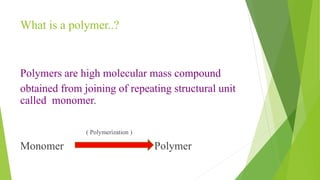
Polymers are high molecular mass compound
obtained from joining of repeating structural unit
called monomer.
( Polymerization )
Monomer Polymer
RUBBERS
BRICK
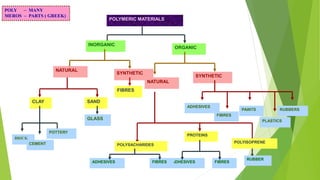
POLYMERIC MATERIALS
INORGANIC
ORGANIC
NATURAL
SYNTHETIC
FIBRES
CLAY SAND
GLASS
CEMENT
POTTERY
NATURAL
SYNTHETIC
ADHESIVES
FIBRES
PAINTS
PLASTICS
POLYSACHARIDES
PROTEINS
POLYISOPRENE
RUBBER
ADHESIVES FIBRESADHESIVES FIBRES
POLY – MANY
MEROS – PARTS ( GREEK)
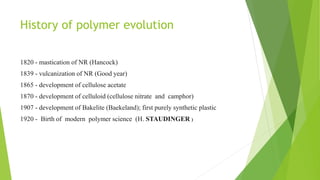
History of polymer evolution
1820 - mastication of NR (Hancock)
1839 - vulcanization of NR (Good year)
1865 - development of cellulose acetate
1870 - development of celluloid (cellulose nitrate and camphor)
1907 - development of Bakelite (Baekeland); first purely synthetic plastic
1920 - Birth of modern polymer science (H. STAUDINGER )

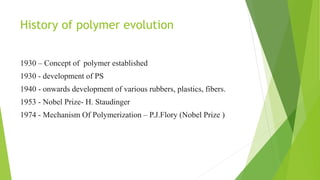
History of polymer evolution
1930 – Concept of polymer established
1930 - development of PS
1940 - onwards development of various rubbers, plastics, fibers.
1953 - Nobel Prize- H. Staudinger
1974 - Mechanism Of Polymerization – P.J.Flory (Nobel Prize )
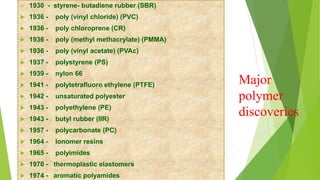
 1930 - styrene- butadiene rubber (SBR)
 1936 - poly (vinyl chloride) (PVC)
 1936 - poly chloroprene (CR)
 1936 - poly (methyl methacrylate) (PMMA)
 1936 - poly (vinyl acetate) (PVAc)
 1937 - polystyrene (PS)
 1939 - nylon 66
 1941 - polytetrafluoro ethylene (PTFE)
 1942 - unsaturated polyester
 1943 - polyethylene (PE)
 1943 - butyl rubber (IIR)
 1957 - polycarbonate (PC)
 1964 - Ionomer resins
 1965 - polyimides
 1970 - thermoplastic elastomers
 1974 - aromatic polyamides
Major
polymer
discoveries
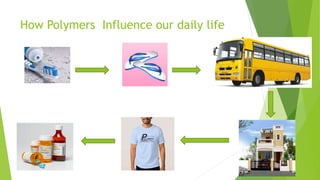
How Polymers Influence our daily life
Fields of application
 Construction
 House holds
 Transportation & Automobile
 Sports
 Agriculture
 Medicine & Cosmetics
 Toys & Other Products…
Polymers in constructional field
 Application of polymer in construction field mainly account for flooring,
Windows, Cladding, Pipes, Sealant, Insulators etc..
 Strong but light weight hence easy transportation and maneuver.
 durable, knock-and scratch resistant with excellent weatherability.
 easy to install; many have a snap-fit kind of jointing procedures
 limitless possibilities in design achieved by extrusion, bending, moulding etc.
Polymers in Households
 Polymers have great number of application in households such as mugs,
Hanker, Chair, Bottle, Toys, Plastic bags etc..
 Low cost and durability
 High temperature resistance & non-stickiness for frying pans,
 Versatility and convenience
 Easy maintenance
Polymers in transportation
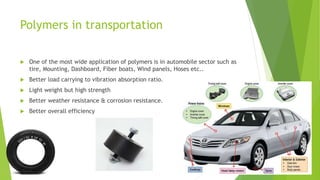
 One of the most wide application of polymers is in automobile sector such as
tire, Mounting, Dashboard, Fiber boats, Wind panels, Hoses etc..
 Better load carrying to vibration absorption ratio.
 Light weight but high strength
 Better weather resistance & corrosion resistance.
 Better overall efficiency
Polymers used in sports
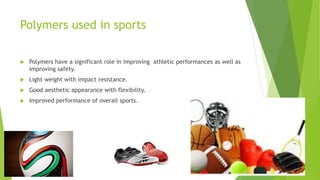
 Polymers have a significant role in improving athletic performances as well as
improving safety.
 Light weight with impact resistance.
 Good aesthetic appearance with flexibility.
 Improved performance of overall sports.
Polymers in Agriculture
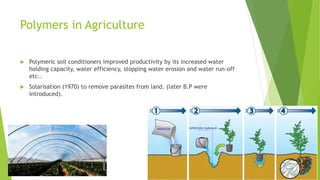
 Polymeric soil conditioners improved productivity by its increased water
holding capacity, water efficiency, stopping water erosion and water run-off
etc..
 Solarisation (1970) to remove parasites from land. (later B.P were
introduced).
Polymers in medicine & Cosmetics
 Biodegradable Polymers as Drug Carrier Systems Eg:Lactide/ Glycolide Copolymers have
been used for the delivery of steroids, anticancer agent, antibiotics, etc.
 polyacrylate used as dental filler. PMMA is also used.
 PTFE is used in heart valve because of its high chemical stability
 UHMWPE chosen for artificial joint because of its low friction coefficient, high
resistance to wear, high impact resistance, high ductility and stability in the body
 Pressure Sensitive Adhesive polymers used in wound healing
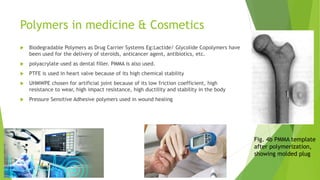
Fig. 4b PMMA template
after polymerization,
showing molded plug
Polymers in toys & other products
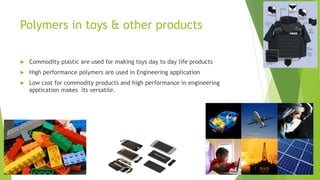
 Commodity plastic are used for making toys day to day life products
 High performance polymers are used in Engineering application
 Low cost for commodity products and high performance in engineering
application makes its versatile.
Disadvantages of Polymers
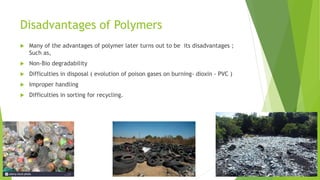
 Many of the advantages of polymer later turns out to be its disadvantages ;
Such as,
 Non-Bio degradability
 Difficulties in disposal ( evolution of poison gases on burning- dioxin - PVC )
 Improper handling
 Difficulties in sorting for recycling.
How to overcome..???
 Use a reusable produce bag. A single plastic bag can take 1,000 years to degrade.
Purchase or make your own reusable produce bag and be sure to wash them often!
 Give up gum. Gum is made of a synthetic rubber, aka plastic.
 Buy boxes instead of bottles. Often, products like laundry detergent come in cardboard
which is more easily recycled than plastic.
 Purchase food, like cereal, pasta, and rice from bulk bins and fill a reusable bag or
container. You save money and unnecessary packaging.
How to overcome..???
 Pack your lunch in reusable containers and bags.
 Use a reusable product than single time use product
 Use a reusable bottle or mug for your beverages, even when ordering from a to-go shop
 Bring your own container for take-out or your restaurant doggy-bag since many
restaurants use Styrofoam.
How to overcome..???
 Use matches instead of disposable plastic lighters or invest in a refillable metal lighter.
 Ask your local grocer to take your plastic containers (for berries, tomatoes, etc.) back.
If you shop at a farmers market they can refill it for y
 Make fresh squeezed juice or eat fruit instead of buying juice in plastic bottles. It's
healthier and better for the environment.
Mass waste disposal methods…?
 Planning
 Recycling
 Chemical decomposition
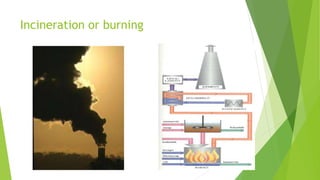
 Combustion, incineration
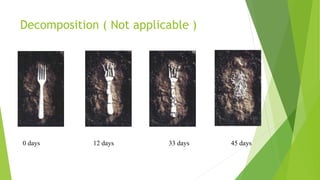
 Decomposition
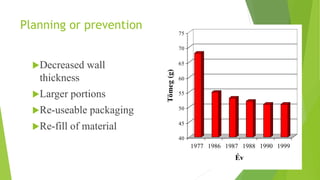
Planning or prevention
Decreased wall
thickness
Larger portions
Re-useable packaging
Re-fill of material
40
45
50
55
60
65
70
75
Tömeg(g)
1977 1986 1987 1988 1990 1999
Év
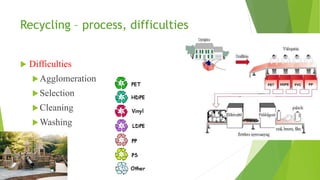
Recycling – process, difficulties
 Difficulties
Agglomeration
Selection
Cleaning
Washing
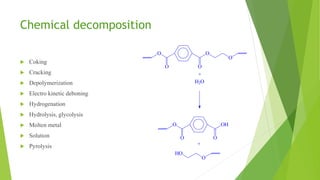
Chemical decomposition
 Coking
 Cracking
 Depolymerization
 Electro kinetic deboning
 Hydrogenation
 Hydrolysis, glycolysis
 Molten metal
 Solution
 Pyrolysis
O
O
O
O
O
O
O
OH
O
HO
O
+
H2O
+
Incineration or burning
Decomposition ( Not applicable )
0 days 12 days 33 days 45 days
Future Solution = Biodegradable polymer
 One of the problems with traditional plastics is that they do not break down
when thrown away.
 Biodegradable plastics are plastics that can be broken down. They are
converted into carbon dioxide, water and minerals by micro-organisms.
 Biodegradable plastics are increasingly being used in carrier bags, bin bags
and food packaging.
 Biodegradable plastics, such as polylactide, are plant-based polymers.
They are often made from starch that has been modified to become more
stable.
Conclusion…..
 The human race is so attached with polymer and polymer product so that a sudden ignorance
is not an appropriate option.
 Biodegradable polymer can be used as a future solution
 Optimization of use is also necessary
 Proper guidance and awareness can be a great tool
POLYMER IS MANS BEST FRIEND, IF USED PROPERLY
Reference….
 Polymer Applications in Agriculture (L. O. Ekebafe, D. E. Ogbeifun and F. E.
Okieimen)
 The History of Plastics (Department of Plastics Engineering - Lowell )
 Wikipedia
 Polymer Science ( Gowariker )
 Plastic materials ( Brickson )
Sherin  peter

Sherin peter

  • 1.
    POLYMERS AN OVERVIEW (How it influenced our life's ) SUBMITTED TO: Dr. ANAS SUBMITTED BY: SHERIN PETER SCHOOL OF CHEMICAL SCIENCE
  • 2.
    What is apolymer..? Polymers are high molecular mass compound obtained from joining of repeating structural unit called monomer. ( Polymerization ) Monomer Polymer
  • 3.
  • 4.
    History of polymerevolution 1820 - mastication of NR (Hancock) 1839 - vulcanization of NR (Good year) 1865 - development of cellulose acetate 1870 - development of celluloid (cellulose nitrate and camphor) 1907 - development of Bakelite (Baekeland); first purely synthetic plastic 1920 - Birth of modern polymer science (H. STAUDINGER ) 
  • 5.
    History of polymerevolution 1930 – Concept of polymer established 1930 - development of PS 1940 - onwards development of various rubbers, plastics, fibers. 1953 - Nobel Prize- H. Staudinger 1974 - Mechanism Of Polymerization – P.J.Flory (Nobel Prize )
  • 6.
     1930 -styrene- butadiene rubber (SBR)  1936 - poly (vinyl chloride) (PVC)  1936 - poly chloroprene (CR)  1936 - poly (methyl methacrylate) (PMMA)  1936 - poly (vinyl acetate) (PVAc)  1937 - polystyrene (PS)  1939 - nylon 66  1941 - polytetrafluoro ethylene (PTFE)  1942 - unsaturated polyester  1943 - polyethylene (PE)  1943 - butyl rubber (IIR)  1957 - polycarbonate (PC)  1964 - Ionomer resins  1965 - polyimides  1970 - thermoplastic elastomers  1974 - aromatic polyamides Major polymer discoveries
  • 7.
    How Polymers Influenceour daily life
  • 8.
    Fields of application Construction  House holds  Transportation & Automobile  Sports  Agriculture  Medicine & Cosmetics  Toys & Other Products…
  • 9.
    Polymers in constructionalfield  Application of polymer in construction field mainly account for flooring, Windows, Cladding, Pipes, Sealant, Insulators etc..  Strong but light weight hence easy transportation and maneuver.  durable, knock-and scratch resistant with excellent weatherability.  easy to install; many have a snap-fit kind of jointing procedures  limitless possibilities in design achieved by extrusion, bending, moulding etc.
  • 10.
    Polymers in Households Polymers have great number of application in households such as mugs, Hanker, Chair, Bottle, Toys, Plastic bags etc..  Low cost and durability  High temperature resistance & non-stickiness for frying pans,  Versatility and convenience  Easy maintenance
  • 11.
    Polymers in transportation One of the most wide application of polymers is in automobile sector such as tire, Mounting, Dashboard, Fiber boats, Wind panels, Hoses etc..  Better load carrying to vibration absorption ratio.  Light weight but high strength  Better weather resistance & corrosion resistance.  Better overall efficiency
  • 12.
    Polymers used insports  Polymers have a significant role in improving athletic performances as well as improving safety.  Light weight with impact resistance.  Good aesthetic appearance with flexibility.  Improved performance of overall sports.
  • 13.
    Polymers in Agriculture Polymeric soil conditioners improved productivity by its increased water holding capacity, water efficiency, stopping water erosion and water run-off etc..  Solarisation (1970) to remove parasites from land. (later B.P were introduced).
  • 14.
    Polymers in medicine& Cosmetics  Biodegradable Polymers as Drug Carrier Systems Eg:Lactide/ Glycolide Copolymers have been used for the delivery of steroids, anticancer agent, antibiotics, etc.  polyacrylate used as dental filler. PMMA is also used.  PTFE is used in heart valve because of its high chemical stability  UHMWPE chosen for artificial joint because of its low friction coefficient, high resistance to wear, high impact resistance, high ductility and stability in the body  Pressure Sensitive Adhesive polymers used in wound healing Fig. 4b PMMA template after polymerization, showing molded plug
  • 15.
    Polymers in toys& other products  Commodity plastic are used for making toys day to day life products  High performance polymers are used in Engineering application  Low cost for commodity products and high performance in engineering application makes its versatile.
  • 16.
    Disadvantages of Polymers Many of the advantages of polymer later turns out to be its disadvantages ; Such as,  Non-Bio degradability  Difficulties in disposal ( evolution of poison gases on burning- dioxin - PVC )  Improper handling  Difficulties in sorting for recycling.
  • 17.
    How to overcome..??? Use a reusable produce bag. A single plastic bag can take 1,000 years to degrade. Purchase or make your own reusable produce bag and be sure to wash them often!  Give up gum. Gum is made of a synthetic rubber, aka plastic.  Buy boxes instead of bottles. Often, products like laundry detergent come in cardboard which is more easily recycled than plastic.  Purchase food, like cereal, pasta, and rice from bulk bins and fill a reusable bag or container. You save money and unnecessary packaging.
  • 18.
    How to overcome..??? Pack your lunch in reusable containers and bags.  Use a reusable product than single time use product  Use a reusable bottle or mug for your beverages, even when ordering from a to-go shop  Bring your own container for take-out or your restaurant doggy-bag since many restaurants use Styrofoam.
  • 19.
    How to overcome..??? Use matches instead of disposable plastic lighters or invest in a refillable metal lighter.  Ask your local grocer to take your plastic containers (for berries, tomatoes, etc.) back. If you shop at a farmers market they can refill it for y  Make fresh squeezed juice or eat fruit instead of buying juice in plastic bottles. It's healthier and better for the environment.
  • 20.
    Mass waste disposalmethods…?  Planning  Recycling  Chemical decomposition  Combustion, incineration  Decomposition
  • 21.
    Planning or prevention Decreasedwall thickness Larger portions Re-useable packaging Re-fill of material 40 45 50 55 60 65 70 75 Tömeg(g) 1977 1986 1987 1988 1990 1999 Év
  • 22.
    Recycling – process,difficulties  Difficulties Agglomeration Selection Cleaning Washing
  • 23.
    Chemical decomposition  Coking Cracking  Depolymerization  Electro kinetic deboning  Hydrogenation  Hydrolysis, glycolysis  Molten metal  Solution  Pyrolysis O O O O O O O OH O HO O + H2O +
  • 24.
  • 25.
    Decomposition ( Notapplicable ) 0 days 12 days 33 days 45 days
  • 26.
    Future Solution =Biodegradable polymer  One of the problems with traditional plastics is that they do not break down when thrown away.  Biodegradable plastics are plastics that can be broken down. They are converted into carbon dioxide, water and minerals by micro-organisms.  Biodegradable plastics are increasingly being used in carrier bags, bin bags and food packaging.  Biodegradable plastics, such as polylactide, are plant-based polymers. They are often made from starch that has been modified to become more stable.
  • 27.
    Conclusion…..  The humanrace is so attached with polymer and polymer product so that a sudden ignorance is not an appropriate option.  Biodegradable polymer can be used as a future solution  Optimization of use is also necessary  Proper guidance and awareness can be a great tool POLYMER IS MANS BEST FRIEND, IF USED PROPERLY
  • 28.
    Reference….  Polymer Applicationsin Agriculture (L. O. Ekebafe, D. E. Ogbeifun and F. E. Okieimen)  The History of Plastics (Department of Plastics Engineering - Lowell )  Wikipedia  Polymer Science ( Gowariker )  Plastic materials ( Brickson )