POLYMERS IN DAILY LIFE
BY
VIGNESH PRABHU.T
SCHOOL OF SCIENCE AND HUMANITIES
KONGU ENGINEERING COLLEGE
(AUTONOMUS)
PERUNDURAI-638052.
CONTENT
 What is a Polymer ?
 Classification
 Poly lactic acid
 Preparation
 Properties
 Applications
 Degradation
 Drawbacks
 Benefits
 Future works
WHAT IS A POLYMER ?
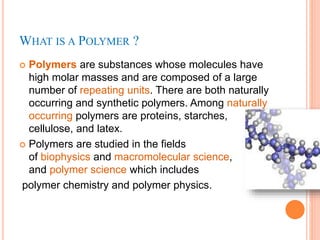
 Polymers are substances whose molecules have
high molar masses and are composed of a large
number of repeating units. There are both naturally
occurring and synthetic polymers. Among naturally
occurring polymers are proteins, starches,
cellulose, and latex.
 Polymers are studied in the fields
of biophysics and macromolecular science,
and polymer science which includes
polymer chemistry and polymer physics.
SOME COMMON EXAMPLES OF SYNTHETIC
POLYMERS
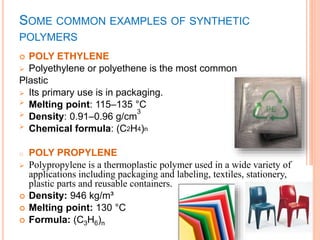
 POLY ETHYLENE
 Polyethylene or polyethene is the most common
Plastic
 Its primary use is in packaging.
 Melting point: 115–135 °C
 Density: 0.91–0.96 g/cm
3
 Chemical formula: (C2H4)n
o POLY PROPYLENE
 Polypropylene is a thermoplastic polymer used in a wide variety of
applications including packaging and labeling, textiles, stationery,
plastic parts and reusable containers.
 Density: 946 kg/m³
 Melting point: 130 °C
 Formula: (C3H6)n
 POLY VINYL CHLORIDE
 Polyvinyl chloride, more correctly but unusually
poly(vinyl chloride), commonly abbreviated PVC, is the
third-most widely produced synthetic plastic polymer
 Density[g/cm3] :1.3–1.45
 Chemical formula: (C2H3Cl)n
 Melting point :100–260 °C
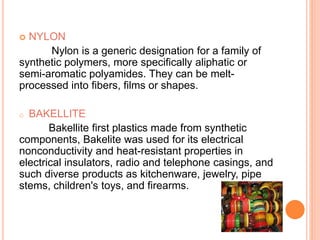
 NYLON
Nylon is a generic designation for a family of
synthetic polymers, more specifically aliphatic or
semi-aromatic polyamides. They can be melt-
processed into fibers, films or shapes.
o BAKELLITE
Bakellite first plastics made from synthetic
components, Bakelite was used for its electrical
nonconductivity and heat-resistant properties in
electrical insulators, radio and telephone casings, and
such diverse products as kitchenware, jewelry, pipe
stems, children's toys, and firearms.
POLY LACTIC ACID
 Polylactic acid (PLA) is a rigid thermoplastic
polymer that can be semicrystalline or totally
amorphous, depending on the stereopurity of the
polymer backbone.
 Highly versatile thermoplastic material
 Made from 100% renewable resources
 PRODUCTION
 SOLVENT METHOD
 NON SOLVENT METHOD
SOLVENT METHOD
Producers have several industrial routes to usable
(i.e. high molecular weight) PLA. Two main
monomers are used: lactic acid, and the cyclic di-
ester, lactide.
NON SOLVENT METHOD
 Start with starch from renewable resource
 Renewable resources used : corn starch ,
tapioca roots, chips or sugarcane.
 Unrefined dextrose processed from starch
 Dextrose fermented into lactic acid
 Lactide produced through condensation
 Purification through vacuum distillation
PROPERTIES:
 PLLA has a crystallinity of around 37%, a glass
transition temperature 60–65 °C, a melting
temperature 130°–230°C and a tensile modulus
2.7–16 GPa.
 Heat-resistant PLA can withstand temperatures of
110 °C.
 It is upto 7 times recycleable.
PROPERTIES(CONT’)
 Below Tg, PLA behaves as a glass with the ability
to creep until cooled to its transition temperature of
approximately _45°C.
 Below this temperature PLA will only behave as a
brittle polymer.
 Polylactic acid can be processed like most
thermoplastics into fiber (for example, using
conventional melt spinning processes) and film
APPLICATIONS
 In agriculture :
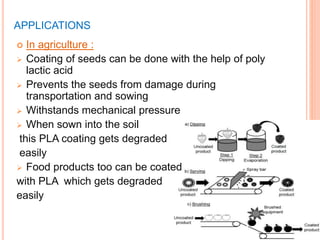
 Coating of seeds can be done with the help of poly
lactic acid
 Prevents the seeds from damage during
transportation and sowing
 Withstands mechanical pressure
 When sown into the soil
this PLA coating gets degraded
easily
 Food products too can be coated
with PLA which gets degraded
easily
 In medicine :
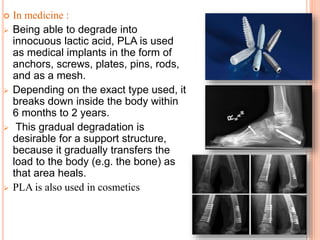
 Being able to degrade into
innocuous lactic acid, PLA is used
as medical implants in the form of
anchors, screws, plates, pins, rods,
and as a mesh.
 Depending on the exact type used, it
breaks down inside the body within
6 months to 2 years.
 This gradual degradation is
desirable for a support structure,
because it gradually transfers the
load to the body (e.g. the bone) as
that area heals.
 PLA is also used in cosmetics
 In industrial field :
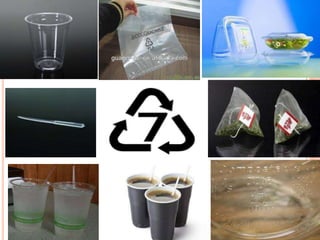
 PLA can also be used as a decomposable packaging
material, either cast, injection-molded, or spun.
 Cups and bags have been made from this material.
 In the form of a film, it shrinks upon heating, allowing it
to be used in shrink tunnels.
 It is useful for producing loose-fill packaging, compost
bags, food packaging, and disposable tableware.
 In the form of fibers and non-woven textiles, PLA also
has many potential uses, for example as upholstery,
disposable garments.
DEGRADATION
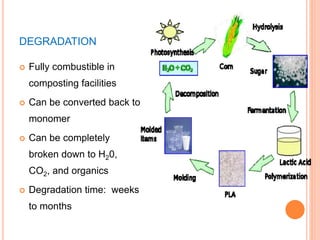
 Fully combustible in
composting facilities
 Can be converted back to
monomer
 Can be completely
broken down to H20,
CO2, and organics
 Degradation time: weeks
to months
DRAWBACKS
 PLA releases carbon dioxide and methane during
the biological breakdown phase
 Fossil fuels still needed to produce PLA
 Some believe that PLA will degrade too slowly to
make a difference in waste streams
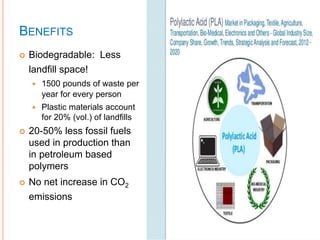
BENEFITS
 Biodegradable: Less
landfill space!
 1500 pounds of waste per
year for every person
 Plastic materials account
for 20% (vol.) of landfills
 20-50% less fossil fuels
used in production than
in petroleum based
polymers
 No net increase in CO2
emissions
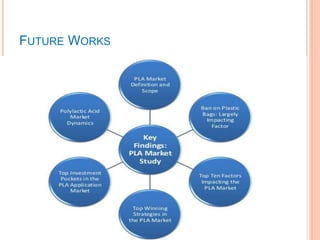
FUTURE WORKS
THANK YOU

Polymers in daily life

  • 1.
    POLYMERS IN DAILYLIFE BY VIGNESH PRABHU.T SCHOOL OF SCIENCE AND HUMANITIES KONGU ENGINEERING COLLEGE (AUTONOMUS) PERUNDURAI-638052.
  • 2.
    CONTENT  What isa Polymer ?  Classification  Poly lactic acid  Preparation  Properties  Applications  Degradation  Drawbacks  Benefits  Future works
  • 3.
    WHAT IS APOLYMER ?  Polymers are substances whose molecules have high molar masses and are composed of a large number of repeating units. There are both naturally occurring and synthetic polymers. Among naturally occurring polymers are proteins, starches, cellulose, and latex.  Polymers are studied in the fields of biophysics and macromolecular science, and polymer science which includes polymer chemistry and polymer physics.
  • 5.
    SOME COMMON EXAMPLESOF SYNTHETIC POLYMERS  POLY ETHYLENE  Polyethylene or polyethene is the most common Plastic  Its primary use is in packaging.  Melting point: 115–135 °C  Density: 0.91–0.96 g/cm 3  Chemical formula: (C2H4)n o POLY PROPYLENE  Polypropylene is a thermoplastic polymer used in a wide variety of applications including packaging and labeling, textiles, stationery, plastic parts and reusable containers.  Density: 946 kg/m³  Melting point: 130 °C  Formula: (C3H6)n
  • 6.
     POLY VINYLCHLORIDE  Polyvinyl chloride, more correctly but unusually poly(vinyl chloride), commonly abbreviated PVC, is the third-most widely produced synthetic plastic polymer  Density[g/cm3] :1.3–1.45  Chemical formula: (C2H3Cl)n  Melting point :100–260 °C
  • 7.
     NYLON Nylon isa generic designation for a family of synthetic polymers, more specifically aliphatic or semi-aromatic polyamides. They can be melt- processed into fibers, films or shapes. o BAKELLITE Bakellite first plastics made from synthetic components, Bakelite was used for its electrical nonconductivity and heat-resistant properties in electrical insulators, radio and telephone casings, and such diverse products as kitchenware, jewelry, pipe stems, children's toys, and firearms.
  • 8.
    POLY LACTIC ACID Polylactic acid (PLA) is a rigid thermoplastic polymer that can be semicrystalline or totally amorphous, depending on the stereopurity of the polymer backbone.  Highly versatile thermoplastic material  Made from 100% renewable resources  PRODUCTION  SOLVENT METHOD  NON SOLVENT METHOD
  • 9.
    SOLVENT METHOD Producers haveseveral industrial routes to usable (i.e. high molecular weight) PLA. Two main monomers are used: lactic acid, and the cyclic di- ester, lactide. NON SOLVENT METHOD  Start with starch from renewable resource  Renewable resources used : corn starch , tapioca roots, chips or sugarcane.  Unrefined dextrose processed from starch  Dextrose fermented into lactic acid  Lactide produced through condensation  Purification through vacuum distillation
  • 10.
    PROPERTIES:  PLLA hasa crystallinity of around 37%, a glass transition temperature 60–65 °C, a melting temperature 130°–230°C and a tensile modulus 2.7–16 GPa.  Heat-resistant PLA can withstand temperatures of 110 °C.  It is upto 7 times recycleable.
  • 11.
    PROPERTIES(CONT’)  Below Tg,PLA behaves as a glass with the ability to creep until cooled to its transition temperature of approximately _45°C.  Below this temperature PLA will only behave as a brittle polymer.  Polylactic acid can be processed like most thermoplastics into fiber (for example, using conventional melt spinning processes) and film
  • 12.
    APPLICATIONS  In agriculture:  Coating of seeds can be done with the help of poly lactic acid  Prevents the seeds from damage during transportation and sowing  Withstands mechanical pressure  When sown into the soil this PLA coating gets degraded easily  Food products too can be coated with PLA which gets degraded easily
  • 13.
     In medicine:  Being able to degrade into innocuous lactic acid, PLA is used as medical implants in the form of anchors, screws, plates, pins, rods, and as a mesh.  Depending on the exact type used, it breaks down inside the body within 6 months to 2 years.  This gradual degradation is desirable for a support structure, because it gradually transfers the load to the body (e.g. the bone) as that area heals.  PLA is also used in cosmetics
  • 14.
     In industrialfield :  PLA can also be used as a decomposable packaging material, either cast, injection-molded, or spun.  Cups and bags have been made from this material.  In the form of a film, it shrinks upon heating, allowing it to be used in shrink tunnels.  It is useful for producing loose-fill packaging, compost bags, food packaging, and disposable tableware.  In the form of fibers and non-woven textiles, PLA also has many potential uses, for example as upholstery, disposable garments.
  • 16.
    DEGRADATION  Fully combustiblein composting facilities  Can be converted back to monomer  Can be completely broken down to H20, CO2, and organics  Degradation time: weeks to months
  • 17.
    DRAWBACKS  PLA releasescarbon dioxide and methane during the biological breakdown phase  Fossil fuels still needed to produce PLA  Some believe that PLA will degrade too slowly to make a difference in waste streams
  • 18.
    BENEFITS  Biodegradable: Less landfillspace!  1500 pounds of waste per year for every person  Plastic materials account for 20% (vol.) of landfills  20-50% less fossil fuels used in production than in petroleum based polymers  No net increase in CO2 emissions
  • 19.
  • 20.