Step-Growth Polymerization.
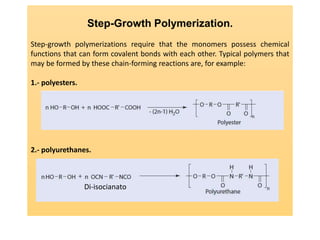
Step-growth polymerizations require that the monomers possess chemical
functions that can form covalent bonds with each other. Typical polymers that
may be formed by these chain-forming reactions are, for example:
1.- polyesters.
2.- polyurethanes.
Di-isocianato
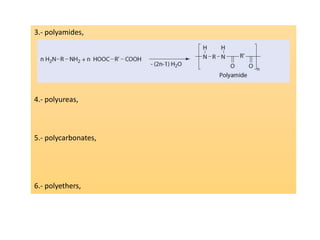
3.- polyamides,
4.- polyureas,
5.- polycarbonates,
6.- polyethers,
Step-Growth Polymerization.
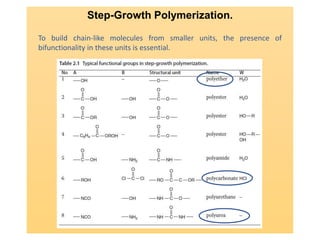
To build chain-like molecules from smaller units, the presence of
bifunctionality in these units is essential.
 Step-growth polymerizations require that the monomers possess chemical
functions that can form covalent bonds with each other: amine, oxhidrile,
 These functions can be united in the same molecule,
such as ω-hydroxyl carboxylic acid, which can produce
a polyester via dehydration.
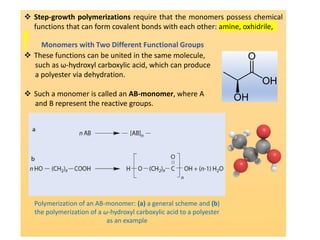
 Such a monomer is called an AB-monomer, where A
and B represent the reactive groups.
Polymerization of an AB-monomer: (a) a general scheme and (b)
the polymerization of a ω-hydroxyl carboxylic acid to a polyester
as an example
Monomers with Two Different Functional Groups
Synthesis of a lactide from hydroxyacetic acid
For x = 1 a lactide forms as the main product
Reaction of 3-hydroxypropionic acid
to acrylic acid
When x = 2, heating produces mainly acrylic
acid via dehydration
Formation of the corresponding lactones
from 4-hydroxybutanoic acid (x = 3) or
5-hydroxypentanoic acid (x = 4)
When x = 3 or x = 4, lactones are the major
products from the corresponding monomers
In contrast, 6-hydroxyhexanoic acid (x = 5) can be converted into the corresponding polyesters
without any problems
5-membered or 6-
membered lactone ring
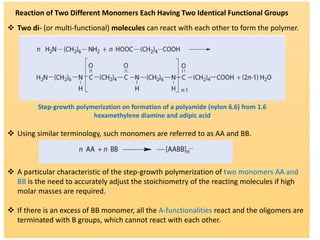
 Two di- (or multi-functional) molecules can react with each other to form the polymer.
 Using similar terminology, such monomers are referred to as AA and BB.
 A particular characteristic of the step-growth polymerization of two monomers AA and
BB is the need to accurately adjust the stoichiometry of the reacting molecules if high
molar masses are required.
 If there is an excess of BB monomer, all the A-functionalities react and the oligomers are
terminated with B groups, which cannot react with each other.
Step-growth polymerization on formation of a polyamide (nylon 6.6) from 1.6
hexamethylene diamine and adipic acid
Reaction of Two Different Monomers Each Having Two Identical Functional Groups
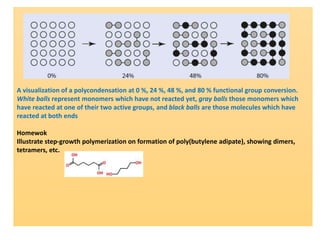
A visualization of a polycondensation at 0 %, 24 %, 48 %, and 80 % functional group conversion.
White balls represent monomers which have not reacted yet, gray balls those monomers which
have reacted at one of their two active groups, and black balls are those molecules which have
reacted at both ends
Homewok
Illustrate step-growth polymerization on formation of poly(butylene adipate), showing dimers,
tetramers, etc.
PBAT (short for polybutylene adipate terephthalate)
Describe, giving chemical equations, catalysts, and reaction conditions for
commercial preparations of poly(ethylene terephthalate)

1-step growth polymerization.pptx

  • 1.
    Step-Growth Polymerization. Step-growth polymerizationsrequire that the monomers possess chemical functions that can form covalent bonds with each other. Typical polymers that may be formed by these chain-forming reactions are, for example: 1.- polyesters. 2.- polyurethanes. Di-isocianato
  • 2.
    3.- polyamides, 4.- polyureas, 5.-polycarbonates, 6.- polyethers,
  • 3.
    Step-Growth Polymerization. To buildchain-like molecules from smaller units, the presence of bifunctionality in these units is essential.
  • 4.
     Step-growth polymerizationsrequire that the monomers possess chemical functions that can form covalent bonds with each other: amine, oxhidrile,  These functions can be united in the same molecule, such as ω-hydroxyl carboxylic acid, which can produce a polyester via dehydration.  Such a monomer is called an AB-monomer, where A and B represent the reactive groups. Polymerization of an AB-monomer: (a) a general scheme and (b) the polymerization of a ω-hydroxyl carboxylic acid to a polyester as an example Monomers with Two Different Functional Groups
  • 5.
    Synthesis of alactide from hydroxyacetic acid For x = 1 a lactide forms as the main product Reaction of 3-hydroxypropionic acid to acrylic acid When x = 2, heating produces mainly acrylic acid via dehydration Formation of the corresponding lactones from 4-hydroxybutanoic acid (x = 3) or 5-hydroxypentanoic acid (x = 4) When x = 3 or x = 4, lactones are the major products from the corresponding monomers In contrast, 6-hydroxyhexanoic acid (x = 5) can be converted into the corresponding polyesters without any problems 5-membered or 6- membered lactone ring
  • 6.
     Two di-(or multi-functional) molecules can react with each other to form the polymer.  Using similar terminology, such monomers are referred to as AA and BB.  A particular characteristic of the step-growth polymerization of two monomers AA and BB is the need to accurately adjust the stoichiometry of the reacting molecules if high molar masses are required.  If there is an excess of BB monomer, all the A-functionalities react and the oligomers are terminated with B groups, which cannot react with each other. Step-growth polymerization on formation of a polyamide (nylon 6.6) from 1.6 hexamethylene diamine and adipic acid Reaction of Two Different Monomers Each Having Two Identical Functional Groups
  • 7.
    A visualization ofa polycondensation at 0 %, 24 %, 48 %, and 80 % functional group conversion. White balls represent monomers which have not reacted yet, gray balls those monomers which have reacted at one of their two active groups, and black balls are those molecules which have reacted at both ends Homewok Illustrate step-growth polymerization on formation of poly(butylene adipate), showing dimers, tetramers, etc.
  • 9.
    PBAT (short forpolybutylene adipate terephthalate) Describe, giving chemical equations, catalysts, and reaction conditions for commercial preparations of poly(ethylene terephthalate)