



TOPIC: BAN THE PLASTIC
BAG
ENGLISH
PROJECTWORK
Index
 Introduction
 History
 Breakthrough in
plastics chemistry
 Plastic processing
 World war II
 The post-war boom
 Kinds of plastic
 HowThermosetting
plastic are formed
 Processibility
 Plastic pellets and
extrusion
 Chemical nature
 Manufacture
 Blow film extrusion
 Raw material
 Synthesizing the
polymer
 Installation insulation
 Additives
 Sorting of plastics
 Health and
Environmental hazards
The Indus valley civilization left beautifully crafted
pottery that speaks volumes of the advances its
people made. After 3,000 years, if the ruins we leave
behind are excavated, chances are only plastic bags
would be dug up. It may sound like an exaggeration,
but these bags are not biodegradable. Apart from
causing emissions when these are manufactured,
noxious fumes are released while these are being
burnt or disposed off. So, be kind to mother Earth
the next time you go shopping for groceries,
remember to carry a cloth bag with you.
Introduction
Plastics, organic polymeric materials (those
consisting of giant organic molecules) that
are plastic—that is, they can be formed into
desired shapes through extrusion, molding,
casting, or spinning.The molecules can be
either natural—including cellulose, wax,
and natural rubber—or synthetic—including
polyethene and nylon.The starting
materials are resins in the form of pellets,
powders, or solutions; from these are
formed the finished plastics.
Plastics, organic polymeric materials (those
consisting of giant organic molecules) that are
plastic—that is, they can be formed into desired
shapes through extrusion, molding, casting, or
spinning.The molecules can be either natural—
including cellulose, wax, and natural rubber—or
synthetic—including polyethene and nylon.The
starting materials are resins in the form of
pellets, powders, or solutions; from these are
formed the finished plastics.
History
The development of plastics began about 1860, after
Phelan and Collander, a United States firm
manufacturing billiard and pool balls, offered a prize
of $10,000 for a satisfactory substitute for natural
ivory. One of those who tried to win this prize was a
US inventor, JohnWesley Hyatt. Hyatt developed a
method of pressure-working pyroxylin, a cellulose
nitrate of low nitration that had been plasticized
with camphor and a minimum of alcohol solvent.
Although Hyatt did not win the prize, his product,
patented under the trademark Celluloid, was used in
the manufacture of objects ranging from dental
plates to men's collars.
Despite its flammability and liability to
deterioration when exposed to light, Celluloid
achieved a notable commercial success.
Other plastics were introduced gradually over
the next few decades.Among them were the
first totally synthetic plastics: the family of
phenol-formaldehyde resins developed by the
Belgian-American chemist Leo Hendrik
Baekeland about 1906 and sold under the
trademark Bakelite. Other plastics introduced
during this period include modified natural
polymers such as rayon, made from cellulose
Breakthrough in plastics chemistry
In 1920 an event occurred that set the stage for the
future rapid development of plastic materials.The
German chemist Hermann Staudinger conjectured
that plastics were truly giant molecules. His
subsequent efforts to prove this claim initiated an
outburst of scientific investigation that resulted in
major breakthroughs in the chemistry of plastics.
Throughout the 1920s and 1930s large numbers of
new products were introduced, including cellulose
ethanoate (originally called cellulose acetate), used in
molding resins and fibers;
PVC—polyvinyl chloride, or polychloroethene—
used in plastic pipe, vinyl coatings, and wire
insulation; urea-formaldehyde resins, used in
tableware and electrical applications; and acrylic
resin, developed as a binder for laminated glass.
One of the most familiar plastics developed in
this period is polymerized methyl methacrylate,
which is marketed in Britain as Perspex and in
the United States as Lucite and Plexiglas.This
material has excellent optical properties and is
suitable for spectacles and camera lenses and
for street and advertising illumination.
Polystyrene resins, also first produced commercially
about 1937, are characterized by high resistance to
chemical and mechanical alteration at low
temperatures and by very low absorption of water.
The polystyrenes are especially suitable for radio-
frequency insulation and for accessories used in low
temperatures, as in refrigeration installations and in
aero planes designed for high-altitude flight. PTFE
(polytetrafluoroethene), first made in 1938, was
eventually produced commercially asTeflon in 1950;
it is the coating used on non-stick cooking utensils.
Another key development during the 1930s was the
synthesis of nylon, the first high-performance
engineering plastic.
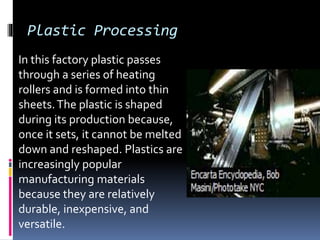
Plastic Processing
In this factory plastic passes
through a series of heating
rollers and is formed into thin
sheets.The plastic is shaped
during its production because,
once it sets, it cannot be melted
down and reshaped. Plastics are
increasingly popular
manufacturing materials
because they are relatively
durable, inexpensive, and
versatile.
World war II
DuringWorldWar II, both theAllies and the Axis
powers were faced with severe shortages of natural
raw materials.The plastics industry proved to be rich
source of acceptable substitutes. Germany, for
example, which was soon cut off from sources of
natural latex, initiated a major programme that led
the development of a practical synthetic rubber.
Japan's entry into the war eliminated most of the
United States'Far Eastern sources of natural rubber,
silk, and many metals.The US response was to
accelerate the development and production of
plastic
Nylon became a major souce of textile fibers,
polyesters were used in fabricating armor and other
war materials, and various types of synthetic rubber
were produced in quantity.
The post-war boom
The scientific and technological momentum in the plastics
industry carried over into the post-war years. Of particular
interest were the advances in such engineering plastics as
polycarbonates, acetyls, and polyamides; other synthetics
were used in place of metal in machinery, safety helmets,
high-temperature devices and many other products used in
environmentally demanding settings. In 1953 the German
chemist Karl Ziegler developed polyethene (originally
called polyethylene), and in 1954 the Italian chemist Giulio
Natta developed polypropene (originally called
polypropylene)—two of today's most important plastics. A
decade later, these two men shared the 1963 Nobel Prize
for Chemistry for their studies of polymers.
Polymerization
Kinds of plastic
Three of the ways in which plastics can be
categorized are by the polymerization process that
forms them, by their processibility, and by their
chemical nature.
The two basic polymerization processes for
producing resins are condensation and addition
reactions. Condensation produces a variety of
lengths of the chain of monomers (repeating
units), whereas addition reactions produce only
specific lengths.
How Thermosetting Plastic Are
Formed
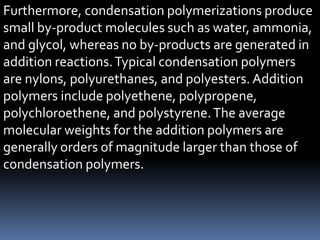
Thermosetting plastics are plastics that
cannot be remelted once they have
hardened. Compression moulding
forms thermosetting plastic objects in
a steel mould.When heat and pressure
are applied, the softened plastic
squeezes into all parts of the mould to
form the desired shape. Laminating
binds layers of materials together in a
plastic matrix.The layers are fused
when heated plates melt the plastic
and squeeze the material together.
Furthermore, condensation polymerizations produce
small by-product molecules such as water, ammonia,
and glycol, whereas no by-products are generated in
addition reactions.Typical condensation polymers
are nylons, polyurethanes, and polyesters. Addition
polymers include polyethene, polypropene,
polychloroethene, and polystyrene.The average
molecular weights for the addition polymers are
generally orders of magnitude larger than those of
condensation polymers.
Processibility
The processibility of a plastic depends on
whether it is thermoplastic or thermosetting.
Thermoplastics, which are made up of linear or
branched polymers, are fusible: they soften
when heated and harden when cooled.This is
also true of thermosets that are lightly cross-
linked. Most thermosets, however, harden
when heated.This final cross-linking, which
fixes the true thermosets, takes place after the
plastic has already been formed.
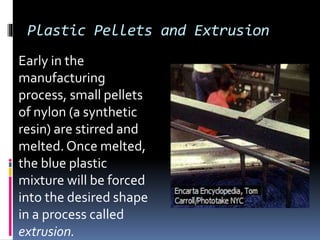
Plastic Pellets and Extrusion
Early in the
manufacturing
process, small pellets
of nylon (a synthetic
resin) are stirred and
melted. Once melted,
the blue plastic
mixture will be forced
into the desired shape
in a process called
extrusion.
Chemical Nature
The chemical nature of a plastic is defined by the
monomer that makes up the chain of the polymer.
For example, polyolefins are made up of monomer
units of olefins, which are open-chain hydrocarbons
with at least one double bond. Polyethene is a
polyolefin; its monomer unit is ethene (formerly
called ethylene). Other categories are acrylics (such
as polymethylmethacrylate), styrenes (such as
polystyrene), vinyl halides (such as polyvinyl
chloride), polyesters, polyurethanes, polyamides
(such as nylons), polyethers, acetals, phenolics,
Manufacture
The manufacture of plastic and plastic products
involves procuring the raw materials, synthesizing
the basic polymer, compounding the polymer into
a material useful for fabrication, and moulding or
shaping the plastic into its final form.
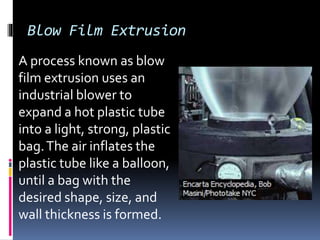
Blow Film Extrusion
A process known as blow
film extrusion uses an
industrial blower to
expand a hot plastic tube
into a light, strong, plastic
bag.The air inflates the
plastic tube like a balloon,
until a bag with the
desired shape, size, and
wall thickness is formed.
Raw Materials
Originally, most plastics were made from resins derived
from vegetable matter, such as cellulose (from cotton),
furfural (from oat hulls), oils (from seeds), starch
derivatives, or coal. Casein (from milk) was among the
nonvegetable materials used. Although the production of
nylon was originally based on coal, air, and water, and nylon
11 is still based on oil from castor beans, most plastics
today are derived from petrochemicals.These oil-based raw
materials are relatively widely available and inexpensive.
However, because the world supply of oil is limited, other
sources of raw materials, such as coal gasification, are
being explored.
Synthesizing the polymer
The first stage in manufacturing plastic is polymerization.
The two basic polymerization processes of condensation
and addition reactions may be carried out in various ways.
In bulk polymerization, the pure monomer alone is
polymerized, generally either in the gaseous or liquid
phase, although a few solid-state polymerizations are also
used. In solution polymerization, an emulsion is formed
and then coagulated. In interfacial polymerization, the
monomers are dissolved in two immiscible liquids, and the
polymerization occurs at the interface of the two liquids.
Installing Insulation
The polystyrene
insulation installed in
this building is full of
minute air pockets that
provide a barrier against
the flow of heat. In
addition a metallic,
reflective outer covering
reflects light, further
isolating the interior of
the building.
Additives
Chemical additives are often used in plastics to
produce some desired characteristic. For instance,
antioxidants protect a polymer from chemical
degradation by oxygen or ozone; similarly,
ultraviolet stabilizers protect against weathering.
Plasticizers make a polymer more flexible,
lubricants reduce problems with friction, and
pigments add colour. Among other additives are
flame retardants and antistatics.
Many plastics are manufactured as composites.
This involves a system where reinforcing material
(usually fibers made of glass or carbon) is added to a
plastic resin matrix. Composites have strength and
stability comparable to that of metals but generally
with less weight. Plastic foams, which are composites
of plastic and gas, offer bulk with low weight.
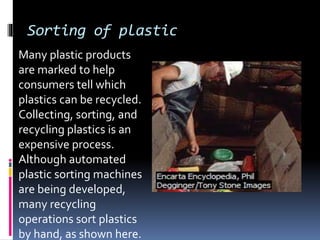
Sorting of plastic
Many plastic products
are marked to help
consumers tell which
plastics can be recycled.
Collecting, sorting, and
recycling plastics is an
expensive process.
Although automated
plastic sorting machines
are being developed,
many recycling
operations sort plastics
by hand, as shown here.
Health and environmental hazards
Because plastics are relatively inert, the final
products do not normally present health hazards to
the maker or user. However, some monomers used
in the manufacture of plastics have been shown to
cause cancer. Similarly, benzene, which is an
important raw material for the synthesis of nylon,
is a carcinogen.The problems involved in the
manufacture of plastics parallel those of the
chemical industry in general.
Most synthetic plastics are not environmentally
degradable; unlike wood, paper, natural fibers, or even
metal and glass, they do not rot or otherwise break down
over time. (Some degradable plastics have been developed,
but none has proved compatible with the conditions
required for most waste landfills.)Thus, there is an
environmental problem associated with the disposal of
plastics. Recycling has emerged as the most practical
method to deal with this problem, especially with products
such as the polyethene terephlalate bottles used for
carbonated drinks, where the process of recycling is fairly
straightforward. More complex solutions are being
developed for handling the commingled plastic scrap that
constitutes a highly visible, albeit relatively small, part of
the problem of solid waste disposal.
PRESENTED BY: HIMANSHI
GUIDED BY: SUNIL MORE
SIR

Ban Plastic bag

  • 1.
    TOPIC: BAN THEPLASTIC BAG ENGLISH PROJECTWORK
  • 2.
    Index  Introduction  History Breakthrough in plastics chemistry  Plastic processing  World war II  The post-war boom  Kinds of plastic  HowThermosetting plastic are formed  Processibility  Plastic pellets and extrusion  Chemical nature  Manufacture  Blow film extrusion  Raw material  Synthesizing the polymer  Installation insulation  Additives  Sorting of plastics  Health and Environmental hazards
  • 3.
    The Indus valleycivilization left beautifully crafted pottery that speaks volumes of the advances its people made. After 3,000 years, if the ruins we leave behind are excavated, chances are only plastic bags would be dug up. It may sound like an exaggeration, but these bags are not biodegradable. Apart from causing emissions when these are manufactured, noxious fumes are released while these are being burnt or disposed off. So, be kind to mother Earth the next time you go shopping for groceries, remember to carry a cloth bag with you. Introduction
  • 4.
    Plastics, organic polymericmaterials (those consisting of giant organic molecules) that are plastic—that is, they can be formed into desired shapes through extrusion, molding, casting, or spinning.The molecules can be either natural—including cellulose, wax, and natural rubber—or synthetic—including polyethene and nylon.The starting materials are resins in the form of pellets, powders, or solutions; from these are formed the finished plastics.
  • 5.
    Plastics, organic polymericmaterials (those consisting of giant organic molecules) that are plastic—that is, they can be formed into desired shapes through extrusion, molding, casting, or spinning.The molecules can be either natural— including cellulose, wax, and natural rubber—or synthetic—including polyethene and nylon.The starting materials are resins in the form of pellets, powders, or solutions; from these are formed the finished plastics.
  • 6.
    History The development ofplastics began about 1860, after Phelan and Collander, a United States firm manufacturing billiard and pool balls, offered a prize of $10,000 for a satisfactory substitute for natural ivory. One of those who tried to win this prize was a US inventor, JohnWesley Hyatt. Hyatt developed a method of pressure-working pyroxylin, a cellulose nitrate of low nitration that had been plasticized with camphor and a minimum of alcohol solvent. Although Hyatt did not win the prize, his product, patented under the trademark Celluloid, was used in the manufacture of objects ranging from dental plates to men's collars.
  • 7.
    Despite its flammabilityand liability to deterioration when exposed to light, Celluloid achieved a notable commercial success. Other plastics were introduced gradually over the next few decades.Among them were the first totally synthetic plastics: the family of phenol-formaldehyde resins developed by the Belgian-American chemist Leo Hendrik Baekeland about 1906 and sold under the trademark Bakelite. Other plastics introduced during this period include modified natural polymers such as rayon, made from cellulose
  • 8.
    Breakthrough in plasticschemistry In 1920 an event occurred that set the stage for the future rapid development of plastic materials.The German chemist Hermann Staudinger conjectured that plastics were truly giant molecules. His subsequent efforts to prove this claim initiated an outburst of scientific investigation that resulted in major breakthroughs in the chemistry of plastics. Throughout the 1920s and 1930s large numbers of new products were introduced, including cellulose ethanoate (originally called cellulose acetate), used in molding resins and fibers;
  • 9.
    PVC—polyvinyl chloride, orpolychloroethene— used in plastic pipe, vinyl coatings, and wire insulation; urea-formaldehyde resins, used in tableware and electrical applications; and acrylic resin, developed as a binder for laminated glass. One of the most familiar plastics developed in this period is polymerized methyl methacrylate, which is marketed in Britain as Perspex and in the United States as Lucite and Plexiglas.This material has excellent optical properties and is suitable for spectacles and camera lenses and for street and advertising illumination.
  • 10.
    Polystyrene resins, alsofirst produced commercially about 1937, are characterized by high resistance to chemical and mechanical alteration at low temperatures and by very low absorption of water. The polystyrenes are especially suitable for radio- frequency insulation and for accessories used in low temperatures, as in refrigeration installations and in aero planes designed for high-altitude flight. PTFE (polytetrafluoroethene), first made in 1938, was eventually produced commercially asTeflon in 1950; it is the coating used on non-stick cooking utensils. Another key development during the 1930s was the synthesis of nylon, the first high-performance engineering plastic.
  • 11.
    Plastic Processing In thisfactory plastic passes through a series of heating rollers and is formed into thin sheets.The plastic is shaped during its production because, once it sets, it cannot be melted down and reshaped. Plastics are increasingly popular manufacturing materials because they are relatively durable, inexpensive, and versatile.
  • 12.
    World war II DuringWorldWarII, both theAllies and the Axis powers were faced with severe shortages of natural raw materials.The plastics industry proved to be rich source of acceptable substitutes. Germany, for example, which was soon cut off from sources of natural latex, initiated a major programme that led the development of a practical synthetic rubber. Japan's entry into the war eliminated most of the United States'Far Eastern sources of natural rubber, silk, and many metals.The US response was to accelerate the development and production of plastic
  • 13.
    Nylon became amajor souce of textile fibers, polyesters were used in fabricating armor and other war materials, and various types of synthetic rubber were produced in quantity.
  • 14.
    The post-war boom Thescientific and technological momentum in the plastics industry carried over into the post-war years. Of particular interest were the advances in such engineering plastics as polycarbonates, acetyls, and polyamides; other synthetics were used in place of metal in machinery, safety helmets, high-temperature devices and many other products used in environmentally demanding settings. In 1953 the German chemist Karl Ziegler developed polyethene (originally called polyethylene), and in 1954 the Italian chemist Giulio Natta developed polypropene (originally called polypropylene)—two of today's most important plastics. A decade later, these two men shared the 1963 Nobel Prize for Chemistry for their studies of polymers.
  • 15.
    Polymerization Kinds of plastic Threeof the ways in which plastics can be categorized are by the polymerization process that forms them, by their processibility, and by their chemical nature. The two basic polymerization processes for producing resins are condensation and addition reactions. Condensation produces a variety of lengths of the chain of monomers (repeating units), whereas addition reactions produce only specific lengths.
  • 16.
    How Thermosetting PlasticAre Formed Thermosetting plastics are plastics that cannot be remelted once they have hardened. Compression moulding forms thermosetting plastic objects in a steel mould.When heat and pressure are applied, the softened plastic squeezes into all parts of the mould to form the desired shape. Laminating binds layers of materials together in a plastic matrix.The layers are fused when heated plates melt the plastic and squeeze the material together.
  • 17.
    Furthermore, condensation polymerizationsproduce small by-product molecules such as water, ammonia, and glycol, whereas no by-products are generated in addition reactions.Typical condensation polymers are nylons, polyurethanes, and polyesters. Addition polymers include polyethene, polypropene, polychloroethene, and polystyrene.The average molecular weights for the addition polymers are generally orders of magnitude larger than those of condensation polymers.
  • 18.
    Processibility The processibility ofa plastic depends on whether it is thermoplastic or thermosetting. Thermoplastics, which are made up of linear or branched polymers, are fusible: they soften when heated and harden when cooled.This is also true of thermosets that are lightly cross- linked. Most thermosets, however, harden when heated.This final cross-linking, which fixes the true thermosets, takes place after the plastic has already been formed.
  • 19.
    Plastic Pellets andExtrusion Early in the manufacturing process, small pellets of nylon (a synthetic resin) are stirred and melted. Once melted, the blue plastic mixture will be forced into the desired shape in a process called extrusion.
  • 20.
    Chemical Nature The chemicalnature of a plastic is defined by the monomer that makes up the chain of the polymer. For example, polyolefins are made up of monomer units of olefins, which are open-chain hydrocarbons with at least one double bond. Polyethene is a polyolefin; its monomer unit is ethene (formerly called ethylene). Other categories are acrylics (such as polymethylmethacrylate), styrenes (such as polystyrene), vinyl halides (such as polyvinyl chloride), polyesters, polyurethanes, polyamides (such as nylons), polyethers, acetals, phenolics,
  • 21.
    Manufacture The manufacture ofplastic and plastic products involves procuring the raw materials, synthesizing the basic polymer, compounding the polymer into a material useful for fabrication, and moulding or shaping the plastic into its final form.
  • 22.
    Blow Film Extrusion Aprocess known as blow film extrusion uses an industrial blower to expand a hot plastic tube into a light, strong, plastic bag.The air inflates the plastic tube like a balloon, until a bag with the desired shape, size, and wall thickness is formed.
  • 23.
    Raw Materials Originally, mostplastics were made from resins derived from vegetable matter, such as cellulose (from cotton), furfural (from oat hulls), oils (from seeds), starch derivatives, or coal. Casein (from milk) was among the nonvegetable materials used. Although the production of nylon was originally based on coal, air, and water, and nylon 11 is still based on oil from castor beans, most plastics today are derived from petrochemicals.These oil-based raw materials are relatively widely available and inexpensive. However, because the world supply of oil is limited, other sources of raw materials, such as coal gasification, are being explored.
  • 24.
    Synthesizing the polymer Thefirst stage in manufacturing plastic is polymerization. The two basic polymerization processes of condensation and addition reactions may be carried out in various ways. In bulk polymerization, the pure monomer alone is polymerized, generally either in the gaseous or liquid phase, although a few solid-state polymerizations are also used. In solution polymerization, an emulsion is formed and then coagulated. In interfacial polymerization, the monomers are dissolved in two immiscible liquids, and the polymerization occurs at the interface of the two liquids.
  • 25.
    Installing Insulation The polystyrene insulationinstalled in this building is full of minute air pockets that provide a barrier against the flow of heat. In addition a metallic, reflective outer covering reflects light, further isolating the interior of the building.
  • 26.
    Additives Chemical additives areoften used in plastics to produce some desired characteristic. For instance, antioxidants protect a polymer from chemical degradation by oxygen or ozone; similarly, ultraviolet stabilizers protect against weathering. Plasticizers make a polymer more flexible, lubricants reduce problems with friction, and pigments add colour. Among other additives are flame retardants and antistatics. Many plastics are manufactured as composites.
  • 27.
    This involves asystem where reinforcing material (usually fibers made of glass or carbon) is added to a plastic resin matrix. Composites have strength and stability comparable to that of metals but generally with less weight. Plastic foams, which are composites of plastic and gas, offer bulk with low weight.
  • 28.
    Sorting of plastic Manyplastic products are marked to help consumers tell which plastics can be recycled. Collecting, sorting, and recycling plastics is an expensive process. Although automated plastic sorting machines are being developed, many recycling operations sort plastics by hand, as shown here.
  • 29.
    Health and environmentalhazards Because plastics are relatively inert, the final products do not normally present health hazards to the maker or user. However, some monomers used in the manufacture of plastics have been shown to cause cancer. Similarly, benzene, which is an important raw material for the synthesis of nylon, is a carcinogen.The problems involved in the manufacture of plastics parallel those of the chemical industry in general.
  • 30.
    Most synthetic plasticsare not environmentally degradable; unlike wood, paper, natural fibers, or even metal and glass, they do not rot or otherwise break down over time. (Some degradable plastics have been developed, but none has proved compatible with the conditions required for most waste landfills.)Thus, there is an environmental problem associated with the disposal of plastics. Recycling has emerged as the most practical method to deal with this problem, especially with products such as the polyethene terephlalate bottles used for carbonated drinks, where the process of recycling is fairly straightforward. More complex solutions are being developed for handling the commingled plastic scrap that constitutes a highly visible, albeit relatively small, part of the problem of solid waste disposal.
  • 31.