Bohai Bay, China
Present by : Behzad Hosseinzadeh
1
Polymer Flooding
Number of slides:17 Winter-1392 EOR course
Reservoir Location
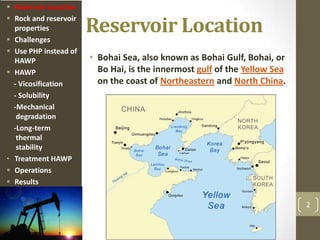
• Bohai Sea, also known as Bohai Gulf, Bohai, or
Bo Hai, is the innermost gulf of the Yellow Sea
on the coast of Northeastern and North China.
2
 Reservoir Location
 Rock and reservoir
properties
 Challenges
 Use PHP instead of
HAWP
 HAWP
- Vicosification
- Solubility
-Mechanical
degradation
-Long-term
thermal
stability
• Treatment HAWP
 Operations
 Results
Reservoir Location
• SZ36-1 oilfield is located at the coast of
Liaodong, Bohai Bay, China 9
• It is estimated that around 70% of oil reserve in
China offshore oilfields are heavy oil
• 64% of them are discovered in Bohai bay.
• The oil recovery by water flooding is only 18 –
25%, which is far below than that of the onshore the
average oil recovery of 32 –40%.
• It was put into operation since 1993
• Sea water with high salinity of 32,423mg/L was
initially injected for about 8 years.
• Then water from Guantao formation with salinity
of 9048mg/L was injected.
• The history of water injection makes the salinity of
produced water higher than that of the original
formation water, especially of Ca 2+ and Mg 2+ .
3
 Reservoir Location
 Rock and reservoir
properties
 Challenges
 Use PHP instead of
HAWP
 HAWP
- Vicosification
- Solubility
-Mechanical
degradation
-Long-term
thermal
stability
• Treatment HAWP
 Operations
 Results
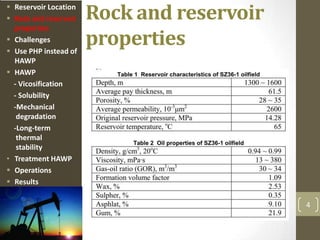
Rock and reservoir
properties
4
 Reservoir Location
 Rock and reservoir
properties
 Challenges
 Use PHP instead of
HAWP
 HAWP
- Vicosification
- Solubility
-Mechanical
degradation
-Long-term
thermal
stability
• Treatment HAWP
 Operations
 Results
Rock and reservoir
properties
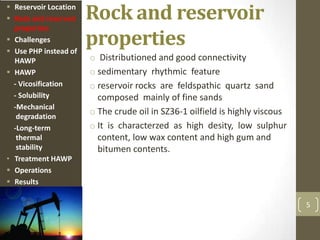
o Distributioned and good connectivity
o sedimentary rhythmic feature
o reservoir rocks are feldspathic quartz sand
composed mainly of fine sands
o The crude oil in SZ36-1 oilfield is highly viscous
o It is characterzed as high desity, low sulphur
content, low wax content and high gum and
bitumen contents.
5
 Reservoir Location
 Rock and reservoir
properties
 Challenges
 Use PHP instead of
HAWP
 HAWP
- Vicosification
- Solubility
-Mechanical
degradation
-Long-term
thermal
stability
• Treatment HAWP
 Operations
 Results
Challenges
High salinity and hardness of the make-up water (Ca
2+ and Mg 2+ : 600 – 1,200mg/L), and high viscosity
of oil (in average of 70mPa·s), which require the
polymer to be salt resistant and good viscosification.
Limited spacing of platform does not allow big
volume installation for polymer resolving, so
development of fast-resolving polymer is necessary.
Drilling and completion by wire wrapped screen
gravel-packed sand control and large displacement of
offshore oilfields require strong anti-mechanical
degradation ability of polymer.
 Long-term stability of polymer in the formation
is required because of the large well spacing and
thick pay zone.
Treatment of produced fluid to meet the
environmental requirements should fast and
complete in the platform. So the effect of polymer to
the produced fluid should be considered in the
polymer design.
6
 Reservoir Location
 Rock and reservoir
properties
 Challenges
 Use PHP instead of
HAWP
 HAWP
- Vicosification
- Solubility
-Mechanical
degradation
-Long-term
thermal
stability
• Treatment HAWP
 Operations
 Results
Use PHP instead of HAWP
Partially hydrolyzed Polyacrylamide (PHP) is a
long chain high molecular weight polymer with
great visocification
Partially hydrolyzed Polyacrylamide (PHP) is a
long chain high molecular weight polymer with
great visocification
a kind of Hydrophobically Associating Water-
soluble Polymer (HAWP) is being designed and
synethesized with less sensitive to sanility
and high viscosification as a driving agent for
offshore polymer flooding.
7
 Reservoir Location
 Rock and reservoir
properties
 Challenges
 Use PHP instead of
HAWP
 HAWP
- Vicosification
- Solubility
-Mechanical
degradation
-Long-term
thermal
stability
• Treatment HAWP
 Operations
 Results
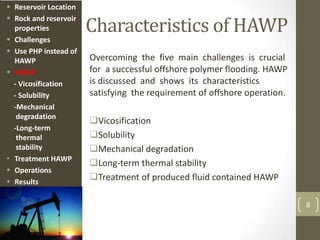
Characteristics of HAWP
Overcoming the five main challenges is crucial
for a successful offshore polymer flooding. HAWP
is discussed and shows its characteristics
satisfying the requirement of offshore operation.
Vicosification
Solubility
Mechanical degradation
Long-term thermal stability
Treatment of produced fluid contained HAWP
8
 Reservoir Location
 Rock and reservoir
properties
 Challenges
 Use PHP instead of
HAWP
 HAWP
- Vicosification
- Solubility
-Mechanical
degradation
-Long-term
thermal
stability
• Treatment HAWP
 Operations
 Results
Vicosification
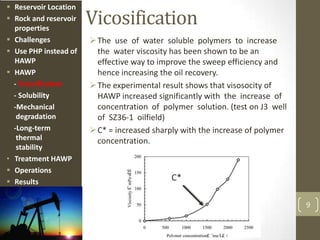
The use of water soluble polymers to increase
the water viscosity has been shown to be an
effective way to improve the sweep efficiency and
hence increasing the oil recovery.
The experimental result shows that visosocity of
HAWP increased significantly with the increase of
concentration of polymer solution. (test on J3 well
of SZ36-1 oilfield)
C* = increased sharply with the increase of polymer
concentration.
9
C*
 Reservoir Location
 Rock and reservoir
properties
 Challenges
 Use PHP instead of
HAWP
 HAWP
- Vicosification
- Solubility
-Mechanical
degradation
-Long-term
thermal
stability
• Treatment HAWP
 Operations
 Results
Solubility
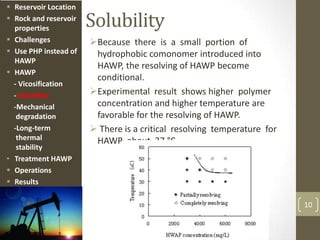
Because there is a small portion of
hydrophobic comonomer introduced into
HAWP, the resolving of HAWP become
conditional.
Experimental result shows higher polymer
concentration and higher temperature are
favorable for the resolving of HAWP.
 There is a critical resolving temperature for
HAWP about 37 °C.
10
 Reservoir Location
 Rock and reservoir
properties
 Challenges
 Use PHP instead of
HAWP
 HAWP
- Vicosification
- Solubility
-Mechanical
degradation
-Long-term
thermal
stability
• Treatment HAWP
 Operations
 Results
Mechanical degradation
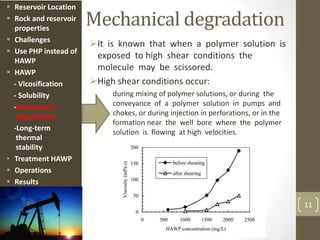
It is known that when a polymer solution is
exposed to high shear conditions the
molecule may be scissored.
High shear conditions occur:
during mixing of polymer solutions, or during the
conveyance of a polymer solution in pumps and
chokes, or during injection in perforations, or in the
formation near the well bore where the polymer
solution is flowing at high velocities.
11
 Reservoir Location
 Rock and reservoir
properties
 Challenges
 Use PHP instead of
HAWP
 HAWP
- Vicosification
- Solubility
-Mechanical
degradation
-Long-term
thermal
stability
• Treatment HAWP
 Operations
 Results
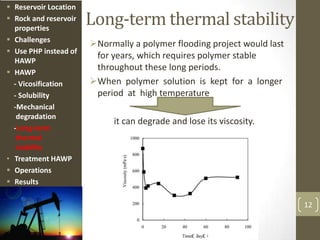
Long-term thermal stability
Normally a polymer flooding project would last
for years, which requires polymer stable
throughout these long periods.
When polymer solution is kept for a longer
period at high temperature
it can degrade and lose its viscosity.
12
 Reservoir Location
 Rock and reservoir
properties
 Challenges
 Use PHP instead of
HAWP
 HAWP
- Vicosification
- Solubility
-Mechanical
degradation
-Long-term
thermal
stability
• Treatment HAWP
 Operations
 Results
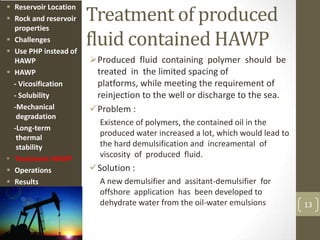
Treatment of produced
fluid contained HAWP
Produced fluid containing polymer should be
treated in the limited spacing of
platforms, while meeting the requirement of
reinjection to the well or discharge to the sea.
Problem :
Existence of polymers, the contained oil in the
produced water increased a lot, which would lead to
the hard demulsification and increamental of
viscosity of produced fluid.
Solution :
A new demulsifier and assitant-demulsifier for
offshore application has been developed to
dehydrate water from the oil-water emulsions 13
 Reservoir Location
 Rock and reservoir
properties
 Challenges
 Use PHP instead of
HAWP
 HAWP
- Vicosification
- Solubility
-Mechanical
degradation
-Long-term
thermal
stability
• Treatment HAWP
 Operations
 Results
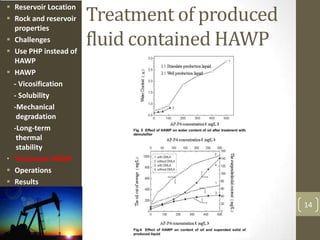
Treatment of produced
fluid contained HAWP
14
 Reservoir Location
 Rock and reservoir
properties
 Challenges
 Use PHP instead of
HAWP
 HAWP
- Vicosification
- Solubility
-Mechanical
degradation
-Long-term
thermal
stability
• Treatment HAWP
 Operations
 Results
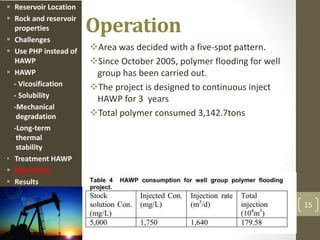
Operation
Area was decided with a five-spot pattern.
Since October 2005, polymer flooding for well
group has been carried out.
The project is designed to continuous inject
HAWP for 3 years
Total polymer consumed 3,142.7tons
15
 Reservoir Location
 Rock and reservoir
properties
 Challenges
 Use PHP instead of
HAWP
 HAWP
- Vicosification
- Solubility
-Mechanical
degradation
-Long-term
thermal
stability
• Treatment HAWP
 Operations
 Results
Result
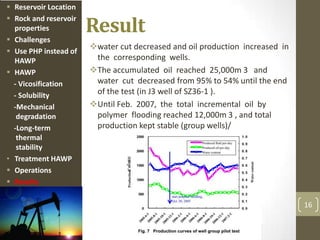
water cut decreased and oil production increased in
the corresponding wells.
The accumulated oil reached 25,000m 3 and
water cut decreased from 95% to 54% until the end
of the test (in J3 well of SZ36-1 ).
Until Feb. 2007, the total incremental oil by
polymer flooding reached 12,000m 3 , and total
production kept stable (group wells)/
16
 Reservoir Location
 Rock and reservoir
properties
 Challenges
 Use PHP instead of
HAWP
 HAWP
- Vicosification
- Solubility
-Mechanical
degradation
-Long-term
thermal
stability
• Treatment HAWP
 Operations
 Results
Thanks For Your Attention
17

Polymer flooding

  • 1.
    Bohai Bay, China Presentby : Behzad Hosseinzadeh 1 Polymer Flooding Number of slides:17 Winter-1392 EOR course
  • 2.
    Reservoir Location • BohaiSea, also known as Bohai Gulf, Bohai, or Bo Hai, is the innermost gulf of the Yellow Sea on the coast of Northeastern and North China. 2  Reservoir Location  Rock and reservoir properties  Challenges  Use PHP instead of HAWP  HAWP - Vicosification - Solubility -Mechanical degradation -Long-term thermal stability • Treatment HAWP  Operations  Results
  • 3.
    Reservoir Location • SZ36-1oilfield is located at the coast of Liaodong, Bohai Bay, China 9 • It is estimated that around 70% of oil reserve in China offshore oilfields are heavy oil • 64% of them are discovered in Bohai bay. • The oil recovery by water flooding is only 18 – 25%, which is far below than that of the onshore the average oil recovery of 32 –40%. • It was put into operation since 1993 • Sea water with high salinity of 32,423mg/L was initially injected for about 8 years. • Then water from Guantao formation with salinity of 9048mg/L was injected. • The history of water injection makes the salinity of produced water higher than that of the original formation water, especially of Ca 2+ and Mg 2+ . 3  Reservoir Location  Rock and reservoir properties  Challenges  Use PHP instead of HAWP  HAWP - Vicosification - Solubility -Mechanical degradation -Long-term thermal stability • Treatment HAWP  Operations  Results
  • 4.
    Rock and reservoir properties 4 Reservoir Location  Rock and reservoir properties  Challenges  Use PHP instead of HAWP  HAWP - Vicosification - Solubility -Mechanical degradation -Long-term thermal stability • Treatment HAWP  Operations  Results
  • 5.
    Rock and reservoir properties oDistributioned and good connectivity o sedimentary rhythmic feature o reservoir rocks are feldspathic quartz sand composed mainly of fine sands o The crude oil in SZ36-1 oilfield is highly viscous o It is characterzed as high desity, low sulphur content, low wax content and high gum and bitumen contents. 5  Reservoir Location  Rock and reservoir properties  Challenges  Use PHP instead of HAWP  HAWP - Vicosification - Solubility -Mechanical degradation -Long-term thermal stability • Treatment HAWP  Operations  Results
  • 6.
    Challenges High salinity andhardness of the make-up water (Ca 2+ and Mg 2+ : 600 – 1,200mg/L), and high viscosity of oil (in average of 70mPa·s), which require the polymer to be salt resistant and good viscosification. Limited spacing of platform does not allow big volume installation for polymer resolving, so development of fast-resolving polymer is necessary. Drilling and completion by wire wrapped screen gravel-packed sand control and large displacement of offshore oilfields require strong anti-mechanical degradation ability of polymer.  Long-term stability of polymer in the formation is required because of the large well spacing and thick pay zone. Treatment of produced fluid to meet the environmental requirements should fast and complete in the platform. So the effect of polymer to the produced fluid should be considered in the polymer design. 6  Reservoir Location  Rock and reservoir properties  Challenges  Use PHP instead of HAWP  HAWP - Vicosification - Solubility -Mechanical degradation -Long-term thermal stability • Treatment HAWP  Operations  Results
  • 7.
    Use PHP insteadof HAWP Partially hydrolyzed Polyacrylamide (PHP) is a long chain high molecular weight polymer with great visocification Partially hydrolyzed Polyacrylamide (PHP) is a long chain high molecular weight polymer with great visocification a kind of Hydrophobically Associating Water- soluble Polymer (HAWP) is being designed and synethesized with less sensitive to sanility and high viscosification as a driving agent for offshore polymer flooding. 7  Reservoir Location  Rock and reservoir properties  Challenges  Use PHP instead of HAWP  HAWP - Vicosification - Solubility -Mechanical degradation -Long-term thermal stability • Treatment HAWP  Operations  Results
  • 8.
    Characteristics of HAWP Overcomingthe five main challenges is crucial for a successful offshore polymer flooding. HAWP is discussed and shows its characteristics satisfying the requirement of offshore operation. Vicosification Solubility Mechanical degradation Long-term thermal stability Treatment of produced fluid contained HAWP 8  Reservoir Location  Rock and reservoir properties  Challenges  Use PHP instead of HAWP  HAWP - Vicosification - Solubility -Mechanical degradation -Long-term thermal stability • Treatment HAWP  Operations  Results
  • 9.
    Vicosification The use ofwater soluble polymers to increase the water viscosity has been shown to be an effective way to improve the sweep efficiency and hence increasing the oil recovery. The experimental result shows that visosocity of HAWP increased significantly with the increase of concentration of polymer solution. (test on J3 well of SZ36-1 oilfield) C* = increased sharply with the increase of polymer concentration. 9 C*  Reservoir Location  Rock and reservoir properties  Challenges  Use PHP instead of HAWP  HAWP - Vicosification - Solubility -Mechanical degradation -Long-term thermal stability • Treatment HAWP  Operations  Results
  • 10.
    Solubility Because there isa small portion of hydrophobic comonomer introduced into HAWP, the resolving of HAWP become conditional. Experimental result shows higher polymer concentration and higher temperature are favorable for the resolving of HAWP.  There is a critical resolving temperature for HAWP about 37 °C. 10  Reservoir Location  Rock and reservoir properties  Challenges  Use PHP instead of HAWP  HAWP - Vicosification - Solubility -Mechanical degradation -Long-term thermal stability • Treatment HAWP  Operations  Results
  • 11.
    Mechanical degradation It isknown that when a polymer solution is exposed to high shear conditions the molecule may be scissored. High shear conditions occur: during mixing of polymer solutions, or during the conveyance of a polymer solution in pumps and chokes, or during injection in perforations, or in the formation near the well bore where the polymer solution is flowing at high velocities. 11  Reservoir Location  Rock and reservoir properties  Challenges  Use PHP instead of HAWP  HAWP - Vicosification - Solubility -Mechanical degradation -Long-term thermal stability • Treatment HAWP  Operations  Results
  • 12.
    Long-term thermal stability Normallya polymer flooding project would last for years, which requires polymer stable throughout these long periods. When polymer solution is kept for a longer period at high temperature it can degrade and lose its viscosity. 12  Reservoir Location  Rock and reservoir properties  Challenges  Use PHP instead of HAWP  HAWP - Vicosification - Solubility -Mechanical degradation -Long-term thermal stability • Treatment HAWP  Operations  Results
  • 13.
    Treatment of produced fluidcontained HAWP Produced fluid containing polymer should be treated in the limited spacing of platforms, while meeting the requirement of reinjection to the well or discharge to the sea. Problem : Existence of polymers, the contained oil in the produced water increased a lot, which would lead to the hard demulsification and increamental of viscosity of produced fluid. Solution : A new demulsifier and assitant-demulsifier for offshore application has been developed to dehydrate water from the oil-water emulsions 13  Reservoir Location  Rock and reservoir properties  Challenges  Use PHP instead of HAWP  HAWP - Vicosification - Solubility -Mechanical degradation -Long-term thermal stability • Treatment HAWP  Operations  Results
  • 14.
    Treatment of produced fluidcontained HAWP 14  Reservoir Location  Rock and reservoir properties  Challenges  Use PHP instead of HAWP  HAWP - Vicosification - Solubility -Mechanical degradation -Long-term thermal stability • Treatment HAWP  Operations  Results
  • 15.
    Operation Area was decidedwith a five-spot pattern. Since October 2005, polymer flooding for well group has been carried out. The project is designed to continuous inject HAWP for 3 years Total polymer consumed 3,142.7tons 15  Reservoir Location  Rock and reservoir properties  Challenges  Use PHP instead of HAWP  HAWP - Vicosification - Solubility -Mechanical degradation -Long-term thermal stability • Treatment HAWP  Operations  Results
  • 16.
    Result water cut decreasedand oil production increased in the corresponding wells. The accumulated oil reached 25,000m 3 and water cut decreased from 95% to 54% until the end of the test (in J3 well of SZ36-1 ). Until Feb. 2007, the total incremental oil by polymer flooding reached 12,000m 3 , and total production kept stable (group wells)/ 16  Reservoir Location  Rock and reservoir properties  Challenges  Use PHP instead of HAWP  HAWP - Vicosification - Solubility -Mechanical degradation -Long-term thermal stability • Treatment HAWP  Operations  Results
  • 17.
    Thanks For YourAttention 17