






PRESENT A DEVELOPED MODEL FOR
PREDICTING PERFORMANCE OF
CARBONATE MATRIX ACIDIZING
Presented by:
Behzad Hosseinzadeh
Supervisors:
Dr. Behzad Rostami,
Dr. Shahab Ayatollahi
Dr. Mohammad Bazargan Summer 2016
2 / 44
 Introduction
 Literature review
 Continuum model
 Results
 Conclusions
 Recommendations
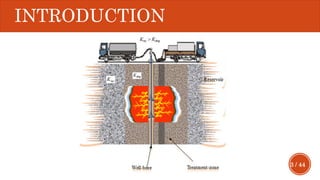
INTRODUCTION
3 / 44
INTRODUCTION
4 / 44
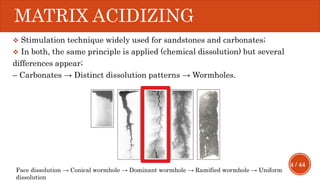
MATRIX ACIDIZING
 Stimulation technique widely used for sandstones and carbonates;
 In both, the same principle is applied (chemical dissolution) but several
differences appear;
– Carbonates → Distinct dissolution patterns → Wormholes.
Face dissolution → Conical wormhole → Dominant wormhole → Ramified wormhole → Uniform
dissolution
5 / 44
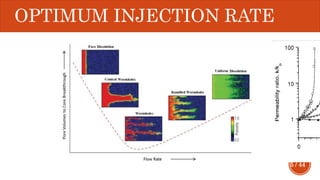
OPTIMUM INJECTION RATE
6 / 44
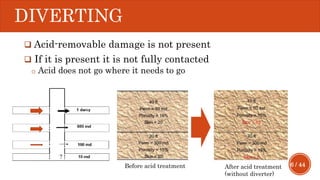
DIVERTING
 Acid-removable damage is not present
 If it is present it is not fully contacted
o Acid does not go where it needs to go
Before acid treatment After acid treatment
(without diverter)
7 / 44
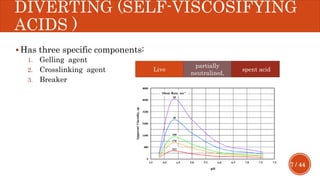
DIVERTING (SELF-VISCOSIFYING
ACIDS )
 Has three specific components:
1. Gelling agent
2. Crosslinking agent
3. Breaker
Live
partially
neutralized,
spent acid
8 / 44
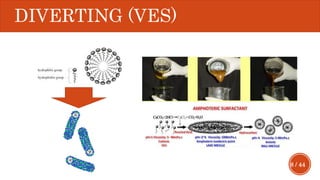
DIVERTING (VES)
9 / 44
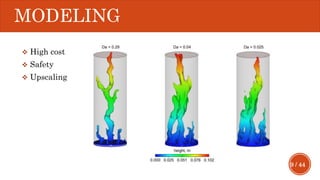
MODELING
 High cost
 Safety
 Upscaling
10 / 44
 Introduction
 Literature review
 Continuum model
 Results
 Conclusions
 Recommendations
LITERATURE
REVIEW
11 / 44
LITERATURE REVIEW
Experimental
• Williams et al. (1979)
• Daccord et al. (1987, 1993a, 1993b)
• Lund et al. (1973, 1975)
• Hoefner and Fogler (1989)
• Bazin et al. (1995)
• Fredd and Fogler (1998)
• Golfier et al. (2002)
• Taylor et al. 2002
• Nasr-El-Din et al. (2006, 2007)
• Ziauddin and Bize (2007)
• Omer Izgec (2009)
• Gomaa et al. (2010, 2011)
• Rabie et al. (2012)
• Mehdi Gommem (2015)
Mathematical
• Capillary Tube Model: Hung et al.
(1997), Buijse (1997), Huang et al.
(1999, 2000)
• Fractal and Dimensionless: Dacord
(1993), Kurmayr (1992), Pichler et
al. (1992) Fred and Fogler (1999)
• Network Model: Hoefner and Fogler
(1988), Fred and Fogler (1998)
• Continuum (Averaged) Model:
Newtonian: Golfier et al. (2002),
Panga (2005), Kalia (2005,2009),
Cohen et al. (2008), Liu et al.
(2012), Maheshwari (2013, 2015),
Gommem (2015)
Non-Newtonian: Ratnakar et al.
(2013), Naizhen et al. (2015)
12 / 44
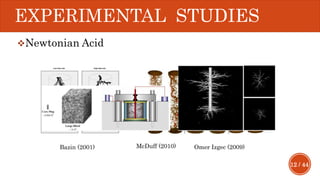
EXPERIMENTAL STUDIES
Newtonian Acid
Bazin (2001) Omer Izgec (2009)McDuff (2010)
13 / 44
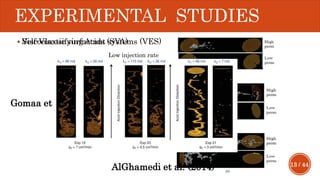
EXPERIMENTAL STUDIES
 Self-Viscosifying Acids (SVA)
Low injection rate
High injection rate
Intermediate injection rate
Gomaa et al. (2011)
 Viscoelastic surfactant systems (VES)
AlGhamedi et al. (2014)
14 / 44
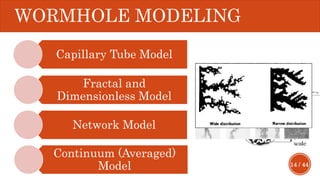
WORMHOLE MODELING
Capillary Tube Model
Fractal and
Dimensionless Model
Network Model
Continuum (Averaged)
Model
15 / 44
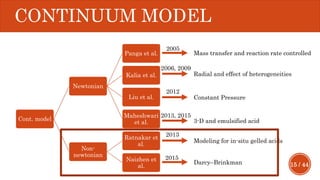
CONTINUUM MODEL
Cont. model
Newtonian
Panga et al.
Kalia et al.
Liu et al.
Maheshwari
et al.
Non-
newtonian
Ratnakar et
al.
Naizhen et
al.
Mass transfer and reaction rate controlled
Radial and effect of heterogeneities
Constant Pressure
3-D and emulsified acid
Modeling for in-situ gelled acids
Darcy–Brinkman
2005
2006, 2009
2012
2013, 2015
2013
2015
16 / 44
 Introduction
 Literature review
 Continuum model
 Results
 Conclusions
 Recommendations
CONTINUUM MODEL
17 / 44
DARCY SCALE MODEL
Darcy Equation𝐔 = −
1
𝜇
𝐊 . 𝛁𝑃,
Continuity
𝜕𝜀
𝜕𝑡
+ 𝛁. 𝑼 = 0,
Acid Transport
𝜕(𝜀𝐶𝑓)
𝜕𝑡
+ 𝛁. 𝐔𝐶𝑓 = 𝛁. 𝜀𝐃 𝐞. 𝛁𝐶𝑓 − 𝑘 𝑐 𝑎 𝑣(𝐶𝑓 − 𝐶𝑠),
Reaction Rate → first order
irreversible reaction
𝑘 𝑐 𝐶𝑓 − 𝐶𝑠 = 𝑅(𝐶𝑠), 𝑅 𝐶𝑠 = 𝑘 𝑠 𝐶𝑠
Porosity Variation
𝜕𝜀
𝜕𝑡
=
𝑅(𝐶𝑠)𝑎 𝑣 𝛼
𝜌𝑠
,
Newtonian
18 / 44
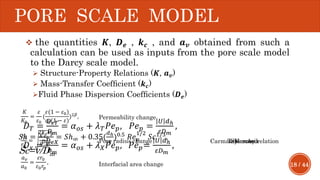
PORE SCALE MODEL
 the quantities 𝑲, 𝑫 𝒆 , 𝒌 𝒄 , and 𝒂 𝒗 obtained from such a
calculation can be used as inputs from the pore scale model
to the Darcy scale model.
 Structure-Property Relations (𝑲, 𝒂 𝒗)
 Mass-Transfer Coefficient (𝒌 𝒄)
Fluid Phase Dispersion Coefficients (𝑫 𝒆)
Carman-Kozney relation
Permeability change
𝐾
𝐾0
=
𝜀
𝜀0
(
𝜀(1 − 𝜀0)
𝜀0(1 − 𝜀)
)2𝛽
,
Pore radius change
𝑟𝑝
𝑟0
=
𝐾𝜀0
𝐾0 𝜀
,
Interfacial area change
𝑎 𝑣
𝑎0
=
𝜀𝑟0
𝜀0 𝑟𝑝
,
𝑆ℎ =
2𝑘 𝑐 𝑟 𝑝
𝐷 𝑚
= 𝑆ℎ∞ + 0.35(
𝑑ℎ
𝑥
)0.5 𝑅𝑒 𝑝
1/2
𝑆𝑐1/3,
Sc=ν/Dm
Sherwood
𝐷 𝑇 =
𝐷 𝑒𝑇
𝐷 𝑚
= 𝛼 𝑜𝑠 + 𝜆 𝑇 𝑃𝑒 𝑝, 𝑃𝑒 𝑝 =
𝑈 𝑑ℎ
𝜀𝐷 𝑚
,
𝐷 𝑥 =
𝐷 𝑒𝑋
𝐷 𝑚
= 𝛼 𝑜𝑠 + 𝜆 𝑋 𝑃𝑒 𝑝, 𝑃𝑒 𝑝=
𝑈 𝑑ℎ
𝜀𝐷 𝑚
,
Taylor-Aris
19 / 44
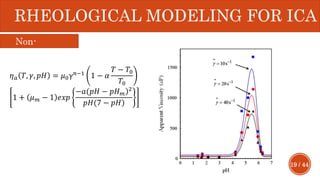
RHEOLOGICAL MODELING FOR ICA
𝜂 𝑎 𝑇, 𝛾, 𝑝𝐻 = 𝜇0γ 𝑛−1 1 − 𝛼
𝑇 − 𝑇0
𝑇0
1 + 𝜇 𝑚 − 1 𝑒𝑥𝑝
−𝑎( )𝑝𝐻 − 𝑝𝐻 𝑚
2
)𝑝𝐻(7 − 𝑝𝐻
Non-
Newtonian
20 / 44
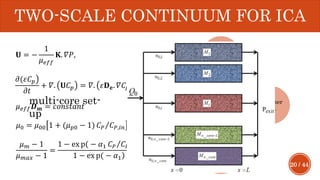
TWO-SCALE CONTINUUM FOR ICA
𝐔 = −
1
𝜇 𝑒𝑓𝑓
𝐊. 𝛻𝑃,
൯𝜕(𝜀𝐶 𝑝
𝜕𝑡
+ 𝛻. 𝐔𝐶 𝑝 = 𝛻. 𝜀𝐃 𝐞. 𝛻𝐶𝑓 ,
𝜇 𝑒𝑓𝑓 𝑫 𝒎 = 𝑐𝑜𝑛𝑠𝑡𝑎𝑛𝑡
𝜇0 = 𝜇00 1 + (𝜇 𝑝0 − 1) Τ𝐶 𝑃 𝐶 𝑃,𝑖𝑛 ,
𝜇 𝑚 − 1
𝜇 𝑚𝑎𝑥 − 1
=
൯1 − ex p( − 𝛼1 Τ𝐶 𝑃 𝐶 𝑃,𝑖𝑛
)1 − ex p( − 𝛼1
Improveme
nt
Darcy
equivale
nt
Polymer
con.
Stoke-
Einstein
Existenc
e
polymer
multi-core set-
up
21 / 44
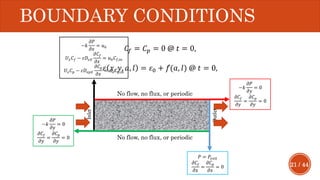
BOUNDARY CONDITIONS
No flow, no flux, or periodic
𝐶𝑓 = 𝐶 𝑝 = 0 @ 𝑡 = 0,
𝜀 𝑥, 𝑦, 𝑎, 𝑙 = 𝜀0 + 𝑓̂̂(𝑎, 𝑙) @ 𝑡 = 0,
22 / 44
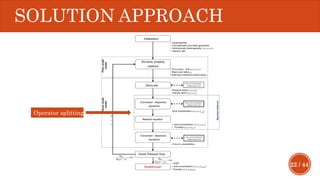
SOLUTION APPROACH
Operator splitting
23 / 44
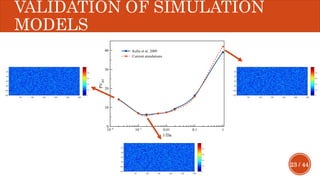
VALIDATION OF SIMULATION
MODELS
24 / 44
VALIDATION OF SIMULATION
MODELS
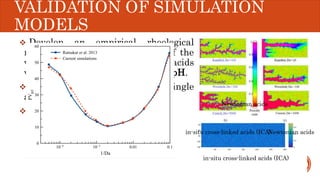
 Develop an empirical rheological
model to describe the variation of the
viscosity of in-situ cross-linked acids
with temperature, shear rate and pH.
 Analyze wormhole formation in single
and dual core set-ups.
 2D and 3D
Newtonian acidsin-situ cross-linked acids (ICA)
Newtonian acids
in-situ cross-linked acids (ICA)
25 / 44
 Introduction
 Literature review
 Continuum model
 Results
 Conclusions
 Recommendations
RESULTS
26 / 44
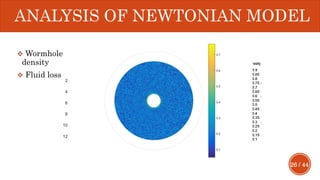
ANALYSIS OF NEWTONIAN MODEL
 Wormhole
density
 Fluid loss
27 / 44
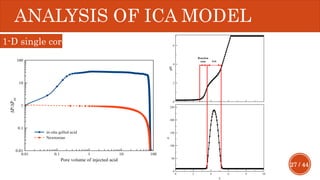
ANALYSIS OF ICA MODEL
1-D single core
28 / 44
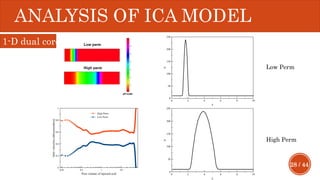
ANALYSIS OF ICA MODEL
High Perm
Low Perm
1-D dual core
29 / 44
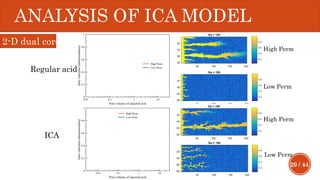
ANALYSIS OF ICA MODEL
ICA
Low Perm
High Perm
Low Perm
Regular acid
High Perm
2-D dual core
30 / 44
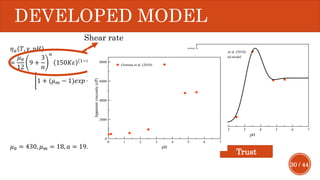
DEVELOPED MODEL
𝜂 𝑎 𝑇, 𝛾, 𝑝𝐻
=
𝜇0
12
9 +
3
𝑛
𝑛
150𝐾𝜀 Τ1−𝑛 2 𝐔 𝑛−1 1 − 𝛼
𝑇 − 𝑇0
𝑇0
ቈ1 + (𝜇 𝑚 − 1)𝑒𝑥𝑝
−𝑎( )𝑝𝐻 − 𝑝𝐻 𝑚
2
)𝑝𝐻(7 − 𝑝𝐻
𝜇0 = 430, 𝜇 𝑚 = 18, 𝑎 = 19.9, 𝑝𝐻 𝑚 = 3.6, 𝑏 = 1.4, 𝑐 = 6.6, 𝑊 = 3.2
Trust
Region
Shear rate
31 / 44
POWER-LAW INDEX
2
,
2
32 / 44
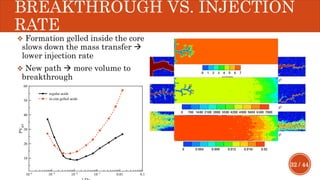
BREAKTHROUGH VS. INJECTION
RATE
 Formation gelled inside the core
slows down the mass transfer 
lower injection rate
 New path  more volume to
breakthrough
33 / 44
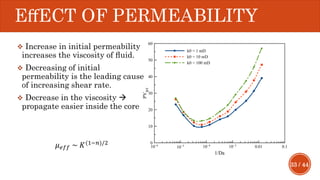
EffECT OF PERMEABILITY
𝜇 𝑒𝑓𝑓 ~ 𝐾(1−𝑛)/2
 Increase in initial permeability
increases the viscosity of fluid.
 Decreasing of initial
permeability is the leading cause
of increasing shear rate.
 Decrease in the viscosity 
propagate easier inside the core
34 / 44
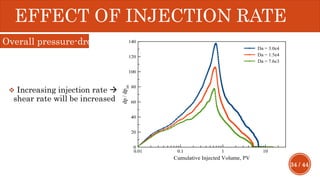
EFFECT OF INJECTION RATE
 Increasing injection rate 
shear rate will be increased
Overall pressure-drop
35 / 44
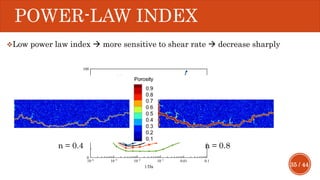
POWER-LAW INDEX
Low power law index  more sensitive to shear rate  decrease sharply
n = 0.4 n = 0.8
36 / 44
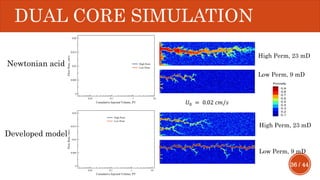
DUAL CORE SIMULATION
High Perm, 23 mD
Low Perm, 9 mD
High Perm, 23 mD
Low Perm, 9 mD
𝑈0 = 0.02 𝑐𝑚/𝑠
Newtonian acid
Developed model
37 / 44
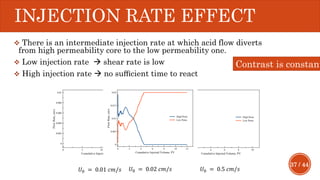
INJECTION RATE EFFECT
𝑈0 = 0.01 𝑐𝑚/𝑠 𝑈0 = 0.5 𝑐𝑚/𝑠
 There is an intermediate injection rate at which acid flow diverts
from high permeability core to the low permeability one.
 Low injection rate  shear rate is low
 High injection rate  no sufficient time to react
𝑈0 = 0.02 𝑐𝑚/𝑠
Contrast is constant
38 / 44
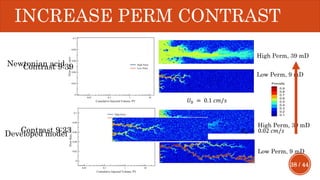
INCREASE PERM CONTRAST
Contrast 9:39
Contrast 9:23 𝑈0 = 0.02 𝑐𝑚/𝑠
𝑈0 = 0.1 𝑐𝑚/𝑠
Low Perm, 9 mD
High Perm, 39 mD
Newtonian acid
Developed model
High Perm, 39 mD
Low Perm, 9 mD
39 / 44
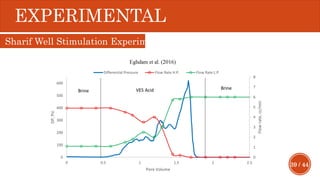
EXPERIMENTAL
Sharif Well Stimulation Experiment
40 / 44
 Introduction
 Literature review
 Continuum model
 Results
 Conclusions
 Recommendations
CONCLUSIONS
41 / 44
CONCLUSIONS
 New in-situ gelled  higher 𝑃𝑉𝐵𝑇 and thinner compared to regular acid.
 Remaining viscosity at high  the key to block-off the high
permeability core.
 Rheology parameters  play the most important role to divert acid.
 There is a intermediate injection rate to achieve diversion.
 Increasing permeability contrast  increase optimum injection rate to
divert acid.
 Increasing permeability contrast  wormhole shape to uniform shape
42 / 44
 Introduction
 Literature review
 Continuum model
 Results
 Conclusions
 Recommendations
RECOMMENDATIO
NS
43 / 44
RECOMMENDATIONS
 The current model can be extended to include the effects of filtration
or adsorption/desorption of polymers and cross-linkers. In addition,
all additives (polymer, cross-linker and breakers) have been assumed
as a single species in the model, i.e. they are assumed to have similar
properties.
 In the present work, we have assumed that the reaction is
irreversible and occurs in a single step, which might not be the case
for slow reacting acids. Thus, another important extension of the
work is to include the multistep chemistry and effect of ionic-
equilibria on the dissolution process.
 Other possible extensions include the analysis of radial flow and
field scale operation to estimate wormhole properties such as density,
length, fractal dimension, etc. in extended domains.
 Extension to other diverting acids such as viscoelastic acids (VES).
44 / 44
THANK YOU FOR YOUR
KIND ATTENTION

Developed Model for Carbonate Matrix Acidizing

  • 1.
    PRESENT A DEVELOPEDMODEL FOR PREDICTING PERFORMANCE OF CARBONATE MATRIX ACIDIZING Presented by: Behzad Hosseinzadeh Supervisors: Dr. Behzad Rostami, Dr. Shahab Ayatollahi Dr. Mohammad Bazargan Summer 2016
  • 2.
    2 / 44 Introduction  Literature review  Continuum model  Results  Conclusions  Recommendations INTRODUCTION
  • 3.
  • 4.
    4 / 44 MATRIXACIDIZING  Stimulation technique widely used for sandstones and carbonates;  In both, the same principle is applied (chemical dissolution) but several differences appear; – Carbonates → Distinct dissolution patterns → Wormholes. Face dissolution → Conical wormhole → Dominant wormhole → Ramified wormhole → Uniform dissolution
  • 5.
    5 / 44 OPTIMUMINJECTION RATE
  • 6.
    6 / 44 DIVERTING Acid-removable damage is not present  If it is present it is not fully contacted o Acid does not go where it needs to go Before acid treatment After acid treatment (without diverter)
  • 7.
    7 / 44 DIVERTING(SELF-VISCOSIFYING ACIDS )  Has three specific components: 1. Gelling agent 2. Crosslinking agent 3. Breaker Live partially neutralized, spent acid
  • 8.
  • 9.
    9 / 44 MODELING High cost  Safety  Upscaling
  • 10.
    10 / 44 Introduction  Literature review  Continuum model  Results  Conclusions  Recommendations LITERATURE REVIEW
  • 11.
    11 / 44 LITERATUREREVIEW Experimental • Williams et al. (1979) • Daccord et al. (1987, 1993a, 1993b) • Lund et al. (1973, 1975) • Hoefner and Fogler (1989) • Bazin et al. (1995) • Fredd and Fogler (1998) • Golfier et al. (2002) • Taylor et al. 2002 • Nasr-El-Din et al. (2006, 2007) • Ziauddin and Bize (2007) • Omer Izgec (2009) • Gomaa et al. (2010, 2011) • Rabie et al. (2012) • Mehdi Gommem (2015) Mathematical • Capillary Tube Model: Hung et al. (1997), Buijse (1997), Huang et al. (1999, 2000) • Fractal and Dimensionless: Dacord (1993), Kurmayr (1992), Pichler et al. (1992) Fred and Fogler (1999) • Network Model: Hoefner and Fogler (1988), Fred and Fogler (1998) • Continuum (Averaged) Model: Newtonian: Golfier et al. (2002), Panga (2005), Kalia (2005,2009), Cohen et al. (2008), Liu et al. (2012), Maheshwari (2013, 2015), Gommem (2015) Non-Newtonian: Ratnakar et al. (2013), Naizhen et al. (2015)
  • 12.
    12 / 44 EXPERIMENTALSTUDIES Newtonian Acid Bazin (2001) Omer Izgec (2009)McDuff (2010)
  • 13.
    13 / 44 EXPERIMENTALSTUDIES  Self-Viscosifying Acids (SVA) Low injection rate High injection rate Intermediate injection rate Gomaa et al. (2011)  Viscoelastic surfactant systems (VES) AlGhamedi et al. (2014)
  • 14.
    14 / 44 WORMHOLEMODELING Capillary Tube Model Fractal and Dimensionless Model Network Model Continuum (Averaged) Model
  • 15.
    15 / 44 CONTINUUMMODEL Cont. model Newtonian Panga et al. Kalia et al. Liu et al. Maheshwari et al. Non- newtonian Ratnakar et al. Naizhen et al. Mass transfer and reaction rate controlled Radial and effect of heterogeneities Constant Pressure 3-D and emulsified acid Modeling for in-situ gelled acids Darcy–Brinkman 2005 2006, 2009 2012 2013, 2015 2013 2015
  • 16.
    16 / 44 Introduction  Literature review  Continuum model  Results  Conclusions  Recommendations CONTINUUM MODEL
  • 17.
    17 / 44 DARCYSCALE MODEL Darcy Equation𝐔 = − 1 𝜇 𝐊 . 𝛁𝑃, Continuity 𝜕𝜀 𝜕𝑡 + 𝛁. 𝑼 = 0, Acid Transport 𝜕(𝜀𝐶𝑓) 𝜕𝑡 + 𝛁. 𝐔𝐶𝑓 = 𝛁. 𝜀𝐃 𝐞. 𝛁𝐶𝑓 − 𝑘 𝑐 𝑎 𝑣(𝐶𝑓 − 𝐶𝑠), Reaction Rate → first order irreversible reaction 𝑘 𝑐 𝐶𝑓 − 𝐶𝑠 = 𝑅(𝐶𝑠), 𝑅 𝐶𝑠 = 𝑘 𝑠 𝐶𝑠 Porosity Variation 𝜕𝜀 𝜕𝑡 = 𝑅(𝐶𝑠)𝑎 𝑣 𝛼 𝜌𝑠 , Newtonian
  • 18.
    18 / 44 PORESCALE MODEL  the quantities 𝑲, 𝑫 𝒆 , 𝒌 𝒄 , and 𝒂 𝒗 obtained from such a calculation can be used as inputs from the pore scale model to the Darcy scale model.  Structure-Property Relations (𝑲, 𝒂 𝒗)  Mass-Transfer Coefficient (𝒌 𝒄) Fluid Phase Dispersion Coefficients (𝑫 𝒆) Carman-Kozney relation Permeability change 𝐾 𝐾0 = 𝜀 𝜀0 ( 𝜀(1 − 𝜀0) 𝜀0(1 − 𝜀) )2𝛽 , Pore radius change 𝑟𝑝 𝑟0 = 𝐾𝜀0 𝐾0 𝜀 , Interfacial area change 𝑎 𝑣 𝑎0 = 𝜀𝑟0 𝜀0 𝑟𝑝 , 𝑆ℎ = 2𝑘 𝑐 𝑟 𝑝 𝐷 𝑚 = 𝑆ℎ∞ + 0.35( 𝑑ℎ 𝑥 )0.5 𝑅𝑒 𝑝 1/2 𝑆𝑐1/3, Sc=ν/Dm Sherwood 𝐷 𝑇 = 𝐷 𝑒𝑇 𝐷 𝑚 = 𝛼 𝑜𝑠 + 𝜆 𝑇 𝑃𝑒 𝑝, 𝑃𝑒 𝑝 = 𝑈 𝑑ℎ 𝜀𝐷 𝑚 , 𝐷 𝑥 = 𝐷 𝑒𝑋 𝐷 𝑚 = 𝛼 𝑜𝑠 + 𝜆 𝑋 𝑃𝑒 𝑝, 𝑃𝑒 𝑝= 𝑈 𝑑ℎ 𝜀𝐷 𝑚 , Taylor-Aris
  • 19.
    19 / 44 RHEOLOGICALMODELING FOR ICA 𝜂 𝑎 𝑇, 𝛾, 𝑝𝐻 = 𝜇0γ 𝑛−1 1 − 𝛼 𝑇 − 𝑇0 𝑇0 1 + 𝜇 𝑚 − 1 𝑒𝑥𝑝 −𝑎( )𝑝𝐻 − 𝑝𝐻 𝑚 2 )𝑝𝐻(7 − 𝑝𝐻 Non- Newtonian
  • 20.
    20 / 44 TWO-SCALECONTINUUM FOR ICA 𝐔 = − 1 𝜇 𝑒𝑓𝑓 𝐊. 𝛻𝑃, ൯𝜕(𝜀𝐶 𝑝 𝜕𝑡 + 𝛻. 𝐔𝐶 𝑝 = 𝛻. 𝜀𝐃 𝐞. 𝛻𝐶𝑓 , 𝜇 𝑒𝑓𝑓 𝑫 𝒎 = 𝑐𝑜𝑛𝑠𝑡𝑎𝑛𝑡 𝜇0 = 𝜇00 1 + (𝜇 𝑝0 − 1) Τ𝐶 𝑃 𝐶 𝑃,𝑖𝑛 , 𝜇 𝑚 − 1 𝜇 𝑚𝑎𝑥 − 1 = ൯1 − ex p( − 𝛼1 Τ𝐶 𝑃 𝐶 𝑃,𝑖𝑛 )1 − ex p( − 𝛼1 Improveme nt Darcy equivale nt Polymer con. Stoke- Einstein Existenc e polymer multi-core set- up
  • 21.
    21 / 44 BOUNDARYCONDITIONS No flow, no flux, or periodic No flow, no flux, or periodic 𝐶𝑓 = 𝐶 𝑝 = 0 @ 𝑡 = 0, 𝜀 𝑥, 𝑦, 𝑎, 𝑙 = 𝜀0 + 𝑓̂̂(𝑎, 𝑙) @ 𝑡 = 0,
  • 22.
    22 / 44 SOLUTIONAPPROACH Operator splitting
  • 23.
    23 / 44 VALIDATIONOF SIMULATION MODELS
  • 24.
    24 / 44 VALIDATIONOF SIMULATION MODELS  Develop an empirical rheological model to describe the variation of the viscosity of in-situ cross-linked acids with temperature, shear rate and pH.  Analyze wormhole formation in single and dual core set-ups.  2D and 3D Newtonian acidsin-situ cross-linked acids (ICA) Newtonian acids in-situ cross-linked acids (ICA)
  • 25.
    25 / 44 Introduction  Literature review  Continuum model  Results  Conclusions  Recommendations RESULTS
  • 26.
    26 / 44 ANALYSISOF NEWTONIAN MODEL  Wormhole density  Fluid loss
  • 27.
    27 / 44 ANALYSISOF ICA MODEL 1-D single core
  • 28.
    28 / 44 ANALYSISOF ICA MODEL High Perm Low Perm 1-D dual core
  • 29.
    29 / 44 ANALYSISOF ICA MODEL ICA Low Perm High Perm Low Perm Regular acid High Perm 2-D dual core
  • 30.
    30 / 44 DEVELOPEDMODEL 𝜂 𝑎 𝑇, 𝛾, 𝑝𝐻 = 𝜇0 12 9 + 3 𝑛 𝑛 150𝐾𝜀 Τ1−𝑛 2 𝐔 𝑛−1 1 − 𝛼 𝑇 − 𝑇0 𝑇0 ቈ1 + (𝜇 𝑚 − 1)𝑒𝑥𝑝 −𝑎( )𝑝𝐻 − 𝑝𝐻 𝑚 2 )𝑝𝐻(7 − 𝑝𝐻 𝜇0 = 430, 𝜇 𝑚 = 18, 𝑎 = 19.9, 𝑝𝐻 𝑚 = 3.6, 𝑏 = 1.4, 𝑐 = 6.6, 𝑊 = 3.2 Trust Region Shear rate
  • 31.
    31 / 44 POWER-LAWINDEX 2 , 2
  • 32.
    32 / 44 BREAKTHROUGHVS. INJECTION RATE  Formation gelled inside the core slows down the mass transfer  lower injection rate  New path  more volume to breakthrough
  • 33.
    33 / 44 EffECTOF PERMEABILITY 𝜇 𝑒𝑓𝑓 ~ 𝐾(1−𝑛)/2  Increase in initial permeability increases the viscosity of fluid.  Decreasing of initial permeability is the leading cause of increasing shear rate.  Decrease in the viscosity  propagate easier inside the core
  • 34.
    34 / 44 EFFECTOF INJECTION RATE  Increasing injection rate  shear rate will be increased Overall pressure-drop
  • 35.
    35 / 44 POWER-LAWINDEX Low power law index  more sensitive to shear rate  decrease sharply n = 0.4 n = 0.8
  • 36.
    36 / 44 DUALCORE SIMULATION High Perm, 23 mD Low Perm, 9 mD High Perm, 23 mD Low Perm, 9 mD 𝑈0 = 0.02 𝑐𝑚/𝑠 Newtonian acid Developed model
  • 37.
    37 / 44 INJECTIONRATE EFFECT 𝑈0 = 0.01 𝑐𝑚/𝑠 𝑈0 = 0.5 𝑐𝑚/𝑠  There is an intermediate injection rate at which acid flow diverts from high permeability core to the low permeability one.  Low injection rate  shear rate is low  High injection rate  no sufficient time to react 𝑈0 = 0.02 𝑐𝑚/𝑠 Contrast is constant
  • 38.
    38 / 44 INCREASEPERM CONTRAST Contrast 9:39 Contrast 9:23 𝑈0 = 0.02 𝑐𝑚/𝑠 𝑈0 = 0.1 𝑐𝑚/𝑠 Low Perm, 9 mD High Perm, 39 mD Newtonian acid Developed model High Perm, 39 mD Low Perm, 9 mD
  • 39.
    39 / 44 EXPERIMENTAL SharifWell Stimulation Experiment
  • 40.
    40 / 44 Introduction  Literature review  Continuum model  Results  Conclusions  Recommendations CONCLUSIONS
  • 41.
    41 / 44 CONCLUSIONS New in-situ gelled  higher 𝑃𝑉𝐵𝑇 and thinner compared to regular acid.  Remaining viscosity at high  the key to block-off the high permeability core.  Rheology parameters  play the most important role to divert acid.  There is a intermediate injection rate to achieve diversion.  Increasing permeability contrast  increase optimum injection rate to divert acid.  Increasing permeability contrast  wormhole shape to uniform shape
  • 42.
    42 / 44 Introduction  Literature review  Continuum model  Results  Conclusions  Recommendations RECOMMENDATIO NS
  • 43.
    43 / 44 RECOMMENDATIONS The current model can be extended to include the effects of filtration or adsorption/desorption of polymers and cross-linkers. In addition, all additives (polymer, cross-linker and breakers) have been assumed as a single species in the model, i.e. they are assumed to have similar properties.  In the present work, we have assumed that the reaction is irreversible and occurs in a single step, which might not be the case for slow reacting acids. Thus, another important extension of the work is to include the multistep chemistry and effect of ionic- equilibria on the dissolution process.  Other possible extensions include the analysis of radial flow and field scale operation to estimate wormhole properties such as density, length, fractal dimension, etc. in extended domains.  Extension to other diverting acids such as viscoelastic acids (VES).
  • 44.
    44 / 44 THANKYOU FOR YOUR KIND ATTENTION