 Chemical Injection
in EOR
 Methods
-Surfactant Method
-Alkaline Method
-Polymer Method
 What is ASP?
 Reservoir Location
 Rock and reservoir
properties
 Injection sequence
 Operations
 Challenges
 Solutions
 Results
2
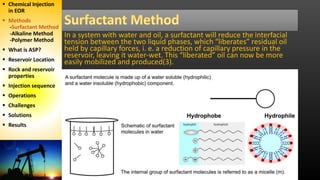
In a system with water and oil, a surfactant will reduce the interfacial
tension between the two liquid phases, which “liberates” residual oil
held by capillary forces, i. e. a reduction of capillary pressure in the
reservoir, leaving it water-wet. This “liberated” oil can now be more
easily mobilized and produced(3).
3
 Chemical Injection
in EOR
 Methods
-Surfactant Method
-Alkaline Method
-Polymer Method
 What is ASP?
 Reservoir Location
 Rock and reservoir
properties
 Injection sequence
 Operations
 Challenges
 Solutions
 Results
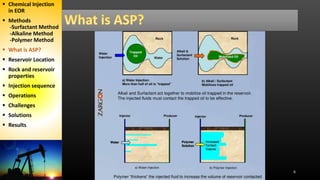
The use of alkali in a chemical flood is beneficial in many ways:
1. reduces the absorption of the surfactant on the reservoir
rock.
2. alkali makes the reservoir rock more water-wet.
3. alkali is relatively inexpensive.
-Softened injection water is required in ASP i.e. very low
concentrations of divalent cations (hardness) such as Ca +2 and
Mg +2 . Otherwise, these cations react with the alkali agent and
form a precipitate (e.g. hydroxides), which could plug the pores
of most reservoirs.
-Higher salinity of the water phase can also be undesirable; it can
decrease the solubility of surfactant molecules in the water. In
essence, the alkali, usually caustic soda, reacts with components
present in some oil to form soap.
4
 Chemical Injection
in EOR
 Methods
-Surfactant Method
-Alkaline Method
-Polymer Method
 What is ASP?
 Reservoir Location
 Rock and reservoir
properties
 Injection sequence
 Operations
 Challenges
 Solutions
 Results
5
 Chemical Injection
in EOR
 Methods
-Surfactant Method
-Alkaline Method
-Polymer Method
 What is ASP?
 Reservoir Location
 Rock and reservoir
properties
 Injection sequence
 Operations
 Challenges
 Solutions
 Results
6
 Chemical Injection
in EOR
 Methods
-Surfactant Method
-Alkaline Method
-Polymer Method
 What is ASP?
 Reservoir Location
 Rock and reservoir
properties
 Injection sequence
 Operations
 Challenges
 Solutions
 Results
7
 Chemical Injection
in EOR
 Methods
-Surfactant Method
-Alkaline Method
-Polymer Method
 What is ASP?
 Reservoir Location
 Rock and reservoir
properties
 Injection sequence
 Operations
 Challenges
 Solutions
 Results
8
 Chemical Injection
in EOR
 Methods
-Surfactant Method
-Alkaline Method
-Polymer Method
 What is ASP?
 Reservoir Location
 Rock and reservoir
properties
 Injection sequence
 Operations
 Challenges
 Solutions
 Results
9
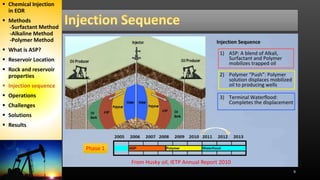
From Husky oil, IETP Annual Report 2010
Phase 1
 Chemical Injection
in EOR
 Methods
-Surfactant Method
-Alkaline Method
-Polymer Method
 What is ASP?
 Reservoir Location
 Rock and reservoir
properties
 Injection sequence
 Operations
 Challenges
 Solutions
 Results
10
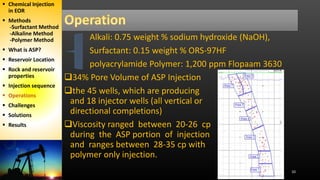
Alkali: 0.75 weight % sodium hydroxide (NaOH),
Surfactant: 0.15 weight % ORS-97HF
polyacrylamide Polymer: 1,200 ppm Flopaam 3630
34% Pore Volume of ASP Injection
the 45 wells, which are producing
and 18 injector wells (all vertical or
directional completions)
Viscosity ranged between 20-26 cp
during the ASP portion of injection
and ranges between 28-35 cp with
polymer only injection.
 Chemical Injection
in EOR
 Methods
-Surfactant Method
-Alkaline Method
-Polymer Method
 What is ASP?
 Reservoir Location
 Rock and reservoir
properties
 Injection sequence
 Operations
 Challenges
 Solutions
 Results
11
2 producers and 3 injectors were drilled (infill) during the first half of 2008.
Baker Chemicals was able to supply a scale inhibitor that helped control the
scale being produced at this time. Installation of chemical pumps on
producing ASP wells to continuously inject scale inhibitor on problem wells.
Silicate scale and reduced injectivity have been the biggest factors
contributing to the lower
production.
“silicate” (silica) scale has plagued the
project, with “very frequent” well
servicing required and chemical companies
working toward a solution to this problem
As a result, the production
forecast and reserves estimates
have be reduced.
The decision has also been made
to increase the polymer injection
to 40% pore volume (from 30%).
Redrilling wells that had plugged
off with scale.
 Chemical Injection in EOR
 Methods
-Surfactant Method
-Alkaline Method
-Polymer Method
 What is ASP?
 Reservoir Location
 Rock and reservoir
properties
 Injection sequence
 Operations
 Challenges
 Solutions
 Results
12
Scale issues continue to be a problem in 2010, but after
that advances in the scale inhibitors used have allowed for
increased runtime.
Scale issues continue to be a problem in 2010, however
recent advances in the scale inhibitors used have allowed
for increased runtime.
Pipelines are pigged frequently and there is always lots of
scale returns.
 Chemical Injection
in EOR
 Methods
-Surfactant Method
-Alkaline Method
-Polymer Method
 What is ASP?
 Reservoir Location
 Rock and reservoir
properties
 Injection sequence
 Operations
 Challenges
 Solutions
 Results
13
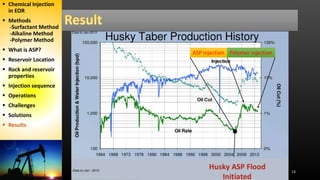
ASP injection Polymer injection
 Chemical Injection
in EOR
 Methods
-Surfactant Method
-Alkaline Method
-Polymer Method
 What is ASP?
 Reservoir Location
 Rock and reservoir
properties
 Injection sequence
 Operations
 Challenges
 Solutions
 Results
14
Incremental reserves decreased from 14.1% to 12.7% OOIP
for the unrisked production, and a drop from 11.4% to
11.3% for the risked production.
 Chemical Injection
in EOR
 Methods
-Surfactant Method
-Alkaline Method
-Polymer Method
 What is ASP?
 Reservoir Location
 Rock and reservoir
properties
 Injection sequence
 Operations
 Challenges
 Solutions
 Results
1. Marc Charest, M.Sc., P.Geol., Senior Exploration Analyst, “Marc Charest,
M.Sc., P.Geol., Senior Exploration Analyst”, Canadian Discovery, 2013
2. Lee McInnis, “Innovative Energy Technologies Program Application 01-
023Taber S Mannville B Alkaline-Surfactant-Polymer Flood Warner ASP
Flood”, Annual Report June 25, 2010
3. Lee McInnis, “Innovative Energy Technologies Program Application 01-
023Taber S Mannville B Alkaline-Surfactant-Polymer Flood Warner ASP
Flood”, Annual Report June 25, 2008
4. R. A. Shaw" and D. H. Stright, Jr, “Performance of the Taber South
Polymer Flood”, Ashland Oil Canada Limited,1977
5. http://www.rigzone.com
6. http://www.canadiandiscovery.com/
7. http://www.chemistry.co.nz/surfactants.htm
8. http://www.aer.ca/
15
16

ASP Flooding

  • 2.
     Chemical Injection inEOR  Methods -Surfactant Method -Alkaline Method -Polymer Method  What is ASP?  Reservoir Location  Rock and reservoir properties  Injection sequence  Operations  Challenges  Solutions  Results 2
  • 3.
    In a systemwith water and oil, a surfactant will reduce the interfacial tension between the two liquid phases, which “liberates” residual oil held by capillary forces, i. e. a reduction of capillary pressure in the reservoir, leaving it water-wet. This “liberated” oil can now be more easily mobilized and produced(3). 3  Chemical Injection in EOR  Methods -Surfactant Method -Alkaline Method -Polymer Method  What is ASP?  Reservoir Location  Rock and reservoir properties  Injection sequence  Operations  Challenges  Solutions  Results
  • 4.
    The use ofalkali in a chemical flood is beneficial in many ways: 1. reduces the absorption of the surfactant on the reservoir rock. 2. alkali makes the reservoir rock more water-wet. 3. alkali is relatively inexpensive. -Softened injection water is required in ASP i.e. very low concentrations of divalent cations (hardness) such as Ca +2 and Mg +2 . Otherwise, these cations react with the alkali agent and form a precipitate (e.g. hydroxides), which could plug the pores of most reservoirs. -Higher salinity of the water phase can also be undesirable; it can decrease the solubility of surfactant molecules in the water. In essence, the alkali, usually caustic soda, reacts with components present in some oil to form soap. 4  Chemical Injection in EOR  Methods -Surfactant Method -Alkaline Method -Polymer Method  What is ASP?  Reservoir Location  Rock and reservoir properties  Injection sequence  Operations  Challenges  Solutions  Results
  • 5.
    5  Chemical Injection inEOR  Methods -Surfactant Method -Alkaline Method -Polymer Method  What is ASP?  Reservoir Location  Rock and reservoir properties  Injection sequence  Operations  Challenges  Solutions  Results
  • 6.
    6  Chemical Injection inEOR  Methods -Surfactant Method -Alkaline Method -Polymer Method  What is ASP?  Reservoir Location  Rock and reservoir properties  Injection sequence  Operations  Challenges  Solutions  Results
  • 7.
    7  Chemical Injection inEOR  Methods -Surfactant Method -Alkaline Method -Polymer Method  What is ASP?  Reservoir Location  Rock and reservoir properties  Injection sequence  Operations  Challenges  Solutions  Results
  • 8.
    8  Chemical Injection inEOR  Methods -Surfactant Method -Alkaline Method -Polymer Method  What is ASP?  Reservoir Location  Rock and reservoir properties  Injection sequence  Operations  Challenges  Solutions  Results
  • 9.
    9 From Husky oil,IETP Annual Report 2010 Phase 1  Chemical Injection in EOR  Methods -Surfactant Method -Alkaline Method -Polymer Method  What is ASP?  Reservoir Location  Rock and reservoir properties  Injection sequence  Operations  Challenges  Solutions  Results
  • 10.
    10 Alkali: 0.75 weight% sodium hydroxide (NaOH), Surfactant: 0.15 weight % ORS-97HF polyacrylamide Polymer: 1,200 ppm Flopaam 3630 34% Pore Volume of ASP Injection the 45 wells, which are producing and 18 injector wells (all vertical or directional completions) Viscosity ranged between 20-26 cp during the ASP portion of injection and ranges between 28-35 cp with polymer only injection.  Chemical Injection in EOR  Methods -Surfactant Method -Alkaline Method -Polymer Method  What is ASP?  Reservoir Location  Rock and reservoir properties  Injection sequence  Operations  Challenges  Solutions  Results
  • 11.
    11 2 producers and3 injectors were drilled (infill) during the first half of 2008. Baker Chemicals was able to supply a scale inhibitor that helped control the scale being produced at this time. Installation of chemical pumps on producing ASP wells to continuously inject scale inhibitor on problem wells. Silicate scale and reduced injectivity have been the biggest factors contributing to the lower production. “silicate” (silica) scale has plagued the project, with “very frequent” well servicing required and chemical companies working toward a solution to this problem As a result, the production forecast and reserves estimates have be reduced. The decision has also been made to increase the polymer injection to 40% pore volume (from 30%). Redrilling wells that had plugged off with scale.  Chemical Injection in EOR  Methods -Surfactant Method -Alkaline Method -Polymer Method  What is ASP?  Reservoir Location  Rock and reservoir properties  Injection sequence  Operations  Challenges  Solutions  Results
  • 12.
    12 Scale issues continueto be a problem in 2010, but after that advances in the scale inhibitors used have allowed for increased runtime. Scale issues continue to be a problem in 2010, however recent advances in the scale inhibitors used have allowed for increased runtime. Pipelines are pigged frequently and there is always lots of scale returns.  Chemical Injection in EOR  Methods -Surfactant Method -Alkaline Method -Polymer Method  What is ASP?  Reservoir Location  Rock and reservoir properties  Injection sequence  Operations  Challenges  Solutions  Results
  • 13.
    13 ASP injection Polymerinjection  Chemical Injection in EOR  Methods -Surfactant Method -Alkaline Method -Polymer Method  What is ASP?  Reservoir Location  Rock and reservoir properties  Injection sequence  Operations  Challenges  Solutions  Results
  • 14.
    14 Incremental reserves decreasedfrom 14.1% to 12.7% OOIP for the unrisked production, and a drop from 11.4% to 11.3% for the risked production.  Chemical Injection in EOR  Methods -Surfactant Method -Alkaline Method -Polymer Method  What is ASP?  Reservoir Location  Rock and reservoir properties  Injection sequence  Operations  Challenges  Solutions  Results
  • 15.
    1. Marc Charest,M.Sc., P.Geol., Senior Exploration Analyst, “Marc Charest, M.Sc., P.Geol., Senior Exploration Analyst”, Canadian Discovery, 2013 2. Lee McInnis, “Innovative Energy Technologies Program Application 01- 023Taber S Mannville B Alkaline-Surfactant-Polymer Flood Warner ASP Flood”, Annual Report June 25, 2010 3. Lee McInnis, “Innovative Energy Technologies Program Application 01- 023Taber S Mannville B Alkaline-Surfactant-Polymer Flood Warner ASP Flood”, Annual Report June 25, 2008 4. R. A. Shaw" and D. H. Stright, Jr, “Performance of the Taber South Polymer Flood”, Ashland Oil Canada Limited,1977 5. http://www.rigzone.com 6. http://www.canadiandiscovery.com/ 7. http://www.chemistry.co.nz/surfactants.htm 8. http://www.aer.ca/ 15
  • 16.