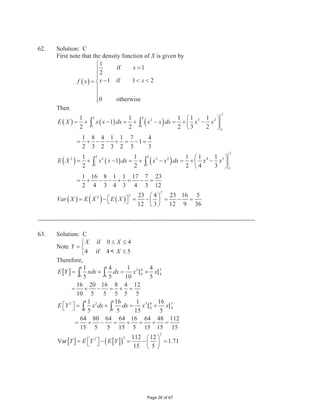
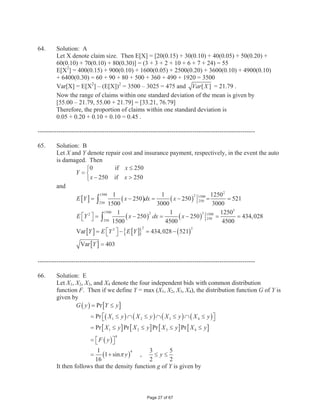
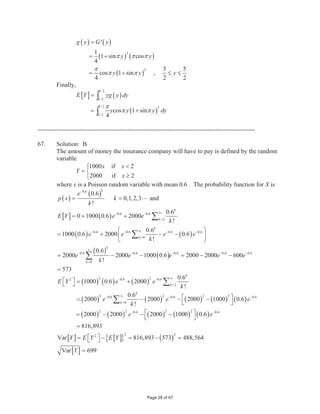
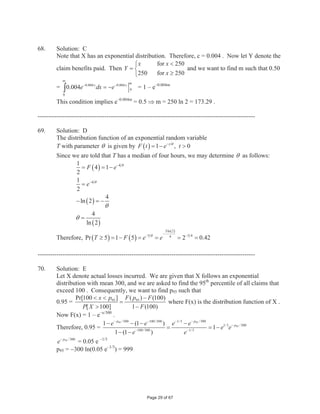
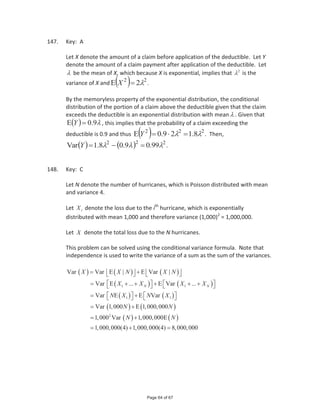
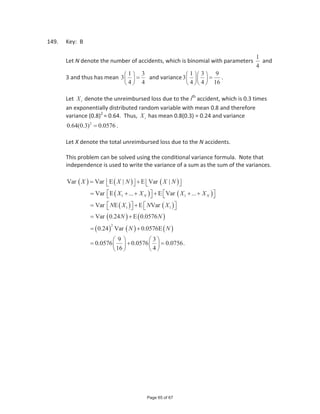
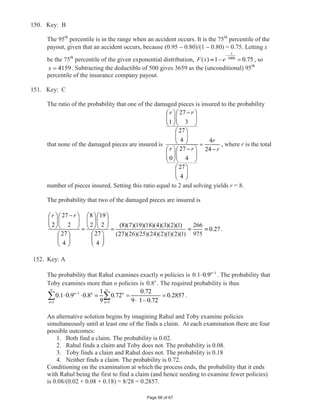
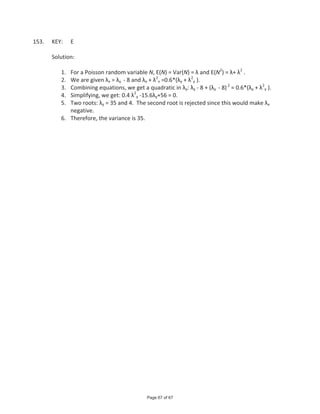
62&,(7< 2) $&78$5,(6$68$/7 $78$5,$/ 62,(7


                             (;$0 3 352%$%,/,7


                         3 6$03/( (;$0 62/87,216


   RSULJKW  E WKH 6RFLHW RI $FWXDULHV DQG WKH DVXDOW $FWXDULDO 6RFLHW


6RPH RI WKH TXHVWLRQV LQ WKLV VWXG QRWH DUH WDNHQ IURP SDVW 62$$6 H[DPLQDWLRQV


                                     Page 1 of 67
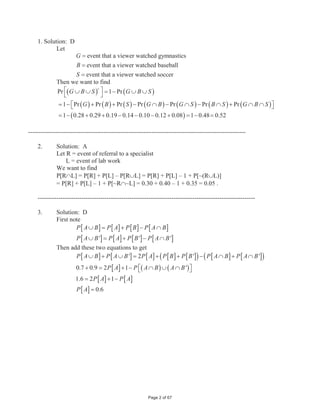
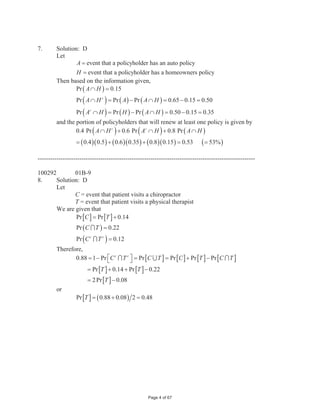
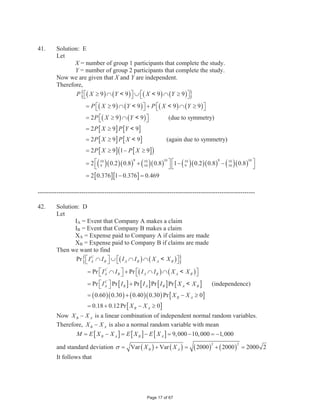
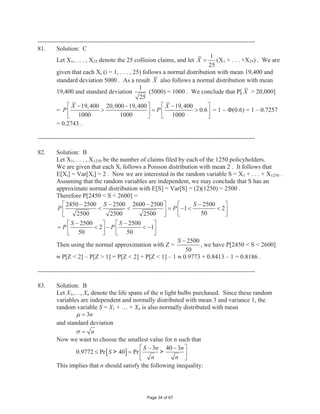
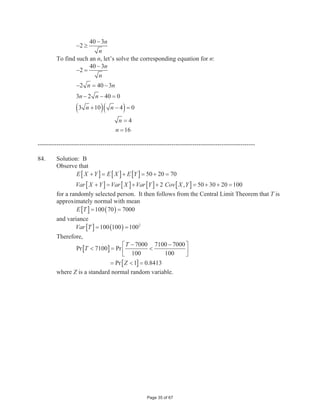
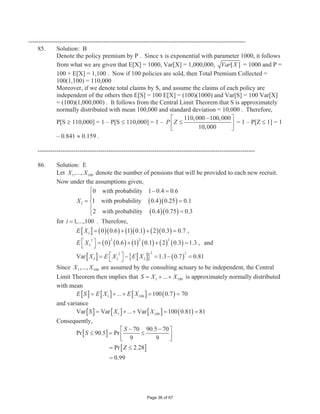
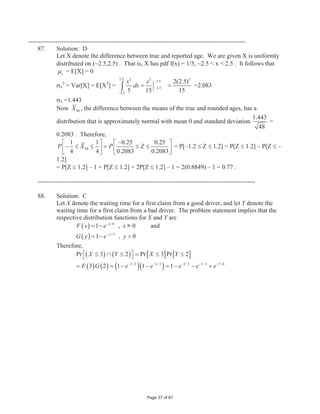
1. Solution: D
            Let
                      G     event that a viewer watched gymnastics
                     B event that a viewer watched baseball
                     S event that a viewer watched soccer
             Then we want to find
             Pr ª G ‰ B ‰ S
º 1  Pr  G ‰ B ‰ S
c
                ¬               ¼
                1  ª Pr  G
Pr  B
Pr  S
Pr  G ˆ B
Pr  G ˆ S
Pr  B ˆ S
Pr  G ˆ B ˆ S
º
                    ¬                                                                                                ¼
                1   0.28  0.29  0.19  0.14  0.10  0.12  0.08
1  0.48 0.52

--------------------------------------------------------------------------------------------------------

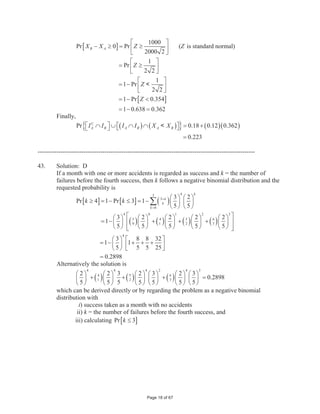
    2.       Solution: A
             Let R = event of referral to a specialist
                 L = event of lab work
             We want to find
             P[RˆL] = P[R] + P[L] – P[R‰L] = P[R] + P[L] – 1 + P[~(R‰L)]
             = P[R] + P[L] – 1 + P[~Rˆ~L] = 0.30 + 0.40 – 1 + 0.35 = 0.05 .

    --------------------------------------------------------------------------------------------------------

    3.       Solution: D
             First note
                     P  A ‰ B@      P  A@  P  B @  P  A ˆ B @
                    P  A ‰ B '@ P  A@  P  B '@  P  A ˆ B '@
             Then add these two equations to get
                    P  A ‰ B @  P  A ‰ B '@ 2 P  A@   P  B @  P  B '@
P  A ˆ B @  P  A ˆ B '@
0.7  0.9 2 P  A@  1  P ª A ˆ B
‰  A ˆ B '
º
                                                 ¬                       ¼
                      1.6 2 P  A@  1  P  A@
                       P  A@ 0.6


                                                         Page 2 of 67
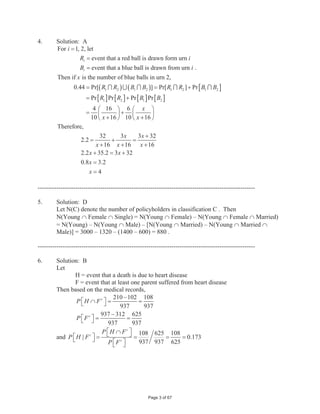
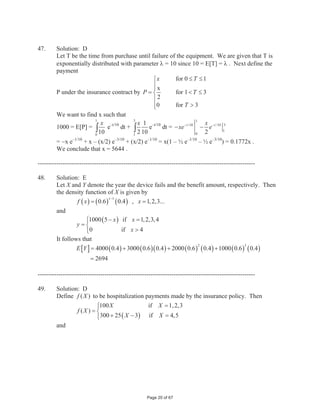
4.       Solution: A
         For i 1, 2, let
                  Ri event that a red ball is drawn form urn i
                    Bi    event that a blue ball is drawn from urn i .
         Then if x is the number of blue balls in urn 2,
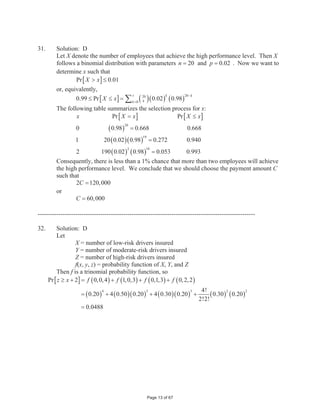
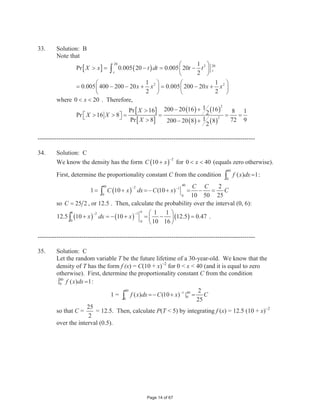
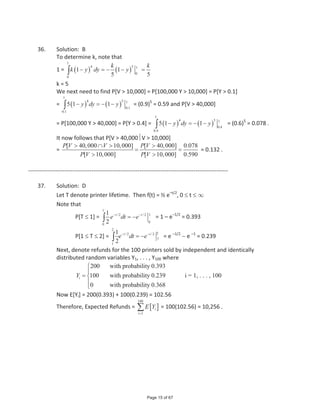
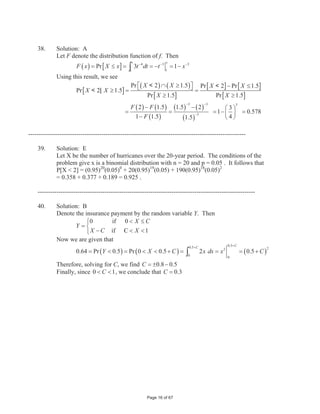
                 0.44 Pr[ R1  R2
*  B1  B2
] Pr[ R1  R2 ]  Pr  B1  B2 @
                          Pr  R1 @ Pr  R2 @  Pr  B1 @ Pr  B2 @
                           4 § 16 · 6 § x ·
                             ¨        ¸ ¨          ¸
                          10 © x  16 ¹ 10 © x  16 ¹
         Therefore,
                             32     3x    3x  32
                    2.2          
                           x  16 x  16 x  16
                    2.2 x  35.2 3 x  32
                    0.8 x 3.2
                        x 4

--------------------------------------------------------------------------------------------------------

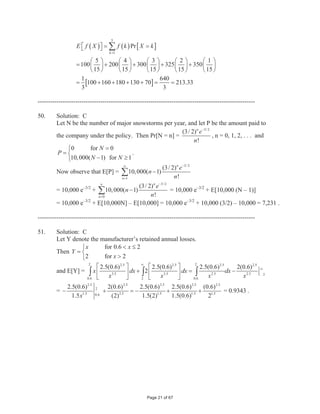
5.       Solution: D
         Let N(C) denote the number of policyholders in classification C . Then
         N(Young ˆ Female ˆ Single) = N(Young ˆ Female) – N(Young ˆ Female ˆ Married)
         = N(Young) – N(Young ˆ Male) – [N(Young ˆ Married) – N(Young ˆ Married ˆ
         Male)] = 3000 – 1320 – (1400 – 600) = 880 .

--------------------------------------------------------------------------------------------------------

6.       Solution: B
         Let
                 H = event that a death is due to heart disease
                 F = event that at least one parent suffered from heart disease
         Then based on the medical records,
                                  210  102 108
                  P ªH ˆ F c º
                    ¬        ¼      937        937
                           937  312 625
                  P ªF c º
                    ¬ ¼         937        937
                            P ª H ˆ F º 108 625 108
                               ¬
                                       c
                                         ¼
         and P ª H | F c º
                ¬        ¼                                      0.173
                                P ªF º
                                    c
                                  ¬ ¼        937 937 625


                                                         Page 3 of 67
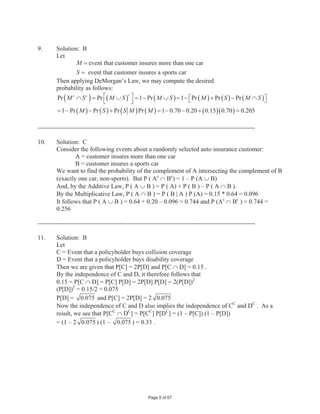
7.       Solution: D
         Let
                 A event that a policyholder has an auto policy
                 H event that a policyholder has a homeowners policy
         Then based on the information given,
                 Pr  A ˆ H
0.15
                  Pr  A ˆ H c
Pr  A
Pr  A ˆ H
0.65  0.15 0.50
                  Pr  Ac ˆ H
Pr  H
Pr  A ˆ H
0.50  0.15 0.35
         and the portion of policyholders that will renew at least one policy is given by
                 0.4 Pr  A ˆ H c
0.6 Pr  Ac ˆ H
0.8 Pr  A ˆ H
0.4
0.5
0.6
0.35
0.8
0.15
0.53        53%
--------------------------------------------------------------------------------------------------------

100292       01B-9
8.    Solution: D
      Let
             C = event that patient visits a chiropractor
             T = event that patient visits a physical therapist
      We are given that
              Pr C @ Pr T @  0.14
                  Pr  C  T
0.22
                  Pr  C c  T c
0.12
         Therefore,
                0.88 1  Pr ªC c  T c º
                            ¬          ¼         Pr C * T @ Pr C @  Pr T @  Pr C  T @
                            Pr T @  0.14  Pr T @  0.22
                            2 Pr T @  0.08
         or
                  Pr T @      0.88  0.08
2 0.48


                                                     Page 4 of 67
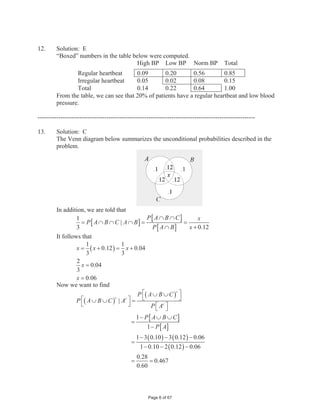
9.       Solution: B
         Let
                  M event that customer insures more than one car
                  S event that customer insures a sports car
         Then applying DeMorgan’s Law, we may compute the desired
         probability as follows:
         Pr  M c ˆ S c
Pr ª M ‰ S
º 1  Pr  M ‰ S
1  ¬ Pr  M
Pr  S
Pr  M ˆ S
¼
                                            c
                                                                     ª                              º
                               ¬              ¼
           1  Pr  M
Pr  S
Pr  S M
Pr  M
1  0.70  0.20   0.15
0.70
0.205

--------------------------------------------------------------------------------------------------------

10.      Solution: C
         Consider the following events about a randomly selected auto insurance customer:
                 A = customer insures more than one car
                 B = customer insures a sports car
         We want to find the probability of the complement of A intersecting the complement of B
         (exactly one car, non-sports). But P ( Ac ˆ Bc) = 1 – P (A ‰ B)
         And, by the Additive Law, P ( A ‰ B ) = P ( A) + P ( B ) – P ( A ˆ B ).
         By the Multiplicative Law, P ( A ˆ B ) = P ( B _ A ) P (A) = 0.15 * 0.64 = 0.096
         It follows that P ( A ‰ B ) = 0.64 + 0.20 – 0.096 = 0.744 and P (Ac ˆ Bc ) = 0.744 =
         0.256

--------------------------------------------------------------------------------------------------------

11.      Solution: B
         Let
         C = Event that a policyholder buys collision coverage
         D = Event that a policyholder buys disability coverage
         Then we are given that P[C] = 2P[D] and P[C ˆ D] = 0.15 .
         By the independence of C and D, it therefore follows that
         0.15 = P[C ˆ D] = P[C] P[D] = 2P[D] P[D] = 2(P[D])2
         (P[D])2 = 0.15/2 = 0.075
         P[D] = 0.075 and P[C] = 2P[D] = 2 0.075
         Now the independence of C and D also implies the independence of CC and DC . As a
         result, we see that P[CC ˆ DC] = P[CC] P[DC] = (1 – P[C]) (1 – P[D])
         = (1 – 2 0.075 ) (1 – 0.075 ) = 0.33 .


                                                    Page 5 of 67
12.      Solution: E
         “Boxed” numbers in the table below were computed.
                                       High BP Low BP Norm BP                            Total
                 Regular heartbeat       0.09       0.20       0.56         0.85
                 Irregular heartbeat     0.05       0.02       0.08         0.15
                 Total                   0.14       0.22       0.64         1.00
         From the table, we can see that 20% of patients have a regular heartbeat and low blood
         pressure.

--------------------------------------------------------------------------------------------------------

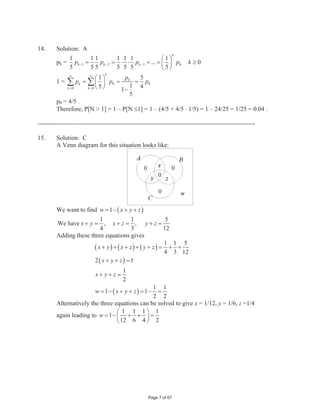
13.      Solution: C
         The Venn diagram below summarizes the unconditional probabilities described in the
         problem.


         In addition, we are told that
                  1                             P A ˆ B ˆ C@                x
                       P  A ˆ B ˆ C | A ˆ B@
                  3                                P  A ˆ B@            x  0.12
         It follows that
                      1               1
                  x      x  0.12
x  0.04
                      3               3
                  2
                    x 0.04
                  3
                  x 0.06
         Now we want to find
                                            P ª A ‰ B ‰ C
º
                                                             c

                  P ª A ‰ B ‰ C
| Ac º
                                    c         ¬                ¼
                    ¬                    ¼        P ªA ºc
                                                    ¬ ¼
                                            1 P A ‰ B ‰ C@
                                                    1  P  A@
                                               1  3  0.10
3  0.12
0.06
                                                 1  0.10  2  0.12
0.06
                                               0.28
                                                         0.467
                                               0.60


                                                      Page 6 of 67
14.      Solution: A
                                                                    k
             1           11           1 1 1                 §1·
         pk = pk 1         pk  2     ˜ ˜ pk 3        ... ¨ ¸ p0      kt0
             5           55           5 5 5                 ©5¹
               f        f       k
                          §1·            p0      5
         1=   ¦ pk     ¦ ¨ 5 ¸ p0
                       k 0© ¹
                                           1     4
                                                   p0
              k 0
                                        1
                                           5
         p0 = 4/5 .
         Therefore, P[N  1] = 1 – P[N d1] = 1 – (4/5 + 4/5 ˜ 1/5) = 1 – 24/25 = 1/25 = 0.04 .

--------------------------------------------------------------------------------------------------------

15.      Solution: C
         A Venn diagram for this situation looks like:


         We want to find w 1   x  y  z
1           1                       5
         We have x  y      , xz       , yz
                          4           3                      12
         Adding these three equations gives
                                                             1 1 5
                             x  y
x  z
y  z
4 3 12
                            2 x  y  z
1
                                         1
                            x y z
                                         2
                                                1 1
                            w 1  x  y  z
1
                                                2 2
         Alternatively the three equations can be solved to give x = 1/12, y = 1/6, z =1/4
                                  § 1 1 1· 1
         again leading to w 1  ¨   ¸
                                  © 12 6 4 ¹ 2


                                                     Page 7 of 67

Exam p samplesolutions

  • 1.
    62&,(7< 2) $&78$5,(6$68$/7$78$5,$/ 62,(7 (;$0 3 352%$%,/,7 3 6$03/( (;$0 62/87,216 RSULJKW E WKH 6RFLHW RI $FWXDULHV DQG WKH DVXDOW $FWXDULDO 6RFLHW 6RPH RI WKH TXHVWLRQV LQ WKLV VWXG QRWH DUH WDNHQ IURP SDVW 62$$6 H[DPLQDWLRQV Page 1 of 67
  • 2.
    1. Solution: D Let G event that a viewer watched gymnastics B event that a viewer watched baseball S event that a viewer watched soccer Then we want to find Pr ª G ‰ B ‰ S
  • 3.
    º 1 Pr G ‰ B ‰ S
  • 4.
    c ¬ ¼ 1 ª Pr G
  • 5.
  • 6.
  • 7.
    Pr Gˆ B
  • 8.
    Pr Gˆ S
  • 9.
    Pr Bˆ S
  • 10.
    Pr Gˆ B ˆ S
  • 11.
    º ¬ ¼ 1 0.28 0.29 0.19 0.14 0.10 0.12 0.08
  • 12.
    1 0.480.52 -------------------------------------------------------------------------------------------------------- 2. Solution: A Let R = event of referral to a specialist L = event of lab work We want to find P[RˆL] = P[R] + P[L] – P[R‰L] = P[R] + P[L] – 1 + P[~(R‰L)] = P[R] + P[L] – 1 + P[~Rˆ~L] = 0.30 + 0.40 – 1 + 0.35 = 0.05 . -------------------------------------------------------------------------------------------------------- 3. Solution: D First note P A ‰ B@ P A@ P B @ P A ˆ B @ P A ‰ B '@ P A@ P B '@ P A ˆ B '@ Then add these two equations to get P A ‰ B @ P A ‰ B '@ 2 P A@ P B @ P B '@
  • 13.
    P Aˆ B @ P A ˆ B '@
  • 14.
    0.7 0.92 P A@ 1 P ª A ˆ B
  • 15.
    ‰ Aˆ B '
  • 16.
    º ¬ ¼ 1.6 2 P A@ 1 P A@ P A@ 0.6 Page 2 of 67
  • 17.
    4. Solution: A For i 1, 2, let Ri event that a red ball is drawn form urn i Bi event that a blue ball is drawn from urn i . Then if x is the number of blue balls in urn 2, 0.44 Pr[ R1 R2
  • 18.
    * B1 B2
  • 19.
    ] Pr[ R1 R2 ] Pr B1 B2 @ Pr R1 @ Pr R2 @ Pr B1 @ Pr B2 @ 4 § 16 · 6 § x · ¨ ¸ ¨ ¸ 10 © x 16 ¹ 10 © x 16 ¹ Therefore, 32 3x 3x 32 2.2 x 16 x 16 x 16 2.2 x 35.2 3 x 32 0.8 x 3.2 x 4 -------------------------------------------------------------------------------------------------------- 5. Solution: D Let N(C) denote the number of policyholders in classification C . Then N(Young ˆ Female ˆ Single) = N(Young ˆ Female) – N(Young ˆ Female ˆ Married) = N(Young) – N(Young ˆ Male) – [N(Young ˆ Married) – N(Young ˆ Married ˆ Male)] = 3000 – 1320 – (1400 – 600) = 880 . -------------------------------------------------------------------------------------------------------- 6. Solution: B Let H = event that a death is due to heart disease F = event that at least one parent suffered from heart disease Then based on the medical records, 210 102 108 P ªH ˆ F c º ¬ ¼ 937 937 937 312 625 P ªF c º ¬ ¼ 937 937 P ª H ˆ F º 108 625 108 ¬ c ¼ and P ª H | F c º ¬ ¼ 0.173 P ªF º c ¬ ¼ 937 937 625 Page 3 of 67
  • 20.
    7. Solution: D Let A event that a policyholder has an auto policy H event that a policyholder has a homeowners policy Then based on the information given, Pr A ˆ H
  • 21.
    0.15 Pr A ˆ H c
  • 22.
  • 23.
    Pr Aˆ H
  • 24.
    0.65 0.150.50 Pr Ac ˆ H
  • 25.
  • 26.
    Pr Aˆ H
  • 27.
    0.50 0.150.35 and the portion of policyholders that will renew at least one policy is given by 0.4 Pr A ˆ H c
  • 28.
    0.6 Pr Ac ˆ H
  • 29.
    0.8 Pr A ˆ H
  • 30.
  • 31.
  • 32.
  • 33.
  • 34.
  • 35.
  • 36.
    0.53 53%
  • 37.
    -------------------------------------------------------------------------------------------------------- 100292 01B-9 8. Solution: D Let C = event that patient visits a chiropractor T = event that patient visits a physical therapist We are given that Pr C @ Pr T @ 0.14 Pr C T
  • 38.
    0.22 Pr C c T c
  • 39.
    0.12 Therefore, 0.88 1 Pr ªC c T c º ¬ ¼ Pr C * T @ Pr C @ Pr T @ Pr C T @ Pr T @ 0.14 Pr T @ 0.22 2 Pr T @ 0.08 or Pr T @ 0.88 0.08
  • 40.
    2 0.48 Page 4 of 67
  • 41.
    9. Solution: B Let M event that customer insures more than one car S event that customer insures a sports car Then applying DeMorgan’s Law, we may compute the desired probability as follows: Pr M c ˆ S c
  • 42.
    Pr ª M‰ S
  • 43.
    º 1 Pr M ‰ S
  • 44.
    1 ¬Pr M
  • 45.
  • 46.
    Pr Mˆ S
  • 47.
    ¼ c ª º ¬ ¼ 1 Pr M
  • 48.
  • 49.
  • 50.
  • 51.
    1 0.70 0.20 0.15
  • 52.
  • 53.
    0.205 -------------------------------------------------------------------------------------------------------- 10. Solution: C Consider the following events about a randomly selected auto insurance customer: A = customer insures more than one car B = customer insures a sports car We want to find the probability of the complement of A intersecting the complement of B (exactly one car, non-sports). But P ( Ac ˆ Bc) = 1 – P (A ‰ B) And, by the Additive Law, P ( A ‰ B ) = P ( A) + P ( B ) – P ( A ˆ B ). By the Multiplicative Law, P ( A ˆ B ) = P ( B _ A ) P (A) = 0.15 * 0.64 = 0.096 It follows that P ( A ‰ B ) = 0.64 + 0.20 – 0.096 = 0.744 and P (Ac ˆ Bc ) = 0.744 = 0.256 -------------------------------------------------------------------------------------------------------- 11. Solution: B Let C = Event that a policyholder buys collision coverage D = Event that a policyholder buys disability coverage Then we are given that P[C] = 2P[D] and P[C ˆ D] = 0.15 . By the independence of C and D, it therefore follows that 0.15 = P[C ˆ D] = P[C] P[D] = 2P[D] P[D] = 2(P[D])2 (P[D])2 = 0.15/2 = 0.075 P[D] = 0.075 and P[C] = 2P[D] = 2 0.075 Now the independence of C and D also implies the independence of CC and DC . As a result, we see that P[CC ˆ DC] = P[CC] P[DC] = (1 – P[C]) (1 – P[D]) = (1 – 2 0.075 ) (1 – 0.075 ) = 0.33 . Page 5 of 67
  • 54.
    12. Solution: E “Boxed” numbers in the table below were computed. High BP Low BP Norm BP Total Regular heartbeat 0.09 0.20 0.56 0.85 Irregular heartbeat 0.05 0.02 0.08 0.15 Total 0.14 0.22 0.64 1.00 From the table, we can see that 20% of patients have a regular heartbeat and low blood pressure. -------------------------------------------------------------------------------------------------------- 13. Solution: C The Venn diagram below summarizes the unconditional probabilities described in the problem. In addition, we are told that 1 P A ˆ B ˆ C@ x P A ˆ B ˆ C | A ˆ B@ 3 P A ˆ B@ x 0.12 It follows that 1 1 x x 0.12
  • 55.
    x 0.04 3 3 2 x 0.04 3 x 0.06 Now we want to find P ª A ‰ B ‰ C
  • 56.
    º c P ª A ‰ B ‰ C
  • 57.
    | Ac º c ¬ ¼ ¬ ¼ P ªA ºc ¬ ¼ 1 P A ‰ B ‰ C@ 1 P A@ 1 3 0.10
  • 58.
  • 59.
    0.06 1 0.10 2 0.12
  • 60.
    0.06 0.28 0.467 0.60 Page 6 of 67
  • 61.
    14. Solution: A k 1 11 1 1 1 §1· pk = pk 1 pk 2 ˜ ˜ pk 3 ... ¨ ¸ p0 kt0 5 55 5 5 5 ©5¹ f f k §1· p0 5 1= ¦ pk ¦ ¨ 5 ¸ p0 k 0© ¹ 1 4 p0 k 0 1 5 p0 = 4/5 . Therefore, P[N 1] = 1 – P[N d1] = 1 – (4/5 + 4/5 ˜ 1/5) = 1 – 24/25 = 1/25 = 0.04 . -------------------------------------------------------------------------------------------------------- 15. Solution: C A Venn diagram for this situation looks like: We want to find w 1 x y z
  • 62.
    1 1 5 We have x y , xz , yz 4 3 12 Adding these three equations gives 1 1 5 x y
  • 63.
  • 64.
  • 65.
    4 3 12 2 x y z
  • 66.
    1 1 x y z 2 1 1 w 1 x y z
  • 67.
    1 2 2 Alternatively the three equations can be solved to give x = 1/12, y = 1/6, z =1/4 § 1 1 1· 1 again leading to w 1 ¨ ¸ © 12 6 4 ¹ 2 Page 7 of 67