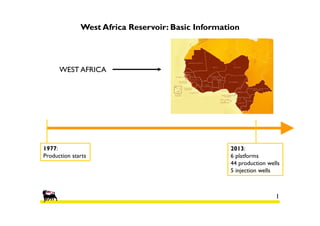
West Africa Reservoir: Basic Information

WEST AFRICA

1977:
Production starts

2013:
6 platforms
44 production wells
5 injection wells

1
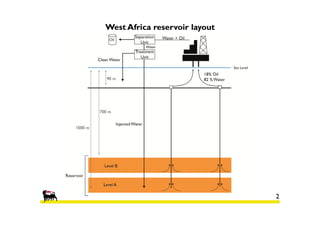
West Africa reservoir layout

2
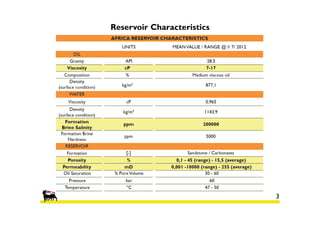
Reservoir Characteristics

3
Index
_Overview on the most important EOR techniques
_What is polymer flooding
_Reservoir sectors models
_Simulation results on extended sector in level A
_Simulation results on extended sector in level B
_Economic evaluation
_Conclusions
_Future perspectives

4
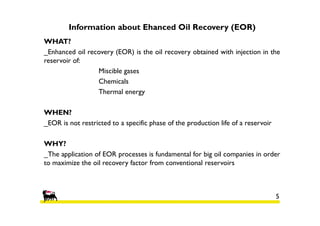
Information about Ehanced Oil Recovery (EOR)
WHAT?
_Enhanced oil recovery (EOR) is the oil recovery obtained with injection in the
reservoir of:
Miscible gases
Chemicals
Thermal energy
WHEN?
_EOR is not restricted to a specific phase of the production life of a reservoir
WHY?
_The application of EOR processes is fundamental for big oil companies in order
to maximize the oil recovery factor from conventional reservoirs

5
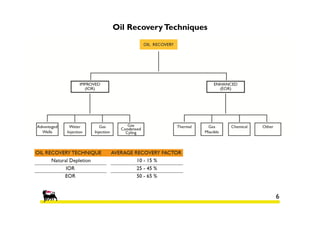
Oil Recovery Techniques

6
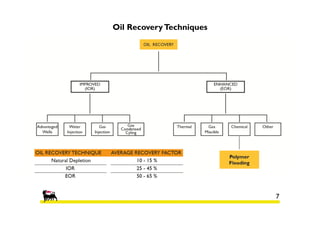
Oil Recovery Techniques

7
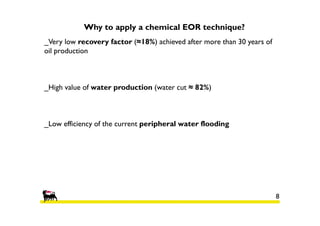
Why to apply a chemical EOR technique?
_Very low recovery factor (≈18%) achieved after more than 30 years of
oil production

_High value of water production (water cut ≈ 82%)

_Low efficiency of the current peripheral water flooding

8
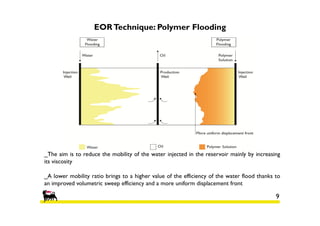
EOR Technique: Polymer Flooding

_The aim is to reduce the mobility of the water injected in the reservoir mainly by increasing
its viscosity
_A lower mobility ratio brings to a higher value of the efficiency of the water flood thanks to
an improved volumetric sweep efficiency and a more uniform displacement front

9
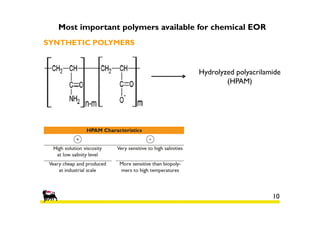
Most important polymers available for chemical EOR
SYNTHETIC POLYMERS

Hydrolyzed polyacrilamide
(HPAM)

10
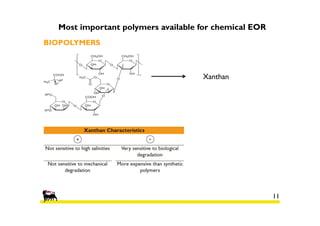
Most important polymers available for chemical EOR
BIOPOLYMERS

Xanthan

11
Properties of polymer mixtures
VISCOSITY
_Polymer viscosity depends on:
_Polymer concentration

‫ ܭ‬ൌ	

ܸ݅‫݊݋݅ݐݑ݈݋ݏ	ݎ݁݉ݕ݈݋݌	݂݋	ݕݐ݅ݏ݋ܿݏ‬
ܸ݅‫ݎ݁ݐܽݓ	݂݋	ݕݐ݅ݏ݋ܿݏ‬

Viscosity coefficient (K)
40
35
30

K [-]

25
20
15
10
5
0
0

1

2

3

4

Polymer concentration [kg/Sm^3]

5

12
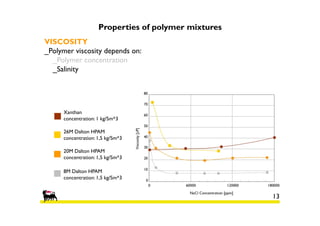
Properties of polymer mixtures
VISCOSITY
_Polymer viscosity depends on:
_Polymer concentration
_Salinity

Xanthan
concentration: 1 kg/Sm^3
26M Dalton HPAM
concentration: 1,5 kg/Sm^3
20M Dalton HPAM
concentration: 1,5 kg/Sm^3
8M Dalton HPAM
concentration: 1,5 kg/Sm^3

13
Properties of polymer mixtures
VISCOSITY
_Polymer viscosity depends on:
_Polymer concentration
_Salinity
_Shear rate
Shear rate ≈ Velocity of propagation of the mixture

HPAM
concentration 1 kg/Sm^3
HPAM
concentration 1,5 kg/Sm^3
HPAM
concentration 2 kg/Sm^3

Polymer solution viscosity [cP]

HPAM solution Viscosity vs.Velocity
7
6
5
4
3
2
1
0
0

0,2

0,4

0,6

0,8

Velocity of propagation of the mixture
[m/day]

1

14
Properties of polymer mixtures
ADSORPTION
_Adsorption refers to the interaction, through physical adsorption, Van
Der Waals forces and hydrogen bonding, between polymer molecules and
porous media surfaces
_Adsorption causes a reduction in rock permeability
Polymer adsorption [g/grock]

HPAM adsorption curve
0,00003
0,000025
0,00002
0,000015
0,00001
0,000005
0
0

1

2

3

4

Polymer concentration [kg/Sm^3]

5

15
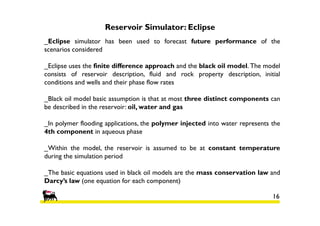
Reservoir Simulator: Eclipse
_Eclipse simulator has been used to forecast future performance of the
scenarios considered
_Eclipse uses the finite difference approach and the black oil model. The model
consists of reservoir description, fluid and rock property description, initial
conditions and wells and their phase flow rates
_Black oil model basic assumption is that at most three distinct components can
be described in the reservoir: oil, water and gas
_In polymer flooding applications, the polymer injected into water represents the
4th component in aqueous phase
_Within the model, the reservoir is assumed to be at constant temperature
during the simulation period
_The basic equations used in black oil models are the mass conservation law and
Darcy’s law (one equation for each component)
16
Extended sectors extraction
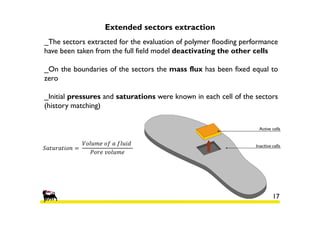
_The sectors extracted for the evaluation of polymer flooding performance
have been taken from the full field model deactivating the other cells
_On the boundaries of the sectors the mass flux has been fixed equal to
zero
_Initial pressures and saturations were known in each cell of the sectors
(history matching)

ܵܽ‫ ݊݋݅ݐܽݎݑݐ‬ൌ 	

ܸ‫	݀݅ݑ݈݂	ܽ	݂݋	݁݉ݑ݈݋‬
ܲ‫݁݉ݑ݈݋ݒ	݁ݎ݋‬

17
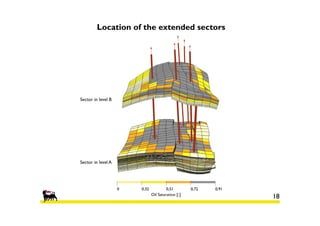
Location of the extended sectors

18
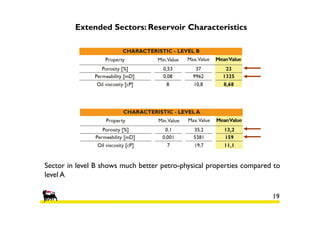
Extended Sectors: Reservoir Characteristics

Sector in level B shows much better petro-physical properties compared to
level A
19
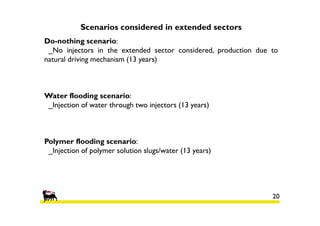
Scenarios considered in extended sectors
Do-nothing scenario:
_No injectors in the extended sector considered, production due to
natural driving mechanism (13 years)

Water flooding scenario:
_Injection of water through two injectors (13 years)

Polymer flooding scenario:
_Injection of polymer solution slugs/water (13 years)

20
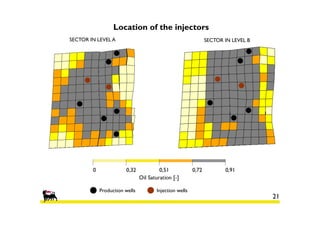
Location of the injectors
SECTOR IN LEVEL A

Production wells

SECTOR IN LEVEL B

Injection wells

21
Results of simulations run on extended sector level A
1/1/2025

FOE = RECOVERY FACTOR
0,4

Do-nothing
Water Flooding
Polymer Flooding

0

0,08

0,16

0,24

0,32

0,4

Polymer Concentration
[kg/Sm^3]

22
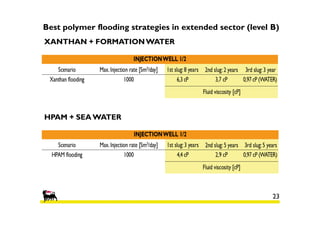
Best polymer flooding strategies in extended sector (level B)
XANTHAN + FORMATION WATER

HPAM + SEA WATER

23
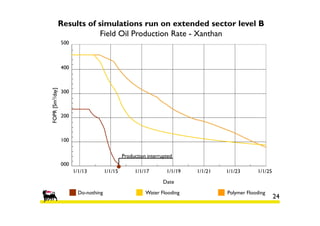
Results of simulations run on extended sector level B
Field Oil Production Rate - Xanthan

Production interrupted

Do-nothing

Water Flooding

Polymer Flooding

24
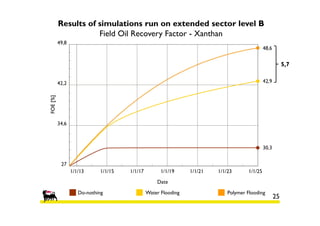
Results of simulations run on extended sector level B
Field Oil Recovery Factor - Xanthan

5,7

Do-nothing

Water Flooding

Polymer Flooding

25
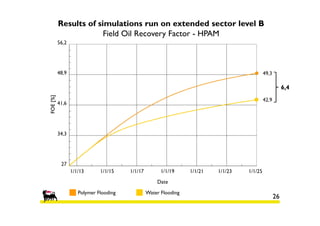
Results of simulations run on extended sector level B
Field Oil Recovery Factor - HPAM

6,4

Polymer Flooding

Water Flooding

26
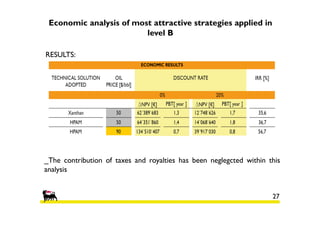
Economic analysis of most attractive strategies applied in
level B
RESULTS:

_The contribution of taxes and royalties has been neglegcted within this
analysis

27
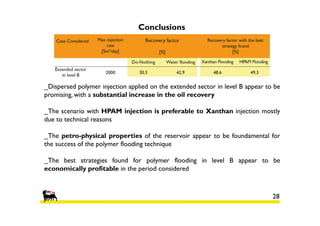
Conclusions

_Dispersed polymer injection applied on the extended sector in level B appear to be
promising, with a substantial increase in the oil recovery
_The scenario with HPAM injection is preferable to Xanthan injection mostly
due to technical reasons
_The petro-physical properties of the reservoir appear to be foundamental for
the success of the polymer flooding technique
_The best strategies found for polymer flooding in level B appear to be
economically profitable in the period considered

28
Future Perspectives: Full Field Implementation
From the current study level B appears to be more interesting to perform a
full field polymer injection implementation
Laboratory tests are necessary in order to evaluate:
_The most appropriate polymer according to the field conditions
_The effect of salinity and shear rate on polymer solution viscosity
(rheology)
_The polymer solution long term stability (chemical, mechanical and
biological)
_The polymer adsorption on reservoir porous medium
The polymer plant design must be considered as key point for the
realization of the project
29
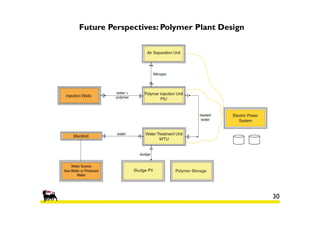
Future Perspectives: Polymer Plant Design

30
Thanks for your attention
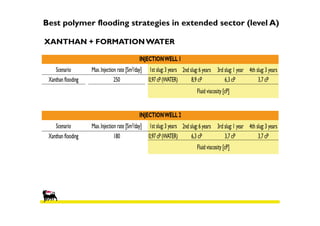
Best polymer flooding strategies in extended sector (level A)
XANTHAN + FORMATION WATER
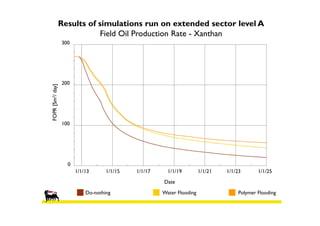
Results of simulations run on extended sector level A
Field Oil Production Rate - Xanthan

Do-nothing

Water Flooding

Polymer Flooding
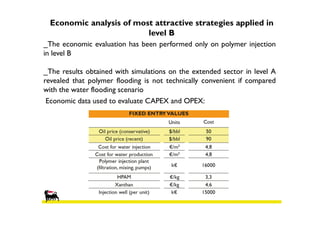
Economic analysis of most attractive strategies applied in
level B
_The economic evaluation has been performed only on polymer injection
in level B
_The results obtained with simulations on the extended sector in level A
revealed that polymer flooding is not technically convenient if compared
with the water flooding scenario
Economic data used to evaluate CAPEX and OPEX:

Polymer injection eor

  • 2.
    West Africa Reservoir:Basic Information WEST AFRICA 1977: Production starts 2013: 6 platforms 44 production wells 5 injection wells 1
  • 3.
  • 4.
  • 5.
    Index _Overview on themost important EOR techniques _What is polymer flooding _Reservoir sectors models _Simulation results on extended sector in level A _Simulation results on extended sector in level B _Economic evaluation _Conclusions _Future perspectives 4
  • 6.
    Information about EhancedOil Recovery (EOR) WHAT? _Enhanced oil recovery (EOR) is the oil recovery obtained with injection in the reservoir of: Miscible gases Chemicals Thermal energy WHEN? _EOR is not restricted to a specific phase of the production life of a reservoir WHY? _The application of EOR processes is fundamental for big oil companies in order to maximize the oil recovery factor from conventional reservoirs 5
  • 7.
  • 8.
  • 9.
    Why to applya chemical EOR technique? _Very low recovery factor (≈18%) achieved after more than 30 years of oil production _High value of water production (water cut ≈ 82%) _Low efficiency of the current peripheral water flooding 8
  • 10.
    EOR Technique: PolymerFlooding _The aim is to reduce the mobility of the water injected in the reservoir mainly by increasing its viscosity _A lower mobility ratio brings to a higher value of the efficiency of the water flood thanks to an improved volumetric sweep efficiency and a more uniform displacement front 9
  • 11.
    Most important polymersavailable for chemical EOR SYNTHETIC POLYMERS Hydrolyzed polyacrilamide (HPAM) 10
  • 12.
    Most important polymersavailable for chemical EOR BIOPOLYMERS Xanthan 11
  • 13.
    Properties of polymermixtures VISCOSITY _Polymer viscosity depends on: _Polymer concentration ‫ ܭ‬ൌ ܸ݅‫݊݋݅ݐݑ݈݋ݏ ݎ݁݉ݕ݈݋݌ ݂݋ ݕݐ݅ݏ݋ܿݏ‬ ܸ݅‫ݎ݁ݐܽݓ ݂݋ ݕݐ݅ݏ݋ܿݏ‬ Viscosity coefficient (K) 40 35 30 K [-] 25 20 15 10 5 0 0 1 2 3 4 Polymer concentration [kg/Sm^3] 5 12
  • 14.
    Properties of polymermixtures VISCOSITY _Polymer viscosity depends on: _Polymer concentration _Salinity Xanthan concentration: 1 kg/Sm^3 26M Dalton HPAM concentration: 1,5 kg/Sm^3 20M Dalton HPAM concentration: 1,5 kg/Sm^3 8M Dalton HPAM concentration: 1,5 kg/Sm^3 13
  • 15.
    Properties of polymermixtures VISCOSITY _Polymer viscosity depends on: _Polymer concentration _Salinity _Shear rate Shear rate ≈ Velocity of propagation of the mixture HPAM concentration 1 kg/Sm^3 HPAM concentration 1,5 kg/Sm^3 HPAM concentration 2 kg/Sm^3 Polymer solution viscosity [cP] HPAM solution Viscosity vs.Velocity 7 6 5 4 3 2 1 0 0 0,2 0,4 0,6 0,8 Velocity of propagation of the mixture [m/day] 1 14
  • 16.
    Properties of polymermixtures ADSORPTION _Adsorption refers to the interaction, through physical adsorption, Van Der Waals forces and hydrogen bonding, between polymer molecules and porous media surfaces _Adsorption causes a reduction in rock permeability Polymer adsorption [g/grock] HPAM adsorption curve 0,00003 0,000025 0,00002 0,000015 0,00001 0,000005 0 0 1 2 3 4 Polymer concentration [kg/Sm^3] 5 15
  • 17.
    Reservoir Simulator: Eclipse _Eclipsesimulator has been used to forecast future performance of the scenarios considered _Eclipse uses the finite difference approach and the black oil model. The model consists of reservoir description, fluid and rock property description, initial conditions and wells and their phase flow rates _Black oil model basic assumption is that at most three distinct components can be described in the reservoir: oil, water and gas _In polymer flooding applications, the polymer injected into water represents the 4th component in aqueous phase _Within the model, the reservoir is assumed to be at constant temperature during the simulation period _The basic equations used in black oil models are the mass conservation law and Darcy’s law (one equation for each component) 16
  • 18.
    Extended sectors extraction _Thesectors extracted for the evaluation of polymer flooding performance have been taken from the full field model deactivating the other cells _On the boundaries of the sectors the mass flux has been fixed equal to zero _Initial pressures and saturations were known in each cell of the sectors (history matching) ܵܽ‫ ݊݋݅ݐܽݎݑݐ‬ൌ ܸ‫ ݀݅ݑ݈݂ ܽ ݂݋ ݁݉ݑ݈݋‬ ܲ‫݁݉ݑ݈݋ݒ ݁ݎ݋‬ 17
  • 19.
    Location of theextended sectors 18
  • 20.
    Extended Sectors: ReservoirCharacteristics Sector in level B shows much better petro-physical properties compared to level A 19
  • 21.
    Scenarios considered inextended sectors Do-nothing scenario: _No injectors in the extended sector considered, production due to natural driving mechanism (13 years) Water flooding scenario: _Injection of water through two injectors (13 years) Polymer flooding scenario: _Injection of polymer solution slugs/water (13 years) 20
  • 22.
    Location of theinjectors SECTOR IN LEVEL A Production wells SECTOR IN LEVEL B Injection wells 21
  • 23.
    Results of simulationsrun on extended sector level A 1/1/2025 FOE = RECOVERY FACTOR 0,4 Do-nothing Water Flooding Polymer Flooding 0 0,08 0,16 0,24 0,32 0,4 Polymer Concentration [kg/Sm^3] 22
  • 24.
    Best polymer floodingstrategies in extended sector (level B) XANTHAN + FORMATION WATER HPAM + SEA WATER 23
  • 25.
    Results of simulationsrun on extended sector level B Field Oil Production Rate - Xanthan Production interrupted Do-nothing Water Flooding Polymer Flooding 24
  • 26.
    Results of simulationsrun on extended sector level B Field Oil Recovery Factor - Xanthan 5,7 Do-nothing Water Flooding Polymer Flooding 25
  • 27.
    Results of simulationsrun on extended sector level B Field Oil Recovery Factor - HPAM 6,4 Polymer Flooding Water Flooding 26
  • 28.
    Economic analysis ofmost attractive strategies applied in level B RESULTS: _The contribution of taxes and royalties has been neglegcted within this analysis 27
  • 29.
    Conclusions _Dispersed polymer injectionapplied on the extended sector in level B appear to be promising, with a substantial increase in the oil recovery _The scenario with HPAM injection is preferable to Xanthan injection mostly due to technical reasons _The petro-physical properties of the reservoir appear to be foundamental for the success of the polymer flooding technique _The best strategies found for polymer flooding in level B appear to be economically profitable in the period considered 28
  • 30.
    Future Perspectives: FullField Implementation From the current study level B appears to be more interesting to perform a full field polymer injection implementation Laboratory tests are necessary in order to evaluate: _The most appropriate polymer according to the field conditions _The effect of salinity and shear rate on polymer solution viscosity (rheology) _The polymer solution long term stability (chemical, mechanical and biological) _The polymer adsorption on reservoir porous medium The polymer plant design must be considered as key point for the realization of the project 29
  • 31.
  • 32.
    Thanks for yourattention
  • 33.
    Best polymer floodingstrategies in extended sector (level A) XANTHAN + FORMATION WATER
  • 34.
    Results of simulationsrun on extended sector level A Field Oil Production Rate - Xanthan Do-nothing Water Flooding Polymer Flooding
  • 35.
    Economic analysis ofmost attractive strategies applied in level B _The economic evaluation has been performed only on polymer injection in level B _The results obtained with simulations on the extended sector in level A revealed that polymer flooding is not technically convenient if compared with the water flooding scenario Economic data used to evaluate CAPEX and OPEX: