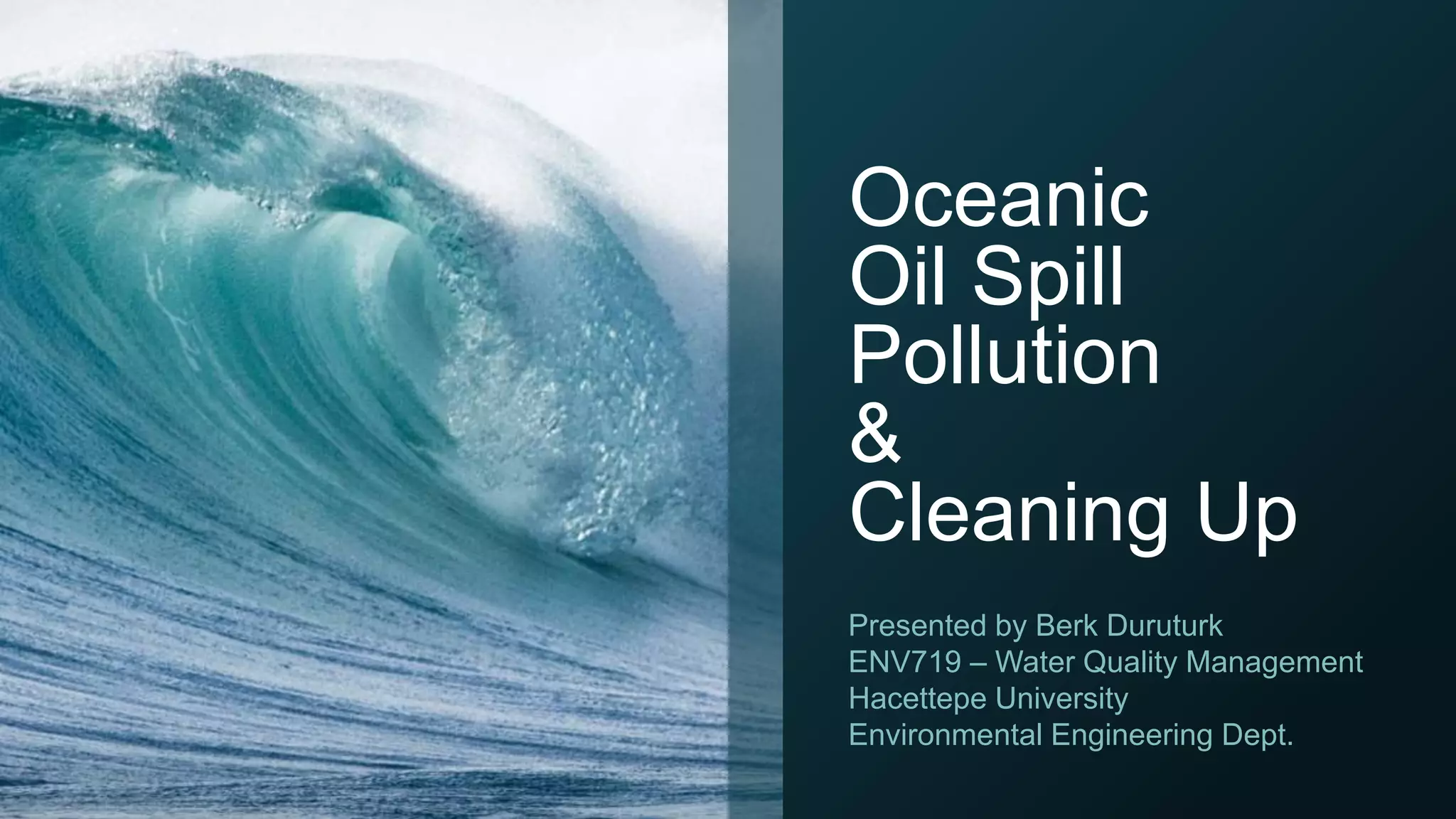
Oceanic
Oil Spill
Pollution
&
Cleaning Up
Presented by Berk Duruturk
ENV719 – Water Quality Management
Hacettepe University
Environmental Engineering Dept.
Oceanic Oil Spill Pollution
• Ocean Pollution and Causes
• Petroleum
• Oil Spills
• How Oil Spills occur
• Impacts of Oil Spills
• Cleaning Up Methods
• Recently Developed Techniques
Marine Pollution – Definition by WHO
The introduction by man, directly or indirectly, of
substances or energy into the marine environment,
including estuaries, which results or is likely to result in
such deleterious effects as harm to living resources and
marine life, hazards to human health, hindrance to
marine activities, including fishing and other legitimate
uses of the sea, impairment of quality for use of sea
water and reduction of amenities. (World Health
Organization)
Ocean Pollution Sources and Causes
• Oil Spills
• Untreated Sewage
• Heavy Siltation
• Eutrophication (Nutrient Enrichment)
• Persistent Organic Pollutants (POP’s)
• Heavy Metals from Mine Tailings
• Acidification
• Radioactive Substances
• Marine Litter
• Thermal – Heat
• Overfishing and Destruction of Coastal and Marine Habitats
Main Types of inputs of Pollution into the Ocean
1- Direct discharge of waste into the ocean
2- Runoff into the waste due to precipitation
3- Pollutants that are released from the atmosphere
Oil - Petroleum
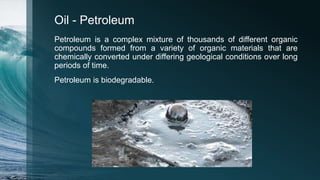
Petroleum is a complex mixture of thousands of different organic
compounds formed from a variety of organic materials that are
chemically converted under differing geological conditions over long
periods of time.
Petroleum is biodegradable.
Crude Oil – Refined Petroleum
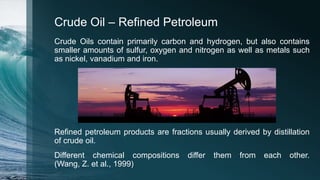
Crude Oils contain primarily carbon and hydrogen, but also contains
smaller amounts of sulfur, oxygen and nitrogen as well as metals such
as nickel, vanadium and iron.
Refined petroleum products are fractions usually derived by distillation
of crude oil.
Different chemical compositions differ them from each other.
(Wang, Z. et al., 1999)
Oil Spills
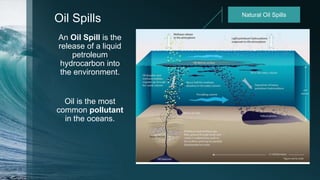
An Oil Spill is the
release of a liquid
petroleum
hydrocarbon into
the environment.
Oil is the most
common pollutant
in the oceans.
Natural Oil Spills
Oil Spills
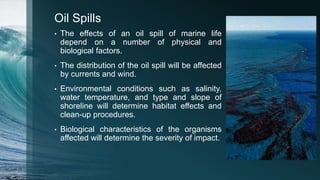
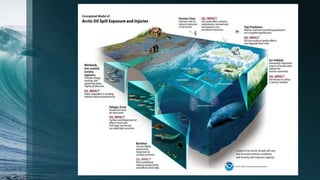
• The effects of an oil spill of marine life
depend on a number of physical and
biological factors.
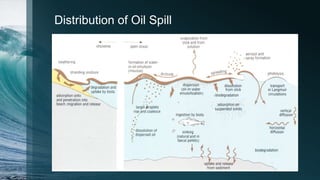
• The distribution of the oil spill will be affected
by currents and wind.
• Environmental conditions such as salinity,
water temperature, and type and slope of
shoreline will determine habitat effects and
clean-up procedures.
• Biological characteristics of the organisms
affected will determine the severity of impact.
Distribution of Oil Spill
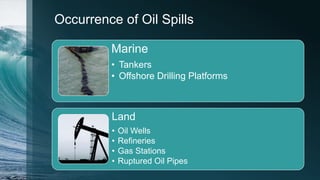
Occurrence of Oil Spills
Marine
• Tankers
• Offshore Drilling Platforms
Land
• Oil Wells
• Refineries
• Gas Stations
• Ruptured Oil Pipes
Impact of Oil Spills
• Economic, Social and Environmental impacts
• Wildlife and their habitats
• Impacts on Coastal areas and Shoreline
• Impact on endangered animals
• Impact on Benthic and inter-tidal organisms
• Tourism
• Increase on the oil prices
• The variety of health effects on human life
Cleaning Up - Methods
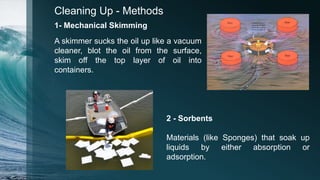
1- Mechanical Skimming
A skimmer sucks the oil up like a vacuum
cleaner, blot the oil from the surface,
skim off the top layer of oil into
containers.
2 - Sorbents
Materials (like Sponges) that soak up
liquids by either absorption or
adsorption.
Cleaning Up - Methods
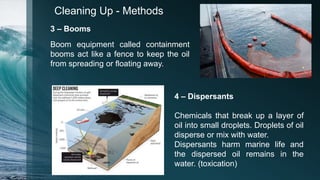
3 – Booms
Boom equipment called containment
booms act like a fence to keep the oil
from spreading or floating away.
4 – Dispersants
Chemicals that break up a layer of
oil into small droplets. Droplets of oil
disperse or mix with water.
Dispersants harm marine life and
the dispersed oil remains in the
water. (toxication)
Cleaning Up - Methods
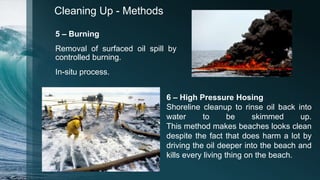
5 – Burning
Removal of surfaced oil spill by
controlled burning.
In-situ process.
6 – High Pressure Hosing
Shoreline cleanup to rinse oil back into
water to be skimmed up.
This method makes beaches looks clean
despite the fact that does harm a lot by
driving the oil deeper into the beach and
kills every living thing on the beach.
Cleaning Up - Methods
7 – Bioremediation (In situ and ex situ)
a. Land Farming – Solid-phase treatment system
b. Composting – Aerobic, thermophilic treatment system
c. Bioreators – Biodegradation in a container or reactor
d. Bioventing – Drawing oxygen through the soil to stimulate microbial activity
e. Biofilters – Use of microbial stripping columns to treat air emissions
f. Bioaugmentation – Addition of bacterial cultures to a contaminated medium
g. Biostimulation – Stimulation of indigenous microbial populations
h. Pump and treat – Pumping groundwater to the surface, treating, and reinjecting.
( Boopathy, 2000)
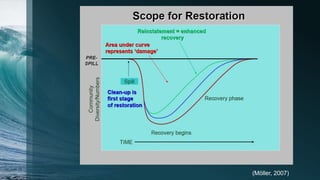
(Möller, 2007)
Cleaning Up - Materials
• Human Hair and Sheep’s Wool
-The wool absorbs oil.
-The oil sticks to the hair but does not soak into it.
• Recycled Cellulose Material
-Made of recycled natural plant material.
-Begins to absorb the moment that it touches the oil.
-Hydrophobic
• Oil Absorbing Polymer
-Named “Envirobond 403”.
-Formulated to bond crude oil.
-When the polymer and liquid hydrocarbon (oil) contact each
other a gel form occurs.
-Hydrophobic
Cleaning Up - Materials
• Nonwoven Wool Blanket
-Made by scarp wool and recycled yarns.
-The blanket form of wool makes it easier to handle than loose
wool.
-Has same general oil adsorbing properties as raw wool.
• Superwetting Nanowire Membranes
-Thermally stable membrane material, based upon self-
assembled, free-standing, paper-like structures of cryptomelane-
type manganese oxide nanowires.
-Withstand harsh conditions.
-Increased sorption capacity.
-Superhydrophobicity
(Yuan, J., et al., 2008)
Cleaning Up - Materials
• Rice Husk
-Agricultural waste.
-Rice Husk is modified with cationic polymer, polyethylenimine
(PEI).
-Efficient and inexpensive.
-Environmental-friendly oil removing adsorbent.
-Enhanced oil removing performance.
(Lin, K.A. & Chen, S., 2015) and (Razavi, Z., 2015)
• Walnut Shell Media
-Hard, chemically inert, nontoxic and biodegradable.
-Agricultural waste.
-Easy to find and inexpensive.
-Need to apply pressure.
(Viraraghavan, T., 2008)
References
• Boopathy, R., 2000. “Factors limiting bioremediation technologies”. Bioresource Technology, 74 (2000), pg. 63-67.
• Dong, T., Xu, G. and Wang, F., 2015. “Oil spill cleanup by structured natural sorbents made from cattail fibers”. Industrial Crops
and Products, 76, pg. 25-33.
• Möller, T., 2008. “Methods for Assessing Oil Spill Impact on the Marine Environment”. ITOPF, GdR AMURE Presentation, 10-11
May 2007.
• Lin, K. A. and Chen S., 2015. “Enhanced Removal of Oil Droplets from Oil-in-Water Emulsions Using Polyethylenimine-Modified
Rice Husk”. Waster Biomass Valor, 6, pg. 495-505.
• Razavi, Z., Mirghaffari, N. and Rezaei, B., 2013. “Performance Comparison of Raw and Thermal Modified Rice Husk for
Decontamination of Oil Polluted Water”. Clean – Soil, Air, Water. 43 (2), pg. 182-190.
• Viraraghavan, T. and Srinivasan, A., 2010. “Oil removal from water by fungal biomass: A factorial design analysis”. Journal of
Hazardous Materials, 175, pg. 695-702.
• Viraraghavan, T. and Srinivasan, A., 2008. “Removal of oil by walnut shell media”. Bioresource Technology, 99, pg. 8217-8220.
• Yuan, J., Lui, X., Akbulut, O., Hu, J., Suib, S. L., Kong, J. and Stellacci, F., 2008. “Superwetting nanowire membranes for
selective absorption”. Nature nanotechnology, Vol 3, June 8.
• Wang, Z., et al., 1999. “Oil Spill identification”. Journal of Chromatography A, 845, pg. 369-411.
• Google Images, http://www.google.com
• NOAA, http://www.noaa.gov/
• World Health Organization, http://www.who.int/en/
Thank you
for your
contribution

Oceanic Oil Spill Pollution & Cleaning Up

  • 1.
    Oceanic Oil Spill Pollution & Cleaning Up Presentedby Berk Duruturk ENV719 – Water Quality Management Hacettepe University Environmental Engineering Dept.
  • 2.
    Oceanic Oil SpillPollution • Ocean Pollution and Causes • Petroleum • Oil Spills • How Oil Spills occur • Impacts of Oil Spills • Cleaning Up Methods • Recently Developed Techniques
  • 3.
    Marine Pollution –Definition by WHO The introduction by man, directly or indirectly, of substances or energy into the marine environment, including estuaries, which results or is likely to result in such deleterious effects as harm to living resources and marine life, hazards to human health, hindrance to marine activities, including fishing and other legitimate uses of the sea, impairment of quality for use of sea water and reduction of amenities. (World Health Organization)
  • 4.
    Ocean Pollution Sourcesand Causes • Oil Spills • Untreated Sewage • Heavy Siltation • Eutrophication (Nutrient Enrichment) • Persistent Organic Pollutants (POP’s) • Heavy Metals from Mine Tailings • Acidification • Radioactive Substances • Marine Litter • Thermal – Heat • Overfishing and Destruction of Coastal and Marine Habitats
  • 5.
    Main Types ofinputs of Pollution into the Ocean 1- Direct discharge of waste into the ocean 2- Runoff into the waste due to precipitation 3- Pollutants that are released from the atmosphere
  • 6.
    Oil - Petroleum Petroleumis a complex mixture of thousands of different organic compounds formed from a variety of organic materials that are chemically converted under differing geological conditions over long periods of time. Petroleum is biodegradable.
  • 7.
    Crude Oil –Refined Petroleum Crude Oils contain primarily carbon and hydrogen, but also contains smaller amounts of sulfur, oxygen and nitrogen as well as metals such as nickel, vanadium and iron. Refined petroleum products are fractions usually derived by distillation of crude oil. Different chemical compositions differ them from each other. (Wang, Z. et al., 1999)
  • 8.
    Oil Spills An OilSpill is the release of a liquid petroleum hydrocarbon into the environment. Oil is the most common pollutant in the oceans. Natural Oil Spills
  • 9.
    Oil Spills • Theeffects of an oil spill of marine life depend on a number of physical and biological factors. • The distribution of the oil spill will be affected by currents and wind. • Environmental conditions such as salinity, water temperature, and type and slope of shoreline will determine habitat effects and clean-up procedures. • Biological characteristics of the organisms affected will determine the severity of impact.
  • 10.
  • 11.
    Occurrence of OilSpills Marine • Tankers • Offshore Drilling Platforms Land • Oil Wells • Refineries • Gas Stations • Ruptured Oil Pipes
  • 12.
    Impact of OilSpills • Economic, Social and Environmental impacts • Wildlife and their habitats • Impacts on Coastal areas and Shoreline • Impact on endangered animals • Impact on Benthic and inter-tidal organisms • Tourism • Increase on the oil prices • The variety of health effects on human life
  • 14.
    Cleaning Up -Methods 1- Mechanical Skimming A skimmer sucks the oil up like a vacuum cleaner, blot the oil from the surface, skim off the top layer of oil into containers. 2 - Sorbents Materials (like Sponges) that soak up liquids by either absorption or adsorption.
  • 15.
    Cleaning Up -Methods 3 – Booms Boom equipment called containment booms act like a fence to keep the oil from spreading or floating away. 4 – Dispersants Chemicals that break up a layer of oil into small droplets. Droplets of oil disperse or mix with water. Dispersants harm marine life and the dispersed oil remains in the water. (toxication)
  • 16.
    Cleaning Up -Methods 5 – Burning Removal of surfaced oil spill by controlled burning. In-situ process. 6 – High Pressure Hosing Shoreline cleanup to rinse oil back into water to be skimmed up. This method makes beaches looks clean despite the fact that does harm a lot by driving the oil deeper into the beach and kills every living thing on the beach.
  • 17.
    Cleaning Up -Methods 7 – Bioremediation (In situ and ex situ) a. Land Farming – Solid-phase treatment system b. Composting – Aerobic, thermophilic treatment system c. Bioreators – Biodegradation in a container or reactor d. Bioventing – Drawing oxygen through the soil to stimulate microbial activity e. Biofilters – Use of microbial stripping columns to treat air emissions f. Bioaugmentation – Addition of bacterial cultures to a contaminated medium g. Biostimulation – Stimulation of indigenous microbial populations h. Pump and treat – Pumping groundwater to the surface, treating, and reinjecting. ( Boopathy, 2000)
  • 19.
  • 20.
    Cleaning Up -Materials • Human Hair and Sheep’s Wool -The wool absorbs oil. -The oil sticks to the hair but does not soak into it. • Recycled Cellulose Material -Made of recycled natural plant material. -Begins to absorb the moment that it touches the oil. -Hydrophobic • Oil Absorbing Polymer -Named “Envirobond 403”. -Formulated to bond crude oil. -When the polymer and liquid hydrocarbon (oil) contact each other a gel form occurs. -Hydrophobic
  • 21.
    Cleaning Up -Materials • Nonwoven Wool Blanket -Made by scarp wool and recycled yarns. -The blanket form of wool makes it easier to handle than loose wool. -Has same general oil adsorbing properties as raw wool. • Superwetting Nanowire Membranes -Thermally stable membrane material, based upon self- assembled, free-standing, paper-like structures of cryptomelane- type manganese oxide nanowires. -Withstand harsh conditions. -Increased sorption capacity. -Superhydrophobicity (Yuan, J., et al., 2008)
  • 22.
    Cleaning Up -Materials • Rice Husk -Agricultural waste. -Rice Husk is modified with cationic polymer, polyethylenimine (PEI). -Efficient and inexpensive. -Environmental-friendly oil removing adsorbent. -Enhanced oil removing performance. (Lin, K.A. & Chen, S., 2015) and (Razavi, Z., 2015) • Walnut Shell Media -Hard, chemically inert, nontoxic and biodegradable. -Agricultural waste. -Easy to find and inexpensive. -Need to apply pressure. (Viraraghavan, T., 2008)
  • 23.
    References • Boopathy, R.,2000. “Factors limiting bioremediation technologies”. Bioresource Technology, 74 (2000), pg. 63-67. • Dong, T., Xu, G. and Wang, F., 2015. “Oil spill cleanup by structured natural sorbents made from cattail fibers”. Industrial Crops and Products, 76, pg. 25-33. • Möller, T., 2008. “Methods for Assessing Oil Spill Impact on the Marine Environment”. ITOPF, GdR AMURE Presentation, 10-11 May 2007. • Lin, K. A. and Chen S., 2015. “Enhanced Removal of Oil Droplets from Oil-in-Water Emulsions Using Polyethylenimine-Modified Rice Husk”. Waster Biomass Valor, 6, pg. 495-505. • Razavi, Z., Mirghaffari, N. and Rezaei, B., 2013. “Performance Comparison of Raw and Thermal Modified Rice Husk for Decontamination of Oil Polluted Water”. Clean – Soil, Air, Water. 43 (2), pg. 182-190. • Viraraghavan, T. and Srinivasan, A., 2010. “Oil removal from water by fungal biomass: A factorial design analysis”. Journal of Hazardous Materials, 175, pg. 695-702. • Viraraghavan, T. and Srinivasan, A., 2008. “Removal of oil by walnut shell media”. Bioresource Technology, 99, pg. 8217-8220. • Yuan, J., Lui, X., Akbulut, O., Hu, J., Suib, S. L., Kong, J. and Stellacci, F., 2008. “Superwetting nanowire membranes for selective absorption”. Nature nanotechnology, Vol 3, June 8. • Wang, Z., et al., 1999. “Oil Spill identification”. Journal of Chromatography A, 845, pg. 369-411. • Google Images, http://www.google.com • NOAA, http://www.noaa.gov/ • World Health Organization, http://www.who.int/en/
  • 24.