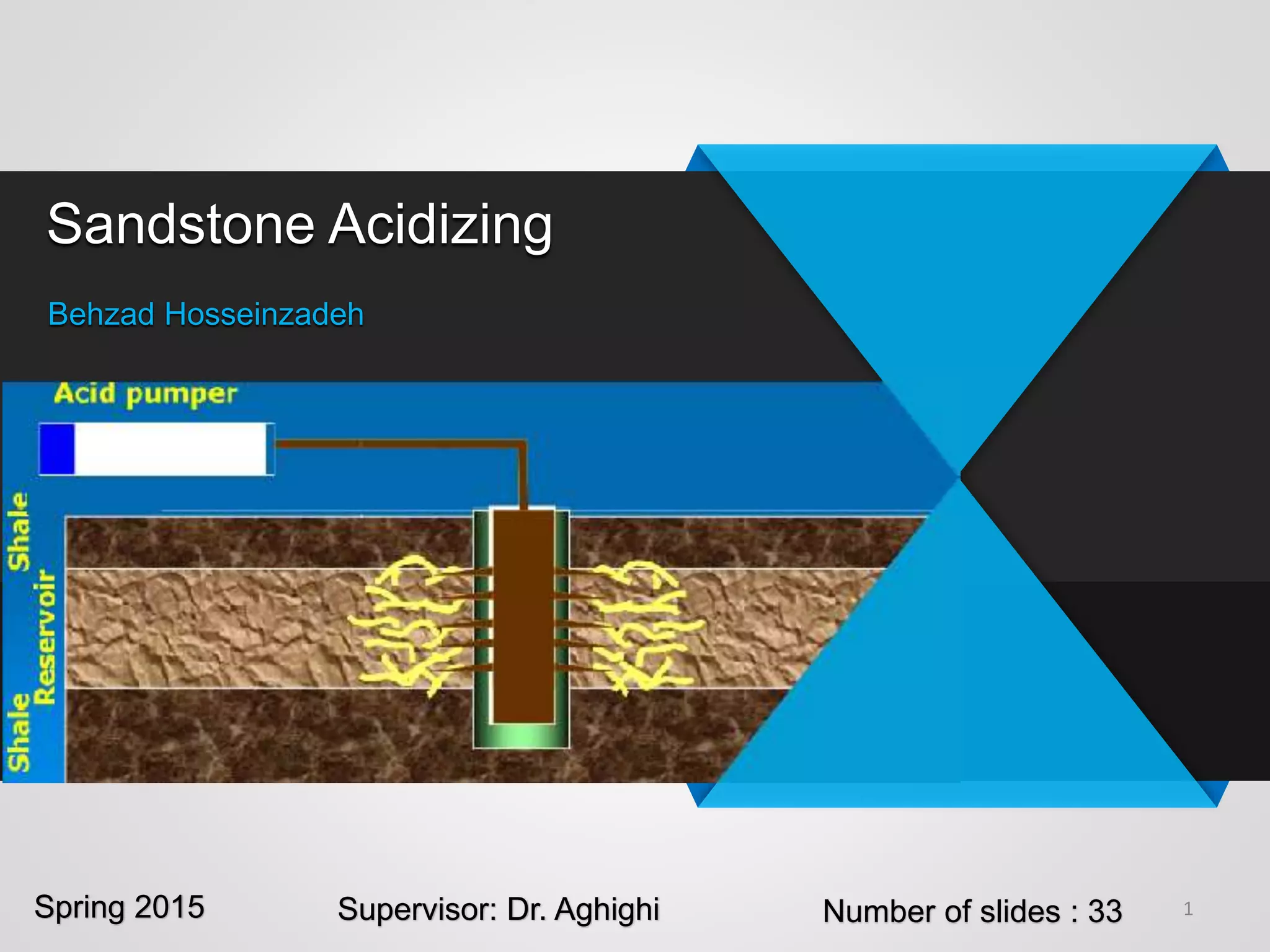
Sandstone Acidizing
Behzad Hosseinzadeh
1Spring 2015 Number of slides : 33Supervisor: Dr. Aghighi
Introduction
SandStone Acidizing
 The main aim of matrix acidizing is to improve production and
reduce skin by:
 Dissolving formation damage
 Creating new pathways around the wellbore
 Matrix acidizing should be below fracture pressure.
 Sandstone acidizing is performed for two primary purposes:
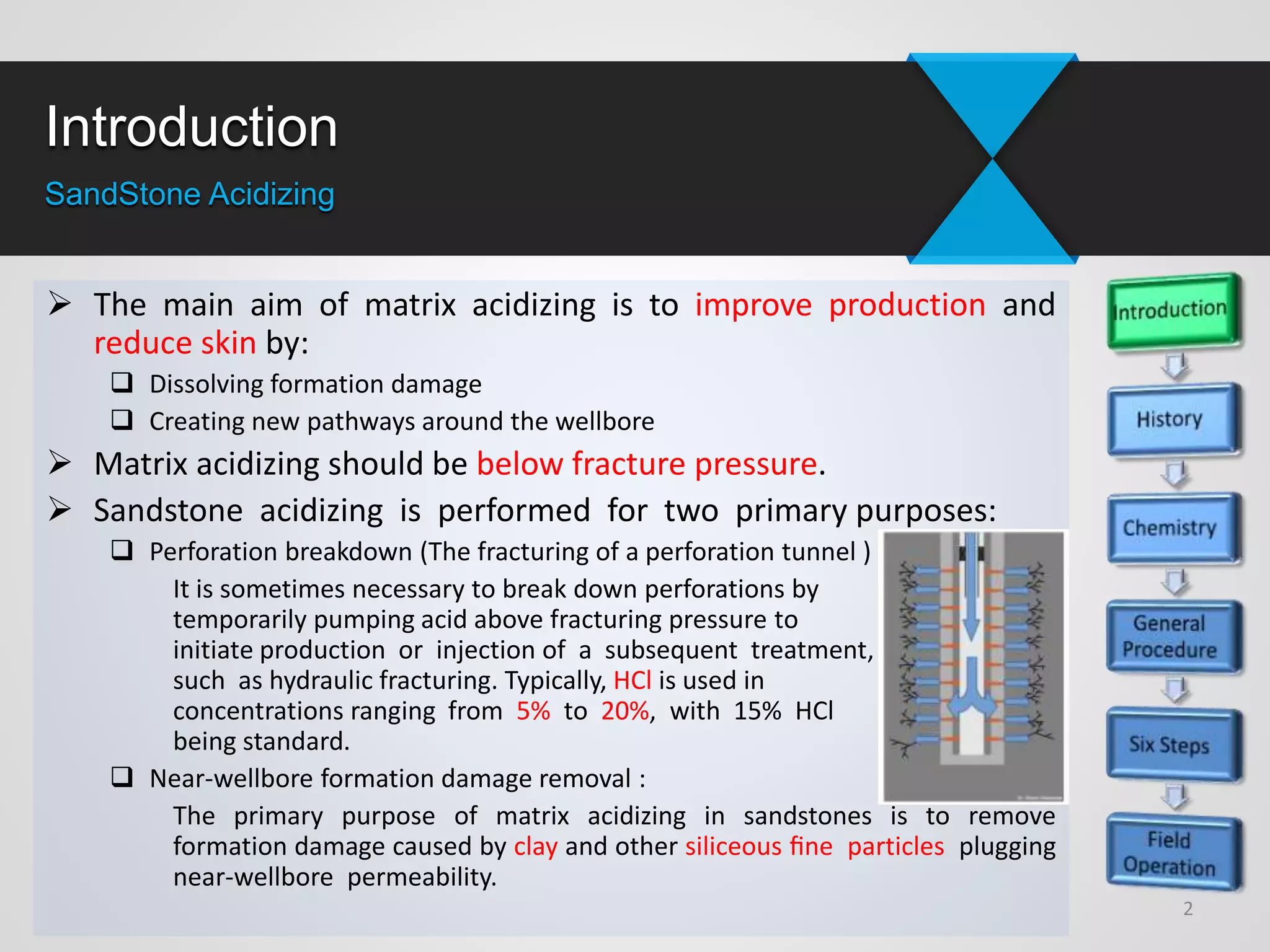
 Perforation breakdown (The fracturing of a perforation tunnel ) :
It is sometimes necessary to break down perforations by
temporarily pumping acid above fracturing pressure to
initiate production or injection of a subsequent treatment,
such as hydraulic fracturing. Typically, HCl is used in
concentrations ranging from 5% to 20%, with 15% HCl
being standard.
 Near-wellbore formation damage removal :
The primary purpose of matrix acidizing in sandstones is to remove
formation damage caused by clay and other siliceous fine particles plugging
near-wellbore permeability.
2
History
SandStone Acidizing
 Because of the growing excitement surrounding acid treatment of limestone
(Carbonate rocks) formations throughout 1932, interest in developing
treatments for sandstone formations began growing too.
 In May 1933, Halliburton conducted the first sandstone acidizing treatment using
a mixture of HCl and hydrofluoric acid (HF).
 Unfortunately, the results of this first attempt were very discouraging. The reaction
of the strong acid solution in the formation caused substantial sand production into
the wellbore.
 Consequently, use of HCl-HF was not very popular for the next 20 years.
 Many sandstone acidizing treatments have been pumped since, without such
understanding of purpose and potential.
 In 1965, the study by Smith and Hendrickson removed much of the mystery in HF
acidizing for petroleum engineers and led the way to improved design practices.
The most important result of this work was the development of tapered HF
treatments, with HCl preflush and overflush, to inhibit deposition of plugging
reaction products.
3
Chemistry
SandStone Acidizing
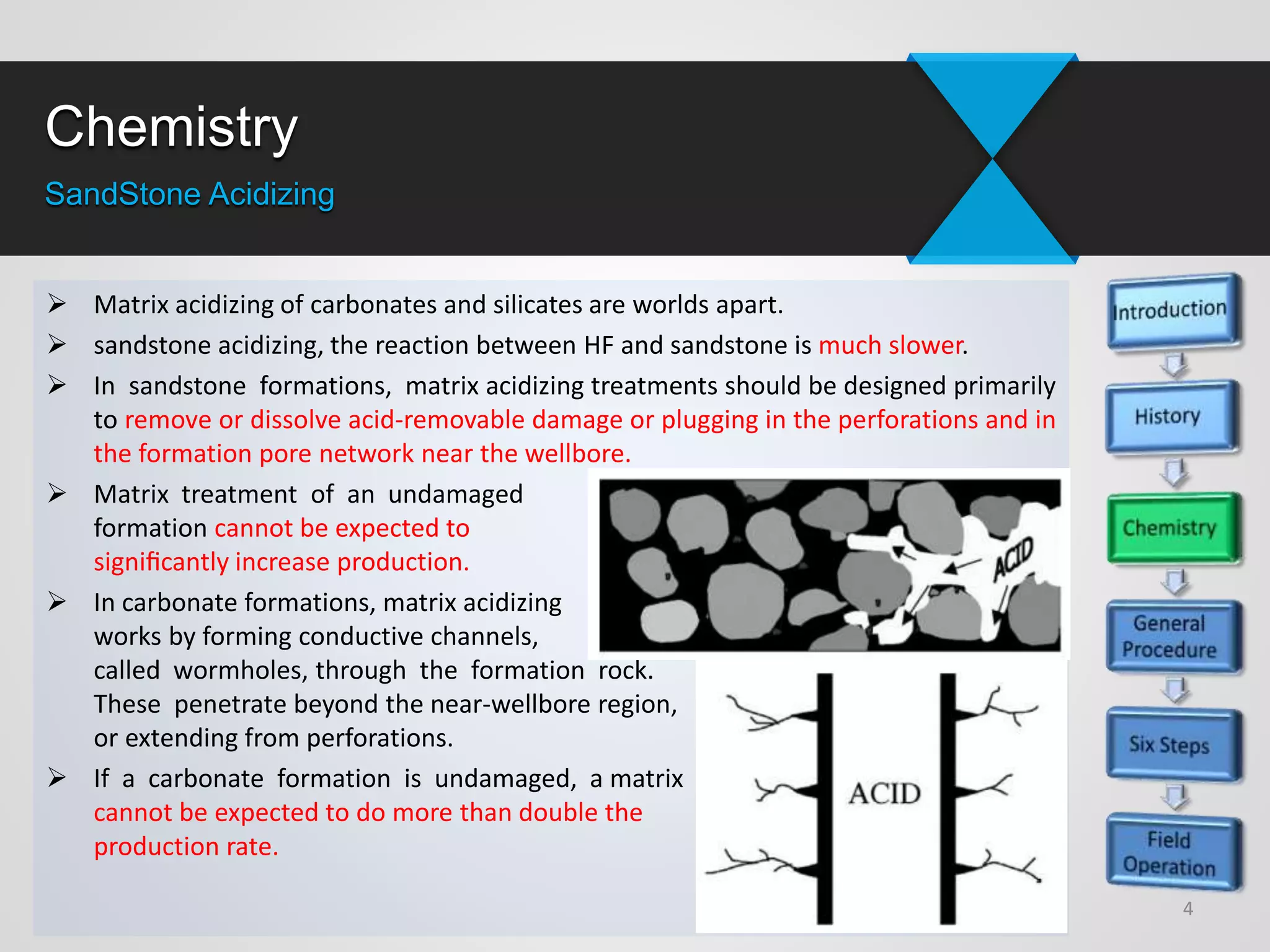
 Matrix acidizing of carbonates and silicates are worlds apart.
 sandstone acidizing, the reaction between HF and sandstone is much slower.
 In sandstone formations, matrix acidizing treatments should be designed primarily
to remove or dissolve acid-removable damage or plugging in the perforations and in
the formation pore network near the wellbore.
 Matrix treatment of an undamaged
formation cannot be expected to
significantly increase production.
 In carbonate formations, matrix acidizing
works by forming conductive channels,
called wormholes, through the formation rock.
These penetrate beyond the near-wellbore region,
or extending from perforations.
 If a carbonate formation is undamaged, a matrix acidizing treatment probably
cannot be expected to do more than double the
production rate.
4
Chemistry
SandStone Acidizing
5
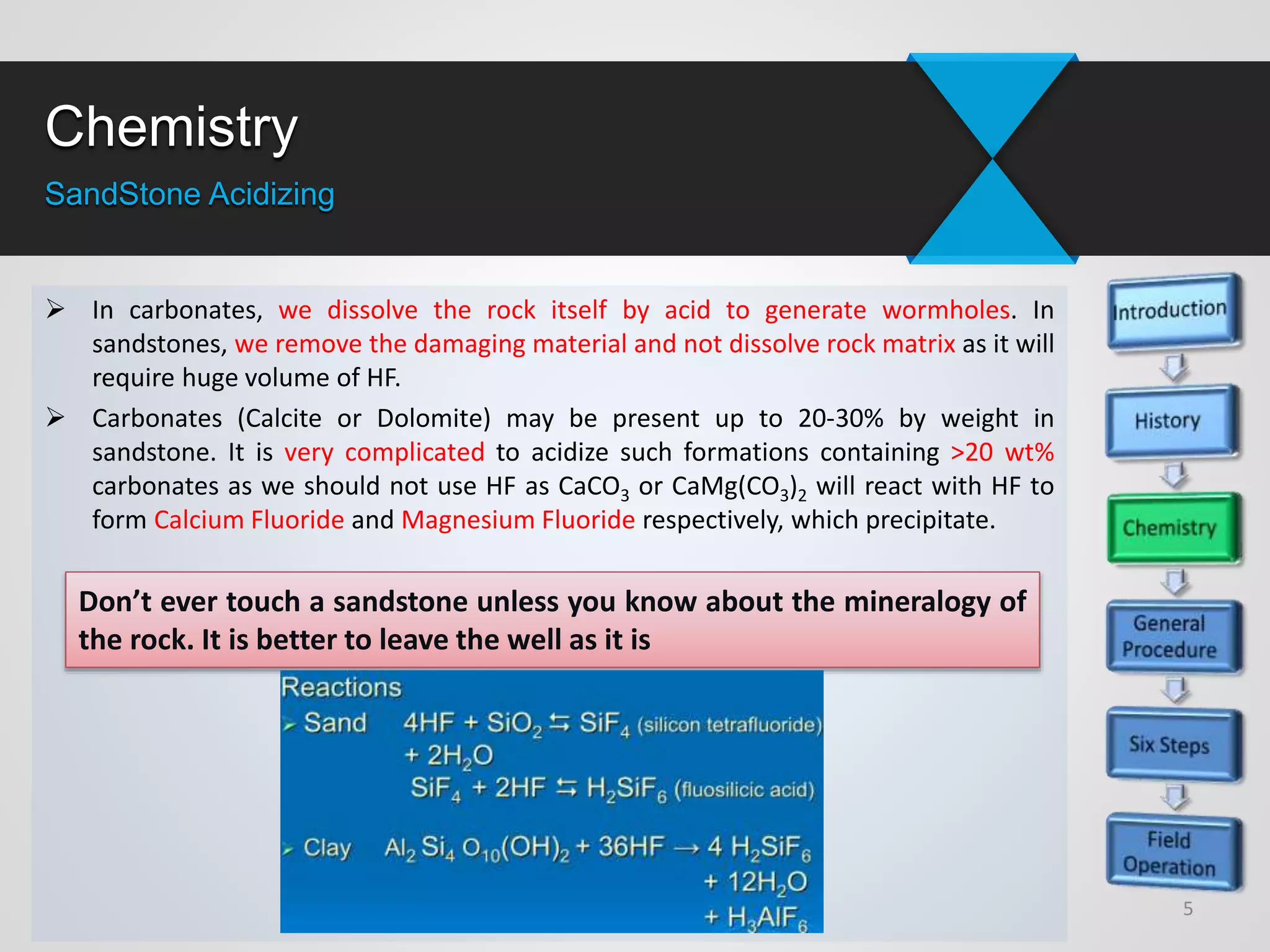
Don’t ever touch a sandstone unless you know about the mineralogy of
the rock. It is better to leave the well as it is
 In carbonates, we dissolve the rock itself by acid to generate wormholes. In
sandstones, we remove the damaging material and not dissolve rock matrix as it will
require huge volume of HF.
 Carbonates (Calcite or Dolomite) may be present up to 20-30% by weight in
sandstone. It is very complicated to acidize such formations containing >20 wt%
carbonates as we should not use HF as CaCO3 or CaMg(CO3)2 will react with HF to
form Calcium Fluoride and Magnesium Fluoride respectively, which precipitate.
Chemistry
SandStone Acidizing
6
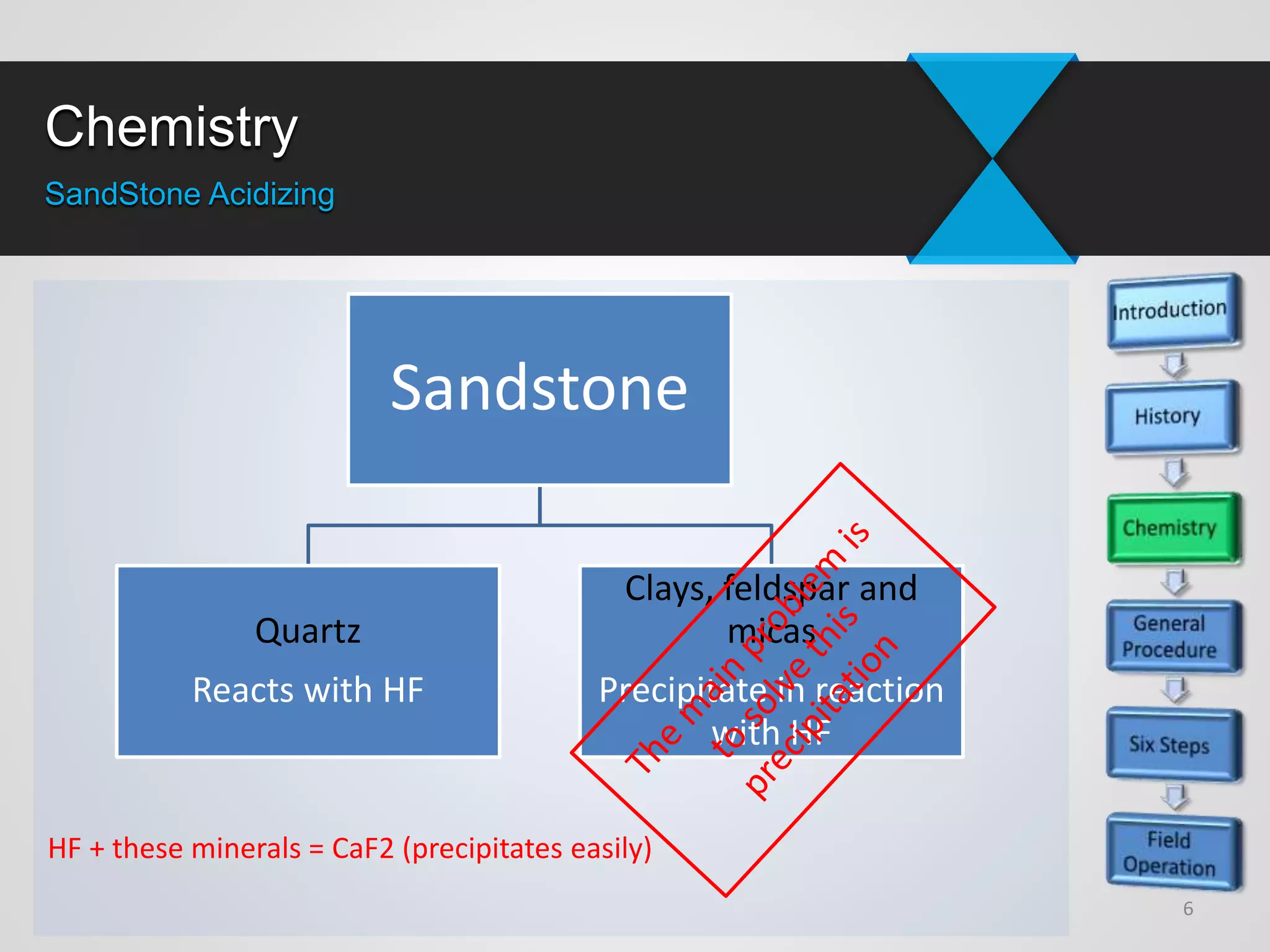
Sandstone
Quartz
Reacts with HF
Clays, feldspar and
micas
Precipitate in reaction
with HF
HF + these minerals = CaF2 (precipitates easily)
Sandstone Acidizing General Procedure
SandStone Acidizing
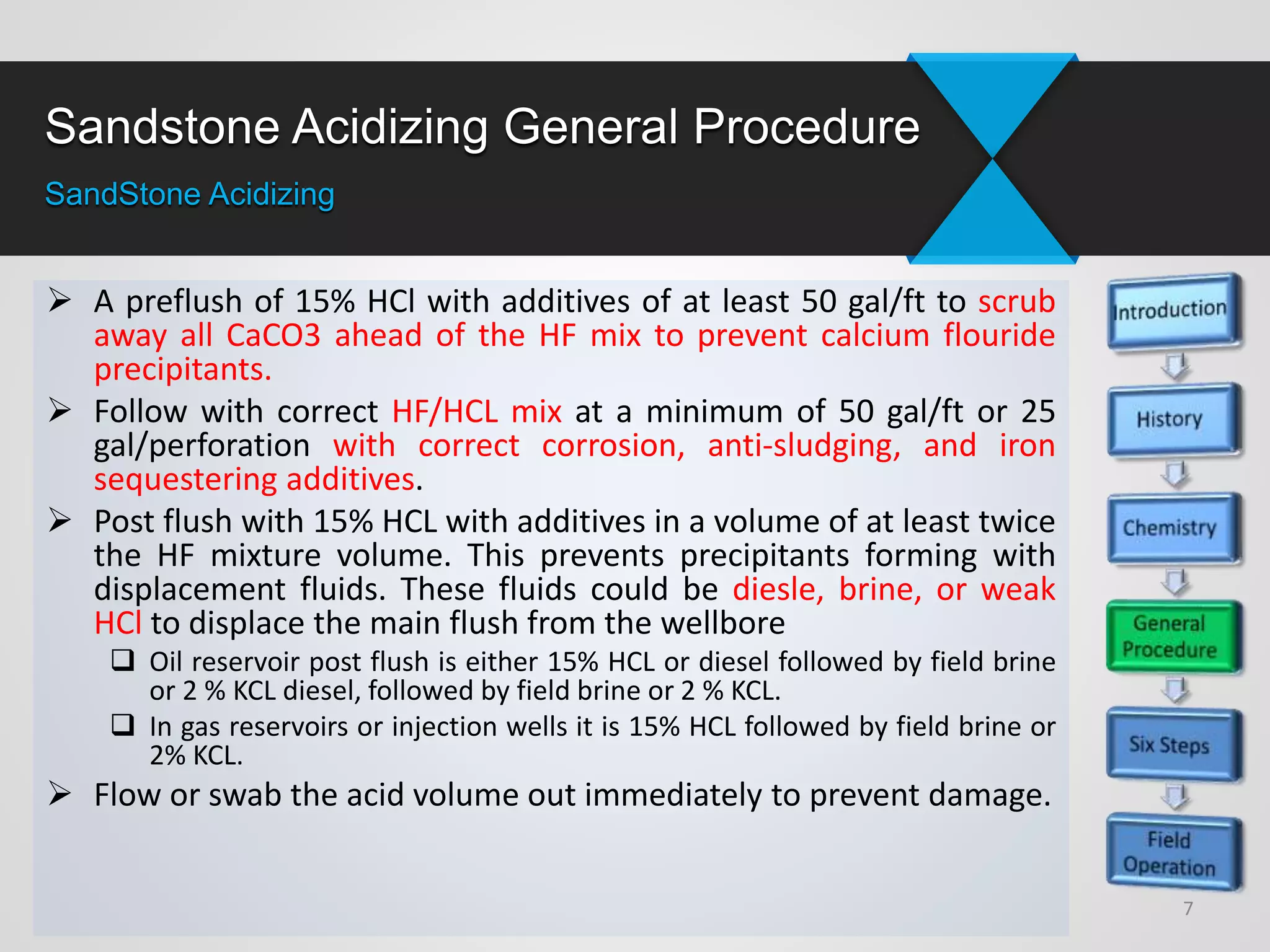
 A preflush of 15% HCl with additives of at least 50 gal/ft to scrub
away all CaCO3 ahead of the HF mix to prevent calcium flouride
precipitants.
 Follow with correct HF/HCL mix at a minimum of 50 gal/ft or 25
gal/perforation with correct corrosion, anti-sludging, and iron
sequestering additives.
 Post flush with 15% HCL with additives in a volume of at least twice
the HF mixture volume. This prevents precipitants forming with
displacement fluids. These fluids could be diesle, brine, or weak
HCl to displace the main flush from the wellbore
 Oil reservoir post flush is either 15% HCL or diesel followed by field brine
or 2 % KCL diesel, followed by field brine or 2 % KCL.
 In gas reservoirs or injection wells it is 15% HCL followed by field brine or
2% KCL.
 Flow or swab the acid volume out immediately to prevent damage.
7
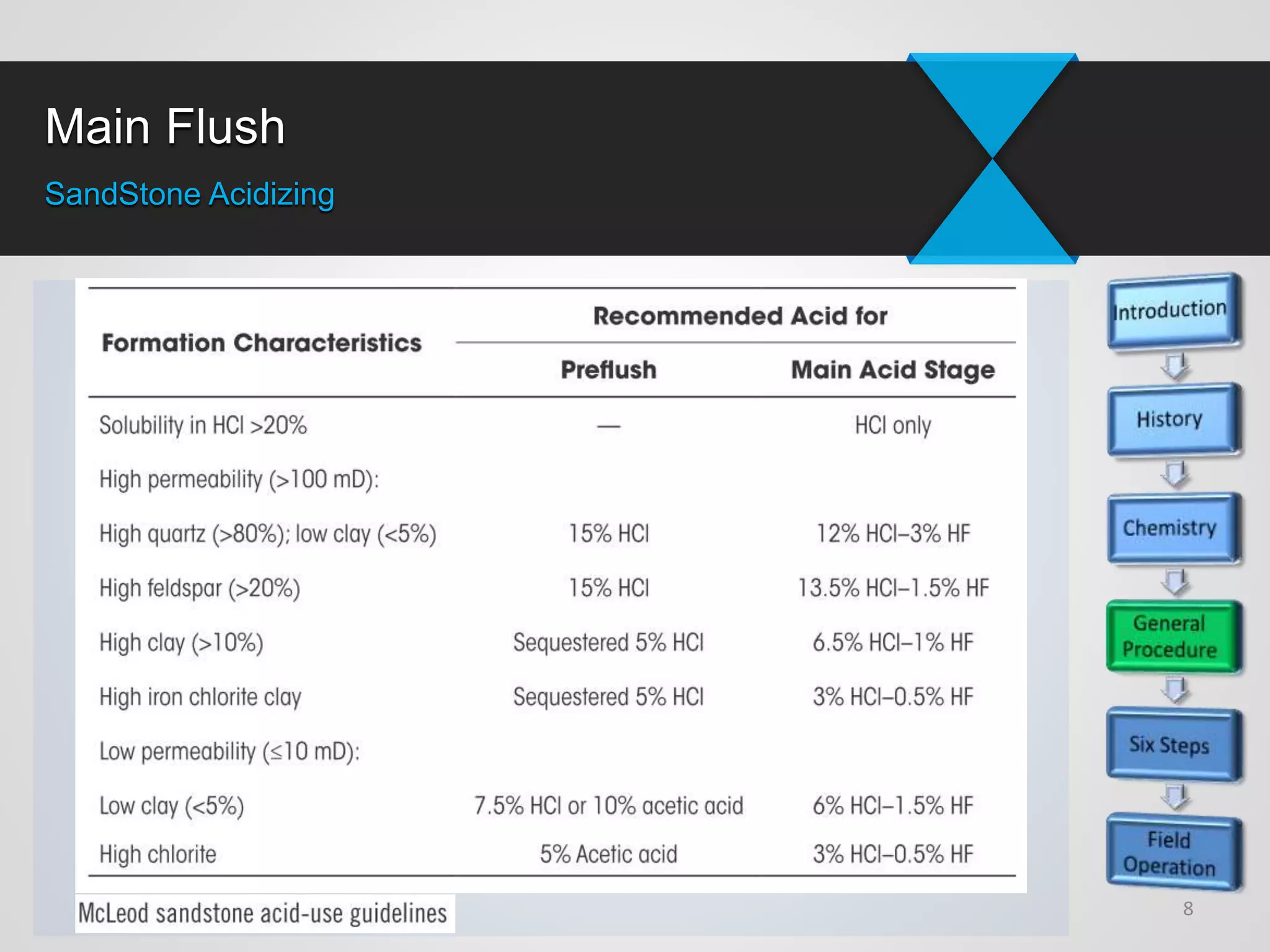
Main Flush
SandStone Acidizing
8
Six Steps to Successful Sandstone Acidizing
SandStone Acidizing
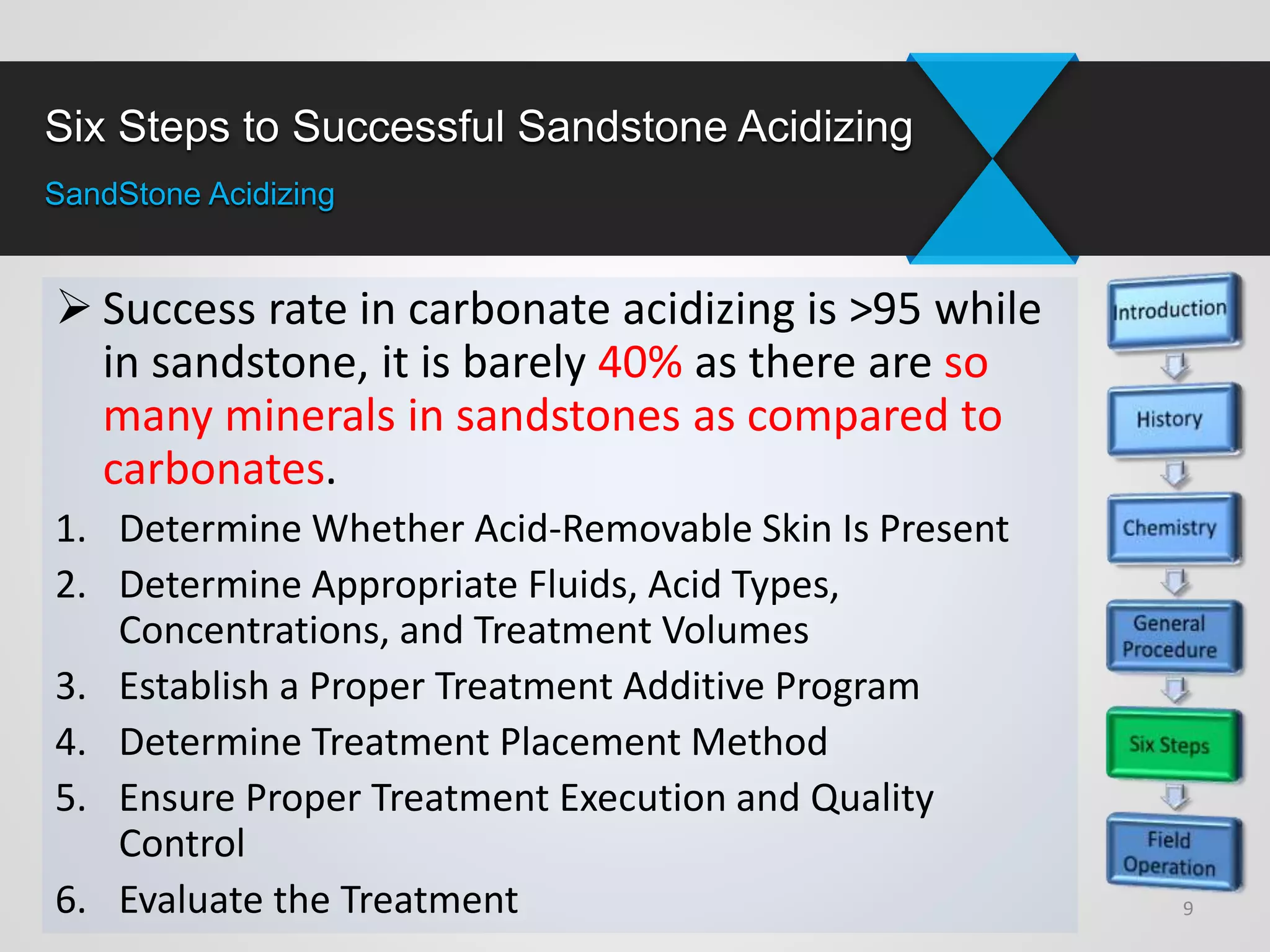
 Success rate in carbonate acidizing is >95 while
in sandstone, it is barely 40% as there are so
many minerals in sandstones as compared to
carbonates.
1. Determine Whether Acid-Removable Skin Is Present
2. Determine Appropriate Fluids, Acid Types,
Concentrations, and Treatment Volumes
3. Establish a Proper Treatment Additive Program
4. Determine Treatment Placement Method
5. Ensure Proper Treatment Execution and Quality
Control
6. Evaluate the Treatment 9
Six Steps to Successful Sandstone Acidizing
SandStone Acidizing
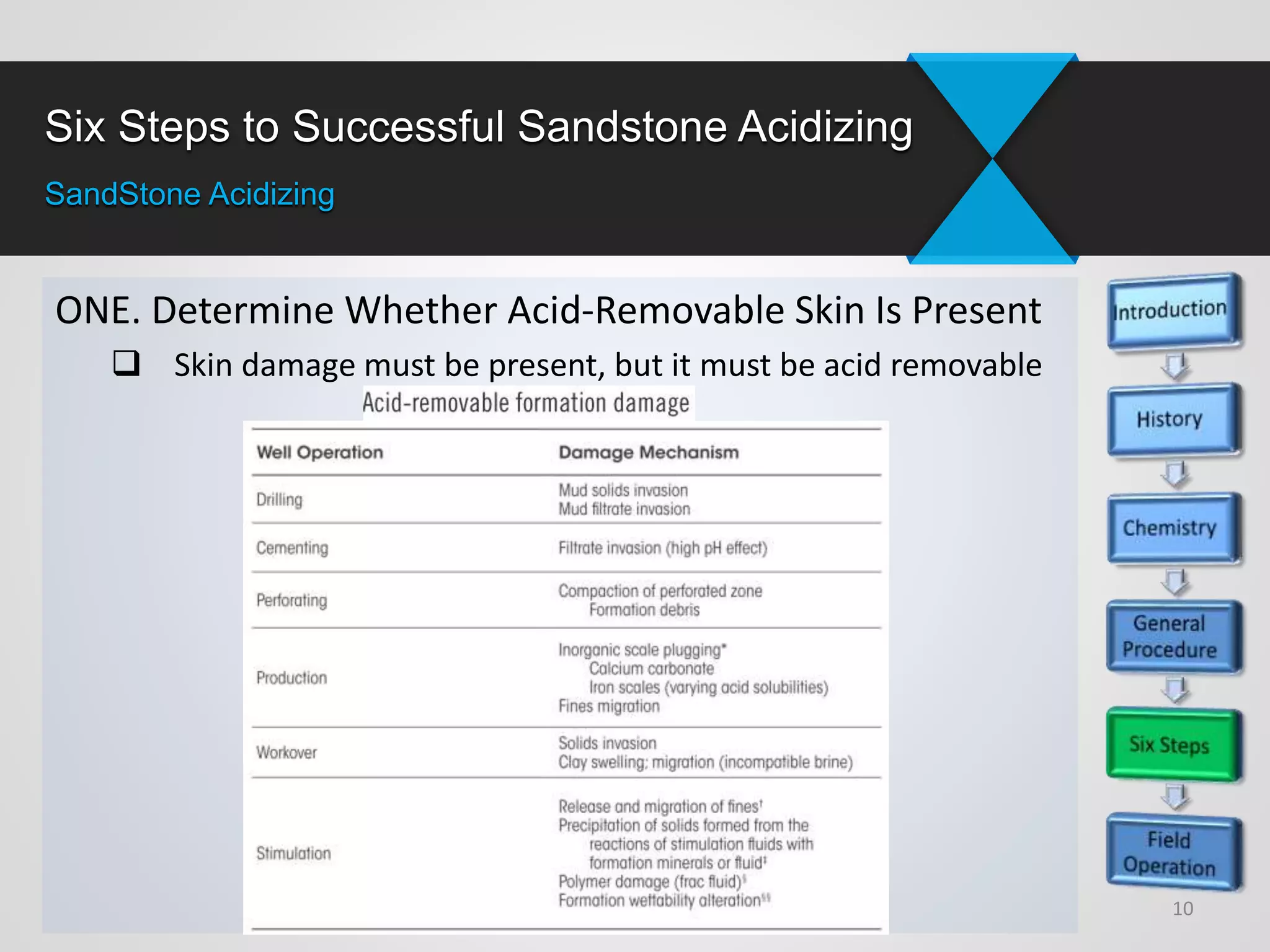
ONE. Determine Whether Acid-Removable Skin Is Present
 Skin damage must be present, but it must be acid removable
10
Six Steps to Successful Sandstone Acidizing
SandStone Acidizing
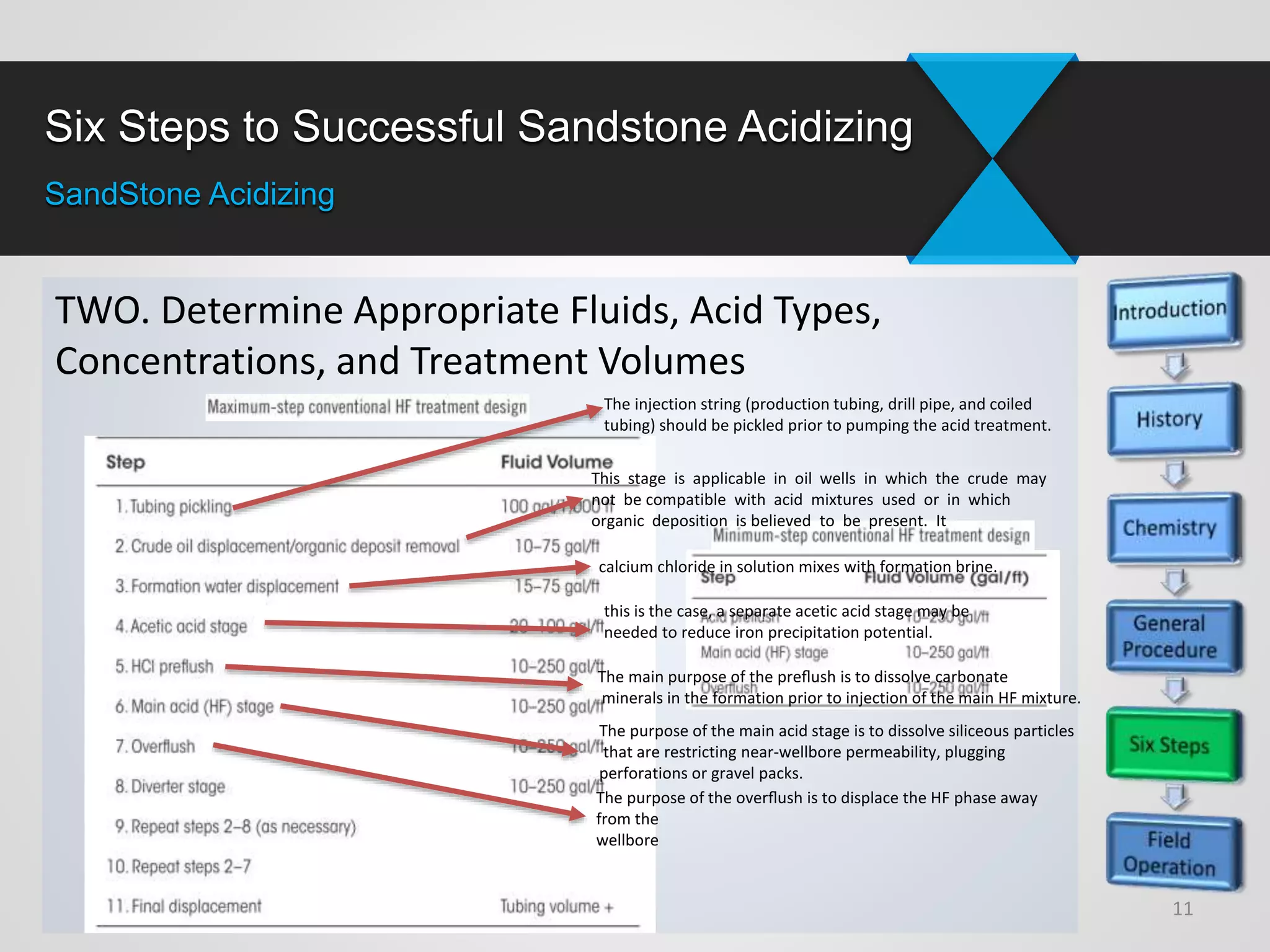
TWO. Determine Appropriate Fluids, Acid Types,
Concentrations, and Treatment Volumes
11
The injection string (production tubing, drill pipe, and coiled
tubing) should be pickled prior to pumping the acid treatment.
This stage is applicable in oil wells in which the crude may
not be compatible with acid mixtures used or in which
organic deposition is believed to be present. It
calcium chloride in solution mixes with formation brine.
this is the case, a separate acetic acid stage may be
needed to reduce iron precipitation potential.
The main purpose of the preflush is to dissolve carbonate
minerals in the formation prior to injection of the main HF mixture.
The purpose of the main acid stage is to dissolve siliceous particles
that are restricting near-wellbore permeability, plugging
perforations or gravel packs.
The purpose of the overflush is to displace the HF phase away
from the
wellbore
Six Steps to Successful Sandstone Acidizing
SandStone Acidizing
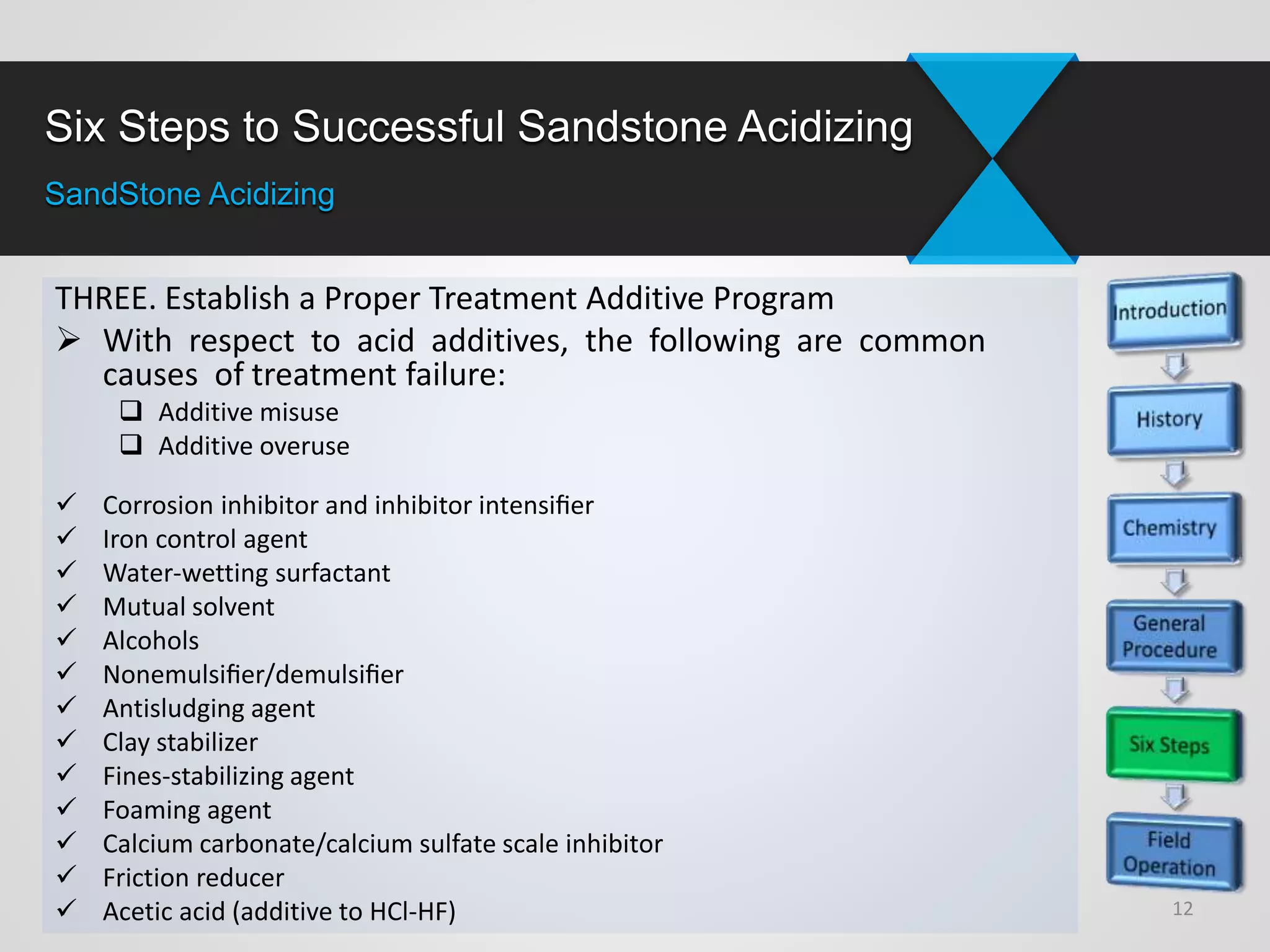
THREE. Establish a Proper Treatment Additive Program
 With respect to acid additives, the following are common
causes of treatment failure:
 Additive misuse
 Additive overuse
 Corrosion inhibitor and inhibitor intensifier
 Iron control agent
 Water-wetting surfactant
 Mutual solvent
 Alcohols
 Nonemulsifier/demulsifier
 Antisludging agent
 Clay stabilizer
 Fines-stabilizing agent
 Foaming agent
 Calcium carbonate/calcium sulfate scale inhibitor
 Friction reducer
 Acetic acid (additive to HCl-HF) 12
Six Steps to Successful Sandstone Acidizing
SandStone Acidizing
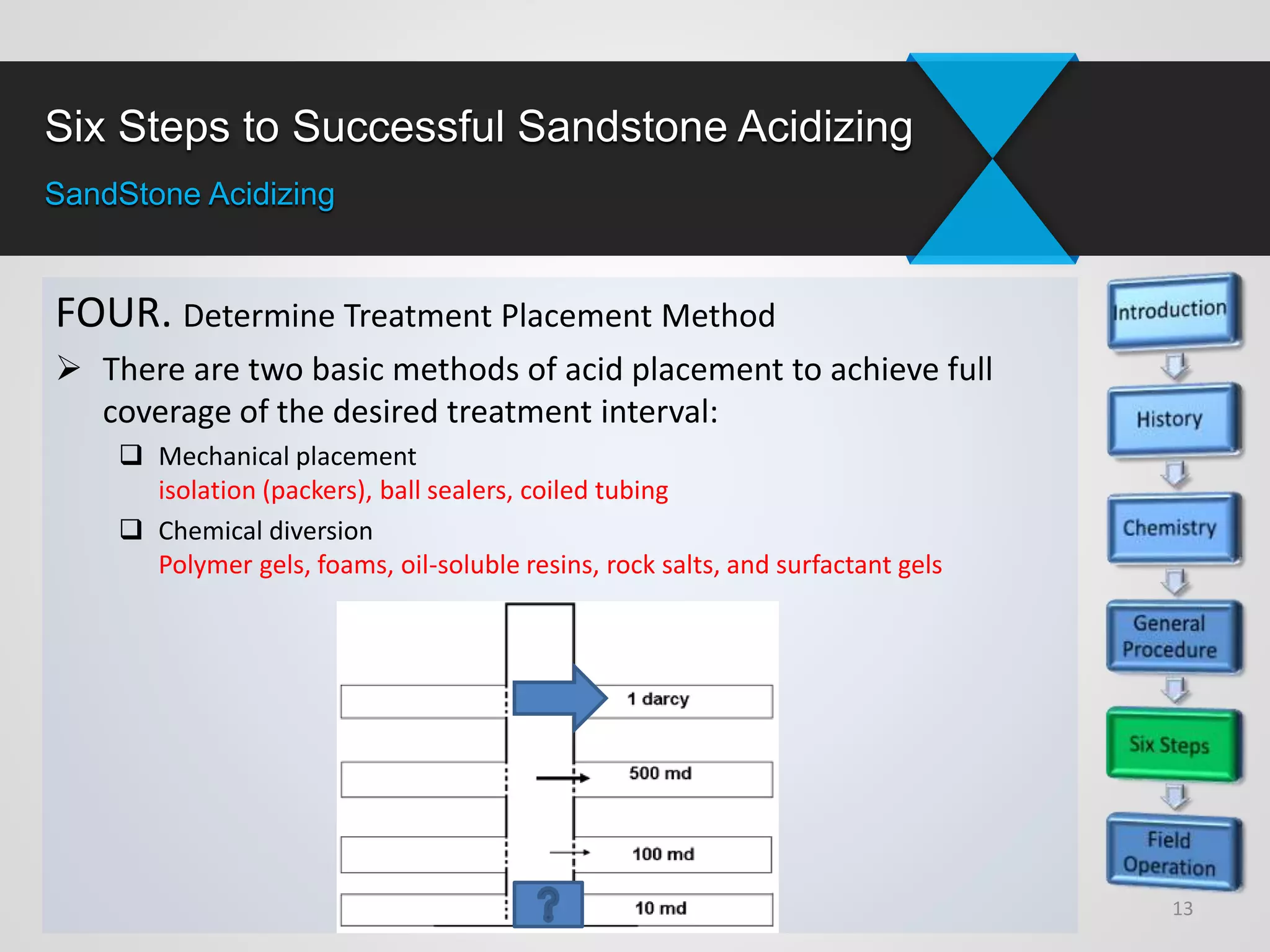
FOUR. Determine Treatment Placement Method
 There are two basic methods of acid placement to achieve full
coverage of the desired treatment interval:
 Mechanical placement
isolation (packers), ball sealers, coiled tubing
 Chemical diversion
Polymer gels, foams, oil-soluble resins, rock salts, and surfactant gels
13
Six Steps to Successful Sandstone Acidizing
SandStone Acidizing
• FIVE. Ensure Proper Treatment Execution and Quality Control
(Safety at the job site, Quality control during rig-up of equipment,
Quality control before pumping, Quality control during pumping,
Quality control after pumping /during flowback) (produced a
booklet BY King and Holman of the Amoco Production Company)
• SIX. Evaluate the Treatment
 Treatment evaluation involves the following:
 Pressure monitoring during injection
 Flowback-sample analysis
 Production-rate comparison and analysis
 Well test analysis (skin removal)
 Payout and return on investment (ROI)
14

Sandstone acidizing

  • 1.
    Sandstone Acidizing Behzad Hosseinzadeh 1Spring2015 Number of slides : 33Supervisor: Dr. Aghighi
  • 2.
    Introduction SandStone Acidizing  Themain aim of matrix acidizing is to improve production and reduce skin by:  Dissolving formation damage  Creating new pathways around the wellbore  Matrix acidizing should be below fracture pressure.  Sandstone acidizing is performed for two primary purposes:  Perforation breakdown (The fracturing of a perforation tunnel ) : It is sometimes necessary to break down perforations by temporarily pumping acid above fracturing pressure to initiate production or injection of a subsequent treatment, such as hydraulic fracturing. Typically, HCl is used in concentrations ranging from 5% to 20%, with 15% HCl being standard.  Near-wellbore formation damage removal : The primary purpose of matrix acidizing in sandstones is to remove formation damage caused by clay and other siliceous fine particles plugging near-wellbore permeability. 2
  • 3.
    History SandStone Acidizing  Becauseof the growing excitement surrounding acid treatment of limestone (Carbonate rocks) formations throughout 1932, interest in developing treatments for sandstone formations began growing too.  In May 1933, Halliburton conducted the first sandstone acidizing treatment using a mixture of HCl and hydrofluoric acid (HF).  Unfortunately, the results of this first attempt were very discouraging. The reaction of the strong acid solution in the formation caused substantial sand production into the wellbore.  Consequently, use of HCl-HF was not very popular for the next 20 years.  Many sandstone acidizing treatments have been pumped since, without such understanding of purpose and potential.  In 1965, the study by Smith and Hendrickson removed much of the mystery in HF acidizing for petroleum engineers and led the way to improved design practices. The most important result of this work was the development of tapered HF treatments, with HCl preflush and overflush, to inhibit deposition of plugging reaction products. 3
  • 4.
    Chemistry SandStone Acidizing  Matrixacidizing of carbonates and silicates are worlds apart.  sandstone acidizing, the reaction between HF and sandstone is much slower.  In sandstone formations, matrix acidizing treatments should be designed primarily to remove or dissolve acid-removable damage or plugging in the perforations and in the formation pore network near the wellbore.  Matrix treatment of an undamaged formation cannot be expected to significantly increase production.  In carbonate formations, matrix acidizing works by forming conductive channels, called wormholes, through the formation rock. These penetrate beyond the near-wellbore region, or extending from perforations.  If a carbonate formation is undamaged, a matrix acidizing treatment probably cannot be expected to do more than double the production rate. 4
  • 5.
    Chemistry SandStone Acidizing 5 Don’t evertouch a sandstone unless you know about the mineralogy of the rock. It is better to leave the well as it is  In carbonates, we dissolve the rock itself by acid to generate wormholes. In sandstones, we remove the damaging material and not dissolve rock matrix as it will require huge volume of HF.  Carbonates (Calcite or Dolomite) may be present up to 20-30% by weight in sandstone. It is very complicated to acidize such formations containing >20 wt% carbonates as we should not use HF as CaCO3 or CaMg(CO3)2 will react with HF to form Calcium Fluoride and Magnesium Fluoride respectively, which precipitate.
  • 6.
    Chemistry SandStone Acidizing 6 Sandstone Quartz Reacts withHF Clays, feldspar and micas Precipitate in reaction with HF HF + these minerals = CaF2 (precipitates easily)
  • 7.
    Sandstone Acidizing GeneralProcedure SandStone Acidizing  A preflush of 15% HCl with additives of at least 50 gal/ft to scrub away all CaCO3 ahead of the HF mix to prevent calcium flouride precipitants.  Follow with correct HF/HCL mix at a minimum of 50 gal/ft or 25 gal/perforation with correct corrosion, anti-sludging, and iron sequestering additives.  Post flush with 15% HCL with additives in a volume of at least twice the HF mixture volume. This prevents precipitants forming with displacement fluids. These fluids could be diesle, brine, or weak HCl to displace the main flush from the wellbore  Oil reservoir post flush is either 15% HCL or diesel followed by field brine or 2 % KCL diesel, followed by field brine or 2 % KCL.  In gas reservoirs or injection wells it is 15% HCL followed by field brine or 2% KCL.  Flow or swab the acid volume out immediately to prevent damage. 7
  • 8.
  • 9.
    Six Steps toSuccessful Sandstone Acidizing SandStone Acidizing  Success rate in carbonate acidizing is >95 while in sandstone, it is barely 40% as there are so many minerals in sandstones as compared to carbonates. 1. Determine Whether Acid-Removable Skin Is Present 2. Determine Appropriate Fluids, Acid Types, Concentrations, and Treatment Volumes 3. Establish a Proper Treatment Additive Program 4. Determine Treatment Placement Method 5. Ensure Proper Treatment Execution and Quality Control 6. Evaluate the Treatment 9
  • 10.
    Six Steps toSuccessful Sandstone Acidizing SandStone Acidizing ONE. Determine Whether Acid-Removable Skin Is Present  Skin damage must be present, but it must be acid removable 10
  • 11.
    Six Steps toSuccessful Sandstone Acidizing SandStone Acidizing TWO. Determine Appropriate Fluids, Acid Types, Concentrations, and Treatment Volumes 11 The injection string (production tubing, drill pipe, and coiled tubing) should be pickled prior to pumping the acid treatment. This stage is applicable in oil wells in which the crude may not be compatible with acid mixtures used or in which organic deposition is believed to be present. It calcium chloride in solution mixes with formation brine. this is the case, a separate acetic acid stage may be needed to reduce iron precipitation potential. The main purpose of the preflush is to dissolve carbonate minerals in the formation prior to injection of the main HF mixture. The purpose of the main acid stage is to dissolve siliceous particles that are restricting near-wellbore permeability, plugging perforations or gravel packs. The purpose of the overflush is to displace the HF phase away from the wellbore
  • 12.
    Six Steps toSuccessful Sandstone Acidizing SandStone Acidizing THREE. Establish a Proper Treatment Additive Program  With respect to acid additives, the following are common causes of treatment failure:  Additive misuse  Additive overuse  Corrosion inhibitor and inhibitor intensifier  Iron control agent  Water-wetting surfactant  Mutual solvent  Alcohols  Nonemulsifier/demulsifier  Antisludging agent  Clay stabilizer  Fines-stabilizing agent  Foaming agent  Calcium carbonate/calcium sulfate scale inhibitor  Friction reducer  Acetic acid (additive to HCl-HF) 12
  • 13.
    Six Steps toSuccessful Sandstone Acidizing SandStone Acidizing FOUR. Determine Treatment Placement Method  There are two basic methods of acid placement to achieve full coverage of the desired treatment interval:  Mechanical placement isolation (packers), ball sealers, coiled tubing  Chemical diversion Polymer gels, foams, oil-soluble resins, rock salts, and surfactant gels 13
  • 14.
    Six Steps toSuccessful Sandstone Acidizing SandStone Acidizing • FIVE. Ensure Proper Treatment Execution and Quality Control (Safety at the job site, Quality control during rig-up of equipment, Quality control before pumping, Quality control during pumping, Quality control after pumping /during flowback) (produced a booklet BY King and Holman of the Amoco Production Company) • SIX. Evaluate the Treatment  Treatment evaluation involves the following:  Pressure monitoring during injection  Flowback-sample analysis  Production-rate comparison and analysis  Well test analysis (skin removal)  Payout and return on investment (ROI) 14

Editor's Notes

  • #15 In this section, the steps that should be taken in the interest of quality assurance are listed. Because quality control applies to all acid treatments, these steps are revisited in further detail in chapter 16. Safety at the job site is discussed in chapter 17. Quality control steps to be implemented in the execution of a sandstone acid treatment, as recommended by King and Holman (with slight modification), are as follows: 1. Quality control during rig-up of equipment